

ASTM D2425-23
(Test Method)Standard Test Method for Hydrocarbon Types in Middle Distillates by Mass Spectrometry
General Information
- Abstract
SIGNIFICANCE AND USE
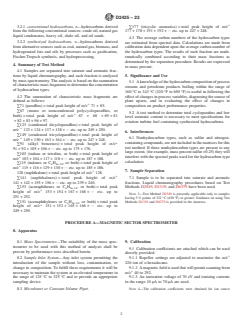
5.1 A knowledge of the hydrocarbon composition of process streams and petroleum products boiling within the range of 160 °C to 343 °C (320 °F to 650 °F) is useful in following the effect of changes in process variables, diagnosing the source of plant upsets, and in evaluating the effect of changes in composition on product performance properties.
5.2 A test method to determine total cycloparafins and low level aromatic content is necessary to meet specifications for aviation turbine fuel containing synthesized hydrocarbons.
SCOPE
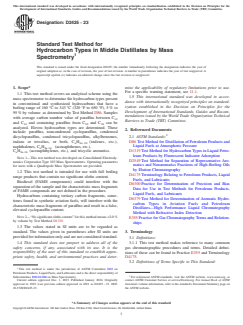
1.1 This test method covers an analytical scheme using the mass spectrometer to determine the hydrocarbon types present in conventional and synthesized hydrocarbons that have a boiling range of 160 °C to 343 °C (320 °F to 650 °F), 5 % to 95 % by volume as determined by Test Method D86. Samples with average carbon number value of paraffins between C12 and C16 and containing paraffins from C10 and C18 can be analyzed. Eleven hydrocarbon types are determined. These include: paraffins, noncondensed cycloparaffins, condensed dicycloparaffins, condensed tricycloparaffins, alkylbenzenes, indans or tetralins, or both, CnH 2n-10 (indenes, etc.), naphthalenes, CnH2n-14 (acenaphthenes, etc.), CnH 2n-16 (acenaphthylenes, etc.), and tricyclic aromatics.
Note 1: This test method was developed on Consolidated Electrodynamics Corporation Type 103 Mass Spectrometers. Operating parameters for users with a Quadrupole Mass Spectrometer are provided.
1.2 This test method is intended for use with full boiling range products that contain no significant olefin content.
Biodiesel (FAME components) could interfere with the separation of the sample and the characteristic mass fragments of FAME compounds are not defined in the procedure.
Hydrocarbons containing tertiary carbon fragments, sometimes found in synthetic aviation fuels, will interfere with the characteristic mass fragments of paraffins and result in a false, elevated cycloparaffin content.
Note 2: “No significant olefin content” for this method means D1319.
1.3 The values stated in SI units are to be regarded as standard. The values given in parentheses after SI units are provided for information only and are not considered standard.
1.4 This standard does not purport to address all of the safety concerns, if any, associated with its use. It is the responsibility of the user of this standard to establish appropriate safety, health, and environmental practices and determine the applicability of regulatory limitations prior to use. For a specific warning statement, see 11.1.
1.5 This international standard was developed in accordance with internationally recognized principles on standardization established in the Decision on Principles for the Development of International Standards, Guides and Recommendations issued by the World Trade Organization Technical Barriers to Trade (TBT) Committee.
- Status
- Published
- Publication Date
- 30-Nov-2023
- Technical Committee
- D02 - Petroleum Products, Liquid Fuels, and Lubricants
- Drafting Committee
- D02.04.0M - Mass Spectrometry
Buy Documents
ASTM D2425-23 - Standard Test Method for Hydrocarbon Types in Middle Distillates by Mass Spectrometry
REDLINE ASTM D2425-23 - Standard Test Method for Hydrocarbon Types in Middle Distillates by Mass Spectrometry
Overview
ASTM D2425-23 is the Standard Test Method for Hydrocarbon Types in Middle Distillates by Mass Spectrometry. Developed by ASTM International, this standard provides a robust analytical approach to determine hydrocarbon types present in both conventional and synthesized hydrocarbons with boiling ranges from 160°C to 343°C (320°F to 650°F). Accurate hydrocarbon characterization is essential for monitoring process streams, troubleshooting plant upsets, and evaluating product performance-especially in sectors using aviation turbine fuels and middle distillates.
Key Topics
- Analytical Scope: Applies to petroleum products and process streams with paraffin carbon numbers between C10 and C18, targeting samples with negligible olefin content.
- Mass Spectrometry Analysis: Uses mass spectrometry (either magnetic sector or quadrupole type) to identify eleven distinct hydrocarbon classes, including paraffins, cycloparaffins, aromatic compounds, and polycyclic aromatics.
- Sample Fractionation: Requires separating samples into saturate and aromatic fractions before mass spectrometric analysis. Techniques referenced include modified ASTM D1319 and D6379 procedures.
- Critical Parameters:
- Detects paraffins, non-condensed and condensed cycloparaffins, various aromatic subtypes, and tricyclic aromatics.
- Demonstrates suitability for full boiling range products with low olefin content.
- Biodiesel components (FAMEs) and hydrocarbons with tertiary carbon atoms may interfere with results.
- Results: Data are reported as mass percent composition for each hydrocarbon type, supporting informed product quality and process control decisions.
Applications
ASTM D2425-23 is widely utilized in the petroleum and fuels industries for:
- Quality Control: Ensuring middle distillate fuels, kerosene, diesel, and aviation turbine fuels meet specifications for hydrocarbon composition, particularly cycloparaffin and aromatic content.
- Process Optimization: Tracking effects of process adjustments on stream composition, thus supporting efficiency and yield improvements.
- Troubleshooting: Diagnosing composition-related plant upsets by pinpointing the presence and quantity of specific hydrocarbon types.
- Product Development: Evaluating new fuel formulations, especially those containing synthesized hydrocarbons, to meet performance and regulatory requirements.
- Fuel Specification Compliance: Determining low-level aromatic content-critical for aviation turbine fuels derived from synthetic sources.
This method is particularly valuable for refineries, fuel testing labs, and R&D departments needing precise, reproducible hydrocarbon profile data for process and product validation.
Related Standards
ASTM D2425-23 references several related ASTM standards integral to hydrocarbon analysis workflows:
- ASTM D86: Distillation of Petroleum Products and Liquid Fuels at Atmospheric Pressure
- ASTM D1319: Hydrocarbon Types in Liquid Petroleum Products by Fluorescent Indicator Adsorption
- ASTM D2549: Separation of Representative Aromatics and Nonaromatics Fractions of High-Boiling Oils by Elution Chromatography
- ASTM D4175: Terminology Relating to Petroleum Products, Liquid Fuels, and Lubricants
- ASTM D6300: Precision and Bias Data Determination in Test Methods for Petroleum Products
- ASTM D6379: Determination of Aromatic Hydrocarbon Types in Aviation Fuels and Petroleum Distillates via HPLC
- ASTM E355: Gas Chromatography Terms and Relationships
Practical Value
Implementing ASTM D2425-23 ensures reliable, standardized hydrocarbon type analysis in middle distillates, supporting compliance, product integrity, and operational excellence. By using this test method, organizations gain accurate, repeatable data critical for meeting both regulatory requirements and performance criteria in fuels and lubricants.
For professionals involved in fuel quality or petrochemical analysis, this standard is an essential tool for leveraging mass spectrometry in routine and advanced hydrocarbon characterization.
Keywords: ASTM D2425-23, hydrocarbon types, mass spectrometry, middle distillates, synthesized hydrocarbons, paraffins, cycloparaffins, aromatics, petroleum testing, aviation fuel analysis.
Relations
- Effective Date
- 01-Dec-2023
- Effective Date
- 01-Mar-2024
- Effective Date
- 01-Dec-2023
- Effective Date
- 01-Dec-2023
- Effective Date
- 01-Dec-2023
- Effective Date
- 01-Mar-2023
- Effective Date
- 01-Dec-2023
- Effective Date
- 01-Dec-2023
- Effective Date
- 01-Dec-2023
- Effective Date
- 01-Dec-2023
- Effective Date
- 01-Dec-2023
- Effective Date
- 01-Dec-2023
- Referred By
ASTM D4054-23 - Standard Practice for Evaluation of New Aviation Turbine Fuels and Fuel Additives - Effective Date
- 01-Dec-2023
- Referred By
ASTM F715-07(2023) - Standard Test Methods for Coated Fabrics Used for Oil Spill Control and Storage - Effective Date
- 01-Dec-2023
- Effective Date
- 01-Dec-2023
Buy Documents
ASTM D2425-23 - Standard Test Method for Hydrocarbon Types in Middle Distillates by Mass Spectrometry
REDLINE ASTM D2425-23 - Standard Test Method for Hydrocarbon Types in Middle Distillates by Mass Spectrometry
Get Certified
Connect with accredited certification bodies for this standard

Element Materials Technology
Materials testing and product certification.

ABS Group Brazil
ABS Group certification services in Brazil.

ABS Quality Evaluations Inc.
American Bureau of Shipping quality certification.
Sponsored listings
Frequently Asked Questions
ASTM D2425-23 is a standard published by ASTM International. Its full title is "Standard Test Method for Hydrocarbon Types in Middle Distillates by Mass Spectrometry". This standard covers: SIGNIFICANCE AND USE 5.1 A knowledge of the hydrocarbon composition of process streams and petroleum products boiling within the range of 160 °C to 343 °C (320 °F to 650 °F) is useful in following the effect of changes in process variables, diagnosing the source of plant upsets, and in evaluating the effect of changes in composition on product performance properties. 5.2 A test method to determine total cycloparafins and low level aromatic content is necessary to meet specifications for aviation turbine fuel containing synthesized hydrocarbons. SCOPE 1.1 This test method covers an analytical scheme using the mass spectrometer to determine the hydrocarbon types present in conventional and synthesized hydrocarbons that have a boiling range of 160 °C to 343 °C (320 °F to 650 °F), 5 % to 95 % by volume as determined by Test Method D86. Samples with average carbon number value of paraffins between C12 and C16 and containing paraffins from C10 and C18 can be analyzed. Eleven hydrocarbon types are determined. These include: paraffins, noncondensed cycloparaffins, condensed dicycloparaffins, condensed tricycloparaffins, alkylbenzenes, indans or tetralins, or both, CnH 2n-10 (indenes, etc.), naphthalenes, CnH2n-14 (acenaphthenes, etc.), CnH 2n-16 (acenaphthylenes, etc.), and tricyclic aromatics. Note 1: This test method was developed on Consolidated Electrodynamics Corporation Type 103 Mass Spectrometers. Operating parameters for users with a Quadrupole Mass Spectrometer are provided. 1.2 This test method is intended for use with full boiling range products that contain no significant olefin content. Biodiesel (FAME components) could interfere with the separation of the sample and the characteristic mass fragments of FAME compounds are not defined in the procedure. Hydrocarbons containing tertiary carbon fragments, sometimes found in synthetic aviation fuels, will interfere with the characteristic mass fragments of paraffins and result in a false, elevated cycloparaffin content. Note 2: “No significant olefin content” for this method means D1319. 1.3 The values stated in SI units are to be regarded as standard. The values given in parentheses after SI units are provided for information only and are not considered standard. 1.4 This standard does not purport to address all of the safety concerns, if any, associated with its use. It is the responsibility of the user of this standard to establish appropriate safety, health, and environmental practices and determine the applicability of regulatory limitations prior to use. For a specific warning statement, see 11.1. 1.5 This international standard was developed in accordance with internationally recognized principles on standardization established in the Decision on Principles for the Development of International Standards, Guides and Recommendations issued by the World Trade Organization Technical Barriers to Trade (TBT) Committee.
SIGNIFICANCE AND USE 5.1 A knowledge of the hydrocarbon composition of process streams and petroleum products boiling within the range of 160 °C to 343 °C (320 °F to 650 °F) is useful in following the effect of changes in process variables, diagnosing the source of plant upsets, and in evaluating the effect of changes in composition on product performance properties. 5.2 A test method to determine total cycloparafins and low level aromatic content is necessary to meet specifications for aviation turbine fuel containing synthesized hydrocarbons. SCOPE 1.1 This test method covers an analytical scheme using the mass spectrometer to determine the hydrocarbon types present in conventional and synthesized hydrocarbons that have a boiling range of 160 °C to 343 °C (320 °F to 650 °F), 5 % to 95 % by volume as determined by Test Method D86. Samples with average carbon number value of paraffins between C12 and C16 and containing paraffins from C10 and C18 can be analyzed. Eleven hydrocarbon types are determined. These include: paraffins, noncondensed cycloparaffins, condensed dicycloparaffins, condensed tricycloparaffins, alkylbenzenes, indans or tetralins, or both, CnH 2n-10 (indenes, etc.), naphthalenes, CnH2n-14 (acenaphthenes, etc.), CnH 2n-16 (acenaphthylenes, etc.), and tricyclic aromatics. Note 1: This test method was developed on Consolidated Electrodynamics Corporation Type 103 Mass Spectrometers. Operating parameters for users with a Quadrupole Mass Spectrometer are provided. 1.2 This test method is intended for use with full boiling range products that contain no significant olefin content. Biodiesel (FAME components) could interfere with the separation of the sample and the characteristic mass fragments of FAME compounds are not defined in the procedure. Hydrocarbons containing tertiary carbon fragments, sometimes found in synthetic aviation fuels, will interfere with the characteristic mass fragments of paraffins and result in a false, elevated cycloparaffin content. Note 2: “No significant olefin content” for this method means D1319. 1.3 The values stated in SI units are to be regarded as standard. The values given in parentheses after SI units are provided for information only and are not considered standard. 1.4 This standard does not purport to address all of the safety concerns, if any, associated with its use. It is the responsibility of the user of this standard to establish appropriate safety, health, and environmental practices and determine the applicability of regulatory limitations prior to use. For a specific warning statement, see 11.1. 1.5 This international standard was developed in accordance with internationally recognized principles on standardization established in the Decision on Principles for the Development of International Standards, Guides and Recommendations issued by the World Trade Organization Technical Barriers to Trade (TBT) Committee.
ASTM D2425-23 is classified under the following ICS (International Classification for Standards) categories: 75.080 - Petroleum products in general. The ICS classification helps identify the subject area and facilitates finding related standards.
ASTM D2425-23 has the following relationships with other standards: It is inter standard links to ASTM D2425-21, ASTM D6300-24, ASTM D86-23a, ASTM D6300-23a, ASTM D86-23ae1, ASTM D86-23, ASTM D8144-22, ASTM D8305-19, ASTM D8302-20, ASTM D6750-23, ASTM D6618-23, ASTM D6591-19, ASTM D4054-23, ASTM F715-07(2023), ASTM D2549-23. Understanding these relationships helps ensure you are using the most current and applicable version of the standard.
ASTM D2425-23 is available in PDF format for immediate download after purchase. The document can be added to your cart and obtained through the secure checkout process. Digital delivery ensures instant access to the complete standard document.
Standards Content (Sample)
This international standard was developed in accordance with internationally recognized principles on standardization established in the Decision on Principles for the
Development of International Standards, Guides and Recommendations issued by the World Trade Organization Technical Barriers to Trade (TBT) Committee.
Designation: D2425 − 23
Standard Test Method for
Hydrocarbon Types in Middle Distillates by Mass
Spectrometry
This standard is issued under the fixed designation D2425; the number immediately following the designation indicates the year of
original adoption or, in the case of revision, the year of last revision. A number in parentheses indicates the year of last reapproval. A
superscript epsilon (´) indicates an editorial change since the last revision or reapproval.
1. Scope* mine the applicability of regulatory limitations prior to use.
For a specific warning statement, see 11.1.
1.1 This test method covers an analytical scheme using the
1.5 This international standard was developed in accor-
mass spectrometer to determine the hydrocarbon types present
dance with internationally recognized principles on standard-
in conventional and synthesized hydrocarbons that have a
ization established in the Decision on Principles for the
boiling range of 160 °C to 343 °C (320 °F to 650 °F), 5 % to
Development of International Standards, Guides and Recom-
95 % by volume as determined by Test Method D86. Samples
mendations issued by the World Trade Organization Technical
with average carbon number value of paraffins between C
Barriers to Trade (TBT) Committee.
and C and containing paraffins from C and C can be
16 10 18
analyzed. Eleven hydrocarbon types are determined. These
2. Referenced Documents
include: paraffins, noncondensed cycloparaffins, condensed
2.1 ASTM Standards:
dicycloparaffins, condensed tricycloparaffins, alkylbenzenes,
D86 Test Method for Distillation of Petroleum Products and
indans or tetralins, or both, C H (indenes, etc.),
n 2n-10
Liquid Fuels at Atmospheric Pressure
naphthalenes, C H (acenaphthenes, etc.),
n 2n-14
D1319 Test Method for Hydrocarbon Types in Liquid Petro-
C H (acenaphthylenes, etc.), and tricyclic aromatics.
n 2n-16
leum Products by Fluorescent Indicator Adsorption
NOTE 1—This test method was developed on Consolidated Electrody-
D2549 Test Method for Separation of Representative Aro-
namics Corporation Type 103 Mass Spectrometers. Operating parameters
matics and Nonaromatics Fractions of High-Boiling Oils
for users with a Quadrupole Mass Spectrometer are provided.
by Elution Chromatography
1.2 This test method is intended for use with full boiling
D4175 Terminology Relating to Petroleum Products, Liquid
range products that contain no significant olefin content.
Fuels, and Lubricants
Biodiesel (FAME components) could interfere with the
D6300 Practice for Determination of Precision and Bias
separation of the sample and the characteristic mass fragments
Data for Use in Test Methods for Petroleum Products,
of FAME compounds are not defined in the procedure.
Liquid Fuels, and Lubricants
Hydrocarbons containing tertiary carbon fragments, some-
D6379 Test Method for Determination of Aromatic Hydro-
times found in synthetic aviation fuels, will interfere with the
carbon Types in Aviation Fuels and Petroleum
characteristic mass fragments of paraffins and result in a false,
Distillates—High Performance Liquid Chromatography
elevated cycloparaffin content.
Method with Refractive Index Detection
NOTE 2—“No significant olefin content” for this method means <2.0 %
E355 Practice for Gas Chromatography Terms and Relation-
by volume by Test Method D1319.
ships
1.3 The values stated in SI units are to be regarded as
3. Terminology
standard. The values given in parentheses after SI units are
provided for information only and are not considered standard.
3.1 Definitions:
1.4 This standard does not purport to address all of the 3.1.1 This test method makes reference to many common
safety concerns, if any, associated with its use. It is the
gas chromatographic procedures and terms. Detailed defini-
responsibility of the user of this standard to establish appro- tions of these can be found in Practice E355 and Terminology
priate safety, health, and environmental practices and deter-
D4175.
3.2 Definitions of Terms Specific to This Standard:
This test method is under the jurisdiction of ASTM Committee D02 on
Petroleum Products, Liquid Fuels, and Lubricants and is the direct responsibility of
Subcommittee D02.04.0M on Mass Spectrometry. For referenced ASTM standards, visit the ASTM website, www.astm.org, or
Current edition approved Dec. 1, 2023. Published January 2024. Originally contact ASTM Customer Service at service@astm.org. For Annual Book of ASTM
approved in 1965. Last previous edition approved in 2021 as D2425 – 21. DOI: Standards volume information, refer to the standard’s Document Summary page on
10.1520/D2425-23. the ASTM website.
*A Summary of Changes section appears at the end of this standard
Copyright © ASTM International, 100 Barr Harbor Drive, PO Box C700, West Conshohocken, PA 19428-2959. United States
D2425 − 23
+
3.2.1 conventional hydrocarbons, n—hydrocarbons derived ∑177 (tricyclic aromatics) = total peak height of m/e
from the following conventional sources: crude oil, natural gas 177 + 178 + 191 + 192 + ··· etc. up to 247 + 248.
liquid condensates, heavy oil, shale oil, and oil sands.
4.3 The average carbon numbers of the hydrocarbon types
3.2.2 synthesized hydrocarbons, n—hydrocarbons derived
are estimated from spectral data. Calculations are made from
from alternative sources such as coal, natural gas, biomass, and
calibration data dependent upon the average carbon number of
hydrogenated fats and oils by processes such as gasification,
the hydrocarbon types. The results of each fraction are math-
Fischer-Tropsch synthesis, and hydroprocessing.
ematically combined according to their mass fractions as
determined by the separation procedure. Results are expressed
4. Summary of Test Method
in mass percent.
4.1 Samples are separated into saturate and aromatic frac-
tions by liquid chromatography, and each fraction is analyzed 5. Significance and Use
by mass spectrometry. The analysis is based on the summation
5.1 A knowledge of the hydrocarbon composition of process
of characteristic mass fragments to determine the concentration
streams and petroleum products boiling within the range of
of hydrocarbon types.
160 °C to 343 °C (320 °F to 650 °F) is useful in following the
4.2 The summation of characteristic mass fragments are
effect of changes in process variables, diagnosing the source of
defined as follows: plant upsets, and in evaluating the effect of changes in
+
∑71 (paraffins) = total peak height of m/e 71 + 85. composition on product performance properties.
∑67 (mono or noncondensed polycycloparaffins, or
5.2 A test method to determine total cycloparafins and low
+
both) = total peak height of m/e 67 + 68 + 69 + 81
level aromatic content is necessary to meet specifications for
+ 82 + 83 + 96 + 97.
aviation turbine fuel containing synthesized hydrocarbons.
∑123 (condensed dicycloparaffins) = total peak height of
+
m/e 123 + 124 + 137 + 138 + ··· etc. up to 249 + 250.
6. Interferences
∑149 (condensed tricycloparaffins) = total peak height of
+
6.1 Nonhydrocarbon types, such as sulfur and nitrogen-
m/e 149 + 150 + 163 + 164 + ··· etc. up to 247 + 248.
+ containing compounds, are not included in the matrices for this
∑91 (alkyl benzenes) = total peak height of m/e
test method. If these nonhydrocarbon types are present to any
91 + 92 + 105 + 106 + ··· etc. up to 175 + 176.
large extent, (for example, mass percent sulfur >0.25) they will
∑103 (indans or tetralins, or both) = total peak height of
+
interfere with the spectral peaks used for the hydrocarbon-type
m/e 103 + 104 + 117 + 118 + ··· etc. up to 187 + 188.
calculation.
∑115 (indenes or C H , or both) = total peak height of
n 2n-10
+
m/e 115 + 116 + 129 + 130 + ··· etc. up to 185 + 186.
+ 7. Sample Separation
128 (naphthalene) = total peak height of m/e 128.
+
7.1 Sample is to be separated into saturate and aromatic
∑141 (naphthalenes) = total peak height of m/e
141 + 142 + 155 + 156 + ··· etc. up to 239 + 240. fractions. Liquid chromatography procedures based on Test
∑153 (acenaphthenes or C H , or both) = total peak Methods D2549, D1319, and D6379 have been used.
n 2n-14
+
height of m/e 153 + 154 + 167 + 168 + ··· etc. up to
NOTE 3—Test Method D2549 is presently applicable only to samples
251 + 252.
having 5 % points of 232 °C (450 °F) or greater. Guidance on using Test
∑151 (acenaphthylenes or C H , or both) = total peak
Methods D1319 and D6379 is provided in the Annexes.
n 2n-16
+
height of m/e 151 + 152 + 165 + 166 + ··· etc. up to
249 + 250.
PROCEDURE A—MAGNETIC SECTOR SPECTROMETER
8. Apparatus
8.1 Mass Spectrometer—The suitability of the mass spec- 9. Calibration
trometer to be used with this method of analysis shall be
9.1 Calibration coefficients are attached which can be used
proven by performance tests described herein.
directly provided:
+
8.2 Sample Inlet System—Any inlet system permitting the 9.1.1 Repeller settings are adjusted to maximize the m/e
226 ion of n-hexadecane.
introduction of the sample without loss, contamination, or
change in composition. To fulfill these requirements it will be 9.1.2 A magnetic field is used that will permit scanning from
+
m/e 40 to 292.
necessary to maintain the system at an elevated temperature in
the range of 125 °C to 325 °C and to provide an appropriate 9.1.3 An ionization voltage of 70 eV and ionizing currents
in the range 10 μA to 70 μA are used.
sampling device.
8.3 Microburet or Constant-Volume Pipet. NOTE 4—The calibration coefficients were obtained for ion source
D2425 − 23
conditions such that the ∑67/∑71 ratio for n-hexadecane was 0.26/1. The
be reduced to less than 0.1 % of the corresponding peaks in the
cooperative study of this test method indicated an acceptable range for this
mixture spectrum after a normal pump out time of 2 min to
∑ ratio between 0.2/1 to 0.30/1.
5 min.
10. Performance Test
11. Mass Spectrometric Procedure
10.1 Generally, mass spectrometers are in continuous op-
11.1 Obtaining the Mass Spectrum for Each Chromato-
eration and should require no additional preparation before
graphic Fraction—Using a microburet or constant-volume
analyzing samples. If the spectrometer has been turned on only
pipet, introduce sufficient sample through the inlet sample to
recently, it will be necessary to check its operation in accor-
give a pressure of 2 Pa to 4 Pa (15 mtorr to 30 mtorr) in the
dance with this method and instructions of the manufacturer to
inlet reservoir. (Warning—Hydrocarbon samples of this boil-
ensure stability before proceeding.
ing range are combustible.) Record the mass spectrum of the
+
10.2 Mass Spectral Background—Samples in the carbon sample from m/e 40 to 292 using the instrument conditions
number range C to C should pump out so that less than outlined in 9.1.1 – 9.1.3.
10 18
0.1 % of the two largest peaks remain. For example, back-
+
ground peaks from a saturate fraction at m/e 69 and 71 should
PROCEDURE B—QUADRUPOLE SPECTROMETER
12. Apparatus
12.1 Mass Spectrometer—Mass spectrometers provided 14. Mass Spectrometric Procedure
with a quadrupole as ion separator and use electron impact at
14.1 Obtaining the Mass Spectrum for Each Chromato-
70 ev have been used.
graphic Fraction—Using an automated sampling system or
manual injection, inject an appropriate amount of each sample
12.2 Sample Inlet System—Any inlet system permitting the
+
fraction. Record the mass spectrum of the sample from m/e 50
introduction of the sample without loss, contamination, or
to 300.
change in composition. Separation of components is not
required.
15. Calculations and Report
12.2.1 For sample fractions that do not contain solvents:
NOTE 6—A guideline for the calculations is available in Appendix X1.
12.2.1.1 The inlet to introduce the sample into the detector
15.1 Aromatic Fraction—Read peak heights from the record
can be an all glass inlet system (also known as AGIS)
+
mass spectrum corresponding to m/e ratios of 67 to 69, 71, 81
connected to the GC inlet and interfaced with the mass
to 83, 85, 91, 92, 96, 97, 103 to 106, 115 to 120, 128 to 134,
spectrometer with uncoated tubing. The inlet system is in-
141 to 148, 151 to 162, 165 to 198, 203 to 212, 217 to 226, 231
stalled in a gas chromatograph and heated at 300 °C, isother-
to 240, 245, 246, 247 to 252.
mal.
Find:
12.2.1.2 Gas chromatography using a boiling point column.
71 5 71185 (1)
(
12.2.2 For sample fractions that contain solvents, gas
67 5 67168169181182183196197 (2)
chromatography using a boiling point column should be used
(
to isolate the solvent.
NOTE 5—Appendix X2 provides additional information on chromatog-
TABLE 1 Parent Ion Isotope Factors and Mole Sensitivities
raphy options for samples with or without solvents.
Isotope Mole
Carbon No. m/e
Factor, K Sensitivity, K
12.2.3 Split ratio should be adjusted to prevent detector
1 2
Alkylbenzenes
overload.
10 134 0.1101 85
11 148 0.1212 63
12 162 0.1323 60
13. Calibration
13 176 0.1434 57
14 190 0.1545 54
13.1 Mass calibration is performed using PerFluoro-
15 204 0.1656 51
TriButylAmine (PFTBA) which contains the masses 69, 131,
16 218 0.1767 48
219, 414, and 502. An ionization voltage of 70 ev is used.
17 232 0.1878 45
18 246 0.1989 42
13.2 Tune the spectrometer using the tune file recommended L L
1 2
Naphthalenes
by the manufacturer. Typically, the masses of 69, 219, 502 are
11 142 0.1201 194
used for tuning with 219 being the ion for repeller maximum.
12 156 0.1314 166
Ensure that none of the masses are saturated.
13 170 0.1425 150
14 184 0.1536 150
13.3 It is possible to check the tuning by introducing 15 198 0.1647 150
16 212 0.1758 150
n-hexadecane and verifying that the sum of the ∑67/∑71 = 0.2
17 226 0.1871 150
– 0.3. Verify that the sum elements are those shown in 15.1, Eq
18 240 0.1982 150
1 and Eq 2.
D2425 − 23
N56
number of the paraffins and cycloparaffins (∑71 and ∑67,
91 5 @~91114N!1~92114N!# (3)
( ( N50
respectively) are related to the calculated average carbon of the
N56
103 5 103114N 1 104114N (4)
@~ ! ~ !#
( ( N50
alkylbenzenes (15.3), as shown in Table 2. Both ∑71 and ∑67
N55
are included in the aromatic fraction matrix to check on
115 5 115114N 1 116114N (5)
@~ ! ~ !#
( ( N50
possible overlap in the separation. The other types present,
N57
141 5 @~141114N!1~142114N!# (6)
( ( N50
represented by ∑’s 103, 115, 153, and 151, are usually
N57 relatively low in concentration so that their parent ions are
153 5 @~153114N!1~154114N!# (7)
( ( N50
affected by other types present. The calculation of their average
N57
151 5 151114N 1 152114N (8)
@~ ! ~ !#
carbon number is not straight forward. Therefore, their average
( ( N50
carbon numbers are estimated by inspection of the aromatic
N55
177 5 @~177114N!1~178114N!# (9)
( ( N50
spectrum. Generally, their average carbon numbers may be
15.2 Calculate the mole fraction at each carbon number of
taken to be equivalent to that of the naphthalenes, or to the
the alkylbenzenes for n = 10 to n = 18 as follows:
closest whole number thereof, as calculated in 15.5. The
average carbon number of tricyclic aromatics ∑177 has to be at
μ 5 P 2 P K /K (10)
@ ~ !#
n m m21 1 2
least C and in full boiling range middle distillates C may be
14 14
where:
used to represent the ∑177 types carbon number. From the
μ = mole fraction of each alkylbenzene as represented
calculated and estimated average carbon numbers of the
n
by n which indicates the number of carbons in each
hydrocarbon types, a matrix for the aromatic fraction is set up
molecular species,
using the calibration data given in Table 3. A sample matrix for
m = molecular weight of the alkylbenzene being
the aromatic fraction is shown in Table 4. The matrix calcula-
calculated,
tions consist in solving a set of simultaneous linear equations.
m − 1 = molecular weight minus 1,
The pattern coefficients are listed in Table 3. The constants are
P = polyisotopic mixture peak at m, m − 1,
the ∑ values determined from the mass spectrum. Second
K = isotopic correction factor (see Table 1), and
approximation solutions are of sufficient accuracy. If many
K = mole sensitivity for n (see Table 1).
analyses are performed using the same type of a matrix, the
NOTE 7—This step of calculation assumes no mass spectral pattern
matrix may be inverted for simpler, more rapid desk calcula-
contributions from other hydrocarbon types to the parent and parent-1
tion. Matrices may also be programmed for automatic com-
peaks of the alkylbenzenes. Selection of the lowest carbon number 10 is
based upon the fact that C alkylbenzenes boil below 204 °C (400 °F) and puter operations. The results of matrix calculations are con-
their concentration can be considered negligible.
verted to mass fractions by dividing by mass sensitivity. The
mass fractions are normalized to the mass percent of the
15.3 Find the average carbon number of the alkylbenzenes,
aromatic fraction, as determined by the separation procedure.
A, in the aromatic fraction as follows:
n518 n518
15.7 Saturate Fraction—Read peak at heights from the
A 5 n × μ / μ (11)
~ ! ~ !
(n510 n (n510 n
+
record of the mass spectrum corresponding to m/e ratios of 67
15.4 Calculate the mole fraction at each carbon number of
to 69, 71, 81 to 83, 85, 91, 92, 96, 97, 105, 106, 119, 120, 123,
the naphthalenes for n = 11 to n = 18 as follows:
124, 133, 134, 137, 138, 147 to 152, 161 to 166, 175 to 180,
x 5 P 2 P ~L ! /L (12) 191 to 194, 205 to 208, 219 to 222, 233 to 236, 247 to 250.
@ #
n m m21 1 2
Find:
where:
71 5 71185 (14)
x = mole fraction of each naphthalene as represented by (
n
n which indicates the number of carbons in each
67 5 67168169181182183196197 (15)
(
molecular species,
N59
123 5 123114N 1 124114N (16)
@~ ! ~ !#
( ( N50
m = molecular weight of the naphthalenes being
calculated, N57
149 5 @~149114N!1~150114N!# (17)
( ( N50
m − 1 = molecular weight minus 1,
N56
91 5 91114N 1 92114N (18)
@~ ! ~ !#
P = polyisotopic mixture peak at m, m − 1,
( ( N50
L = isotopic correction factor (see Table 1), and
15.8 Selection of the pattern and sensitivity data for matrix
L = mole sensitivity for n (see Table 1).
calculation is dependent upon the average carbon number of
NOTE 8—This step of calculation assumes no mass spectral pattern
the types present. The average carbon number of the paraffins
contributions to the parent and parent-1 peaks of the naphthalenes. The
and cycloparaffin types (∑’s 71, 69, 123, and 149), are related
concentration of naphthalene itself at a molecular weight of 128 shall be
+
determined separately from the polyisotopic peak at m/e 128 in the
matrix calculation. The average carbon number for the naphthalenes shall
TABLE 2 Relationship Between Average Carbon Numbers of
be calculated from carbon number 11 (molecular weight 142) to 18
Alkylbenzenes, Paraffins, and Cycloparaffins
(molecular weight 240).
Alkylbenzenes Paraffin and Cycloparaffin
15.5 Find the average carbon number of the naphthalenes,
Average Carbon No. Average Carbon No.
B, in the aromatic fraction as follows:
10 11
11 12
n518 n518
B 5 nx / x (13)
~ ! ~ !
(n511 n (n511 n 12 13
13 15 (14.5)
15.6 Selection of pattern and sensitivity data for matrix
14 16 (15.5)
carbon number of the types present. The average carbon
D2425 − 23
TABLE 3 Patterns and Sensitivities for Middle Distillates
Hydrocarbon
Paraffins Noncondensed Cycloparaffins Condensed Dicycloparaffins Condensed Tricycloparaffins
Type
Carbon No. 12 13 14.5 15.5 12 13 14.5 15.5 13 14.5 15.5 13 14.5 15.5
Peaks read:
^71 100 100 100 100 4 4 6 6 2 1.1 1.5 1 1 2
^67 19 21 23 26 100 100 100 100 160 130 150 175 170 150
^123 . . 0.1 0.2 1 1 1 3 100 100 100 26 10 20
^149 . . . . . . . . 0.2 5 8 100 100 100
^91 to 176 0.4 0.4 0.4 0.4 . . 0.2 3 4 4 5 15 15 20
^103 to 188 . . . . . . . . . . . 1 . 3
^115 to 186 0.5 . . . 1 1 1 1 0.5 . . . . .
^128 pk . . . . . . . . . . . . . .
^141 9 9 10 12 . . 2 0.3 0.2 . . 0.1 0.1 0.4
^153 . . . . 1 2 2 2 . . . . . .
^151 . . . . 1 5 7 10 . . . . . .
^177 . . . . . . 2 2 . . . . . .
...
Sensitivity:
Mole 148 170 192 238 302 347 416 439 220 268 298 220 268 298
Volume 66 70 74 81 145 153 165 170 107 137 117 118 150 127
Mass 87 92 97 104 180 191 204 209 122 156 134 124 158 135
Hydrocarbon Alkylbenzenes Indans or Tetralins, or Both Indenes or C H , Naphthalenes
n 2n-10
Type or Both
Carbon No. 11 12 13 14 10 11 12 13 10 13 10 11 12 13
Peaks read:
^71 0.3 0.3 0.4 0.5 0.2 0.4 0.4 1 0.3 1.7 0.5 5.2 1.5 2
^67 0.7 0.7 2 3 0.6 1 1 2 0.3 6.0 0.8 1.2 1.5 2
^123 0.1 0.1 0.2 0.3 . 0.1 1 2 0.4 4.8 0.2 0.5 7.8 4
^149 1.3 1 1.5 2 . 0.1 0.2 0.3 . 0.9 . 0.1 0.7 0.5
^91 to 176 100 100 100 100 15 to 18 17 15 0.6 6.2 0.1 0.9 1 1
A,B
^103 to 188 9 10 10 9 100 100 100 100 1.5 20.3 0.6 0.1 0.1 0.1
^115 to 186 4.4 4.5 5 5 20 to 28 25 25 100 100 11.4 23 19 18
A,B
^128 pk 0.7 1 1 1 3 5.4 7 . 15 13 100 0.7 5.6 5.6
^141 . . . . . 1.0 2.5 . . 28 . 100 100 100
^153 . . . . . . . . . 6.1 . . 8 10
^151 . . . . . . . . . 4.5 . . 7 7
^177 . . . . . . . . . 0.6 . . . .
Sensitivity:
Mole 450 450 450 450 380 420 420 420 410 372 236 360 380 380
Volume 265 242 222 206 280 276 250 227 307 198 211 259 248 226
Mass 304 278 256 237 288 288 263 241 315 200 184 254 244 224
Acenaph-
Acenaph-
Hydrocarbon thenes or Tricyclic
thylenes or Characteristic Mass Groupings
Type C H -14, Aromatics
n 2n
C H -16
n 2n
or Both
Carbon No. 12 13 12 13 14 Peaks Read Hydrocarbon Types
Peaks read:
^71 1 1 1 1 0.6
^67 0.3 2 1 5 0.7 ^71 = 71, 85 paraffins
^91 to 176 0.1 5 1 3 18 ^67 = 67, 68, 69, 81, 82, 83, 96, 97 cycloparaffins, mono or noncondensed
^103 to 188 . 3 0.2 3 1.5 cycloparaffins
^115 to 186 0.8 0.8 0.3 2.7 1.0 ^123 = 123, 134, 137, 138 up to 249, 250 condensed dicycloparaffins
^128 pk 1 0.7 0.2 0.1 0.8 ^149 = 149, 150, 163, 164 up to 247, 248 condensed tricycloparaffins
^141 8 10 1 . 0.3 ^91 = 91, 92, 105, 106 up to 175, 176 alkylbenzenes
^153 100 100 17 15 3.5 ^103 = 103, 104, 117, 118, up to 187, 188 indan or tetrains, or both
^151 27 20 100 100 30 ^115 = 115, 116, 129, 130 up to 185, 186 C H (indenes, etc.)
n 2n-10
^177 . 4 . 15 100 ^128 = poly 128 pk naphthalene
Sensitivity: ^141 = 141, 142, 155, 156 up to 239, 240 naphthalenes
Mole 330 330 340 340 365 ^153 = 153, 154, 167, 168 up to 251, 252 C H (acenaphthenes, etc.)
n 2n-14
Volume 218 198 199 187 211 ^151 = 151, 152, 165, 166 up to 249, 250 C H (acenaphthylenes, etc.)
n 2n-16
Mass 214 196 224 205 205 ^177 = 177, 178, 191, 192 up to 247, 248 tricyclic aromatics
A
= methyl indans.
B
tetralins.
D2425 − 23
TABLE 4 Aromatic Concentration Matrix
Indans Acenaph- Acenaph-
Hydrocarbon Alkylben- Tricyclic
Paraffins Cycloparaffins and Indenes Naphthalene Naphthalenes thenes thylenes
Type zenes Aromatics
Tetralins C H C H
n 2n-14 n 2n-16
Carbon No. 15.5 15.5 14 13 13 10 13 13 13 14
Peaks read:
^71 100 6 0.5 1 1.7 0.5 2 1 1 0.6
^67 26 100 3 2 6 0.8 2 2 5 0.7
^91 0.4 3 100 15 6.2 0.1 1 5 3 18
^103 . 2 9 100 20.3 0.6 0.1 3 3 1.5
^115 . 1 5 25 100 11.4 18 0.8 2.7 1
^128 pk . . 1 3 13 100 5.6 0.7 0.1 0.8
^141 12 0.3 . . 28 . 100 10 . 0.3
^153 . 2 . . 6.1 . 10 100 15 3.5
^151 . 10 . . 4.5 . 7 20 100 30
^177 . 2 . . 0.6 . . 4 15 100
Sensitivity:
Mole 238 439 450 420 372 236 380 330 340 365
Volume 81 170 206 227 198 211 226 198 187 211
Weight 105 209 237 241 200 184 224 196 205 205
A
TABLE 6 Composition of Samples Tested
to the calculated average carbon number of the alkylbenzenes
B C
Component Mean, Mass, % σ σ
r R
of the aromatic fraction (15.3), as shown in Table 2. The ∑91
D
Sample No. 7 :
is included in the saturate fraction as a check on the efficiency
Paraffins 44.25 0.16 1.30
Monocycloparaffin 22.04 0.34 1.70
of the separation procedure. The pattern and sensitivity data for
Dicyloparaffin 8.54 0.23 1.42
the ∑91 are based on the calculated or estimated average
Tricycloparaffin 2.84 0.11 0.64
carbon number from the mass spectra of the aromatic fraction
Alkylbenzene 0.33 0.04 0.10
E
Sample No. 8 :
(see 15.3). From the determined average carbon numbers of the
Paraffins 0.07 0.14 0.14
hydrocarbon types, a matrix for the saturate fraction is set up
Cycloparaffin 0.75 0.15 0.25
using the calibration data given in Table 3. A sample matrix for
Alkylbenzene 5.10 0.10 0.44
Indan and/or tetralin 3.65 0.09 0.14
the saturate fraction is shown in Table 5. The matrix calcula-
C H2n-10 2.05 0.08 0.20
n
tions of the saturate fraction consists in solving a set of
Naphthalenes 5.15 0.08 0.29
simultaneous linear equations. The results of the matrix calcu-
C H2n-14 2.50 0.04 0.28
n
C H2n-16 1.65 0.10 0.18
lations (second approximation solutions are sufficient) are n
C H2n-18 1.05 0.04 0.14
n
converted to mass fractions by dividing by mass sensitivity.
A
Twelve laboratories cooperated and each sample was run twice.
The mass fractions are normalized to the mass percent of the
B
σ = repeatability standard deviation.
r
saturate fraction as determined by the separation procedure. C
σ = reproducibility standard deviation.
R
D
Sample No. 7 = saturate fraction of a virgin middle distillate (78.0 wt % of total).
15.9 Report the mass percent of each hydrocarbon type to
E
Sample No. 8 = aromatic fraction of a virgin middle distillate (22.0 wt % of total).
the nearest 0.1 % and reference this test method and procedure
used.
material, would be in the long run, in the normal and correct
16. Precision and Bias
operation of the test method, exceed the values shown in Table
16.1 Procedure A—The precision of this test method as 7 only in one case in twenty.
obtai
...
This document is not an ASTM standard and is intended only to provide the user of an ASTM standard an indication of what changes have been made to the previous version. Because
it may not be technically possible to adequately depict all changes accurately, ASTM recommends that users consult prior editions as appropriate. In all cases only the current version
of the standard as published by ASTM is to be considered the official document.
Designation: D2425 − 21 D2425 − 23
Standard Test Method for
Hydrocarbon Types in Middle Distillates by Mass
Spectrometry
This standard is issued under the fixed designation D2425; the number immediately following the designation indicates the year of
original adoption or, in the case of revision, the year of last revision. A number in parentheses indicates the year of last reapproval. A
superscript epsilon (´) indicates an editorial change since the last revision or reapproval.
1. Scope*
1.1 This test method covers an analytical scheme using the mass spectrometer to determine the hydrocarbon types present in
conventional and synthesized hydrocarbons that have a boiling range of 160 °C to 343 °C (320 °F to 650 °F), 5 % to 95 % by
volume as determined by Test Method D86. Samples with average carbon number value of paraffins between C and C and
12 16
containing paraffins from C and C can be analyzed. Eleven hydrocarbon types are determined. These include: paraffins,
10 18
noncondensed cycloparaffins, condensed dicycloparaffins, condensed tricycloparaffins, alkylbenzenes, indans or tetralins, or both,
C H (indenes, etc.), naphthalenes, C H (acenaphthenes, etc.),
n 2n-10 n 2n-14
C H (acenaphthylenes, etc.), and tricyclic aromatics.
n 2n-16
NOTE 1—This test method was developed on Consolidated Electrodynamics Corporation Type 103 Mass Spectrometers. Operating parameters for users
with a Quadrupole Mass Spectrometer are provided.
1.2 This test method is intended for use with full boiling range products that contain no significant olefin content.
Biodiesel (FAME components) could interfere with the separation of the sample and the characteristic mass fragments of FAME
compounds are not defined in the procedure.
Hydrocarbons containing tertiary carbon fragments, sometimes found in synthetic aviation fuels, will interfere with the
characteristic mass fragments of paraffins and result in a false, elevated cycloparaffin content.
NOTE 2—“No significant olefin content” for this method means <2.0 % by volume by Test Method D1319.
1.3 The values stated in SI units are to be regarded as standard. The values given in parentheses after SI units are provided for
information only and are not considered standard.
1.4 This standard does not purport to address all of the safety concerns, if any, associated with its use. It is the responsibility
of the user of this standard to establish appropriate safety, health, and environmental practices and determine the applicability of
regulatory limitations prior to use. For a specific warning statement, see 11.1.
1.5 This international standard was developed in accordance with internationally recognized principles on standardization
established in the Decision on Principles for the Development of International Standards, Guides and Recommendations issued
by the World Trade Organization Technical Barriers to Trade (TBT) Committee.
This test method is under the jurisdiction of ASTM Committee D02 on Petroleum Products, Liquid Fuels, and Lubricants and is the direct responsibility of Subcommittee
D02.04.0M on Mass Spectrometry.
Current edition approved June 1, 2021Dec. 1, 2023. Published June 2021January 2024. Originally approved in 1965. Last previous edition approved in 20192021 as
D2425 – 19.D2425 – 21. DOI: 10.1520/D2425-21.10.1520/D2425-23.
*A Summary of Changes section appears at the end of this standard
Copyright © ASTM International, 100 Barr Harbor Drive, PO Box C700, West Conshohocken, PA 19428-2959. United States
D2425 − 23
2. Referenced Documents
2.1 ASTM Standards:
D86 Test Method for Distillation of Petroleum Products and Liquid Fuels at Atmospheric Pressure
D1319 Test Method for Hydrocarbon Types in Liquid Petroleum Products by Fluorescent Indicator Adsorption
D2549 Test Method for Separation of Representative Aromatics and Nonaromatics Fractions of High-Boiling Oils by Elution
Chromatography
D4175 Terminology Relating to Petroleum Products, Liquid Fuels, and Lubricants
D6300 Practice for Determination of Precision and Bias Data for Use in Test Methods for Petroleum Products, Liquid Fuels, and
Lubricants
D6379 Test Method for Determination of Aromatic Hydrocarbon Types in Aviation Fuels and Petroleum Distillates—High
Performance Liquid Chromatography Method with Refractive Index Detection
E355 Practice for Gas Chromatography Terms and Relationships
3. Terminology
3.1 Definitions:
3.1.1 This test method makes reference to many common gas chromatographic procedures and terms. Detailed definitions of these
can be found in Practice E355 and Terminology D4175.
3.2 Definitions:Definitions of Terms Specific to This Standard:
3.2.1 conventional hydrocarbons, n—hydrocarbons derived from the following conventional sources: crude oil, natural gas liquid
condensates, heavy oil, shale oil, and oil sands.
3.2.2 synthesized hydrocarbons, n—hydrocarbons derived from alternative sources such as coal, natural gas, biomass, and
hydrogenated fats and oils by processes such as gasification, Fischer-Tropsch synthesis, and hydroprocessing.
4. Summary of Test Method
4.1 Samples are separated into saturate and aromatic fractions by liquid chromatography, and each fraction is analyzed by mass
spectrometry. The analysis is based on the summation of characteristic mass fragments to determine the concentration of
hydrocarbon types.
4.2 The summation of characteristic mass fragments are defined as follows:
+
∑71 (paraffins) = total peak height of m/e 71 + 85.
+
∑67 (mono or noncondensed polycycloparaffins, or both) = total peak height of m/e 67 + 68 + 69 + 81 + 82 + 83 + 96 + 97.
+
∑123 (condensed dicycloparaffins) = total peak height of m/e 123 + 124 + 137 + 138 + ··· etc. up to 249 + 250.
+
∑149 (condensed tricycloparaffins) = total peak height of m/e 149 + 150 + 163 + 164 + ··· etc. up to 247 + 248.
+
∑91 (alkyl benzenes) = total peak height of m/e 91 + 92 + 105 + 106 + ··· etc. up to 175 + 176.
+
∑103 (indans or tetralins, or both) = total peak height of m/e 103 + 104 + 117 + 118 + ··· etc. up to 187 + 188.
+
∑115 (indenes or C H , or both) = total peak height of m/e 115 + 116 + 129 + 130 + ··· etc. up to 185 + 186.
n 2n-10
+
128 (naphthalene) = total peak height of m/e 128.
+
∑141 (naphthalenes) = total peak height of m/e 141 + 142 + 155 + 156 + ··· etc. up to 239 + 240.
+
∑153 (acenaphthenes or C H , or both) = total peak height of m/e 153 + 154 + 167 + 168 + ··· etc. up to 251 + 252.
n 2n-14
+
∑151 (acenaphthylenes or C H , or both) = total peak height of m/e 151 + 152 + 165 + 166 + ··· etc. up to 249 + 250.
n 2n-16
+
∑177 (tricyclic aromatics) = total peak height of m/e 177 + 178 + 191 + 192 + ··· etc. up to 247 + 248.
4.3 The average carbon numbers of the hydrocarbon types are estimated from spectral data. Calculations are made from calibration
data dependent upon the average carbon number of the hydrocarbon types. The results of each fraction are mathematically
combined according to their mass fractions as determined by the separation procedure. Results are expressed in mass percent.
5. Significance and Use
5.1 A knowledge of the hydrocarbon composition of process streams and petroleum products boiling within the range of 160 °C
For referenced ASTM standards, visit the ASTM website, www.astm.org, or contact ASTM Customer Service at service@astm.org. For Annual Book of ASTM Standards
volume information, refer to the standard’s Document Summary page on the ASTM website.
D2425 − 23
to 343 °C (320 °F to 650 °F) is useful in following the effect of changes in process variables, diagnosing the source of plant upsets,
and in evaluating the effect of changes in composition on product performance properties.
5.2 A test method to determine total cycloparafins and low level aromatic content is necessary to meet specifications for aviation
turbine fuel containing synthesized hydrocarbons.
6. Interferences
6.1 Nonhydrocarbon types, such as sulfur and nitrogen-containing compounds, are not included in the matrices for this test
method. If these nonhydrocarbon types are present to any large extent, (for example, mass percent sulfur >0.25) they will interfere
with the spectral peaks used for the hydrocarbon-type calculation.
7. Sample Separation
7.1 Sample is to be separated into saturate and aromatic fractions. Liquid chromatography procedures based on Test Methods
D2549, D1319, and D6379 have been used.
NOTE 3—Test Method D2549 is presently applicable only to samples having 5 % points of 232 °C (450 °F) or greater. Guidance on using Test Methods
D1319 and D6379 is provided in the Annexes.
PROCEDURE A—MAGNETIC SECTOR SPECTROMETER
8. Apparatus
8.1 Mass Spectrometer—The suitability of the mass spectrometer to be used with this method of analysis shall be proven by
performance tests described herein.
8.2 Sample Inlet System—Any inlet system permitting the introduction of the sample without loss, contamination, or change in
composition. To fulfill these requirements it will be necessary to maintain the system at an elevated temperature in the range of
125 °C to 325 °C and to provide an appropriate sampling device.
8.3 Microburet or Constant-Volume Pipet.
9. Calibration
9.1 Calibration coefficients are attached which can be used directly provided:
+
9.1.1 Repeller settings are adjusted to maximize the m/e 226 ion of n-hexadecane.
+
9.1.2 A magnetic field is used that will permit scanning from m/e 40 to 292.
9.1.3 An ionization voltage of 70 eV and ionizing currents in the range 10 μA to 70 μA are used.
NOTE 4—The calibration coefficients were obtained for ion source conditions such that the ∑67/∑71 ratio for n-hexadecane was 0.26/1. The cooperative
study of this test method indicated an acceptable range for this ∑ ratio between 0.2/1 to 0.30/1.
10. Performance Test
10.1 Generally, mass spectrometers are in continuous operation and should require no additional preparation before analyzing
samples. If the spectrometer has been turned on only recently, it will be necessary to check its operation in accordance with this
method and instructions of the manufacturer to ensure stability before proceeding.
10.2 Mass Spectral Background—Samples in the carbon number range C to C should pump out so that less than 0.1 % of the
10 18
+
two largest peaks remain. For example, background peaks from a saturate fraction at m/e 69 and 71 should be reduced to less than
0.1 % of the corresponding peaks in the mixture spectrum after a normal pump out time of 2 min to 5 min.
D2425 − 23
11. Mass Spectrometric Procedure
11.1 Obtaining the Mass Spectrum for Each Chromatographic Fraction—Using a microburet or constant-volume pipet, introduce
sufficient sample through the inlet sample to give a pressure of 2 Pa to 4 Pa (15 mtorr to 30 mtorr) in the inlet reservoir.
+
(Warning—Hydrocarbon samples of this boiling range are combustible.) Record the mass spectrum of the sample from m/e 40
to 292 using the instrument conditions outlined in 9.1.1 – 9.1.3.
PROCEDURE B—QUADRUPOLE SPECTROMETER
12. Apparatus
12.1 Mass Spectrometer—Mass spectrometers provided with a quadrupole as ion separator and use electron impact at 70 ev have
been used.
12.2 Sample Inlet System—Any inlet system permitting the introduction of the sample without loss, contamination, or change in
composition. Separation of components is not required.
12.2.1 For sample fractions that do not contain solvents:
12.2.1.1 The inlet to introduce the sample into the detector can be an all glass inlet system (also known as AGIS) connected to
the GC inlet and interfaced with the mass spectrometer with uncoated tubing. The inlet system is installed in a gas chromatograph
and heated at 300 °C, isothermal.
12.2.1.2 Gas chromatography using a boiling point column.
12.2.2 For sample fractions that contain solvents, gas chromatography using a boiling point column should be used to isolate the
solvent.
NOTE 5—Appendix X2 provides additional information on chromatography options for samples with or without solvents.
12.2.3 Split ratio should be adjusted to prevent detector overload.
13. Calibration
13.1 Mass calibration is performed using PerFluoroTriButylAmine (PFTBA) which contains the masses 69, 131, 219, 414, and
502. An ionization voltage of 70 ev is used.
13.2 Tune the spectrometer using the tune file recommended by the manufacturer. Typically, the masses of 69, 219, 502 are used
for tuning with 219 being the ion for repeller maximum. Ensure that none of the masses are saturated.
13.3 It is possible to check the tuning by introducing n-hexadecane and verifying that the sum of the ∑67/∑71 = 0.2 – 0.3. Verify
that the sum elements are those shown in 15.1, Eq 1 and Eq 2.
14. Mass Spectrometric Procedure
14.1 Obtaining the Mass Spectrum for Each Chromatographic Fraction—Using an automated sampling system or manual
+
injection, inject an appropriate amount of each sample fraction. Record the mass spectrum of the sample from m/e 50 to 300.
15. Calculations and Report
NOTE 6—A guideline for the calculations is available in Appendix X1.
+
15.1 Aromatic Fraction—Read peak heights from the record mass spectrum corresponding to m/e ratios of 67 to 69, 71, 81 to
83, 85, 91, 92, 96, 97, 103 to 106, 115 to 120, 128 to 134, 141 to 148, 151 to 162, 165 to 198, 203 to 212, 217 to 226, 231 to
240, 245, 246, 247 to 252.
Find:
D2425 − 23
TABLE 1 Parent Ion Isotope Factors and Mole Sensitivities
Isotope Mole
Carbon No. m/e
Factor, K Sensitivity, K
1 2
Alkylbenzenes
10 134 0.1101 85
11 148 0.1212 63
12 162 0.1323 60
13 176 0.1434 57
14 190 0.1545 54
15 204 0.1656 51
16 218 0.1767 48
17 232 0.1878 45
18 246 0.1989 42
L L
1 2
Naphthalenes
11 142 0.1201 194
12 156 0.1314 166
13 170 0.1425 150
14 184 0.1536 150
15 198 0.1647 150
16 212 0.1758 150
17 226 0.1871 150
18 240 0.1982 150
71 5 71185 (1)
(
67 5 67168169181182183196197 (2)
(
N56
91 5 91114N 1 92114N (3)
@~ ! ~ !#
( ( N50
N56
103 5 @ 103114N 1 104114N # (4)
~ ! ~ !
( ( N50
N55
115 5 @~115114N!1~116114N!# (5)
( ( N50
N57
141 5 141114N 1 142114N (6)
@~ ! ~ !#
( ( N50
N57
153 5 153114N 1 154114N (7)
@~ ! ~ !#
( ( N50
N57
151 5 @~151114N!1~152114N!# (8)
( ( N50
N55
177 5 177114N 1 178114N (9)
@~ ! ~ !#
( ( N50
15.2 Calculate the mole fraction at each carbon number of the alkylbenzenes for n = 10 to n = 18 as follows:
μ 5 P 2 P K /K (10)
~ !
@ #
n m m21 1 2
where:
μ = mole fraction of each alkylbenzene as represented by n which indicates the number of carbons in each molecular
n
species,
m = molecular weight of the alkylbenzene being calculated,
m − 1 = molecular weight minus 1,
P = polyisotopic mixture peak at m,m − 1,
K = isotopic correction factor (see Table 1), and
K = mole sensitivity for n (see Table 1).
NOTE 7—This step of calculation assumes no mass spectral pattern contributions from other hydrocarbon types to the parent and parent-1 peaks of the
alkylbenzenes. Selection of the lowest carbon number 10 is based upon the fact that C alkylbenzenes boil below 204 °C (400 °F) and their concentration
can be considered negligible.
15.3 Find the average carbon number of the alkylbenzenes, A, in the aromatic fraction as follows:
n518 n518
A 5 n ×μ / μ (11)
~ ! ~ !
n n
(n510 (n510
15.4 Calculate the mole fraction at each carbon number of the naphthalenes for n = 11 to n = 18 as follows:
x 5 P 2 P L /L (12)
@ ~ !#
n m m21 1 2
D2425 − 23
where:
x = mole fraction of each naphthalene as represented by n which indicates the number of carbons in each molecular species,
n
m = molecular weight of the naphthalenes being calculated,
m − 1 = molecular weight minus 1,
P = polyisotopic mixture peak at m,m − 1,
L = isotopic correction factor (see Table 1), and
L = mole sensitivity for n (see Table 1).
NOTE 8—This step of calculation assumes no mass spectral pattern contributions to the parent and parent-1 peaks of the naphthalenes. The concentration
+
of naphthalene itself at a molecular weight of 128 shall be determined separately from the polyisotopic peak at m/e 128 in the matrix calculation. The
average carbon number for the naphthalenes shall be calculated from carbon number 11 (molecular weight 142) to 18 (molecular weight 240).
15.5 Find the average carbon number of the naphthalenes, B, in the aromatic fraction as follows:
n518 n518
B 5 nx / x (13)
~ ! ~ !
(n511 n (n511 n
15.6 Selection of pattern and sensitivity data for matrix carbon number of the types present. The average carbon number of the
paraffins and cycloparaffins (∑71 and ∑67, respectively) are related to the calculated average carbon of the alkylbenzenes (15.3),
as shown in Table 2. Both ∑71 and ∑67 are included in the aromatic fraction matrix to check on possible overlap in the separation.
The other types present, represented by ∑’s 103, 115, 153, and 151, are usually relatively low in concentration so that their parent
ions are affected by other types present. The calculation of their average carbon number is not straight forward. Therefore, their
average carbon numbers are estimated by inspection of the aromatic spectrum. Generally, their average carbon numbers may be
taken to be equivalent to that of the naphthalenes, or to the closest whole number thereof, as calculated in 15.5. The average carbon
number of tricyclic aromatics ∑177 has to be at least C and in full boiling range middle distillates C may be used to represent
14 14
the ∑177 types carbon number. From the calculated and estimated average carbon numbers of the hydrocarbon types, a matrix for
the aromatic fraction is set up using the calibration data given in Table 3. A sample matrix for the aromatic fraction is shown in
Table 4. The matrix calculations consist in solving a set of simultaneous linear equations. The pattern coefficients are listed in Table
3. The constants are the ∑ values determined from the mass spectrum. Second approximation solutions are of sufficient accuracy.
If many analyses are performed using the same type of a matrix, the matrix may be inverted for simpler, more rapid desk
calculation. Matrices may also be programmed for automatic computer operations. The results of matrix calculations are converted
to mass fractions by dividing by mass sensitivity. The mass fractions are normalized to the mass percent of the aromatic fraction,
as determined by the separation procedure.
+
15.7 Saturate Fraction—Read peak at heights from the record of the mass spectrum corresponding to m/e ratios of 67 to 69, 71,
81 to 83, 85, 91, 92, 96, 97, 105, 106, 119, 120, 123, 124, 133, 134, 137, 138, 147 to 152, 161 to 166, 175 to 180, 191 to 194,
205 to 208, 219 to 222, 233 to 236, 247 to 250.
Find:
71 5 71185 (14)
(
67 5 67168169181182183196197 (15)
(
N59
123 5 123114N 1 124114N (16)
@~ ! ~ !#
( ( N50
N57
149 5 149114N 1 150114N (17)
@~ ! ~ !#
( ( N50
N56
91 5 @~91114N!1~92114N!# (18)
( ( N50
15.8 Selection of the pattern and sensitivity data for matrix calculation is dependent upon the average carbon number of the types
present. The average carbon number of the paraffins and cycloparaffin types (∑’s 71, 69, 123, and 149), are related to the calculated
TABLE 2 Relationship Between Average Carbon Numbers of
Alkylbenzenes, Paraffins, and Cycloparaffins
Alkylbenzenes Paraffin and Cycloparaffin
Average Carbon No. Average Carbon No.
10 11
11 12
12 13
13 15 (14.5)
14 16 (15.5)
D2425 − 23
TABLE 3 Patterns and Sensitivities for Middle Distillates
Hydrocarbon
Paraffins Noncondensed Cycloparaffins Condensed Dicycloparaffins Condensed Tricycloparaffins
Type
Carbon No. 12 13 14.5 15.5 12 13 14.5 15.5 13 14.5 15.5 13 14.5 15.5
Peaks read:
^71 100 100 100 100 4 4 6 6 2 1.1 1.5 1 1 2
^67 19 21 23 26 100 100 100 100 160 130 150 175 170 150
^123 . . 0.1 0.2 1 1 1 3 100 100 100 26 10 20
^149 . . . . . . . . 0.2 5 8 100 100 100
^91 to 176 0.4 0.4 0.4 0.4 . . 0.2 3 4 4 5 15 15 20
^103 to 188 . . . . . . . . . . . 1 . 3
^115 to 186 0.5 . . . 1 1 1 1 0.5 . . . . .
^128 pk . . . . . . . . . . . . . .
^141 9 9 10 12 . . 2 0.3 0.2 . . 0.1 0.1 0.4
^153 . . . . 1 2 2 2 . . . . . .
^151 . . . . 1 5 7 10 . . . . . .
^177 . . . . . . 2 2 . . . . . .
...
Sensitivity:
Mole 148 170 192 238 302 347 416 439 220 268 298 220 268 298
Volume 66 70 74 81 145 153 165 170 107 137 117 118 150 127
Mass 87 92 97 104 180 191 204 209 122 156 134 124 158 135
Hydrocarbon Alkylbenzenes Indans or Tetralins, or Both Indenes or C H , Naphthalenes
n 2n-10
Type or Both
Carbon No. 11 12 13 14 10 11 12 13 10 13 10 11 12 13
Peaks read:
^71 0.3 0.3 0.4 0.5 0.2 0.4 0.4 1 0.3 1.7 0.5 5.2 1.5 2
^67 0.7 0.7 2 3 0.6 1 1 2 0.3 6.0 0.8 1.2 1.5 2
^123 0.1 0.1 0.2 0.3 . 0.1 1 2 0.4 4.8 0.2 0.5 7.8 4
^149 1.3 1 1.5 2 . 0.1 0.2 0.3 . 0.9 . 0.1 0.7 0.5
^91 to 176 100 100 100 100 15 to 18 17 15 0.6 6.2 0.1 0.9 1 1
A,B
^103 to 188 9 10 10 9 100 100 100 100 1.5 20.3 0.6 0.1 0.1 0.1
^115 to 186 4.4 4.5 5 5 20 to 28 25 25 100 100 11.4 23 19 18
A,B
^128 pk 0.7 1 1 1 3 5.4 7 . 15 13 100 0.7 5.6 5.6
^141 . . . . . 1.0 2.5 . . 28 . 100 100 100
^153 . . . . . . . . . 6.1 . . 8 10
^151 . . . . . . . . . 4.5 . . 7 7
^177 . . . . . . . . . 0.6 . . . .
Sensitivity:
Mole 450 450 450 450 380 420 420 420 410 372 236 360 380 380
Volume 265 242 222 206 280 276 250 227 307 198 211 259 248 226
Mass 304 278 256 237 288 288 263 241 315 200 184 254 244 224
Acenaph-
Acenaph-
Hydrocarbon thenes or Tricyclic
thylenes or Characteristic Mass Groupings
Type C H -14, Aromatics
n 2n
C H -16
n 2n
or Both
Carbon No. 12 13 12 13 14 Peaks Read Hydrocarbon Types
Peaks read:
^71 1 1 1 1 0.6
^67 0.3 2 1 5 0.7 ^71 = 71, 85 paraffins
^91 to 176 0.1 5 1 3 18 ^67 = 67, 68, 69, 81, 82, 83, 96, 97 cycloparaffins, mono or noncondensed
^103 to 188 . 3 0.2 3 1.5 cycloparaffins
^115 to 186 0.8 0.8 0.3 2.7 1.0 ^123 = 123, 134, 137, 138 up to 249, 250 condensed dicycloparaffins
^128 pk 1 0.7 0.2 0.1 0.8 ^149 = 149, 150, 163, 164 up to 247, 248 condensed tricycloparaffins
^141 8 10 1 . 0.3 ^91 = 91, 92, 105, 106 up to 175, 176 alkylbenzenes
^153 100 100 17 15 3.5 ^103 = 103, 104, 117, 118, up to 187, 188 indan or tetrains, or both
^151 27 20 100 100 30 ^115 = 115, 116, 129, 130 up to 185, 186 C H (indenes, etc.)
n 2n-10
^177 . 4 . 15 100 ^128 = poly 128 pk naphthalene
Sensitivity: ^141 = 141, 142, 155, 156 up to 239, 240 naphthalenes
Mole 330 330 340 340 365 ^153 = 153, 154, 167, 168 up to 251, 252 C H (acenaphthenes, etc.)
n 2n-14
Volume 218 198 199 187 211 ^151 = 151, 152, 165, 166 up to 249, 250 C H (acenaphthylenes, etc.)
n 2n-16
Mass 214 196 224 205 205 ^177 = 177, 178, 191, 192 up to 247, 248 tricyclic aromatics
A
= methyl indans.
B
tetralins.
D2425 − 23
TABLE 4 Aromatic Concentration Matrix
Indans Acenaph- Acenaph-
Hydrocarbon Alkylben- Tricyclic
Paraffins Cycloparaffins and Indenes Naphthalene Naphthalenes thenes thylenes
Type zenes Aromatics
Tetralins C H C H
n 2n-14 n 2n-16
Carbon No. 15.5 15.5 14 13 13 10 13 13 13 14
Peaks read:
^71 100 6 0.5 1 1.7 0.5 2 1 1 0.6
^67 26 100 3 2 6 0.8 2 2 5 0.7
^91 0.4 3 100 15 6.2 0.1 1 5 3 18
^103 . 2 9 100 20.3 0.6 0.1 3 3 1.5
^115 . 1 5 25 100 11.4 18 0.8 2.7 1
^128 pk . . 1 3 13 100 5.6 0.7 0.1 0.8
^141 12 0.3 . . 28 . 100 10 . 0.3
^153 . 2 . . 6.1 . 10 100 15 3.5
^151 . 10 . . 4.5 . 7 20 100 30
^177 . 2 . . 0.6 . . 4 15 100
Sensitivity:
Mole 238 439 450 420 372 236 380 330 340 365
Volume 81 170 206 227 198 211 226 198 187 211
Weight 105 209 237 241 200 184 224 196 205 205
average carbon number of the alkylbenzenes of the aromatic fraction (15.3), as shown in Table 2. The ∑91 is included in the
saturate fraction as a check on the efficiency of the separation procedure. The pattern and sensitivity data for the ∑91 are based
on the calculated or estimated average carbon number from the mass spectra of the aromatic fraction (see 15.3). From the
determined average carbon numbers of the hydrocarbon types, a matrix for the saturate fraction is set up using the calibration data
given in Table 3. A sample matrix for the saturate fraction is shown in Table 5. The matrix calculations of the saturate fraction
consists in solving a set of simultaneous linear equations. The results of the matrix calculations (second approximation solutions
are sufficient) are converted to mass fractions by dividing by mass sensitivity. The mass fractions are normalized to the mass
percent of the saturate fraction as determined by the separation procedure.
15.9 Report the mass percent of each hydrocarbon type to the nearest 0.1 % and reference this test method and procedure used.
16. Precision and Bias
16.1 Procedure A—The precision of this test method as obtained by statistical examination of interlaboratory test results on
samples having the composition given in Table 6 is as follows:
16.1.1 Repeatability—The difference between successive test results obtained by the same operator with the same apparatus under
constant operating conditions on identical test material, would be in the long run, in the normal and correct operation of the test
method, exceed the values shown in Table 7 only in one case in twenty.
16.1.2 Reproducibility—The difference between two single and independent results, obtained by different operators working in
different laboratories on identical test material, would in the long run, in the normal and correct operation of the test method,
exceed the values shown in Table 7 only in one case in twenty.
NOTE 9—If samples are analyzed that differ appreciably in composition from those used for the interlaboratory study, this precision statement may not
apply.
NOTE 10—The precision for this test method was not obtained in accordance with
...