

ASTM D8144-22
(Test Method)Standard Test Method for Separation and Determination of Aromatics, Nonaromatics, and FAME Fractions in Middle Distillates by Solid-Phase Extraction and Gas Chromatography
General Information
- Abstract
SIGNIFICANCE AND USE
5.1 For the middle distillates whose boiling range is between 170 °C and 400 °C by such distillation methods like Test Method D2887, Procedure A can separate and determine the content of total aromatics and total nonaromatics by SPE and GC analysis of the resulting fractions. The determination of the total content of saturates and aromatics in petroleum middle distillates is useful to investigate the effects of petroleum processes on production of various finished fuels.
5.2 The total aromatics content and polycyclic aromatics content are important to characterize the quality of diesel fuels. This test method is demonstrated to be time-saving and eco-friendly by reducing the amount of reagent consumption and avoiding the necessity of solvent evaporation step as required, for example, in such Test Method D2549.
5.3 The determination of detailed hydrocarbon composition by mass spectrometry requires a preliminary separation of the sample into representative aromatics and nonaromatics, as in Test Method D2425, where Test Method D2549 is used to separate the distillate fuel. The SPE fractionation procedure described herein may provide a suitable fractionation alternative approach for these mass spectrometric types of methods.
5.4 Biodiesel is a blendstock commodity primarily used as a value-added blending component with diesel fuel. Procedure B can provide a separation and determination technique to monitor the FAME content for FAME biodiesel blends.
SCOPE
1.1 This test method covers the separation and determination of representative aromatics, nonaromatics, and fatty acid methyl ester (FAME) fractions in middle distillates that boil between 170 °C and 400 °C, including biodiesel blends with up to 20 % by volume of FAME, by solid phase extraction and gas chromatography.
1.2 This test method provides two procedures, A and B. Procedure A is applicable to the petroleum-based middle distillates fuel, and Procedure B is applicable to the biodiesel blends with up to 20 % by volume of FAME.
1.3 This test method is applicable to middle distillates samples with aromatics content ranging from 5 % to 50 % by mass and biodiesel blends with FAME content in the range of 0.5 % to 20 % by volume. This test method may apply to concentrations outside these ranges, but the precision has not been determined.
1.4 For Procedure B, biodiesels in the form of fatty acid ethyl ester (FAEE) can also fully elute into the FAME fraction, and they have the similar FID (flame ionization detector) relative response factors with that of FAME. The determined content of FAME fractions are the sum of concentrations of FAME and FAEE by this test method (see 3.2.5).
1.5 From the investigation results obtained for FAME determination, the low concentrations of monoglycerides (usually less than 0.5 % by mass in biodiesel blends) are not detectable under the gas chromatographic (GC) condition of this test method and will not interfere with the determination of FAME by Procedure B. As a result, biodiesel blends, conforming to the requirements of Specification D7467, containing up to 20 % by volume of biodiesel blendstock meeting the requirements in Specification D6751, typically contain concentrations of monoglycerides of less than 0.1 % by mass. The diglycerides and triglycerides, if present, are not detected under the GC condition of this test method due to their higher boiling points.
Note 1: If a sample is suspected of containing an abnormal FAME biodiesel feedstock than specified in Specification D6751, for example, a sample contaminated with vegetable oil with a high level of total triglycerides, the content of mono-, di-, or tri-glycerides in the isolated FAME fraction may be determined using Test Method D6584. Samples containing biodiesels with a high amount of glycerides than specified in Specification D6751 may contaminate the GC column and not recommended for this test method.
1.6 The values stated in a...
- Status
- Published
- Publication Date
- 31-Oct-2022
- Technical Committee
- D02 - Petroleum Products, Liquid Fuels, and Lubricants
- Drafting Committee
- D02.04.0L - Gas Chromatography Methods
Buy Documents
ASTM D8144-22 - Standard Test Method for Separation and Determination of Aromatics, Nonaromatics, and FAME Fractions in Middle Distillates by Solid-Phase Extraction and Gas Chromatography
REDLINE ASTM D8144-22 - Standard Test Method for Separation and Determination of Aromatics, Nonaromatics, and FAME Fractions in Middle Distillates by Solid-Phase Extraction and Gas Chromatography
Overview
ASTM D8144-22 is the Standard Test Method for Separation and Determination of Aromatics, Nonaromatics, and FAME Fractions in Middle Distillates by Solid-Phase Extraction and Gas Chromatography. Issued by ASTM International, this method is designed to analyze middle distillate fuels-including petroleum-based diesel and biodiesel blends-by separating and quantifying aromatics, nonaromatics (saturates), and fatty acid methyl ester (FAME) fractions. Utilizing solid-phase extraction (SPE) and gas chromatography (GC), ASTM D8144-22 provides a streamlined and environmentally considerate analytical technique for fuel characterization.
Key Topics
- Sample Scope: Applies to middle distillates boiling between 170 °C and 400 °C, including diesel and biodiesel blends containing up to 20% FAME by volume.
- Dual Procedures:
- Procedure A: For petroleum-based middle distillate fuels to determine aromatics and nonaromatics.
- Procedure B: For biodiesel blends, expanding analysis to include FAME content.
- Analytical Range: Detects aromatics in the 5–50% by mass range and FAME in the 0.5–20% by volume range.
- Analytical Technique: A combination of SPE for fractionation and GC with a flame ionization detector (FID) for quantification, ensuring accurate separation and determination of hydrocarbon types.
- Eco-friendly Approach: Reduces reagent use and eliminates the need for solvent evaporation, making it both cost-efficient and environmentally conscious.
Applications
Petroleum and Biodiesel Quality Assessment
- Fuel Quality Control: Differentiates and quantifies aromatics, saturates (nonaromatics), and FAME, key components affecting combustion performance, emissions, and fuel stability in both diesel and biodiesel blends.
- Process Monitoring: Valuable for refinery process optimization by tracking changes in aromatic and saturate content, helping producers ensure fuel meets regulatory and performance specifications.
- Mass Spectrometry Preparation: Provides a preparative step for detailed hydrocarbon analysis by mass spectrometry (as in ASTM D2425), supplying clean fractions for more in-depth compositional studies.
- Biodiesel Compliance: Assists in validating FAME content in blends, supporting compliance with ASTM D7467 for B6–B20 biodiesel blends, as well as confirming conformity to specification D6751 for B100.
Environmental and Efficiency Benefits
- Time and Cost Savings: Automates fractionation and reduces manual handling compared to older methods, maximizing laboratory throughput and minimizing exposure to hazardous solvents.
- Reduced Environmental Impact: Minimized chemical waste and lower solvent consumption benefit both laboratory safety and sustainability initiatives.
Related Standards
- ASTM D2887 – Boiling Range Distribution of Petroleum Fractions by GC
Used for referencing boiling ranges suitable for this test. - ASTM D2549 – Separation of Representative Aromatics and Nonaromatics in High-Boiling Oils
A reference method but more labor-intensive than D8144-22. - ASTM D2425 – Hydrocarbon Types in Middle Distillates by Mass Spectrometry
Often used in conjunction with SPE-prepared fractions. - ASTM D6751 – Specification for Biodiesel Fuel Blend Stock (B100)
Defines requirements for neat biodiesel used in blends. - ASTM D7467 – Specification for Diesel Fuel Oil, Biodiesel Blend (B6 to B20)
Provides quality guidelines for on-road biodiesel blends. - EN 14214 and EN 14103 – European standards for biodiesel and FAME quality.
Conclusion
ASTM D8144-22 is an essential analytical standard for fuel producers, laboratories, and regulators needing precise determination of aromatics, nonaromatics, and FAME fractions in diesel and biodiesel blends. By integrating solid-phase extraction and gas chromatography, it delivers fast, reliable, and environmentally friendly results that support fuel quality assurance, regulatory compliance, and process optimization in the evolving energy market.
Keywords: ASTM D8144-22, aromatics determination, nonaromatics, diesel fuel analysis, FAME, biodiesel blends, gas chromatography, solid-phase extraction, fuel quality, middle distillates.
Relations
- Refers
ASTM D4175-23a - Standard Terminology Relating to Petroleum Products, Liquid Fuels, and Lubricants - Effective Date
- 15-Dec-2023
- Effective Date
- 01-Dec-2023
- Effective Date
- 01-Dec-2023
- Effective Date
- 01-Oct-2023
- Refers
ASTM D4175-23e1 - Standard Terminology Relating to Petroleum Products, Liquid Fuels, and Lubricants - Effective Date
- 01-Jul-2023
- Effective Date
- 01-Jul-2023
- Effective Date
- 01-Jun-2020
- Effective Date
- 01-Jan-2020
- Effective Date
- 01-Jul-2019
- Effective Date
- 01-May-2019
- Effective Date
- 15-Dec-2018
- Effective Date
- 01-Oct-2018
- Effective Date
- 01-Oct-2018
- Effective Date
- 01-May-2018
- Effective Date
- 15-Dec-2017
Buy Documents
ASTM D8144-22 - Standard Test Method for Separation and Determination of Aromatics, Nonaromatics, and FAME Fractions in Middle Distillates by Solid-Phase Extraction and Gas Chromatography
REDLINE ASTM D8144-22 - Standard Test Method for Separation and Determination of Aromatics, Nonaromatics, and FAME Fractions in Middle Distillates by Solid-Phase Extraction and Gas Chromatography
Get Certified
Connect with accredited certification bodies for this standard

Element Materials Technology
Materials testing and product certification.

ABS Group Brazil
ABS Group certification services in Brazil.

ABS Quality Evaluations Inc.
American Bureau of Shipping quality certification.
Sponsored listings
Frequently Asked Questions
ASTM D8144-22 is a standard published by ASTM International. Its full title is "Standard Test Method for Separation and Determination of Aromatics, Nonaromatics, and FAME Fractions in Middle Distillates by Solid-Phase Extraction and Gas Chromatography". This standard covers: SIGNIFICANCE AND USE 5.1 For the middle distillates whose boiling range is between 170 °C and 400 °C by such distillation methods like Test Method D2887, Procedure A can separate and determine the content of total aromatics and total nonaromatics by SPE and GC analysis of the resulting fractions. The determination of the total content of saturates and aromatics in petroleum middle distillates is useful to investigate the effects of petroleum processes on production of various finished fuels. 5.2 The total aromatics content and polycyclic aromatics content are important to characterize the quality of diesel fuels. This test method is demonstrated to be time-saving and eco-friendly by reducing the amount of reagent consumption and avoiding the necessity of solvent evaporation step as required, for example, in such Test Method D2549. 5.3 The determination of detailed hydrocarbon composition by mass spectrometry requires a preliminary separation of the sample into representative aromatics and nonaromatics, as in Test Method D2425, where Test Method D2549 is used to separate the distillate fuel. The SPE fractionation procedure described herein may provide a suitable fractionation alternative approach for these mass spectrometric types of methods. 5.4 Biodiesel is a blendstock commodity primarily used as a value-added blending component with diesel fuel. Procedure B can provide a separation and determination technique to monitor the FAME content for FAME biodiesel blends. SCOPE 1.1 This test method covers the separation and determination of representative aromatics, nonaromatics, and fatty acid methyl ester (FAME) fractions in middle distillates that boil between 170 °C and 400 °C, including biodiesel blends with up to 20 % by volume of FAME, by solid phase extraction and gas chromatography. 1.2 This test method provides two procedures, A and B. Procedure A is applicable to the petroleum-based middle distillates fuel, and Procedure B is applicable to the biodiesel blends with up to 20 % by volume of FAME. 1.3 This test method is applicable to middle distillates samples with aromatics content ranging from 5 % to 50 % by mass and biodiesel blends with FAME content in the range of 0.5 % to 20 % by volume. This test method may apply to concentrations outside these ranges, but the precision has not been determined. 1.4 For Procedure B, biodiesels in the form of fatty acid ethyl ester (FAEE) can also fully elute into the FAME fraction, and they have the similar FID (flame ionization detector) relative response factors with that of FAME. The determined content of FAME fractions are the sum of concentrations of FAME and FAEE by this test method (see 3.2.5). 1.5 From the investigation results obtained for FAME determination, the low concentrations of monoglycerides (usually less than 0.5 % by mass in biodiesel blends) are not detectable under the gas chromatographic (GC) condition of this test method and will not interfere with the determination of FAME by Procedure B. As a result, biodiesel blends, conforming to the requirements of Specification D7467, containing up to 20 % by volume of biodiesel blendstock meeting the requirements in Specification D6751, typically contain concentrations of monoglycerides of less than 0.1 % by mass. The diglycerides and triglycerides, if present, are not detected under the GC condition of this test method due to their higher boiling points. Note 1: If a sample is suspected of containing an abnormal FAME biodiesel feedstock than specified in Specification D6751, for example, a sample contaminated with vegetable oil with a high level of total triglycerides, the content of mono-, di-, or tri-glycerides in the isolated FAME fraction may be determined using Test Method D6584. Samples containing biodiesels with a high amount of glycerides than specified in Specification D6751 may contaminate the GC column and not recommended for this test method. 1.6 The values stated in a...
SIGNIFICANCE AND USE 5.1 For the middle distillates whose boiling range is between 170 °C and 400 °C by such distillation methods like Test Method D2887, Procedure A can separate and determine the content of total aromatics and total nonaromatics by SPE and GC analysis of the resulting fractions. The determination of the total content of saturates and aromatics in petroleum middle distillates is useful to investigate the effects of petroleum processes on production of various finished fuels. 5.2 The total aromatics content and polycyclic aromatics content are important to characterize the quality of diesel fuels. This test method is demonstrated to be time-saving and eco-friendly by reducing the amount of reagent consumption and avoiding the necessity of solvent evaporation step as required, for example, in such Test Method D2549. 5.3 The determination of detailed hydrocarbon composition by mass spectrometry requires a preliminary separation of the sample into representative aromatics and nonaromatics, as in Test Method D2425, where Test Method D2549 is used to separate the distillate fuel. The SPE fractionation procedure described herein may provide a suitable fractionation alternative approach for these mass spectrometric types of methods. 5.4 Biodiesel is a blendstock commodity primarily used as a value-added blending component with diesel fuel. Procedure B can provide a separation and determination technique to monitor the FAME content for FAME biodiesel blends. SCOPE 1.1 This test method covers the separation and determination of representative aromatics, nonaromatics, and fatty acid methyl ester (FAME) fractions in middle distillates that boil between 170 °C and 400 °C, including biodiesel blends with up to 20 % by volume of FAME, by solid phase extraction and gas chromatography. 1.2 This test method provides two procedures, A and B. Procedure A is applicable to the petroleum-based middle distillates fuel, and Procedure B is applicable to the biodiesel blends with up to 20 % by volume of FAME. 1.3 This test method is applicable to middle distillates samples with aromatics content ranging from 5 % to 50 % by mass and biodiesel blends with FAME content in the range of 0.5 % to 20 % by volume. This test method may apply to concentrations outside these ranges, but the precision has not been determined. 1.4 For Procedure B, biodiesels in the form of fatty acid ethyl ester (FAEE) can also fully elute into the FAME fraction, and they have the similar FID (flame ionization detector) relative response factors with that of FAME. The determined content of FAME fractions are the sum of concentrations of FAME and FAEE by this test method (see 3.2.5). 1.5 From the investigation results obtained for FAME determination, the low concentrations of monoglycerides (usually less than 0.5 % by mass in biodiesel blends) are not detectable under the gas chromatographic (GC) condition of this test method and will not interfere with the determination of FAME by Procedure B. As a result, biodiesel blends, conforming to the requirements of Specification D7467, containing up to 20 % by volume of biodiesel blendstock meeting the requirements in Specification D6751, typically contain concentrations of monoglycerides of less than 0.1 % by mass. The diglycerides and triglycerides, if present, are not detected under the GC condition of this test method due to their higher boiling points. Note 1: If a sample is suspected of containing an abnormal FAME biodiesel feedstock than specified in Specification D6751, for example, a sample contaminated with vegetable oil with a high level of total triglycerides, the content of mono-, di-, or tri-glycerides in the isolated FAME fraction may be determined using Test Method D6584. Samples containing biodiesels with a high amount of glycerides than specified in Specification D6751 may contaminate the GC column and not recommended for this test method. 1.6 The values stated in a...
ASTM D8144-22 is classified under the following ICS (International Classification for Standards) categories: 75.160.20 - Liquid fuels. The ICS classification helps identify the subject area and facilitates finding related standards.
ASTM D8144-22 has the following relationships with other standards: It is inter standard links to ASTM D4175-23a, ASTM D2425-23, ASTM D6299-23a, ASTM D7467-23, ASTM D4175-23e1, ASTM D2887-23, ASTM D7467-20a, ASTM D7467-20, ASTM D2887-19, ASTM D7467-19, ASTM D7467-18b, ASTM D7467-18a, ASTM D6751-18, ASTM D7467-18, ASTM D6299-17b. Understanding these relationships helps ensure you are using the most current and applicable version of the standard.
ASTM D8144-22 is available in PDF format for immediate download after purchase. The document can be added to your cart and obtained through the secure checkout process. Digital delivery ensures instant access to the complete standard document.
Standards Content (Sample)
This international standard was developed in accordance with internationally recognized principles on standardization established in the Decision on Principles for the
Development of International Standards, Guides and Recommendations issued by the World Trade Organization Technical Barriers to Trade (TBT) Committee.
Designation: D8144 − 22
Standard Test Method for
Separation and Determination of Aromatics, Nonaromatics,
and FAME Fractions in Middle Distillates by Solid-Phase
Extraction and Gas Chromatography
This standard is issued under the fixed designation D8144; the number immediately following the designation indicates the year of
original adoption or, in the case of revision, the year of last revision. A number in parentheses indicates the year of last reapproval. A
superscript epsilon (´) indicates an editorial change since the last revision or reapproval.
1. Scope* diglyceridesandtriglycerides,ifpresent,arenotdetectedunder
the GC condition of this test method due to their higher boiling
1.1 This test method covers the separation and determina-
points.
tion of representative aromatics, nonaromatics, and fatty acid
NOTE 1—If a sample is suspected of containing an abnormal FAME
methyl ester (FAME) fractions in middle distillates that boil
biodiesel feedstock than specified in Specification D6751, for example, a
between170 °Cand400 °C,includingbiodieselblendswithup
sample contaminated with vegetable oil with a high level of total
to20 %byvolumeofFAME,bysolidphaseextractionandgas
triglycerides, the content of mono-, di-, or tri-glycerides in the isolated
FAME fraction may be determined using Test Method D6584. Samples
chromatography.
containing biodiesels with a high amount of glycerides than specified in
1.2 This test method provides two procedures, A and B.
Specification D6751 may contaminate the GC column and not recom-
Procedure A is applicable to the petroleum-based middle mended for this test method.
distillates fuel, and Procedure B is applicable to the biodiesel
1.6 The values stated in acceptable SI units are to be
blends with up to 20 % by volume of FAME.
regarded as the standard. No other units of measurement are
included in this standard
1.3 This test method is applicable to middle distillates
samples with aromatics content ranging from 5 % to 50 % by
1.7 This standard does not purport to address all of the
mass and biodiesel blends with FAME content in the range of
safety concerns, if any, associated with its use. It is the
0.5 % to 20 % by volume. This test method may apply to
responsibility of the user of this standard to establish appro-
concentrations outside these ranges, but the precision has not
priate safety, health, and environmental practices and deter-
been determined.
mine the applicability of regulatory limitations prior to use.
1.8 This international standard was developed in accor-
1.4 For Procedure B, biodiesels in the form of fatty acid
dance with internationally recognized principles on standard-
ethyl ester (FAEE) can also fully elute into the FAME fraction,
ization established in the Decision on Principles for the
and they have the similar FID (flame ionization detector)
Development of International Standards, Guides and Recom-
relative response factors with that of FAME. The determined
mendations issued by the World Trade Organization Technical
content of FAME fractions are the sum of concentrations of
Barriers to Trade (TBT) Committee.
FAME and FAEE by this test method (see 3.2.5).
1.5 From the investigation results obtained for FAME
2. Referenced Documents
determination, the low concentrations of monoglycerides (usu-
2.1 ASTM Standards:
ally less than 0.5 % by mass in biodiesel blends) are not
D2425 Test Method for Hydrocarbon Types in Middle Dis-
detectable under the gas chromatographic (GC) condition of
tillates by Mass Spectrometry
thistestmethodandwillnotinterferewiththedeterminationof
D2549 Test Method for Separation of Representative Aro-
FAME by Procedure B.As a result, biodiesel blends, conform-
matics and Nonaromatics Fractions of High-Boiling Oils
ing to the requirements of Specification D7467, containing up
by Elution Chromatography
to 20 % by volume of biodiesel blendstock meeting the
D2887 Test Method for Boiling Range Distribution of Pe-
requirementsinSpecificationD6751,typicallycontainconcen-
troleum Fractions by Gas Chromatography
trations of monoglycerides of less than 0.1 % by mass. The
D4052 Test Method for Density, Relative Density, and API
Gravity of Liquids by Digital Density Meter
This test method is under the jurisdiction of ASTM Committee D02 on
Petroleum Products, Liquid Fuels, and Lubricants and is the direct responsibility of
Subcommittee D02.04.0L on Gas Chromatography Methods. For referenced ASTM standards, visit the ASTM website, www.astm.org, or
Current edition approved Nov. 1, 2022. Published November 2022. Originally contact ASTM Customer Service at service@astm.org. For Annual Book of ASTM
ɛ1
approved in 2018. Last previous edition approved in 2018 as D8144 – 18 . DOI: Standards volume information, refer to the standard’s Document Summary page on
10.1520/D8144-22. the ASTM website.
*A Summary of Changes section appears at the end of this standard
Copyright © ASTM International, 100 Barr Harbor Drive, PO Box C700, West Conshohocken, PA 19428-2959. United States
D8144 − 22
D4057 Practice for Manual Sampling of Petroleum and 3.2.7 solid phase extraction separating system, n—a solid-
Petroleum Products phase extraction cartridge packed with stationary phase mate-
D4175 Terminology Relating to Petroleum Products, Liquid rial to effectively separate the aromatics, nonaromatics, and
Fuels, and Lubricants other compounds (such as FAME) fractions in middle distil-
D4177 Practice for Automatic Sampling of Petroleum and lates based on the mechanism of solid phase extraction (SPE).
Petroleum Products
4. Summary of Test Method
D6299 Practice for Applying Statistical Quality Assurance
and Control Charting Techniques to Evaluate Analytical 4.1 ProcedureA—ThesampleischargedtothetopofaSPE
Measurement System Performance
column and separated into aromatics and nonaromatics frac-
D6584 Test Method for Determination of Total tions by eluants with different polarities. Two aliquots of
Monoglycerides, Total Diglycerides, Total Triglycerides,
internal standards are added to these two fractions and both
and Free and Total Glycerin in B-100 Biodiesel Methyl fractionsareanalyzedbythegaschromatographequippedwith
Esters by Gas Chromatography
hydrogen flame ionization detector (GC-FID). The content of
D6751 Specification for Biodiesel Fuel Blend Stock (B100) the aromatics and nonaromatics are calculated based on the
for Middle Distillate Fuels peak areas of the aromatics, nonaromatics, and internal stan-
D7467 Specification for Diesel Fuel Oil, Biodiesel Blend
dards.
(B6 to B20)
4.2 Procedure B—ThesampleischargedtothetopofaSPE
2.2 Other Standards:
column and separated into aromatics, nonaromatics, and
EN 14103 Fat and oil derivatives—FattyAcid Methyl Esters
FAME fractions by eluants with different polarities. Three
(FAME)—Determination of ester and linolenic acid
aliquotsofinternalstandardsareaddedtothesethreefractions.
methyl ester contents
All of these fractions are analyzed by the gas chromatograph
EN 14214 Automotive fuels—Fatty acid methyl esters
equipped with hydrogen flame ionization detector (GC-FID).
(FAME) for diesel engines—Requirements and test meth-
The content of the aromatics, nonaromatics, and FAME frac-
ods
tions are calculated based on the peak areas of the aromatics,
nonaromatics, FAME, and internal standards. The volume
3. Terminology
percent of FAME is calculated based on the density of sample
3.1 Definitions:
and mass percent of FAME.
3.1.1 For definitions of terms used in this test method, refer
to Terminology D4175.
5. Significance and Use
3.2 Definitions of Terms Specific to This Standard:
5.1 For the middle distillates whose boiling range is be-
3.2.1 aromatics fraction, n—the portion of the sample
tween170 °Cand400 °CbysuchdistillationmethodslikeTest
desorbed with the dichloromethane-ethyl alcohol mixture elu-
Method D2887, Procedure A can separate and determine the
ants (Procedure A) and dichloromethane-n-hexane eluants
content of total aromatics and total nonaromatics by SPE and
(Procedure B); the aromatics fraction may contain aromatics,
GCanalysisoftheresultingfractions.Thedeterminationofthe
condensed naphthenic-aromatics, aromatic olefins, and com-
total content of saturates and aromatics in petroleum middle
pounds containing sulfur, nitrogen, and oxygen atoms.
distillates is useful to investigate the effects of petroleum
3.2.2 biodiesel, n—a fuel comprised of mono-alkyl esters of
processes on production of various finished fuels.
long chain fatty acids derived from vegetable oils or animal
5.2 The total aromatics content and polycyclic aromatics
fats, designated B100.
contentareimportanttocharacterizethequalityofdieselfuels.
3.2.3 biodiesel blend, n—a blend of biodiesel fuel with
This test method is demonstrated to be time-saving and
petroleum-based diesel fuel.
eco-friendly by reducing the amount of reagent consumption
3.2.4 diesel fuel, n—petroleum-based middle distillate fuel. and avoiding the necessity of solvent evaporation step as
required, for example, in such Test Method D2549.
3.2.5 fatty acid methyl ester fraction, n—the portion of the
diesel fuels blends with fatty acid methyl ester (FAME) eluted
5.3 The determination of detailed hydrocarbon composition
with dichloromethane-ethyl alcohol; the FAME fraction may
by mass spectrometry requires a preliminary separation of the
contain FAEE and compounds containing nitrogen and oxygen
sample into representative aromatics and nonaromatics, as in
atoms.
Test Method D2425, where Test Method D2549 is used to
separate the distillate fuel. The SPE fractionation procedure
3.2.6 nonaromatics fraction, n—the portion of the sample
described herein may provide a suitable fractionation alterna-
eluted with n-hexane.
tive approach for these mass spectrometric types of methods.
3.2.6.1 Discussion—The nonaromatics fraction is a mixture
5.4 Biodieselisablendstockcommodityprimarilyusedasa
of paraffinic and naphthenic hydrocarbons if the sample is a
value-added blending component with diesel fuel. Procedure B
straight-run material. If the sample is a cracked stock, the
can provide a separation and determination technique to
nonaromatics fraction will also contain aliphatic and cyclic
monitor the FAME content for FAME biodiesel blends.
olefins.
Available from British Standards Institution (BSI), 389 Chiswick High Rd.,
London W4 4AL, U.K., http://www.bsigroup.com.
D8144 − 22
6. Apparatus 6.2 Gas Chromatographic (GC) System—The gas chro-
matographic system shall be equipped with sample inlet
6.1 Solid Phase Extraction Separating System:
4 system, capillary column, column temperature programmer,
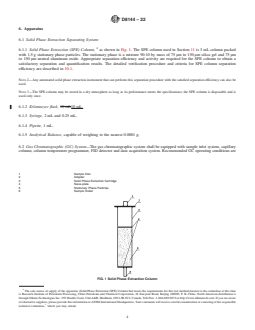
6.1.1 Solid Phase Extraction (SPE) Column, as shown in
FID detector and data acquisition system. Recommended GC
Fig. 1. The SPE column used in Section 11 is 3 mL column
operating conditions are given in Table 1. The GC system and
packed with 1.5 g stationary phase particles. The stationary
operating conditions shall ensure baseline separation of the
phase is a mixture 90:10 by mass of 75 µm to 150 µm silica gel
solvent, sample and internal standard as shown in Fig. 2 and
and 75 µm to 150 µm neutral aluminum oxide. Appropriate
Fig. 3.Any other gas chromatograph instrument and operating
separation efficiency and activity are required for the SPE
conditions capable of yielding equivalent results may be used.
column to obtain a satisfactory separation and quantification
6.2.1 Sample Introduction System—Manual or recom-
results.ThedetailedverificationprocedureandcriteriaforSPE
mended automated liquid syringe injection into a splitting inlet
column separation efficiency are described in 10.1.
may be employed. The sample amount reaching the column
NOTE 2—Any automated solid phase extraction instrument that can
(combination of injection volume and split ratio) should meet
perform this separation procedure with the satisfied separation efficiency
the requirement of separation efficiency and linear response
can also be used.
calibration range.
NOTE 3—The SPE column may be stored in a dry atmosphere as long
6.2.2 Capillary Column—This test method is limited to the
as its performance meets the specifications; the SPE column is disposable
and is used only once.
use of non-polar silica capillary columns. The column and
conditions shall provide separation of typical petroleum hydro-
6.1.2 Erlenmeyer flask, 10 mL.
carbonsinorderofincreasingboilingpoint.SeeFig.2andFig.
6.1.3 Syringe, 2 mL and 0.25 mL.
3 for examples of acceptable separation.
6.1.4 Pipette, 1 mL.
6.2.3 Detector—This test method requires a flame ioniza-
6.1.5 Analytical Balance,capableofweighingtothenearest
tion detector (FID). The detector shall have enough sensitivity,
0.0001 g.
linearity, and stability to meet performance requirements.
6.2.4 Data Acquisition System—Acomputerized data acqui-
sition and reporting system is required to acquire, display, and
process GC data. The areas of chromatographic peaks can be
The sole source of supply of the apparatus (Solid Phase Extraction (SPE)
determined through either manual or automated peak integra-
Column that meets the requirements for this test method) known to the committee
tion.
at this time is Research Institute of Petroleum Processing, China Petroleum and
Chemical Corporation, 18 Xueyuan Road, Beijing 100083, P. R. China. North
A
American distribution is through Dikma Technologies Inc. 255 Shields Court, Unit
TABLE 1 Recommended Operating Conditions of GC
A&B, Markham, ON L3R 8V2, Canada, Toll-Free: 1-866-889-9072 or http://
Column Fused silica WCOT capillary column
www.dikmatech.com. If you are aware of alternative suppliers, please provide this
information to ASTM International Headquarters. Your comments will receive
Size 30m×0.25mmID, filmthickness 0.25 µm
careful consideration at a meeting of the responsible technical committee, which
you may attend.
Stationary phase Non-polar, such as 100 % dimethyl polysiloxane
or 5 % phenyl-methyl polysiloxane
Column Temperature Program Initial oven temperature 60 °C, initial hold 2 min,
1 Sample Inlet
program rate 40 °C ⁄min, final oven temperature
2 Adapter
300 °C, final hold 5 min
3 Solid Phase Extraction Cartridge
4 Sieve-plate
Inlet
5 Stationary Phase Particles
Temperature 300 °C
6 Sample Outlet
Split ratio 20:1
Sample size 0.5 µL
Carrier gas
Type Helium, Nitrogen, or Hydrogen
Constant Flow Mode 1 mL ⁄min
Detector
Type Flame ionization detector (FID)
Temperature 350 °C
Fuel gas Hydrogen (~30 mL/min)
Oxidizing gas Air (~300 mL/min)
Make-up gas ~25 mL/min
A
The operating conditions given in this table are typical and may vary. The length
of the WCOT column can be 15 m to 30 m; the inner diameter can be 0.15 mm to
0.32 mm. The suitable oven program can be selected to ensure baseline separa-
tion of the solvent, sample ,and internal standard. See Fig. 2 and Fig. 3 for
examples of suitable resolution.
FIG. 1 Solid Phase Extraction Column
D8144 − 22
FIG. 2 Chromatograms of Nonaromatics and Aromatics Fractions in Petroleum-based Middle Distillate Fuel
7. Reagents and Materials 7.10 Silica Gel, 75 µm to 150 µm.
7.1 Purity of Reagents—Reagent grade chemicals shall be
7.11 Aluminum oxide (neutral), 75 µm to 150 µm.
used in this test. Unless otherwise indicated, it is intended that
7.12 Carrier gas, Nitrogen, Helium, or Hydrogen, 99.99 %
all reagents shall conform to the specifications of the Commit-
5 pure. (Warning—Compressed gas under high pressure.)
teeonAnalyticalReagentsoftheAmericanChemicalSociety,
where such specifications are available. Other grades may be 7.13 Hydrogen, 99.9 % pure. (Warning—Extremely flam-
used, provided it is first ascertained that the reagent is of mable gas under high pressure.)
sufficiently high purity to permit its use without lessening the
7.14 Air,compressed,99.9%pure.(Warning—Compressed
accuracy of the determination.
gas under high pressure that supports combustion.)
7.2 Ethyl Alcohol, anhydrous, reagent grade. (Warning—
7.15 Column Fractionation Effıciency Evaluation Mixture
Flammable.)
(Procedure A), used to evaluate the separation efficiency of
7.3 Dichloromethane, reagent grade. (Warning—Toxic.
SPE column in Procedure A. The mixture can be prepared by
Harmful if inhaled or skin contact.)
pure saturates in the range of 50 % to 95 % by mass and pure
aromatics in the range of 5 % to 50 % by mass. The pure
7.4 n-hexane, reagent grade. (Warning—Flammable.)
saturates can be a qualitative mixture of at least three paraffins
7.5 n-hexadecane, reagent grade.
from n-C to n-C .The pure aromatics can be a qualitative
10 20
7.6 n-triacontane, reagent grade.
mixture of at least three alkylbenzenes, such as C to C -
4 12
benzene, naphthalene, and phenanthrene. It is recommended
7.7 n-dotriacontane, reagent grade.
that the concentrations of alkylbenzene and polycyclic aromat-
7.8 Methyl oleate, >99 %.
ics are similar with that in a diesel fuel sample. The represen-
7.9 Internal Standard Solution, n-triacontane or
tative compositions and concentrations for the evaluation
n-dotriacontane dissolved in n-hexane solvent to obtain the
mixtures are listed in Table A1.1 in Annex A1.
mass concentrations of 0.001 g/mL to 0.005 g/mL.
7.16 Column Fractionation Effıciency Evaluation Mixture
(Procedure B), used to evaluate the separation efficiency of
SPE column in Procedure B. The mixture can be prepared by
ACS Reagent Chemicals, Specifications and Procedures for Reagents and
Standard-Grade Reference Materials, American Chemical Society, Washington,
pure saturates in the range of 30 % to 95 % by mass, pure
DC. For suggestions on the testing of reagents not listed by theAmerican Chemical
aromatics in the range of 5 % to 50 % by mass and FAME in
Society, see Analar Standards for Laboratory Chemicals, BDH Ltd., Poole, Dorset,
the range of 0.5 % to 20 % by volume. The pure saturates can
U.K., and the United States Pharmacopeia and National Formulary, U.S. Pharma-
copeial Convention, Inc. (USPC), Rockville, MD. be a qualitative mixture of at least three paraffins from n-C to
D8144 − 22
FIG. 3 Chromatograms of Nonaromatics, Aromatics, and FAME Fractions in FAME Biodiesel Blends
n-C . The pure aromatics can be a qualitative mixture of at precision of the test method. The quality control (QC) sample
least three alkylbenzenes, such as C to C -benzene, is prepared by weighing and blending a certain mass of
4 12
naphthalene, and phenanthrene. It is recommended that the aromatics and nonaromatics fractions, which are separated
concentrations of alkylbenzene and polycyclic aromatics are fromTestMethodD2549.ThecompositionofQCsampleshall
similar with that in a diesel fuel sample. Any FAME standard be similar with that in test sample.
or a mixture of FAME standards can be used to prepare this
7.19 Quality Control Sample (Procedure B), used to rou-
mixture. The representative composition and concentrations
tinelymonitortheoperationofthegaschromatographicsystem
for the evaluation mixtures are listed in Table A1.2 in Annex
and verify that the reported concentration are within the
A1.
precision of the test method. The quality control (QC) sample
7.17 Relative Response Factor Mixture, used to calculate is prepared by weighing and blending a certain mass of FAME
biodieselwiththearomaticsandnonaromaticsfractions,which
the relative response factor of FAME (relative to
n-hexadecane). Prepare a quantitative mixture of methyl oleate are separated from Test Method D2549. The composition of
QC sample shall be similar with that in test sample.
(see Note 4) and n-hexadecane at the weight ratio of 1:1. Use
n-hexane as the solvent to provide a solution with a mass
7.20 Reference Sample of Middle Distillates, middle distil-
percent of 1 %.
lates with known content of aromatics and nonaromatics
fractions, a check standard meeting the requirement in Practice
NOTE 4—Any FAME standard or a mixture of FAME standard can be
D6299 with accepted reference value (ARV) determined by
used as the reference to calculate the relative response factor.
Test Method D2549.
7.18 Quality Control Sample (Procedure A), used to rou-
tinelymonitortheoperationofthegaschromatographicsystem 7.21 Reference Sample blended with FAME, diesel fuel with
and verify that the reported concentrations are within the known content of aromatics, nonaromatics, and FAME, a
D8144 − 22
TABLE 3 Requirements of Separation Efficiency for FAME and
check standard prepared by spiking the weighed FAME into
Hydrocarbons Standards in Procedure B
the reference sample listed in 7.20. The ARV shall be deter-
Range of the volume Mass percent of Mass percent of FAME
mined in accordance with their blended weight ratio.
percent of FAME hydrocarbons in FAME in aromatics fraction
fraction
8. Sampling
1.0# x# 20 <5 <5
0.5# x<1.0 <10
8.1 Unless otherwise specified, samples shall be obtained in
accordance with Practices D4057, D4177, or other comparable
practices. Samples should be stored in sealed containers.
10.3 Verification for the Total Operation of the System:
9. Preparation of Apparatus
10.3.1 Analyze the reference sample listed in 7.20 and 7.21
9.1 Chromatograph—Place in service and maintain in ac- routinelyandthedeterminedresultsofreferencesampleshould
cordance with the manufacturer’s instructions. Typical operat- agree with their accepted reference values (ARVs). If the test
ing conditions are shown in Table 1, but manufacturer’s result is not within 6 (R/√2) of the ARV, in which R is the
recommendat
...
This document is not an ASTM standard and is intended only to provide the user of an ASTM standard an indication of what changes have been made to the previous version. Because
it may not be technically possible to adequately depict all changes accurately, ASTM recommends that users consult prior editions as appropriate. In all cases only the current version
of the standard as published by ASTM is to be considered the official document.
´1
Designation: D8144 − 18 D8144 − 22
Standard Test Method for
Separation and Determination of Aromatics, Nonaromatics,
and FAME Fractions in Middle Distillates by Solid-Phase
Extraction and Gas Chromatography
This standard is issued under the fixed designation D8144; the number immediately following the designation indicates the year of
original adoption or, in the case of revision, the year of last revision. A number in parentheses indicates the year of last reapproval. A
superscript epsilon (´) indicates an editorial change since the last revision or reapproval.
ε NOTE—Footnote 4 was updated editorially in June 2019.
1. Scope Scope*
1.1 This test method covers the separation and determination of representative aromatics, nonaromatics, and fatty acid methyl ester
(FAME) fractions in middle distillates that boil between 170 °C and 400 °C, including biodiesel blends with up to 20 % by volume
of FAME, by solid phase extraction and gas chromatography.
1.2 This test method provides two procedures, A and B. Procedure A is applicable to the petroleum-based middle distillates fuel,
and Procedure B is applicable to the biodiesel blends with up to 20 % by volume of FAME.
1.3 This test method is applicable to middle distillates samples with aromatics content ranging from 5 % to 50 % by mass and
biodiesel blends with FAME content in the range of 0.5 % to 20 % by volume. This test method may apply to concentrations
outside these ranges, but the precision has not been determined.
1.4 For Procedure B, biodiesels in the form of fatty acid ethyl ester (FAEE) can also fully elute into the FAME fraction, and they
have the similar FID (flame ionization detector) relative response factors with that of FAME. The determined content of FAME
fractions are the sum of concentrations of FAME and FAEE by this test method (see 3.1.53.2.5).
1.5 From the investigation results obtained for FAME determination, the low concentrations of monoglycerides (usually less than
0.5 % by mass in biodiesel blends) are not detectable under the gas chromatographic (GC) condition of this test method and will
not interfere with the determination of FAME by Procedure B. As a result, biodiesel blends, conforming to the requirements of
Specification D7467, containing up to 20 % by volume of biodiesel blendstock meeting the requirements in Specification D6751,
typically contain concentrations of monoglycerides of less than 0.1 % by mass. The diglycerides and triglycerides, if present, are
not detected under the GC condition of this test method due to their higher boiling points.
NOTE 1—If a sample is suspected of containing an abnormal FAME biodiesel feedstock than specified in Specification D6751, for example, a sample
contaminated with vegetable oil with a high level of total triglycerides, the content of mono-, di-, or tri-glycerides in the isolated FAME fraction may
be determined using Test Method D6584. Samples containing biodiesels with a high amount of glycerides than specified in Specification D6751 may
contaminate the GC column and not recommended for this test method.
1.6 The values stated in acceptable SI units are to be regarded as the standard. No other units of measurement are included in this
standard
This test method is under the jurisdiction of ASTM Committee D02 on Petroleum Products, Liquid Fuels, and Lubricants and is the direct responsibility of Subcommittee
D02.04.0L on Gas Chromatography Methods.
Current edition approved March 1, 2018Nov. 1, 2022. Published April 2018November 2022. Originally approved in 2018. Last previous edition approved in 2018 as
ɛ1
D8144 – 18 . DOI: 10.1520/D8144-18E01.10.1520/D8144-22.
*A Summary of Changes section appears at the end of this standard
Copyright © ASTM International, 100 Barr Harbor Drive, PO Box C700, West Conshohocken, PA 19428-2959. United States
D8144 − 22
1.7 This standard does not purport to address all of the safety concerns, if any, associated with its use. It is the responsibility
of the user of this standard to establish appropriate safety, health, and environmental practices and determine the applicability of
regulatory limitations prior to use.
1.8 This international standard was developed in accordance with internationally recognized principles on standardization
established in the Decision on Principles for the Development of International Standards, Guides and Recommendations issued
by the World Trade Organization Technical Barriers to Trade (TBT) Committee.
2. Referenced Documents
2.1 ASTM Standards:
D2425 Test Method for Hydrocarbon Types in Middle Distillates by Mass Spectrometry
D2549 Test Method for Separation of Representative Aromatics and Nonaromatics Fractions of High-Boiling Oils by Elution
Chromatography
D2887 Test Method for Boiling Range Distribution of Petroleum Fractions by Gas Chromatography
D4052 Test Method for Density, Relative Density, and API Gravity of Liquids by Digital Density Meter
D4057 Practice for Manual Sampling of Petroleum and Petroleum Products
D4175 Terminology Relating to Petroleum Products, Liquid Fuels, and Lubricants
D4177 Practice for Automatic Sampling of Petroleum and Petroleum Products
D6299 Practice for Applying Statistical Quality Assurance and Control Charting Techniques to Evaluate Analytical Measure-
ment System Performance
D6584 Test Method for Determination of Total Monoglycerides, Total Diglycerides, Total Triglycerides, and Free and Total
Glycerin in B-100 Biodiesel Methyl Esters by Gas Chromatography
D6751 Specification for Biodiesel Fuel Blend Stock (B100) for Middle Distillate Fuels
D7467 Specification for Diesel Fuel Oil, Biodiesel Blend (B6 to B20)
2.2 Other Standards:
EN 14103 Fat and oil derivatives—Fatty Acid Methyl Esters (FAME)—Determination of ester and linolenic acid methyl ester
contents
EN 14214 Automotive fuels—Fatty acid methyl esters (FAME) for diesel engines—Requirements and test methods
3. Terminology
3.1 Definitions:
3.1.1 For definitions of terms used in this test method, refer to Terminology D4175.
3.2 Definitions of Terms Specific to This Standard:
3.2.1 aromatics fraction, n—the portion of the sample desorbed with the dichloromethane-ethyl alcohol mixture eluants
(Procedure A) and dichloromethane-n-hexane eluants (Procedure B); the aromatics fraction may contain aromatics, condensed
naphthenic-aromatics, aromatic olefins, and compounds containing sulfur, nitrogen, and oxygen atoms.
3.2.2 biodiesel, n—a fuel comprised of mono-alkyl esters of long chain fatty acids derived from vegetable oils or animal fats,
designated B100.
3.2.3 biodiesel blend, n—a blend of biodiesel fuel with petroleum-based diesel fuel.
3.2.4 diesel fuel, n—petroleum-based middle distillate fuel.
3.2.5 fatty acid methyl ester fraction, n—the portion of the diesel fuels blends with fatty acid methyl ester (FAME) eluted with
dichloromethane-ethyl alcohol; the FAME fraction may contain FAEE and compounds containing nitrogen and oxygen atoms.
3.2.6 nonaromatics fraction, n—the portion of the sample eluted with n-hexane.
3.2.6.1 Discussion—
The nonaromatics fraction is a mixture of paraffinic and naphthenic hydrocarbons if the sample is a straight-run material. If the
sample is a cracked stock, the nonaromatics fraction will also contain aliphatic and cyclic olefins.
For referenced ASTM standards, visit the ASTM website, www.astm.org, or contact ASTM Customer Service at service@astm.org. For Annual Book of ASTM Standards
volume information, refer to the standard’s Document Summary page on the ASTM website.
Available from British Standards Institution (BSI), 389 Chiswick High Rd., London W4 4AL, U.K., http://www.bsigroup.com.
D8144 − 22
3.2.7 solid phase extraction separating system, n—a solid-phase extraction cartridge packed with stationary phase material to
effectively separate the aromatics, nonaromatics, and other compounds (such as FAME) fractions in middle distillates based on the
mechanism of solid phase extraction (SPE).
4. Summary of Test Method
4.1 Procedure A—The sample is charged to the top of a SPE column and separated into aromatics and nonaromatics fractions by
eluants with different polarities. Two aliquots of internal standards are added to these two fractions and both fractions are analyzed
by the gas chromatograph equipped with hydrogen flame ionization detector (GC-FID). The content of the aromatics and
nonaromatics are calculated based on the peak areas of the aromatics, nonaromatics, and internal standards.
4.2 Procedure B—The sample is charged to the top of a SPE column and separated into aromatics, nonaromatics, and FAME
fractions by eluants with different polarities. Three aliquots of internal standards are added to these three fractions. All of these
fractions are analyzed by the gas chromatograph equipped with hydrogen flame ionization detector (GC-FID). The content of the
aromatics, nonaromatics, and FAME fractions are calculated based on the peak areas of the aromatics, nonaromatics, FAME, and
internal standards. The volume percent of FAME is calculated based on the density of sample and mass percent of FAME.
5. Significance and Use
5.1 For the middle distillates whose boiling range is between 170 °C and 400 °C by such distillation methods like Test Method
D2887, Procedure A can separate and determine the content of total aromatics and total nonaromatics by SPE and GC analysis of
the resulting fractions. The determination of the total content of saturates and aromatics in petroleum middle distillates is useful
to investigate the effects of petroleum processes on production of various finished fuels.
5.2 The total aromatics content and polycyclic aromatics content are important to characterize the quality of diesel fuels. This test
method is demonstrated to be time-saving and eco-friendly by reducing the amount of reagent consumption and avoiding the
necessity of solvent evaporation step as required, for example, in such Test Method D2549.
5.3 The determination of detailed hydrocarbon composition by mass spectrometry requires a preliminary separation of the sample
into representative aromatics and nonaromatics, as in Test Method D2425, where Test Method D2549 is used to separate the
distillate fuel. The SPE fractionation procedure described herein may provide a suitable fractionation alternative approach for these
mass spectrometric types of methods.
5.4 Biodiesel is a blendstock commodity primarily used as a value-added blending component with diesel fuel. Procedure B can
provide a separation and determination technique to monitor the FAME content for FAME biodiesel blends.
D8144 − 22
6. Apparatus
6.1 Solid Phase Extraction Separating System:
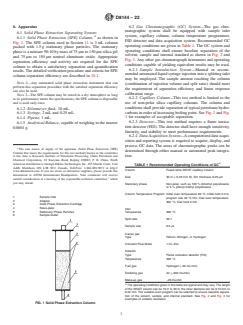
6.1.1 Solid Phase Extraction (SPE) Column, as shown in Fig. 1. The SPE column used in Section 11 is 3 mL column packed
with 1.5 g stationary phase particles. The stationary phase is a mixture 90:10 by mass of 75 μm to 150 μm silica gel and 75 μm
to 150 μm neutral aluminum oxide. Appropriate separation efficiency and activity are required for the SPE column to obtain a
satisfactory separation and quantification results. The detailed verification procedure and criteria for SPE column separation
efficiency are described in 10.1.
NOTE 2—Any automated solid phase extraction instrument that can perform this separation procedure with the satisfied separation efficiency can also be
used.
NOTE 3—The SPE column may be stored in a dry atmosphere as long as its performance meets the specifications; the SPE column is disposable and is
used only once.
6.1.2 Erlenmeyer flask, 10 mL10 mL.
6.1.3 Syringe, 2 mL and 0.25 mL.
6.1.4 Pipette, 1 mL.
6.1.5 Analytical Balance, capable of weighing to the nearest 0.0001 g.
6.2 Gas Chromatographic (GC) System—The gas chromatographic system shall be equipped with sample inlet system, capillary
column, column temperature programmer, FID detector and data acquisition system. Recommended GC operating conditions are
1 Sample Inlet
2 Adapter
3 Solid Phase Extraction Cartridge
4 Sieve-plate
5 Stationary Phase Particles
6 Sample Outlet
FIG. 1 Solid Phase Extraction Column
The sole source of supply of the apparatus (Solid Phase Extraction (SPE) Column that meets the requirements for this test method) known to the committee at this time
is Research Institute of Petroleum Processing, China Petroleum and Chemical Corporation, 18 Xueyuan Road, Beijing 100083, P. R. China. North American distribution is
through Dikma Technologies Inc. 255 Shields Court, Unit A&B, Markham, ON L3R 8V2, Canada, Toll-Free: 1-866-889-9072 or http://www.dikmatech.com. If you are aware
of alternative suppliers, please provide this information to ASTM International Headquarters. Your comments will receive careful consideration at a meeting of the responsible
technical committee, which you may attend.
D8144 − 22
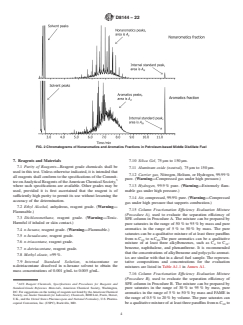
given in Table 1. The GC system and operating conditions shall ensure baseline separation of the solvent, sample and internal
standard as shown in Fig. 2 and Fig. 3. Any other gas chromatograph instrument and operating conditions capable of yielding
equivalent results may be used.
6.2.1 Sample Introduction System—Manual or recommended automated liquid syringe injection into a splitting inlet may be
employed. The sample amount reaching the column (combination of injection volume and split ratio) should meet the requirement
of separation efficiency and linear response calibration range.
6.2.2 Capillary Column—This test method is limited to the use of non-polar silica capillary columns. The column and conditions
shall provide separation of typical petroleum hydrocarbons in order of increasing boiling point. See Fig. 2 and Fig. 3 for examples
of acceptable separation.
6.2.3 Detector—This test method requires a flame ionization detector (FID). The detector shall have enough sensitivity, linearity,
and stability to meet performance requirements.
6.2.4 Data Acquisition System—A computerized data acquisition and reporting system is required to acquire, display, and process
GC data. The areas of chromatographic peaks can be determined through either manual or automated peak integration.
7. Reagents and Materials
7.1 Purity of Reagents—Reagent grade chemicals shall be used in this test. Unless otherwise indicated, it is intended that all
reagents shall conform to the specifications of the Committee on Analytical Reagents of the American Chemical Society, where
A
TABLE 1 Recommended Operating Conditions of GC
Column Fused silica WCOT capillary column
Size 30 m × 0.25 mm ID, film thickness 0.25 μm
Stationary phase Non-polar, such as 100 % dimethyl polysiloxane
or 5 % phenyl-methyl polysiloxane
Column Temperature Program Initial oven temperature 60 °C, initial hold 2 min,
program rate 40 °C ⁄min, final oven temperature
300 °C, final hold 5 min
Inlet
Temperature 300 °C
Split ratio 20:1
Sample size 0.5 μL
Carrier gas
Type Helium, Nitrogen, or Hydrogen
Constant Flow Mode 1 mL ⁄min
Detector
Type Flame ionization detector (FID)
Temperature 350 °C
Fuel gas Hydrogen (~30 mL/min)
Oxidizing gas Air (~300 mL/min)
Make-up gas ~25 mL/min
A
The operating conditions given in this table are typical and may vary. The length
of the WCOT column can be 15 m to 30 m; the inner diameter can be 0.15 mm to
0.32 mm. The suitable oven program can be selected to ensure baseline separa-
tion of the solvent, sample ,and internal standard. See Fig. 2 and Fig. 3 for
examples of suitable resolution.
ACS Reagent Chemicals, Specifications and Procedures for Reagents and Standard-Grade Reference Materials, American Chemical Society, Washington, DC. For
suggestions on the testing of reagents not listed by the American Chemical Society, see Analar Standards for Laboratory Chemicals, BDH Ltd., Poole, Dorset, U.K., and
the United States Pharmacopeia and National Formulary, U.S. Pharmacopeial Convention, Inc. (USPC), Rockville, MD.
D8144 − 22
FIG. 2 Chromatograms of Nonaromatics and Aromatics Fractions in Petroleum-based Middle Distillate Fuel
such specifications are available. Other grades may be used, provided it is first ascertained that the reagent is of sufficiently high
purity to permit its use without lessening the accuracy of the determination.
7.2 Ethyl Alcohol, anhydrous, reagent grade. (Warning—Flammable.)
7.3 Dichloromethane, reagent grade. (Warning—Toxic. Harmful if inhaled or skin contact.)
7.4 n-hexane, reagent grade. (Warning—Flammable.)
7.5 n-hexadecane, reagent grade.
7.6 n-triacontane, reagent grade.
7.7 n-dotriacontane, reagent grade.
7.8 Methyl oleate, >99 %.
7.9 Internal Standard Solution, n-triacontane or n-dotriacontane dissolved in n-hexane solvent to obtain the mass concentrations
of 0.001 g/mL to 0.005 g/mL.
7.10 Silica Gel, 75 μm to 150 μm.
7.11 Aluminum oxide (neutral), 75 μm to 150 μm.
7.12 Carrier gas, Nitrogen, Helium, or Hydrogen, 99.99 % pure. (Warning—Compressed gas under high pressure.)
7.13 Hydrogen, 99.9 % pure. (Warning—Extremely flammable gas under high pressure.)
D8144 − 22
FIG. 3 Chromatograms of Nonaromatics, Aromatics, and FAME Fractions in FAME Biodiesel Blends
7.14 Air, compressed, 99.9% pure. (Warning—Compressed gas under high pressure that supports combustion.)
7.15 Column Fractionation Effıciency Evaluation Mixture (Procedure A), used to evaluate the separation efficiency of SPE column
in Procedure A. The mixture can be prepared by pure saturates in the range of 50 % to 95 % by mass and pure aromatics in the
range of 5 % to 50 % by mass. The pure saturates can be a qualitative mixture of at least three paraffins from n-C to n-C .The
10 20
pure aromatics can be a qualitative mixture of at least three alkylbenzenes, such as C to C -benzene, naphthalene, and
4 12
phenanthrene. It is recommended that the concentrations of alkylbenzene and polycyclic aromatics are similar with that in a diesel
fuel sample. The representative compositions and concentrations for the evaluation mixtures are listed in Table A1.1 in Annex A1.
7.16 Column Fractionation Effıciency Evaluation Mixture (Procedure B), used to evaluate the separation efficiency of SPE column
in Procedure B. The mixture can be prepared by pure saturates in the range of 30 % to 95 % by mass, pure aromatics in the range
of 5 % to 50 % by mass and FAME in the range of 0.5 % to 20 % by volume. The pure saturates can be a qualitative mixture of
at least three paraffins from n-C to n-C . The pure aromatics can be a qualitative mixture of at least three alkylbenzenes, such
10 20
as C to C -benzene, naphthalene, and phenanthrene. It is recommended that the concentrations of alkylbenzene and polycyclic
4 12
aromatics are similar with that in a diesel fuel sample. Any FAME standard or a mixture of FAME standards can be used to prepare
this mixture. The representative composition and concentrations for the evaluation mixtures are listed in Table A1.2 in Annex A1.
7.17 Relative Response Factor Mixture, used to calculate the relative response factor of FAME (relative to n-hexadecane). Prepare
D8144 − 22
a quantitative mixture of methyl oleate (see Note 4) and n-hexadecane at the weight ratio of 1:1. Use n-hexane as the solvent to
provide a solution with a mass percent of 1 %.
NOTE 4—Any FAME standard or a mixture of FAME standard can be used as the reference to calculate the relative response factor.
7.18 Quality Control Sample (Procedure A), used to routinely monitor the operation of the gas chromatographic system and verify
that the reported concentrations are within the precision of the test method. The quality control (QC) sample is prepared by
weighing and blending a certain mass of aromatics and nonaromatics fractions, which are separated from Test Method D2549. The
composition of QC sample shall be similar with that in test sample.
7.19 Quality Control Sample (Procedure B), used to routinely monitor the operation of the gas chromatographic system and verify
that the reported concentration are within the precision of the test method. The quality control (QC) sample is prepared by weighing
and blending a certain mass of FAME biodiesel with the aromatics and nonaromatics fractions, which are separated from Test
Method D2549. The composition of QC sample shall be similar with that in test sample.
7.20 Reference Sample of Middle Distillates, middle distillates with known content of aromatics and nonaromatics fractions, a
check standard meeting the requirement in Practice D6299 with accepted reference value (ARV) determined by Test Method
D2549.
7.21 Reference Sample blended with FAME, diesel fuel with known content of aromatics, nonaromatics, and FAME, a check
standard prepared by spiking the weighed FAME into the reference sample listed in 7.20. The ARV shall be determined in
accordance with their blended weight ratio.
8. Sampling
8.1 Unless otherwise specified, samples shall be obtained in accordance with Practices D4057, D4177, or other comparable
practices. Samples should be stored in sealed containers.
9. Preparation of Apparatus
9.1 Chromatograph—Place in service and maintain in accordance with the manufacturer’s instructions. Typical operating
conditions are shown in Table 1, but manufacturer’s recommendations should be followed when possible.
10. Standardization and Verification
10.1 Verification of the Separation Effıciency of the SPE Column:
10.1.1 For a new batch of SPE columns or a new stationary phase used in the SPE column, or when overall performance criteria
are not being met, it is necessary to determine the separation efficiency of the column in accordance with the procedure as follows.
10.1.2 Use the separation efficiency evaluation mixture listed in 7.15 and 7.16 to evaluate the separatio
...