

ASTM D7467-23
(Specification)Standard Specification for Diesel Fuel Oil, Biodiesel Blend (B6 to B20)
General Information
- Abstract
SCOPE
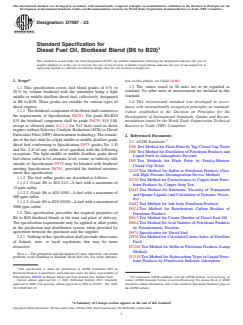
1.1 This specification covers fuel blend grades of 6 % to 20 % by volume biodiesel with the remainder being a light middle or middle distillate diesel fuel, collectively designated as B6 to B20. These grades are suitable for various types of diesel engines.
1.1.1 The biodiesel component of the blend shall conform to the requirements of Specification D6751. For grade B6-B20 S15 the biodiesel component shall be grade D6751 S15 LM, except as allowed under 6.1.1.1 for S15 fuels used in diesel engines without Selective Catalytic Reduction (SCR) or Diesel Particulate Filter (DPF) aftertreatment technology. The remainder of the fuel shall be a light middle or middle distillate grade diesel fuel conforming to Specification D975 grades No. 1-D and No. 2-D of any sulfur level specified with the following exceptions. The light middle or middle distillate grade diesel fuel whose sulfur level, aromatic level, cetane, or lubricity falls outside of Specification D975 may be blended with biodiesel meeting Specification D6751, provided the finished mixtures meets this specification.
1.1.2 The fuel sulfur grades are described as follows:
1.1.2.1 Grade B6 to B20 S15—A fuel with a maximum of 15 ppm sulfur.
1.1.2.2 Grade B6 to B20 S500—A fuel with a maximum of 500 ppm sulfur.
1.1.2.3 Grade B6 to B20 S5000—A fuel with a maximum of 5000 ppm sulfur.
1.2 This specification prescribes the required properties of B6 to B20 biodiesel blends at the time and place of delivery. The specification requirements may be applied at other points in the production and distribution system when provided by agreement between the purchaser and the supplier.
1.2.1 Nothing in this specification shall preclude observance of federal, state, or local regulations that may be more restrictive.
Note 1: The generation and dissipation of static electricity can create problems in the handling of distillate diesel fuel oils. For more information on this subject, see Guide D4865.
1.3 The values stated in SI units are to be regarded as standard. No other units of measurement are included in this standard.
1.4 This international standard was developed in accordance with internationally recognized principles on standardization established in the Decision on Principles for the Development of International Standards, Guides and Recommendations issued by the World Trade Organization Technical Barriers to Trade (TBT) Committee.
- Status
- Published
- Publication Date
- 30-Sep-2023
- Technical Committee
- D02 - Petroleum Products, Liquid Fuels, and Lubricants
- Drafting Committee
- D02.E0 - Burner, Diesel and Non-Aviation Gas Turbine Fuels
Buy Documents
ASTM D7467-23 - Standard Specification for Diesel Fuel Oil, Biodiesel Blend (B6 to B20)
REDLINE ASTM D7467-23 - Standard Specification for Diesel Fuel Oil, Biodiesel Blend (B6 to B20)
Overview
ASTM D7467-23: Standard Specification for Diesel Fuel Oil, Biodiesel Blend (B6 to B20) defines the requirements for diesel fuel oil blends containing 6% to 20% biodiesel by volume, designated as B6 to B20. Developed by ASTM International, this specification ensures that biodiesel blends meet quality and performance standards suitable for use in a wide range of diesel engines. The biodiesel component must comply with ASTM D6751, while the diesel portion generally conforms to ASTM D975. This standard supports the reliability and compatibility of biodiesel blends in fuel distribution, storage, and end-use applications.
Key Topics
Blend Grades and Composition
- Covers blends from 6% to 20% biodiesel (B6 to B20) with the remainder as light or middle distillate diesel fuel.
- Biodiesel used in blends must meet ASTM D6751 criteria.
- Diesel component typically meets ASTM D975 specifications for Grades No. 1-D or No. 2-D.
Sulfur Content
- Specifies three grades for sulfur levels:
- S15: Maximum 15 ppm sulfur
- S500: Maximum 500 ppm sulfur
- S5000: Maximum 5000 ppm sulfur
- Specifies three grades for sulfur levels:
Required Properties at Delivery
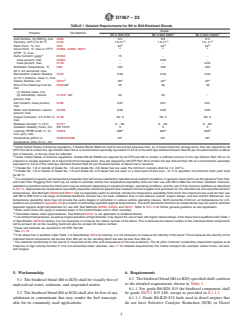
- Prescribes quality requirements for parameters like acid number, viscosity, flash point, cloud point, carbon residue, ash, cetane number, aromatics content, water and sediment, copper corrosion, biodiesel content, oxidation stability, lubricity, and electrical conductivity.
- Ensures blends are visually free of undissolved water, sediment, and other contaminants.
Testing and Quality Control
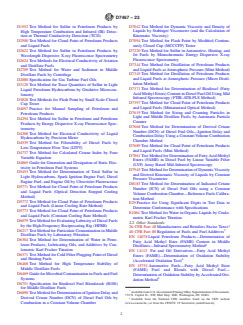
- Details numerous ASTM, ISO, and EN test methods for verifying properties at the time and place of delivery.
- Test methods ensure compliance with performance, safety, and environmental regulations.
Regulatory Compliance
- States that adherence to federal, state, and local regulations is mandatory if more restrictive requirements apply.
- Developed in alignment with World Trade Organization TBT (Technical Barriers to Trade) principles.
Applications
- On-Road and Off-Road Diesel Engines
- Suitable for various applications, including fleets, transportation, agriculture, and construction equipment.
- Energy Sector
- Used in power generation, backup generators, and industrial engines requiring reliable and clean-burning fuel.
- Sustainable and Renewable Fuel Initiatives
- Supports the integration of renewable energy sources by enabling a transition to cleaner diesel alternatives with lower greenhouse gas emissions.
- Fuel Distribution and Storage
- Provides guidance for long-term storage, handling, and monitoring, including best practices for avoiding biodiesel degradation.
By adhering to ASTM D7467-23, fuel suppliers, distributors, and users can be confident in the performance and safety of B6 to B20 biodiesel diesel blends across multiple industries and applications.
Related Standards
- ASTM D6751 - Specification for Biodiesel Fuel Blend Stock (B100) for Middle Distillate Fuels
- ASTM D975 - Specification for Diesel Fuel Oils (Grades No. 1-D and 2-D)
- ASTM D4865 - Guide for Generation and Dissipation of Static Electricity in Petroleum Fuel Systems
- EN 14078, EN 14112, EN 15751 - European methods for FAME (biodiesel) content and oxidation stability
- U.S. Code of Federal Regulations (CFR) Part 48 & Part 80 - Regulations on fuel taxes and fuel additives
Keywords: ASTM D7467-23, biodiesel blend, B6 to B20, diesel fuel specification, sulfur content, ASTM D975, ASTM D6751, biodiesel fuel, fuel oil, renewable diesel, sulfur grades, fuel standards, diesel engine fuel, sustainable fuels.
Relations
- Effective Date
- 01-Oct-2023
- Effective Date
- 01-Apr-2024
- Refers
ASTM D6371-24 - Standard Test Method for Cold Filter Plugging Point of Diesel and Heating Fuels - Effective Date
- 01-Mar-2024
- Effective Date
- 01-Feb-2024
- Effective Date
- 01-Jan-2024
- Effective Date
- 15-Dec-2023
- Effective Date
- 01-Dec-2023
- Effective Date
- 01-Dec-2023
- Effective Date
- 01-Dec-2023
- Effective Date
- 01-Dec-2023
- Effective Date
- 01-Nov-2023
- Effective Date
- 01-Nov-2023
- Effective Date
- 01-Nov-2023
- Effective Date
- 01-Oct-2023
- Effective Date
- 15-Jul-2023
Buy Documents
ASTM D7467-23 - Standard Specification for Diesel Fuel Oil, Biodiesel Blend (B6 to B20)
REDLINE ASTM D7467-23 - Standard Specification for Diesel Fuel Oil, Biodiesel Blend (B6 to B20)
Get Certified
Connect with accredited certification bodies for this standard

Element Materials Technology
Materials testing and product certification.

ABS Group Brazil
ABS Group certification services in Brazil.

ABS Quality Evaluations Inc.
American Bureau of Shipping quality certification.
Sponsored listings
Frequently Asked Questions
ASTM D7467-23 is a technical specification published by ASTM International. Its full title is "Standard Specification for Diesel Fuel Oil, Biodiesel Blend (B6 to B20)". This standard covers: SCOPE 1.1 This specification covers fuel blend grades of 6 % to 20 % by volume biodiesel with the remainder being a light middle or middle distillate diesel fuel, collectively designated as B6 to B20. These grades are suitable for various types of diesel engines. 1.1.1 The biodiesel component of the blend shall conform to the requirements of Specification D6751. For grade B6-B20 S15 the biodiesel component shall be grade D6751 S15 LM, except as allowed under 6.1.1.1 for S15 fuels used in diesel engines without Selective Catalytic Reduction (SCR) or Diesel Particulate Filter (DPF) aftertreatment technology. The remainder of the fuel shall be a light middle or middle distillate grade diesel fuel conforming to Specification D975 grades No. 1-D and No. 2-D of any sulfur level specified with the following exceptions. The light middle or middle distillate grade diesel fuel whose sulfur level, aromatic level, cetane, or lubricity falls outside of Specification D975 may be blended with biodiesel meeting Specification D6751, provided the finished mixtures meets this specification. 1.1.2 The fuel sulfur grades are described as follows: 1.1.2.1 Grade B6 to B20 S15—A fuel with a maximum of 15 ppm sulfur. 1.1.2.2 Grade B6 to B20 S500—A fuel with a maximum of 500 ppm sulfur. 1.1.2.3 Grade B6 to B20 S5000—A fuel with a maximum of 5000 ppm sulfur. 1.2 This specification prescribes the required properties of B6 to B20 biodiesel blends at the time and place of delivery. The specification requirements may be applied at other points in the production and distribution system when provided by agreement between the purchaser and the supplier. 1.2.1 Nothing in this specification shall preclude observance of federal, state, or local regulations that may be more restrictive. Note 1: The generation and dissipation of static electricity can create problems in the handling of distillate diesel fuel oils. For more information on this subject, see Guide D4865. 1.3 The values stated in SI units are to be regarded as standard. No other units of measurement are included in this standard. 1.4 This international standard was developed in accordance with internationally recognized principles on standardization established in the Decision on Principles for the Development of International Standards, Guides and Recommendations issued by the World Trade Organization Technical Barriers to Trade (TBT) Committee.
SCOPE 1.1 This specification covers fuel blend grades of 6 % to 20 % by volume biodiesel with the remainder being a light middle or middle distillate diesel fuel, collectively designated as B6 to B20. These grades are suitable for various types of diesel engines. 1.1.1 The biodiesel component of the blend shall conform to the requirements of Specification D6751. For grade B6-B20 S15 the biodiesel component shall be grade D6751 S15 LM, except as allowed under 6.1.1.1 for S15 fuels used in diesel engines without Selective Catalytic Reduction (SCR) or Diesel Particulate Filter (DPF) aftertreatment technology. The remainder of the fuel shall be a light middle or middle distillate grade diesel fuel conforming to Specification D975 grades No. 1-D and No. 2-D of any sulfur level specified with the following exceptions. The light middle or middle distillate grade diesel fuel whose sulfur level, aromatic level, cetane, or lubricity falls outside of Specification D975 may be blended with biodiesel meeting Specification D6751, provided the finished mixtures meets this specification. 1.1.2 The fuel sulfur grades are described as follows: 1.1.2.1 Grade B6 to B20 S15—A fuel with a maximum of 15 ppm sulfur. 1.1.2.2 Grade B6 to B20 S500—A fuel with a maximum of 500 ppm sulfur. 1.1.2.3 Grade B6 to B20 S5000—A fuel with a maximum of 5000 ppm sulfur. 1.2 This specification prescribes the required properties of B6 to B20 biodiesel blends at the time and place of delivery. The specification requirements may be applied at other points in the production and distribution system when provided by agreement between the purchaser and the supplier. 1.2.1 Nothing in this specification shall preclude observance of federal, state, or local regulations that may be more restrictive. Note 1: The generation and dissipation of static electricity can create problems in the handling of distillate diesel fuel oils. For more information on this subject, see Guide D4865. 1.3 The values stated in SI units are to be regarded as standard. No other units of measurement are included in this standard. 1.4 This international standard was developed in accordance with internationally recognized principles on standardization established in the Decision on Principles for the Development of International Standards, Guides and Recommendations issued by the World Trade Organization Technical Barriers to Trade (TBT) Committee.
ASTM D7467-23 is classified under the following ICS (International Classification for Standards) categories: 75.160.20 - Liquid fuels. The ICS classification helps identify the subject area and facilitates finding related standards.
ASTM D7467-23 has the following relationships with other standards: It is inter standard links to ASTM D7467-20a, ASTM D445-24, ASTM D6371-24, ASTM D613-24, ASTM E1064-24, ASTM D975-23a, ASTM D86-23ae1, ASTM D7094-23, ASTM D86-23a, ASTM D7345-23, ASTM D7945-23, ASTM D445-23, ASTM D4865-23, ASTM D7668-23, ASTM E1064-23. Understanding these relationships helps ensure you are using the most current and applicable version of the standard.
ASTM D7467-23 is available in PDF format for immediate download after purchase. The document can be added to your cart and obtained through the secure checkout process. Digital delivery ensures instant access to the complete standard document.
Standards Content (Sample)
This international standard was developed in accordance with internationally recognized principles on standardization established in the Decision on Principles for the
Development of International Standards, Guides and Recommendations issued by the World Trade Organization Technical Barriers to Trade (TBT) Committee.
Designation: D7467 − 23
Standard Specification for
Diesel Fuel Oil, Biodiesel Blend (B6 to B20)
This standard is issued under the fixed designation D7467; the number immediately following the designation indicates the year of
original adoption or, in the case of revision, the year of last revision. A number in parentheses indicates the year of last reapproval. A
superscript epsilon (´) indicates an editorial change since the last revision or reapproval.
tion on this subject, see Guide D4865.
1. Scope*
1.3 The values stated in SI units are to be regarded as
1.1 This specification covers fuel blend grades of 6 % to
standard. No other units of measurement are included in this
20 % by volume biodiesel with the remainder being a light
standard.
middle or middle distillate diesel fuel, collectively designated
as B6 to B20. These grades are suitable for various types of
1.4 This international standard was developed in accor-
diesel engines.
dance with internationally recognized principles on standard-
1.1.1 The biodiesel component of the blend shall conform to
ization established in the Decision on Principles for the
the requirements of Specification D6751. For grade B6-B20
Development of International Standards, Guides and Recom-
S15 the biodiesel component shall be grade D6751 S15 LM,
mendations issued by the World Trade Organization Technical
except as allowed under 6.1.1.1 for S15 fuels used in diesel
Barriers to Trade (TBT) Committee.
engines without Selective Catalytic Reduction (SCR) or Diesel
Particulate Filter (DPF) aftertreatment technology. The remain-
2. Referenced Documents
der of the fuel shall be a light middle or middle distillate grade 2
2.1 ASTM Standards:
diesel fuel conforming to Specification D975 grades No. 1-D
D56 Test Method for Flash Point by Tag Closed Cup Tester
and No. 2-D of any sulfur level specified with the following
D86 Test Method for Distillation of Petroleum Products and
exceptions. The light middle or middle distillate grade diesel
Liquid Fuels at Atmospheric Pressure
fuel whose sulfur level, aromatic level, cetane, or lubricity falls
D93 Test Methods for Flash Point by Pensky-Martens
outside of Specification D975 may be blended with biodiesel
Closed Cup Tester
meeting Specification D6751, provided the finished mixtures
D129 Test Method for Sulfur in Petroleum Products (Gen-
meets this specification.
eral High Pressure Decomposition Device Method)
1.1.2 The fuel sulfur grades are described as follows:
D130 Test Method for Corrosiveness to Copper from Petro-
1.1.2.1 Grade B6 to B20 S15—A fuel with a maximum of
leum Products by Copper Strip Test
15 ppm sulfur.
D445 Test Method for Kinematic Viscosity of Transparent
1.1.2.2 Grade B6 to B20 S500—A fuel with a maximum of
and Opaque Liquids (and Calculation of Dynamic Viscos-
500 ppm sulfur.
ity)
1.1.2.3 Grade B6 to B20 S5000—A fuel with a maximum of
D482 Test Method for Ash from Petroleum Products
5000 ppm sulfur.
D524 Test Method for Ramsbottom Carbon Residue of
1.2 This specification prescribes the required properties of
Petroleum Products
B6 to B20 biodiesel blends at the time and place of delivery.
D613 Test Method for Cetane Number of Diesel Fuel Oil
The specification requirements may be applied at other points
D664 Test Method for Acid Number of Petroleum Products
in the production and distribution system when provided by
by Potentiometric Titration
agreement between the purchaser and the supplier.
D975 Specification for Diesel Fuel
1.2.1 Nothing in this specification shall preclude observance
D976 Test Method for Calculated Cetane Index of Distillate
of federal, state, or local regulations that may be more Fuels
restrictive.
D1266 Test Method for Sulfur in Petroleum Products (Lamp
Method)
NOTE 1—The generation and dissipation of static electricity can create
D1319 Test Method for Hydrocarbon Types in Liquid Petro-
problems in the handling of distillate diesel fuel oils. For more informa-
leum Products by Fluorescent Indicator Adsorption
This specification is under the jurisdiction of ASTM Committee D02 on
Petroleum Products, Liquid Fuels, and Lubricants and is the direct responsibility of
Subcommittee D02.E0 on Burner, Diesel and Non-Aviation Gas Turbine Fuels. For referenced ASTM standards, visit the ASTM website, www.astm.org, or
Current edition approved Oct. 1, 2023. Published October 2023. Originally contact ASTM Customer Service at service@astm.org. For Annual Book of ASTM
approved in 2008. Last previous edition approved in 2020 as D7467 – 20a. DOI: Standards volume information, refer to the standard’s Document Summary page on
10.1520/D7467-23. the ASTM website.
*A Summary of Changes section appears at the end of this standard
Copyright © ASTM International, 100 Barr Harbor Drive, PO Box C700, West Conshohocken, PA 19428-2959. United States
D7467 − 23
D1552 Test Method for Sulfur in Petroleum Products by D7042 Test Method for Dynamic Viscosity and Density of
High Temperature Combustion and Infrared (IR) Detec- Liquids by Stabinger Viscometer (and the Calculation of
Kinematic Viscosity)
tion or Thermal Conductivity Detection (TCD)
D2500 Test Method for Cloud Point of Petroleum Products D7094 Test Method for Flash Point by Modified Continu-
ously Closed Cup (MCCCFP) Tester
and Liquid Fuels
D7220 Test Method for Sulfur in Automotive, Heating, and
D2622 Test Method for Sulfur in Petroleum Products by
Jet Fuels by Monochromatic Energy Dispersive X-ray
Wavelength Dispersive X-ray Fluorescence Spectrometry
Fluorescence Spectrometry
D2624 Test Methods for Electrical Conductivity of Aviation
D7344 Test Method for Distillation of Petroleum Products
and Distillate Fuels
and Liquid Fuels at Atmospheric Pressure (Mini Method)
D2709 Test Method for Water and Sediment in Middle
D7345 Test Method for Distillation of Petroleum Products
Distillate Fuels by Centrifuge
and Liquid Fuels at Atmospheric Pressure (Micro Distil-
D2880 Specification for Gas Turbine Fuel Oils
lation Method)
D3120 Test Method for Trace Quantities of Sulfur in Light
D7371 Test Method for Determination of Biodiesel (Fatty
Liquid Petroleum Hydrocarbons by Oxidative Microcou-
Acid Methyl Esters) Content in Diesel Fuel Oil Using Mid
lometry
Infrared Spectroscopy (FTIR-ATR-PLS Method)
D3828 Test Methods for Flash Point by Small Scale Closed
D7397 Test Method for Cloud Point of Petroleum Products
Cup Tester
and Liquid Fuels (Miniaturized Optical Method)
D4057 Practice for Manual Sampling of Petroleum and
D7619 Test Method for Sizing and Counting Particles in
Petroleum Products
Light and Middle Distillate Fuels, by Automatic Particle
D4294 Test Method for Sulfur in Petroleum and Petroleum
Counter
Products by Energy Dispersive X-ray Fluorescence Spec-
D7668 Test Method for Determination of Derived Cetane
trometry
Number (DCN) of Diesel Fuel Oils—Ignition Delay and
D4308 Test Method for Electrical Conductivity of Liquid
Combustion Delay Using a Constant Volume Combustion
Hydrocarbons by Precision Meter
Chamber Method
D4539 Test Method for Filterability of Diesel Fuels by
D7689 Test Method for Cloud Point of Petroleum Products
Low-Temperature Flow Test (LTFT)
and Liquid Fuels (Mini Method)
D4737 Test Method for Calculated Cetane Index by Four
D7861 Test Method for Determination of Fatty Acid Methyl
Variable Equation
Esters (FAME) in Diesel Fuel by Linear Variable Filter
D4865 Guide for Generation and Dissipation of Static Elec-
(LVF) Array Based Mid-Infrared Spectroscopy
tricity in Petroleum Fuel Systems
D7945 Test Method for Determination of Dynamic Viscosity
D5453 Test Method for Determination of Total Sulfur in
and Derived Kinematic Viscosity of Liquids by Constant
Light Hydrocarbons, Spark Ignition Engine Fuel, Diesel
Pressure Viscometer
Engine Fuel, and Engine Oil by Ultraviolet Fluorescence
D8183 Test Method for Determination of Indicated Cetane
D5771 Test Method for Cloud Point of Petroleum Products
Number (ICN) of Diesel Fuel Oils using a Constant
and Liquid Fuels (Optical Detection Stepped Cooling
Volume Combustion Chamber—Reference Fuels Calibra-
Method)
tion Method
D5772 Test Method for Cloud Point of Petroleum Products
E29 Practice for Using Significant Digits in Test Data to
and Liquid Fuels (Linear Cooling Rate Method)
Determine Conformance with Specifications
D5773 Test Method for Cloud Point of Petroleum Products
E1064 Test Method for Water in Organic Liquids by Coulo-
and Liquid Fuels (Constant Cooling Rate Method)
metric Karl Fischer Titration
D6079 Test Method for Evaluating Lubricity of Diesel Fuels
2.2 Other Standards:
by the High-Frequency Reciprocating Rig (HFRR)
26 CFR Part 48 Manufacturers and Retailers Excise Taxes
D6217 Test Method for Particulate Contamination in Middle
40 CFR Part 80 Regulation of Fuels and Fuel Additives
Distillate Fuels by Laboratory Filtration
EN 14078 Liquid Petroleum Products—Determination of
D6304 Test Method for Determination of Water in Petro-
Fatty Acid Methyl Ester (FAME) Content in Middle
leum Products, Lubricating Oils, and Additives by Cou-
Distillates—Infrared Spectrometry Method
lometric Karl Fischer Titration
EN 14112 Fat and Oil Derivatives—Fatty Acid Methyl
D6371 Test Method for Cold Filter Plugging Point of Diesel
Esters (FAME)—Determination of Oxidation Stability
and Heating Fuels
(Accelerated Oxidation Test)
D6468 Test Method for High Temperature Stability of
EN 15751 Automotive Fuels—Fatty Acid Methyl Ester
Middle Distillate Fuels
(FAME) Fuel and Blends with Diesel Fuel—
D6469 Guide for Microbial Contamination in Fuels and Fuel
Determination of Oxidation Stability by Accelerated Oxi-
Systems
dation Method
D6751 Specification for Biodiesel Fuel Blendstock (B100)
for Middle Distillate Fuels
Available from U.S. Government Printing Office Superintendent of Documents,
D6890 Test Method for Determination of Ignition Delay and
732 N. Capitol St., NW, Mail Stop: SDE, Washington, DC 20401.
Derived Cetane Number (DCN) of Diesel Fuel Oils by
Available from the National CEN members listed on the CEN website
Combustion in a Constant Volume Chamber (www.cenorm.be.) or from the CEN/TC 19 Secretariat (astm@nen.nl).
D7467 − 23
ISO 4406 Hydraulic Fluid Power—Fluids—Method for 4.1.9 Distillation—Test Method D86, D7344, or D7345. For
Coding the Level of Contamination by Solid Particles all grades, Test Method D7344 can be used as an alternative.
ISO 16889 Hydraulic Fluid Power—Filters—Multi-pass
Results from Test Method D7344 shall be reported as “Pre-
Method for Evaluating Filtration Performance of a Filter
dicted D86” results by application of the corrections described
Element
in Test Method D7344 to improve agreement with D86 values.
Results from Test Method D7345 shall be reported as “Pre-
3. Terminology
dicted D86” results by application of the corrections described
3.1 Definitions:
in Test Method D7345 to improve agreement with D86 values.
3.1.1 B6 to B20, n—fuel blend consisting of 6 % to 20 % by
In case of dispute, Test Method D86 shall be used as the referee
volume biodiesel conforming to the requirements of Specifi-
test method.
cation D6751 with the remainder being a light middle or
4.1.10 Viscosity—Test Methods D445, D7042, or D7945
middle distillate grade diesel fuel and meeting the requirements
may be used with the same limits. Bias-corrected results from
of this specification.
Test Method D7042 shall be reported as “Predicted D445.” Use
3.1.1.1 Discussion—The abbreviation BXX represents a
bias correction for Biodiesel fuel according the Precision and
specific blend concentration in the range B6 to B20, where XX
Bias section of D7042. In case of dispute, Test Method D445
is the percent volume of biodiesel in the fuel blend.
shall be used as the referee test method.
3.1.2 biodiesel, n—fuel comprised of mono-alkyl esters of
4.1.11 Sulfur—Table 2 shows the referee test methods and
long chain fatty acids derived from vegetable oils or animal
alternate test methods for sulfur, the range over which each test
fats, designated B100.
method applies and the corresponding fuel grades.
3.1.3 S(numerical specification maximum), n—a part of the
4.1.12 Aromaticity—Test Method D1319. This test method
grade name that states the maximum sulfur content, in ppm by
provides an indication of the aromatic content of fuels. For
mass (mg/kg), allowed by this specification.
fuels with a maximum final boiling point of 315 °C, this test
-4
3.1.3.1 Discussion—mg/kg is equivalent to μg/g, 1×10 %
method is a measurement of the aromatic content of the fuel.
by mass, and mass fraction 0.000001.
Grade S5000 does not have an aromatics content. The supplier
3.1.3.2 Discussion—Most, but not all, test methods to de-
of the fluorescent indicator dyed gel used in Test Method
termine sulfur content mentioned in this specification produce
D1319 (and IP 156) is no longer able to supply the dye needed
results in units of mg/kg. Consult the test method in use to
for the method to work with diesel fuel. Lot numbers
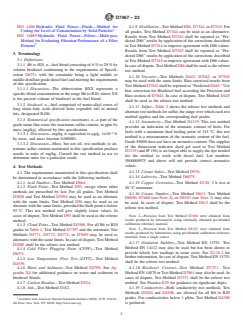
determine units for a particular result.
3000000975 and above will not provide correct aromatics
values.
4. Test Methods
4.1.13 Cetane Index—Test Method D976.
4.1 The requirements enumerated in this specification shall
4.1.14 Lubricity—Test Method D6079.
be determined in accordance with the following methods:
4.1.1 Acid Number—Test Method D664.
4.1.15 Copper Corrosion—Test Method D130, 3 h test at
4.1.2 Flash Point—Test Method D93, except where other
50 °C minimum.
methods are prescribed by law. For all grades, Test Method
4.1.16 Cetane Number—Test Method D613. Test Method
D3828 and Test Method D7094 may be used as an alternate
D6890, D7668 (see Note 2), or D8183 (see Note 3) may also
with the same limits. Test Method D56 may be used as an
be used. In cases of dispute, Test Method D613 shall be the
alternate with the same limits, provided the flash point is below
referee test method.
93 °C. This test method will give slightly lower values. In
cases of dispute, Test Method D93 shall be used as the referee NOTE 2—Precision from Test Method D7668 were obtained from
results produced by laboratories using externally obtained pre-blended
method.
calibration reference material.
4.1.3 Cloud Point—Test Method D2500. For all B6 to B20
NOTE 3—Precision from Test Method D8183 were obtained from
grades in Table 1, Test Method D7397 and the automatic Test
results produced by laboratories using pre-blended calibration reference
Methods D5771, D5772, D5773, or D7689 may be used as
materials from a single source.
alternates with the same limits. In case of dispute, Test Method
4.1.17 Oxidation Stability—Test Method EN 15751. Test
D2500 shall be the referee test method.
Method EN 14112 may also be used but has been shown to
4.1.4 Cold Filter Plugging Point (CFPP)—Test Method
provide falsely low readings in some cases. See X1.16.2 for
D6371.
further information. In case of dispute, Test Method EN 15751
4.1.5 Low Temperature Flow Test (LTFT)—Test Method
shall be the referee test method.
D4539.
4.1.18 Biodiesel Content—Test Method D7371. Test
4.1.6 Water and Sediment—Test Method D2709. See Ap-
Method EN 14078 or Test Method D7861 may also be used. In
pendix X4 for additional guidance on water and sediment in
biodiesel blends. cases of dispute, Test Method D7371 shall be the referee test
method. See Practice E29 for guidance on significant digits.
4.1.7 Carbon Residue—Test Method D524.
4.1.8 Ash—Test Method D482.
4.1.19 Conductivity—Both conductivity test methods, Test
Methods D2624 and D4308, are allowed for all B6 to B20
5 grades. For conductivities below 1 pS/m, Test Method D4308
Available from American National Standards Institute (ANSI), 25 W. 43rd St.,
4th Floor, New York, NY 10036, http://www.ansi.org. is preferred.
D7467 − 23
TABLE 1 Detailed Requirements for B6 to B20 Biodiesel Blends
Grade
Property Test Method
A B
B6 to B20 S15 B6 to B20 S500 B6 to B20 S5000
Acid Number, mg KOH/g, max D664 0.3 0.3 0.3
2 C C C
Viscosity, mm /s at 40 °C D445 1.9-4.1 1.9-4.1 1.9- 4.1
D D D
Flash Point, °C, min D93 52 52 52
E E E
Cloud Point, °C, max or LTFT/ D2500, D4539, D6371
CFPP, °C, max
F
Sulfur Content, (μg/g) D5453 15 . .
mass percent, max D2622 . 0.05 .
mass percent, max D129 . . 0.50
Distillation Temperature, °C, D86 343 343 343
90 % vol recovered, max
Ramsbottom Carbon Residue D524 0.35 0.35 0.35
on 10 % bottoms, mass %, max
G H H H
Cetane Number, min D613 40 40 40
I
One of the following must be D976-80 40 40 40
met:
(1) Cetane index, min.
J I
(2) Aromaticity, volume D1319 -03 35 35 .
percent, max
Ash Content, mass percent, D482 0.01 0.01 0.01
max
Water and Sediment, volume D2709 0.05 0.05 0.05
percent, max
Copper Corrosion, 3 h at 50 °C, D130 No. 3 No. 3 No. 3
max
Biodiesel Content, % (V/V) D7371 6. - 20. 6. - 20. 6. - 20.
Oxidation Stability, hours, min EN 15751 6 6 6
K K K
Lubricity, HFRR at 60 °C, mi- D6079 520 520 520
cron (μm), max
L L L
Conductivity (pS/m) or D2624/D4308 25 25 25
Conductivity Units (C.U.), min
A
Under United States of America regulations, if Grades B6-20 S500 are sold for tax exempt purposes then, at, or beyond terminal storage tanks, they are required by 26
CFR Part 48 to contain the dye Solvent Red 164 at a concentration spectrally equivalent to 3.9 lb of the solid dye standard Solvent Red 26 per thousand barrels of diesel
fuel or kerosine, or the tax must be collected.
B
Under United States of America regulations, Grades B6-20 S5000 are required by 40 CFR part 80 to contain a sufficient amount of the dye Solvent Red 164 so its
presence is visually apparent. At or beyond terminal storage tanks, they are required by 26 CFR Part 48 to contain the dye Solvent Red 164 at a concentration spectrally
equivalent to 3.9 lb of the solid dye standard Solvent Red 26 per thousand barrels of diesel fuel or kerosine.
C 2
If Grade No. 1-D or blends of Grade No. 1-D and Grade No. 2-D diesel fuel are used, the minimum viscosity shall be 1.3 mm /s.
D
If Grade No. 1-D or blends of Grade No. 1-D and Grade No. 2-D diesel fuel are used, or a cloud point of less than –12 °C is specified, the minimum flash point shall
be 38 °C.
E
It is unrealistic to specify low temperature properties that will ensure satisfactory operation at all ambient conditions. In general, cloud point Low Temperature Flow Test,
and Cold Filter Plugging Point Test may be useful to estimate vehicle low temperature operability limits but their use with B6 to B20 has not been validated. However,
satisfactory operation below the cloud point may be achieved depending on equipment design, operating conditions, and the use of flow-improver additives as described
in X3.1.2. Appropriate low temperature operability properties should be agreed upon between the fuel supplier and purchaser for the intended use and expected ambient
temperatures. Test Methods D4539 and D6371 may be especially useful to estimate vehicle low temperature operability limits when flow improvers are used but their use
with B6 to B20 from a full range of biodiesel feedstock sources has not been validated. Due to fuel delivery system, engine design, and test method differences, low
temperature operability tests may not provide the same degree of protection in various vehicle operating classes. Tenth percentile minimum air temperatures for U.S.
locations are provided in Appendix X3 as a means of estimating expected regional temperatures. The tenth percentile minimum air temperatures may be used to estimate
expected regional target temperatures for use with Test Methods D2500, D4539, and D6371. Refer to X3.1.3 for further general guidance on test application.
F
Other sulfur limits can apply in selected areas in the United States and in other countries.
G
Calculated cetane index approximation, Test Method D4737, is not applicable to biodiesel blends.
H
Low ambient temperatures, as well as engine operation at high altitudes, may require the use of fuels with higher cetane ratings. If the diesel fuel is qualified under Table 1
of Specification D975 for cetane, it is not necessary to measure the cetane number of the blend. This is because the cetane number of the individual blend components
will be at least 40, so the resulting blend will also be at least 40 cetane number.
I
These test methods are specified in 40 CFR Part 80.
J
See 4.1.12.
K
If the diesel fuel is qualified under Table 1 of Specification D975 for lubricity, it is not necessary to measure the lubricity of the blend. This is because the lubricity of the
individual blend components will be less than 520 μm so the resulting blend will also be less than 520 μm.
L
The electrical conductivity of the fuel oil is measured at the time and temperature of the fuel at delivery. The 25 pS/m minimum conductivity requirement applies at all
instances of high velocity transfer (7 m/s) but sometimes lower velocities, see 7.1 for detailed requirements) into mobile transport (for example, tanker trucks, rail cars,
and barges).
5. Workmanship 6. Requirements
6.1 The biodiesel blend (B6 to B20) specified shall conform
5.1 The biodiesel blend (B6 to B20) shall be visually free of
to the detailed requirements shown in Table 1.
undissolved water, sediment, and suspended matter.
6.1.1 For grade B6-B20 S15 the biodiesel component shall
5.2 The biodiesel blend (B6 to B20) shall also be free of any
be grade D6751 S15 LM, except as provided in 6.1.1.1.
adulterant or contaminant that may render the fuel unaccept-
6.1.1.1 Grade B6-B20 S15 fuels used in diesel engines that
able for its commonly used applications. do not have Selective Catalytic Reduction (SCR) or Diesel
D7467 − 23
TABLE 2 Sulfur Test Methods
A
Sulfur Test Method Range Grades Units Used to Report Results
D129 >0.1 % mass S5000 mass percent
(referee)
D1266 0.0005 % to 0.4 % mass S500 mass percent
5 mg ⁄kg to 4000 mg/kg (wt ppm)
D1552 >0.06 % mass S5000 mass percent
D2622 0.0003 % to 5.3 % mass all grades mass percent
(referee for S500 grades) 3 mg ⁄kg to 53 000 mg/kg (wt ppm)
D3120 3.0 mg ⁄kg to 100 mg/kg (wt ppm) S15, S500 ppm (μg/g)
(S500 grades must be diluted before
testing)
D4294 0.0150 % to 5.00 % mass S5000 mass percent
150 mg ⁄kg to 50 000 mg/kg (wt ppm)
D5453 0.0001 % to 0.8 % mass all grades ppm (μg/g)
(referee for S15 grades) 1.0 mg ⁄kg to 8000 mg/kg (wt ppm)
D7220 3.0 mg ⁄kg to 942 mg/kg (mass ppm) S15, S500 mass ppm (μg/g)
A
Results reported in mg/kg and in ppm (μg/g) are numerically the same. The units used in Table 1 for the sulfur requirements are the units in which results for the referee
test are reported.
Particulate Filter (DPF) aftertreatment technology may use of delivery shall apply when the transfer conditions in Table 3
biodiesel meeting grades ASTM D6751 S15 or S15 LM. exist for the delivery into a mobile transport container (for
example, tanker trucks, railcars, and barges).
7. Precautionary Notes on Conductivity
8. Keywords
7.1 Accumulation of static charge occurs when a hydrocar-
bon liquid flows with respect to another surface. The electrical 8.1 biodiesel; biodiesel blend; diesel; fuel oil; petroleum
conductivity requirement of 25 pS ⁄m minimum at temperature and petroleum products
TABLE 3 Transfer Conditions
Maximum Pipe Diameter (for a When Filling Tank Truck When Filling Undivided Rail Car When Filling Marine Vessels
distance of 30 s upstream of delivery Compartments Compartments
nozzle)
0.1023 m Fuel velocity $ 4.9 m/s Fuel velocity $ 7.0 m/s Fuel velocity $ 7.0 m/s
0.1541 m Fuel velocity $ 3.24 m/s Fuel velocity $ 5.20 m/s Fuel velocity $ 7.0 m/s
0.2027 m Fuel velocity $ 2.47 m/s Fuel velocity $ 3.90 m/s Fuel velocity $ 7.0 m/s
0.2545 m Fuel velocity $ 1.96 m/s Fuel velocity $ 3.14 m/s Fuel velocity $ 7.0 m/s
D7467 − 23
APPENDIXES
(Nonmandatory Information)
X1. SIGNIFICANCE OF ASTM SPECIFICATION FOR B6 to B20 BIODIESEL BLENDS
X1.1 Introduction emission control systems performance. To ensure maximum
availability of fuels, the permissible sulfur content should be
X1.1.1 The properties of commercial B6 to B20 blends
specified as high as is practicable, consistent with maintenance
depend on the refining practices employed and the nature of the
considerations and legal limits.
distillate fuel oils and biodiesel from which they are produced.
Distillate fuel oils, for example, may be produced within the
X1.7 Flash Point
boiling range of 150 °C and 400 °C having many possible
combinations of various properties, such as volatility, ignition X1.7.1 The flash point as specified is not directly related to
engine performance. It is, however, of importance in connec-
quality, viscosity, and other characteristics. Biodiesel, for
example, can be produced from a variety of animal fats or tion with legal requirements and safety precautions involved in
fuel handling and storage, and it is normally specified to meet
vegetable oils that produce similar volatility characteristics and
combustion emissions with varying cold flow properties. insurance and fire regulations.
X1.2 Cetane Number
X1.8 Cloud Point
X1.2.1 Cetane number is a measure of the ignition quality of
X1.8.1 Cloud point is of importance in that it defines the
the fuel and influences combustion roughness. The cetane
temperature at which a cloud or haze of wax crystals appears
number requirements depend on engine design, size, nature of
in the oil under prescribed test conditions that generally relates
speed and load variations, and on starting and atmospheric
to the temperature at which wax crystals begin to precipitate
conditions. Increase in cetane number over values actually
from the oil in use.
required does not materially improve engine performance.
Accordingly, the cetane number specified should be as low as
X1.9 Ash
possible to ensure maximum fuel availability.
X1.9.1 Ash-forming materials may be present in fuel oil in
three forms: (1) abrasive solids, (2) soluble metallic soaps, and
X1.3 Distillation
(3) unremoved biodiesel catalysts. Abrasive solids and unre-
X1.3.1 The fuel volatility requirements depend on engine
moved biodiesel catalysts contribute to injector, fuel pump,
design, size, nature of speed and load variations, and starting
piston and ring wear, and also to engine deposits. Soluble
and atmospheric conditions. For engines in services involving
metallic soaps have little effect on wear but may contribute to
rapidly fluctuating loads and speeds, as in bus and truck
engine deposits and filter clogging.
operation, the more volatile fuels may provide best
performance, particularly with respect to smoke and odor. The
X1.10 Copper Strip Corrosion
biodiesel portion of the B6 to B20 may also provide smoke and
X1.10.1 This test serves as a measure of possible difficulties
odor improvements. However, best fuel economy is generally
with copper and brass or bronze parts of the fuel system.
obtained from the heavier types of fuels because of their higher
heat content.
X1.11 Aromaticity
X1.4 Viscosity
X1.11.1 This test is used as an indication of the aromatics
content of diesel fuel. Aromatics content is specified to prevent
X1.4.1 For some engines it is advantageous to specify a
an increase in the average aromatics content in diesel fuels.
minimum viscosity because of power loss due to injection
Increases in aromatics content of fuels over current levels may
pump and injector leakage. Maximum viscosity, on the other
have a negative impact on emissions. Use of Test Method
hand, is limited by considerations involved in engine design
D1319-03 or cetane index, Test Method D976-80, is required
and size, and the characteristics of the injection system.
in the United States of America by 40 CFR Part 80. The
X1.5 Carbon Residue
precision and bias of Test Method D1319-03 with biodiesel
blends is not known and is currently under investigation.
X1.5.1 Carbon residue gives a measure of the carbon
depositing tendencies of a fuel oil when heated in a bulb under
X1.12 Cetane Index
prescribed conditions. While not directly correlating with
engine deposits, this property is considered an approximation.
X1.12.1 Cetane index is specified as a limitation on the
amount of high aromatic components in S15 and S500 Grades.
X1.6 Sulfur
Use of Test Method D1319-03 or cetane index, Test Method
X1.6.1 The effect of sulfur content on engine wear and D976-80, is required in the United States of America by 40
deposits appears to vary considerably in importance and CFR Part 80. The precision and bias of Test Method D976-80
depends largely on operating conditions. Fuel sulfur can affect with biodiesel blends is not known.
D7467 − 23
X1.13 Total and Free Glycerin X1.15.1.2 Because the microbes contributing to the afore-
mentioned problems are not necessarily present in the fuel
X1.13.1 High levels of total or free glycerin can cause
itself, no microbial quality criterion for fuels is recommended.
injector deposits and may adversely affect cold weather opera-
However, it is important that personnel responsible for fuel
tion and filter plugging and result in a buildup of material in the
quality understand how uncontrolled microbial contamination
bottom of storage and fueling systems. The total and free
can affect fuel quality.
glycerin levels are controlled by Specification D6751 to 0.24 %
X1.15.1.3 Guide D6469 provides personnel with limited
mass maximum and 0.02 % mass maximum, respectively.
microbiological background an understanding of the
Diesel fuel contains no total or free glycerin, so the level of
symptoms, occurrences, and consequences of microbial con-
total and free glycerin in a biodiesel blend is solely derived
tamination. Guide D6469 also suggests means for detecting
from the biodiesel contribution and is extremely low and in
and controlling microbial contamination in fuels and fuel
direct proportion to the level of biodiesel added and its total
systems. Good housekeeping, especially keeping fuel dry, is
and free glycerin values. In finished blends, the ability to
critical.
measure total and free glycerin is compromised by interference
with naturally occurring petroleum diesel fuel components and
X1.16 Oxidation Stability
the extremely low values. No ASTM test methods for measur-
X1.16.1 If the biodiesel is qualified under Table 1 of Speci-
ing total and free glycerin in blends currently exist, so no
fication D6751 for oxidation stability, it may not be necessary
specification for the finished B6 to B20 blend is included. If
to measure the oxidation stability of the blend. Existing data
test methods become available, the level of total and free
indicates the oxidation stability of B6 to B20 should be over
glycerin should not exceed the maximum contribution derived
6 h if the oxidation stability of the biodiesel is 3 h or higher at
from biodiesel based on the blend content and the maximum
the time of blending.
level allowed in Specification D6751.
X1.16.2 Special precautions may be necessary to eliminate
X1.14 Calcium and Magnesium, Sodium and Potassium,
falsely low readings using EN 14112 with biodiesel blends.
and Phosphorus Content
The petroleum portion of the blend may affect tubing between
X1.14.1 Calcium and magnesium combined and sodium
the reaction vessel and the measuring vessel and the plastic seal
and potassium combined are controlled to 5 ppm maximum in
on the top of the reaction vessel or condense in various parts of
Specification D6751. Phosphorus is controlled to 10 ppm
the test setup. Some of these parts may need to be replaced
maximum in Specification D6751. The presence of high levels
frequently, and all components should be thoroughly cleaned to
of these elements could adversely affect exhaust catalysts and
prevent falsely low readings. Improvements to these parts and
after-treatment systems. The concentration of these materials
changes in the test method have been incorporated into a
due to biodiesel in a B6 to B20 blends should be less than 1 or
revised method, EN 15751, which is the referee method. It is
2 ppm, making accurate measurement difficult. There are also
recommended that EN 15751 be utilized for measurement of
no controls for these materials in Specification D975 at present
biodiesel blend oxidation stability, because EN 14112 may be
and no available database for the potential contribution of these
withdrawn in the future as an option for testing biodiesel and
materials from petroleum based diesel fuel. Based on this, a
biodiesel blends.
specification for finished blends for these compounds has not
been established. If measured, the level of these materials
X1.17 Acid Number
should not exceed the maximum contribution derived from
X1.17.1 The acid number is used to determine the level of
biodiesel based on the blend content and the maximum level
free fatty acids or processing acids that may be present in the
allowed in Specification D6751 and the contribution of the
biodiesel or diesel fuel oil when produced, or those which form
petroleum based diesel fuel.
upon aging. Biodiesel blends with a high acid number have
X1.15 Other
been shown to increase fueling system deposits and may
increase the likelihood for corrosion.
X1.15.1 Microbial Contamination:
X1.15.1.1 Uncontrolled microbial contamination in fuel
systems can cause or contribute to a variety of problems,
McCormick, R. L., and Westbrook, S. R., “Empirical Study of the Stability of
including increased corrosivity and decreased stability,
Biodiesel and Biodiesel Blends, Milestone Report,” NREL/TP-540-41619, National
filterability, and caloric value. Microbial processes in fuel
Renewable Energy Laboratory, Golden, Colorado, May 2007. http://www.nrel.gov/
systems can also cause or contribute to system damage. docs/fy07osti/41619.pdf.
D7467 − 23
X2. STORAGE AND THERMAL STABILITY OF B6 TO B20 BLENDS
X2.1 Scope X2.2.4 long-term storage, n—storage of fuel for longer than
six months after it is received by the user.
X2.1.1 This appendix provides guidance for consumers of
X2.2.5 severe use, n—use of the fuel in applications which
B6 to B20 who may wish to store quantities of fuels for
extended periods or use the fuel in severe service or high may result in engines operating under high load conditions that
may cause the fuel to be exposed to excessive heat.
temperature applications. Fuels containing residual compo-
nents are excluded. Consistently successful long-term fuel
X2.3 Fuel Selection
storage or use in severe applications requires attention to fuel
selection, storage conditions, handling and monitoring of
X2.3.1 Certain distilled refinery and biodiesel products are
properties during storage and prior to use.
generally more suitable for long-term storage and severe
service than others. The stability properties of B6 to B20
X2.1.2 Normally produced fuels have adequate stability
blends are highly dependent on the crude oil sources, severity
properties to withstand normal storage and use without the
of processing, use of additives and whether additional refinery
formation of troublesome amounts of insoluble degradation
treatment has been carried out.
products although data suggests some B6 to B20 blends may
degrade faster than petrodiesel. Fuels that are to be stored for X2.3.2 The composition and stability properties of B6 to
prolonged periods or used in severe applications should be
B20 produced at specific refineries or blending locations may
selected to avoid formation of sediments or gums, high acid be different. Any special requirements of the user, such as
numbers, or high viscosity which can overload filters or plug
long-term storage or severe service, should be discussed with
injectors. Selection of these fuels should result from supplier- the supplier.
user discussions.
X2.3.3 Blends of fuels from various sources may interact to
give stability properties worse than expected based on the
X2.1.3 These suggested practices are general in nature and
should not be considered substitutes for any requirements characteristics of the individual fuels.
imposed by the warranty of the distillate fuel equipment
X2.4 Fuel Additives
manufacturer or by federal, state, or local government regula-
tions. Although they cannot replace a knowledge of local
X2.4.1 Available fuel additives can improve the suitability
conditions or good engineering and scientific judgment, these
of marginal fuels for long-term storage and thermal stability,
suggested practices do provide guidance in developing an
but may be unsuccessful for fuels with markedly poor stability
individual fuel management system for the B6 to B20 fuel user.
properties. Most additives should be added at the refinery or
They include suggestions in the operation and maintenance of
during the early weeks of storage to obtain maximum benefits.
existing fuel storage and handling facilities and for identifying
X2.4.2 Biocides or biostats destroy or inhibit the growth of
where, when, and how fuel quality should be monitored or
fungi and bacteria, which can grow at fuel-water interfaces to
selected for storage or severe use.
give high particulate concentrations in the fuel. Available
biocides are soluble in both the fuel and water or in the water
X2.2 Definitions
phase only.
X2.2.1 bulk fuel, n—fuel in the storage facility in quantities
X2.5 Tests for Fuel Quality
over 50 gal.
X2.5.1 At the time of manufacture, the storage stability of
X2.2.2 fuel contaminants, n—foreign materials that make
B6 to B20 may be assessed using Test Method EN 14112.
fuel less suitable or unsuitable for the intended use.
Other tests methods are under development. However, these
X2.2.2.1 Discussion—Fuel contaminants include materials
accelerated stability tests may not correlate well with field
introduced subsequent to the manufacture of fuel and fuel
storage stability due to varying field conditions and to fuel
degradation products.
composition.
X2.2.3 fuel-degradation products, n—those materials that
X2.5.2 Performance criteria for accelerated stability tests
are formed in fuel during extended storage or exposure to high
that ensure satisfactory long-term storage of fuels have not
temperatures.
been established.
X2.2.3.1 Discussion—Insoluble degradation products may
X2.5.3 Test Method D6468 provides an indication of ther-
combine with other fuel contaminants to reinforce deleterious
mal oxidative stability of middle distillate fuels when heated to
effects. Soluble degradation products (soluble gums) are less
temperatures near 150 °C.
volatile than fuel and may carbonize to form deposits due to
complex interactions and oxidation of small amounts of
X2.6 Fuel Monitoring
olefinic or sulfur-, oxygen-, or nitrogen-contaminating com-
pounds present in fuels. The formation of degradation products X2.6.1 A plan for monitoring the quality of bulk fuel during
may be catalyzed by dissolved metals, especially copper salts. prolonged storage is an integral part of a successful program. A
When dissolved copper is present it can be deactivated with plan to replace aged fuel with fresh product at established
metal deactivator additives. intervals is also desirable.
D7467 − 23
X2.6.2 Stored fuel should be periodically sampled and its temperature stability can be a necessary requirement in some
quality assessed. Practice D4057 provides guidance for sam- severe applications or types of service.
pling. Fuel contaminants and degradation products will usually
X2.8.2 Inadequate high temperature stability may result in
settle to the bottom of a quiescent tank. A “Bottom” or
the formation of insoluble degradation products.
“Clearance” sample, as defined in Practice D4057, should be
included in the evaluation along with an “All Level” sample. X2.9 Use of Degraded Fuels
X2.6.3 The quantity of insoluble fuel contaminants present
X2.9.1 Fuels that have undergone mild-to-moderate degra-
in fuel can be determined using Test Method D6217 although dation can sometimes be consumed in a normal way, depend-
no precision or bias testing has been performed with B6 to B20
ing on the fuel system requirements. Filters and other cleanup
blends. equipment can require special attention and increased mainte-
nance. Burner nozzle or injector fouling can occur more
X2.6.4 Test Method D6468 can be used for investigation of
rapidly.
operational problems that might be related to fuel thermal
stability. Testing samples from the fuel tank or from bulk
X2.9.2 Fuels containing very large quantities of fuel degra-
storage may give an indication as to the cause of filter
dation products and other contaminants or with runaway
plugging. It is more difficult to monitor the quality of fuels in
microbiological growth require special attention. Consultation
vehicle tanks since operation may be on fuels from multiple
with experts in this area is desirable. It can be possible to drain
sources.
the sediment or draw off most of the fuel above the sediment
layer and use it with the precautions described in X2.9.1.
X2.6.5 Some additives exhibit effects on fuels tested in
However, very high soluble gum levels or corrosion products
accordance with Test Method D6468 that may or may not be
from microbiological contamination can cause severe opera-
observed in the field. Data have not been developed that
tional problems.
correlate results from the test method for various engine types
and levels of operating severity.
X2.10 Thermal Stability Guidelines
X2.6.6 Ongoing monitoring of the acid number is a useful
X2.10.1 Results from truck fleet experience suggests that
means of monitoring oxidation or degradation of biodiesel
Test Method D6468 can be used to qualitatively indicate
blends.
whether diesel fuels have satisfactory thermal stability perfor-
7,8
mance properties.
X2.7 Fuel Storage Conditions
X2.10.2 Performance in engines has not been sufficiently
X2.7.1 Contamination levels in fuel can be reduced by
correlated with results from Test Method D6468 to provide
storage in tanks kept free of water, and tankage should have
definitive specification requirements. However, the following
provisions for water draining on a scheduled basis. Water
guidelines are suggested.
promotes corrosion, and microbiological growth may occur at
X2.10.2.1 Fuels giving a Test Method D6468 reflectance
a fuel-water interface. Refer to Guide D6469 for a more
value of 70 % or more in a 90 min test at the time of
complete discussion. Underground storage is preferred to avoid
manufacture should give satisfactory performance in normal
temperature extremes; above-ground storage tanks should be
use.
sheltered or painted with reflective paint. High storage tem-
X2.10.2.2 Fuels giving a Test Method D6468 reflectance
peratures accelerate fuel degradation. Fixed roof tanks should
value of 80 % or more in a 180 min test at the time of
be kept full to limit oxygen supply and tank breathing.
manufacture should give satisfactory performance in severe
X2.7.2 Copper and copper-containing alloys should be
use.
avoided. Copper can promote fuel degradation and may pro-
X2.10.3 Thermal stability as determined by Test Method
duce mercaptide gels. Zinc coatings can react with water or
D6468 is known to degrade during storage. The guidance
organic acids in the fuel to form gels that rapidly plug filters.
under X2.10 is for fuels used within six months of manufac-
X2.7.3 Appendix X2 of Specification D2880 discusses fuel
ture.
contaminants as a general topic.
X2.8 Fuel Use Conditions
Bacha, John D., and Lesnini, David G., “Diesel Fuel Thermal Stability at
300°F,” Proceedings of the 6th International Conference on Stability and Handling
X2.8.1 Many diesel engines are designed so that the diesel
of Liquid Fuels, Vancouver, B.C., October 1997.
fuel is used for heat transfer. In modern heavy-duty diesel
Schwab, Scott D., Henly, Timothy J., Moxley, Joel F., and Miller, Keith,
“Thermal Stability of Diesel Fuel,” Proceedings of the 7th International Conference
engines, for example, only a portion of the fuel that is
on Stability and Handling of Liquid Fuels, Graz, Austria, September 2000.
circulated to the fuel injectors is actually delivered to the
Henry, C. P., “ The du Pont F21 149 °C(300 °F)Accelerated Stability Test,”
combustion chamber. The remainder of the fuel is circulated
Distillate Fuel Stability and Cleanliness, ASTM STP 751, Stavinoha, L. L., Henry,
back to the fuel tank, carrying heat with it. Thus adequate high C. P., editors, ASTM International, W. Conshohocken, PA, 1981, pp. 22-33.
D7467 − 23
X3. TENTH PERCENTILE M
...
This document is not an ASTM standard and is intended only to provide the user of an ASTM standard an indication of what changes have been made to the previous version. Because
it may not be technically possible to adequately depict all changes accurately, ASTM recommends that users consult prior editions as appropriate. In all cases only the current version
of the standard as published by ASTM is to be considered the official document.
Designation: D7467 − 20a D7467 − 23
Standard Specification for
Diesel Fuel Oil, Biodiesel Blend (B6 to B20)
This standard is issued under the fixed designation D7467; the number immediately following the designation indicates the year of
original adoption or, in the case of revision, the year of last revision. A number in parentheses indicates the year of last reapproval. A
superscript epsilon (´) indicates an editorial change since the last revision or reapproval.
1. Scope*
1.1 This specification covers fuel blend grades of 6 volume percent to 20 volume percent (%) 6 % to 20 % by volume biodiesel
with the remainder being a light middle or middle distillate diesel fuel, collectively designated as B6 to B20. These grades are
suitable for various types of diesel engines.
1.1.1 The biodiesel component of the blend shall conform to the requirements of Specification D6751. For grade B6-B20 S15 the
biodiesel component shall be grade D6751 S15 LM, except as allowed under 6.1.1.1 for S15 fuels used in diesel engines without
Selective Catalytic Reduction (SCR) or Diesel Particulate Filter (DPF) aftertreatment technology. The remainder of the fuel shall
be a light middle or middle distillate grade diesel fuel conforming to Specification D975 grades No. 1-D and No. 2-D of any sulfur
level specified with the following exceptions. The light middle or middle distillate grade diesel fuel whose sulfur level, aromatic
level, cetane, or lubricity falls outside of Specification D975 may be blended with biodiesel meeting Specification D6751, provided
the finished mixtures meets this specification.
1.1.2 The fuel sulfur grades are described as follows:
1.1.2.1 Grade B6 to B20 S15—A fuel with a maximum of 15 ppm sulfur.
1.1.2.2 Grade B6 to B20 S500—A fuel with a maximum of 500 ppm sulfur.
1.1.2.3 Grade B6 to B20 S5000—A fuel with a maximum of 5000 ppm sulfur.
1.2 This specification prescribes the required properties of B6 to B20 biodiesel blends at the time and place of delivery. The
specification requirements may be applied at other points in the production and distribution system when provided by agreement
between the purchaser and the supplier.
1.2.1 Nothing in this specification shall preclude observance of federal, state, or local regulations that may be more restrictive.
NOTE 1—The generation and dissipation of static electricity can create problems in the handling of distillate diesel fuel oils. For more information on this
subject, see Guide D4865.
1.3 The values stated in SI units are to be regarded as standard. No other units of measurement are included in this standard.
1.4 This international standard was developed in accordance with internationally recognized principles on standardization
established in the Decision on Principles for the Development of International Standards, Guides and Recommendations issued
by the World Trade Organization Technical Barriers to Trade (TBT) Committee.
This specification is under the jurisdiction of ASTM Committee D02 on Petroleum Products, Liquid Fuels, and Lubricants and is the direct responsibility of Subcommittee
D02.E0 on Burner, Diesel, Diesel and Non-Aviation Gas Turbine, and Marine Turbine Fuels.
Current edition approved June 1, 2020Oct. 1, 2023. Published June 2020October 2023. Originally approved in 2008. Last previous edition approved in 2020 as
D7467 – 20.D7467 – 20a. DOI: 10.1520/D7467-20A.10.1520/D7467-23.
*A Summary of Changes section appears at the end of this standard
Copyright © ASTM International, 100 Barr Harbor Drive, PO Box C700, West Conshohocken, PA 19428-2959. United States
D7467 − 23
2. Referenced Documents
2.1 ASTM Standards:
D56 Test Method for Flash Point by Tag Closed Cup Tester
D86 Test Method for Distillation of Petroleum Products and Liquid Fuels at Atmospheric Pressure
D93 Test Methods for Flash Point by Pensky-Martens Closed Cup Tester
D129 Test Method for Sulfur in Petroleum Products (General High Pressure Decomposition Device Method)
D130 Test Method for Corrosiveness to Copper from Petroleum Products by Copper Strip Test
D445 Test Method for Kinematic Viscosity of Transparent and Opaque Liquids (and Calculation of Dynamic Viscosity)
D482 Test Method for Ash from Petroleum Products
D524 Test Method for Ramsbottom Carbon Residue of Petroleum Products
D613 Test Method for Cetane Number of Diesel Fuel Oil
D664 Test Method for Acid Number of Petroleum Products by Potentiometric Titration
D975 Specification for Diesel Fuel
D976 Test Method for Calculated Cetane Index of Distillate Fuels
D1266 Test Method for Sulfur in Petroleum Products (Lamp Method)
D1319 Test Method for Hydrocarbon Types in Liquid Petroleum Products by Fluorescent Indicator Adsorption
D1552 Test Method for Sulfur in Petroleum Products by High Temperature Combustion and Infrared (IR) Detection or Thermal
Conductivity Detection (TCD)
D2500 Test Method for Cloud Point of Petroleum Products and Liquid Fuels
D2622 Test Method for Sulfur in Petroleum Products by Wavelength Dispersive X-ray Fluorescence Spectrometry
D2624 Test Methods for Electrical Conductivity of Aviation and Distillate Fuels
D2709 Test Method for Water and Sediment in Middle Distillate Fuels by Centrifuge
D2880 Specification for Gas Turbine Fuel Oils
D3120 Test Method for Trace Quantities of Sulfur in Light Liquid Petroleum Hydrocarbons by Oxidative Microcoulometry
D3828 Test Methods for Flash Point by Small Scale Closed Cup Tester
D4057 Practice for Manual Sampling of Petroleum and Petroleum Products
D4294 Test Method for Sulfur in Petroleum and Petroleum Products by Energy Dispersive X-ray Fluorescence Spectrometry
D4308 Test Method for Electrical Conductivity of Liquid Hydrocarbons by Precision Meter
D4539 Test Method for Filterability of Diesel Fuels by Low-Temperature Flow Test (LTFT)
D4737 Test Method for Calculated Cetane Index by Four Variable Equation
D4865 Guide for Generation and Dissipation of Static Electricity in Petroleum Fuel Systems
D5453 Test Method for Determination of Total Sulfur in Light Hydrocarbons, Spark Ignition Engine Fuel, Diesel Engine Fuel,
and Engine Oil by Ultraviolet Fluorescence
D5771 Test Method for Cloud Point of Petroleum Products and Liquid Fuels (Optical Detection Stepped Cooling Method)
D5772 Test Method for Cloud Point of Petroleum Products and Liquid Fuels (Linear Cooling Rate Method)
D5773 Test Method for Cloud Point of Petroleum Products and Liquid Fuels (Constant Cooling Rate Method)
D6079 Test Method for Evaluating Lubricity of Diesel Fuels by the High-Frequency Reciprocating Rig (HFRR)
D6217 Test Method for Particulate Contamination in Middle Distillate Fuels by Laboratory Filtration
D6304 Test Method for Determination of Water in Petroleum Products, Lubricating Oils, and Additives by Coulometric Karl
Fischer Titration
D6371 Test Method for Cold Filter Plugging Point of Diesel and Heating Fuels
D6468 Test Method for High Temperature Stability of Middle Distillate Fuels
D6469 Guide for Microbial Contamination in Fuels and Fuel Systems
D6751 Specification for Biodiesel Fuel Blendstock (B100) for Middle Distillate Fuels
D6890 Test Method for Determination of Ignition Delay and Derived Cetane Number (DCN) of Diesel Fuel Oils by Combustion
in a Constant Volume Chamber
D7042 Test Method for Dynamic Viscosity and Density of Liquids by Stabinger Viscometer (and the Calculation of Kinematic
Viscosity)
D7094 Test Method for Flash Point by Modified Continuously Closed Cup (MCCCFP) Tester
D7220 Test Method for Sulfur in Automotive, Heating, and Jet Fuels by Monochromatic Energy Dispersive X-ray Fluorescence
Spectrometry
D7344 Test Method for Distillation of Petroleum Products and Liquid Fuels at Atmospheric Pressure (Mini Method)
D7345 Test Method for Distillation of Petroleum Products and Liquid Fuels at Atmospheric Pressure (Micro Distillation
Method)
For referenced ASTM standards, visit the ASTM website, www.astm.org, or contact ASTM Customer Service at service@astm.org. For Annual Book of ASTM Standards
volume information, refer to the standard’s Document Summary page on the ASTM website.
D7467 − 23
D7371 Test Method for Determination of Biodiesel (Fatty Acid Methyl Esters) Content in Diesel Fuel Oil Using Mid Infrared
Spectroscopy (FTIR-ATR-PLS Method)
D7397 Test Method for Cloud Point of Petroleum Products and Liquid Fuels (Miniaturized Optical Method)
D7619 Test Method for Sizing and Counting Particles in Light and Middle Distillate Fuels, by Automatic Particle Counter
D7668 Test Method for Determination of Derived Cetane Number (DCN) of Diesel Fuel Oils—Ignition Delay and Combustion
Delay Using a Constant Volume Combustion Chamber Method
D7689 Test Method for Cloud Point of Petroleum Products and Liquid Fuels (Mini Method)
D7861 Test Method for Determination of Fatty Acid Methyl Esters (FAME) in Diesel Fuel by Linear Variable Filter (LVF) Array
Based Mid-Infrared Spectroscopy
D7945 Test Method for Determination of Dynamic Viscosity and Derived Kinematic Viscosity of Liquids by Constant Pressure
Viscometer
D8183 Test Method for Determination of Indicated Cetane Number (ICN) of Diesel Fuel Oils using a Constant Volume
Combustion Chamber—Reference Fuels Calibration Method
E29 Practice for Using Significant Digits in Test Data to Determine Conformance with Specifications
E1064 Test Method for Water in Organic Liquids by Coulometric Karl Fischer Titration
2.2 Other Standards:
26 CFR Part 48 Manufacturers and Retailers Excise Taxes
40 CFR Part 80 Regulation of Fuels and Fuel Additives
EN 14078 Liquid Petroleum Products—Determination of Fatty Acid Methyl Ester (FAME) Content in Middle Distillates—
Infrared Spectrometry Method
EN 14112 Fat and Oil Derivatives—Fatty Acid Methyl Esters (FAME)—Determination of Oxidation Stability (Accelerated
Oxidation Test)
EN 15751 Automotive Fuels—Fatty Acid Methyl Ester (FAME) Fuel and Blends with Diesel Fuel—Determination of Oxidation
Stability by Accelerated Oxidation Method
ISO 4406 Hydraulic Fluid Power—Fluids—Method for Coding the Level of Contamination by Solid Particles
ISO 16889 Hydraulic Fluid Power—Filters—Multi-pass Method for Evaluating Filtration Performance of a Filter Element
3. Terminology
3.1 Definitions:
3.1.1 B6 to B20, n—fuel blend consisting of 6 volume percent to 20 volume percent 6 % to 20 % by volume biodiesel conforming
to the requirements of Specification D6751 with the remainder being a light middle or middle distillate grade diesel fuel and
meeting the requirements of this specification.
3.1.1.1 Discussion—
The abbreviation BXX represents a specific blend concentration in the range B6 to B20, where XX is the percent volume of
biodiesel in the fuel blend.
3.1.2 biodiesel, n—fuel comprised of mono-alkyl esters of long chain fatty acids derived from vegetable oils or animal fats,
designated B100.
3.1.3 S(numerical specification maximum), n—a part of the grade name that states the maximum sulfur content, in ppm by mass
(mg/kg), allowed by this specification.
3.1.3.1 Discussion—
-4
mg/kg is equivalent to μg/g, 1×10 % by mass, and mass fraction 0.000001.
3.1.3.2 Discussion—
Most, but not all, test methods to determine sulfur content mentioned in this specification produce results in units of mg/kg. Consult
the test method in use to determine units for a particular result.
4. Test Methods
4.1 The requirements enumerated in this specification shall be determined in accordance with the following methods:
4.1.1 Acid Number—Test Method D664.
Available from U.S. Government Printing Office Superintendent of Documents, 732 N. Capitol St., NW, Mail Stop: SDE, Washington, DC 20401.
Available from the National CEN members listed on the CEN website (www.cenorm.be.) or from the CEN/TC 19 Secretariat (astm@nen.nl).
Available from American National Standards Institute (ANSI), 25 W. 43rd St., 4th Floor, New York, NY 10036, http://www.ansi.org.
D7467 − 23
4.1.2 Flash Point—Test Method D93, except where other methods are prescribed by law. For all grades, Test Method D3828 and
Test Method D7094 may be used as an alternate with the same limits. Test Method D56 may be used as an alternate with the same
limits, provided the flash point is below 93 °C. This test method will give slightly lower values. In cases of dispute, Test Method
D93 shall be used as the referee method.
4.1.3 Cloud Point—Test Method D2500. For all B6 to B20 grades in Table 1, Test Method D7397 and the automatic Test Methods
D5771, D5772, D5773, or D7689 may be used as alternates with the same limits. In case of dispute, Test Method D2500 shall be
the referee test method.
TABLE 1 Detailed Requirements for B6 to B20 Biodiesel Blends
Grade
Property Test Method
A B
B6 to B20 S15 B6 to B20 S500 B6 to B20 S5000
Acid Number, mg KOH/g, max D664 0.3 0.3 0.3
2 C C C
Viscosity, mm /s at 40 °C D445 1.9-4.1 1.9-4.1 1.9- 4.1
D D D
Flash Point, °C, min D93 52 52 52
E E E
Cloud Point, °C, max or LTFT/ D2500, D4539, D6371
CFPP, °C, max
F
Sulfur Content, (μg/g) D5453 15 . .
mass percent, max D2622 . 0.05 .
mass percent, max D129 . . 0.50
Distillation Temperature, °C, D86 343 343 343
90 % vol recovered, max
Ramsbottom Carbon Residue D524 0.35 0.35 0.35
on 10 % bottoms, mass %, max
G H H H
Cetane Number, min D613 40 40 40
I
One of the following must be D976-80 40 40 40
met:
(1) Cetane index, min.
J I
(2) Aromaticity, volume D1319 -03 35 35 .
percent, max
Ash Content, mass percent, D482 0.01 0.01 0.01
max
Water and Sediment, volume D2709 0.05 0.05 0.05
percent, max
Copper Corrosion, 3 h at 50 °C, D130 No. 3 No. 3 No. 3
max
Biodiesel Content, % (V/V) D7371 6. - 20. 6. - 20. 6. - 20.
Oxidation Stability, hours, min EN 15751 6 6 6
K K K
Lubricity, HFRR at 60 °C, mi- D6079 520 520 520
cron (μm), max
L L L
Conductivity (pS/m) or D2624/D4308 25 25 25
Conductivity Units (C.U.), min
A
Under United States of America regulations, if Grades B6-20 S500 are sold for tax exempt purposes then, at, or beyond terminal storage tanks, they are required by 26
CFR Part 48 to contain the dye Solvent Red 164 at a concentration spectrally equivalent to 3.9 lb of the solid dye standard Solvent Red 26 per thousand barrels of diesel
fuel or kerosine, or the tax must be collected.
B
Under United States of America regulations, Grades B6-20 S5000 are required by 40 CFR part 80 to contain a sufficient amount of the dye Solvent Red 164 so its
presence is visually apparent. At or beyond terminal storage tanks, they are required by 26 CFR Part 48 to contain the dye Solvent Red 164 at a concentration spectrally
equivalent to 3.9 lb of the solid dye standard Solvent Red 26 per thousand barrels of diesel fuel or kerosine.
C 2
If Grade No. 1-D or blends of Grade No. 1-D and Grade No. 2-D diesel fuel are used, the minimum viscosity shall be 1.3 mm /s.
D
If Grade No. 1-D or blends of Grade No. 1-D and Grade No. 2-D diesel fuel are used, or a cloud point of less than –12 °C is specified, the minimum flash point shall
be 38 °C.
E
It is unrealistic to specify low temperature properties that will ensure satisfactory operation at all ambient conditions. In general, cloud point Low Temperature Flow Test,
and Cold Filter Plugging Point Test may be useful to estimate vehicle low temperature operability limits but their use with B6 to B20 has not been validated. However,
satisfactory operation below the cloud point may be achieved depending on equipment design, operating conditions, and the use of flow-improver additives as described
in X3.1.2. Appropriate low temperature operability properties should be agreed upon between the fuel supplier and purchaser for the intended use and expected ambient
temperatures. Test Methods D4539 and D6371 may be especially useful to estimate vehicle low temperature operability limits when flow improvers are used but their use
with B6 to B20 from a full range of biodiesel feedstock sources has not been validated. Due to fuel delivery system, engine design, and test method differences, low
temperature operability tests may not provide the same degree of protection in various vehicle operating classes. Tenth percentile minimum air temperatures for U.S.
locations are provided in Appendix X3 as a means of estimating expected regional temperatures. The tenth percentile minimum air temperatures may be used to estimate
expected regional target temperatures for use with Test Methods D2500, D4539, and D6371. Refer to X3.1.3 for further general guidance on test application.
F
Other sulfur limits can apply in selected areas in the United States and in other countries.
G
Calculated cetane index approximation, Test Method D4737, is not applicable to biodiesel blends.
H
Low ambient temperatures, as well as engine operation at high altitudes, may require the use of fuels with higher cetane ratings. If the diesel fuel is qualified under Table 1
of Specification D975 for cetane, it is not necessary to measure the cetane number of the blend. This is because the cetane number of the individual blend components
will be at least 40, so the resulting blend will also be at least 40 cetane number.
I
These test methods are specified in 40 CFR Part 80.
J
See 4.1.12.
K
If the diesel fuel is qualified under Table 1 of Specification D975 for lubricity, it is not necessary to measure the lubricity of the blend. This is because the lubricity of the
individual blend components will be less than 520 μm so the resulting blend will also be less than 520 μm.
L
The electrical conductivity of the fuel oil is measured at the time and temperature of the fuel at delivery. The 25 pS/m minimum conductivity requirement applies at all
instances of high velocity transfer (7 m/s) but sometimes lower velocities, see 7.1 for detailed requirements) into mobile transport (for example, tanker trucks, rail cars,
and barges).
D7467 − 23
4.1.4 Cold Filter Plugging Point (CFPP)—Test Method D6371.
4.1.5 Low Temperature Flow Test (LTFT)—Test Method D4539.
4.1.6 Water and Sediment—Test Method D2709. See Appendix X4 for additional guidance on water and sediment in biodiesel
blends.
4.1.7 Carbon Residue—Test Method D524.
4.1.8 Ash—Test Method D482.
4.1.9 Distillation—Test Method D86, D7344, or D7345. For all grades, Test Method D7344 can be used as an alternative. Results
from Test Method D7344 shall be reported as “Predicted D86” results by application of the corrections described in Test Method
D7344 to improve agreement with D86 values. Results from Test Method D7345 shall be reported as “Predicted D86” results by
application of the corrections described in Test Method D7345 to improve agreement with D86 values. In case of dispute, Test
Method D86 shall be used as the referee test method.
4.1.10 Viscosity—Test Methods D445, D7042, or D7945 may be used with the same limits. Bias-corrected results from Test
Method D7042 shall be reported as “Predicted D445.” Use bias correction for Biodiesel fuel according the Precision and Bias
section of D7042. In case of dispute, Test Method D445 shall be used as the referee test method.
4.1.11 Sulfur—Table 2 shows the referee test methods and alternate test methods for sulfur, the range over which each test method
applies and the corresponding fuel grades.
4.1.12 Aromaticity—Test Method D1319. This test method provides an indication of the aromatic content of fuels. For fuels with
a maximum final boiling point of 315 °C, this test method is a measurement of the aromatic content of the fuel. Grade S5000 does
not have an aromatics content. The supplier of the fluorescent indicator dyed gel used in Test Method D1319 (and IP 156) is no
longer able to supply the dye needed for the method to work with diesel fuel. Lot numbers 3000000975 and above will not provide
correct aromatics values.
4.1.13 Cetane Index—Test Method D976.
4.1.14 Lubricity—Test Method D6079.
4.1.15 Copper Corrosion—Test Method D130, 3 h test at 50 °C minimum.
4.1.16 Cetane Number—Test Method D613. Test Method D6890, D7668 (see Note 2), or D8183 (see Note 3) may also be used.
In cases of dispute, Test Method D613 shall be the referee test method.
TABLE 2 Sulfur Test Methods
A
Sulfur Test Method Range Grades Units Used to Report Results
D129 >0.1 % mass S5000 mass percent
(referee)
D1266 0.0005 % to 0.4 % mass S500 mass percent
5 mg ⁄kg to 4000 mg/kg (wt ppm)
D1552 >0.06 % mass S5000 mass percent
D2622 0.0003 % to 5.3 % mass all grades mass percent
(referee for S500 grades) 3 mg ⁄kg to 53 000 mg/kg (wt ppm)
D3120 3.0 mg ⁄kg to 100 mg/kg (wt ppm) S15, S500 ppm (μg/g)
(S500 grades must be diluted before
testing)
D4294 0.0150 % to 5.00 % mass S5000 mass percent
150 mg ⁄kg to 50 000 mg/kg (wt ppm)
D5453 0.0001 % to 0.8 % mass all grades ppm (μg/g)
(referee for S15 grades) 1.0 mg ⁄kg to 8000 mg/kg (wt ppm)
D7220 3.0 mg ⁄kg to 942 mg/kg (mass ppm) S15, S500 mass ppm (μg/g)
A
Results reported in mg/kg and in ppm (μg/g) are numerically the same. The units used in Table 1 for the sulfur requirements are the units in which results for the referee
test are reported.
D7467 − 23
NOTE 2—Precision from Test Method D7668 were obtained from results produced by laboratories using externally obtained pre-blended calibration
reference material.
NOTE 3—Precision from Test Method D8183 were obtained from results produced by laboratories using pre-blended calibration reference materials from
a single source.
4.1.17 Oxidation Stability—Test Method EN 15751. Test Method EN 14112 may also be used but has been shown to provide
falsely low readings in some cases. See X1.16.2 for further information. In case of dispute, Test Method EN 15751 shall be the
referee test method.
4.1.18 Biodiesel Content—Test Method D7371. Test Method EN 14078 or Test Method D7861 may also be used. In cases of
dispute, Test Method D7371 shall be the referee test method. See Practice E29 for guidance on significant digits.
4.1.19 Conductivity—Both conductivity test methods, Test Methods D2624 and D4308, are allowed for all B6 to B20 grades. For
conductivities below 1 pS/m, Test Method D4308 is preferred.
5. Workmanship
5.1 The biodiesel blend (B6 to B20) shall be visually free of undissolved water, sediment, and suspended matter.
5.2 The biodiesel blend (B6 to B20) shall also be free of any adulterant or contaminant that may render the fuel unacceptable for
its commonly used applications.
6. Requirements
6.1 The biodiesel blend (B6 to B20) specified shall conform to the detailed requirements shown in Table 1.
6.1.1 For grade B6-B20 S15 the biodiesel component shall be grade D6751 S15 LM, except as provided in 6.1.1.1.
6.1.1.1 Grade B6-B20 S15 fuels used in diesel engines that do not have Selective Catalytic Reduction (SCR) or Diesel Particulate
Filter (DPF) aftertreatment technology may use biodiesel meeting grades ASTM D6751 S15 or S15 LM.
7. Precautionary Notes on Conductivity
7.1 Accumulation of static charge occurs when a hydrocarbon liquid flows with respect to another surface. The electrical
conductivity requirement of 25 pS ⁄m minimum at temperature of delivery shall apply when the transfer conditions in Table 3 exist
for the delivery into a mobile transport container (for example, tanker trucks, railcars, and barges).
8. Keywords
8.1 biodiesel; biodiesel blend; diesel; fuel oil; petroleum and petroleum products
TABLE 3 Transfer Conditions
Maximum Pipe Diameter (for a When Filling Tank Truck When Filling Undivided Rail Car When Filling Marine Vessels
distance of 30 s upstream of delivery Compartments Compartments
nozzle)
0.1023 m Fuel velocity $ 4.9 m/s Fuel velocity $ 7.0 m/s Fuel velocity $ 7.0 m/s
0.1541 m Fuel velocity $ 3.24 m/s Fuel velocity $ 5.20 m/s Fuel velocity $ 7.0 m/s
0.2027 m Fuel velocity $ 2.47 m/s Fuel velocity $ 3.90 m/s Fuel velocity $ 7.0 m/s
0.2545 m Fuel velocity $ 1.96 m/s Fuel velocity $ 3.14 m/s Fuel velocity $ 7.0 m/s
D7467 − 23
APPENDIXES
(Nonmandatory Information)
X1. SIGNIFICANCE OF ASTM SPECIFICATION FOR B6 to B20 BIODIESEL BLENDS
X1.1 Introduction
X1.1.1 The properties of commercial B6 to B20 blends depend on the refining practices employed and the nature of the distillate
fuel oils and biodiesel from which they are produced. Distillate fuel oils, for example, may be produced within the boiling range
of 150 °C and 400 °C having many possible combinations of various properties, such as volatility, ignition quality, viscosity, and
other characteristics. Biodiesel, for example, can be produced from a variety of animal fats or vegetable oils that produce similar
volatility characteristics and combustion emissions with varying cold flow properties.
X1.2 Cetane Number
X1.2.1 Cetane number is a measure of the ignition quality of the fuel and influences combustion roughness. The cetane number
requirements depend on engine design, size, nature of speed and load variations, and on starting and atmospheric conditions.
Increase in cetane number over values actually required does not materially improve engine performance. Accordingly, the cetane
number specified should be as low as possible to ensure maximum fuel availability.
X1.3 Distillation
X1.3.1 The fuel volatility requirements depend on engine design, size, nature of speed and load variations, and starting and
atmospheric conditions. For engines in services involving rapidly fluctuating loads and speeds, as in bus and truck operation, the
more volatile fuels may provide best performance, particularly with respect to smoke and odor. The biodiesel portion of the B6
to B20 may also provide smoke and odor improvements. However, best fuel economy is generally obtained from the heavier types
of fuels because of their higher heat content.
X1.4 Viscosity
X1.4.1 For some engines it is advantageous to specify a minimum viscosity because of power loss due to injection pump and
injector leakage. Maximum viscosity, on the other hand, is limited by considerations involved in engine design and size, and the
characteristics of the injection system.
X1.5 Carbon Residue
X1.5.1 Carbon residue gives a measure of the carbon depositing tendencies of a fuel oil when heated in a bulb under prescribed
conditions. While not directly correlating with engine deposits, this property is considered an approximation.
D7467 − 23
X1.6 Sulfur
X1.6.1 The effect of sulfur content on engine wear and deposits appears to vary considerably in importance and depends largely
on operating conditions. Fuel sulfur can affect emission control systems performance. To ensure maximum availability of fuels,
the permissible sulfur content should be specified as high as is practicable, consistent with maintenance considerations and legal
limits.
X1.7 Flash Point
X1.7.1 The flash point as specified is not directly related to engine performance. It is, however, of importance in connection with
legal requirements and safety precautions involved in fuel handling and storage, and it is normally specified to meet insurance and
fire regulations.
X1.8 Cloud Point
X1.8.1 Cloud point is of importance in that it defines the temperature at which a cloud or haze of wax crystals appears in the oil
under prescribed test conditions that generally relates to the temperature at which wax crystals begin to precipitate from the oil
in use.
X1.9 Ash
X1.9.1 Ash-forming materials may be present in fuel oil in three forms: (1) abrasive solids, (2) soluble metallic soaps, and (3)
unremoved biodiesel catalysts. Abrasive solids and unremoved biodiesel catalysts contribute to injector, fuel pump, piston and ring
wear, and also to engine deposits. Soluble metallic soaps have little effect on wear but may contribute to engine deposits and filter
clogging.
X1.10 Copper Strip Corrosion
X1.10.1 This test serves as a measure of possible difficulties with copper and brass or bronze parts of the fuel system.
X1.11 Aromaticity
X1.11.1 This test is used as an indication of the aromatics content of diesel fuel. Aromatics content is specified to prevent an
increase in the average aromatics content in diesel fuels. Increases in aromatics content of fuels over current levels may have a
negative impact on emissions. Use of Test Method D1319-03 or cetane index, Test Method D976-80, is required in the United
States of America by 40 CFR Part 80. The precision and bias of Test Method D1319-03 with biodiesel blends is not known and
is currently under investigation.
D7467 − 23
X1.12 Cetane Index
X1.12.1 Cetane index is specified as a limitation on the amount of high aromatic components in S15 and S500 Grades. Use of
Test Method D1319-03 or cetane index, Test Method D976-80, is required in the United States of America by 40 CFR Part 80.
The precision and bias of Test Method D976-80 with biodiesel blends is not known.
X1.13 Total and Free Glycerin
X1.13.1 High levels of total or free glycerin can cause injector deposits and may adversely affect cold weather operation and filter
plugging and result in a buildup of material in the bottom of storage and fueling systems. The total and free glycerin levels are
controlled by Specification D6751 to 0.24 % mass maximum and 0.02 % mass maximum, respectively. Diesel fuel contains no
total or free glycerin, so the level of total and free glycerin in a biodiesel blend is solely derived from the biodiesel contribution
and is extremely low and in direct proportion to the level of biodiesel added and its total and free glycerin values. In finished
blends, the ability to measure total and free glycerin is compromised by interference with naturally occurring petroleum diesel fuel
components and the extremely low values. No ASTM test methods for measuring total and free glycerin in blends currently exist,
so no specification for the finished B6 to B20 blend is included. If test methods become available, the level of total and free
glycerin should not exceed the maximum contribution derived from biodiesel based on the blend content and the maximum level
allowed in Specification D6751.
X1.14 Calcium and Magnesium, Sodium and Potassium, and Phosphorus Content
X1.14.1 Calcium and magnesium combined and sodium and potassium combined are controlled to 5 ppm maximum in
Specification D6751. Phosphorus is controlled to 10 ppm maximum in Specification D6751. The presence of high levels of these
elements could adversely affect exhaust catalysts and after-treatment systems. The concentration of these materials due to biodiesel
in a B6 to B20 blends should be less than 1 or 2 ppm, making accurate measurement difficult. There are also no controls for these
materials in Specification D975 at present and no available database for the potential contribution of these materials from
petroleum based diesel fuel. Based on this, a specification for finished blends for these compounds has not been established. If
measured, the level of these materials should not exceed the maximum contribution derived from biodiesel based on the blend
content and the maximum level allowed in Specification D6751 and the contribution of the petroleum based diesel fuel.
X1.15 Other
X1.15.1 Microbial Contamination:
X1.15.1.1 Uncontrolled microbial contamination in fuel systems can cause or contribute to a variety of problems, including
increased corrosivity and decreased stability, filterability, and caloric value. Microbial processes in fuel systems can also cause or
contribute to system damage.
X1.15.1.2 Because the microbes contributing to the aforementioned problems are not necessarily present in the fuel itself, no
microbial quality criterion for fuels is recommended. However, it is important that personnel responsible for fuel quality
understand how uncontrolled microbial contamination can affect fuel quality.
X1.15.1.3 Guide D6469 provides personnel with limited microbiological background an understanding of the symptoms,
D7467 − 23
occurrences, and consequences of microbial contamination. Guide D6469 also suggests means for detecting and controlling
microbial contamination in fuels and fuel systems. Good housekeeping, especially keeping fuel dry, is critical.
X1.16 Oxidation Stability
X1.16.1 If the biodiesel is qualified under Table 1 of Specification D6751 for oxidation stability, it may not be necessary to
measure the oxidation stability of the blend. Existing data indicates the oxidation stability of B6 to B20 should be over 6 h if the
oxidation stability of the biodiesel is 3 h or higher at the time of blending.
X1.16.2 Special precautions may be necessary to eliminate falsely low readings using EN 14112 with biodiesel blends. The
petroleum portion of the blend may affect tubing between the reaction vessel and the measuring vessel and the plastic seal on the
top of the reaction vessel or condense in various parts of the test setup. Some of these parts may need to be replaced frequently,
and all components should be thoroughly cleaned to prevent falsely low readings. Improvements to these parts and changes in the
test method have been incorporated into a revised method, EN 15751, which is the referee method. It is recommended that EN
15751 be utilized for measurement of biodiesel blend oxidation stability, because EN 14112 may be withdrawn in the future as
an option for testing biodiesel and biodiesel blends.
X1.17 Acid Number
X1.17.1 The acid number is used to determine the level of free fatty acids or processing acids that may be present in the biodiesel
or diesel fuel oil when produced, or those which form upon aging. Biodiesel blends with a high acid number have been shown
to increase fueling system deposits and may increase the likelihood for corrosion.
X2. STORAGE AND THERMAL STABILITY OF B6 TO B20 BLENDS
X2.1 Scope
X2.1.1 This appendix provides guidance for consumers of B6 to B20 who may wish to store quantities of fuels for extended
periods or use the fuel in severe service or high temperature applications. Fuels containing residual components are excluded.
Consistently successful long-term fuel storage or use in severe applications requires attention to fuel selection, storage conditions,
handling and monitoring of properties during storage and prior to use.
X2.1.2 Normally produced fuels have adequate stability properties to withstand normal storage and use without the formation of
troublesome amounts of insoluble degradation products although data suggests some B6 to B20 blends may degrade faster than
petrodiesel. Fuels that are to be stored for prolonged periods or used in severe applications should be selected to avoid formation
of sediments or gums, high acid numbers, or high viscosity which can overload filters or plug injectors. Selection of these fuels
should result from supplier-user discussions.
X2.1.3 These suggested practices are general in nature and should not be considered substitutes for any requirements imposed by
the warranty of the distillate fuel equipment manufacturer or by federal, state, or local government regulations. Although they
cannot replace a knowledge of local conditions or good engineering and scientific judgment, these suggested practices do provide
guidance in developing an individual fuel management system for the B6 to B20 fuel user. They include suggestions in the
McCormick, R. L., and Westbrook, S. R., “Empirical Study of the Stability of Biodiesel and Biodiesel Blends, Milestone Report,” NREL/TP-540-41619, National
Renewable Energy Laboratory, Golden, Colorado, May 2007. http://www.nrel.gov/docs/fy07osti/41619.pdf.
D7467 − 23
operation and maintenance of existing fuel storage and handling facilities and for identifying where, when, and how fuel quality
should be monitored or selected for storage or severe use.
X2.2 Definitions
X2.2.1 bulk fuel—fuel, n—fuel in the storage facility in quantities over 50 gal.
X2.2.2 fuel contaminants—contaminants, n—foreign materials that make fuel less suitable or unsuitable for the intended use.
X2.2.2.1 Discussion Discussion—
Fuel contaminants include materials introduced subsequent to the manufacture of fuel and fuel degradation products.
X2.2.3 fuel-degradation products—products, n—those materials that are formed in fuel during extended storage or exposure to
high temperatures.
X2.2.3.1 Discussion—Insoluble degradation products may combine with other fuel contaminants to reinforce deleterious effects.
Soluble degradation products (soluble gums) are less volatile than fuel and may carbonize to form deposits due to complex
interactions and oxidation of small amounts of olefinic or sulfur-, oxygen-, or nitrogen-contaminating compounds present in fuels.
The formation of degradation products may be catalyzed by dissolved metals, especially copper salts. When dissolved copper is
present it can be deactivated with metal deactivator additives.
X2.2.4 long-term storage—storage, n—storage of fuel for longer than six months after it is received by the user.
X2.2.5 severe use—use, n—use of the fuel in applications which may result in engines operating under high load conditions that
may cause the fuel to be exposed to excessive heat.
X2.3 Fuel Selection
X2.3.1 Certain distilled refinery and biodiesel products are generally more suitable for long-term storage and severe service than
others. The stability properties of B6 to B20 blends are highly dependent on the crude oil sources, severity of processing, use of
additives and whether additional refinery treatment has been carried out.
X2.3.2 The composition and stability properties of B6 to B20 produced at specific refineries or blending locations may be
different. Any special requirements of the user, such as long-term storage or severe service, should be discussed with the supplier.
X2.3.3 Blends of fuels from various sources may interact to give stability properties worse than expected based on the
characteristics of the individual fuels.
X2.4 Fuel Additives
D7467 − 23
X2.4.1 Available fuel additives can improve the suitability of marginal fuels for long-term storage and thermal stability, but may
be unsuccessful for fuels with markedly poor stability properties. Most additives should be added at the refinery or during the early
weeks of storage to obtain maximum benefits.
X2.4.2 Biocides or biostats destroy or inhibit the growth of fungi and bacteria, which can grow at fuel-water interfaces to give
high particulate concentrations in the fuel. Available biocides are soluble in both the fuel and water or in the water phase only.
X2.5 Tests for Fuel Quality
X2.5.1 At the time of manufacture, the storage stability of B6 to B20 may be assessed using Test Method EN 14112. Other tests
methods are under development. However, these accelerated stability tests may not correlate well with field storage stability due
to varying field conditions and to fuel composition.
X2.5.2 Performance criteria for accelerated stability tests that ensure satisfactory long-term storage of fuels have not been
established.
X2.5.3 Test Method D6468 provides an indication of thermal oxidative stability of middle distillate fuels when heated to
temperatures near 150 °C.
X2.6 Fuel Monitoring
X2.6.1 A plan for monitoring the quality of bulk fuel during prolonged storage is an integral part of a successful program. A plan
to replace aged fuel with fresh product at established intervals is also desirable.
X2.6.2 Stored fuel should be periodically sampled and its quality assessed. Practice D4057 provides guidance for sampling. Fuel
contaminants and degradation products will usually settle to the bottom of a quiescent tank. A “Bottom” or “Clearance” sample,
as defined in Practice D4057, should be included in the evaluation along with an “All Level” sample.
X2.6.3 The quantity of insoluble fuel contaminants present in fuel can be determined using Test Method D6217 although no
precision or bias testing has been performed with B6 to B20 blends.
X2.6.4 Test Method D6468 can be used for investigation of operational problems that might be related to fuel thermal stability.
Testing samples from the fuel tank or from bulk storage may give an indication as to the cause of filter plugging. It is more difficult
to monitor the quality of fuels in vehicle tanks since operation may be on fuels from multiple sources.
X2.6.5 Some additives exhibit effects on fuels tested in accordance with Test Method D6468 that may or may not be observed
in the field. Data have not been developed that correlate results from the test method for various engine types and levels of
operating severity.
X2.6.6 Ongoing monitoring of the acid number is a useful means of monitoring oxidation or degradation of biodiesel blends.
D7467 − 23
X2.7 Fuel Storage Conditions
X2.7.1 Contamination levels in fuel can be reduced by storage in tanks kept free of water, and tankage should have provisions
for water draining on a scheduled basis. Water promotes corrosion, and microbiological growth may occur at a fuel-water interface.
Refer to Guide D6469 for a more complete discussion. Underground storage is preferred to avoid temperature extremes;
above-ground storage tanks should be sheltered or painted with reflective paint. High storage temperatures accelerate fuel
degradation. Fixed roof tanks should be kept full to limit oxygen supply and tank breathing.
X2.7.2 Copper and copper-containing alloys should be avoided. Copper can promote fuel degradation and may produce
mercaptide gels. Zinc coatings can react with water or organic acids in the fuel to form gels that rapidly plug filters.
X2.7.3 Appendix X2 of Specification D2880 discusses fuel contaminants as a general topic.
X2.8 Fuel Use Conditions
X2.8.1 Many diesel engines are designed so that the diesel fuel is used for heat transfer. In modern heavy-duty diesel engines, for
example, only a portion of the fuel that is circulated to the fuel injectors is actually delivered to the combustion chamber. The
remainder of the fuel is circulated back to the fuel tank, carrying heat with it. Thus adequate high temperature stability can be a
necessary requirement in some severe applications or types of service.
X2.8.2 Inadequate high temperature stability may result in the formation of insoluble degradation products.
X2.9 Use of Degraded Fuels
X2.9.1 Fuels that have undergone mild-to-moderate degradation can sometimes be consumed in a normal way, depending on the
fuel system requirements. Filters and other cleanup equipment can require special attention and increased maintenance. Burner
nozzle or injector fouling can occur more rapidly.
X2.9.2 Fuels containing very large quantities of fuel degradation products and other contaminants or with runaway microbio-
logical growth require special attention. Consultation with experts in this area is desirable. It can be possible to drain the sediment
or draw off most of the fuel above the sediment layer and use it with the precautions described in X2.9.1. However, very high
soluble gum levels or corrosion products from microbiological contamination can cause severe operational problems.
X2.10 Thermal Stability Guidelines
X2.10.1 Results from truck fleet experience suggests that Test Method D6468 can be used to qualitatively indicate whether diesel
7,8
fuels have satisfactory thermal stability performance properties.
Bacha, John D., and Lesnini, David G., “Diesel Fuel Thermal Stability at 300°F,” Proceedings of the 6th International Conference on Stability and Handling of Liquid
Fuels, Vancouver, B.C., October 1997.
D7467 − 23
X2.10.2 Performance in engines has not been sufficiently correlated with results from Test Method D6468 to provide definitive
specification requirements. However, the following guidelines are suggested.
X2.10.2.1 Fuels giving a Test Method D6468 reflectance value of 70 % or more in a 90 min test at the time of manufacture should
give satisfactory performance in normal use.
X2.10.2.2 Fuels giving a Test Method D6468 reflectance value of 80 % or more in a 180 min test at the time of manufacture should
give satisfactory performance in severe use.
X2.10.3 Thermal stability as determined by Test Method D6468 is known to degrade during storage. The guidance under X2.1
...