

ASTM D2549-23
(Test Method)Standard Test Method for Separation of Representative Aromatics and Nonaromatics Fractions of High-Boiling Oils by Elution Chromatography
General Information
- Abstract
SIGNIFICANCE AND USE
5.1 The determination of compound types by mass spectrometry requires, in some instances, a preliminary separation of the petroleum sample into representative aromatics and nonaromatics fractions, as in Test Methods D2425, D2786, and D3239. This test method provides a suitable separation technique for this application.
SCOPE
1.1 This test method covers the separation and determination of representative aromatics and nonaromatics fractions from hydrocarbon mixtures that boil between 232 °C and 538 °C (450 °F and 1000 °F). Alternative procedures are provided for the separation of 2 g or 10 g of hydrocarbon mixture.
Note 1: Some components may not be eluted from the chromatographic column for some types of samples under the conditions used in this method.
Note 2: Test Method D2007 is an alternative method of separating high-boiling oils into polar compounds, aromatics, and saturates fractions.
1.2 An alternative procedure is provided to handle samples boiling below 232 °C (450 °F), but whose 5 % point is above 178 °C (350 °F) as determined by Test Method D2887. This procedure is given in Appendix X1.
1.3 The values stated in acceptable SI units are to be regarded as the standard. The values given in parentheses are provided for information purposes only.
1.4 This standard does not purport to address all of the safety concerns, if any, associated with its use. It is the responsibility of the user of this standard to establish appropriate safety, health, and environmental practices and determine the applicability of regulatory limitations prior to use.
1.5 This international standard was developed in accordance with internationally recognized principles on standardization established in the Decision on Principles for the Development of International Standards, Guides and Recommendations issued by the World Trade Organization Technical Barriers to Trade (TBT) Committee.
- Status
- Published
- Publication Date
- 28-Feb-2023
- Technical Committee
- D02 - Petroleum Products, Liquid Fuels, and Lubricants
- Drafting Committee
- D02.04.0C - Liquid Chromatography
Buy Documents
ASTM D2549-23 - Standard Test Method for Separation of Representative Aromatics and Nonaromatics Fractions of High-Boiling Oils by Elution Chromatography
REDLINE ASTM D2549-23 - Standard Test Method for Separation of Representative Aromatics and Nonaromatics Fractions of High-Boiling Oils by Elution Chromatography
Overview
ASTM D2549-23: Standard Test Method for Separation of Representative Aromatics and Nonaromatics Fractions of High-Boiling Oils by Elution Chromatography is a widely recognized method for separating and quantitatively determining aromatics and nonaromatics in high-boiling hydrocarbon mixtures. Developed by ASTM, this standard provides an effective approach to fractionate petroleum samples, especially those with boiling points between 232°C and 538°C (450°F and 1000°F). The procedure facilitates accurate compound-type analysis, often used as a preparatory step before advanced analytical techniques like mass spectrometry.
Key Topics
- Separation by Elution Chromatography: Uses a chromatographic column packed with activated bauxite and silica gel to separate aromatics and nonaromatics based on their chemical properties and solubility in selected solvents.
- Sample Applicability: Designed primarily for hydrocarbon mixtures within the specified boiling range. An alternative appendix method addresses lighter samples with 5% distillation points above 178°C (350°F) and below 232°C (450°F).
- Procedure Variability: Accommodates different sample sizes (2 g and 10 g), enabling flexibility in laboratory workflows for varying analytical needs.
- Preparation for Mass Spectrometry: Supplies critical sample preparation for compound type determination in Test Methods such as ASTM D2425, D2786, and D3239.
- Safety Considerations: Recommends strict adherence to safety, health, and environmental protocols due to the hazardous nature of solvents and chemicals involved.
Applications
ASTM D2549-23 is employed across various industries and laboratory settings where precise separation of hydrocarbon fractions is needed:
- Petroleum Refining and Processing: Facilitates quality control and research by distinguishing between aromatic and nonaromatic content in high-boiling oils, helping to predict product performance and regulatory compliance.
- Analytical Chemistry Laboratories: Provides key preparatory steps for detailed compound-type analysis using mass spectrometry, enabling more accurate characterization of complex mixtures.
- Fuel and Lubricant Formulation: Used to analyze feedstock purity, ingredient composition, and blending constituents in fuels, lubricants, and rubber processing oils.
- Environmental and Regulatory Testing: Supports identification and quantification of petroleum components in environmental samples, crucial for compliance, monitoring, and remediation efforts.
Related Standards
A number of ASTM standards are related or referenced within ASTM D2549-23, providing complementary methods and terminologies in petroleum analysis:
- ASTM D2425: Test Method for Hydrocarbon Types in Middle Distillates by Mass Spectrometry.
- ASTM D2786: Test Method for Hydrocarbon Type Analysis of Gas-Oil Saturates Fractions by High Ionizing Voltage Mass Spectrometry.
- ASTM D2887: Test Method for Boiling Range Distribution of Petroleum Fractions by Gas Chromatography.
- ASTM D2007: Alternative separation method for high-boiling oils into polar compounds, aromatics, and saturates, using the clay-gel absorption chromatographic method.
- ASTM D3239: Test Method for Aromatic Types Analysis of Gas-Oil Aromatic Fractions by Mass Spectrometry.
- ASTM D4175: Terminology relating to petroleum products, liquid fuels, and lubricants.
Practical Value
Adoption of ASTM D2549-23 streamlines petroleum fractionation, enhances analytical precision, and supports rigorous compound type determinations necessary for product development, regulatory compliance, and environmental stewardship. By ensuring reproducibility and consistency, laboratories can reliably prepare samples for advanced analysis, contributing to innovation, safety, and quality in the petroleum industry.
Keywords: ASTM D2549-23, elution chromatography, aromatics fraction, nonaromatics fraction, high-boiling oils, petroleum analysis, hydrocarbon separation, mass spectrometry preparation, analytical standards.
Relations
- Effective Date
- 01-Mar-2024
- Refers
ASTM D4175-23a - Standard Terminology Relating to Petroleum Products, Liquid Fuels, and Lubricants - Effective Date
- 15-Dec-2023
- Effective Date
- 01-Dec-2023
- Effective Date
- 01-Jul-2023
- Refers
ASTM D4175-23e1 - Standard Terminology Relating to Petroleum Products, Liquid Fuels, and Lubricants - Effective Date
- 01-Jul-2023
- Effective Date
- 15-Dec-2019
- Effective Date
- 01-Jul-2019
- Effective Date
- 01-Oct-2017
- Effective Date
- 01-Oct-2016
- Effective Date
- 01-Jul-2015
- Effective Date
- 01-May-2013
- Effective Date
- 01-Nov-2012
- Effective Date
- 01-Oct-2011
- Effective Date
- 01-Oct-2011
- Effective Date
- 01-May-2011
Buy Documents
ASTM D2549-23 - Standard Test Method for Separation of Representative Aromatics and Nonaromatics Fractions of High-Boiling Oils by Elution Chromatography
REDLINE ASTM D2549-23 - Standard Test Method for Separation of Representative Aromatics and Nonaromatics Fractions of High-Boiling Oils by Elution Chromatography
Get Certified
Connect with accredited certification bodies for this standard

Element Materials Technology
Materials testing and product certification.

ABS Group Brazil
ABS Group certification services in Brazil.

ABS Quality Evaluations Inc.
American Bureau of Shipping quality certification.
Sponsored listings
Frequently Asked Questions
ASTM D2549-23 is a standard published by ASTM International. Its full title is "Standard Test Method for Separation of Representative Aromatics and Nonaromatics Fractions of High-Boiling Oils by Elution Chromatography". This standard covers: SIGNIFICANCE AND USE 5.1 The determination of compound types by mass spectrometry requires, in some instances, a preliminary separation of the petroleum sample into representative aromatics and nonaromatics fractions, as in Test Methods D2425, D2786, and D3239. This test method provides a suitable separation technique for this application. SCOPE 1.1 This test method covers the separation and determination of representative aromatics and nonaromatics fractions from hydrocarbon mixtures that boil between 232 °C and 538 °C (450 °F and 1000 °F). Alternative procedures are provided for the separation of 2 g or 10 g of hydrocarbon mixture. Note 1: Some components may not be eluted from the chromatographic column for some types of samples under the conditions used in this method. Note 2: Test Method D2007 is an alternative method of separating high-boiling oils into polar compounds, aromatics, and saturates fractions. 1.2 An alternative procedure is provided to handle samples boiling below 232 °C (450 °F), but whose 5 % point is above 178 °C (350 °F) as determined by Test Method D2887. This procedure is given in Appendix X1. 1.3 The values stated in acceptable SI units are to be regarded as the standard. The values given in parentheses are provided for information purposes only. 1.4 This standard does not purport to address all of the safety concerns, if any, associated with its use. It is the responsibility of the user of this standard to establish appropriate safety, health, and environmental practices and determine the applicability of regulatory limitations prior to use. 1.5 This international standard was developed in accordance with internationally recognized principles on standardization established in the Decision on Principles for the Development of International Standards, Guides and Recommendations issued by the World Trade Organization Technical Barriers to Trade (TBT) Committee.
SIGNIFICANCE AND USE 5.1 The determination of compound types by mass spectrometry requires, in some instances, a preliminary separation of the petroleum sample into representative aromatics and nonaromatics fractions, as in Test Methods D2425, D2786, and D3239. This test method provides a suitable separation technique for this application. SCOPE 1.1 This test method covers the separation and determination of representative aromatics and nonaromatics fractions from hydrocarbon mixtures that boil between 232 °C and 538 °C (450 °F and 1000 °F). Alternative procedures are provided for the separation of 2 g or 10 g of hydrocarbon mixture. Note 1: Some components may not be eluted from the chromatographic column for some types of samples under the conditions used in this method. Note 2: Test Method D2007 is an alternative method of separating high-boiling oils into polar compounds, aromatics, and saturates fractions. 1.2 An alternative procedure is provided to handle samples boiling below 232 °C (450 °F), but whose 5 % point is above 178 °C (350 °F) as determined by Test Method D2887. This procedure is given in Appendix X1. 1.3 The values stated in acceptable SI units are to be regarded as the standard. The values given in parentheses are provided for information purposes only. 1.4 This standard does not purport to address all of the safety concerns, if any, associated with its use. It is the responsibility of the user of this standard to establish appropriate safety, health, and environmental practices and determine the applicability of regulatory limitations prior to use. 1.5 This international standard was developed in accordance with internationally recognized principles on standardization established in the Decision on Principles for the Development of International Standards, Guides and Recommendations issued by the World Trade Organization Technical Barriers to Trade (TBT) Committee.
ASTM D2549-23 is classified under the following ICS (International Classification for Standards) categories: 75.080 - Petroleum products in general. The ICS classification helps identify the subject area and facilitates finding related standards.
ASTM D2549-23 has the following relationships with other standards: It is inter standard links to ASTM D2007-19(2024)e1, ASTM D4175-23a, ASTM D2425-23, ASTM D2887-23, ASTM D4175-23e1, ASTM D2007-19, ASTM D2887-19, ASTM D2425-17, ASTM D2007-11(2016), ASTM D2887-15, ASTM D2887-13, ASTM D2887-12, ASTM D2786-91(2011), ASTM D3239-91(2011), ASTM D2007-11. Understanding these relationships helps ensure you are using the most current and applicable version of the standard.
ASTM D2549-23 is available in PDF format for immediate download after purchase. The document can be added to your cart and obtained through the secure checkout process. Digital delivery ensures instant access to the complete standard document.
Standards Content (Sample)
This international standard was developed in accordance with internationally recognized principles on standardization established in the Decision on Principles for the
Development of International Standards, Guides and Recommendations issued by the World Trade Organization Technical Barriers to Trade (TBT) Committee.
Designation: D2549 − 23
Standard Test Method for
Separation of Representative Aromatics and Nonaromatics
Fractions of High-Boiling Oils by Elution Chromatography
This standard is issued under the fixed designation D2549; the number immediately following the designation indicates the year of
original adoption or, in the case of revision, the year of last revision. A number in parentheses indicates the year of last reapproval. A
superscript epsilon (´) indicates an editorial change since the last revision or reapproval.
1. Scope* D2007 Test Method for Characteristic Groups in Rubber
Extender and Processing Oils and Other Petroleum-
1.1 This test method covers the separation and determina-
Derived Oils by the Clay-Gel Absorption Chromato-
tion of representative aromatics and nonaromatics fractions
graphic Method
from hydrocarbon mixtures that boil between 232 °C and
D2425 Test Method for Hydrocarbon Types in Middle Dis-
538 °C (450 °F and 1000 °F). Alternative procedures are pro-
tillates by Mass Spectrometry
vided for the separation of 2 g or 10 g of hydrocarbon mixture.
D2786 Test Method for Hydrocarbon Types Analysis of
NOTE 1—Some components may not be eluted from the chromato-
Gas-Oil Saturates Fractions by High Ionizing Voltage
graphic column for some types of samples under the conditions used in
Mass Spectrometry
this method.
D2887 Test Method for Boiling Range Distribution of Pe-
NOTE 2—Test Method D2007 is an alternative method of separating
high-boiling oils into polar compounds, aromatics, and saturates fractions. troleum Fractions by Gas Chromatography
D3239 Test Method for Aromatic Types Analysis of Gas-Oil
1.2 An alternative procedure is provided to handle samples
Aromatic Fractions by High Ionizing Voltage Mass Spec-
boiling below 232 °C (450 °F), but whose 5 % point is above
trometry
178 °C (350 °F) as determined by Test Method D2887. This
D4175 Terminology Relating to Petroleum Products, Liquid
procedure is given in Appendix X1.
Fuels, and Lubricants
1.3 The values stated in acceptable SI units are to be
regarded as the standard. The values given in parentheses are
3. Terminology
provided for information purposes only.
3.1 Definitions:
1.4 This standard does not purport to address all of the
3.1.1 For definitions of terms used in this test method, refer
safety concerns, if any, associated with its use. It is the
to Terminology D4175.
responsibility of the user of this standard to establish appro-
3.2 Definitions of Terms Specific to This Standard:
priate safety, health, and environmental practices and deter-
mine the applicability of regulatory limitations prior to use. 3.2.1 aromatics fraction, n—the portion of the sample
1.5 This international standard was developed in accor- desorbed with the polar eluants. The aromatics fraction may
dance with internationally recognized principles on standard- contain aromatics, condensed naphthenic-aromatics, aromatic
ization established in the Decision on Principles for the olefins, and compounds containing sulfur, nitrogen, and oxy-
Development of International Standards, Guides and Recom- gen atoms.
mendations issued by the World Trade Organization Technical
3.2.2 nonaromatics fraction, n—the portion of the sample
Barriers to Trade (TBT) Committee.
eluted with n-pentane. The nonaromatics fraction is a mixture
of paraffinic and naphthenic hydrocarbons if the sample is a
2. Referenced Documents
straight-run material. If the sample is a cracked stock, the
2.1 ASTM Standards:
nonaromatics fraction will also contain aliphatic and cyclic
olefins.
This test method is under the jurisdiction of ASTM Committee D02 on
4. Summary of Test Method
Petroleum Products, Liquid Fuels, and Lubricants and is the direct responsibility of
Subcommittee D02.04.0C on Liquid Chromatography.
4.1 A weighed amount of sample is charged to the top of a
Current edition approved March 1, 2023. Published March 2023. Originally
glass chromatographic column packed with activated bauxite
approved in 1966. Last previous edition approved in 2017 as D2549 – 02 (2017).
DOI: 10.1520/D2549-23.
and silica gel. n-Pentane is added to the column to elute the
For referenced ASTM standards, visit the ASTM website, www.astm.org, or
nonaromatics. When all of the nonaromatics are eluted, the
contact ASTM Customer Service at service@astm.org. For Annual Book of ASTM
aromatics fraction is eluted by additions of diethyl ether,
Standards volume information, refer to the standard’s Document Summary page on
the ASTM website. chloroform, and ethyl alcohol.
*A Summary of Changes section appears at the end of this standard
Copyright © ASTM International, 100 Barr Harbor Drive, PO Box C700, West Conshohocken, PA 19428-2959. United States
D2549 − 23
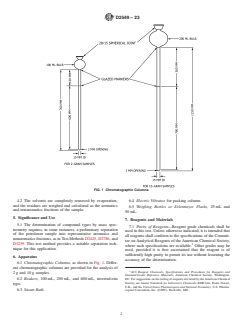
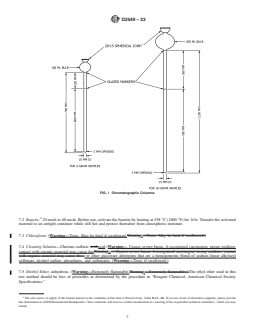
FIG. 1 Chromatographic Columns
4.2 The solvents are completely removed by evaporation, 6.4 Electric Vibrator, for packing column.
and the residues are weighed and calculated as the aromatics
6.5 Weighing Bottles or Erlenmeyer Flasks, 25 mL and
and nonaromatics fractions of the sample.
50 mL.
5. Significance and Use
7. Reagents and Materials
5.1 The determination of compound types by mass spec-
7.1 Purity of Reagents—Reagent grade chemicals shall be
trometry requires, in some instances, a preliminary separation
used in this test. Unless otherwise indicated, it is intended that
of the petroleum sample into representative aromatics and
all reagents shall conform to the specifications of the Commit-
nonaromatics fractions, as in Test Methods D2425, D2786, and
tee on Analytical Reagents of the American Chemical Society,
D3239. This test method provides a suitable separation tech- 3
where such specifications are available. Other grades may be
nique for this application.
used, provided it is first ascertained that the reagent is of
sufficiently high purity to permit its use without lessening the
6. Apparatus
accuracy of the determination.
6.1 Chromatographic Columns, as shown in Fig. 1. Differ-
ent chromatographic columns are provided for the analysis of
ACS Reagent Chemicals, Specifications and Procedures for Reagents and
2 g and 10 g samples.
Standard-Grade Reference Materials, American Chemical Society, Washington,
6.2 Beakers, 100 mL, 250 mL, and 600 mL, inverted-rim DC. For suggestions on the testing of reagents not listed by the American Chemical
Society, see Analar Standards for Laboratory Chemicals, BDH Ltd., Poole, Dorset,
type.
U.K., and the United States Pharmacopeia and National Formulary, U.S. Pharma-
6.3 Steam Bath. copeial Convention, Inc. (USPC), Rockville, MD.
D2549 − 23
7.2 Bauxite, 20 mesh to 60 mesh. Before use, activate the column and add bauxite until the bauxite layer extends to the
bauxite by heating at 538 °C (1000 °F) for 16 h. Transfer the upper mark on the chromatographic column. Vibrate the
activated material to an airtight container while still hot and column for an additional 3 min after filling is completed.
protect thereafter from atmospheric moisture.
8.4 If 2 g of sample are to be analyzed, continue as in 8.4.1,
7.3 Chloroform. (Warning—Toxic. May be fatal if swal-
otherwise continue as in 8.5.
lowed.)
8.4.1 If the sample is viscous, warm it with intermittent
mixing or shaking until it is completely fluid. Transfer a
7.4 Cleaning Solution—Chromic-sulfuric acid (Warning—
representative sample (approximately 2 g) to a 25 mL weigh-
Causes severe burns. A recognized carcinogen, strong oxidizer,
ing bottle or flask. Determine the mass of the sample to the
contact with organic material may cause fire); or other glass-
nearest 1 mg by weighing the flask before and after sample
ware detergents that are a homogeneous blend of sodium linear
transfer. Add 10 mL of n-pentane (Warning—Extremely flam-
alkylaryl sulfonate, alcohol sulfate, phosphates, and carbon-
mable liquid.) to the flask and dissolve the sample. If the
ates. (Warning—Toxic if swallowed.)
sample does not dissolve completely in cold n-pentane, warm
7.5 Diethyl Ether, anhydrous. (Warning—Extremely flam-
it in warm water or over a steam bath. If the sample does not
mable.) The ethyl ether used in this test method should be free
dissolve in warm n-pentane, take a fresh sample and substitute
of peroxides as determined by the procedure in “Reagent
cyclohexane for the n-pentane.
Chemical, American Chemical Society Specifications.”
8.4.2 Add 10 mL of n-pentane to the top of the column to
7.6 Ethyl Alcohol, denatured. (Warning—Flammable.)
prewet the adsorbent. When the liquid level reaches the top of
the bauxite bed, transfer the sample solution from the weighing
7.7 Pressuring Gas, dry air or nitrogen, delivered to the top
flask to the top of the column. Rinse the flask with three
of the column at a regulated gage pressure of 0 psi to 2 psi
successive 3 mL washes of n-pentane. Add each wash to the
(13.8 kPa). (Warning—Compressed gas.)
top of the column. Then rinse the walls of the column bulb with
7.8 n-Pentane, commercial grade, aromatic-free. Some
two 3 mL portions of n-pentane, allowing the liquid level to
samples of waxy stocks may not dissolve completely in
reach the top of the bauxite bed before adding the next portion.
n-pentane, in which case cyclohexane, commercial grade,
Finally add 35 mL of n-pentane to the column bulb.
aromatic-free, may be substituted for n-pentane. (Warning—
8.4.3 Place a 50 mL graduate beneath the column to collect
Extremely flammable liquid.)
the eluate. The elution rate should be approximately 1 mL ⁄min.
7.9 Silica Gel, 100 mesh to 200 mesh.
NOTE 4—Gas pressure (Warning—Compressed gas.) can be applied to
the top of the column as necessary to maintain the elution rate at
8. Procedure
approximately 1 mL ⁄min. If the correct pressure setting is known from
NOTE 3—The procedural details differ depending on the initial boiling
previous runs, gas pressure may be applied after addition of the last
point of the sample. If the 5 % point is above 178 °C (350 °F), but below
increment of n-pentane. Otherwise, gas pressure should be applied when
232 °C (450 °F), use procedure described in Appendix X1. If above
n-pentane begins to elute from the column and should be adjusted to give
232 °C, continue as written depending on amount of sample to be
a flow rate of approximately 1 mL ⁄min.
analyzed. Instructions specific for 2 g samples are given in 8.4.1 – 8.4.13,
and instructions specific for 10 g samples are given in 8.5.1 and 8.5.8.
8.4.4 When the n-pentane level reaches the top of the
8.1 Select the appropriate column, depending on whether bauxite bed, add 80 mL of diethyl ether. (Warning—
Extremely flammable.) Connect the pressuring gas to the top of
2 g or 10 g of sample are to be analyzed. Clean the column
with either chromic-sulfuric acid (Warning—Causes severe the column and adjust the pressure to maintain an elution rate
of 1 mL ⁄min to 2 mL ⁄min.
burns), or a glassware detergent followed by distilled or
demineralized water, acetone, and dry air or nitrogen.
8.4.5 Collect 50 mL of n-pentane eluate in the graduate.
Rinse the tip of the column with 1 mL to 2 mL of n-pentane,
8.2 Introduce a small plug of glass wool into the column,
adding this to the 50 mL in the graduate (Note 5). Label the
pressing it firmly into the lower end to prevent the flow of silica
50 mL graduate as n-pentane eluate.
gel from the column.
NOTE 5—The n-pentane will have reached the adsorbent bed before the
8.3 Clamp the column in a vertical position. Add small
required volume of eluate has been collected in the 50 mL receiver.
increments of silica gel, while vibrating the column along its
Continue collection in this receiver after the addition of ether until the
length, until the tightly packed silica gel extends to the lower
proper volume has been collected before changing to the 100 mL
mark on the chromatographic column. Continue to vibrate the
graduate.
8.4.6 When the ether level reaches the top of the bauxite
bed, release the gas pressure and add 100 mL of chloroform
The sole source of supply of the bauxite known to the committee at this time
is Porocel Corp., Little Rock, AR. If you are aware of alternative suppliers, please (Warning—Toxic. May be fatal if swallowed.) to the top of the
provide this information to ASTM International Headquarters. Your comments will
column. Reconnect the gas pressuring system and continue the
receive careful consideration at a meeting of the responsible technical committee ,
elution. When 80 mL of eluate have been collected in the
which you may attend.
graduate, rinse the column tip with 1 mL of ether and add the
The sole source of supply of the silica gel known to the committee at this time
is W.R. Grace and Co., Davison Chemical Div., Baltimore, MD 21203, by
rinse to the 100 mL graduate. Change the receiver to a 250 mL
specifying Code 923. If you are aware of alternative suppliers, please provide this
graduate. Label the 100 mL graduate as ether-eluted fraction.
information to ASTM International Headquarters. Your comments will receive
8.4.7 When the chloroform level reaches the top of the
careful consideration at a meeting of the responsible technical committee , which
you may attend. bauxite bed, release the gas pressure and add 75 mL of ethyl
D2549 − 23
alcohol. (Warning—Flammable liquid.) Reconnect the gas Rinse the flask with three successive 3 mL washes of
pressuring system and continue the elution until the alcohol n-pentane. Add each wash to the top of the column. Then rinse
level reaches the top of the bauxite bed. Release the gas
the walls of the column
...
This document is not an ASTM standard and is intended only to provide the user of an ASTM standard an indication of what changes have been made to the previous version. Because
it may not be technically possible to adequately depict all changes accurately, ASTM recommends that users consult prior editions as appropriate. In all cases only the current version
of the standard as published by ASTM is to be considered the official document.
Designation: D2549 − 02 (Reapproved 2017) D2549 − 23
Standard Test Method for
Separation of Representative Aromatics and Nonaromatics
Fractions of High-Boiling Oils by Elution Chromatography
This standard is issued under the fixed designation D2549; the number immediately following the designation indicates the year of
original adoption or, in the case of revision, the year of last revision. A number in parentheses indicates the year of last reapproval. A
superscript epsilon (´) indicates an editorial change since the last revision or reapproval.
1. Scope Scope*
1.1 This test method covers the separation and determination of representative aromatics and nonaromatics fractions from
hydrocarbon mixtures that boil between 232 °C and 538 °C (450 °F and 1000 °F). Alternative procedures are provided for the
separation of 2 g or 10 g of hydrocarbon mixture.
NOTE 1—Some components may not be eluted from the chromatographic column for some types of samples under the conditions used in this method.
NOTE 2—Test Method D2007 is an alternative method of separating high-boiling oils into polar compounds, aromatics, and saturates fractions.
1.2 An alternative procedure is provided to handle samples boiling below 232 °C (450 °F), but whose 5 % point is above 178 °C
(350 °F) as determined by Test Method D2887. This procedure is given in Appendix X1.
1.3 The values stated in acceptable SI units are to be regarded as the standard. The values given in parentheses are provided for
information purposes only.
1.4 This standard does not purport to address all of the safety concerns, if any, associated with its use. It is the responsibility
of the user of this standard to establish appropriate safety, health, and environmental practices and determine the applicability of
regulatory limitations prior to use.
1.5 This international standard was developed in accordance with internationally recognized principles on standardization
established in the Decision on Principles for the Development of International Standards, Guides and Recommendations issued
by the World Trade Organization Technical Barriers to Trade (TBT) Committee.
2. Referenced Documents
2.1 ASTM Standards:
D2007 Test Method for Characteristic Groups in Rubber Extender and Processing Oils and Other Petroleum-Derived Oils by the
Clay-Gel Absorption Chromatographic Method
D2425 Test Method for Hydrocarbon Types in Middle Distillates by Mass Spectrometry
D2786 Test Method for Hydrocarbon Types Analysis of Gas-Oil Saturates Fractions by High Ionizing Voltage Mass
Spectrometry
D2887 Test Method for Boiling Range Distribution of Petroleum Fractions by Gas Chromatography
This test method is under the jurisdiction of ASTM Committee D02 on Petroleum Products, Liquid Fuels, and Lubricants and is the direct responsibility of Subcommittee
D02.04.0C on Liquid Chromatography.
Current edition approved Dec. 1, 2017March 1, 2023. Published December 2017March 2023. Originally approved in 1966. Last previous edition approved in 20122017
as D2549 – 02 (2012).(2017). DOI: 10.1520/D2549-02R17.10.1520/D2549-23.
For referenced ASTM standards, visit the ASTM website, www.astm.org, or contact ASTM Customer Service at service@astm.org. For Annual Book of ASTM Standards
volume information, refer to the standard’s Document Summary page on the ASTM website.
*A Summary of Changes section appears at the end of this standard
Copyright © ASTM International, 100 Barr Harbor Drive, PO Box C700, West Conshohocken, PA 19428-2959. United States
D2549 − 23
D3239 Test Method for Aromatic Types Analysis of Gas-Oil Aromatic Fractions by High Ionizing Voltage Mass Spectrometry
D4175 Terminology Relating to Petroleum Products, Liquid Fuels, and Lubricants
3. Terminology
3.1 Definitions:
3.1.1 For definitions of terms used in this test method, refer to Terminology D4175.
3.2 Definitions of Terms Specific to This Standard:
3.2.1 aromatics fraction—fraction, n—the portion of the sample desorbed with the polar eluants. The aromatics fraction may
contain aromatics, condensed naphthenic-aromatics, aromatic olefins, and compounds containing sulfur, nitrogen, and oxygen
atoms.
3.2.2 nonaromatics fraction—fraction, n—the portion of the sample eluted with n-pentane. The nonaromatics fraction is a mixture
of paraffinic and naphthenic hydrocarbons if the sample is a straight-run material. If the sample is a cracked stock, the nonaromatics
fraction will also contain aliphatic and cyclic olefins.
4. Summary of Test Method
4.1 A weighed amount of sample is charged to the top of a glass chromatographic column packed with activated bauxite and silica
gel. n-Pentane is added to the column to elute the nonaromatics. When all of the nonaromatics are eluted, the aromatics fraction
is eluted by additions of diethyl ether, chloroform, and ethyl alcohol.
4.2 The solvents are completely removed by evaporation, and the residues are weighed and calculated as the aromatics and
nonaromatics fractions of the sample.
5. Significance and Use
5.1 The determination of compound types by mass spectrometry requires, in some instances, a preliminary separation of the
petroleum sample into representative aromatics and nonaromatics fractions, as in Test Methods D2425, D2786, and D3239. This
test method provides a suitable separation technique for this application.
6. Apparatus
6.1 Chromatographic Columns, as shown in Fig. 1. Different chromatographic columns are provided for the analysis of 2 g and
10 g samples.
6.2 Beakers, 100 mL, 250 mL, and 600 mL, inverted-rim type.
6.3 Steam Bath.
6.4 Electric Vibrator, for packing column.
6.5 Weighing Bottles or Erlenmeyer Flasks, 25 mL and 50 mL.
7. Reagents and Materials
7.1 Purity of Reagents—Reagent grade chemicals shall be used in this test. Unless otherwise indicated, it is intended that all
reagents shall conform to the specifications of the Committee on Analytical Reagents of the American Chemical Society, where
such specifications are available. Other grades may be used, provided it is first ascertained that the reagent is of sufficiently high
purity to permit its use without lessening the accuracy of the determination.
Reagent Chemicals, American Chemical Society Specifications,ACS Reagent Chemicals, Specifications and Procedures for Reagents and Standard-Grade Reference
Materials, American Chemical Society, Washington, DC. For Suggestionssuggestions on the testing of reagents not listed by the American Chemical Society, see
AnnualAnalar Standards for Laboratory Chemicals, BDH Ltd., Poole, Dorset, U.K., and the United States Pharmacopeia and National Formulary, U.S. Pharmacopeial
Convention, Inc. (USPC), Rockville, MD.
D2549 − 23
FIG. 1 Chromatographic Columns
7.2 Bauxite, 20 mesh to 60 mesh. Before use, activate the bauxite by heating at 538 °C (1000 °F) for 16 h. Transfer the activated
material to an airtight container while still hot and protect thereafter from atmospheric moisture.
7.3 Chloroform. (Warning—Toxic. May be fatal if swallowed.Warning)—Toxic. May be fatal if swallowed.)
7.4 Cleaning Solution—Chromic-sulfuric acid.acid (Warning— Causes severe burns. A recognized carcinogen, strong oxidizer,
contact with organic material may cause fireWarning);— Causes severe burns. A recognized carcinogen, strong oxidizer, contact
with organic material may cause fire.) or other glassware detergents that are a homogeneous blend of sodium linear alkylaryl
sulfonate, alcohol sulfate, phosphates, and carbonates. (Warning—Toxic if swallowed.)
7.5 Diethyl Ether, anhydrous. (Warning—Extremely flammable.Warning)—Extremely flammable.) The ethyl ether used in this
test method should be free of peroxides as determined by the procedure in “Reagent Chemical, American Chemical Society
Specifications.”
The sole source of supply of the bauxite known to the committee at this time is Porocel Corp., Little Rock, AR. If you are aware of alternative suppliers, please provide
this information to ASTM International Headquarters. Your comments will receive careful consideration at a meeting of the responsible technical committee , which you may
attend.
D2549 − 23
7.6 Ethyl Alcohol, denatured, conforming to Formula 2B of the U.S. Bureau of Internal Revenue. denatured. (Warning—
Flammable.Warning—)Flammable.)
7.7 Pressuring Gas, dry air or nitrogen, delivered to the top of the column at a regulated gage pressure of 0 psi to 2 psi (13.8 kPa).
(Warning—Compressed gas.Warning—)Compressed gas.)
7.8 n-Pentane, commercial grade, aromatic-free. Some samples of waxy stocks may not dissolve completely in n-pentane, in
which case cyclohexane, commercial grade, aromatic-free, may be substituted for n-pentane. (Warning—Extremely flammable
liquid.Warning—)Extremely flammable liquid.)
7.9 Silica Gel, 100 mesh to 200 mesh.
8. Procedure
NOTE 3—The procedural details differ depending on the initial boiling point of the sample. If the 5 % point is above 178 °C (350 °F), but below 232 °C
(450 °F), use procedure described in Appendix X1. If above 232 °C, continue as written depending on amount of sample to be analyzed. Instructions
specific for 2 g samples are given in 8.4.1 – 8.4.13, and instructions specific for 10 g samples are given in 8.5.1 and 8.5.8.
8.1 Select the appropriate column, depending on whether 2 g or 10 g of sample are to be analyzed. Clean the column with either
chromic-sulfuric acid (Warning—Causes severe burnsWarning—),Causes severe burns), or a glassware detergent followed by
distilled or demineralized water, acetone, and dry air or nitrogen.
8.2 Introduce a small plug of glass wool into the column, pressing it firmly into the lower end to prevent the flow of silica gel
from the column.
8.3 Clamp the column in a vertical position. Add small increments of silica gel, while vibrating the column along its length, until
the tightly packed silica gel extends to the lower mark on the chromatographic column. Continue to vibrate the column and add
bauxite until the bauxite layer extends to the upper mark on the chromatographic column. Vibrate the column for an additional
3 min after filling is completed.
8.4 If 2 g of sample are to be analyzed, continue as in 8.4.1, otherwise continue as in 8.5.
8.4.1 If the sample is viscous, warm it with intermittent mixing or shaking until it is completely fluid. Transfer a representative
sample (approximately 2 g) to a 25 mL weighing bottle or flask. Determine the mass of the sample to the nearest 1 mg by weighing
the flask before and after sample transfer. Add 10 mL of n-pentane (Warning—Extremely flammable liquid.Warning—)Extremely
flammable liquid), to the flask and dissolve the sample. If the sample does not dissolve completely in cold n-pentane, warm it in
warm water or over a steam bath. If the sample does not dissolve in warm n-pentane, take a fresh sample and substitute
cyclohexane for the n-pentane.
8.4.2 Add 10 mL of n-pentane to the top of the column to prewet the adsorbent. When the liquid level reaches the top of the
bauxite bed, transfer the sample solution from the weighing flask to the top of the column. Rinse the flask with three successive
3 mL washes of n-pentane. Add each wash to the top of the column. Then rinse the walls of the column bulb with two 3 mL
portions of n-pentane, allowing the liquid level to reach the top of the bauxite bed before adding the next portion. Finally add
35 mL of n-pentane to the column bulb.
8.4.3 Place a 50 mL graduate beneath the column to collect the eluate. The elution rate should be approximately 1 mL ⁄min.
NOTE 4—Gas pressure (Warning—Compressed gas.Warning—)Compressed gas) can be applied to the top of the column as necessary to maintain the
elution rate at approximately 1 mL ⁄min. If the correct pressure setting is known from previous runs, gas pressure may be applied after addition of the
last increment of n-pentane. Otherwise, gas pressure should be applied when n-pentane begins to elute from the column and should be adjusted to give
a flow rate of approximately 1 mL ⁄min.
The sole source of supply of the silica gel known to the committee at this time is W.R. Grace and Co., Davison Chemical Div., Baltimore, MD 21203, by specifying
Code 923. If you are aware of alternative suppliers, please provide this information to ASTM International Headquarters. Your comments will receive careful consideration
at a meeting of the responsible technical committee , which you may attend.
D2549 − 23
8.4.4 When the n-pentane level reaches the top of the bauxite bed, add 80 mL of diethyl etherether. (Warning—Extremely
flammable.Warning—)Extremely flammable). Connect the pressuring gas to the top of the column and adjust the pressure to
maintain an elution rate of 1 mL ⁄min to 2 mL ⁄min.
8.4.5 Collect 50 mL of n-pentane eluate in the graduate. Rinse the tip of the column with 1 mL to 2 mL of n-pentane, adding this
to the 50 mL in the graduate (Note 5). Label the 50 mL graduate as n-pentane eluate.
NOTE 5—The n-pentane will have reached the adsorbent bed before the required volume of eluate has been collected in the 50 mL receiver. Continue
collection in this receiver after the addition of ether until the proper volume has been collected before changing to the 100 mL graduate.
8.4.6 When the ether level reaches the top of the bauxite bed, release the gas pressure and add 100 mL of chloroform
(Warning—Toxic. May be fatal if swallowed.Warning—)Toxic. May be fatal if swallowed) to the top of the column. Reconnect
the gas pressuring system and continue the elution. When 80 mL of eluate have been collected in the graduate, rinse the column
tip with 1 mL of ether and add the rinse to the 100 mL graduate. Change the receiver to a 250 mL graduate. Label the 100 mL
graduate as ether-eluted fraction.
8.4.7 When the chloroform level reaches the top of the bauxite bed, release the gas pressure and add 75 mL of ethyl
alcoholalcohol. (Warning—Flammable liquid.Warning—)Flammable liquid). Reconnect the gas pressuring system and continue
the elution until the alcohol level reaches the top of the bauxite bed. Release the gas pressure
...