

ASTM D3699-19
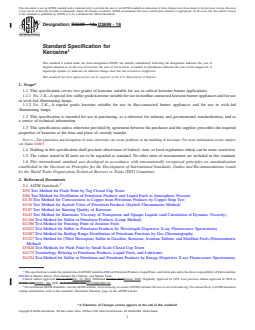
(Specification)Standard Specification for Kerosine
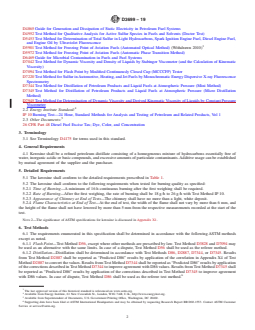
General Information
- Abstract
ABSTRACT
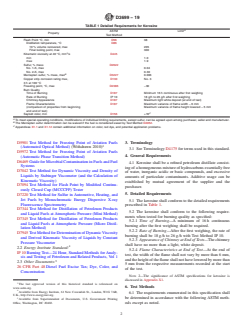
This specification covers two grades of kerosine suitable for use in critical kerosine burner applications: no. 1-K - a special low-sulfur grade kerosine suitable for use in nonflue-connected kerosine burner appliances and for use in wick-fed illuminating lamps, and no. 2-K - a regular grade kerosine suitable for use in flue-connected kerosine burner appliances and for use in wick-fed illuminating lamps. Kerosine shall be a refined petroleum distillate consisting of a homogeneous mixture of hydrocarbons essentially free of water, inorganic acidic or basic compounds, and excessive amounts of particulate contaminants. The flash point, distillation range, viscosity requirements, sulphur requirements, mercaptan sulphur, copper strip corrosion, freezing point, burning quality, and saybolt color shall be tested to meet the requirements prescribed.
SCOPE
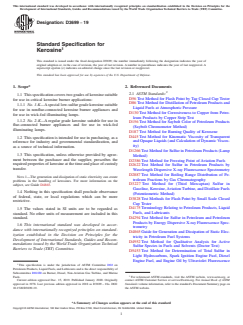
1.1 This specification covers two grades of kerosine suitable for use in critical kerosine burner applications:
1.1.1 No. 1-K—A special low-sulfur grade kerosine suitable for use in nonflue-connected kerosine burner appliances and for use in wick-fed illuminating lamps.
1.1.2 No. 2-K—A regular grade kerosine suitable for use in flue-connected burner appliances and for use in wick-fed illuminating lamps.
1.2 This specification is intended for use in purchasing, as a reference for industry and governmental standardization, and as a source of technical information.
1.3 This specification, unless otherwise provided by agreement between the purchaser and the supplier, prescribes the required properties of kerosine at the time and place of custody transfer.
Note 1: The generation and dissipation of static electricity can create problems in the handling of kerosines. For more information on the subject, see Guide D4865.
1.4 Nothing in this specification shall preclude observance of federal, state, or local regulations which can be more restrictive.
1.5 The values stated in SI units are to be regarded as standard. No other units of measurement are included in this standard.
1.6 This international standard was developed in accordance with internationally recognized principles on standardization established in the Decision on Principles for the Development of International Standards, Guides and Recommendations issued by the World Trade Organization Technical Barriers to Trade (TBT) Committee.
- Status
- Published
- Publication Date
- 14-Dec-2019
- Technical Committee
- D02 - Petroleum Products, Liquid Fuels, and Lubricants
- Drafting Committee
- D02.E0 - Burner, Diesel and Non-Aviation Gas Turbine Fuels
Overview
ASTM D3699-19: Standard Specification for Kerosine defines requirements for two grades of kerosine suitable for use in critical burner applications and wick-fed illuminating lamps. Published by ASTM International, this standard is crucial for industry, governmental standardization, and purchasing, providing a clear basis for specifying and evaluating kerosine quality. Kerosine covered under this specification must be a refined petroleum distillate-free of water, inorganic acids or bases, and excessive particulate contaminants. The standard focuses on properties such as flash point, distillation range, viscosity, sulfur content, burning quality, and corrosiveness, ensuring safety, performance, and regulatory compliance in end-use applications.
Key Topics
- Grades of Kerosine:
- No. 1-K: Special low-sulfur grade, ideal for nonflue-connected burner appliances and wick-fed lamps.
- No. 2-K: Regular grade, suitable for flue-connected burner appliances and wick-fed lamps.
- Required Properties:
- Homogeneous hydrocarbon mixture
- Flash point minimum of 38°C
- Distillation parameters to ensure proper volatility
- Kinematic viscosity range for proper fuel handling
- Sulfur content limits to comply with environmental and health guidelines
- Restrictions on mercaptan sulfur and copper strip corrosion
- Low freezing point to prevent clogging in cold conditions
- High burning quality for clean, consistent performance
- Minimum Saybolt color value for purity
- Testing Requirements:
- Standard test methods for flash point (ASTM D56), distillation (ASTM D86), viscosity (ASTM D445), sulfur content (ASTM D2622), burning quality (ASTM D187), and others
- Compliance:
- Observance of all relevant federal, state, or local regulations
- Conformity to the standard at the point of custody transfer
Applications
ASTM D3699-19 plays a vital role in several practical applications:
- Heating: Used in residential, industrial, and commercial space heaters-especially wick-fed, unvented heaters requiring high-purity kerosine.
- Illumination: Ensures safe and efficient operation in wick-fed kerosine lamps, widely used in areas without access to electricity or in emergency lighting.
- Regulatory Compliance: Assists suppliers, distributors, and regulatory bodies in verifying kerosine meets safety and environmental standards by providing clear test methods and property limits.
- Procurement & Quality Control: Procurement professionals utilize ASTM D3699-19 as a reference for purchasing contracts, ensuring consistent product quality across suppliers and shipments.
- Prevention of Contamination: The specification helps identify and prevent use of kerosine contaminated by other fuels, additives, or excessive dye, which can impact performance and safety in sensitive applications.
- Emissions Control: By specifying maximum sulfur content, the standard supports compliance with regulations on sulfur dioxide emissions, contributing to environmental protection.
Related Standards
Organizations and professionals working with kerosine and petroleum products should be aware of the following related ASTM and industry standards:
- ASTM D56: Test Method for Flash Point by Tag Closed Cup Tester
- ASTM D86: Test Method for Distillation of Petroleum Products
- ASTM D130: Test Method for Corrosiveness to Copper from Petroleum Products
- ASTM D187: Test Method for Burning Quality of Kerosene
- ASTM D2622: Test Method for Sulfur in Petroleum Products
- ASTM D445: Test Method for Kinematic Viscosity
- ASTM D2386: Test Method for Freezing Point of Aviation Fuels
- ASTM D156: Test Method for Saybolt Color of Petroleum Products
- ASTM D4865: Guide for Generation and Dissipation of Static Electricity in Petroleum Fuel Systems
- ASTM D6469: Guide for Microbial Contamination in Fuels and Fuel Systems
Using ASTM D3699-19 in conjunction with these referenced standards ensures comprehensive quality and safety management for kerosine in critical applications while supporting regulatory compliance and operational efficiency.
Keywords: kerosine specification, ASTM D3699-19, kerosine burner fuel, wick-fed lamps, low-sulfur kerosine, petroleum product standards, kerosine quality, fuel oil, kerosine compliance.
Relations
- Effective Date
- 01-Apr-2024
- Effective Date
- 01-Mar-2024
- Refers
ASTM D4175-23a - Standard Terminology Relating to Petroleum Products, Liquid Fuels, and Lubricants - Effective Date
- 15-Dec-2023
- Effective Date
- 01-Dec-2023
- Effective Date
- 01-Dec-2023
- Effective Date
- 01-Dec-2023
- Effective Date
- 01-Dec-2023
- Effective Date
- 01-Nov-2023
- Effective Date
- 01-Nov-2023
- Effective Date
- 01-Nov-2023
- Effective Date
- 01-Oct-2023
- Effective Date
- 01-Jul-2023
- Refers
ASTM D4175-23e1 - Standard Terminology Relating to Petroleum Products, Liquid Fuels, and Lubricants - Effective Date
- 01-Jul-2023
- Effective Date
- 01-Jul-2019
- Effective Date
- 01-Jul-2019
Get Certified
Connect with accredited certification bodies for this standard

Element Materials Technology
Materials testing and product certification.

ABS Group Brazil
ABS Group certification services in Brazil.

ABS Quality Evaluations Inc.
American Bureau of Shipping quality certification.
Sponsored listings
Frequently Asked Questions
ASTM D3699-19 is a technical specification published by ASTM International. Its full title is "Standard Specification for Kerosine". This standard covers: ABSTRACT This specification covers two grades of kerosine suitable for use in critical kerosine burner applications: no. 1-K - a special low-sulfur grade kerosine suitable for use in nonflue-connected kerosine burner appliances and for use in wick-fed illuminating lamps, and no. 2-K - a regular grade kerosine suitable for use in flue-connected kerosine burner appliances and for use in wick-fed illuminating lamps. Kerosine shall be a refined petroleum distillate consisting of a homogeneous mixture of hydrocarbons essentially free of water, inorganic acidic or basic compounds, and excessive amounts of particulate contaminants. The flash point, distillation range, viscosity requirements, sulphur requirements, mercaptan sulphur, copper strip corrosion, freezing point, burning quality, and saybolt color shall be tested to meet the requirements prescribed. SCOPE 1.1 This specification covers two grades of kerosine suitable for use in critical kerosine burner applications: 1.1.1 No. 1-K—A special low-sulfur grade kerosine suitable for use in nonflue-connected kerosine burner appliances and for use in wick-fed illuminating lamps. 1.1.2 No. 2-K—A regular grade kerosine suitable for use in flue-connected burner appliances and for use in wick-fed illuminating lamps. 1.2 This specification is intended for use in purchasing, as a reference for industry and governmental standardization, and as a source of technical information. 1.3 This specification, unless otherwise provided by agreement between the purchaser and the supplier, prescribes the required properties of kerosine at the time and place of custody transfer. Note 1: The generation and dissipation of static electricity can create problems in the handling of kerosines. For more information on the subject, see Guide D4865. 1.4 Nothing in this specification shall preclude observance of federal, state, or local regulations which can be more restrictive. 1.5 The values stated in SI units are to be regarded as standard. No other units of measurement are included in this standard. 1.6 This international standard was developed in accordance with internationally recognized principles on standardization established in the Decision on Principles for the Development of International Standards, Guides and Recommendations issued by the World Trade Organization Technical Barriers to Trade (TBT) Committee.
ABSTRACT This specification covers two grades of kerosine suitable for use in critical kerosine burner applications: no. 1-K - a special low-sulfur grade kerosine suitable for use in nonflue-connected kerosine burner appliances and for use in wick-fed illuminating lamps, and no. 2-K - a regular grade kerosine suitable for use in flue-connected kerosine burner appliances and for use in wick-fed illuminating lamps. Kerosine shall be a refined petroleum distillate consisting of a homogeneous mixture of hydrocarbons essentially free of water, inorganic acidic or basic compounds, and excessive amounts of particulate contaminants. The flash point, distillation range, viscosity requirements, sulphur requirements, mercaptan sulphur, copper strip corrosion, freezing point, burning quality, and saybolt color shall be tested to meet the requirements prescribed. SCOPE 1.1 This specification covers two grades of kerosine suitable for use in critical kerosine burner applications: 1.1.1 No. 1-K—A special low-sulfur grade kerosine suitable for use in nonflue-connected kerosine burner appliances and for use in wick-fed illuminating lamps. 1.1.2 No. 2-K—A regular grade kerosine suitable for use in flue-connected burner appliances and for use in wick-fed illuminating lamps. 1.2 This specification is intended for use in purchasing, as a reference for industry and governmental standardization, and as a source of technical information. 1.3 This specification, unless otherwise provided by agreement between the purchaser and the supplier, prescribes the required properties of kerosine at the time and place of custody transfer. Note 1: The generation and dissipation of static electricity can create problems in the handling of kerosines. For more information on the subject, see Guide D4865. 1.4 Nothing in this specification shall preclude observance of federal, state, or local regulations which can be more restrictive. 1.5 The values stated in SI units are to be regarded as standard. No other units of measurement are included in this standard. 1.6 This international standard was developed in accordance with internationally recognized principles on standardization established in the Decision on Principles for the Development of International Standards, Guides and Recommendations issued by the World Trade Organization Technical Barriers to Trade (TBT) Committee.
ASTM D3699-19 is classified under the following ICS (International Classification for Standards) categories: 75.160.20 - Liquid fuels. The ICS classification helps identify the subject area and facilitates finding related standards.
ASTM D3699-19 has the following relationships with other standards: It is inter standard links to ASTM D445-24, ASTM D3227-24, ASTM D4175-23a, ASTM D7345-23, ASTM D86-23ae1, ASTM D7094-23, ASTM D86-23a, ASTM D445-23, ASTM D4865-23, ASTM D7945-23, ASTM D156-23, ASTM D2887-23, ASTM D4175-23e1, ASTM D5453-19a, ASTM D2887-19. Understanding these relationships helps ensure you are using the most current and applicable version of the standard.
ASTM D3699-19 is available in PDF format for immediate download after purchase. The document can be added to your cart and obtained through the secure checkout process. Digital delivery ensures instant access to the complete standard document.
Standards Content (Sample)
This international standard was developed in accordance with internationally recognized principles on standardization established in the Decision on Principles for the
Development of International Standards, Guides and Recommendations issued by the World Trade Organization Technical Barriers to Trade (TBT) Committee.
Designation:D3699 −19
Standard Specification for
Kerosine
This standard is issued under the fixed designation D3699; the number immediately following the designation indicates the year of
original adoption or, in the case of revision, the year of last revision. A number in parentheses indicates the year of last reapproval. A
superscript epsilon (´) indicates an editorial change since the last revision or reapproval.
This standard has been approved for use by agencies of the U.S. Department of Defense.
1. Scope* 2. Referenced Documents
2.1 ASTM Standards:
1.1 Thisspecificationcoverstwogradesofkerosinesuitable
D56 Test Method for Flash Point by Tag Closed Cup Tester
for use in critical kerosine burner applications:
D86 Test Method for Distillation of Petroleum Products and
1.1.1 No. 1-K—Aspecial low-sulfur grade kerosine suitable
Liquid Fuels at Atmospheric Pressure
for use in nonflue-connected kerosine burner appliances and
D130 Test Method for Corrosiveness to Copper from Petro-
for use in wick-fed illuminating lamps.
leum Products by Copper Strip Test
1.1.2 No. 2-K—A regular grade kerosine suitable for use in
D156 Test Method for Saybolt Color of Petroleum Products
flue-connected burner appliances and for use in wick-fed
(Saybolt Chromometer Method)
illuminating lamps.
D187 Test Method for Burning Quality of Kerosene
D445 Test Method for Kinematic Viscosity of Transparent
1.2 This specification is intended for use in purchasing, as a
and Opaque Liquids (and Calculation of Dynamic Viscos-
reference for industry and governmental standardization, and
ity)
as a source of technical information.
D1266 Test Method for Sulfur in Petroleum Products (Lamp
1.3 This specification, unless otherwise provided by agree-
Method)
ment between the purchaser and the supplier, prescribes the
D2386 Test Method for Freezing Point of Aviation Fuels
required properties of kerosine at the time and place of custody
D2622 Test Method for Sulfur in Petroleum Products by
transfer.
Wavelength Dispersive X-ray Fluorescence Spectrometry
D2887 Test Method for Boiling Range Distribution of Pe-
NOTE 1—The generation and dissipation of static electricity can create
troleum Fractions by Gas Chromatography
problems in the handling of kerosines. For more information on the
D3227 Test Method for (Thiol Mercaptan) Sulfur in
subject, see Guide D4865.
Gasoline, Kerosine,Aviation Turbine, and Distillate Fuels
1.4 Nothing in this specification shall preclude observance
(Potentiometric Method)
of federal, state, or local regulations which can be more
D3828 Test Methods for Flash Point by Small Scale Closed
restrictive.
Cup Tester
D4175 Terminology Relating to Petroleum Products, Liquid
1.5 The values stated in SI units are to be regarded as
Fuels, and Lubricants
standard. No other units of measurement are included in this
D4294 Test Method for Sulfur in Petroleum and Petroleum
standard.
Products by Energy Dispersive X-ray Fluorescence Spec-
1.6 This international standard was developed in accor-
trometry
dance with internationally recognized principles on standard-
D4865 Guide for Generation and Dissipation of Static Elec-
ization established in the Decision on Principles for the
tricity in Petroleum Fuel Systems
Development of International Standards, Guides and Recom-
D4952 Test Method for Qualitative Analysis for Active
mendations issued by the World Trade Organization Technical
Sulfur Species in Fuels and Solvents (Doctor Test)
Barriers to Trade (TBT) Committee.
D5453 Test Method for Determination of Total Sulfur in
Light Hydrocarbons, Spark Ignition Engine Fuel, Diesel
Engine Fuel, and Engine Oil by Ultraviolet Fluorescence
This specification is under the jurisdiction of ASTM Committee D02 on
Petroleum Products, Liquid Fuels, and Lubricants and is the direct responsibility of
Subcommittee D02.E0 on Burner, Diesel, Non-Aviation Gas Turbine, and Marine
Fuels. For referenced ASTM standards, visit the ASTM website, www.astm.org, or
Current edition approved Dec. 15, 2019. Published January 2020. Originally contact ASTM Customer Service at service@astm.org. For Annual Book of ASTM
approved in 1978. Last previous edition approved in 2018 as D3699 – 18a. DOI: Standards volume information, refer to the standard’s Document Summary page on
10.1520/D3699-19. the ASTM website.
*A Summary of Changes section appears at the end of this standard
Copyright © ASTM International, 100 Barr Harbor Drive, PO Box C700, West Conshohocken, PA 19428-2959. United States
D3699−19
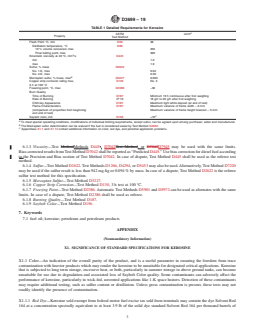
TABLE 1 Detailed Requirements for Kerosine
A
ASTM Limit
Property
Test Method
Flash Point °C, min D56 38
Distillation temperature, °C D86
10 % volume recovered, max 205
Final boiling point, max 300
Kinematic viscosity at 40 °C, mm /s D445
min 1.0
max 1.9
Sulfur, % mass D2622
No. 1-K, max 0.04
No. 2-K, max 0.30
B
Mercaptan sulfur, % mass, max D3227 0.003
Copper strip corrosion rating max, D130 No. 3
3 h at 100 °C
Freezing point, °C, max D2386 −30
Burn Quality
Time of Burning D187 Minimum 16 h continuous after first weighing
Rate of Burning IP 10 18 g/h to 26 g/h after first weighing
Chimney Appearance D187 Maximum light white deposit (at end of test)
Flame Characteristics D187 Maximum variance of flame width–6mm
(comparison of properties from beginning Maximum variance of flame height lowered–5mm
and end of test)
C
Saybolt color, min D156 +16
A
To meet special operating conditions, modifications of individual limiting requirements, except sulfur, can be agreed upon among purchaser, seller and manufacturer.
B
The Mercaptan sulfur determination can be waived if the fuel is considered sweet by Test Method D4952.
C
Appendixes X1.1 and X1.12 contain additional information on color, red dye, and potential application problems.
D5901 Test Method for Freezing Point of Aviation Fuels 3. Terminology
(Automated Optical Method) (Withdrawn 2010)
3.1 See Terminology D4175 for terms used in this standard.
D5972 Test Method for Freezing Point of Aviation Fuels
4. General Requirements
(Automatic Phase Transition Method)
D6469 GuideforMicrobialContaminationinFuelsandFuel
4.1 Kerosine shall be a refined petroleum distillate consist-
Systems
ing of a homogeneous mixture of hydrocarbons essentially free
D7042 Test Method for Dynamic Viscosity and Density of
of water, inorganic acidic or basic compounds, and excessive
Liquids by Stabinger Viscometer (and the Calculation of
amounts of particulate contaminants. Additive usage can be
Kinematic Viscosity)
established by mutual agreement of the supplier and the
D7094 Test Method for Flash Point by Modified Continu-
purchaser.
ously Closed Cup (MCCCFP) Tester
5. Detailed Requirements
D7220 Test Method for Sulfur in Automotive, Heating, and
Jet Fuels by Monochromatic Energy Dispersive X-ray
5.1 The kerosine shall conform to the detailed requirements
Fluorescence Spectrometry
prescribed in Table 1.
D7344 Test Method for Distillation of Petroleum Products
5.2 The kerosine shall conform to the following require-
and Liquid Fuels at Atmospheric Pressure (Mini Method)
ments when tested for burning quality as specified:
D7345 Test Method for Distillation of Petroleum Products
5.2.1 Time of Burning—A minimum of 16 h continuous
and Liquid Fuels at Atmospheric Pressure (Micro Distil-
burning after the first weighing shall be required.
lation Method)
5.2.2 Rate of Burning—After the first weighing, the rate of
D7945 TestMethodforDeterminationofDynamicViscosity
burning shall be 18 g⁄h to 26 g⁄h with Test Method IP 10.
and Derived Kinematic Viscosity of Liquids by Constant
5.2.3 AppearanceofChimneyatEndofTests—Thechimney
Pressure Viscometer
shall have no more than a light, white deposit.
2.2 Energy Institute Standard:
5.2.4 Flame Characteristics at End of Test—At the end of
IP 10 Burning Test—24 Hour, Standard Methods forAnaly-
test, the width of the flame shall not vary by more than 6 mm,
sis and Testing of Petroleum and Related Products, Vol 1
andtheheightoftheflameshallnothaveloweredbymorethan
2.3 Other Documents:
5 mm from the respective measurements recorded at the start
26 CFR Part 48 Diesel Fuel Excise Tax; Dye, Color, and
of the test.
Concentration
NOTE 2—The significance of ASTM specifications for kerosine is
discussed in Appendix X1.
The last approved version of this historical standard is referenced on
6. Test Methods
www.astm.org.
Available from Energy Institute, 61 New Cavendish St., London, W1G 7AR,
6.1 The requirements enumerated in this specification shall
U.K., http://www.energyinst.org.
be determined in accordance with the following ASTM meth-
Available from Superintendent of Documents, U.S. Government Printing
Office, Washington, DC 20402. ods except as noted.
D3699−19
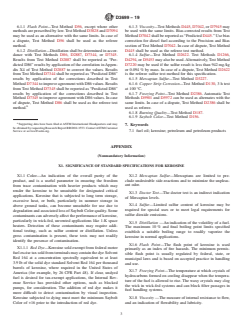
6.1.1 Flash Point—Test Method D56, except where other 6.1.3 Viscosity—Test Methods D445, D7042,or D7945 may
methods are prescribed by law.Test Method D3828 and D7094 be used with the same limits. Bias-corrected results from Test
may be used as an alternative with the same limits. In case of MethodD7042shallbereportedas“PredictedD445.”Usebias
a dispute, Test Method D56 shall be used as the referee correction for diesel fuel according to the Precision and Bias
method. section ofTest Method D7042. In case of dispute,Test Method
6.1.2 Distillation—Distillation shall be determined in accor- D445 shall be used as the referee test method.
dance with Test Methods D86, D2887, D7344,or D7345. 6.1.4 Sulfur—Test Method D2622. Test Methods D1266,
Results from Test Method D2887 shall be reported as “Pre- D4294,or D5453 may also be used.Alternatively,Test Method
dicted D86” results by application of the correlation inAppen- D7220 may be used if the sulfur result is less than 942 mg⁄kg
dix X4 of Test Method D2887 to convert the values. Results or 0.094 % by mass. In case of a dispute, Test Method D2622
from Test Method D7344 shall be reported as
...
This document is not an ASTM standard and is intended only to provide the user of an ASTM standard an indication of what changes have been made to the previous version. Because
it may not be technically possible to adequately depict all changes accurately, ASTM recommends that users consult prior editions as appropriate. In all cases only the current version
of the standard as published by ASTM is to be considered the official document.
Designation: D3699 − 18a D3699 − 19
Standard Specification for
Kerosine
This standard is issued under the fixed designation D3699; the number immediately following the designation indicates the year of
original adoption or, in the case of revision, the year of last revision. A number in parentheses indicates the year of last reapproval. A
superscript epsilon (´) indicates an editorial change since the last revision or reapproval.
This standard has been approved for use by agencies of the U.S. Department of Defense.
1. Scope*
1.1 This specification covers two grades of kerosine suitable for use in critical kerosine burner applications:
1.1.1 No. 1-K—A special low-sulfur grade kerosine suitable for use in nonflue-connected kerosine burner appliances and for use
in wick-fed illuminating lamps.
1.1.2 No. 2-K—A regular grade kerosine suitable for use in flue-connected burner appliances and for use in wick-fed
illuminating lamps.
1.2 This specification is intended for use in purchasing, as a reference for industry and governmental standardization, and as
a source of technical information.
1.3 This specification, unless otherwise provided by agreement between the purchaser and the supplier, prescribes the required
properties of kerosine at the time and place of custody transfer.
NOTE 1—The generation and dissipation of static electricity can create problems in the handling of kerosines. For more information on the subject,
see Guide D4865.
1.4 Nothing in this specification shall preclude observance of federal, state, or local regulations which can be more restrictive.
1.5 The values stated in SI units are to be regarded as standard. No other units of measurement are included in this standard.
1.6 This international standard was developed in accordance with internationally recognized principles on standardization
established in the Decision on Principles for the Development of International Standards, Guides and Recommendations issued
by the World Trade Organization Technical Barriers to Trade (TBT) Committee.
2. Referenced Documents
2.1 ASTM Standards:
D56 Test Method for Flash Point by Tag Closed Cup Tester
D86 Test Method for Distillation of Petroleum Products and Liquid Fuels at Atmospheric Pressure
D130 Test Method for Corrosiveness to Copper from Petroleum Products by Copper Strip Test
D156 Test Method for Saybolt Color of Petroleum Products (Saybolt Chromometer Method)
D187 Test Method for Burning Quality of Kerosene
D445 Test Method for Kinematic Viscosity of Transparent and Opaque Liquids (and Calculation of Dynamic Viscosity)
D1266 Test Method for Sulfur in Petroleum Products (Lamp Method)
D2386 Test Method for Freezing Point of Aviation Fuels
D2622 Test Method for Sulfur in Petroleum Products by Wavelength Dispersive X-ray Fluorescence Spectrometry
D2887 Test Method for Boiling Range Distribution of Petroleum Fractions by Gas Chromatography
D3227 Test Method for (Thiol Mercaptan) Sulfur in Gasoline, Kerosine, Aviation Turbine, and Distillate Fuels (Potentiometric
Method)
D3828 Test Methods for Flash Point by Small Scale Closed Cup Tester
D4175 Terminology Relating to Petroleum Products, Liquid Fuels, and Lubricants
D4294 Test Method for Sulfur in Petroleum and Petroleum Products by Energy Dispersive X-ray Fluorescence Spectrometry
This specification is under the jurisdiction of ASTM Committee D02 on Petroleum Products, Liquid Fuels, and Lubricants and is the direct responsibility of Subcommittee
D02.E0 on Burner, Diesel, Non-Aviation Gas Turbine, and Marine Fuels.
Current edition approved Oct. 1, 2018Dec. 15, 2019. Published October 2018January 2020. Originally approved in 1978. Last previous edition approved in 2018 as
D3699 – 18.D3699 – 18a. DOI: 10.1520/D3699-18A.10.1520/D3699-19.
For referenced ASTM standards, visit the ASTM website, www.astm.org, or contact ASTM Customer Service at service@astm.org. For Annual Book of ASTM Standards
volume information, refer to the standard’s Document Summary page on the ASTM website.
*A Summary of Changes section appears at the end of this standard
Copyright © ASTM International, 100 Barr Harbor Drive, PO Box C700, West Conshohocken, PA 19428-2959. United States
D3699 − 19
D4865 Guide for Generation and Dissipation of Static Electricity in Petroleum Fuel Systems
D4952 Test Method for Qualitative Analysis for Active Sulfur Species in Fuels and Solvents (Doctor Test)
D5453 Test Method for Determination of Total Sulfur in Light Hydrocarbons, Spark Ignition Engine Fuel, Diesel Engine Fuel,
and Engine Oil by Ultraviolet Fluorescence
D5901 Test Method for Freezing Point of Aviation Fuels (Automated Optical Method) (Withdrawn 2010)
D5972 Test Method for Freezing Point of Aviation Fuels (Automatic Phase Transition Method)
D6469 Guide for Microbial Contamination in Fuels and Fuel Systems
D7042 Test Method for Dynamic Viscosity and Density of Liquids by Stabinger Viscometer (and the Calculation of Kinematic
Viscosity)
D7094 Test Method for Flash Point by Modified Continuously Closed Cup (MCCCFP) Tester
D7220 Test Method for Sulfur in Automotive, Heating, and Jet Fuels by Monochromatic Energy Dispersive X-ray Fluorescence
Spectrometry
D7344 Test Method for Distillation of Petroleum Products and Liquid Fuels at Atmospheric Pressure (Mini Method)
D7345 Test Method for Distillation of Petroleum Products and Liquid Fuels at Atmospheric Pressure (Micro Distillation
Method)
D7945 Test Method for Determination of Dynamic Viscosity and Derived Kinematic Viscosity of Liquids by Constant Pressure
Viscometer
2.2 Energy Institute Standard:
IP 10 Burning Test—24 Hour, Standard Methods for Analysis and Testing of Petroleum and Related Products, Vol 1
2.3 Other Documents:
26 CFR Part 48 Diesel Fuel Excise Tax; Dye, Color, and Concentration
3. Terminology
3.1 See Terminology D4175 for terms used in this standard.
4. General Requirements
4.1 Kerosine shall be a refined petroleum distillate consisting of a homogeneous mixture of hydrocarbons essentially free of
water, inorganic acidic or basic compounds, and excessive amounts of particulate contaminants. Additive usage can be established
by mutual agreement of the supplier and the purchaser.
5. Detailed Requirements
5.1 The kerosine shall conform to the detailed requirements prescribed in Table 1.
5.2 The kerosine shall conform to the following requirements when tested for burning quality as specified:
5.2.1 Time of Burning—A minimum of 16 h continuous burning after the first weighing shall be required.
5.2.2 Rate of Burning—After the first weighing, the rate of burning shall be 18 g ⁄h to 26 g ⁄h with Test Method IP 10.
5.2.3 Appearance of Chimney at End of Tests—The chimney shall have no more than a light, white deposit.
5.2.4 Flame Characteristics at End of Test—At the end of test, the width of the flame shall not vary by more than 6 mm, and
the height of the flame shall not have lowered by more than 5 mm from the respective measurements recorded at the start of the
test.
NOTE 2—The significance of ASTM specifications for kerosine is discussed in Appendix X1.
6. Test Methods
6.1 The requirements enumerated in this specification shall be determined in accordance with the following ASTM methods
except as noted.
6.1.1 Flash Point—Test Method D56, except where other methods are prescribed by law. Test Method D3828 and D7094 may
be used as an alternative with the same limits. In case of a dispute, Test Method D56 shall be used as the referee method.
6.1.2 Distillation—Distillation shall be determined in accordance with Test Methods D86, D2887, D7344, or D7345. Results
from Test Method D2887 shall be reported as “Predicted D86” results by application of the correlation in Appendix X4 of Test
Method D2887 to convert the values. Results from Test Method D7344 shall be reported as “Predicted D86” results by application
of the corrections described in Test Method D7344 to improve agreement with D86 values. Results from Test Method D7345 shall
be reported as “Predicted D86” results by application of the corrections described in Test Method D7345 to improve agreement
with D86 values. In case of dispute, Test Method D86 shall be used as the referee test method.
The last approved version of this historical standard is referenced on www.astm.org.
Available from Energy Institute, 61 New Cavendish St., London, W1G 7AR, U.K., http://www.energyinst.org.
Available from Superintendent of Documents, U.S. Government Printing Office, Washington, DC 20402.
Supporting data have been filed at ASTM International Headquarters and may be obtained by requesting Research Report RR:D02-1553. Contact ASTM Customer
Service at service@astm.org.
D3699 − 19
TABLE 1 Detailed Requirements for Kerosine
A
ASTM Limit
Property
Test Method
Flash Point °C, min D56 38
Distillation temperature, °C D86
10 % volume recovered, max 205
Final boiling point, max 300
Kinematic viscosity at 40 °C, mm /s D445
min 1.0
max 1.9
Sulfur, % mass D2622
No. 1-K, max 0.04
No. 2-K, max 0.30
B
Mercaptan sulfur, % mass, max D3227 0.003
Copper strip corrosion rating max, D130 No. 3
3 h at 100 °C
Freezing point, °C, max D2386 −30
Burn Quality
Time of Burning D187 Minimum 16 h continuous after first weighing
Rate of Burning IP 10 18 g/h to 26 g/h after first weighing
Chimney Appearance D187 Maximum light white deposit (at end of test)
Flame Characteristics D187 Maximum variance of flame width – 6 mm
(comparison of properties from beginning Maximum variance of flame height lowered – 5 mm
and end of test)
C
Saybolt color, min D156 +16
A
To meet special operating conditions, modifications of individual limiting requirements, except sulfur, can be agreed upon among purchaser, seller and manufacturer.
B
The Mercaptan sulfur determination can be waived if the fuel is considered sweet by Test Method D4952.
C
Appendixes X1.1 and X1.12 contain additional information on color, red dye, and potential application problems.
6.1.3 Viscosity—Test MethodMethods D445., D7042T
...