

ASTM D3735-22
(Specification)Standard Specification for VM&P Naphthas
General Information
- Abstract
ABSTRACT
This specification covers four types of moderately volatile hydrocarbon solvents that are mainly aliphatic in composition and normally petroleum distillates, and are commonly referred to as VM&P naphthas used primarily by the coatings industry. Materials shall be available in the following types: Type I, regular; Type II, high flash; Type III, odorless; and Type IV, low aromatics. Specimens shall undergo tests that shall examine their conformance with specified values of the following physical and chemical properties: appearance; bromine number; color (Pt-Co units); aromatics; copper corrosion; distillation (initial boiling point, 50 % recovered, and dry point); flash point; Kauri-butanol value; odor; and apparent specific gravity.
SCOPE
1.1 This specification covers four types of moderately volatile hydrocarbon solvents, mainly aliphatic in composition and normally petroleum distillates. These solvents are used primarily by the coatings industry and are commonly referred to as VM&P naphthas.
1.2 The values stated in SI units are to be regarded as the standard. The values given in parentheses are for information only.
1.3 The following applies to all specified limits in this standard; for purposes of determining conformance with this standard, an observed value or a calculated value shall be rounded-off “to the nearest unit” in the last right-hand digit used in expressing the specification limit, in accordance with the rounding-off method of Practice E29.
1.4 For specific hazard information and guidance, see the supplier's Material Safety Data Sheet for materials listed in this specification.
1.5 This international standard was developed in accordance with internationally recognized principles on standardization established in the Decision on Principles for the Development of International Standards, Guides and Recommendations issued by the World Trade Organization Technical Barriers to Trade (TBT) Committee.
- Status
- Published
- Publication Date
- 31-Dec-2021
- Technical Committee
- D01 - Paint and Related Coatings, Materials, and Applications
- Drafting Committee
- D01.35 - Solvents, Plasticizers, and Chemical Intermediates


Overview
ASTM D3735-22: Standard Specification for VM&P Naphthas defines requirements for four types of moderately volatile hydrocarbon solvents, also known as VM&P (Varnish Makers and Painters) naphthas. These aliphatic petroleum distillates are primarily used in the coatings and paint industry. The standard outlines necessary physical and chemical properties to ensure consistency and reliability in both industrial and commercial applications.
The four types of VM&P naphthas specified are:
- Type I: Regular
- Type II: High flash
- Type III: Odorless
- Type IV: Low aromatics
This specification ensures that VM&P naphthas meet controlled criteria concerning appearance, composition, safety, and performance, providing a reliable baseline for manufacturers, suppliers, and end users in the coatings sector.
Key Topics
ASTM D3735-22 addresses several critical aspects of VM&P naphthas:
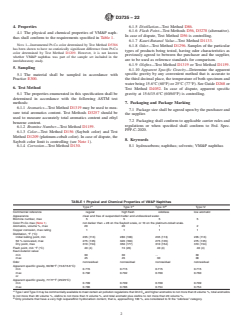
- Physical and Chemical Properties: Standards are set for appearance, distillation range, specific gravity, and color using robust test methods.
- Flash Point and Volatility: Each type has minimum flash point requirements, making them suitable for safe handling and specific industrial uses.
- Aromatic and Olefin Content: The specification limits for aromatics and olefins help control solvent strength and potential emissions.
- Odor Control and Corrosion: Requirements ensure solvents have nonresidual odors and minimal corrosiveness, important for finished coating quality and equipment protection.
- Testing Methods: The standard references ASTM and federal test methods (such as D56, D86, D130, D1133, D1209) to confirm compliance.
- Packaging and Marking: Guidance on packaging is included to ensure proper container selection and compliance with transport regulations.
Applications
VM&P naphthas as defined by ASTM D3735-22 are essential solvents in:
- Paints and Coatings: Used as thinning agents, cleaning solvents, and in the formulation of alkyd and oil-based coatings due to their volatility and solvent strength.
- Industrial Cleaning: Suitable for use in degreasing and surface preparation where controlled evaporation is required.
- Adhesives and Sealants: As diluents, VM&P naphthas provide suitable working times and bonding characteristics.
- Specialty Products: Types with lower aromatic content or odorless grades meet stricter air quality or safety requirements, expanding application possibilities in sensitive environments.
The clear guidelines for each solvent type enable manufacturers and users to select the most appropriate grade for their specific processing, safety, and environmental needs.
Related Standards
Several related standards support proper use, testing, and compliance for VM&P naphthas:
- ASTM D56 - Flash Point by Tag Closed Cup Tester
- ASTM D86 - Distillation of Petroleum Products
- ASTM D1133 - Kauri-Butanol Value
- ASTM D1159 - Bromine Number
- ASTM D1209 / D5386 - Color of Clear Liquids
- ASTM D130 - Copper Corrosion
- ASTM E29 - Significant Digits in Test Data
- ASTM E300 - Sampling Industrial Chemicals
These referenced standards provide methods for assessing properties such as safety, purity, and performance, supporting consistent production and regulatory compliance.
Keywords: VM&P naphthas, hydrocarbon solvents, ASTM D3735-22, coatings industry, paint thinners, aliphatic solvents, petroleum distillates, solvent specifications, aromatic content, solvent testing, industrial cleaning agents.
Relations
- Effective Date
- 01-Dec-2023
- Effective Date
- 01-Dec-2023
- Effective Date
- 01-Nov-2023
- Effective Date
- 01-Oct-2023
- Effective Date
- 01-Jul-2016
- Effective Date
- 01-Jun-2016
- Effective Date
- 01-Oct-2014
- Effective Date
- 01-May-2013
- Effective Date
- 01-Nov-2012
- Effective Date
- 15-Apr-2012
- Refers
ASTM D86-11b - Standard Test Method for Distillation of Petroleum Products at Atmospheric Pressure - Effective Date
- 01-Dec-2011
- Effective Date
- 01-Dec-2010
- Effective Date
- 01-Nov-2010
- Effective Date
- 01-Jan-2010
- Effective Date
- 01-Jun-2009
Frequently Asked Questions
ASTM D3735-22 is a technical specification published by ASTM International. Its full title is "Standard Specification for VM&P Naphthas". This standard covers: ABSTRACT This specification covers four types of moderately volatile hydrocarbon solvents that are mainly aliphatic in composition and normally petroleum distillates, and are commonly referred to as VM&P naphthas used primarily by the coatings industry. Materials shall be available in the following types: Type I, regular; Type II, high flash; Type III, odorless; and Type IV, low aromatics. Specimens shall undergo tests that shall examine their conformance with specified values of the following physical and chemical properties: appearance; bromine number; color (Pt-Co units); aromatics; copper corrosion; distillation (initial boiling point, 50 % recovered, and dry point); flash point; Kauri-butanol value; odor; and apparent specific gravity. SCOPE 1.1 This specification covers four types of moderately volatile hydrocarbon solvents, mainly aliphatic in composition and normally petroleum distillates. These solvents are used primarily by the coatings industry and are commonly referred to as VM&P naphthas. 1.2 The values stated in SI units are to be regarded as the standard. The values given in parentheses are for information only. 1.3 The following applies to all specified limits in this standard; for purposes of determining conformance with this standard, an observed value or a calculated value shall be rounded-off “to the nearest unit” in the last right-hand digit used in expressing the specification limit, in accordance with the rounding-off method of Practice E29. 1.4 For specific hazard information and guidance, see the supplier's Material Safety Data Sheet for materials listed in this specification. 1.5 This international standard was developed in accordance with internationally recognized principles on standardization established in the Decision on Principles for the Development of International Standards, Guides and Recommendations issued by the World Trade Organization Technical Barriers to Trade (TBT) Committee.
ABSTRACT This specification covers four types of moderately volatile hydrocarbon solvents that are mainly aliphatic in composition and normally petroleum distillates, and are commonly referred to as VM&P naphthas used primarily by the coatings industry. Materials shall be available in the following types: Type I, regular; Type II, high flash; Type III, odorless; and Type IV, low aromatics. Specimens shall undergo tests that shall examine their conformance with specified values of the following physical and chemical properties: appearance; bromine number; color (Pt-Co units); aromatics; copper corrosion; distillation (initial boiling point, 50 % recovered, and dry point); flash point; Kauri-butanol value; odor; and apparent specific gravity. SCOPE 1.1 This specification covers four types of moderately volatile hydrocarbon solvents, mainly aliphatic in composition and normally petroleum distillates. These solvents are used primarily by the coatings industry and are commonly referred to as VM&P naphthas. 1.2 The values stated in SI units are to be regarded as the standard. The values given in parentheses are for information only. 1.3 The following applies to all specified limits in this standard; for purposes of determining conformance with this standard, an observed value or a calculated value shall be rounded-off “to the nearest unit” in the last right-hand digit used in expressing the specification limit, in accordance with the rounding-off method of Practice E29. 1.4 For specific hazard information and guidance, see the supplier's Material Safety Data Sheet for materials listed in this specification. 1.5 This international standard was developed in accordance with internationally recognized principles on standardization established in the Decision on Principles for the Development of International Standards, Guides and Recommendations issued by the World Trade Organization Technical Barriers to Trade (TBT) Committee.
ASTM D3735-22 is classified under the following ICS (International Classification for Standards) categories: 87.060.30 - Solvents. The ICS classification helps identify the subject area and facilitates finding related standards.
ASTM D3735-22 has the following relationships with other standards: It is inter standard links to ASTM D86-23a, ASTM D86-23ae1, ASTM D1159-23, ASTM D156-23, ASTM D86-16, ASTM D56-16, ASTM D1319-14, ASTM D1319-13, ASTM D156-12, ASTM D1159-07(2012), ASTM D86-11b, ASTM D1133-10, ASTM D130-10, ASTM D5386-10, ASTM D1133-09. Understanding these relationships helps ensure you are using the most current and applicable version of the standard.
ASTM D3735-22 is available in PDF format for immediate download after purchase. The document can be added to your cart and obtained through the secure checkout process. Digital delivery ensures instant access to the complete standard document.
Standards Content (Sample)
This international standard was developed in accordance with internationally recognized principles on standardization established in the Decision on Principles for the
Development of International Standards, Guides and Recommendations issued by the World Trade Organization Technical Barriers to Trade (TBT) Committee.
Designation:D3735 −22
Standard Specification for
VM&P Naphthas
This standard is issued under the fixed designation D3735; the number immediately following the designation indicates the year of
original adoption or, in the case of revision, the year of last revision. A number in parentheses indicates the year of last reapproval. A
superscript epsilon (´) indicates an editorial change since the last revision or reapproval.
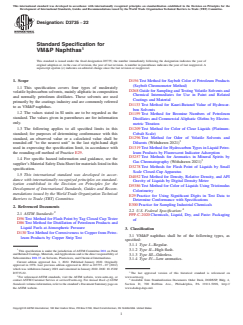
1. Scope D156 Test Method for Saybolt Color of Petroleum Products
(Saybolt Chromometer Method)
1.1 This specification covers four types of moderately
D268 Guide for Sampling and Testing Volatile Solvents and
volatile hydrocarbon solvents, mainly aliphatic in composition
Chemical Intermediates for Use in Paint and Related
and normally petroleum distillates. These solvents are used
Coatings and Material
primarily by the coatings industry and are commonly referred
D1133 Test Method for Kauri-Butanol Value of Hydrocar-
to as VM&P naphthas.
bon Solvents
1.2 The values stated in SI units are to be regarded as the
D1159 Test Method for Bromine Numbers of Petroleum
standard. The values given in parentheses are for information
Distillates and Commercial Aliphatic Olefins by Electro-
only.
metric Titration
1.3 The following applies to all specified limits in this D1209 Test Method for Color of Clear Liquids (Platinum-
Cobalt Scale)
standard; for purposes of determining conformance with this
standard, an observed value or a calculated value shall be D1296 Test Method for Odor of Volatile Solvents and
Diluents (Withdrawn 2021)
rounded-off “to the nearest unit” in the last right-hand digit
used in expressing the specification limit, in accordance with D1319 Test Method for Hydrocarbon Types in Liquid Petro-
leum Products by Fluorescent Indicator Adsorption
the rounding-off method of Practice E29.
D3257 Test Methods for Aromatics in Mineral Spirits by
1.4 For specific hazard information and guidance, see the
Gas Chromatography (Withdrawn 2021)
supplier’sMaterialSafetyDataSheetformaterialslistedinthis
D3278 Test Methods for Flash Point of Liquids by Small
specification.
Scale Closed-Cup Apparatus
1.5 This international standard was developed in accor-
D4052 Test Method for Density, Relative Density, and API
dance with internationally recognized principles on standard-
Gravity of Liquids by Digital Density Meter
ization established in the Decision on Principles for the
D5386 Test Method for Color of Liquids Using Tristimulus
Development of International Standards, Guides and Recom-
Colorimetry
mendations issued by the World Trade Organization Technical
E29 Practice for Using Significant Digits in Test Data to
Barriers to Trade (TBT) Committee.
Determine Conformance with Specifications
E300 Practice for Sampling Industrial Chemicals
2. Referenced Documents
2.2 U.S. Federal Specification:
2.1 ASTM Standards:
PPP-C-2020 Chemicals, Liquid, Dry, and Paste: Packaging
D56 Test Method for Flash Point by Tag Closed Cup Tester
of
D86 Test Method for Distillation of Petroleum Products and
Liquid Fuels at Atmospheric Pressure
3. Classification
D130 Test Method for Corrosiveness to Copper from Petro-
3.1 VM&P naphthas shall be of the following types, as
leum Products by Copper Strip Test
specified:
3.1.1 Type I—Regular.
3.1.2 Type II—High flash.
This specification is under the jurisdiction of ASTM Committee D01 on Paint
and Related Coatings, Materials, andApplications and is the direct responsibility of
3.1.3 Type III—Odorless.
Subcommittee D01.35 on Solvents, Plasticizers, and Chemical Intermediates.
3.1.4 Type IV—Low aromatics.
Current edition approved Jan. 1, 2022. Published January 2022. Originally
approved in 1978. Last previous edition approved in 2012 as D3735 – 07 (2012)
which was withdrawn January 2021 and reinstated in January 2022. DOI: 10.1520/
D3735-22. The last approved version of this historical standard is referenced on
For referenced ASTM standards, visit the ASTM website, www.astm.org, or www.astm.org.
contact ASTM Customer Service at service@astm.org. For Annual Book of ASTM Available from Standardization Documents Order Desk, DODSSP, Bldg. 4,
Standards volume information, refer to the standard’s Document Summary page on Section D, 700 Robbins Ave., Philadelphia, PA 19111-5098, http://
the ASTM website. www.dodssp.daps.mil.
Copyright © ASTM International, 100 Barr Harbor Drive, PO Box C700, West Conshohocken, PA 19428-2959. United States
D3735−22
4. Properties 6.1.5 Distillation—Test Method D86.
6.1.6 Flash Point—Test Methods D56, D3278 (alternative).
4.1 The physical and chemical properties of VM&P naph-
In case of dispute, Test Method D56 is controlling.
thas sh
...