

ASTM D4790-23
(Terminology)Standard Terminology of Aromatic Hydrocarbons and Related Chemicals
General Information
- Abstract
- Status
- Published
- Publication Date
- 31-Mar-2023
- Technical Committee
- D16 - Aromatic, Industrial, Specialty and Related Chemicals
- Drafting Committee
- D16.05 - Editorial and Nomenclature
Overview
ASTM D4790-23: Standard Terminology of Aromatic Hydrocarbons and Related Chemicals establishes a comprehensive vocabulary for the classification, specification, and analysis of aromatic hydrocarbons and their chemical derivatives. Published by ASTM International, this terminology standard is maintained by ASTM Committee D16, which is responsible for standards relating to aromatic, industrial, specialty, and related chemicals. By providing clear and precise definitions for both technical and common terms, ASTM D4790-23 ensures consistent communication and understanding across the chemical industry, laboratories, and regulatory agencies.
Key Topics
- Aromatic Hydrocarbons Definitions
Explains fundamental concepts such as aromatic hydrocarbons, monocyclic and polycyclic ring structures, and their primary uses. - Chemical Derivative Classifications
Covers derivatives including phenols, cycloalkanes, arylthiols, heterocycles (e.g., pyridine, quinoline), and related chemicals, while noting exclusions such as paraffinic and olefinic hydrocarbons used in fuels and lubricants. - Characteristic Properties
Defines key properties such as acidity, acid wash color, bromine index, apparent density, freezing point, boiling point, and purity grades (synthesis grade, industrial grade). - Testing and Measurement Terms
Includes definitions for analytical concepts like limit of detection (LOD), limit of quantitation (LOQ), standard deviation, reproducibility, and proficiency testing program (PTP). - Product Grades and Specifications
Describes specific materials (e.g., benzene-485, benzene-535, cyclohexane-995, styrene monomer, nitration grade toluene and xylene) and links to related ASTM specifications. - Analytical Methods and Procedures
Details concepts including external and internal standard calculations, normalization in gas chromatography, and the distinction between at-line and on-line analysis.
Applications
ASTM D4790-23 terminology is designed to support a wide range of practical applications across industries where aromatic hydrocarbons and related chemicals are manufactured, tested, or utilized. Key applications include:
- Quality Control in Chemical Production
Ensures uniform interpretation of test results for purity, composition, and other critical product attributes in the production of solvents, intermediates, and monomers. - Regulatory Compliance and Documentation
Facilitates accurate documentation and regulatory reporting by standardizing commonly used terms and definitions within safety data sheets (SDS), technical datasheets, and compliance filings. - Laboratory Analytical Methods
Supports the implementation of standardized analytical practices such as gas chromatography, spectroscopy, and physical property measurement. - Product Specification and Procurement
Enables precise communication of material specifications and grades in procurement contracts and international trade. - Research and Development
Provides a foundational language for developing new aromatic chemical products and refining existing formulations.
Related Standards
The following ASTM standards are referenced in or related to ASTM D4790-23 and support its implementation:
- ASTM D835 – Specification for Refined Benzene-485 (Withdrawn)
- ASTM D841 – Specification for Nitration Grade Toluene
- ASTM D843 – Specification for Nitration Grade Xylene
- ASTM D847, D848, D1015, D1016, D1492, D1840, D1298, D2147, D2269, D2359, D2403, D2777, D2827, D2935, D4053, D4734
- ASTM D1129, D2121 – Terminology and methods for water testing and styrene monomer
- ASTM E12 – Terminology Relating to Density and Specific Gravity of Solids, Liquids, and Gases (Withdrawn)
For the most current versions and details, consult the official ASTM website.
Practical Value
By standardizing key terminology, ASTM D4790-23 ensures accurate communication and reduces ambiguity in the management, testing, and regulation of aromatic hydrocarbons and related chemicals. This standard plays a critical role in quality assurance, regulatory compliance, trade, and research across the chemical industry.
Relations
- Effective Date
- 01-Nov-2023
- Effective Date
- 01-May-2020
- Effective Date
- 01-Apr-2020
- Effective Date
- 15-Nov-2019
- Effective Date
- 01-Nov-2019
- Effective Date
- 01-Nov-2019
- Effective Date
- 01-Jun-2019
- Effective Date
- 01-Jan-2019
- Effective Date
- 01-Nov-2018
- Effective Date
- 01-Nov-2018
- Effective Date
- 01-Mar-2018
- Effective Date
- 01-Mar-2018
- Effective Date
- 01-Jan-2018
- Effective Date
- 01-Jul-2017
- Effective Date
- 01-Jun-2017
Get Certified
Connect with accredited certification bodies for this standard

ECOCERT
Organic and sustainability certification.

Eurofins Food Testing Global
Global leader in food, environment, and pharmaceutical product testing.

Intertek Bangladesh
Intertek certification and testing services in Bangladesh.
Sponsored listings
Frequently Asked Questions
ASTM D4790-23 is a standard published by ASTM International. Its full title is "Standard Terminology of Aromatic Hydrocarbons and Related Chemicals". This standard covers: Standard Terminology of Aromatic Hydrocarbons and Related Chemicals
Standard Terminology of Aromatic Hydrocarbons and Related Chemicals
ASTM D4790-23 is classified under the following ICS (International Classification for Standards) categories: 01.040.71 - Chemical technology (Vocabularies); 71.080.15 - Aromatic hydrocarbons. The ICS classification helps identify the subject area and facilitates finding related standards.
ASTM D4790-23 has the following relationships with other standards: It is inter standard links to ASTM D2121-23, ASTM D1129-13(2020)e2, ASTM D4734-20, ASTM D841-19, ASTM D4734-19, ASTM D2359-19, ASTM D2827-19, ASTM D843-19, ASTM D2359-18a, ASTM D4734-18a, ASTM D2359-18, ASTM D4734-18, ASTM D843-18, ASTM D841-17a, ASTM D2359-17. Understanding these relationships helps ensure you are using the most current and applicable version of the standard.
ASTM D4790-23 is available in PDF format for immediate download after purchase. The document can be added to your cart and obtained through the secure checkout process. Digital delivery ensures instant access to the complete standard document.
Standards Content (Sample)
This international standard was developed in accordance with internationally recognized principles on standardization established in the Decision on Principles for the
Development of International Standards, Guides and Recommendations issued by the World Trade Organization Technical Barriers to Trade (TBT) Committee.
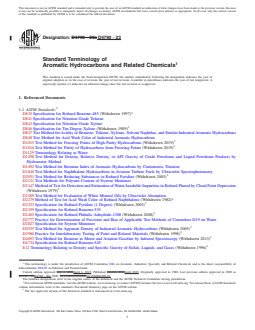
Designation: D4790 − 23
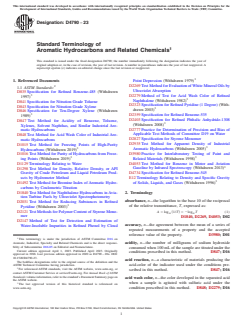
Standard Terminology of
Aromatic Hydrocarbons and Related Chemicals
This standard is issued under the fixed designation D4790; the number immediately following the designation indicates the year of
original adoption or, in the case of revision, the year of last revision. A number in parentheses indicates the year of last reapproval. A
superscript epsilon (´) indicates an editorial change since the last revision or reapproval.
1. Referenced Documents Point Depression (Withdrawn 1979)
D2269 Test Method for Evaluation of White Mineral Oils by
1.1 ASTM Standards:
Ultraviolet Absorption
D835 Specification for Refined Benzene-485 (Withdrawn
D2279 Method of Test for Acid Wash Color of Refined
1997)
Naphthalene (Withdrawn 1982)
D841 Specification for Nitration Grade Toluene
D2323 Specification for Refined Pyridine (1 Degree) (With-
D843 Specification for Nitration Grade Xylene
drawn 2003)
D846 Specification for Ten-Degree Xylene (Withdrawn
D2359 Specification for Refined Benzene-535
1989)
D2403 Specification for Refined Phthalic Anhydride-1308
D847 Test Method for Acidity of Benzene, Toluene,
(Withdrawn 2008)
Xylenes, Solvent Naphthas, and Similar Industrial Aro-
D2777 Practice for Determination of Precision and Bias of
matic Hydrocarbons
Applicable Test Methods of Committee D19 on Water
D848 Test Method for Acid Wash Color of Industrial Aro-
D2827 Specification for Styrene Monomer
matic Hydrocarbons
D2935 Test Method for Apparent Density of Industrial
D1015 Test Method for Freezing Points of High-Purity
Aromatic Hydrocarbons (Withdrawn 2005)
Hydrocarbons (Withdrawn 2019)
D3980 Practice for Interlaboratory Testing of Paint and
D1016 Test Method for Purity of Hydrocarbons from Freez-
3 3
Related Materials (Withdrawn 1998)
ing Points (Withdrawn 2019)
D4053 Test Method for Benzene in Motor and Aviation
D1129 Terminology Relating to Water
Gasoline by Infrared Spectroscopy (Withdrawn 2013)
D1298 Test Method for Density, Relative Density, or API
Gravity of Crude Petroleum and Liquid Petroleum Prod- D4734 Specification for Refined Benzene-545
ucts by Hydrometer Method E12 Terminology Relating to Density and Specific Gravity
D1492 Test Method for Bromine Index of Aromatic Hydro- of Solids, Liquids, and Gases (Withdrawn 1996)
carbons by Coulometric Titration
D1840 Test Method for Naphthalene Hydrocarbons in Avia-
2. Terminology
tion Turbine Fuels by Ultraviolet Spectrophotometry
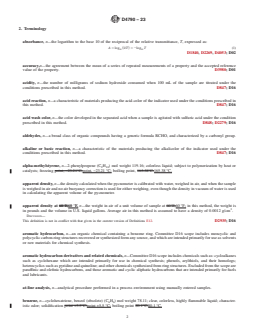
absorbance, n—the logarithm to the base 10 of the reciprocal
D2031 Test Method for Reducing Substances in Refined
of the relative transmittance, T, expressed as:
Pyridine (Withdrawn 2003)
D2121 Test Methods for Polymer Content of Styrene Mono-
A 5 log 1/T 5 2log T (1)
~ !
10 10
mer
D1840, D2269, D4053; D02
D2147 Method of Test for Detection and Estimation of
accuracy, n—the agreement between the mean of a series of
Water-Insoluble Impurities in Refined Phenol by Cloud
repeated measurements of a property and the accepted
reference value of the property. D3980; D01
This terminology is under the jurisdiction of ASTM Committee D16 on
Aromatic, Industrial, Specialty and Related Chemicals and is the direct responsi- acidity, n—the number of milligrams of sodium hydroxide
bility of Subcommittee D16.05 on Editorial and Nomenclature.
consumed when 100 mL of the sample are titrated under the
Current edition approved April 1, 2023. Published April 2023. Originally
conditions prescribed in this method. D847; D16
approved in 1988. Last previous edition approved in 2020 as D4790 – 20a. DOI:
10.1520/D4790-23.
acid reaction, n—a characteristic of materials producing the
The boldface designations refer to the original source of the definition and the
ASTM Technical Committee having jurisdiction. acid-color of the indicator used under the conditions pre-
For referenced ASTM standards, visit the ASTM website, www.astm.org, or
scribed in this method. D847; D16
contact ASTM Customer Service at service@astm.org. For Annual Book of ASTM
Standards volume information, refer to the standard’s Document Summary page on
acid wash color, n—the color developed in the separated acid
the ASTM website.
when a sample is agitated with sulfuric acid under the
The last approved version of this historical standard is referenced on
www.astm.org. condition prescribed in this method. D848; D2279; D16
Copyright © ASTM International, 100 Barr Harbor Drive, PO Box C700, West Conshohocken, PA 19428-2959. United States
D4790 − 23
aldehydes, n—a broad class of organic compounds having a a total distillation range of no more than 1 °C. Refer to
generic formula RCHO, and characterized by a carbonyl Specification D4734.
group.
benzene-485, refined (nitration grade), n—benzene with
alkaline or basic reaction, n—a characteristic of the materials impurities limited by a solidification point of 4.85 °C and
producing the alkalicolor of the indicator used under the
having a total distillation range of no more than 1.0 °C.
conditions prescribed in this method. D847; D16 Refer to Specification D835 for complete specifications.
alpha-methylstyrene, n—2-phenylpropene (C H ) mol
benzene, thiophene-free, n—benzene refined by special treat-
9 10
weight 119.16; colorless liquid; subject to polymerization by
ment and used as a reagent in ASTM standards.
heat or catalysts; freezing point, −23.21 °C; boiling point,
bias, n—a persistent positive or negative deviation of a test
165.38 °C.
method average value from the assumed or accepted true
apparent density, n—the density calculated when the pycnom-
value. D1129; D2777; D19
eter is calibrated with water, weighed in air, and when the
blank, n—a sample prepared to compensate for impurities in
sample is weighed in air and no air buoyancy correction is
the materials used to prepare a sample for analysis.
used for either weighing, even though the density in vacuum
Explanation—A blank is prepared omitting the sample when
of water is used in calculating the apparent volume of the
materials used to prepare a sample for analysis may contain
pycnometer.
the analyte being measured; the blank is then subtracted
apparent density at 60 °F, n—the weight in air of a unit
from the result.
volume of sample at 60 °F; in this method, the weight is in
bromine index, n—the number of milligrams of bromine
pounds and the volume in U.S. liquid gallons. Average air in
consumed by 100 g of sample under given conditions.
this method is assumed to have a density of 0.0012 g/cm .
D1492; D16
DISCUSSION—This definition is not in conflict with that given in the
current version of Definitions E12. D2935; D16
carbon disulfide (CS ), n—mol weight 76.14; clear, colorless,
flammable, volatile liquid; boiling point, 45.6 °C; freezing
aromatic hydrocarbon, n—an organic chemical containing a
point, 111.6 °C.
benzene ring. Committee D16 scope includes moncyclic and
polycyclic carbon-ring structures recovered or synthesized
clear, n—free of turbidity.
form any source, and which are intended primarily for use as
solvents or raw materials for chemical synthesis.
cloud point of phenol, n—the temperature at which a separate
phase forms when a homogeneous solution of phenol in
aromatic hydrocarbon derivatives and related chemicals,
water is allowed to cool at a prescribed rate from a
n—Committee D16 scope includes chemicals such as: cy-
temperature above that at which phase separation occurs. It
cloalkanes such as cyclohexane which are intended primar-
may precisely be defined as follows: when a homogeneous
ily for use in chemical synthesis; phenols, arylthiols, and
solution of phenol and water is allowed to cool at a
their homologs; heterocyclics such as pyridine and quino-
prescribed rate with stirring, the solution will show a slight
line; and other chemicals synthesized from ring structures.
cloudiness or turbidity as the cloud point is approached. On
Excluded from the scope are paraffinic and olefinic
further cooling, the cloudiness will increase rapidly and the
hydrocarbons, and those aromatic and cyclic aliphatic hy-
thermometer bulb, which is centrally located in the test tube,
drocarbons that are intended primarily for fuels and lubri-
will suddenly become invisible. The temperature at which
cants.
the thermometer bulb becomes invisible is taken as the cloud
point. D2147; D16
at-line analysis, n—analytical procedure performed in a pro-
cess environment using manually entered samples.
cloudy, n—qualitative expression of turbidity.
benzene, n—cyclohexatriene, benzol (obsolete) (C H ) mol
6 6
confidence limits, n—the limits on either side of the mean
weight 78.11; clear, colorless, highly flammable liquid;
value of a group of observations which will, in a stated
characteristic odor; solidification point +5.5 °C; boiling
fraction or percent of the cases include the expected value.
point 80.1 °C.
Thus the 95 % confidence limits are the values between
which the population mean will be situated in 95 out of 100
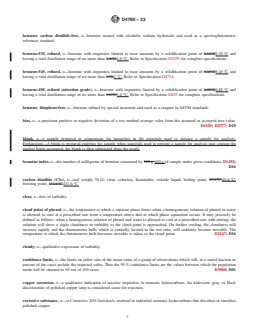
benzene, carbon disulfide-free, n—benzene treated with al-
coholic sodium hydroxide and used as a spectrophotometric cases. D3980; D01
reference standard.
copper corrosion, n—a qualitative indication of reactive
impurities in aromatic hydrocarbons. An iridescent, gray, or
benzene-535, refined, n—benzene with impurities limited to
trace amounts by a solidification point of 5.35 °C and having black discoloration of polished copper strip is considered
a total distillation range of no more than 1.0 °C. Refer to cause for rejection.
Specification D2359 for complete specifications.
corrosive substance, n—in Committee D16 Standards, mate-
benzene-545, refined, n—benzene with impurities limited to rial in industrial aromatic hydrocarbons that discolors or
trace amounts by a solidification point of 5.45 °C and having tarnishes polished copper.
D4790 − 23
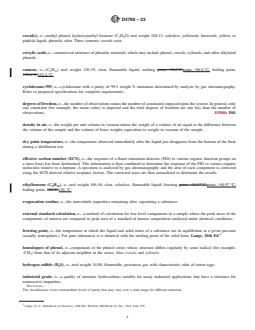
cresol(s), n—methyl phenol, hydroxymethyl benzene (C H O) homologues of phenol, n—compounds of the phenol series
7 8
mol weight 108.13; colorless, yellowish, brownish, yellow, whose structure differs regularly by some radical (for
or pinkish liquid; phenolic odor. Three isomeric cresols example, -CH ) from that of its adjacent neighbor in the
exist. series. Also cresols and xylenols.
cresylic acids, n—commercial mixtures of phenolic materials
hydrogen sulfide (H S), n—mol weight 34.08; flammable,
which may include phenol, cresols, xylenols, and other poisonous gas with characteristic odor of rotten eggs.
alkylated phenols.
industrial grade, n—a quality of aromatic hydrocarbons
cumene, n—(C H ) mol weight 120.19; clear, flammable
suitable for many industrial applications that have a toler-
9 12
liquid; melting point, −96.0 °C; boiling point, 152.4 °C.
ance for nonreactive impurities.
DISCUSSION—The classification covers intermediate levels of purity
cyclohexane-995, n—cyclohexane with a purity of 99.5
that may vary over a wide range for different materials.
weight % minimum determined by analysis by gas chroma-
inhibitor, n—a substance added to a material to retard or
tography. Refer to proposed specifications for complete
prevent deterioration.
requirements.
degrees of freedom, n—the number of observations minus the initial boiling point, n—the temperature observed immedi-
number of constraints imposed upon the system. In general, ately after the first drop of distillate falls into the receiving
only one constraint (for example, the mean value) is imposed cylinder during a distillation test.
and the total degrees of freedom are one less than the number
internal standard calculation, n—a method of calculation for
of observations. D3980; D01
low-level components in a sample where the peak areas of
density in air, n—the weight per unit volume in vacuum minus the components of interest are compared to peak area of a
the weight of a volume of air equal to the difference between
compound, not originally present in the sample, which was
the volume of the sample and the volume of brass weights quantitatively added to the specimen before analysis. The
equivalent to weight in vacuum of the sample.
peak areas may be corrected for known differences in
response by applying relative response factors.
dry point temperature, n—the temperature observed imme-
diately after the liquid just disappears from the bottom of the
isopropylbenzene—see cumene.
flask during a distillation test.
ketones, n—a class of organic compounds possessing a carbo-
effective carbon number (ECN), n—the response of a flame
nyl group attached to two hydrocarbon groups. Acetone is
ionization detector (FID) to various organic function groups
the first member of this series.
on a mass basis has been determined. This information is
limit of detection (LOD), n—this is the limiting level where
then combined to determine the response of the FID to
the measured value exceeds its uncertainty and is thus the
various organic molecules relative to n-heptane. A specimen
limit of detection with 95 % confidence and is calculated as
is analyzed by gas chromatography and the area of each
3 * s . The relative uncertainty is 6100 %. When LOD is
o
component is corrected using the ECN-derived relative
determined from a proficiency testing program (PTP), LOD
response factors. The corrected areas are then normalized to
is defined as LOD .
PTP
determine the results.
limit of quantitation (LOQ), n—the American Chemical
ethylbenzene (C H ), n—mol weight 106.16; clear, colorless,
8 10
Society Committee on Environmental Quality calls this the
flammable liquid; freezing point, −94.97 °C; boiling point,
limit of quantitation and arbitrarily defines it as 10 * s . The
136 °C. o
relative uncertainty is 630 %. s is the standard deviation as
o
evaporation residue, n—the nonvolatile impurities remaining
the concentration approaches 0.
after vaporizing a substance.
meta-xylene, n—1,3-dimethylbenzene (C H ) mol weight
8 10
external standard calculation, n—a method of calculation for
106.16; clear, colorless, flammable liquid; freezing
low-level components in a sample wher
...
This document is not an ASTM standard and is intended only to provide the user of an ASTM standard an indication of what changes have been made to the previous version. Because
it may not be technically possible to adequately depict all changes accurately, ASTM recommends that users consult prior editions as appropriate. In all cases only the current version
of the standard as published by ASTM is to be considered the official document.
Designation: D4790 − 20a D4790 − 23
Standard Terminology of
Aromatic Hydrocarbons and Related Chemicals
This standard is issued under the fixed designation D4790; the number immediately following the designation indicates the year of
original adoption or, in the case of revision, the year of last revision. A number in parentheses indicates the year of last reapproval. A
superscript epsilon (´) indicates an editorial change since the last revision or reapproval.
1. Referenced Documents
1.1 ASTM Standards:
D835 Specification for Refined Benzene-485 (Withdrawn 1997)
D841 Specification for Nitration Grade Toluene
D843 Specification for Nitration Grade Xylene
D846 Specification for Ten-Degree Xylene (Withdrawn 1989)
D847 Test Method for Acidity of Benzene, Toluene, Xylenes, Solvent Naphthas, and Similar Industrial Aromatic Hydrocarbons
D848 Test Method for Acid Wash Color of Industrial Aromatic Hydrocarbons
D1015 Test Method for Freezing Points of High-Purity Hydrocarbons (Withdrawn 2019)
D1016 Test Method for Purity of Hydrocarbons from Freezing Points (Withdrawn 2019)
D1129 Terminology Relating to Water
D1298 Test Method for Density, Relative Density, or API Gravity of Crude Petroleum and Liquid Petroleum Products by
Hydrometer Method
D1492 Test Method for Bromine Index of Aromatic Hydrocarbons by Coulometric Titration
D1840 Test Method for Naphthalene Hydrocarbons in Aviation Turbine Fuels by Ultraviolet Spectrophotometry
D2031 Test Method for Reducing Substances in Refined Pyridine (Withdrawn 2003)
D2121 Test Methods for Polymer Content of Styrene Monomer
D2147 Method of Test for Detection and Estimation of Water-Insoluble Impurities in Refined Phenol by Cloud Point Depression
(Withdrawn 1979)
D2269 Test Method for Evaluation of White Mineral Oils by Ultraviolet Absorption
D2279 Method of Test for Acid Wash Color of Refined Naphthalene (Withdrawn 1982)
D2323 Specification for Refined Pyridine (1 Degree) (Withdrawn 2003)
D2359 Specification for Refined Benzene-535
D2403 Specification for Refined Phthalic Anhydride-1308 (Withdrawn 2008)
D2777 Practice for Determination of Precision and Bias of Applicable Test Methods of Committee D19 on Water
D2827 Specification for Styrene Monomer
D2935 Test Method for Apparent Density of Industrial Aromatic Hydrocarbons (Withdrawn 2005)
D3980 Practice for Interlaboratory Testing of Paint and Related Materials (Withdrawn 1998)
D4053 Test Method for Benzene in Motor and Aviation Gasoline by Infrared Spectroscopy (Withdrawn 2013)
D4734 Specification for Refined Benzene-545
E12 Terminology Relating to Density and Specific Gravity of Solids, Liquids, and Gases (Withdrawn 1996)
This terminology is under the jurisdiction of ASTM Committee D16 on Aromatic, Industrial, Specialty and Related Chemicals and is the direct responsibility of
Subcommittee D16.05 on Editorial and Nomenclature.
Current edition approved Oct. 1, 2020April 1, 2023. Published October 2020April 2023. Originally approved in 1988. Last previous edition approved in 2020 as
D4790 – 20.D4790 – 20a. DOI: 10.1520/D4790-20A.10.1520/D4790-23.
The boldface designations refer to the original source of the definition and the ASTM Technical Committee having jurisdiction.
For referenced ASTM standards, visit the ASTM website, www.astm.org, or contact ASTM Customer Service at service@astm.org. For Annual Book of ASTM Standards
volume information, refer to the standard’s Document Summary page on the ASTM website.
The last approved version of this historical standard is referenced on www.astm.org.
Copyright © ASTM International, 100 Barr Harbor Drive, PO Box C700, West Conshohocken, PA 19428-2959. United States
D4790 − 23
2. Terminology
absorbance, n—the logarithm to the base 10 of the reciprocal of the relative transmittance, T, expressed as:
A 5 log 1/T 52log T (1)
~ !
10 10
D1840, D2269, D4053; D02
accuracy,n—the agreement between the mean of a series of repeated measurements of a property and the accepted reference
value of the property. D3980; D01
acidity, n—the number of milligrams of sodium hydroxide consumed when 100 mL of the sample are titrated under the
conditions prescribed in this method. D847; D16
acid reaction, n—a characteristic of materials producing the acid-color of the indicator used under the conditions prescribed in
this method. D847; D16
acid wash color, n—the color developed in the separated acid when a sample is agitated with sulfuric acid under the condition
prescribed in this method. D848; D2279; D16
aldehydes, n—a broad class of organic compounds having a generic formula RCHO, and characterized by a carbonyl group.
alkaline or basic reaction, n—a characteristic of the materials producing the alkalicolor of the indicator used under the
conditions prescribed in this method. D847; D16
alpha-methylstyrene, n—2-phenylpropene (C H ) mol weight 119.16; colorless liquid; subject to polymerization by heat or
9 10
catalysts; freezing point, −23.21°C;point, −23.21 °C; boiling point, 165.38°C.165.38 °C.
apparent density, n—the density calculated when the pycnometer is calibrated with water, weighed in air, and when the sample
is weighed in air and no air buoyancy correction is used for either weighing, even though the density in vacuum of water is used
in calculating the apparent volume of the pycnometer.
apparent density at 60°F,60 °F, n—the weight in air of a unit volume of sample at 60°F;60 °F; in this method, the weight is
in pounds and the volume in U.S. liquid gallons. Average air in this method is assumed to have a density of 0.0012 g/cm .
DISCUSSION—
This definition is not in conflict with that given in the current version of Definitions E12. D2935; D16
aromatic hydrocarbon, n—an organic chemical containing a benzene ring. Committee D16 scope includes moncyclic and
polycyclic carbon-ring structures recovered or synthesized form any source, and which are intended primarily for use as solvents
or raw materials for chemical synthesis.
aromatic hydrocarbon derivatives and related chemicals, n—Committee D16 scope includes chemicals such as: cycloalkanes
such as cyclohexane which are intended primarily for use in chemical synthesis; phenols, arylthiols, and their homologs;
heterocyclics such as pyridine and quinoline; and other chemicals synthesized from ring structures. Excluded from the scope are
paraffinic and olefinic hydrocarbons, and those aromatic and cyclic aliphatic hydrocarbons that are intended primarily for fuels
and lubricants.
at-line analysis, n—analytical procedure performed in a process environment using manually entered samples.
benzene, n—cyclohexatriene, benzol (obsolete) (C H ) mol weight 78.11; clear, colorless, highly flammable liquid; character-
6 6
istic odor; solidification point +5.5°C;point +5.5 °C; boiling point 80.1°C.80.1 °C.
D4790 − 23
benzene, carbon disulfide-free, n—benzene treated with alcoholic sodium hydroxide and used as a spectrophotometric
reference standard.
benzene-535, refined, n—benzene with impurities limited to trace amounts by a solidification point of 5.35°C5.35 °C and
having a total distillation range of no more than 1.0°C.1.0 °C. Refer to Specification D2359 for complete specifications.
benzene-545, refined, n—benzene with impurities limited to trace amounts by a solidification point of 5.45°C5.45 °C and
having a total distillation range of no more than 1°C.1 °C. Refer to Specification D4734.
benzene-485, refined (nitration grade), n—benzene with impurities limited by a solidification point of 4.85°C4.85 °C and
having a total distillation range of no more than 1.0°C.1.0 °C. Refer to Specification D835 for complete specifications.
benzene, thiophene-free, n—benzene refined by special treatment and used as a reagent in ASTM standards.
bias, n—a persistent positive or negative deviation of a test method average value from the assumed or accepted true value.
D1129; D2777; D19
blank, n—a sample prepared to compensate for impurities in the materials used to prepare a sample for analysis.
Explanation—A blank is prepared omitting the sample when materials used to prepare a sample for analysis may contain the
analyte being measured; the blank is then subtracted from the result.
bromine index, n—the number of milligrams of bromine consumed by 100 g 100 g of sample under given conditions. D1492;
D16
carbon disulfide (CS ), n—mol weight 76.14; clear, colorless, flammable, volatile liquid; boiling point, 45.6°C;45.6 °C;
freezing point, 111.6°C.111.6 °C.
clear, n—free of turbidity.
cloud point of phenol, n—the temperature at which a separate phase forms when a homogeneous solution of phenol in water
is allowed to cool at a prescribed rate from a temperature above that at which phase separation occurs. It may precisely be
defined as follows: when a homogeneous solution of phenol and water is allowed to cool at a prescribed rate with stirring, the
solution will show a slight cloudiness or turbidity as the cloud point is approached. On further cooling, the cloudiness will
increase rapidly and the thermometer bulb, which is centrally located in the test tube, will suddenly become invisible. The
temperature at which the thermometer bulb becomes invisible is taken as the cloud point. D2147; D16
cloudy, n—qualitative expression of turbidity.
confidence limits, n—the limits on either side of the mean value of a group of observations which will, in a stated fraction or
percent of the cases include the expected value. Thus the 95 % confidence limits are the values between which the population
mean will be situated in 95 out of 100 cases. D3980; D01
copper corrosion, n—a qualitative indication of reactive impurities in aromatic hydrocarbons. An iridescent, gray, or black
discoloration of polished copper strip is considered cause for rejection.
corrosive substance, n—in Committee D16 Standards, material in industrial aromatic hydrocarbons that discolors or tarnishes
polished copper.
D4790 − 23
cresol(s), n—methyl phenol, hydroxymethyl benzene (C H O) mol weight 108.13; colorless, yellowish, brownish, yellow, or
7 8
pinkish liquid; phenolic odor. Three isomeric cresols exist.
cresylic acids, n—commercial mixtures of phenolic materials which may include phenol, cresols, xylenols, and other alkylated
phenols.
cumene, n—(C H ) mol weight 120.19; clear, flammable liquid; melting point, −96.0°C;point, −96.0 °C; boiling point,
9 12
152.4°C.152.4 °C.
cyclohexane-995, n—cyclohexane with a purity of 99.5 weight % minimum determined by analysis by gas chromatography.
Refer to proposed specifications for complete requirements.
degrees of freedom, n—the number of observations minus the number of constraints imposed upon the system. In general, only
one constraint (for example, the mean value) is imposed and the total degrees of freedom are one less than the number of
observations. D3980; D01
density in air, n—the weight per unit volume in vacuum minus the weight of a volume of air equal to the difference between
the volume of the sample and the volume of brass weights equivalent to weight in vacuum of the sample.
dry point temperature, n—the temperature observed immediately after the liquid just disappears from the bottom of the flask
during a distillation test.
effective carbon number (ECN), n—the response of a flame ionization detector (FID) to various organic function groups on
a mass basis has been determined. This information is then combined to determine the response of the FID to various organic
molecules relative to n-heptane. A specimen is analyzed by gas chromatography and the area of each component is corrected
using the ECN-derived relative response factors. The corrected areas are then normalized to determine the results.
ethylbenzene (C H ), n—mol weight 106.16; clear, colorless, flammable liquid; freezing point, −94.97°C;point, −94.97 °C;
8 10
boiling point, 136°C.136 °C.
evaporation residue, n—the nonvolatile impurities remaining after vaporizing a substance.
external standard calculation, n—a method of calculation for low-level components in a sample where the peak areas of the
components of interest are compared to peak area of a standard of known composition analyzed under identical conditions.
freezing point, n—the temperature at which the liquid and solid states of a substance are in equilibrium at a given pressure
(usually atmospheric). For pure substances it is identical with the melting point of the solid form. Lange, 10th Ed.
homologues of phenol, n—compounds of the phenol series whose structure differs regularly by some radical (for example,
-CH ) from that of its adjacent neighbor in the series. Also cresols and xylenols.
hydrogen sulfide (H S), n—mol weight 34.08; flammable, poisonous gas with characteristic odor of rotten eggs.
industrial grade, n—a quality of aromatic hydrocarbons suitable for many industrial applications that have a tolerance for
nonreactive impurities.
DISCUSSION—
The classification covers intermediate levels of purity that may vary over a wide range for different materials.
Lange, N. A., Handbook of Chemistry, 10th Ed., McGraw Hill Book Co. Inc., New York, NY.
D4790 − 23
inhibitor, n—a substance added to a material to retard or prevent deterioration.
initial boiling point, n—the temperature observed immediately after the first drop of distillate falls into the receiving cylinder
during a distillation test.
internal standard calculation, n—a method of calculation for low-level components in a sample where the peak areas of the
components of interest are compared to peak area of a compound, not originally present in the sample, which was quantitatively
added to the specimen before analysis. The peak areas may be corrected for known differences in response by applying relative
response factors.
isopropylbenzene—see cumene.
ketones, n—a class of organic compounds possessing a carbonyl group attached to two hydrocarbon groups. Acetone is the first
member of this series.
limit of detection (LOD), n—this is the limiting level where the measured value exceeds its uncertainty and is thus the limit
of detection with 95 % confidence and is calculated as 3 * s e. . The relative uncertainty is 6100 %. When LOD is determined
o
from a proficiency testing program (PTP), LOD is defined as LOD .
PTP
limit of quantitation (LOQ), n—the American Chemic
...