

ASTM F906-85(2020)
(Specification)Standard Specification for Letters and Numerals for Ships
General Information
- Abstract
ABSTRACT
This specification covers the shape, size, spacing, and shading requirements of letters and numerals used in shipboard markings. Covered by this specification are five types of characters: plain letters and numerals (Type 1), block letters and numerals having the same width (Type 2), Type 2 characters with shading (Type 3), block letters and numerals of different widths (Type 4), and Type 4 characters with shading (Type 5). The characters shall be designed using the grid method, which will allow one to change the character size proportionately as required. Not covered in this specification are the location and size of various shipboard markings using letters and numerals.
SCOPE
1.1 This specification specifies shape, size, spacing, and shading of letters and numerals to be used aboard ship.
1.2 Characters are of Five Types:
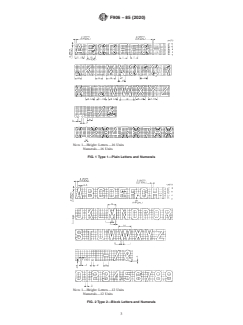
1.2.1 Type 1—Plain letters and numerals (16 units).
1.2.2 Type 2—Block letters and numerals (12 units).
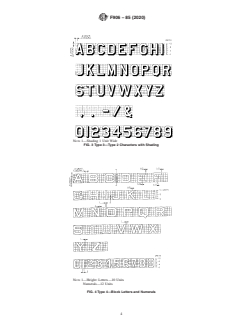
1.2.3 Type 3—Type 2 characters with shading (shading—1 unit).
1.2.4 Type 4—Block letters (10 units) and numerals (12 units).
1.2.5 Type 5—Type 4 characters with shading (shading—1 unit).
1.3 This specification does not give location or size of various shipboard markings incorporating letters and numerals.
1.4 This international standard was developed in accordance with internationally recognized principles on standardization established in the Decision on Principles for the Development of International Standards, Guides and Recommendations issued by the World Trade Organization Technical Barriers to Trade (TBT) Committee.
- Status
- Published
- Publication Date
- 31-Jan-2020
- Technical Committee
- F25 - Ships and Marine Technology
- Drafting Committee
- F25.07 - General Requirements
Overview
ASTM F906-85(2020): Standard Specification for Letters and Numerals for Ships defines the standardized requirements for the shape, size, spacing, and shading of letters and numerals used on shipboard markings. The intent of this standard is to ensure uniformity, readability, and clarity in the presentation of alphanumeric characters applied to ships. This specification is widely recognized and has been approved for use by U.S. Department of Defense agencies, and it is developed in accordance with international principles of standardization as established by the World Trade Organization (WTO) Technical Barriers to Trade (TBT) Committee.
Key Topics
- Character Types: The standard covers five different character types for shipboard markings:
- Type 1: Plain letters and numerals
- Type 2: Block letters and numerals (equal width)
- Type 3: Type 2 characters with shading
- Type 4: Block letters (varying width) and numerals
- Type 5: Type 4 characters with shading
- Design Principle: All characters are designed using a grid method, allowing proportional scaling to meet varying size requirements.
- Key Features Specified:
- Shape and stroke of each character
- Character height and width (expressed in units, varying by type)
- Spacing between individual letters, numerals, words, and sentences
- Shading requirements for certain character types
- Exclusions: The standard does not cover the specific locations or overall size of markings on ships, only the appearance and arrangement of the actual characters.
Applications
Adoption of ASTM F906-85(2020) is essential in the following areas:
- Shipboard Identification: Ensures that all ship markings (such as names, identification numbers, and other labels) are consistent, legible, and easily recognizable in marine environments.
- Regulatory Compliance: Addresses requirements set by defense and maritime authorities for vessel marking schemes.
- Shipbuilding and Maintenance: Provides clear guidelines to naval architects, marine engineers, painters, and maintenance teams for applying durable and standardized ship lettering and numbering.
- Safety and Emergency Response: Enhances legibility for first responders and crew, helping to quickly identify vessels in routine and emergency scenarios.
- International Uniformity: Facilitates consistency in marking ships on a global scale, aiding shipping companies, port authorities, and inspection bodies in verifying compliance.
Related Standards
- ASTM F25: Committee on Ships and Marine Technology provides guidance for various marine-related standards.
- ISO Ship Marking Standards: International standards outlining vessel marking practices and requirements.
- US Coast Guard Regulations: Complementary requirements for vessel identification and safety compliance.
- IMO Conventions: International Maritime Organization guidance may reference or be harmonized with character marking practices encouraged by ASTM F906-85(2020).
Practical Value
Implementing ASTM F906-85(2020) offers several practical benefits for ship operators, designers, and regulators:
- Consistency: Promotes uniform shipboard markings across fleets, reducing confusion and enhancing vessel identification.
- Efficiency: Streamlines the process for specifying, ordering, and applying letters and numerals, thanks to clear design and spacing rules.
- Readability: Optimizes legibility in various lighting and weather conditions, which is critical for operational safety and compliance auditing.
By adhering to this ASTM ship marking standard, marine industry stakeholders ensure that all shipboard letters and numerals meet recognized international specifications for clarity, legibility, and uniformity.
Relations
- Effective Date
- 01-Feb-2020
- Effective Date
- 01-Feb-2020
Get Certified
Connect with accredited certification bodies for this standard

DNV
DNV is an independent assurance and risk management provider.

Lloyd's Register
Lloyd's Register is a global professional services organisation specialising in engineering and technology.

FSC International
Forest Stewardship Council certification.
Sponsored listings
Frequently Asked Questions
ASTM F906-85(2020) is a technical specification published by ASTM International. Its full title is "Standard Specification for Letters and Numerals for Ships". This standard covers: ABSTRACT This specification covers the shape, size, spacing, and shading requirements of letters and numerals used in shipboard markings. Covered by this specification are five types of characters: plain letters and numerals (Type 1), block letters and numerals having the same width (Type 2), Type 2 characters with shading (Type 3), block letters and numerals of different widths (Type 4), and Type 4 characters with shading (Type 5). The characters shall be designed using the grid method, which will allow one to change the character size proportionately as required. Not covered in this specification are the location and size of various shipboard markings using letters and numerals. SCOPE 1.1 This specification specifies shape, size, spacing, and shading of letters and numerals to be used aboard ship. 1.2 Characters are of Five Types: 1.2.1 Type 1—Plain letters and numerals (16 units). 1.2.2 Type 2—Block letters and numerals (12 units). 1.2.3 Type 3—Type 2 characters with shading (shading—1 unit). 1.2.4 Type 4—Block letters (10 units) and numerals (12 units). 1.2.5 Type 5—Type 4 characters with shading (shading—1 unit). 1.3 This specification does not give location or size of various shipboard markings incorporating letters and numerals. 1.4 This international standard was developed in accordance with internationally recognized principles on standardization established in the Decision on Principles for the Development of International Standards, Guides and Recommendations issued by the World Trade Organization Technical Barriers to Trade (TBT) Committee.
ABSTRACT This specification covers the shape, size, spacing, and shading requirements of letters and numerals used in shipboard markings. Covered by this specification are five types of characters: plain letters and numerals (Type 1), block letters and numerals having the same width (Type 2), Type 2 characters with shading (Type 3), block letters and numerals of different widths (Type 4), and Type 4 characters with shading (Type 5). The characters shall be designed using the grid method, which will allow one to change the character size proportionately as required. Not covered in this specification are the location and size of various shipboard markings using letters and numerals. SCOPE 1.1 This specification specifies shape, size, spacing, and shading of letters and numerals to be used aboard ship. 1.2 Characters are of Five Types: 1.2.1 Type 1—Plain letters and numerals (16 units). 1.2.2 Type 2—Block letters and numerals (12 units). 1.2.3 Type 3—Type 2 characters with shading (shading—1 unit). 1.2.4 Type 4—Block letters (10 units) and numerals (12 units). 1.2.5 Type 5—Type 4 characters with shading (shading—1 unit). 1.3 This specification does not give location or size of various shipboard markings incorporating letters and numerals. 1.4 This international standard was developed in accordance with internationally recognized principles on standardization established in the Decision on Principles for the Development of International Standards, Guides and Recommendations issued by the World Trade Organization Technical Barriers to Trade (TBT) Committee.
ASTM F906-85(2020) is classified under the following ICS (International Classification for Standards) categories: 01.080.20 - Graphical symbols for use on specific equipment; 47.020.01 - General standards related to shipbuilding and marine structures. The ICS classification helps identify the subject area and facilitates finding related standards.
ASTM F906-85(2020) has the following relationships with other standards: It is inter standard links to ASTM F906-85(2014), ASTM F2363/F2363M-17(2023). Understanding these relationships helps ensure you are using the most current and applicable version of the standard.
ASTM F906-85(2020) is available in PDF format for immediate download after purchase. The document can be added to your cart and obtained through the secure checkout process. Digital delivery ensures instant access to the complete standard document.
Standards Content (Sample)
This international standard was developed in accordance with internationally recognized principles on standardization established in the Decision on Principles for the
Development of International Standards, Guides and Recommendations issued by the World Trade Organization Technical Barriers to Trade (TBT) Committee.
Designation:F906 −85 (Reapproved 2020) An American National Standard
Standard Specification for
Letters and Numerals for Ships
ThisstandardisissuedunderthefixeddesignationF906;thenumberimmediatelyfollowingthedesignationindicatestheyearoforiginal
adoption or, in the case of revision, the year of last revision.Anumber in parentheses indicates the year of last reapproval.Asuperscript
epsilon (´) indicates an editorial change since the last revision or reapproval.
This standard has been approved for use by agencies of the U.S. Department of Defense.
1. Scope 3.1.2 Character Width:
3.1.2.1 Type 1, Plain Characters—12 in accordance with
1.1 This specification specifies shape, size, spacing, and
Fig. 1 unless otherwise noted.
shading of letters and numerals to be used aboard ship.
3.1.2.2 Type 2, Block Characters—8 units in accordance
1.2 Characters are of Five Types:
with Fig. 2 unless otherwise noted.
1.2.1 Type 1—Plain letters and numerals (16 units).
3.1.2.3 Type 3, Block Characters with Shading—Same as
1.2.2 Type 2—Block letters and numerals (12 units).
Type 2 plus 1 unit for shading in accordance with Fig. 3.
1.2.3 Type 3—Type 2 characters with shading (shading—1
3.1.2.4 Type 4, Block Characters, Letters—Width varies.
unit).
Numerals—8 units.
1.2.4 Type 4—Block letters (10 units) and numerals (12
3.1.2.5 Type 5, Block Characters with Shading—Same as
units).
Type 4 plus 1 unit for shading.
1.2.5 Type 5—Type 4 characters with shading (shading—1
3.2 Sizing of the Character:
unit).
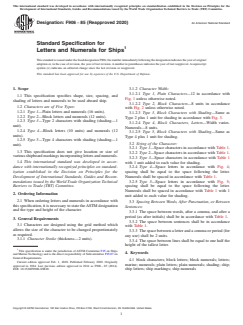
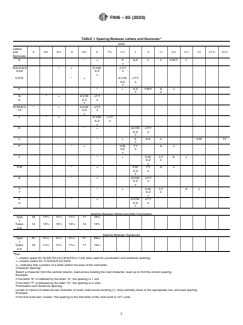
3.2.1 Type 1—Space characters in accordance with Table 1.
1.3 This specification does not give location or size of
3.2.2 Type 2—Space characters in accordance with Table 1.
various shipboard markings incorporating letters and numerals.
3.2.3 Type 3—Space characters in accordance with Table 1
1.4 This international standard was developed in accor- with 1 unit added to each value for shading.
dance with internationally recognized principles on standard-
3.2.4 Type 4—Space letters in accordance with Fig. 4;
ization established in the Decision on Principles for the spacing shall be equal to the space following the letter.
Development of International Standards, Guides and Recom-
Numerals shall be spaced in accordance with Table 1.
mendations issued by the World Trade Organization Technical
3.2.5 Type 5—Space letters in accordance with Fig. 5;
Barriers to Trade (TBT) Committee. spacing shall be equal to the space following the letter.
Numerals shall be spaced in accordance with Table 1 with 1
2. Ordering Information
unit added to each value for shading.
2.1 When ordering letters and numerals in accordance with
3.3 Spacing Between Words, After Punctuation, or Between
this specification, it is necessary to state theASTM designation
Sentences:
and the type and height of the character.
3.3.1 The space between words, after a comma, and after a
period (as after initials) shall be in accordance with Table 1.
3. General Requirements
3.3.2 The space between sentences shall be in accordance
3.1 Characters are designed using the grid method which
with Table 1.
allows the size of the character to be changed proportionately
3.3.3 The space between a letter and a comma or period (for
as required.
any use) shall be 2 units.
3.1.1 Character Stroke (thickness—2 units).
3.3.4 The space between lines shall be equal to one half the
height of the tallest letter.
This specification is under the jurisdiction of ASTM Committee F25 on Ships
4. Keywords
and Marine Technology and is the direct responsibility of Subcommittee F25.07 on
General Requirements.
4.1 block characters; block letters; block numerals; letters;
Current edition approved Feb. 1, 2020. Published February 2020. Originally
marine; numerals; plain letters; plain numerals; shading; ship;
approved in 1984. Last previous edition approv
...