

ASTM F2973-21
(Specification)Standard Specification for Insulating Lifting Links for Load Lifting Equipment Working Near Energized Power Lines
General Information
- Abstract
SCOPE
1.1 This specification covers insulating lifting links used for protection of workers positioning a load from accidental contact of the load lifting equipment with live electrical conductors, apparatus, and circuits.
1.2 This specification includes design, material, and testing requirements for the manufacturer and in-service inspection, testing and care requirements for the user or the agent of the user.
1.3 Insulating links whose primary application does not pertain to power line electrical safety are not within the scope of this specification.
1.4 The values stated in SI units are to be regarded as standard. No other units of measurement are included in this standard.
1.5 This standard does not purport to address all of the safety concerns, if any, associated with its use. It is the responsibility of the user of this standard to establish appropriate safety, health, and environmental practices and determine the applicability of regulatory limitations prior to use.
1.6 This international standard was developed in accordance with internationally recognized principles on standardization established in the Decision on Principles for the Development of International Standards, Guides and Recommendations issued by the World Trade Organization Technical Barriers to Trade (TBT) Committee.
- Status
- Published
- Publication Date
- 30-Apr-2021
- Technical Committee
- F18 - Electrical Protective Equipment for Workers
- Drafting Committee
- F18.55 - Inspection and Non-Destructive Test Methods for Aerial Devices
Buy Documents
ASTM F2973-21 - Standard Specification for Insulating Lifting Links for Load Lifting Equipment Working Near Energized Power Lines
REDLINE ASTM F2973-21 - Standard Specification for Insulating Lifting Links for Load Lifting Equipment Working Near Energized Power Lines
Overview
ASTM F2973-21: Standard Specification for Insulating Lifting Links for Load Lifting Equipment Working Near Energized Power Lines establishes requirements for insulating lifting links designed to protect workers and equipment during lifting operations near energized electrical conductors, apparatus, and circuits. The standard applies to manufacturers and users, detailing specifications for design, materials, testing, inspection, and maintenance to minimize electrical hazards and ensure operational safety in high-voltage environments.
This internationally recognized standard, developed by ASTM Committee F18, is critical in enhancing electrical safety for industries where overhead power line hazards are present, such as utilities, construction, and heavy equipment operations.
Key Topics
- Scope and Applicability: This standard exclusively covers insulating lifting links intended for power line electrical safety during load handling. Products not designed for this purpose are outside its scope.
- Design and Manufacturing Requirements:
- Mechanical design factor requirements based on rated load
- Electrical design factors considering rated voltage protection
- Use of nonconductive, impact-resistant, water-repellent, and UV-resistant materials
- Surface integrity-free of cracks, nicks, or defects that could compromise insulation
- Clear and permanent markings identifying manufacturer, rating, and serial numbers
- Testing and Verification:
- Design verification tests for mechanical strength and electrical insulation
- Manufacturer proof tests performed on all production units for load and voltage withstand
- Adherence to referenced standards such as ASTM E4, ISO 7500-1, and IEEE 4
- Inspection, Maintenance, and In-Service Testing:
- Frequent (daily and operational) visual inspections for surface damage or contamination
- Annual and event-triggered periodic inspections, including more detailed checks after extraordinary events (impacts, lightning, etc.)
- Cleaning, waxing, and storage protocols to maintain water repellency and insulation integrity
- In-service mechanical and electrical testing if inspection indicates potential damage
Applications
ASTM F2973-21 is essential for organizations operating load lifting equipment near energized power lines, aiming to prevent electrical accidents and ensure reliable operation. Typical applications include:
- Utility Companies: Insulating lifting links are required for cranes, derricks, and hoists used in maintenance and construction of electrical transmission and distribution systems.
- Construction Industry: Projects near overhead power lines use these devices to safeguard workers and equipment from accidental electrical contact.
- Heavy Equipment Operations: Any application where lifting operations occur in proximity to live electrical circuits or substations.
- Inspection and Compliance: Safety managers, equipment inspectors, and regulatory agencies use this standard as a benchmark for electrical safety compliance and risk mitigation.
Using ASTM F2973-21 compliant insulating links greatly reduces the risk of electrical hazards, supports regulatory compliance, and reinforces best practices in occupational health and safety management.
Related Standards
For comprehensive electrical safety and performance, consider these related standards:
- ASTM E4: Practices for Force Verification of Testing Machines - referenced for mechanical load testing procedures.
- ASTM F819: Terminology Relating to Electrical Protective Equipment for Workers - standardizes key terms used throughout F2973-21.
- IEEE 4: Standard Techniques for High-Voltage Testing - guides electrical test methodologies.
- ISO 7500-1: Metallic Materials-Verification of Static Uniaxial Testing Machines-Part 1: Tensile Testing Machines.
Referencing these standards alongside ASTM F2973-21 helps ensure comprehensive compliance, safety, and performance for insulating lifting links used near energized power lines.
Keywords: ASTM F2973-21, insulating lifting links, electrical safety, load lifting equipment, energized power lines, high-voltage protection, safety standards, inspection, maintenance, compliance.
Relations
- Effective Date
- 01-Jun-2014
- Effective Date
- 01-Jun-2010
- Effective Date
- 01-Apr-2010
- Effective Date
- 01-Nov-2009
- Effective Date
- 01-Apr-2009
- Effective Date
- 01-Dec-2008
- Effective Date
- 15-May-2008
- Effective Date
- 01-Jan-2007
- Effective Date
- 15-Nov-2006
- Effective Date
- 01-Jan-2005
- Effective Date
- 01-Dec-2004
- Effective Date
- 01-Nov-2004
- Effective Date
- 10-Aug-2003
- Effective Date
- 10-Nov-2002
- Effective Date
- 10-Apr-2001
Buy Documents
ASTM F2973-21 - Standard Specification for Insulating Lifting Links for Load Lifting Equipment Working Near Energized Power Lines
REDLINE ASTM F2973-21 - Standard Specification for Insulating Lifting Links for Load Lifting Equipment Working Near Energized Power Lines
Frequently Asked Questions
ASTM F2973-21 is a technical specification published by ASTM International. Its full title is "Standard Specification for Insulating Lifting Links for Load Lifting Equipment Working Near Energized Power Lines". This standard covers: SCOPE 1.1 This specification covers insulating lifting links used for protection of workers positioning a load from accidental contact of the load lifting equipment with live electrical conductors, apparatus, and circuits. 1.2 This specification includes design, material, and testing requirements for the manufacturer and in-service inspection, testing and care requirements for the user or the agent of the user. 1.3 Insulating links whose primary application does not pertain to power line electrical safety are not within the scope of this specification. 1.4 The values stated in SI units are to be regarded as standard. No other units of measurement are included in this standard. 1.5 This standard does not purport to address all of the safety concerns, if any, associated with its use. It is the responsibility of the user of this standard to establish appropriate safety, health, and environmental practices and determine the applicability of regulatory limitations prior to use. 1.6 This international standard was developed in accordance with internationally recognized principles on standardization established in the Decision on Principles for the Development of International Standards, Guides and Recommendations issued by the World Trade Organization Technical Barriers to Trade (TBT) Committee.
SCOPE 1.1 This specification covers insulating lifting links used for protection of workers positioning a load from accidental contact of the load lifting equipment with live electrical conductors, apparatus, and circuits. 1.2 This specification includes design, material, and testing requirements for the manufacturer and in-service inspection, testing and care requirements for the user or the agent of the user. 1.3 Insulating links whose primary application does not pertain to power line electrical safety are not within the scope of this specification. 1.4 The values stated in SI units are to be regarded as standard. No other units of measurement are included in this standard. 1.5 This standard does not purport to address all of the safety concerns, if any, associated with its use. It is the responsibility of the user of this standard to establish appropriate safety, health, and environmental practices and determine the applicability of regulatory limitations prior to use. 1.6 This international standard was developed in accordance with internationally recognized principles on standardization established in the Decision on Principles for the Development of International Standards, Guides and Recommendations issued by the World Trade Organization Technical Barriers to Trade (TBT) Committee.
ASTM F2973-21 is classified under the following ICS (International Classification for Standards) categories: 53.020.30 - Accessories for lifting equipment. The ICS classification helps identify the subject area and facilitates finding related standards.
ASTM F2973-21 has the following relationships with other standards: It is inter standard links to ASTM E4-14, ASTM E4-10, ASTM F819-10, ASTM E4-09a, ASTM E4-09, ASTM E4-08, ASTM F819-08, ASTM E4-07, ASTM F819-06, ASTM F819-05, ASTM F819-04a, ASTM F819-04, ASTM E4-03, ASTM E4-02, ASTM E4-99. Understanding these relationships helps ensure you are using the most current and applicable version of the standard.
ASTM F2973-21 is available in PDF format for immediate download after purchase. The document can be added to your cart and obtained through the secure checkout process. Digital delivery ensures instant access to the complete standard document.
Standards Content (Sample)
This international standard was developed in accordance with internationally recognized principles on standardization established in the Decision on Principles for the
Development of International Standards, Guides and Recommendations issued by the World Trade Organization Technical Barriers to Trade (TBT) Committee.
Designation:F2973 −21
Standard Specification for
Insulating Lifting Links for Load Lifting Equipment Working
Near Energized Power Lines
This standard is issued under the fixed designation F2973; the number immediately following the designation indicates the year of
original adoption or, in the case of revision, the year of last revision. A number in parentheses indicates the year of last reapproval. A
superscript epsilon (´) indicates an editorial change since the last revision or reapproval.
1. Scope F819 Terminology Relating to Electrical Protective Equip-
ment for Workers
1.1 This specification covers insulating lifting links used for
2.2 IEEE Standard:
protection of workers positioning a load from accidental
IEEE 4 Standard Techniques for High-Voltage Testing
contact of the load lifting equipment with live electrical
2.3 ISO Standard:
conductors, apparatus, and circuits.
ISO 7500–1 Metallic Materials—Verification of Static Uni-
1.2 This specification includes design, material, and testing
axial Testing Machines—Part 1: Tensile Testing
requirements for the manufacturer and in-service inspection,
Machines—Corrigendum
testing and care requirements for the user or the agent of the
user.
3. Terminology
1.3 Insulating links whose primary application does not
3.1 Definitions—Terminology used in this specification is in
pertain to power line electrical safety are not within the scope
accordance with Terminology F819.
of this specification.
3.2 Definitions of Terms Specific to This Standard:
1.4 The values stated in SI units are to be regarded as
3.2.1 design verification test, n—test made on a sample
standard. No other units of measurement are included in this
treated as representative of an industrial product.
standard.
3.2.2 electrical test, n—a test ensuring that a product meets
1.5 This standard does not purport to address all of the
the minimum electrical requirements of the standard.
safety concerns, if any, associated with its use. It is the
3.2.3 flashover, n—adisruptivedischargeoverthesurfaceof
responsibility of the user of this standard to establish appro-
the insulating link.
priate safety, health, and environmental practices and deter-
3.2.4 mechanical test, n—a test confirming that a product
mine the applicability of regulatory limitations prior to use.
meets the minimum mechanical requirements of a standard.
1.6 This international standard was developed in accor-
dance with internationally recognized principles on standard- 3.2.5 proof load, n—specific mechanical load applied in the
ization established in the Decision on Principles for the
performance of the proof load test.
Development of International Standards, Guides and Recom-
3.2.6 proof test, n—mechanical and electrical tests per-
mendations issued by the World Trade Organization Technical
formed by the manufacturer on all production units.
Barriers to Trade (TBT) Committee.
3.2.7 puncture, n—disruptive discharge through an insula-
tor.
2. Referenced Documents
3.2.8 qualified personnel, n—personnel who, by possession
2.1 ASTM Standards:
of a recognized degree, certificate, professional standing, or
E4 Practices for Force Verification of Testing Machines
skill, and who, by knowledge, training, and experience, have
demonstrated the ability to deal with problems relating to the
subject matter, the work, or the project.
This specification is under the jurisdiction of ASTM Committee F18 on
3.2.9 rated load, n—the maximum working load.
Electrical Protective Equipment for Workers and is the direct responsibility of
Subcommittee F18.55 on Inspection and Non-Destructive Test Methods for Aerial
3.2.10 visual inspection, n—visual check made to detect
Devices.
defects that impede the performance of a product(s).
Current edition approved May 1, 2021. Published May 2021. Originally
approved in 2014. Last previous edition approved in 2016 as F2973 – 16. DOI:
10.1520/F2973-21
2 3
For referenced ASTM standards, visit the ASTM website, www.astm.org, or Available from Institute of Electrical and Electronics Engineers, Inc. (IEEE),
contact ASTM Customer Service at service@astm.org. For Annual Book of ASTM 445 Hoes Ln., Piscataway, NJ 08854, http://www.ieee.org.
Standards volume information, refer to the standard’s Document Summary page on Available fromAmerican National Standards Institute (ANSI), 25 W. 43rd St.,
the ASTM website. 4th Floor, New York, NY 10036, http://www.ansi.org.
Copyright © ASTM International, 100 Barr Harbor Drive, PO Box C700, West Conshohocken, PA 19428-2959. United States
F2973−21
4. Materials and Manufacture 6.2 The electrical test equipment shall meet the require-
ments of IEEE 4-1995. The metering systems including mea-
4.1 The mechanical design factor shall not be less than 5.0
surementcableusedtomeasureACcurrentshallhaveasystem
times its rated load for ratings up to 100 tons and 4.0 times
error of5%or less.
rated load for ratings 100 tons and up.
6.3 The electrical test set up shall provide the operator
4.2 The electrical design factor of the link shall not be less
protection in the performance of his duties and isolate the
than 2 times it rated use voltage.
specimen to guard against accidental contact by persons in the
4.3 The insulation system shall not absorb water and shall
vicinity.
have a water repellent surface.
6.4 The ambient temperature for the test location shall not
4.4 Weather shields shall be made of impact resistant
be lower than 15.5 °C.
nonconductive material.
6.5 Electrical discharge characteristics and measured cur-
4.5 UV resistant polymers should be employed by the
rent of a test object can be affected by its general arrangement,
manufacturer if, without them, electrical performance may be
such as the clearance from other energized or grounded
affected.
structures,theheightabovegroundlevel,orthearrangementof
4.6 Steel used shall meet ASTM or AISI standards.
the high-voltage lead that may affect flashover voltages. For
thatreason,thegeneralarrangementshouldbeasshowninFig.
5. Workmanship and Finish
1 for testing links that are not installed on load lifting
5.1 The insulating surface of the links shall be free of
equipment.
cracks, nicks, gouges, damage to the insulating surface that
6.6 Clearance to nearby structures that are equal to or
would affect its insulating properties in both dry and wet
greater than two times the length of the shortest possible
conditions.
electrical discharge path on the test object should make any
5.2 Markings—Each link should bear permanent,
proximity effects negligible.
accessible, and readily visible markings that include, at a
minimum, the manufacturer’s mark, ASTM XXX, unit serial
7. Design Verification Tests
number, rated voltage, and rated load.
7.1 Design verification tests are to be performed on at least
5.3 Manuals—The manufacturer shall provide a manual
one representative unit from each class of insulating link, and
with each link. The manual shall contain:
thiswillqualifythatclassoflinkmodelsofvariableratedloads
5.3.1 Descriptions, specifications, and ratings of the link.
for a given rated voltage. A test unit is considered to be
5.3.2 Ambient temperature range for which the link is
representative of its group if it meets the following require-
designed.
ments:
5.3.3 Precautions concerning weather.
7.1.1 The same structural and dielectric materials, structural
5.3.4 Instructions regarding routine and frequency of in-
designs, manufacturing, and assembly methods apply to all
spections and maintenance.
links in the group,
7.1.2 The same structural stress and loading analysis can be
6. General Test Requirements
applied to all the links in the group,
6.1 Personnel responsible for the tests outlined in this
7.1.3 The test unit has the same or smaller electrical
document shall be qualified individuals in accordance with
creepage and arcing distances per kV of rating.
3.2.8, knowledgeable in the use of the test equipment used for
tensile loading and high-voltage testing. 7.2 Mechanical Design Verification Test Procedure:
FIG. 1Suggested Test Set Up for Insulated Links
F2973−21
7.2.1 The insulating link shall withstand a tensile load test 2) for 60 s without permanent deformation. The load will be
of 5.0 times its rated load for rating up to 100 tons and 4.0 increased gradually in not less than 1 min.When requested, the
times rated load for ratings 100 tons and up for 60 s without manufacturer shall supply certification of compliance by unit
separation.Thetensileloadtestistobeperformedonatestbed serial number to the purchaser.
or hydraulic pulling machine calibrated to the latest revision of
8.2 Electrical Proof Test Procedure:
either ASTM E4 or ISO 7500–1.
8.2.1 General test requirements are given in 6.2 – 6.6.
7.3 Electrical Design Verification Test Procedure: 8.2.2 An electrical proof test will be performed by the
7.3.1 Three electrical tests to verify design voltage rating manufacturer on each insulating link before purchase. A copy
shall be peformed. of the proof test report will be kept on file by the manufacturer
7.3.2 The insulating link will withstand an applied AC and made available to the customer upon request.
voltage while dry of twice the link-ratedAC voltage for 5 min 8.2.3 Electrically test the insulating link under dry
withoutdielectricpunctureorflashoverandleakageofnomore conditions, applying two times the rated link voltage. Test
than 3 mA. voltages for typical voltage ratings are listed in Table 1.
7.3.3 Thelinkshallbetestedtoverifythatitdoesnotabsorb 8.2.4 Test current shall be no more than 3 mA and there
water with time. shall be no sign of flashover or tracking.
7.3.3.1 Install the link in a humidity chamber for 48 h at a
9. Field Care, Inspection and Maintenance
tem
...
This document is not an ASTM standard and is intended only to provide the user of an ASTM standard an indication of what changes have been made to the previous version. Because
it may not be technically possible to adequately depict all changes accurately, ASTM recommends that users consult prior editions as appropriate. In all cases only the current version
of the standard as published by ASTM is to be considered the official document.
Designation: F2973 − 16 F2973 − 21
Standard Specification for
Insulating Lifting Links for Load Lifting Equipment Working
Near Energized Power Lines
This standard is issued under the fixed designation F2973; the number immediately following the designation indicates the year of
original adoption or, in the case of revision, the year of last revision. A number in parentheses indicates the year of last reapproval. A
superscript epsilon (´) indicates an editorial change since the last revision or reapproval.
1. Scope
1.1 This specification covers insulating lifting links used for protection of workers positioning a load from accidental contact of
the load lifting equipment with live electrical conductors, apparatus, and circuits.
1.2 This specification includes design, material, and testing requirements for the manufacturer and in-service inspection, testing
and care requirements for the user or the agent of the user.
1.3 Insulating links whose primary application does not pertain to power line electrical safety are not within the scope of this
specification.
1.4 The values stated in SI units are to be regarded as standard. No other units of measurement are included in this standard.
1.5 This standard does not purport to address all of the safety concerns, if any, associated with its use. It is the responsibility
of the user of this standard to establish appropriate safety safety, health, and healthenvironmental practices and determine the
applicability of regulatory limitations prior to use.
1.6 This international standard was developed in accordance with internationally recognized principles on standardization
established in the Decision on Principles for the Development of International Standards, Guides and Recommendations issued
by the World Trade Organization Technical Barriers to Trade (TBT) Committee.
2. Referenced Documents
2.1 ASTM Standards:
E4 Practices for Force Verification of Testing Machines
F819 Terminology Relating to Electrical Protective Equipment for Workers
2.2 IEEE Standard:
IEEE 4 Standard Techniques for High-Voltage Testing
2.3 ISO Standard:
ISO 7500–1 Metallic Materials—Verification of Static Uniaxial Testing Machines—Part 1: Tensile Testing Machines—
Corrigendum
This specification is under the jurisdiction of ASTM Committee F18 on Electrical Protective Equipment for Workers and is the direct responsibility of Subcommittee
F18.55 on Inspection and Non-Destructive Test Methods for Aerial Devices.
Current edition approved Oct. 1, 2016May 1, 2021. Published November 2016May 2021. Originally approved in 2014. Last previous edition approved in 20152016 as
F2973 – 15.16. DOI: 10.1520/F2973-1610.1520/F2973-21
For referenced ASTM standards, visit the ASTM website, www.astm.org, or contact ASTM Customer Service at service@astm.org. For Annual Book of ASTM Standards
volume information, refer to the standard’s Document Summary page on the ASTM website.
Available from Institute of Electrical and Electronics Engineers, Inc. (IEEE), 445 Hoes Ln., Piscataway, NJ 08854, http://www.ieee.org.
Available from American National Standards Institute (ANSI), 25 W. 43rd St., 4th Floor, New York, NY 10036, http://www.ansi.org.
Copyright © ASTM International, 100 Barr Harbor Drive, PO Box C700, West Conshohocken, PA 19428-2959. United States
F2973 − 21
3. Terminology
3.1 Definitions—Terminology used in this specification is in accordance with Terminology F819.
3.2 Definitions of Terms Specific to This Standard:
3.2.1 design verification test, n—test made on a sample treated as representative of an industrial product.
3.2.2 electrical test, n—a test ensuring that a product meets the minimum electrical requirements of the standard.
3.2.3 flashover, n—a disruptive discharge over the surface of the insulating link.
3.2.4 mechanical test, n—a test confirming that a product meets the minimum mechanical requirements of a standard.
3.2.5 proof load, n—specific mechanical load applied in the performance of the proof load test.
3.2.6 proof test, n—mechanical and electrical tests performed by the manufacturer on all production units.
3.2.7 puncture, n—disruptive discharge through an insulator.
3.2.8 qualified personnel, n—personnel who, by possession of a recognized degree, certificate, professional standing, or skill, and
who, by knowledge, training, and experience, have demonstrated the ability to deal with problems relating to the subject matter,
the work, or the project.
3.2.9 rated load, n—the maximum working load.
3.2.10 visual inspection, n—visual check made to detect defects that impede the performance of a product(s).
4. Materials and Manufacture
4.1 The mechanical design factor shall not be less than 5.0 times its rated load for ratings up to 100 tons and 4.0 times rated load
for ratings 100 tons and up.
4.2 The electrical design factor of the link shall not be less than 2 times it rated use voltage.
4.3 The insulation system shall not absorb water and shall have a water repellent surface.
4.4 Weather shields shall be made of impact resistant nonconductive material.
4.5 UV resistant polymers should be employed by the manufacturer if, without them, electrical performance may be affected.
4.6 Steel used shall meet ASTM or AISI standards.
5. Workmanship and Finish
5.1 The insulating surface of the links shall be free of cracks, nicks, gouges, damage to the insulating surface that would affect
its insulating properties in both dry and wet conditions.
5.2 Markings—Each link should bear permanent, accessible, and readily visible markings that include, at a minimum, the
manufacturer’s mark, ASTM XXX, unit serial number, rated voltage, and rated load.
5.3 Manuals—The manufacturer shall provide a manual with each link. The manual shall contain:
5.3.1 Descriptions, specifications, and ratings of the link.
F2973 − 21
5.3.2 Ambient temperature range for which the link is designed.
5.3.3 Precautions concerning weather.
5.3.4 Instructions regarding routine and frequency of inspections and maintenance.
6. General Test Requirements
6.1 Personnel responsible for the tests outlined in this document shall be qualified individuals in accordance with 3.2.8,
knowledgeable in the use of the test equipment used for tensile loading and high-voltage testing.
6.2 The electrical test equipment shall meet the requirements of IEEE 4-1995. The metering systems including measurement cable
used to measure AC current shall have a system error of 5 % or less.
6.3 The electrical test set up shall provide the operator protection in the performance of his duties and isolate the specimen to guard
against accidental contact by persons in the vicinity.
6.4 The ambient temperature for the test location shall not be lower than 15.5°C.15.5 °C.
6.5 Electrical discharge characteristics and measured current of a test object can be affected by its general arrangement, such as
the clearance from other energized or grounded structures, the height above ground level, or the arrangement of the high-voltage
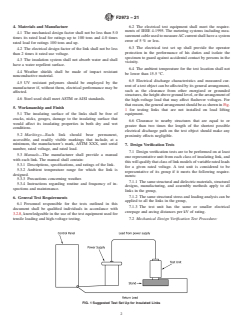
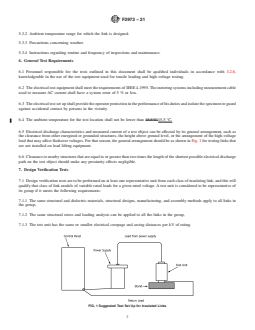
lead that may affect flashover voltages. For that reason, the general arrangement should be as shown in Fig. 1 for testing links that
are not installed on load lifting equipment.
6.6 Clearance to nearby structures that are equal to or greater than two times the length of the shortest possible electrical discharge
path on the test object should make any proximity effects negligible.
7. Design Verification Tests
7.1 Design verification tests are to be performed on at least one representative unit from each class of insulating link, and this will
qualify that class of link models of variable rated loads for a given rated voltage. A test unit is considered to be representative of
its group if it meets the following requirements:
7.1.1 The same structural and dielectric materials, structural designs, manufacturing, and assembly methods apply to all links in
the group,
7.1.2 The same structural stress and loading analysis can be applied to all the links in the group,
7.1.3 The test unit has the same or smaller electrical creepage and arcing distances per kV of rating.
FIG. 1 Suggested Test Set Up for Insulated Links
F2973 − 21
7.2 Mechanical Design Verification Test Procedure:
7.2.1 The insulating link shall withstand a tensile load test of 5.0 times its rated load for rating up to 100 tons and 4.0 times rated
load for ratings 100 tons and up for 60 s without separation. The tensile load test is to be performed on a test bed or hydraulic
pulling machine calibrated to the latest revision of either ASTM E4 or ISO 7500–1.
7.3 Electrical Design Verification Test Procedure:
7.3.1 Three electrical tests to verify design voltage rating shall be peformed.
7.3.2 The insulating link will withstand an applied AC voltage while dry of twice the link-rated AC voltage for 5 min without
dielectric puncture or flashover and leakage of no more than 3 mA.
7.3.3 The link shall be tested to verify that it does not absorb water with time.
7.3.3.1 Install the link in a humidity chamber for 48 h at a temperature between 65 and 100°F 100 °F with a minimum of 93 %
relative humidity.
7.3.3.2 Within a time frame of 5 min after removal from humidity chamber in the vertical use position, apply test voltage in
accordance with Table 1. Increase voltage at approximately 3 kV per second and hold for 3 min.
7.3.3.3 Measure and record the leakage current. A leakage current in excess of the values in Table 1 signifies a failure.
7.3.4 The link shall be tested to verify that it has a water repellent surface.
7.3.4.1 Immerse the entire link completely in a tank under tap water at room temperature for a minimum of 1 min.
7.3.4.2 In the vertical use position allow to set for 2 min to allow water to run off.
7.3.4.3 Apply test voltage in accordance with Table 1 within a time frame of 5 min after wetting
...