

ASTM A906/A906M-02(2022)
(Specification)Standard Specification for Grade 80 and Grade 100 Alloy Steel Chain Slings for Overhead Lifting
General Information
- Abstract
ABSTRACT
This specification covers requirements and method of rating and testing for alloy chain slings. Only component parts compatible with alloy chain shall be used. Sling assembled by welding shall be fabricated by the electric or gas welding process, or both. The material shall undergo proof test to meet the prescribed mechanical requirements. Several grades of alloy chain sling shall conform to the specified working load limit values.
SCOPE
1.1 This specification covers the requirements and method of rating and testing for alloy chain slings. Slings shall be assembled using components manufactured in accordance with Specification A391/A391M for Grade 80 chain, Specification A973/A973M for Grade 100 chain, and Specification A952/A952M for other components. This specification covers welded and mechanically assembled slings.
1.2 This specification does not cover slings used at elevated temperatures (above 400 °F [200 °C]), in harmful or corrosive environmental conditions or for applications such as nonsymmetrical legs or loading.
1.3 This specification is a performance and assembly specification. Other standards, such as OSHA 1910.184, ASME B30.9, and ASME B30.10, apply to the use of the products in this specification.
1.4 The values stated in either inch-pound units or SI units are to be regarded separately as standard. Within the text, the SI units are shown in brackets. The values stated in each system are not necessarily exact equivalents; therefore, to ensure conformance with the standard, each system shall be used independently of the other, and values from the two systems shall not be combined.
1.5 This international standard was developed in accordance with internationally recognized principles on standardization established in the Decision on Principles for the Development of International Standards, Guides and Recommendations issued by the World Trade Organization Technical Barriers to Trade (TBT) Committee.
- Status
- Published
- Publication Date
- 28-Feb-2022
- Technical Committee
- A01 - Steel, Stainless Steel and Related Alloys
- Drafting Committee
- A01.27 - Steel Chain
Overview
ASTM A906/A906M-02(2022), issued by ASTM International, provides a standard specification for Grade 80 and Grade 100 alloy steel chain slings designed for overhead lifting applications. This specification details requirements for materials, design, assembly, proof testing, and performance ratings for chain slings, ensuring reliability and safety in lifting operations. Both welded and mechanically assembled slings are covered, with strict guidelines on component compatibility, mechanical properties, and marking of finished products.
Key Topics
- Alloy Steel Chain Grades: The standard includes Grade 80 and Grade 100 alloy steel chain slings, with ratings based on the weakest component used in their assembly.
- Component Compatibility: Only parts specified for use with alloy chain, conforming to relevant ASTM specifications (A391/A391M for Grade 80 chains, A973/A973M for Grade 100 chains, and A952/A952M for components), are permitted.
- Assembly Methods: Slings may be assembled by electric or gas welding, or mechanically, following the manufacturer’s recommendations to ensure correct structure and functionality.
- Proof Testing and Mechanical Requirements: Every component and completed sling undergoes proof testing to verify performance against designated working load limits (WLL). The proof test loads are set at multiples of the WLL depending on sling configuration.
- Identification and Marking: Finished slings must have permanently attached identification tags specifying the sling size, length (reach), working load limit, grade, serial number, manufacturer, and sling type.
- Rating and Limitations: Working load limits are provided for a range of chain sizes and sling angles. The standard excludes slings intended for use at temperatures above 400°F (200°C), in corrosive environments, or for non-symmetrical leg loadings.
Applications
Alloy steel chain slings per ASTM A906/A906M are engineered for demanding overhead lifting operations where robust performance and safety are paramount. Key application areas include:
- Industrial Lifting: Used in manufacturing plants, metalworking, and heavy equipment handling.
- Construction Sites: For hoisting structural steel, concrete forms, and machinery.
- Shipping and Logistics: Loading and unloading materials where high-strength, flexible lifting solutions are required.
- Cranes and Lifting Machines: Suitable for use with cranes in shops, warehouses, and on-site operations requiring load attachment and transference.
Their versatility and strength make them suitable for vertical, choker, and basket hitches in a wide range of industrial and commercial settings. The standardized proof testing and clear WLL marking provide assurance for critical lifting tasks.
Related Standards
For comprehensive compliance and operational safety, users of alloy steel chain slings should also be familiar with related standards:
- ASTM A391/A391M - Specification for Grade 80 Alloy Steel Chain
- ASTM A973/A973M - Specification for Grade 100 Alloy Steel Chain
- ASTM A952/A952M - Specification for Forged Steel Lifting Components and Welded Attachment Links
- OSHA 1910.184 - Occupational Safety and Health Administration requirements for slings
- ASME B30.9 - Safety standards for slings
- ASME B30.10 - Safety standards for hooks
Complying with ASTM A906/A906M-02(2022), alongside these related documents, supports optimal safety, performance, and regulatory adherence in overhead lifting operations.
Keywords: alloy steel chain slings, overhead lifting, Grade 80, Grade 100, ASTM A906, working load limit, proof test, industrial lifting, safety standards, ASME B30.9, OSHA 1910.184
Relations
- Effective Date
- 01-Apr-2010
- Effective Date
- 01-Nov-2007
- Effective Date
- 01-Nov-2007
- Effective Date
- 10-May-2002
- Effective Date
- 10-Sep-2001
- Effective Date
- 10-Sep-2001
- Effective Date
- 10-Sep-2001
- Effective Date
- 10-Sep-2001
Frequently Asked Questions
ASTM A906/A906M-02(2022) is a technical specification published by ASTM International. Its full title is "Standard Specification for Grade 80 and Grade 100 Alloy Steel Chain Slings for Overhead Lifting". This standard covers: ABSTRACT This specification covers requirements and method of rating and testing for alloy chain slings. Only component parts compatible with alloy chain shall be used. Sling assembled by welding shall be fabricated by the electric or gas welding process, or both. The material shall undergo proof test to meet the prescribed mechanical requirements. Several grades of alloy chain sling shall conform to the specified working load limit values. SCOPE 1.1 This specification covers the requirements and method of rating and testing for alloy chain slings. Slings shall be assembled using components manufactured in accordance with Specification A391/A391M for Grade 80 chain, Specification A973/A973M for Grade 100 chain, and Specification A952/A952M for other components. This specification covers welded and mechanically assembled slings. 1.2 This specification does not cover slings used at elevated temperatures (above 400 °F [200 °C]), in harmful or corrosive environmental conditions or for applications such as nonsymmetrical legs or loading. 1.3 This specification is a performance and assembly specification. Other standards, such as OSHA 1910.184, ASME B30.9, and ASME B30.10, apply to the use of the products in this specification. 1.4 The values stated in either inch-pound units or SI units are to be regarded separately as standard. Within the text, the SI units are shown in brackets. The values stated in each system are not necessarily exact equivalents; therefore, to ensure conformance with the standard, each system shall be used independently of the other, and values from the two systems shall not be combined. 1.5 This international standard was developed in accordance with internationally recognized principles on standardization established in the Decision on Principles for the Development of International Standards, Guides and Recommendations issued by the World Trade Organization Technical Barriers to Trade (TBT) Committee.
ABSTRACT This specification covers requirements and method of rating and testing for alloy chain slings. Only component parts compatible with alloy chain shall be used. Sling assembled by welding shall be fabricated by the electric or gas welding process, or both. The material shall undergo proof test to meet the prescribed mechanical requirements. Several grades of alloy chain sling shall conform to the specified working load limit values. SCOPE 1.1 This specification covers the requirements and method of rating and testing for alloy chain slings. Slings shall be assembled using components manufactured in accordance with Specification A391/A391M for Grade 80 chain, Specification A973/A973M for Grade 100 chain, and Specification A952/A952M for other components. This specification covers welded and mechanically assembled slings. 1.2 This specification does not cover slings used at elevated temperatures (above 400 °F [200 °C]), in harmful or corrosive environmental conditions or for applications such as nonsymmetrical legs or loading. 1.3 This specification is a performance and assembly specification. Other standards, such as OSHA 1910.184, ASME B30.9, and ASME B30.10, apply to the use of the products in this specification. 1.4 The values stated in either inch-pound units or SI units are to be regarded separately as standard. Within the text, the SI units are shown in brackets. The values stated in each system are not necessarily exact equivalents; therefore, to ensure conformance with the standard, each system shall be used independently of the other, and values from the two systems shall not be combined. 1.5 This international standard was developed in accordance with internationally recognized principles on standardization established in the Decision on Principles for the Development of International Standards, Guides and Recommendations issued by the World Trade Organization Technical Barriers to Trade (TBT) Committee.
ASTM A906/A906M-02(2022) is classified under the following ICS (International Classification for Standards) categories: 53.020.30 - Accessories for lifting equipment. The ICS classification helps identify the subject area and facilitates finding related standards.
ASTM A906/A906M-02(2022) has the following relationships with other standards: It is inter standard links to ASTM A952/A952M-02(2010), ASTM A391/A391M-07, ASTM A973/A973M-07, ASTM A952/A952M-02, ASTM A973/A973M-01, ASTM A391/A391M-98, ASTM A391/A391M-01, ASTM A973/A973M-00. Understanding these relationships helps ensure you are using the most current and applicable version of the standard.
ASTM A906/A906M-02(2022) is available in PDF format for immediate download after purchase. The document can be added to your cart and obtained through the secure checkout process. Digital delivery ensures instant access to the complete standard document.
Standards Content (Sample)
This international standard was developed in accordance with internationally recognized principles on standardization established in the Decision on Principles for the
Development of International Standards, Guides and Recommendations issued by the World Trade Organization Technical Barriers to Trade (TBT) Committee.
Designation: A906/A906M −02 (Reapproved 2022)
Standard Specification for
Grade 80 and Grade 100 Alloy Steel Chain Slings for
Overhead Lifting
This standard is issued under the fixed designationA906/A906M; the number immediately following the designation indicates the year
of original adoption or, in the case of revision, the year of last revision.Anumber in parentheses indicates the year of last reapproval.
A superscript epsilon (´) indicates an editorial change since the last revision or reapproval.
1. Scope 2. Referenced Documents
2.1 ASTM Standards:
1.1 This specification covers the requirements and method
A391/A391MSpecification for Grade 80 Alloy Steel Chain
of rating and testing for alloy chain slings. Slings shall be
A952/A952MSpecification for Forged Grade 80 and Grade
assembledusingcomponentsmanufacturedinaccordancewith
100 Steel Lifting Components and Welded Attachment
Specification A391/A391M for Grade 80 chain, Specification
Links
A973/A973M for Grade 100 chain, and Specification A952/
A973/A973MSpecificationforGrade100AlloySteelChain
A952M for other components. This specification covers
2.2 Other Standards:
welded and mechanically assembled slings.
OSHA 1910.184Slings
ASME B30.9Slings
1.2 This specification does not cover slings used at elevated
ASME B30.10Hooks
temperatures (above 400°F [200°C]), in harmful or corrosive
environmental conditions or for applications such as nonsym-
3. Terminology
metrical legs or loading.
3.1 Definitions:
1.3 This specification is a performance and assembly speci-
3.1.1 chain sling—an assembly consisting of alloy steel
fication. Other standards, such as OSHA 1910.184, ASME
chain or chains joined to suitable upper and lower fittings,
B30.9, andASME B30.10, apply to the use of the products in
according to the provisions of this specification, for attaching
this specification.
loads to be lifted by a crane or lifting machine.
3.1.2 coupling link—a link fitted to the end of the chain to
1.4 The values stated in either inch-pound units or SI units
connect to another component of the sling. See Fig. 1.
are to be regarded separately as standard. Within the text, the
SI units are shown in brackets. The values stated in each 3.1.3 master coupling link (secondary or intermediate
link)—a link used on three and four leg slings to connect the
system are not necessarily exact equivalents; therefore, to
ensure conformance with the standard, each system shall be legs to a master link. See Fig. 1.
used independently of the other, and values from the two
3.1.4 master link—a link used as the upper end component
systems shall not be combined.
of a chain sling and by means of which the sling is attached to
a crane or other lifting machine. See Fig. 1.
1.5 This international standard was developed in accor-
3.1.5 overhead lifting—that process of lifting which would
dance with internationally recognized principles on standard-
elevateafreelysuspendedloadtosuchapositionthatdropping
ization established in the Decision on Principles for the
theloadwouldpresentapossibilityofbodilyinjuryorproperty
Development of International Standards, Guides and Recom-
damage.
mendations issued by the World Trade Organization Technical
Barriers to Trade (TBT) Committee.
For referenced ASTM standards, visit the ASTM website, www.astm.org, or
contact ASTM Customer Service at service@astm.org. For Annual Book of ASTM
Standards volume information, refer to the standard’s Document Summary page on
This specification is under the jurisdiction ofASTM Committee A01 on Steel, the ASTM website.
Stainless Steel and RelatedAlloys and is the direct responsibility of Subcommittee Available from Occupational Safety and Health Administration (OSHA), 200
A01.27 on Steel Chain. Constitution Ave., NW, Washington, DC 20210, http://www.osha.gov.
Current edition approved March 1, 2022. Published March 2022. Originally Available from American Society of Mechanical Engineers (ASME), ASME
approved in 1991. Last previous edition approved in 2016 as A906/A906M – International Headquarters, Two Park Ave., New York, NY 10016-5990, http://
02(2016). DOI: 10.1520/A0906_A0906M-02R22. www.asme.org.
Copyright © ASTM International, 100 Barr Harbor Drive, PO Box C700, West Conshohocken, PA 19428-2959. United States
A906/A906M − 02 (2022)
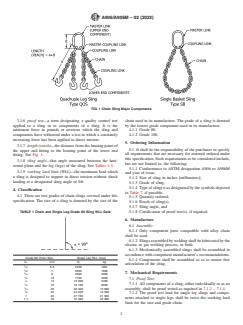
FIG. 1 Chain Sling Major Components
3.1.6 proof test—a term designating a quality control test chain used in its manufacture. The grade of a sling is denoted
applied to a sling or to components of a sling. It is the by the lowest grade component used in its manufacture.
minimum force in pounds or newtons which the sling and 4.1.1 Grade 80.
components have withstood under a test in which a constantly 4.1.2 Grade 100.
increasing force has been applied in direct tension.
5. Ordering Information
3.1.7 length (reach)—the distance from the bearing point of
5.1 It shall be the responsibility of the purchaser to specify
the upper end fitting to the bearing point of the lower end
all requirements that are necessary for material ordered under
fitting. See Fig. 1.
this specification. Such requirements to be considered include,
3.1.8 sling angle—that angle measured between the hori-
but are not limited to, the following:
zontal plane and the leg (legs) of the sling. See Tables 1-3.
5.1.1 Conformance to ASTM designation A906 or A906M
3.1.9 working load limit (WLL)—the maximum load which
and year of issue,
a sling is designed to support in direct tension without shock
5.1.2 Size of sling in inches [millimetres],
loading at a designated sling angle of lift.
5.1.3 Grade of sling,
5.1.4 Typeofsling(s)asdesignatedbythesymbolsdepicted
4. Classification
in Table 7, if possible,
4.1 There are two grades of chain slings covered under this
5.1.5 Quantity ordered,
specification. The size of a sling is denoted by the size of the
5.1.6 Reach of sling(s),
5.1.7 Sling angle, and
5.1.8 Certification of proof test(s), if required.
TABLE 1 Chain and Single Leg Grade 80 Sling WLL Data
6. Manufacture
6.1 Assembly:
6.1.1 Only component parts compatible with alloy chain
shall be used.
6.1.2 Slingsassembledbyweldingshallbefabricatedbythe
electric or gas welding process, or both.
6.1.3 Mechanically assembled slings shall be assembled in
accordance with component manufacturer’s recommendations.
Grade 80 Chain Size Single Leg WLL (max)
6.1.4 Components shall be assembled so as to ensure free
in. mm lb kg
articulation of the sling.
⁄32 5.5 2100 950
⁄32 7 3500 1600
7. Mechanical Requirements
⁄16 8 4500 2000
⁄8 10 7100 3200
7.1 Proof Test:
⁄2 13 12 000 5400
7.1.1 All components of a sling, either individually or as an
⁄8 16 18 100 8200
⁄4 20 28 300 12 800 assembly, shall be proof tested as required in 7.1.2 – 7.1.4.
⁄8 22 34 200 15 500
7.1.2 The proof test load for single leg slings and compo-
1 26 47 700 21 600
nents attached to single legs shall be twice the working load
1 ⁄4 32 72 300 32 800
limit for the size and grade chain.
A906/A906M − 02 (2022)
TABLE 2 Double Leg and Single Basket Grade 80 Alloy Chain Sling WLL Data at 60°, 45°, and 30° Sling Angles
NOTE 1—[WLL (double leg)=2xWLL (single leg) x sin α]
WLL at Sling Angle α of
Grade 80 Chain Size
60° 45° 30°
in. mm lbkglbkglbkg
⁄32 5.5 3600 1650 3000 1350 2100 950
⁄32 7 6100 2750 4900 2250 3500 1600
⁄16 8 7800 3550 6400 2900 4500 2000
⁄8 10 12 300 5500 10 000 4500 7100 3200
⁄2 13 20 800 9450 17 000 7700 12 000 5400
⁄8 16 31 300 14 200 25 600 11 600 18 100 8200
⁄4 20 49 000 22 250 40 000 18 150 28 300 12 800
⁄8 22 59 200
...