

ASTM F1806-21
(Practice)Standard Practice for Tire Testing Operations–Basic Concepts and Terminology for Reference Tire Use
General Information
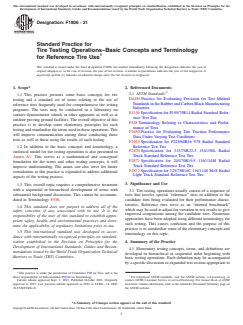
- Abstract
SIGNIFICANCE AND USE
3.1 Tire testing operations usually consist of a sequence of tests that involve special “reference” tires in addition to the candidate tires being evaluated for their performance characteristics. Reference tires serve as an “internal benchmark” which may be used to adjust for variation in test results to give improved comparisons among the candidate tires. Numerous approaches have been adopted using different terminology for such testing. This causes confusion and the purpose of this practice is to standardize some of the elementary concepts and terminology on this topic.
SCOPE
1.1 This practice presents some basic concepts for tire testing and a standard set of terms relating to the use of reference tires frequently used for comprehensive tire testing programs. The tests may be conducted in a laboratory on various dynamometer wheels or other apparatus as well as at outdoor proving ground facilities. The overall objective of this practice is to develop some elementary principles for such testing and standardize the terms used in these operations. This will improve communication among those conducting these tests as well as those using the results of such testing.
1.2 In addition to the basic concepts and terminology, a statistical model for tire testing operations is also presented in Annex A1. This serves as a mathematical and conceptual foundation for the terms and other testing concepts; it will improve understanding. The annex can also serve for future consultation as this practice is expanded to address additional aspects of the testing process.
1.3 This overall topic requires a comprehensive treatment with a sequential or hierarchical development of terms with substantial background discussion. This cannot be accommodated in Terminology F538.
1.4 This standard does not purport to address all of the safety concerns, if any, associated with its use. It is the responsibility of the user of this standard to establish appropriate safety, health, and environmental practices and determine the applicability of regulatory limitations prior to use.
1.5 This international standard was developed in accordance with internationally recognized principles on standardization established in the Decision on Principles for the Development of International Standards, Guides and Recommendations issued by the World Trade Organization Technical Barriers to Trade (TBT) Committee.
- Status
- Published
- Publication Date
- 31-Aug-2021
- Technical Committee
- F09 - Tires
- Drafting Committee
- F09.94 - Terminology
Buy Documents
ASTM F1806-21 - Standard Practice for Tire Testing Operations–Basic Concepts and Terminology for Reference Tire Use
REDLINE ASTM F1806-21 - Standard Practice for Tire Testing Operations–Basic Concepts and Terminology for Reference Tire Use
Overview
ASTM F1806-21: Standard Practice for Tire Testing Operations–Basic Concepts and Terminology for Reference Tire Use, developed by ASTM International, establishes key concepts and standardized terminology for comprehensive tire testing programs. This standard focuses on the use of reference tires as internal benchmarks, enabling more consistent and comparable evaluation of tire performance characteristics. It addresses the diverse approaches and varied terminology previously adopted across the tire industry, creating confusion and impeding effective communication. By defining foundational principles and terms, ASTM F1806-21 enhances clarity, repeatability, and reliability in laboratory and proving ground testing environments.
Key Topics
Basic Testing Concepts and Definitions
The standard introduces hierarchical definitions for core terms such as test tire, candidate tire, test program, sampling, and replication. These definitions are crafted to be general and applicable beyond tires where relevant.Reference Tire Types and Use
ASTM F1806-21 details the concept of reference tires as benchmarks for minimizing bias and variation in test results. It distinguishes between Type 1 reference tires (with controlled and stable characteristics) and Type 2 reference tires (selected for minimal variation within a test program).Special Reference Tire Categories
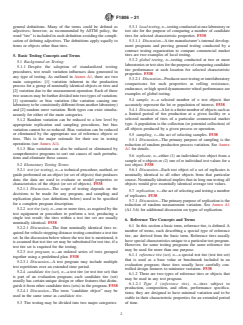
The document defines terms such as:- control tire: a reference tire used throughout a test sequence
- surface monitoring tire: evaluates changes in test surfaces over time
- standard reference test tire (SRTT): a frequently used, specification-defined control tire
- witness tire: demonstrates extended stability for characteristic properties
- master set: a selected group of witness tires for assessing test device function
- calibration tire: helps determine laboratory or test site suitability
Statistical Framework for Variability
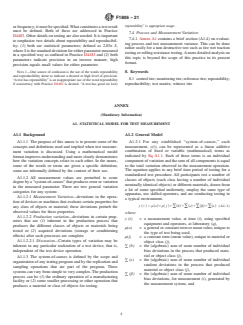
Annex A1 presents a statistical model for interpreting test measurement data, explicitly addressing sources of variation-production-related or measurement-related, bias, and random errors.Precision & Repeatability
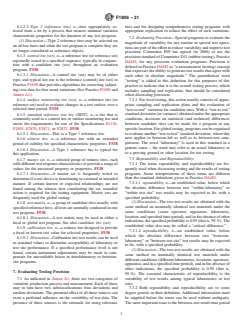
The standard emphasizes the importance of reproducible testing, outlining repeatability (within-laboratory/test site precision) and reproducibility (between-laboratory/site precision) in line with ASTM practices. It incorporates procedures for evaluating test variability using recognized statistical principles.
Applications
ASTM F1806-21 has crucial applications for:
Tire Manufacturers
Supporting R&D and quality assurance programs by providing a consistent vocabulary and methodology for tire comparison, regardless of test site or conditions.Testing Laboratories
Enhancing the precision and reliability of testing through standardized procedures, especially when coordinating local and global testing programs involving multiple sites or labs.Regulatory Bodies and Industry Stakeholders
Facilitating clear communication across organizations by harmonizing key terms and concepts, which strengthens the credibility of test results.Contract Testing Organizations
Streamlining contract and proving ground test operations where uniform evaluation of diverse tire brands or models is required.
By implementing ASTM F1806-21, organizations can confidently compare candidate tires using reference tires, proactively control for measurement and process variability, and produce more accurate, reproducible, and industry-accepted results.
Related Standards
For comprehensive tire testing and evaluation, the following ASTM standards are closely related and frequently referenced in conjunction with ASTM F1806-21:
- ASTM D4483: Evaluating precision for test method standards in the rubber industry
- ASTM E1136: P195/75R14 Radial Standard Reference Test Tire specification
- ASTM F538: Tire characteristics and performance terminology
- ASTM F1650: Evaluating tire traction performance data
- ASTM F2493, F2870, F2871, F2872: Specifications for standard reference test tires in various tire classes
These standards collectively support industry-wide best practices in tire testing, precision evaluation, and terminology standardization. Use of ASTM F1806-21, in alignment with these documents, encourages transparent, reliable test operations and data comparability throughout the tire sector.
Relations
- Effective Date
- 01-Oct-2019
- Effective Date
- 01-Oct-2019
- Effective Date
- 01-Jan-2018
- Effective Date
- 01-Oct-2017
- Effective Date
- 01-Nov-2016
- Effective Date
- 01-Nov-2016
- Effective Date
- 15-Aug-2014
- Effective Date
- 01-Jun-2014
- Effective Date
- 01-Jan-2014
- Effective Date
- 01-Jan-2011
- Effective Date
- 01-Jan-2011
- Effective Date
- 01-Jan-2011
- Effective Date
- 15-Jun-2009
- Effective Date
- 01-May-2008
- Effective Date
- 01-Dec-2006
Buy Documents
ASTM F1806-21 - Standard Practice for Tire Testing Operations–Basic Concepts and Terminology for Reference Tire Use
REDLINE ASTM F1806-21 - Standard Practice for Tire Testing Operations–Basic Concepts and Terminology for Reference Tire Use
Get Certified
Connect with accredited certification bodies for this standard

DIN CERTCO
DIN Group product certification.

Smithers Quality Assessments
US management systems and product certification.
Sponsored listings
Frequently Asked Questions
ASTM F1806-21 is a standard published by ASTM International. Its full title is "Standard Practice for Tire Testing Operations–Basic Concepts and Terminology for Reference Tire Use". This standard covers: SIGNIFICANCE AND USE 3.1 Tire testing operations usually consist of a sequence of tests that involve special “reference” tires in addition to the candidate tires being evaluated for their performance characteristics. Reference tires serve as an “internal benchmark” which may be used to adjust for variation in test results to give improved comparisons among the candidate tires. Numerous approaches have been adopted using different terminology for such testing. This causes confusion and the purpose of this practice is to standardize some of the elementary concepts and terminology on this topic. SCOPE 1.1 This practice presents some basic concepts for tire testing and a standard set of terms relating to the use of reference tires frequently used for comprehensive tire testing programs. The tests may be conducted in a laboratory on various dynamometer wheels or other apparatus as well as at outdoor proving ground facilities. The overall objective of this practice is to develop some elementary principles for such testing and standardize the terms used in these operations. This will improve communication among those conducting these tests as well as those using the results of such testing. 1.2 In addition to the basic concepts and terminology, a statistical model for tire testing operations is also presented in Annex A1. This serves as a mathematical and conceptual foundation for the terms and other testing concepts; it will improve understanding. The annex can also serve for future consultation as this practice is expanded to address additional aspects of the testing process. 1.3 This overall topic requires a comprehensive treatment with a sequential or hierarchical development of terms with substantial background discussion. This cannot be accommodated in Terminology F538. 1.4 This standard does not purport to address all of the safety concerns, if any, associated with its use. It is the responsibility of the user of this standard to establish appropriate safety, health, and environmental practices and determine the applicability of regulatory limitations prior to use. 1.5 This international standard was developed in accordance with internationally recognized principles on standardization established in the Decision on Principles for the Development of International Standards, Guides and Recommendations issued by the World Trade Organization Technical Barriers to Trade (TBT) Committee.
SIGNIFICANCE AND USE 3.1 Tire testing operations usually consist of a sequence of tests that involve special “reference” tires in addition to the candidate tires being evaluated for their performance characteristics. Reference tires serve as an “internal benchmark” which may be used to adjust for variation in test results to give improved comparisons among the candidate tires. Numerous approaches have been adopted using different terminology for such testing. This causes confusion and the purpose of this practice is to standardize some of the elementary concepts and terminology on this topic. SCOPE 1.1 This practice presents some basic concepts for tire testing and a standard set of terms relating to the use of reference tires frequently used for comprehensive tire testing programs. The tests may be conducted in a laboratory on various dynamometer wheels or other apparatus as well as at outdoor proving ground facilities. The overall objective of this practice is to develop some elementary principles for such testing and standardize the terms used in these operations. This will improve communication among those conducting these tests as well as those using the results of such testing. 1.2 In addition to the basic concepts and terminology, a statistical model for tire testing operations is also presented in Annex A1. This serves as a mathematical and conceptual foundation for the terms and other testing concepts; it will improve understanding. The annex can also serve for future consultation as this practice is expanded to address additional aspects of the testing process. 1.3 This overall topic requires a comprehensive treatment with a sequential or hierarchical development of terms with substantial background discussion. This cannot be accommodated in Terminology F538. 1.4 This standard does not purport to address all of the safety concerns, if any, associated with its use. It is the responsibility of the user of this standard to establish appropriate safety, health, and environmental practices and determine the applicability of regulatory limitations prior to use. 1.5 This international standard was developed in accordance with internationally recognized principles on standardization established in the Decision on Principles for the Development of International Standards, Guides and Recommendations issued by the World Trade Organization Technical Barriers to Trade (TBT) Committee.
ASTM F1806-21 is classified under the following ICS (International Classification for Standards) categories: 01.040.83 - Rubber and plastics industries (Vocabularies); 83.160.01 - Tyres in general. The ICS classification helps identify the subject area and facilitates finding related standards.
ASTM F1806-21 has the following relationships with other standards: It is inter standard links to ASTM E1136-19, ASTM F2872-19, ASTM F2493-18, ASTM E1136-17, ASTM F2870-16, ASTM F2872-16, ASTM E1136-14, ASTM F2493-14, ASTM F1650-98(2014), ASTM F2871-11, ASTM F2870-11, ASTM F2872-11, ASTM F538-09, ASTM F2493-08, ASTM F2493-06. Understanding these relationships helps ensure you are using the most current and applicable version of the standard.
ASTM F1806-21 is available in PDF format for immediate download after purchase. The document can be added to your cart and obtained through the secure checkout process. Digital delivery ensures instant access to the complete standard document.
Standards Content (Sample)
This international standard was developed in accordance with internationally recognized principles on standardization established in the Decision on Principles for the
Development of International Standards, Guides and Recommendations issued by the World Trade Organization Technical Barriers to Trade (TBT) Committee.
Designation: F1806 − 21
Standard Practice for
Tire Testing Operations–Basic Concepts and Terminology
for Reference Tire Use
This standard is issued under the fixed designation F1806; the number immediately following the designation indicates the year of
original adoption or, in the case of revision, the year of last revision.Anumber in parentheses indicates the year of last reapproval.A
superscript epsilon (´) indicates an editorial change since the last revision or reapproval.
1. Scope* 2. Referenced Documents
2.1 ASTM Standards:
1.1 This practice presents some basic concepts for tire
D4483Practice for Evaluating Precision for Test Method
testing and a standard set of terms relating to the use of
StandardsintheRubberandCarbonBlackManufacturing
reference tires frequently used for comprehensive tire testing
Industries
programs. The tests may be conducted in a laboratory on
E1136Specification for P195/75R14 Radial Standard Refer-
various dynamometer wheels or other apparatus as well as at
ence Test Tire
outdoor proving ground facilities.The overall objective of this
F538Terminology Relating to Characteristics and Perfor-
practice is to develop some elementary principles for such
mance of Tires
testingandstandardizethetermsusedintheseoperations.This
F1650Practice for Evaluating Tire Traction Performance
will improve communication among those conducting these
Data Under Varying Test Conditions
tests as well as those using the results of such testing.
F2493Specification for P225/60R16 97S Radial Standard
Reference Test Tire
1.2 In addition to the basic concepts and terminology, a
F2870 Specification for 315/70R22.5 154/150L Radial
statistical model for tire testing operations is also presented in
Truck Standard Reference Test Tire
Annex A1. This serves as a mathematical and conceptual
F2871 Specification for 245/70R19.5 136/134M Radial
foundation for the terms and other testing concepts; it will
Truck Standard Reference Test Tire
improve understanding. The annex can also serve for future
F2872Specification for 225/75R16C 116/114S M+S Radial
consultation as this practice is expanded to address additional
Light Truck Standard Reference Test Tire
aspects of the testing process.
3. Significance and Use
1.3 This overall topic requires a comprehensive treatment
with a sequential or hierarchical development of terms with
3.1 Tire testing operations usually consist of a sequence of
substantial background discussion. This cannot be accommo-
tests that involve special “reference” tires in addition to the
dated in Terminology F538.
candidate tires being evaluated for their performance charac-
teristics. Reference tires serve as an “internal benchmark”
1.4 This standard does not purport to address all of the
whichmaybeusedtoadjustforvariationintestresultstogive
safety concerns, if any, associated with its use. It is the
improved comparisons among the candidate tires. Numerous
responsibility of the user of this standard to establish appro-
approaches have been adopted using different terminology for
priate safety, health, and environmental practices and deter-
such testing. This causes confusion and the purpose of this
mine the applicability of regulatory limitations prior to use.
practice is to standardize some of the elementary concepts and
1.5 This international standard was developed in accor-
terminology on this topic.
dance with internationally recognized principles on standard-
ization established in the Decision on Principles for the
4. Summary of the Practice
Development of International Standards, Guides and Recom-
4.1 Elementary testing concepts, terms, and definitions are
mendations issued by the World Trade Organization Technical
developed in hierarchical or sequential order beginning with
Barriers to Trade (TBT) Committee.
basic testing operations. Each definition may be accompanied
byaspecificdiscussionorexpandedtextsectionappropriateto
This practice is under the jurisdiction of Committee F09 on Tires and is the
direct responsibility of Subcommittee F09.94 on Terminology. For referenced ASTM standards, visit the ASTM website, www.astm.org, or
Current edition approved Sept. 1, 2021. Published October 2021. Originally contact ASTM Customer Service at service@astm.org. For Annual Book of ASTM
approved in 1997. Last previous edition approved in 2014 as F1806–14. DOI: Standards volume information, refer to the standard’s Document Summary page on
10.1520/F1806-21. the ASTM website.
*A Summary of Changes section appears at the end of this standard
Copyright © ASTM International, 100 Barr Harbor Drive, PO Box C700, West Conshohocken, PA 19428-2959. United States
F1806 − 21
general definitions. Many of the terms could be defined as 5.3.1 localtesting,n—testingconductedatonelaboratoryor
adjectives; however, as recommended by ASTM policy, the test site for the purpose of comparing a number of candidate
word “tire” is included in each definition avoiding the compli- tires for selected characteristic properties. F538
cation of defining adjectives. The definitions apply equally to 5.3.1.1 Discussion—Atire manufacturer’s internal develop-
items or objects other than tires. ment programs and proving ground testing conducted by a
contract testing organization to compare commercial market
tires are two examples of local testing.
5. Basic Testing Concepts and Terms
5.3.2 global testing, n—testing conducted at two or more
5.1 Background on Testing:
laboratoriesortestsitesforthepurposeofcomparingcandidate
5.1.1 Despite the adoption of standardized testing
tire performance at each location for selected characteristic
procedures, test result variation influences data generated in
properties. F538
any type of testing. As outlined in Annex A1, there are two
5.3.2.1 Discussion—Producer-usertestingorinterlaboratory
main categories: [1] variation inherent in the production
comparisons for such properties as rolling resistance,
process for a group of nominally identical objects or tires and
endurance,orhighspeeddynamometerwheelperformanceare
[2] variation due to the measurement operation. Each of these
examples of global testing.
twosourcesmaybefurtherdividedintotwotypesofvariation;
5.4 sample, n—a selected number of n test objects that
[1] systematic or bias variation (the variation causing one
accurately represent the lot or population of interest. F538
laboratory to be consistently different from another laboratory)
5.4.1 Discussion—Alotisafinitenumberofobjectssuchas
and [2] random error variation. Both types can exist simulta-
a limited period of tire production at a given facility or a
neously for either of the main categories.
selected number of tires of a particular commercial market
5.1.2 Random variation can be reduced to a low level by
type.Apopulation is the collection (or potential collection) of
appropriate replication and sampling procedures, but bias
all objects produced by a given process or operation.
variation cannot be so reduced. Bias variation can be reduced
or eliminated by the appropriate use of reference objects or
5.5 sampling, v—the act of selecting samples. F538
tires. This is the major rationale for their use in testing
5.5.1 Discussion—The primary purpose of sampling is the
operations (see Annex A1).
reduction of random production process variation. See Annex
5.1.3 Bias variation can also be reduced or eliminated by
A1 for details.
comprehensive programs to sort out causes of such perturba-
5.6 replicate, n—either (1) an individual test object from a
tions and eliminate these causes.
sample of n objects or (2) one of m individual test values for a
5.2 Elementary Testing Terms:
test object. F538
5.2.1 test (or testing), n—a technical procedure, method, or 5.6.1 Discussion—Each test object of a set of replicates is
guide performed on an object (or set of objects) that produces nominally identical to all other objects from that particular
data; the data are used to evaluate or model properties or source. Nominally identical implies that in long run testing all
characteristics of the object (or set of objects). F538 objects would give essentially identical average test values.
5.2.1.1 Discussion—The scope of testing depends on the
5.7 replication, v—the act of selecting and testing a number
decisions to be made for any program, and sampling and
of replicates. F538
replication plans (see definitions below) need to be specified
5.7.1 Discussion—The primary purpose of replication is the
for a complete program description.
reduction of random measurement variation. See Annex A1
5.2.2 test tire (set), n—one or more tires, as required by the
(A1.3.6) for additional discussion on types of replication.
test equipment or procedure to perform a test, producing a
single test result; the tires within a test tire set are usually
6. Reference Tire Concepts and Terms
nominally identical. F538
6.1 In this section a basic term, reference tire, is defined.A
5.2.2.1 Discussion—The four nominally identical tires re-
number of terms, each describing a special type of reference
quiredforvehiclestoppingdistancetestingconstituteatesttire
tire, are derived from the basic term. Reference tires usually
set. In the discussion below where the test tire is mentioned, it
havespecialcharacteristicsuniquetoaparticulartestprogram.
is assumed that test tire set may be substituted for test tire, if a
However, for some testing programs the same reference tire
test tire set is required for the testing.
may be used for more than one purpose.
5.2.3 test program, n—an ordered series of tests grouped
6.1.1 reference tire (set), n—a special test tire (test tire set)
together using a predefined plan. F538
that is used as a base value or benchmark included in an
5.2.3.1 Discussion—A test program may include multiple
evaluation program; these tires usually have carefully con-
test repetitions over an extended time period.
trolled design features to minimize variation. F538
5.2.4 candidate tire (set), n—a test tire (or test tire set) that
6.1.2 There are two types of reference tires or objects that
is part of an evaluation program; each candidate tire (set)
may be used in any test program.
usually has certain unique design or other features that distin-
6.1.2.1 Type 1 (reference tire), n—tires subject to
guish it from other candidate tires (sets) in the program. F538
production, composition, and often, performance specifica-
5.2.4.1 Discussion—The term “candidate object” may be
tions; they are designed to have minimal variation and to be
used in the same sense as candidate tire.
stable in their characteristic properties for an extended period
5.3 Tire testing may be divided into two major categories: of time.
F1806 − 21
6.1.2.2 Type 2 (reference tire), n—tires appropriately se- tires and for designing comprehensive testing programs with
lected from a lot by a process that ensures minimal variation appropriate replication to reduce the effect of such variations.
characteristic properties for the duration of any test program.
7.2 Evaluating Precision—Special programs to evaluate the
(1) Discussion—Type 2 reference tires may be selected on
magnitude of variability for any routine or special test opera-
anadhocbasisandwhenthetestprogramiscompletetheyare
tionsarepartoftheefforttoreducevariabilityandimprovetest
no longer considered as reference objects.
precision. Committee F09 has agreed (in 2006) to use the
6.1.3 control tire (set), n—a reference tire (or reference set)
precisionstandardofCommitteeD11(rubbertesting),Practice
repeatedly tested in a specified sequence, typically in conjunc-
D4483, for any precision evaluation programs. Precision is
tion with a candidate tire (set), throughout an evaluation
definedinPracticeD4483as“ameasurement(testing)concept
program. F538
thatexpressestheabilitytogeneratetestresultsthatagreewith
6.1.3.1 Discussion—A control tire (set) may be of either
each other in absolute magnitude.” The parenthetical word
type, and typical tire use is the reference (control) tire (set) in
“testing” is added to this definition for this purposes of this
Practice F1650 that provides algorithms for correcting (adjust-
practice to indicate that it is the overall testing process, which
ing) test data for bias trend variations (See Practice F1650 and
includes sampling and replication, that should be considered
Annex A1).
when discussing precision.
6.1.4 surface monitoring tire (set), n—a reference tire (or
7.2.1 For local testing, this action usually consists of appro-
reference set) used to evaluate changes in a test surface over a priate sampling and replication plans and the evaluation of
selected time period. F538
“test-to-test” variation for candidate tires. With a “test-to-test”
standarddeviation(orvariance)obtainedundertheappropriate
6.1.5 standard reference test tire (SRTT), n—a tire that is
commonly used as a control tire or surface monitoring tire and conditions, decisions on statistical (and technical) differences
between candidate tires can be made for a program at any
meets the requirements for one of the Specifications E1136,
F2493, F2870, F2871,or F2872. F538 specificlocation.Forglobaltesting,programscanbeorganized
toevaluateanother“test-to-test”standarddeviation,wherethis
6.1.5.1 Discussion—This is a Type 1 reference tire.
now applies to between-lab as well as to between-test com-
6.1.6 witness tire, n—a reference tire with an extended
parisons. The word “laboratory” is used in this standard in a
period of stability for specified characteristic properties. F538
generic sense – the word may refer to an actual laboratory or
6.1.6.1 Discussion—A Type 1 reference tire is typical for
to a proving ground or other location for tire testing.
this application.
7.3 Repeatability and Reproducibility:
6.1.7 master set, n—a selected group of witness tires, each
7.3.1 The terms repeatability and reproducibility are fre-
withdifferenttestresponsecharacteristicstoprovidearangeof
quently used when discussing testing and the results of testing
values for the measured property or properties. F538
programs. Some interpretations of these terms are different
6.1.7.1 Discussion—A master set is frequently tested to
than the standard definitions given in Practice D4483.
determineifatestdeviceisfunctioninginanormalorintended
7.3.1.1 repeatability, n—an established value, below which
manner. If certain known or expected relationships are not
the absolute difference between two “within-laboratory” or
found among the witness tires constituting the set, remedial
“within test site” test results may be expected to lie, with a
action is required for the testing equipment. Master sets are
specified probability.
frequently used for global testing.
(1) Discussion—The two test results are obtained with the
6.1.8 test matrix, n—a group of candidate tires usually with
same method on nominally identical test materials under the
specifiedreferencetires;alltestsarenormallyconductedinone
same conditions (same operator, apparatus, laboratory,
test program. F538
location,andspecifiedtimeperiod),andintheabsenceofother
6.1.8.1 Discussion—A test matrix may be used in either a
indications,thespecifiedprobabilityis0.95(thatis,95%).The
local or global test program. See also candidate tire (set).
established value also may be called a “critical difference.”
6.1.9 calibration tire, n—a witness tire designed to provide
7.3.1.2 reproducibility, n—an established value, below
a fixed or known test value for selected properties. F538
which the absolute difference between two “between-
6.1.9.1 Discussion—Calibration tire test results can be used
laboratory” or “between test site” test results may be expected
as standard values to determine acceptability of laboratory or
to lie, with a specified probability.
test site performance. If a specified performance level is not
(1) Discussion—The two test results are obtained with the
found, certain instrument adjustments may be made to com-
same method on nominally identical test materials under
pensate for unavoidable biases in interlaboratory or between-
differentconditions(differentlaboratories,locations,operators,
site programs.
apparatus,andinaspecifiedtimeperiod),andintheabsenceof
other indications, the specified probability is 0.95 (that is,
7. Evaluating Testing Precision
95%). The essential characteristic of reproducibility is the
variability of test results among typical laboratories or test
7.1 As indicated in Annex A1, there are two categories of
variation: production process and measurement. Each of these sites.
may in turn have two subclassifications: bias deviations and 7.3.2 Both repeatability and reproducibility are to some
randomdeviations.Thepotentialeffectofallthesesourcescan degree generic in their definition.Additional information must
exert a profound influence on the variability of test data. The be supplied before the terms can be used without ambiguity.
presence of these sources is the rationale for using reference Themostimportantissueisthebetween–testresulttimeperiod
F1806 − 21
repeatability” is appropriate usage.
orfrequency;itmustbe
...
This document is not an ASTM standard and is intended only to provide the user of an ASTM standard an indication of what changes have been made to the previous version. Because
it may not be technically possible to adequately depict all changes accurately, ASTM recommends that users consult prior editions as appropriate. In all cases only the current version
of the standard as published by ASTM is to be considered the official document.
Designation: F1806 − 14 F1806 − 21
Standard Practice for
Tire Testing Operations–Basic Concepts and Terminology
for Reference Tire Use
This standard is issued under the fixed designation F1806; the number immediately following the designation indicates the year of
original adoption or, in the case of revision, the year of last revision. A number in parentheses indicates the year of last reapproval. A
superscript epsilon (´) indicates an editorial change since the last revision or reapproval.
1. Scope Scope*
1.1 This practice presents some basic concepts for tire testing and a standard set of terms relating to the use of reference tires
frequently used for comprehensive tire testing programs. The tests may be conducted in a laboratory on various dynamometer
wheels or other apparatus as well as at outdoor proving ground facilities. The overall objective of this practice is to develop some
elementary principles for such testing and standardize the terms used in these operations. This will improve communication among
those conducting these tests as well as those using the results of such testing.
1.2 In addition to the basic concepts and terminology, a statistical model for tire testing operations is also presented in Annex A1.
This serves as a mathematical and conceptual foundation for the terms and other testing concepts; it will improve understanding.
The annex can also serve for future consultation as this practice is expanded to address additional aspects of the testing process.
1.3 This overall topic requires a comprehensive treatment with a sequential or hierarchical development of terms with substantial
background discussion. This cannot be accommodated in Terminology F538.
1.4 This standard does not purport to address all of the safety concerns, if any, associated with its use. It is the responsibility
of the user of this standard to establish appropriate safety safety, health, and healthenvironmental practices and determine the
applicability of regulatory limitations prior to use.
1.5 This international standard was developed in accordance with internationally recognized principles on standardization
established in the Decision on Principles for the Development of International Standards, Guides and Recommendations issued
by the World Trade Organization Technical Barriers to Trade (TBT) Committee.
2. Referenced Documents
2.1 ASTM Standards:
D4483 Practice for Evaluating Precision for Test Method Standards in the Rubber and Carbon Black Manufacturing Industries
E1136 Specification for P195/75R14 Radial Standard Reference Test Tire
F538 Terminology Relating to Characteristics and Performance of Tires
F1650 Practice for Evaluating Tire Traction Performance Data Under Varying Test Conditions
F2493 Specification for P225/60R16 97S Radial Standard Reference Test Tire
F2870 Specification for 315/70R22.5 154/150L Radial Truck Standard Reference Test Tire
F2871 Specification for 245/70R19.5 136/134M Radial Truck Standard Reference Test Tire
F2872 Specification for 225/75R16C 116/114S M+S Radial Light Truck Standard Reference Test Tire
This practice is under the jurisdiction of Committee F09 on Tires and is the direct responsibility of Subcommittee F09.94 on Terminology.
Current edition approved June 1, 2014Sept. 1, 2021. Published September 2014October 2021. Originally approved in 1997. Last previous edition approved in 20082014
as F1806 – 97 (2008).F1806 – 14. DOI: 10.1520/F1806-14.10.1520/F1806-21.
For referenced ASTM standards, visit the ASTM website, www.astm.org, or contact ASTM Customer Service at service@astm.org. For Annual Book of ASTM Standards
volume information, refer to the standard’s Document Summary page on the ASTM website.
*A Summary of Changes section appears at the end of this standard
Copyright © ASTM International, 100 Barr Harbor Drive, PO Box C700, West Conshohocken, PA 19428-2959. United States
F1806 − 21
3. Significance and Use
3.1 Tire testing operations usually consist of a sequence of tests that involve special “reference” tires in addition to the candidate
tires being evaluated for their performance characteristics. Reference tires serve as an “internal benchmark” which may be used
to adjust for variation in test results to give improved comparisons among the candidate tires. Numerous approaches have been
adopted using different terminology for such testing. This causes confusion and the purpose of this practice is to standardize some
of the elementary concepts and terminology on this topic.
4. Summary of the Practice
4.1 Elementary testing concepts, terms, and definitions are developed in hierarchical or sequential order beginning with basic
testing operations. Each definition may be accompanied by a specific discussion or expanded text section appropriate to general
definitions. Many of the terms could be defined as adjectives; however, as recommended by ASTM policy, the word “tire” is
included in each definition avoiding the complication of defining adjectives. The definitions apply equally to items or objects other
than tires.
5. Basic Testing Concepts and Terms
5.1 Background on Testing:
5.1.1 Despite the adoption of standardized testing procedures, test result variation influences data generated in any type of testing.
As outlined in Annex A1, there are two main categories: [1] variation inherent in the production process for a group of nominally
identical objects or tires and [2] variation due to the measurement operation. Each of these two sources may be further divided
into two types of variation; [1] systematic or bias variation (the variation causing one laboratory to be consistently different from
another laboratory) and [2] random error variation. Both types can exist simultaneously for either of the main categories.
5.1.2 Random variation can be reduced to a low level by appropriate replication and sampling procedures, but bias variation
cannot be so reduced. Bias variation can be reduced or eliminated by the appropriate use of reference objects or tires. This is the
major rationale for their use in testing operations (see Annex A1).
5.1.3 Bias variation can also be reduced or eliminated by comprehensive programs to sort out causes of such perturbations and
eliminate these causes.
5.2 Elementary Testing Terms:
5.2.1 test (or testing), n—a procedure technical procedure, method, or guide performed on an object (or set of nominally identical
objects) using specified equipment that produces data unique to objects) that produces data; the data are used to evaluate or model
properties or characteristics of the object (or set).set of objects). F538
5.2.1.1 Discussion—Test data are used to evaluate or model selected properties or characteristics of the object (or set of objects).
The scope of testing depends on the decisions to be made for any program, and sampling and replication plans (see definitions
below) need to be specified for a complete program description.F538
5.2.2 test tire, n—a tire used in a test. F538
5.2.3 test program, n—an ordered series of tests grouped together using a predefined plan.
5.2.3.1 Discussion—A test program may include multiple test repetitions over an extended time period. F538
5.2.2 test tire set,(set), n—one or more test tires tires, as required by the test equipment or procedure,procedure to perform a test,
thereby producing a single test result.result; the tires within a test tire set are usually nominally identical. F538
5.2.2.1 Discussion—The four nominally identical tires required for vehicle stopping distance testing constitute a test tire set. In
the discussion below where the test tire is mentioned, it is assumed that test tire set may be substituted for test tire, if a test tire
set is required for the testing.
5.2.3 test program, n—an ordered series of tests grouped together using a predefined plan. F538
F1806 − 21
5.2.3.1 Discussion—A test program may include multiple test repetitions over an extended time period.
5.2.4 candidate tire, tire (set), n—a test tire (or test tire set) that is part of a test an evaluation program; each candidate tire (set)
usually has certain unique design or other features that distinguish it from other candidate tires (sets) in the program. F538
5.2.4.1 Discussion—The term “candidate object” may be used in the same sense as candidate tire.F538
5.2.6 candidate tire set—a set of candidate tires. F538
5.3 Tire testing may be divided into two major categories:
5.3.1 local testing, n—testing conducted at one laboratory or test site for the purpose of comparing a number of candidate tires
for selected characteristic properties. F538
5.3.1.1 Discussion—A tire manufacturer’s internal development programs and proving ground testing conducted by a contract
testing organization to compare commercial market tires are two examples of local testing.F538
5.3.2 global testing, n—testing conducted at two or more laboratories or test sites for the purpose of comparing candidate tire
performance at each location for selected characteristic properties. F538
5.3.2.1 Discussion—Producer-user testing or interlaboratory comparisons for such properties as rolling resistance, endurance, or
high speed dynamometer wheel performance are examples of global testing.F538
5.4 sample, n—a selected number of n test objects that accurately represent the lot or population of interest. F538
5.4.1 Discussion—A lot is a finite number of objects such as a limited period of tire production at a given facility or a selected
number of tires of a particular commercial market type. A population is the collection (or potential collection) of all objects
produced by a given process or operation.F538
5.5 sampling, v—the act of selecting samples. F538
5.5.1 Discussion—The primary purpose of sampling is the reduction of random production process variation. See Annex A1 for
details.F538
5.6 replicate, n—either (1) an individual test object from a sample of n objects or (2) one of m individual test values for a test
object. F538
5.6.1 Discussion—Each test object of a set of replicates is nominally identical to all other objects from that particular source.
Nominally identical implies that in long run testing all objects would give essentially identical average test values.F538
5.7 replication, v—the act of selecting and testing a number of replicates. F538
5.7.1 Discussion—The primary purpose of replication is the reduction of random measurement variation. See Annex A1 (A1.3.6)
for additional discussion on types of replication.F538
6. Reference Tire Concepts and Terms
6.1 In this section a basic term, reference tire, is defined. A number of terms, each describing a special type of reference tire, are
derived from the basic term. Reference tires usually have special characteristics unique to a particular test program. However, for
some testing programs the same reference tire may be used for more than one purpose.
6.1.1 reference tire, tire (set), n—a special tire included in a test program; the test results for this tire have significance test tire
(test tire set) that is used as a base value or internal benchmark. benchmark included in an evaluation program; these tires usually
have carefully controlled design features to minimize variation. F538
6.1.2 There are two types of reference tires or objects that may be used in any test program.
F1806 − 21
6.1.2.1 Type 1 (reference tire), n—tires subject to production, composition, and often, performance specifications; they are
designed to have minimal variation and to be stable in their characteristic properties for an extended period of time.
6.1.2.2 Type 2 (reference tire), n—tires appropriately selected from a lot by a process that ensures minimal variation characteristic
properties for the duration of any test program.
(1) Discussion—Type 2 reference tires may be selected on an ad hoc basis and when the test program is complete they are no
longer considered as reference objects.
6.1.3 control tire, tire (set), n—a reference tire used (or reference set) repeatedly tested in a specified manner throughout a
testsequence, typically in conjunction with a candidate tire (set), throughout an evaluation program. F538
6.1.3.1 Discussion—A control tire (set) may be of either type, and typical tire use is the reference (control) tire (set) in Practice
F1650 that provides algorithms for correcting (adjusting) test data for bias trend variations (See Practice F1650 and Annex A1).
F538
6.1.4 surface monitoring tire, tire (set), n—a reference tire (or reference set) used to evaluate changes in a test surface over a
selected time period. F538
6.1.5 standard reference test tire (SRTT), n—a tire that is commonly used as a control tire or surface monitoring tire (for example,
Specification and meets the requirements for one of the Specifications E1136, F2493, F2870, F2871, andor F2872 tires). F538
6.1.5.1 Discussion—This is a Type 1 reference tire.F538
6.1.6 witness tire, n—a reference tire with an extended period of stability for specified characteristic properties. F538
6.1.6.1 Discussion—A Type 1 reference tire is typical for this application.
6.1.7 master set, n—a selected group of witness tires, each with different test response characteristics to provide a range of values
for the measured property or properties. F538
6.1.7.1 Discussion—A master set is frequently tested to determine if a test device is functioning in a normal or intended manner.
If certain known or expected relationships are not found among the witness tires constituting the set, remedial action is required
for the testing equipment. Master sets are frequently used for global testing.F538
6.1.8 test matrix, n—a group of candidate tires usually with specified reference tires; all tests are normally conducted in one test
program. F538
6.1.8.1 Discussion—A test matrix may be used in either a local or global test program. See also candidate tire set.(set).F538
6.1.9 calibration tire, n—a witness tire designed to provide a fixed or known test value for selected properties. F538
6.1.9.1 Discussion—Calibration tire test results can be used as standard values to determine acceptability of laboratory or test site
performance. If a specified performance level is not found, certain instrument adjustments may be made to compensate for
unavoidable biases in interlaboratory or between-site programs.F538
7. Evaluating Testing Precision
7.1 As indicated in Annex A1, there are two categories of variation: production process and measurement. Each of these may in
turn have two subclassifications: bias deviations and random deviations. The potential effect of all these sources can exert a
profound influence on the variability of test data. The presence of these sources is the rationale for using reference tires and for
designing comprehensive testing programs with appropriate replication to reduce the effect of such variations.
7.2 Evaluating Precision—Special programs to evaluate the magnitude of variability for any routine or special test operations are
part of the effort to reduce variability and improve test precision. Committee F09 has agreed (in 2006) to use the precision standard
of Committee D11 (rubber testing), Practice D4483, for any precision evaluation programs. Precision is defined in Practice D4483
as “a measurement (testing) concept that expresses the ability to generate test results that agree with each other in absolute
F1806 − 21
magnitude.” The parenthetical word “testing” is added to this definition for this purposes of this practice to indicate that it is the
overall testing process, which includes sampling and replication, that should be considered when discussing precision.
7.2.1 For local testing, this action usually consists of appropriate sampling and replication plans and the evaluation of “test-to-test”
variation for candidate tires. With a “test-to-test” standard deviation (or variance) obtained under the appropriate conditions,
decisions on statistical (and technical) differences between candidate tires can be made for a program at any specific location. For
global testing, programs can be organized to evaluate another “test-to-test” standard deviation, where this now applies to
between-lab as well as to between-test comparisons. The word “laboratory” is used in this standard in a generic sense – the word
may refer to an actual laboratory or to a proving ground or other location for tire testing.
7.3 Repeatability and Reproducibility:
7.3.1 The terms repeatability and reproducibility are frequently used when discussing testing and the results of testing programs.
Some interpretations of these terms are different than the standard definitions given in Practice D4483.
7.3.1.1 repeatability, n—an established value, below which the absolute difference between two “within-laboratory” or “within test
site” test results may be expected to lie, with a specified probability.
(1) Discussion—The two test results are obtained with the same method on nominally identical test materials under the same
conditions (same operator, apparatus, laboratory, location, and specified time period), and in the absence of other indications, the
specified probability is 0.95 (that is, 95 %). The established value also may be called a “critical difference.”
7.3.1.2 reproducibility, n—an established value, below which the absolute difference between two “between-laboratory” or
“between test site” test results may be expected to lie, with a specified probability.
(1) Discussion—The two test results are obtained with the same method on nominally identical test materials under different
conditions (different laboratories, locations, operators, apparatus, and in a specified time period), and in the absence of other
indications, the specified probability is 0.95 (that is, 95 %). The essentia
...