

ASTM D4977/D4977M-20
(Test Method)Standard Test Method for Granule Adhesion to Mineral-Surfaced Roofing by Abrasion
General Information
- Abstract
SIGNIFICANCE AND USE
3.1 This test method is used to determine the quality of adhesion of the granular surfacing to the coating asphalt in a sample of mineral-surfaced roofing. The results determine compliance with the applicable specification requirements or for comparative analysis. This test method applies to “as manufactured” material and may not be applicable to material that has had weathering exposure.
SCOPE
1.1 This test method covers the determination of granule adhesion to mineral-surfaced roofing due to abrasion.
1.2 The values stated in either SI units or inch-pound units are to be regarded separately as standard. The values stated in each system may not be exact equivalents; therefore, each system shall be used independently of the other. Combining values from the two systems may result in nonconformance with the standard.
1.3 This standard does not purport to address all of the safety concerns, if any, associated with its use. It is the responsibility of the user of this standard to establish appropriate safety, health, and environmental practices and determine the applicability of regulatory limitations prior to use.
1.4 This international standard was developed in accordance with internationally recognized principles on standardization established in the Decision on Principles for the Development of International Standards, Guides and Recommendations issued by the World Trade Organization Technical Barriers to Trade (TBT) Committee.
- Status
- Published
- Publication Date
- 30-Apr-2020
- Technical Committee
- D08 - Roofing and Waterproofing
- Drafting Committee
- D08.02 - Steep Roofing Products and Assemblies
Buy Documents


ASTM D4977/D4977M-20 - Standard Test Method for Granule Adhesion to Mineral-Surfaced Roofing by Abrasion


REDLINE ASTM D4977/D4977M-20 - Standard Test Method for Granule Adhesion to Mineral-Surfaced Roofing by Abrasion
Overview
ASTM D4977/D4977M-20 is an internationally recognized standard test method for evaluating granule adhesion to mineral-surfaced roofing products by abrasion. Developed by ASTM International, this standard provides a systematic procedure to assess how well granules adhere to the asphalt coating of roofing material-typically asphalt shingles-under controlled laboratory abrasion conditions. Accurate measurement of granule adhesion is critical for manufacturers, specifiers, and quality control processes to ensure product durability and performance.
Key Topics
- Granule Adhesion: The standard outlines procedures to determine the amount of mineral granules that remain bonded to the roofing surface after abrasion, simulating typical wear without actual weathering exposure.
- Test Apparatus: Utilizes a specific granule adhesion test apparatus equipped with a wire-bristled abrasion brush, ensuring repeatable and consistent application of abrasion to the specimen.
- Specimen Preparation: Specifies cutting and conditioning methods for test samples, ensuring standardized testing across various types of mineral-surfaced roofing materials.
- Measurement and Reporting: Details procedures for weighing specimens before and after abrasion, calculation of granule loss, and requirements for test repeatability and reproducibility.
- Dual Units: Provides requirements for conducting tests in both SI units and inch-pound units independently, but not in combination.
- Safety and Compliance: Emphasizes user responsibility to address safety, health, and environmental practices and to meet any regulatory limitations.
Applications
The ASTM D4977/D4977M-20 standard is vital for:
- Roofing Manufacturers: Enables quality control by providing a reliable method to test the adhesion quality of granular surfacing as manufactured, supporting compliance with product specifications.
- Product Development: Assists in comparative analysis during research and development, ensuring granule adhesion improvements in new roofing materials.
- Third-Party Testing Laboratories: Offers a recognized protocol for independent verification of roofing product performance prior to market release or certification.
- Specifiers and Regulatory Bodies: Provides an objective basis for evaluating whether roofing products meet specification requirements, supporting procurement decisions and regulatory compliance.
This test is specifically designed for new, unweathered roofing materials. It is not intended for samples subjected to environmental exposure, as weathering can significantly alter granule adhesion properties.
Related Standards
Professionals using ASTM D4977/D4977M-20 may also be interested in these related standards:
- ASTM D3462: Standard Specification for Asphalt Shingles Made from Glass Felt and Surfaced with Mineral Granules
- ASTM D225: Standard Specification for Asphalt Shingles (Organic Felt) Surfaced with Mineral Granules
- ASTM D3018: Standard Specification for Class A Asphalt Shingles Surfaced with Mineral Granules
- ASTM D6381: Standard Test Method for Measurement of Asphalt Shingle Mechanical Uplift Resistance
Practical Value
Implementing ASTM D4977/D4977M-20 in laboratory and manufacturing environments ensures:
- Enhanced Product Reliability: Greater confidence that roofing materials will resist granule loss and maintain protective and aesthetic properties over time.
- Standardized Quality Benchmark: A consistent, repeatable process for assessing an essential aspect of roofing performance, recognized across the industry.
- Regulatory Compliance: Satisfies procurement and market acceptance criteria that reference ASTM methods for roofing materials.
- Informed Decision-Making: Supports data-driven decisions, whether for material selection, performance claims, or product classification.
By adopting this standard, stakeholders uphold industry best practices and contribute to the delivery of high-quality, durable, and safe roofing products.
Keywords: ASTM D4977, granule adhesion, mineral-surfaced roofing, asphalt shingles, abrasion test, roofing material standards, quality control, roofing durability, granule loss.
Relations
- Effective Date
- 01-May-2020
- Referred By
ASTM D6225/D6225M-98(2020) - Standard Test Method for Granule Cover of Mineral-Surfaced Roofing - Effective Date
- 01-May-2020
- Referred By
ASTM D6380/D6380M-03(2022) - Standard Specification for Asphalt Roll Roofing (Organic Felt) - Effective Date
- 01-May-2020
- Effective Date
- 01-May-2020
- Effective Date
- 01-May-2020
- Effective Date
- 01-May-2020
- Effective Date
- 01-May-2020
- Effective Date
- 01-May-2020
- Effective Date
- 01-May-2020
Buy Documents
ASTM D4977/D4977M-20 - Standard Test Method for Granule Adhesion to Mineral-Surfaced Roofing by Abrasion
REDLINE ASTM D4977/D4977M-20 - Standard Test Method for Granule Adhesion to Mineral-Surfaced Roofing by Abrasion
Get Certified
Connect with accredited certification bodies for this standard

DIBt (Deutsches Institut für Bautechnik)
German Institute for Building Technology.
DIN CERTCO
DIN Group product certification.

Aboma Certification B.V.
Specialized in construction, metal, and transport sectors.
Sponsored listings
Frequently Asked Questions
ASTM D4977/D4977M-20 is a standard published by ASTM International. Its full title is "Standard Test Method for Granule Adhesion to Mineral-Surfaced Roofing by Abrasion". This standard covers: SIGNIFICANCE AND USE 3.1 This test method is used to determine the quality of adhesion of the granular surfacing to the coating asphalt in a sample of mineral-surfaced roofing. The results determine compliance with the applicable specification requirements or for comparative analysis. This test method applies to “as manufactured” material and may not be applicable to material that has had weathering exposure. SCOPE 1.1 This test method covers the determination of granule adhesion to mineral-surfaced roofing due to abrasion. 1.2 The values stated in either SI units or inch-pound units are to be regarded separately as standard. The values stated in each system may not be exact equivalents; therefore, each system shall be used independently of the other. Combining values from the two systems may result in nonconformance with the standard. 1.3 This standard does not purport to address all of the safety concerns, if any, associated with its use. It is the responsibility of the user of this standard to establish appropriate safety, health, and environmental practices and determine the applicability of regulatory limitations prior to use. 1.4 This international standard was developed in accordance with internationally recognized principles on standardization established in the Decision on Principles for the Development of International Standards, Guides and Recommendations issued by the World Trade Organization Technical Barriers to Trade (TBT) Committee.
SIGNIFICANCE AND USE 3.1 This test method is used to determine the quality of adhesion of the granular surfacing to the coating asphalt in a sample of mineral-surfaced roofing. The results determine compliance with the applicable specification requirements or for comparative analysis. This test method applies to “as manufactured” material and may not be applicable to material that has had weathering exposure. SCOPE 1.1 This test method covers the determination of granule adhesion to mineral-surfaced roofing due to abrasion. 1.2 The values stated in either SI units or inch-pound units are to be regarded separately as standard. The values stated in each system may not be exact equivalents; therefore, each system shall be used independently of the other. Combining values from the two systems may result in nonconformance with the standard. 1.3 This standard does not purport to address all of the safety concerns, if any, associated with its use. It is the responsibility of the user of this standard to establish appropriate safety, health, and environmental practices and determine the applicability of regulatory limitations prior to use. 1.4 This international standard was developed in accordance with internationally recognized principles on standardization established in the Decision on Principles for the Development of International Standards, Guides and Recommendations issued by the World Trade Organization Technical Barriers to Trade (TBT) Committee.
ASTM D4977/D4977M-20 is classified under the following ICS (International Classification for Standards) categories: 91.060.20 - Roofs; 91.100.50 - Binders. Sealing materials. The ICS classification helps identify the subject area and facilitates finding related standards.
ASTM D4977/D4977M-20 has the following relationships with other standards: It is inter standard links to ASTM D4977/D4977M-03(2019), ASTM D6225/D6225M-98(2020), ASTM D6380/D6380M-03(2022), ASTM D7530/D7530M-17(2023), ASTM D3462/D3462M-23, ASTM D7505/D7505M-17(2023), ASTM D5147/D5147M-18, ASTM D3909/D3909M-22, ASTM C1629/C1629M-23. Understanding these relationships helps ensure you are using the most current and applicable version of the standard.
ASTM D4977/D4977M-20 is available in PDF format for immediate download after purchase. The document can be added to your cart and obtained through the secure checkout process. Digital delivery ensures instant access to the complete standard document.
Standards Content (Sample)
This international standard was developed in accordance with internationally recognized principles on standardization established in the Decision on Principles for the
Development of International Standards, Guides and Recommendations issued by the World Trade Organization Technical Barriers to Trade (TBT) Committee.
Designation: D4977/D4977M −20
Standard Test Method for
Granule Adhesion to Mineral-Surfaced Roofing by Abrasion
This standard is issued under the fixed designation D4977/D4977M; the number immediately following the designation indicates the
year of original adoption or, in the case of revision, the year of last revision. A number in parentheses indicates the year of last
reapproval. A superscript epsilon (´) indicates an editorial change since the last revision or reapproval.
1. Scope 4. Apparatus
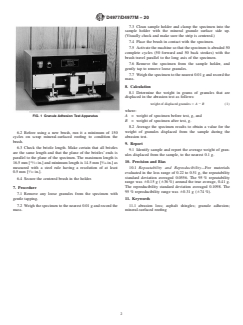
1.1 This test method covers the determination of granule 4.1 Granule Adhesion Test Apparatus —A machine de-
adhesion to mineral-surfaced roofing due to abrasion. signed to cycle a test brush back and forth horizontally across
a specimen at a rate of 50 cycles for 60 to 70 s. The brush
1.2 The values stated in either SI units or inch-pound units
assembly rests on the specimen with a downward mass of 2268
are to be regarded separately as standard. The values stated in
67g[5lb 6 ⁄4 oz]; the stroke length is 152 66mm[6 6
each system may not be exact equivalents; therefore, each
⁄4 in.]. A typical machine is shown in Fig. 1.
system shall be used independently of the other. Combining
values from the two systems may result in nonconformance 4.2 Abrasion Test Brush —A brush with 22 holes contain-
with the standard. ing bristles made of 0.305-mm [0.012-in.] diameter tempered
steel wire, 40 wires per hole, set with epoxy. The design of the
1.3 This standard does not purport to address all of the
brush is shown in Fig. 2.
safety concerns, if any, associated with its use. It is the
responsibility of the user of this standard to establish appro-
4.3 Balance Minimums, 200 g capacity with 0.01 g sensi-
priate safety, health, and environmental practices and deter-
tivity.
mine the applicability of regulatory limitations prior to use.
1.4 This international standard was developed in accor- 5. Test Specimens
dance with internationally recognized principles on standard-
5.1 Cut a minimum of two 50.8 by 229-mm [2 by 9-in.]
ization established in the Decision on Principles for the
specimens with the long dimension in the machine direction.
Development of International Standards, Guides and Recom-
For shingles whose geometry does not allow a continuous 50.8
mendations issued by the World Trade Organization Technical
by 229-mm [2 by 9-in.] specimen, two-piece specimens are
Barriers to Trade (TBT) Committee.
permitted. The minimum machine-direction dimension of any
given piece is 101.6 mm [4 6 ⁄4 in.]. It is permitted to join the
2. Summary of Test Method
two pieces with self-stick tape applied to the nongranulated
2.1 A brush with bristles is used to abrade the granule surfaces.
surface of the specimen on mineral-surfaced roofing. The
NOTE 1—The test result shall be discarded if the specimen fails to
adhesion is assessed by weighing the amount of granules that
remain flat or the two pieces become separated during the 50 complete
are displaced and become loose as a result of the abrasion test.
abrasion cycles.
5.2 Condition specimens at room temperature 23 6 2°C
3. Significance and Use
[73.4 6 3.6 °F] for 30 min before testing. In case of dispute,
3.1 This test method is used to determine the quality of condition specimen for 24 h in a desiccator.
adhesion of the granular surfacing to the coating asphalt in a
sample of mineral-surfaced roofing. The results determine
6. Preparation of Apparatus
compliance with the applicable specification requirements or
6.1 Insert the brush in the holder with the 38.1-mm [1 ⁄2-in.]
for comparative analysis. This test method applies to “as
side parallel to the stroke line.
manufactured” material and may not be applicable to material
that has had weathering exposure.
The sole source of supply of the apparatus (3M Granule Embedding Test
Machine and Abrasion Test Brushes) known to the committee at this time is C. G.
This test method is under the jurisdiction ofASTM Committee D08 on Roofing Hill & Sons, 5150 Quincy Street, Mounds View, MN 55112; phone: 763-783-9055;
andWaterproofingandisthedirectresponsibilityofSubcommitteeD08.02onSteep www.cghill.com. If you are aware of alternative suppliers, ple
...
This document is not an ASTM standard and is intended only to provide the user of an ASTM standard an indication of what changes have been made to the previous version. Because
it may not be technically possible to adequately depict all changes accurately, ASTM recommends that users consult prior editions as appropriate. In all cases only the current version
of the standard as published by ASTM is to be considered the official document.
Designation: D4977/D4977M − 03 (Reapproved 2019) D4977/D4977M − 20
Standard Test Method for
Granule Adhesion to Mineral Surfaced Mineral-Surfaced
Roofing by Abrasion
This standard is issued under the fixed designation D4977/D4977M; the number immediately following the designation indicates the
year of original adoption or, in the case of revision, the year of last revision. A number in parentheses indicates the year of last
reapproval. A superscript epsilon (´) indicates an editorial change since the last revision or reapproval.
1. Scope
1.1 This test method covers the determination of granule adhesion to mineral surfaced mineral-surfaced roofing due to abrasion.
1.2 The values stated in either SI units or inch-pound units are to be regarded separately as standard. The values stated in each
system may not be exact equivalents; therefore, each system shall be used independently of the other. Combining values from the
two systems may result in non-conformancenonconformance with the standard.
1.3 This standard does not purport to address all of the safety concerns, if any, associated with its use. It is the responsibility
of the user of this standard to establish appropriate safety, health, and environmental practices and determine the applicability of
regulatory limitations prior to use.
1.4 This international standard was developed in accordance with internationally recognized principles on standardization
established in the Decision on Principles for the Development of International Standards, Guides and Recommendations issued
by the World Trade Organization Technical Barriers to Trade (TBT) Committee.
2. Summary of Test Method
2.1 A brush with bristles is used to abrade the granule surface of the specimen on mineral surfaced mineral-surfaced roofing.
The adhesion is assessed by weighing the amount of granules that are displaced and become loose as a result of the abrasion test.
3. Significance and Use
3.1 This test method is used to determine the quality of adhesion of the granular surfacing to the coating asphalt in a sample
of mineral surfaced mineral-surfaced roofing. The results determine compliance with the applicable specification requirements or
for comparative analysis. This test method applies to “as manufactured” material and may not be applicable to material that has
had weathering exposure.
4. Apparatus
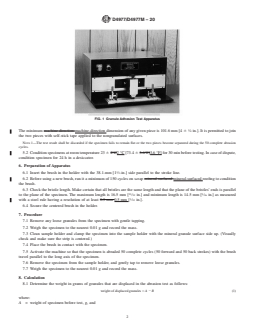
4.1 Granule Adhesion Test Apparatus —A machine designed to cycle a test brush back and forth horizontally across a specimen
at a rate of 50 cycles for 60 to 70 s. The brush assembly rests on the specimen with a downward mass of 2268 6 7 g [5 lb 6 ⁄4
oz]; the stroke length is 152 6 6 mm [6 6 ⁄4 in.]. A typical machine is shown in Fig. 1.
4.2 Abrasion Test Brush —A brush with 22 holes containing bristles made of 0.305-mm [0.012-in.] diameter tempered steel
wire, 40 wires per hole, set with epoxy. The design of the brush is shown in Fig. 2.
4.3 Balance Minimums, 200 g capacity with 0.01 g sensitivity.
5. Test Specimens
5.1 Cut a minimum of two 50.8 by 229-mm [2 by 9-in.] specimens with the long dimension in the machine direction. For
shingles whose geometry does not allow a continuous 50.8 by 229-mm [2 by 9-in.] specimen, two-piece specimens are permitted.
This test method is under the jurisdiction of ASTM Committee D08 on Roofing and Waterproofing and is the direct responsibility of Subcommittee D08.02 on Steep
Roofing Products and Assemblies.
Current edition approved May 1, 2019May 1, 2020. Published June 2019June 2020. Originally approved in 1989. Last previous edition approved in 20132019 as
ɛ1
D4977/D4977M – 03 (2013)(2019). . DOI: 10.1520/D4977_D4977M-03R19.10.1520/D4977_D4977M-20.
The sole source of supply of the apparatus (3M Granule Embedding Test Machine and Abrasion Test Brushes) known to the committee at this time is 3M, 3M Center,
St. Paul, MN 55144. C. G. Hill & Sons, 5150 Quincy Street, Mounds View, MN 55112; phone: 763-783-9055; www.cghill.com. If you are aware of alternative suppliers,
please provide this information to ASTM International Headquarters. Your comments will receive careful consideration at a meeting of the responsible technical committee,
which you may attend.
Use the brush specified by the test machine manufacturer.
Copyright © ASTM International,
...