

ASTM D6380/D6380M-03(2022)
(Specification)Standard Specification for Asphalt Roll Roofing (Organic Felt)
General Information
- Abstract
ABSTRACT
This specification covers three classes and three types of asphalt roll roofing in sheet form, in widths agreed upon between the purchaser and the producer/supplier, and composed of asphalt-saturated organic felt coated on both sides with asphalt. Class M and WS rolls are surfaced on the weather (exposed) side with mineral granules, except for any selvage. Class S rolls are surfaced with powdered talc, mica, or other fine mineral matter to prevent sticking. Type classifications (Types II, III, and IV) are grouped based on minimum net mass per unit area of roofing. Roofing shall adhere to physical property requirements such as breaking strength, water permeance and vapor transmission, width, selvage, area, and moisture.
SCOPE
1.1 This specification covers asphalt roofing in sheet form, in widths agreed upon between the purchaser and the producer/supplier, composed of asphalt-saturated organic felt coated on both sides with asphalt. Class M and WS rolls are surfaced on the (exposed) weather side with mineral granules, except for any selvage. Class S rolls are surfaced with powdered talc, mica, or other fine mineral matter to prevent sticking.
1.2 The values stated in either SI units or inch-pound units are to be regarded separately as standard. The values stated in each system may not be exact equivalents; therefore, each system shall be used independently of the other. Combining values from the two systems may result in nonconformance with the standard.
1.3 This standard does not purport to address all of the safety concerns, if any, associated with its use. It is the responsibility of the user of this standard to establish appropriate safety, health, and environmental practices and determine the applicability of regulatory limitations prior to use.
1.4 This international standard was developed in accordance with internationally recognized principles on standardization established in the Decision on Principles for the Development of International Standards, Guides and Recommendations issued by the World Trade Organization Technical Barriers to Trade (TBT) Committee.
- Status
- Published
- Publication Date
- 31-Oct-2022
- Technical Committee
- D08 - Roofing and Waterproofing
- Drafting Committee
- D08.02 - Steep Roofing Products and Assemblies

Overview
ASTM D6380/D6380M-03(2022) is the internationally recognized standard specification for asphalt roll roofing using organic felt. Developed by ASTM International, this standard defines the requirements for asphalt-saturated organic felt roofing, supplied in sheet form and suitable for use in building and waterproofing applications. The standard covers three classes of roll roofing-Class S (smooth), Class M (mineral-surfaced), and Class WS (wide selvage)-along with three type classifications based on minimum net mass per unit area. This ensures clarity around product quality, performance, dimensions, and essential physical properties required for reliable roof protection.
Key Topics
Product Classes and Types
- Class S: Smooth rolls surfaced with finely-mineral matter (e.g., talc or mica) for anti-stick properties.
- Class M: Mineral-surfaced rolls providing robust weather protection, with granular surfacing on the exposed side.
- Class WS: Wide selvage rolls, partly surfaced with mineral granules for easier lap installation.
- Type II, III, IV: Differentiated by minimum net mass per unit area, supporting various application needs and durability requirements.
Material and Performance Criteria
- Manufactured from a single thickness of organic felt, saturated and coated with asphalt.
- Emphasis on uniformity of saturation, absence of unsaturated areas, and solid adhesion of surfacing materials.
- Physical property requirements, including:
- Breaking strength
- Water permeance and vapor transmission
- Pliability and behavior under heat
- Granule loss (for mineral-surfaced types)
- Tolerance in width, length, area, and mass
Dimensional and Mass Controls
- Sheets typically supplied in 914 mm (36 in.) width, but custom widths are negotiable.
- Strict controls on area and mass deviations ensure product reliability.
Quality Assurance
- Sampling and test methods are specified to verify properties, referencing established ASTM test methods.
- Inspection, packaging, and marking protocols are included to support traceability and consistency.
Applications
Asphalt roll roofing (organic felt) specified by ASTM D6380/D6380M-03(2022) is widely used in:
- Residential and Light Commercial Roofing: As a cost-effective, durable waterproof roofing membrane, especially on low-slope roofs.
- Waterproofing Underlayments: As an underlayment or protection sheet beneath shingles, tiles, or other roof coverings to enhance moisture resistance.
- Temporary Weather Protection: For site protection or as an emergency waterproofing layer during building works.
- Repairs and Renovations: Useful for patching older roofs and extending roof life.
This standard ensures that roll roofing products deliver consistent performance, minimizing the risk of premature failure due to material inconsistencies or improper manufacturing.
Related Standards
ASTM D6380/D6380M-03(2022) references and aligns with several other important ASTM standards for roofing and waterproofing:
- ASTM D146/D146M: Test Methods for Sampling and Testing Bitumen-Saturated Felts and Woven Fabrics
- ASTM D228/D228M: Test Methods for Asphalt Roofing Sampling and Testing
- ASTM D3019/D3019M: Specification for Lap Cement Used with Asphalt Roll Roofing
- ASTM D4977/D4977M: Method for Granule Adhesion to Mineral-Surfaced Roofing
- ASTM D1079: Terminology for Roofing and Waterproofing
By harmonizing requirements and test procedures across these documents, ASTM D6380/D6380M-03(2022) provides a comprehensive baseline for the manufacture, quality assurance, and application of asphalt roll roofing with organic felt-supporting roofers, designers, and manufacturers in delivering safer and more reliable building envelopes.
Keywords: asphalt roll roofing, organic felt, ASTM D6380, roofing sheets, roof membranes, mineral surface, waterproofing
Relations
- Effective Date
- 01-May-2024
- Effective Date
- 01-Mar-2024
- Effective Date
- 15-Nov-2023
- Effective Date
- 01-May-2020
- Effective Date
- 01-May-2020
- Effective Date
- 01-May-2019
- Effective Date
- 01-May-2019
- Effective Date
- 15-Dec-2018
- Effective Date
- 15-Dec-2018
- Effective Date
- 01-Nov-2018
- Effective Date
- 01-Jan-2017
- Effective Date
- 01-Nov-2016
- Effective Date
- 01-Feb-2016
- Effective Date
- 01-May-2015
- Effective Date
- 01-May-2015
Get Certified
Connect with accredited certification bodies for this standard

DIBt (Deutsches Institut für Bautechnik)
German Institute for Building Technology.
DIN CERTCO
DIN Group product certification.

Aboma Certification B.V.
Specialized in construction, metal, and transport sectors.
Sponsored listings
Frequently Asked Questions
ASTM D6380/D6380M-03(2022) is a technical specification published by ASTM International. Its full title is "Standard Specification for Asphalt Roll Roofing (Organic Felt)". This standard covers: ABSTRACT This specification covers three classes and three types of asphalt roll roofing in sheet form, in widths agreed upon between the purchaser and the producer/supplier, and composed of asphalt-saturated organic felt coated on both sides with asphalt. Class M and WS rolls are surfaced on the weather (exposed) side with mineral granules, except for any selvage. Class S rolls are surfaced with powdered talc, mica, or other fine mineral matter to prevent sticking. Type classifications (Types II, III, and IV) are grouped based on minimum net mass per unit area of roofing. Roofing shall adhere to physical property requirements such as breaking strength, water permeance and vapor transmission, width, selvage, area, and moisture. SCOPE 1.1 This specification covers asphalt roofing in sheet form, in widths agreed upon between the purchaser and the producer/supplier, composed of asphalt-saturated organic felt coated on both sides with asphalt. Class M and WS rolls are surfaced on the (exposed) weather side with mineral granules, except for any selvage. Class S rolls are surfaced with powdered talc, mica, or other fine mineral matter to prevent sticking. 1.2 The values stated in either SI units or inch-pound units are to be regarded separately as standard. The values stated in each system may not be exact equivalents; therefore, each system shall be used independently of the other. Combining values from the two systems may result in nonconformance with the standard. 1.3 This standard does not purport to address all of the safety concerns, if any, associated with its use. It is the responsibility of the user of this standard to establish appropriate safety, health, and environmental practices and determine the applicability of regulatory limitations prior to use. 1.4 This international standard was developed in accordance with internationally recognized principles on standardization established in the Decision on Principles for the Development of International Standards, Guides and Recommendations issued by the World Trade Organization Technical Barriers to Trade (TBT) Committee.
ABSTRACT This specification covers three classes and three types of asphalt roll roofing in sheet form, in widths agreed upon between the purchaser and the producer/supplier, and composed of asphalt-saturated organic felt coated on both sides with asphalt. Class M and WS rolls are surfaced on the weather (exposed) side with mineral granules, except for any selvage. Class S rolls are surfaced with powdered talc, mica, or other fine mineral matter to prevent sticking. Type classifications (Types II, III, and IV) are grouped based on minimum net mass per unit area of roofing. Roofing shall adhere to physical property requirements such as breaking strength, water permeance and vapor transmission, width, selvage, area, and moisture. SCOPE 1.1 This specification covers asphalt roofing in sheet form, in widths agreed upon between the purchaser and the producer/supplier, composed of asphalt-saturated organic felt coated on both sides with asphalt. Class M and WS rolls are surfaced on the (exposed) weather side with mineral granules, except for any selvage. Class S rolls are surfaced with powdered talc, mica, or other fine mineral matter to prevent sticking. 1.2 The values stated in either SI units or inch-pound units are to be regarded separately as standard. The values stated in each system may not be exact equivalents; therefore, each system shall be used independently of the other. Combining values from the two systems may result in nonconformance with the standard. 1.3 This standard does not purport to address all of the safety concerns, if any, associated with its use. It is the responsibility of the user of this standard to establish appropriate safety, health, and environmental practices and determine the applicability of regulatory limitations prior to use. 1.4 This international standard was developed in accordance with internationally recognized principles on standardization established in the Decision on Principles for the Development of International Standards, Guides and Recommendations issued by the World Trade Organization Technical Barriers to Trade (TBT) Committee.
ASTM D6380/D6380M-03(2022) is classified under the following ICS (International Classification for Standards) categories: 91.100.50 - Binders. Sealing materials. The ICS classification helps identify the subject area and facilitates finding related standards.
ASTM D6380/D6380M-03(2022) has the following relationships with other standards: It is inter standard links to ASTM D3019/D3019M-17(2024), ASTM E96/E96M-24, ASTM E96/E96M-23, ASTM D1079-20, ASTM D4977/D4977M-20, ASTM D4977/D4977M-03(2019), ASTM D228/D228M-19, ASTM D1079-18e1, ASTM D1079-18, ASTM D228/D228M-18, ASTM D3019/D3019M-17, ASTM D228/D228M-16, ASTM D1079-16, ASTM E96/E96M-15, ASTM D228/D228M-15. Understanding these relationships helps ensure you are using the most current and applicable version of the standard.
ASTM D6380/D6380M-03(2022) is available in PDF format for immediate download after purchase. The document can be added to your cart and obtained through the secure checkout process. Digital delivery ensures instant access to the complete standard document.
Standards Content (Sample)
This international standard was developed in accordance with internationally recognized principles on standardization established in the Decision on Principles for the
Development of International Standards, Guides and Recommendations issued by the World Trade Organization Technical Barriers to Trade (TBT) Committee.
Designation: D6380/D6380M −03 (Reapproved 2022)
Standard Specification for
Asphalt Roll Roofing (Organic Felt)
This standard is issued under the fixed designation D6380/D6380M; the number immediately following the designation indicates the
year of original adoption or, in the case of revision, the year of last revision. A number in parentheses indicates the year of last
reapproval. A superscript epsilon (´) indicates an editorial change since the last revision or reapproval.
1. Scope D224 Specification for Smooth-SurfacedAsphalt Roll Roof-
ing (Organic Felt) (Withdrawn 2002)
1.1 This specification covers asphalt roofing in sheet form,
D228/D228M Test Methods for Sampling, Testing, and
in widths agreed upon between the purchaser and the producer/
Analysis of Asphalt Roll Roofing, Cap Sheets, and
supplier, composed of asphalt-saturated organic felt coated on
Shingles Used in Roofing and Waterproofing
both sides with asphalt. Class M and WS rolls are surfaced on
D249 Specification for Asphalt Roll Roofing (Organic Felt)
the (exposed) weather side with mineral granules, except for
Surfaced with Mineral Granules (Withdrawn 2002)
any selvage. Class S rolls are surfaced with powdered talc,
D371 Specification for Asphalt Roll Roofing (Organic Felt)
mica, or other fine mineral matter to prevent sticking.
Surfaced with Mineral Granules; Wide Selvage (With-
1.2 The values stated in either SI units or inch-pound units
drawn 2002)
are to be regarded separately as standard. The values stated in
D1079 Terminology Relating to Roofing and Waterproofing
each system may not be exact equivalents; therefore, each
D3019/D3019M Specification for Lap Cement Used with
system shall be used independently of the other. Combining
Asphalt Roll Roofing, Non-Fibered, and Fibered
values from the two systems may result in nonconformance
D4977/D4977M Test Method for Granule Adhesion to
with the standard.
Mineral-Surfaced Roofing by Abrasion
1.3 This standard does not purport to address all of the E96/E96M Test Methods for Gravimetric Determination of
safety concerns, if any, associated with its use. It is the
Water Vapor Transmission Rate of Materials
responsibility of the user of this standard to establish appro-
3. Terminology
priate safety, health, and environmental practices and deter-
mine the applicability of regulatory limitations prior to use.
3.1 Definitions—Refer to Terminology D1079 for defini-
1.4 This international standard was developed in accor-
tions of terms used in this specification.
dance with internationally recognized principles on standard-
4. Classification
ization established in the Decision on Principles for the
Development of International Standards, Guides and Recom-
4.1 Class S (smooth) rolls shall be surfaced with fine
mendations issued by the World Trade Organization Technical
mineral matter to prevent sticking.
Barriers to Trade (TBT) Committee.
4.1.1 Type III—Minimum net mass per unit area of roofing,
2 2
2495 g/m [51.1 lb/100 ft ].
2. Referenced Documents
4.1.2 Type IV—Minimum net mass per unit area of roofing,
2 2
1943 g/m [39.8 lb/100 ft ].
2.1 ASTM Standards:
D146/D146M Test Methods for Sampling and Testing
4.2 Class M (mineral) rolls shall be surfaced on the weather
Bitumen-Saturated Felts and Woven Fabrics for Roofing
side with mineral granules, except for any selvage.
and Waterproofing
4.2.1 Type II—Minimum net mass of granule-surfaced
2 2
portion, 3490 g/m [71.5 lb/100 ft ].
4.3 Class WS (wide selvage) rolls shall be surfaced on the
This specification is under the jurisdiction of ASTM Committee D08 on
weather side with mineral granules for approximately half the
Roofing and Waterproofing and is the direct responsibility of Subcommittee D08.02
width.
on Steep Roofing Products and Assemblies.
4.3.1 Type III—Minimum net mass per unit area, 1733 g/m
The materials covered in this standard were previously covered by three separate
roll roofing material standards: Specifications D224, D249, and D371.
[35.5 lb/100 ft ].
Current edition approved Nov. 1, 2022. Published November 2022. Originally 2
4.3.2 Type IV—Minimum net mass per unit area, 2090 g/m
approved in 1999. Last previous edition approved in 2018 as D6380/D6380M – 03
[42.8 lb/100 ft ].
(2018). DOI: 10.1520/D6380_D6380M-03R22.
For referenced ASTM standards, visit the ASTM website, www.astm.org, or
contact ASTM Customer Service at service@astm.org. For Annual Book of ASTM
Standards volume information, refer to the standard’s Document Summary page on The last approved version of this historical standard is referenced on
the ASTM website. www.astm.org.
Copyright © ASTM International, 100 Barr Harbor Drive, PO Box C700, West Conshohocken, PA 19428-2959. United States
D6380/D6380M − 03 (2022)
5. Materials and Manufacture 6.4 Pliability at 25 °C [77 °F]—At least eight strips out of
ten from the granule-surfaced portion of the sheet shall not
5.1 In the process of manufacture, a single thickness of dry
crackwhentestedinaccordancewiththeappropriatesectionof
organic felt shall first be saturated with asphalt. A coating
Test Methods D228/D228M. The samples shall be tested using
asphalt, compounded with or without a fine mineral stabilizer
a mandrel with a radius of 12.7 mm [ ⁄2 in.] for Class S roofing
insoluble in water, shall be applied to one or both sides of the
and 19 mm [ ⁄4 in.] radius for Class M and WS roll roofing.
sheet. Class S rolls shall be surfaced on one side with a suitable
material to prevent sticking in the roll. Class M and WS rolls
6.5 Behavior on Heating to 80 °C [176 °F] for 2 h—There
shall be covered on the weather side with mineral granules,
shall be no more than 1.5 % volatile loss; there shall be no
except for any selvage; the reverse side shall be covered with
flowing, sagging, blistering, or absorption of the asphalt
a suitable material to prevent sticking in the roll.
coating; and any granular surfacing shall not slide more than
2mm[ ⁄16 in.] when tested in accordance with the appropriate
5.2 The felt shall be roofing felt primarily composed of
section of Test Methods D228/D228M.
organic fibers. The surface of the felt shall be uniformly and
relatively smooth. Upon splitting or tearing on the bias, the felt
7. Dimensions, Mass, and Permissible Variations
shall appear reasonably free of lumps or particles of foreign
substances.
7.1 Width—The material shall be put up in rolls and shall be
914 mm [36 in.] wide, 60.7 %. Other widths agreed upon
6. Physical Properties
between the purchaser and the producer/supplier shall not be
6.1 Class S rolls shall conform to the breaking strength and
prohibited.
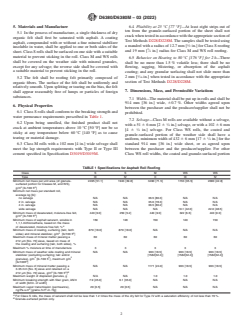
water permeance requirements prescribed in Table 1.
7.2 Selvage—Class M rolls are available without a selvage,
6.2 Upon being unrolled, the finished product shall not
with a 51 66mm[2 6 ⁄4 in.] selvage, or with a 102 66mm
crack at ambient temperatures above 10 °C [50 °F] nor be so
[4 6 ⁄4 in.] selvage. For Class WS rolls, the coated and
sticky at any temperature below 60 °C [140 °F] as to cause
granule-surfaced portion of the weather side shall have a
tearing or material damage.
uniform, minimum width of 432 6 6 mm [17 6 ⁄4 in.] for the
6.3 Class M rolls with a 102 mm [4 in.] wide selvage shall standard 914 mm [36 in.] wide sheet, or as agreed upon
meet the lap strength requirements with Type II or Type III between the purchaser and the producer/supplier. For other
cement specified in Specification D3019/D3019M. Class WS roll widths,
...