

ASTM C1629/C1629M-23
(Classification)Standard Classification for Abuse-Resistant Nondecorated Interior Gypsum Panel Products and Fiber-Reinforced Cement Panels
General Information
- Abstract
SIGNIFICANCE AND USE
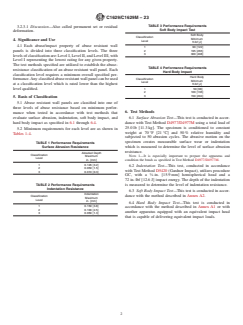
4.1 Each abuse/impact property of abuse resistant wall panels is divided into three classification levels. The three levels of classification are: Level I, Level II, and Level III, with Level I representing the lowest rating for any given property. The test methods specified are utilized to establish the abuse-resistance classification of an abuse resistant wall panel. Each classification level requires a minimum overall specified performance. Any classified abuse resistant wall panel can be used at a classification level which is rated lower than the highest level qualified.
SCOPE
1.1 This standard establishes classifications of abuse resistance based on the abrasion resistance and impact resistance performance of nondecorated interior gypsum panel products and fiber-reinforced cement panels (abuse resistant wall panels).
1.1.1 This standard is a method of classifying gypsum panel product performance and is not intended to classify systems for abuse resistance.
1.2 The values stated in inch-pound and SI (metric) units are to be regarded separately as standard. Within the text, the SI units are shown in brackets. The values stated in each system shall be used independent of the other. Values from the two systems shall not be combined.
1.3 This standard does not purport to address all of the safety concerns, if any, associated with its use. It is the responsibility of the user of this standard to establish appropriate safety, health, and environmental practices and determine the applicability of regulatory limitations prior to use.
1.4 This international standard was developed in accordance with internationally recognized principles on standardization established in the Decision on Principles for the Development of International Standards, Guides and Recommendations issued by the World Trade Organization Technical Barriers to Trade (TBT) Committee.
- Status
- Published
- Publication Date
- 31-May-2023
- Technical Committee
- C11 - Gypsum and Related Building Materials and Systems
- Drafting Committee
- C11.01 - Specifications and Test Methods for Gypsum Products
Buy Documents
ASTM C1629/C1629M-23 - Standard Classification for Abuse-Resistant Nondecorated Interior Gypsum Panel Products and Fiber-Reinforced Cement Panels
REDLINE ASTM C1629/C1629M-23 - Standard Classification for Abuse-Resistant Nondecorated Interior Gypsum Panel Products and Fiber-Reinforced Cement Panels
Overview
ASTM C1629/C1629M-23: Standard Classification for Abuse-Resistant Nondecorated Interior Gypsum Panel Products and Fiber-Reinforced Cement Panels establishes a consistent framework for classifying the abuse resistance of interior wall panels made from gypsum and fiber-reinforced cement. Developed by ASTM International, this standard provides methodologies to evaluate and categorize wall panel products based on their abrasion and impact resistance properties. The goal is to ensure that these nondecorated panels are assigned performance levels, empowering designers, builders, and specifiers to select appropriate products for environments requiring enhanced durability.
Key Topics
- Classification Levels: The standard divides abuse resistance into three levels (Level I, Level II, and Level III) for each resistance property. Level I represents the lowest rating, while Level III indicates the highest performance.
- Tested Properties: Abuse resistance is determined through testing for:
- Surface abrasion resistance
- Indentation resistance
- Soft body impact resistance
- Hard body impact resistance
- Testing Methods: Specific procedures, such as ASTM D4977/D4977M for abrasion and ASTM D5420 for impact, are referenced to ensure consistent measurement and repeatable results.
- Performance Criteria: Each classification level requires minimum performance standards in terms of abraded depth, indentation depth, and energy absorption for both soft and hard body impacts.
- International Relevance: Measurements are presented in both inch-pound and SI (metric) units. The standard is aligned with internationally recognized standardization practices.
Applications
ASTM C1629/C1629M-23 is widely applicable across construction and building product industries, supporting:
- Selection of Durable Wall Panels: Helps architects, engineers, and facility managers specify or select nondecorated interior wall panels suited to high-traffic or high-impact areas, such as schools, hospitals, transportation hubs, and correctional facilities.
- Product Quality Assessment: Manufacturers can classify their products’ performance based on quantifiable criteria, improving transparency for end users.
- Compliance and Building Code Integration: Facilitates compliance with building codes and project specifications that demand minimum impact and abrasion resistance.
- Risk Mitigation: By defining levels of resistance, the standard supports the reduction of maintenance costs and frequency of panel replacement due to abuse.
Related Standards
For comprehensive evaluation and application, ASTM C1629/C1629M-23 references and aligns with other standards, including:
- ASTM C11: Terminology Relating to Gypsum and Related Building Materials and Systems
- ASTM C473: Test Methods for Physical Testing of Gypsum Panel Products
- ASTM C840: Specification for Application and Finishing of Gypsum Board
- ASTM C1154: Terminology for Non-Asbestos Fiber-Reinforced Cement Products
- ASTM D4977/D4977M: Test Method for Granule Adhesion to Mineral-Surfaced Roofing by Abrasion
- ASTM D5420: Test Method for Impact Resistance of Plastic Specimens
- ISO 6707-1: Building and Civil Engineering - Vocabulary
- PS20: American Softwood Lumber Standard
Practical Value
By adopting ASTM C1629/C1629M-23, stakeholders in the construction industry can make informed decisions when specifying and installing abuse-resistant gypsum or fiber-reinforced cement panels. The standard ensures the integrity of interior spaces subject to frequent physical contact and helps maintain building aesthetics and function over time. It is an essential document for those seeking robust, reliable, and standardized performance classifications for interior wall panel products.
Relations
- Effective Date
- 01-Oct-2023
- Effective Date
- 01-May-2020
- Effective Date
- 01-Nov-2019
- Effective Date
- 01-Oct-2019
- Effective Date
- 01-Oct-2019
- Effective Date
- 01-Jun-2019
- Effective Date
- 01-May-2019
- Effective Date
- 15-Nov-2018
- Refers
ASTM C11-18a - Standard Terminology Relating to Gypsum and Related Building Materials and Systems - Effective Date
- 01-Oct-2018
- Effective Date
- 01-Oct-2018
- Effective Date
- 01-Jul-2018
- Refers
ASTM C11-18 - Standard Terminology Relating to Gypsum and Related Building Materials and Systems - Effective Date
- 01-Jun-2018
- Effective Date
- 01-Oct-2017
- Refers
ASTM C11-17a - Standard Terminology Relating to Gypsum and Related Building Materials and Systems - Effective Date
- 01-Oct-2017
- Effective Date
- 01-Oct-2017
Buy Documents
ASTM C1629/C1629M-23 - Standard Classification for Abuse-Resistant Nondecorated Interior Gypsum Panel Products and Fiber-Reinforced Cement Panels
REDLINE ASTM C1629/C1629M-23 - Standard Classification for Abuse-Resistant Nondecorated Interior Gypsum Panel Products and Fiber-Reinforced Cement Panels
Get Certified
Connect with accredited certification bodies for this standard

DIBt (Deutsches Institut für Bautechnik)
German Institute for Building Technology.
DIN CERTCO
DIN Group product certification.

Aboma Certification B.V.
Specialized in construction, metal, and transport sectors.
Sponsored listings
Frequently Asked Questions
ASTM C1629/C1629M-23 is a standard published by ASTM International. Its full title is "Standard Classification for Abuse-Resistant Nondecorated Interior Gypsum Panel Products and Fiber-Reinforced Cement Panels". This standard covers: SIGNIFICANCE AND USE 4.1 Each abuse/impact property of abuse resistant wall panels is divided into three classification levels. The three levels of classification are: Level I, Level II, and Level III, with Level I representing the lowest rating for any given property. The test methods specified are utilized to establish the abuse-resistance classification of an abuse resistant wall panel. Each classification level requires a minimum overall specified performance. Any classified abuse resistant wall panel can be used at a classification level which is rated lower than the highest level qualified. SCOPE 1.1 This standard establishes classifications of abuse resistance based on the abrasion resistance and impact resistance performance of nondecorated interior gypsum panel products and fiber-reinforced cement panels (abuse resistant wall panels). 1.1.1 This standard is a method of classifying gypsum panel product performance and is not intended to classify systems for abuse resistance. 1.2 The values stated in inch-pound and SI (metric) units are to be regarded separately as standard. Within the text, the SI units are shown in brackets. The values stated in each system shall be used independent of the other. Values from the two systems shall not be combined. 1.3 This standard does not purport to address all of the safety concerns, if any, associated with its use. It is the responsibility of the user of this standard to establish appropriate safety, health, and environmental practices and determine the applicability of regulatory limitations prior to use. 1.4 This international standard was developed in accordance with internationally recognized principles on standardization established in the Decision on Principles for the Development of International Standards, Guides and Recommendations issued by the World Trade Organization Technical Barriers to Trade (TBT) Committee.
SIGNIFICANCE AND USE 4.1 Each abuse/impact property of abuse resistant wall panels is divided into three classification levels. The three levels of classification are: Level I, Level II, and Level III, with Level I representing the lowest rating for any given property. The test methods specified are utilized to establish the abuse-resistance classification of an abuse resistant wall panel. Each classification level requires a minimum overall specified performance. Any classified abuse resistant wall panel can be used at a classification level which is rated lower than the highest level qualified. SCOPE 1.1 This standard establishes classifications of abuse resistance based on the abrasion resistance and impact resistance performance of nondecorated interior gypsum panel products and fiber-reinforced cement panels (abuse resistant wall panels). 1.1.1 This standard is a method of classifying gypsum panel product performance and is not intended to classify systems for abuse resistance. 1.2 The values stated in inch-pound and SI (metric) units are to be regarded separately as standard. Within the text, the SI units are shown in brackets. The values stated in each system shall be used independent of the other. Values from the two systems shall not be combined. 1.3 This standard does not purport to address all of the safety concerns, if any, associated with its use. It is the responsibility of the user of this standard to establish appropriate safety, health, and environmental practices and determine the applicability of regulatory limitations prior to use. 1.4 This international standard was developed in accordance with internationally recognized principles on standardization established in the Decision on Principles for the Development of International Standards, Guides and Recommendations issued by the World Trade Organization Technical Barriers to Trade (TBT) Committee.
ASTM C1629/C1629M-23 is classified under the following ICS (International Classification for Standards) categories: 91.100.10 - Cement. Gypsum. Lime. Mortar. The ICS classification helps identify the subject area and facilitates finding related standards.
ASTM C1629/C1629M-23 has the following relationships with other standards: It is inter standard links to ASTM C840-23, ASTM D4977/D4977M-20, ASTM C840-19b, ASTM C473-19, ASTM C840-19a, ASTM C840-19, ASTM D4977/D4977M-03(2019), ASTM C840-18b, ASTM C11-18a, ASTM C840-18a, ASTM C840-18, ASTM C11-18, ASTM C473-17, ASTM C11-17a, ASTM C840-17a. Understanding these relationships helps ensure you are using the most current and applicable version of the standard.
ASTM C1629/C1629M-23 is available in PDF format for immediate download after purchase. The document can be added to your cart and obtained through the secure checkout process. Digital delivery ensures instant access to the complete standard document.
Standards Content (Sample)
This international standard was developed in accordance with internationally recognized principles on standardization established in the Decision on Principles for the
Development of International Standards, Guides and Recommendations issued by the World Trade Organization Technical Barriers to Trade (TBT) Committee.
Designation: C1629/C1629M − 23
Standard Classification for
Abuse-Resistant Nondecorated Interior Gypsum Panel
Products and Fiber-Reinforced Cement Panels
This standard is issued under the fixed designation C1629/C1629M; the number immediately following the designation indicates the
year of original adoption or, in the case of revision, the year of last revision. A number in parentheses indicates the year of last
reapproval. A superscript epsilon (´) indicates an editorial change since the last revision or reapproval.
1. Scope C840 Specification for Application and Finishing of Gypsum
Board
1.1 This standard establishes classifications of abuse resis-
C1154 Terminology for Non-Asbestos Fiber-Reinforced Ce-
tance based on the abrasion resistance and impact resistance
ment Products
performance of nondecorated interior gypsum panel products
D1517 Terminology Relating to Leather
and fiber-reinforced cement panels (abuse resistant wall pan-
D4977/D4977M Test Method for Granule Adhesion to
els).
Mineral-Surfaced Roofing by Abrasion
1.1.1 This standard is a method of classifying gypsum panel
D5420 Test Method for Impact Resistance of Flat, Rigid
product performance and is not intended to classify systems for
Plastic Specimen by Means of a Striker Impacted by a
abuse resistance.
Falling Weight (Gardner Impact)
1.2 The values stated in inch-pound and SI (metric) units are
2.2 ISO Document:
to be regarded separately as standard. Within the text, the SI
ISO 6707-1 Building and Civil Engineering—Vocabulary—
units are shown in brackets. The values stated in each system
Part 1: General Terms
shall be used independent of the other. Values from the two
systems shall not be combined. 2.3 Federal Specification:
A-A-50197A Thread, Linen
1.3 This standard does not purport to address all of the
safety concerns, if any, associated with its use. It is the
2.4 Voluntary Product Standard:
responsibility of the user of this standard to establish appro-
PS20 American Softwood Lumber Standard
priate safety, health, and environmental practices and deter-
mine the applicability of regulatory limitations prior to use.
3. Terminology
1.4 This international standard was developed in accor-
3.1 Definitions of terms shall be in accordance with Termi-
dance with internationally recognized principles on standard-
nologies C11 and C1154.
ization established in the Decision on Principles for the
3.2 Definitions of Terms Specific to This Standard:
Development of International Standards, Guides and Recom-
3.2.1 failure (hard body impact), n—test result constituted
mendations issued by the World Trade Organization Technical
by the penetration or deformation of the wall cavity by the
Barriers to Trade (TBT) Committee.
impact head establishing a residual deflection of the panel
2. Referenced Documents
exceeding the nominal thickness of the test panel.
3.2.2 structural failure (soft body impact), n—a test result
2.1 ASTM Standards:
C11 Terminology Relating to Gypsum and Related Building constituted by the penetration or deformation of the wall cavity
by the soft body impact bag establishing a residual deflection
Materials and Systems
C473 Test Methods for Physical Testing of Gypsum Panel of any area on the test panel that exceeds the nominal thickness
of the test panel.
Products
3.2.2.1 deformation, n—change of shape or dimension or
both. ISO 6707-1
This classification is under the jurisdiction of ASTM Committee C11 on
Gypsum and Related Building Materials and Systems and is the direct responsibility 3.2.2.2 surface damage, n—pulverization of the core of the
of Subcommittee C11.01 on Specifications and Test Methods for Gypsum Products.
test panel at the point of impact, which is evidenced by
Current edition approved June 1, 2023. Published August 2023. Originally
cracking, creasing, or other visible damage short of failure as
approved in 2005. Last previous edition approved in 2019 as C1629/C1629M – 19.
defined in 3.2.2.
DOI: 10.1520/C1629_C1629M-23.
For referenced ASTM standards, visit the ASTM website, www.astm.org, or
3.2.3 residual deflection, n—permanent deformation of a
contact ASTM Customer Service at service@astm.org. For Annual Book of ASTM
building element, component, or structure after removal of
Standards volume information, refer to the standard’s Document Summary page on
the ASTM website. applied force.
Copyright © ASTM International, 100 Barr Harbor Drive, PO Box C700, West Conshohocken, PA 19428-2959. United States
C1629/C1629M − 23
TABLE 3 Performance Requirements
3.2.3.1 Discussion—Also called permanent set or residual
Soft Body Impact Test
deformation.
Soft Body
Classification
Minimum
4. Significance and Use
Level
ft·lbf [J]
4.1 Each abuse/impact property of abuse resistant wall
1 90 [122]
panels is divided into three classification levels. The three 2 195 [265]
3 300 [408]
levels of classification are: Level I, Level II, and Level III, with
Level I representing the lowest rating for any given property.
The test methods specified are utilized to establish the abuse-
TABLE 4 Performance Requirements
resistance classification of an abuse resistant wall panel. Each
Hard Body Impact
classification level requires a minimum overall specified per-
Hard Body
Classification
formance. Any classified abuse resistant wall panel can be used
Minimum
Level
ft·lbf [J]
at a classification level which is rated lower than the highest
level qualified. 1 50 [68]
2 100 [136]
3 150 [204]
5. Basis of Classification
5.1 Abuse resistant wall panels are classified into one of
three levels of abuse resistance based on minimum perfor-
6. Test Methods
mance when tested in accordance with test methods that
evaluate surface abrasion, indentation, soft body impact, and
6.1 Surface Abrasion Test—This test is conducted in accor-
hard body impact as specified in 6.1 through 6.4.
dance with Test Method D4977/D4977M using a total load of
25.0 lb [11.3 kg]. The specimen is conditioned to constant
5.2 Minimum requirements for each level are as shown in
weight at 70 °F [21 °C] and 50 % relative humidity and
Tables 1-4.
subjected to 50 abrasion cycles. The abrasive motion on the
specimen creates measurable surface wear or indentation
TABLE 1 Performance Requirements
which is measured to determine the level of surface abrasion
Surface Abrasion Resistance
resistance.
Abraded Depth
Classification
NOTE 1—It is especially important to prepare the apparatus and
Maximum
Level
in. [mm]
condition the brush as specified in Test Method D4977/D4977M.
1 0.126 [3.2]
6.2 Indentation Test—This test, conducted in accordance
2 0.059 [1.5]
with Test Method D5420 (Gardner Impact), utilizes procedure
3 0.010 [0.3]
GC, with a ⁄8-in. [15.9 mm] hemispherical head and a
72 in.·lbf [12.6 J] impact energy. The depth of the indentation
TABLE 2 Performance Requirements is measured to determine the level of indentation resistance.
Indentation Resistance
6.3 Soft Body Impact Test—This test is conducted in accor-
Indentation
Classification dance with the method described in Annex A2.
Maximum
Level
in. [mm]
6.4 Hard Body Impact Test—This test is conducted in
1 0.150 [3.8]
accordance with the method described in Annex A1 or with
2 0.100 [2.5]
another apparatus equipped with an equivalent impact head
3 0.050 [1.3]
that is capable of delivering equivalent impact loads.
C1629/C1629M − 23
ANNEXES
(Mandatory Information)
A1. HARD BODY IMPACT TEST
A1.1 Scope structural steel tubing), a steel plate pivot arm, a round steel bar
(to add weights), and a rectangular steel plate attached to the
A1.1.1 The hard body impact test measures resistance to
bottom of the structural steel tubing. The total weight of the
penetration of a wall panel when impacted by a rigid body.
components of the ramming arm impactor is 20.0 lb [9.07 kg]
Failure in the hard body impact test is achieved when the
6 0.5 %, as shown in Table A1.1. The center of mass of the
impacting head completely penetrates through the test panel, or
ramming arm impactor coincides with the location of the steel
the depth of the indentation exceeds the thickness of the
round bar (that is, the weight bar). Additional weights are
product being tested when measured from the face side
attached to the weight bar to increase the impacting energy.
following impact, or both.
A1.4.1.2 The ramming arm impactor shall have a suitable
mechanism to secure it at the top of the swing. An example of
A1.2 Summary of Test Method
such a mechanism is a small eyebolt attached to the back of the
A1.2.1 A nominal 2 by 2 ft [610 by 610 mm] specimen is
impactor. When released from the top of the swing, the drop
mounted to the apparatus frame. A ramming arm impactor
height of the center of mass of the ramming arm impactor shall
strikes the wall specimen while swinging in an arc. The
be 12 in. [305 mm].
impactor is dropped from a fixed height to impart specific
A1.4.1.3 The ramming arm is located such that the face of
design energy to the wall specimen. Weights are progressively
the impactor head, when hanging free at the bottom of the arc,
added to the impactor to increase the design impact energy
is in the same plane as the surface of the test specimen so that,
until specimen failure occurs. For each impact, a new test
when dropped, the impactor head strikes the surface of the
specimen is used.
specimen at the bottom of the arc.
A1.3 Significance and Use
A1.5 Test Specimen
A1.3.1 The test method measures relative performance of
A1.5.1 The support for the test specimen shall be con-
interior wall panel materials. Although the test panel is
structed by attaching a 2 by 2 ft [610 by 610 mm] specimen of
mounted on framing and tested vertically as a wall assembly,
the interior wall panel material to a frame of 3 ⁄8 in. [92 mm]
the impact damage is normally limited to a small area. The
deep 30 mil [0.0296 in.] [0.752 mm] minimum thickness steel
method is not intended to evaluate the performance of studs
studs with Type S-12 bugle head screws spaced 8 in. [200 mm]
used in wall construction.
o.c. as shown in Fig. A1.4. The length of the screws shall be
1 5
1 ⁄4 in. [32 mm] for panels up to ⁄8 in. [15.9 mm] in thickness.
A1.4 Apparatus
For panels with thickness greater than ⁄8 in. [15.9 mm], the
A1.4.1 The apparatus consists of a rigid frame with a
length of the screws shall be not less than ⁄8 in. [16 mm] longer
ramming arm pinned to swing in an arc. See Figs. A1.1 and
than the panel thickness.
5 5
A1.2. The frame is constructed of 14 ga, 1 ⁄8 by 1 ⁄8 in.
[41 by 41 mm] B-Line B24 Regular Framing Channels.
A1.6 Preparation of Apparatus
A1.4.1.1 The dimensions and details of the ramming arm
A1.6.1 The apparatus shall be securely anchored to a level
impactor are shown in Fig. A1.3. The ramming arm impactor
floor to prevent sliding or rocking of the apparatus during
consists of a cylindrical steel impact head (made by milling a
impact.
round steel bar), a structural steel tubing with square cross-
section, two square steel plates (front and rear end plates of the
A1.7 Procedure
A1.7.1 The support for the test specimen shall be securely
TABLE A1.1 Weight (Mass) Schedule for the Components of the
clamped to the face of the apparatus so that the surface of the
Ramming Arm Impactor
test specimen is in the same plane as the face of the impact
Weight Mass
head.
Component
lb, ±0.5 % kg, ±0.5 %
A1.7.1.1 A new test specimen shall be used for each impact.
Structural Steel Tubing (square cross-section) 8.10 3.67
Steel Plate Pivot Arm 1.10 0.50
A1.7.2 The ramming arm is raised to the top of the arc and
Front Square Steel Plate (end plate attached to the 0.90 0.41
secured with a pin.
front of the structural steel tubing)
Rear Square Steel Plate (end plate attached to the 0.90 0.41
A1.7.3 The pin is removed, allowing the arm to swing freely
back of the structural steel tubing)
and strike the test specimen.
Cylindrical Steel Impact Head 1.90 0.86
Steel Round Bar (Weight Bar) 2.60 1.18
A1.7.4 A new test specimen is mounted to the support and
Bottom Rectangular Steel Plate (attached to the 4.50 2.04
the weight on the impactor is increased by adding 2.5 lb
bottom of the structural steel tubing)
[1.1 kg] to the weight bar and the test repeated.
C1629/C1629M − 23
in. mm in. mm
1 5
A 6 ⁄16 154.0 I 26 ⁄16 668.3
5 1
B 8 ⁄16 211.1 J 34 ⁄4 870.0
5 1
C 20 ⁄16 515.9 K 37 ⁄2 952.5
9 1
D 20 ⁄16 522.3 L 39 ⁄16 992.2
3 11
E 20 ⁄4 527.1 M 40 ⁄16 1033.5
H 24 609.6
NOTE 1—All framing members shall be B-Line B24 Regular Framing Channels cut to the specified dimensions in this sketch. These channels are
5 5
14 gauge and have an outside dimension of 1 ⁄8 by 1 ⁄8 in. [41 by 41 mm].
FIG. A1.1 Axonometric of Hard Body Apparatus Framing Members (not to scale)
A1.7.5 The test shall be performed by incrementally in- A1.8 Calculation of Impact Energy
creasing the barbell free weights on the impactor until a failure
A1.8.1 Impact energy in ft·lbf units is calculated as the
impact energy is achieved.
product of the weight of the impacting instrument and the drop
A1.7.5.1 The failure impact energy is defined as the mini-
height:
mum energy required for the impactor to penetrate through the
face of the panel, or when the depth of the indentation exceeds
E 5 ~w × h! (A1.1)
the nominal thickness of the product being tested when
where:
measured from the face side.
E = impact energy, ft·lbf,
A1.7.6 Testing shall continue until the failure impact energy
w = weight of impactor, lb, and
is confirmed on three identical specimens for each panel
h = drop height of the center of mass of the impactor, ft.
material being tested.
A1.7.7 Impact energy and damage at each test shall be
recorded.
C1629/C1629M − 23
Fastener Schedule
A B-Line Universal 90° Shelf Bracket B844
B B-Line Two Hole 90° Corner Angle B230
C B-Line Two Hole Flat Splice Plate
D B-Line Beam Clamp B593 Clevis Swivel
E Unistrut 90° Fitting P6281
F B-Line Four Hole Open 45° Angle Fitting B248
G Threaded steel eyebolts with a ⁄2 in. [12.5 mm]
threaded leg 3 in. [75 mm] long, and an eye
interior diame
...
This document is not an ASTM standard and is intended only to provide the user of an ASTM standard an indication of what changes have been made to the previous version. Because
it may not be technically possible to adequately depict all changes accurately, ASTM recommends that users consult prior editions as appropriate. In all cases only the current version
of the standard as published by ASTM is to be considered the official document.
Designation: C1629/C1629M − 19 C1629/C1629M − 23
Standard Classification for
Abuse-Resistant Nondecorated Interior Gypsum Panel
Products and Fiber-Reinforced Cement Panels
This standard is issued under the fixed designation C1629/C1629M; the number immediately following the designation indicates the
year of original adoption or, in the case of revision, the year of last revision. A number in parentheses indicates the year of last
reapproval. A superscript epsilon (´) indicates an editorial change since the last revision or reapproval.
1. Scope*Scope
1.1 This standard establishes classifications of abuse resistance based on the abrasion resistance and impact resistance performance
of nondecorated interior gypsum panel products and fiber-reinforced cement panels (abuse resistant wall panels).
1.1.1 This standard is a method of classifying gypsum panel product performance and is not intended to classify systems for abuse
resistance.
1.2 The values stated in inch-pound and SI (metric) units are to be regarded separately as standard. Within the text, the SI units
are shown in brackets. The values stated in each system shall be used independent of the other. Values from the two systems shall
not be combined.
1.3 This standard does not purport to address all of the safety concerns, if any, associated with its use. It is the responsibility
of the user of this standard to establish appropriate safety, health, and environmental practices and determine the applicability of
regulatory limitations prior to use.
1.4 This international standard was developed in accordance with internationally recognized principles on standardization
established in the Decision on Principles for the Development of International Standards, Guides and Recommendations issued
by the World Trade Organization Technical Barriers to Trade (TBT) Committee.
2. Referenced Documents
2.1 ASTM Standards:
C11 Terminology Relating to Gypsum and Related Building Materials and Systems
C473 Test Methods for Physical Testing of Gypsum Panel Products
C840 Specification for Application and Finishing of Gypsum Board
C1154 Terminology for Non-Asbestos Fiber-Reinforced Cement Products
D1517 Terminology Relating to Leather
D4977/D4977M Test Method for Granule Adhesion to Mineral-Surfaced Roofing by Abrasion
D5420 Test Method for Impact Resistance of Flat, Rigid Plastic Specimen by Means of a Striker Impacted by a Falling Weight
(Gardner Impact)
2.2 ISO Document:
ISO 6707-1 Building and Civil Engineering—Vocabulary—Part 1: General Terms
2.3 Federal Specification:
A-A-50197A Thread, Linen
This classification is under the jurisdiction of ASTM Committee C11 on Gypsum and Related Building Materials and Systems and is the direct responsibility of
Subcommittee C11.01 on Specifications and Test Methods for Gypsum Products.
Current edition approved June 1, 2019June 1, 2023. Published June 2019August 2023. Originally approved in 2005. Last previous edition approved in 20182019 as
C1629/C1629M – 18a.C1629/C1629M – 19. DOI: 10.1520/C1629_C1629M-19.10.1520/C1629_C1629M-23.
For referenced ASTM standards, visit the ASTM website, www.astm.org, or contact ASTM Customer Service at service@astm.org. For Annual Book of ASTM Standards
volume information, refer to the standard’s Document Summary page on the ASTM website.
*A Summary of Changes section appears at the end of this standard
Copyright © ASTM International, 100 Barr Harbor Drive, PO Box C700, West Conshohocken, PA 19428-2959. United States
C1629/C1629M − 23
2.4 Voluntary Product Standard:
PS20 American Softwood Lumber Standard
3. Terminology
3.1 Definitions of terms shall be in accordance with Terminologies C11 and C1154.
3.2 Definitions of Terms Specific to This Standard:
3.2.1 failure (hard body impact), n—test result constituted by the penetration or deformation of the wall cavity by the impact head
establishing a residual deflection of the panel exceeding the nominal thickness of the test panel.
3.2.2 structural failure (soft body impact), n—a test result constituted by the penetration or deformation of the wall cavity by the
soft body impact bag establishing a residual deflection of any area on the test panel that exceeds the nominal thickness of the test
panel.
3.2.2.1 deformation, n—change of shape or dimension or both. ISO 6707-1
3.2.2.2 surface damage, n—pulverization of the core of the test panel at the point of impact, which is evidenced by cracking,
creasing, or other visible damage short of failure as defined in 3.2.2.
3.2.3 residual deflection, n—permanent deformation of a building element, component, or structure after removal of applied force.
3.2.3.1 Discussion—
Also called permanent set or residual deformation.
4. Significance and Use
4.1 Each abuse/impact property of abuse resistant wall panels is divided into three classification levels. The three levels of
classification are: Level I, Level II, and Level III, with Level I representing the lowest rating for any given property. The test
methods specified are utilized to establish the abuse-resistance classification of an abuse resistant wall panel. Each classification
level requires a minimum overall specified performance. Any classified abuse resistant wall panel can be used at a classification
level which is rated lower than the highest level qualified.
5. Basis of Classification
5.1 Abuse resistant wall panels are classified into one of three levels of abuse resistance based on minimum performance when
tested in accordance with test methods that evaluate surface abrasion, indentation, soft body impact, and hard body impact as
specified in 6.1 through 6.4.
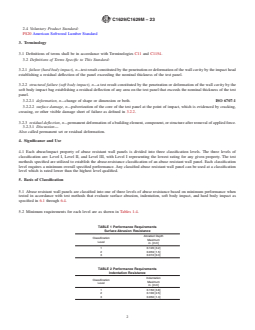
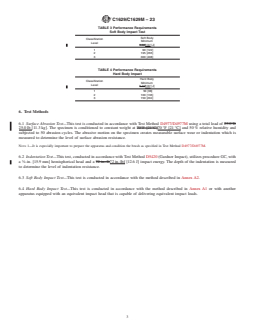
5.2 Minimum requirements for each level are as shown in Tables 1-4.
TABLE 1 Performance Requirements
Surface Abrasion Resistance
Abraded Depth
Classification
Maximum
Level
in. [mm]
1 0.126 [3.2]
2 0.059 [1.5]
3 0.010 [0.3]
TABLE 2 Performance Requirements
Indentation Resistance
Indentation
Classification
Maximum
Level
in. [mm]
1 0.150 [3.8]
2 0.100 [2.5]
3 0.050 [1.3]
C1629/C1629M − 23
TABLE 3 Performance Requirements
Soft Body Impact Test
Soft Body
Classification
Minimum
Level
ft-lbfft·lbf [J]
1 90 [122]
2 195 [265]
3 300 [408]
TABLE 4 Performance Requirements
Hard Body Impact
Hard Body
Classification
Minimum
Level
ft-lbfft·lbf [J]
1 50 [68]
2 100 [136]
3 150 [204]
6. Test Methods
6.1 Surface Abrasion Test—This test is conducted in accordance with Test Method D4977/D4977M using a total load of 25.0 lb
25.0 lb [11.3 kg]. The specimen is conditioned to constant weight at 70°F [21°C]70 °F [21 °C] and 50 % relative humidity and
subjected to 50 abrasion cycles. The abrasive motion on the specimen creates measurable surface wear or indentation which is
measured to determine the level of surface abrasion resistance.
NOTE 1—It is especially important to prepare the apparatus and condition the brush as specified in Test Method D4977/D4977M.
6.2 Indentation Test—This test, conducted in accordance with Test Method D5420 (Gardner Impact), utilizes procedure GC, with
a ⁄8-in. [15.9 mm] hemispherical head and a 72 in.-lb72 in.·lbf [12.6 J] impact energy. The depth of the indentation is measured
to determine the level of indentation resistance.
6.3 Soft Body Impact Test—This test is conducted in accordance with the method described in Annex A2.
6.4 Hard Body Impact Test—This test is conducted in accordance with the method described in Annex A1 or with another
apparatus equipped with an equivalent impact head that is capable of delivering equivalent impact loads.
C1629/C1629M − 23
ANNEXES
(Mandatory Information)
A1. HARD BODY IMPACT TEST
A1.1 Scope
A1.1.1 The hard body impact test measures resistance to penetration of a wall panel when impacted by a rigid body. Failure in
the hard body impact test is achieved when the impacting head completely penetrates through the test panel, or the depth of the
indentation exceeds the thickness of the product being tested when measured from the face side following impact, or both.
A1.2 Summary of Test Method
A1.2.1 A nominal 2 × 2 ft [610 × 610 mm] by 2 ft [610 by 610 mm] specimen is mounted to the apparatus frame. A ramming arm
impactor strikes the wall specimen while swinging in an arc. The impactor is dropped from a fixed height to impart specific design
energy to the wall specimen. Weights are progressively added to the impactor to increase the design impact energy until specimen
failure occurs. For each impact, a new test specimen is used.
A1.3 Significance and Use
A1.3.1 The test method measures relative performance of interior wall panel materials. Although the test panel is mounted on
framing and tested vertically as a wall assembly, the impact damage is normally limited to a small area. The method is not intended
to evaluate the performance of studs used in wall construction.
A1.4 Apparatus
A1.4.1 The apparatus consists of a rigid frame with a ramming arm pinned to swing in an arc. See Figs. A1.1 and A1.2. The frame
5 5
is constructed of 14 ga, 1 ⁄8 ×by 1 ⁄8 in. [41 × 41 mm][41 by 41 mm] B-Line B24 Regular Framing Channels.
TABLE A1.1 Weight (Mass) Schedule for the Components of the
Ramming Arm Impactor
Weight Mass
Component
lb, ±0.5 % kg, ±0.5 %
Structural Steel Tubing (square cross-section) 8.10 3.67
Steel Plate Pivot Arm 1.10 0.50
Front Square Steel Plate (end plate attached to the 0.90 0.41
front of the structural steel tubing)
Rear Square Steel Plate (end plate attached to the 0.90 0.41
back of the structural steel tubing)
Cylindrical Steel Impact Head 1.90 0.86
Steel Round Bar (Weight Bar) 2.60 1.18
Bottom Rectangular Steel Plate (attached to the 4.50 2.04
bottom of the structural steel tubing)
C1629/C1629M − 23
in. mm in. mm
1 5
A 6 ⁄16 154.0 I 26 ⁄16 668.3
5 1
B 8 ⁄16 211.1 J 34 ⁄4 870.0
5 1
C 20 ⁄16 515.9 K 37 ⁄2 952.5
9 1
D 20 ⁄16 522.3 L 39 ⁄16 992.2
3 11
E 20 ⁄4 527.1 M 40 ⁄16 1033.5
H 24 609.6
NOTE 1—All framing members shall be B-Line B24 Regular Framing Channels cut to the specified dimensions in this sketch. These channels are
5 5
14 gauge and have an outside dimension of 1 ⁄8 ×by 1 ⁄8 in. [41 ×by 41 mm].
FIG. A1.1 Axonometric of Hard Body Apparatus Framing Members (not to scale)
A1.4.1.1 The dimensions and details of the ramming arm impactor are shown in Fig. A1.3. The ramming arm impactor consists
of a cylindrical steel impact head (made by milling a round steel bar), a structural steel tubing with square cross-section, two square
steel plates (front and rear end plates of the structural steel tubing), a steel plate pivot arm, a round steel bar (to add weights), and
a rectangular steel plate attached to the bottom of the structural steel tubing. The total weight of the components of the ramming
arm impactor is 20.0 lb [9.07 kg] 6 0.5 %, as shown in Table A1.1. The center of mass of the ramming arm impactor coincides
with the location of the steel round bar (that is, the weight bar). Additional weights are attached to the weight bar to increase the
impacting energy.
A1.4.1.2 The ramming arm impactor shall have a suitable mechanism to secure it at the top of the swing. An example of such a
mechanism is a small eyebolt attached to the back of the impactor. When released from the top of the swing, the drop height of
the center of mass of the ramming arm impactor shall be 12 in. [305 mm].
A1.4.1.3 The ramming arm is located such that the face of the impactor head, when hanging free at the bottom of the arc, is in
the same plane as the surface of the test specimen so that, when dropped, the impactor head strikes the surface of the specimen
at the bottom of the arc.
C1629/C1629M − 23
Fastener Schedule
A B-Line Universal 90° Shelf Bracket B844
B B-Line Two Hole 90° Corner Angle B230
C B-Line Two Hole Flat Splice Plate
D B-Line Beam Clamp B593 Clevis Swivel
E Unistrut 90° Fitting P6281
F B-Line Four Hole Open 45° Angle Fitting B248
G Threaded steel eyebolts with a ⁄2 in. [12.5 mm]
threaded leg 3 in. [75 mm] long, and an eye
interior diameter of ⁄16 in. [5 mm]
1 1 1
NOTE 1—Use B-Line Hex Head Cap Screws HHCS ⁄2 ×by 1 ⁄4 in. [12.7 ×by 31.8 mm], B-Line Flat Washers FW ⁄2 in. [12.5 mm], and B-Line N225
Spring Nuts to secure all fasteners to framing members.
FIG. A1.2 Axonometric of Hard Body Apparatus Fasteners (not to scale)
A1.5 Test Specimen
A1.5.1 The support for the test specimen shall be constructed by attaching a 2 ×by 2 ft [610 ×by 610 mm] specimen of the interior
wall panel material to a frame of 3 ⁄8 in. [92 mm] deep 30 mil [0.0296 in.] [0.752 mm] minimum thickness steel studs with Type
S-12 bugle head screws spaced 8 in. [200 mm] o.c. as shown in Fig. A1.4. The length of the screws shall be 1 ⁄4 in. [32 mm] for
5 5
panels up to ⁄8 in. [15.9 mm] in thickness. For panels with thickness greater than ⁄8 in. [15.9 mm], the length of the screws shall
be not less than ⁄8 in. [16 mm] longer than the panel thickness.
A1.6 Preparation of Apparatus
A1.6.1 The apparatus shall be securely anchored to a level floor to prevent sliding or rocking of the apparatus during impact.
C1629/C1629M − 23
in. mm in. mm
3 1
A ⁄16 4.8 J 3 ⁄2 88.9
1 7
B ⁄4 6.4 K 4 ⁄8 123.8
5 3
C ⁄16 7.9 L 6 ⁄4 171.5
7 1
D ⁄16 11.1 M 7 ⁄4 184.2
E ⁄8 15.9 N 12 304.8
F 1 25.4 O 12 ⁄8 308.0
3 5
G 2 ⁄4 69.9 P 12 ⁄8 320.7
15 1
H 2 ⁄16 74.6 Q 15 ⁄4 387.4
FIG. A1.3 Ramming Arm
A1.7 Procedure
A1.7.1 The support for the test specimen shall be securely clamped to the face of the apparatus so that the surface of the test
specimen is in the same plane as the face of the impact head.
A1.7.1.1 A new test specimen shall be used for each impact.
A1.7.2 The ramming arm is raised to the top of the arc and secured with a pin.
A1.7.3 The pin is removed, allowing the arm to swing freely and strike the test specimen.
A1.7.4 A new test specimen is mounted to the support and the weight on the impactor is increased by adding 2.5 lb [1.1 kg] to
the weight bar and the test repeated.
A1.7.5 The test shall be performed by incrementally increasing the barbell free weights on the impactor until a failure impact
energy is achieved.
C1629/C1629M − 23
in. mm
A ⁄8 9.5
B ⁄8 15.9
C 1 25.4
D 3 ⁄8 92.1
E 8 203.2
F 24 609.6
G 16 406.4
H 24 609.6
FIG. A1.4 Wall Assembly Specimen Construction Detail
A1.7.5.1 The failure impact energy is defined as the minimum energy required for the impactor to penetrate through the face of
the panel, or when the depth of the indentation exceeds the nominal thickness of the product being tested when measured from
the face side.
A1.7.6 Testing shall continue until the failure impact energy is confi
...