

ASTM F363-99(2018)
(Test Method)Standard Test Method for Corrosion Testing of Gaskets
General Information
- Abstract
SIGNIFICANCE AND USE
3.1 This test method is designed to compare all types of gaskets under simulated field operating conditions. Performance of a gasket can thus be measured prior to the start-up of chemical processes.5 The design of the test unit provides maximum range of corrosion resistance so that meaningful results are possible. This test method may be used as a routine test when agreed upon between the purchaser and the seller.
SCOPE
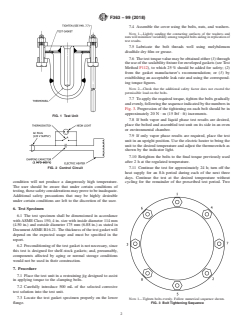
1.1 This test method covers the evaluation of gaskets under corrosive conditions at varying temperature and pressure levels. The test unit may be glass lined if the flanges are sufficiently plane (industry accepted), thus providing resistance to all chemicals, except hydrofluoric acid, from cryogenic temperatures to 260°C (500°F) at pressures from full vacuum to the allowable pressure rating of the unit, or made of other suitable material. The test unit described (Fig. 1) has an internal design pressure rating of 1034 kPa (150 psi) at 260°C (500°F).
FIG. 1 Test Unit
1.2 The values stated in SI units are to be regarded as the standard.
1.3 This standard does not purport to address all of the safety concerns, if any, associated with its use. It is the responsibility of the user of this standard to establish appropriate safety, health, and environmental practices and determine the applicability of regulatory limitations prior to use. For specific hazards statements, see Section 5.
1.4 This international standard was developed in accordance with internationally recognized principles on standardization established in the Decision on Principles for the Development of International Standards, Guides and Recommendations issued by the World Trade Organization Technical Barriers to Trade (TBT) Committee.
- Status
- Published
- Publication Date
- 31-Jul-2018
- Technical Committee
- F03 - Gaskets
- Drafting Committee
- F03.40 - Chemical Test Methods


Overview
ASTM F363-99(2018): Standard Test Method for Corrosion Testing of Gaskets is a globally recognized standard developed by ASTM International. This test method provides guidelines for evaluating and comparing corrosion resistance in gaskets under simulated field operating conditions. Designed to promote safety and performance prior to start-up in chemical process systems, the standard describes systematic procedures to assess a gasket’s durability when exposed to aggressive environments at varying temperatures and pressures. Its use helps manufacturers, purchasers, and operators ensure gasket reliability and compatibility before installation, reducing the risk of premature failure in service.
Key Topics
- Corrosion Resistance Evaluation: The standard prescribes methods to rigorously compare all types of gaskets, identifying their ability to withstand corrosive agents under controlled laboratory simulations.
- Test Unit Design: Guidelines specify features for the corrosion test unit, recommending materials like glass-lining for universal chemical resistance (excluding hydrofluoric acid) and criteria for temperature and pressure ratings up to 260°C (500°F) and 1034 kPa (150 psi).
- Operating Conditions: Procedures cover simulating varied operational scenarios, including temperature and pressure variation, to mirror actual field usage.
- Test Procedure: The method details installation, torque application, test solution introduction, temperature control, and test duration to ensure consistent and comparable results.
- Visual Assessment: Emphasis is placed on inspecting for discoloration, cracking, and physical deformation or failure of gaskets post-test.
Applications
ASTM F363-99(2018) is essential for industries where chemical process integrity and safety are critical, such as:
- Chemical Processing Plants: Used to screen gasket materials for pipes, reactors, and vessels handling corrosive chemicals.
- Oil & Gas Industry: Provides assurance for gaskets used in high-pressure, high-temperature applications where leaks and corrosion can have significant safety and environmental impacts.
- Water Treatment Facilities: Ensures longevity of gaskets in systems carrying aggressive or variable chemicals.
- Manufacturer Quality Control: Serves as a standard routine test between purchaser and seller to verify corrosion resistance claims before shipment or installation.
The method allows testers to replicate real-world conditions, validating gasket materials' suitability and helping prevent expensive downtime and repairs.
Related Standards
Several other standards are directly referenced or relevant for engineers and quality professionals using ASTM F363-99(2018):
- ASTM F112: Standard Test Method for Sealability of Enveloped Gaskets-frequently used in conjunction for comprehensive gasket performance evaluation.
- ASME B16.21: Nonmetallic Gaskets for Pipe Flanges-provides dimensional and design requirements for gaskets aligned with F363’s test protocols.
- General Regulatory Compliance: The standard encourages consideration of all applicable health, safety, and environmental regulations during testing.
Practical Value
Adopting ASTM F363-99(2018) for corrosion testing of gaskets ensures a high standard of quality control and risk mitigation in gasket selection and application. By providing a framework for comparing corrosion-resistant properties across different gasket types and materials, users can make informed decisions, optimize chemical process safety, and extend equipment service life. This method is valuable not just for laboratory testing, but also for routine quality assurance as agreed between buyers and suppliers.
Keywords: gasket corrosion testing, ASTM F363, chemical resistance, gasket durability, industrial gaskets, corrosion test method, ASTM standards, gasket performance, quality assurance.
Relations
- Effective Date
- 01-Aug-2018
- Effective Date
- 01-May-2019
- Effective Date
- 01-May-2013
- Effective Date
- 01-Oct-2006
- Effective Date
- 10-Oct-2000
- Effective Date
- 10-Oct-2000
Get Certified
Connect with accredited certification bodies for this standard

Institut za varilstvo d.o.o. (Welding Institute)
Slovenia's leading welding institute since 1952. ISO 3834, EN 1090, pressure equipment certification, NDT personnel, welder qualification. Only IIW Au
Sponsored listings
Frequently Asked Questions
ASTM F363-99(2018) is a standard published by ASTM International. Its full title is "Standard Test Method for Corrosion Testing of Gaskets". This standard covers: SIGNIFICANCE AND USE 3.1 This test method is designed to compare all types of gaskets under simulated field operating conditions. Performance of a gasket can thus be measured prior to the start-up of chemical processes.5 The design of the test unit provides maximum range of corrosion resistance so that meaningful results are possible. This test method may be used as a routine test when agreed upon between the purchaser and the seller. SCOPE 1.1 This test method covers the evaluation of gaskets under corrosive conditions at varying temperature and pressure levels. The test unit may be glass lined if the flanges are sufficiently plane (industry accepted), thus providing resistance to all chemicals, except hydrofluoric acid, from cryogenic temperatures to 260°C (500°F) at pressures from full vacuum to the allowable pressure rating of the unit, or made of other suitable material. The test unit described (Fig. 1) has an internal design pressure rating of 1034 kPa (150 psi) at 260°C (500°F). FIG. 1 Test Unit 1.2 The values stated in SI units are to be regarded as the standard. 1.3 This standard does not purport to address all of the safety concerns, if any, associated with its use. It is the responsibility of the user of this standard to establish appropriate safety, health, and environmental practices and determine the applicability of regulatory limitations prior to use. For specific hazards statements, see Section 5. 1.4 This international standard was developed in accordance with internationally recognized principles on standardization established in the Decision on Principles for the Development of International Standards, Guides and Recommendations issued by the World Trade Organization Technical Barriers to Trade (TBT) Committee.
SIGNIFICANCE AND USE 3.1 This test method is designed to compare all types of gaskets under simulated field operating conditions. Performance of a gasket can thus be measured prior to the start-up of chemical processes.5 The design of the test unit provides maximum range of corrosion resistance so that meaningful results are possible. This test method may be used as a routine test when agreed upon between the purchaser and the seller. SCOPE 1.1 This test method covers the evaluation of gaskets under corrosive conditions at varying temperature and pressure levels. The test unit may be glass lined if the flanges are sufficiently plane (industry accepted), thus providing resistance to all chemicals, except hydrofluoric acid, from cryogenic temperatures to 260°C (500°F) at pressures from full vacuum to the allowable pressure rating of the unit, or made of other suitable material. The test unit described (Fig. 1) has an internal design pressure rating of 1034 kPa (150 psi) at 260°C (500°F). FIG. 1 Test Unit 1.2 The values stated in SI units are to be regarded as the standard. 1.3 This standard does not purport to address all of the safety concerns, if any, associated with its use. It is the responsibility of the user of this standard to establish appropriate safety, health, and environmental practices and determine the applicability of regulatory limitations prior to use. For specific hazards statements, see Section 5. 1.4 This international standard was developed in accordance with internationally recognized principles on standardization established in the Decision on Principles for the Development of International Standards, Guides and Recommendations issued by the World Trade Organization Technical Barriers to Trade (TBT) Committee.
ASTM F363-99(2018) is classified under the following ICS (International Classification for Standards) categories: 21.140 - Seals, glands; 23.100.60 - Filters, seals and contamination of fluids. The ICS classification helps identify the subject area and facilitates finding related standards.
ASTM F363-99(2018) has the following relationships with other standards: It is inter standard links to ASTM F363-99(2011), ASTM F112-00(2019), ASTM F112-00(2013), ASTM F112-00(2006), ASTM F112-00e1, ASTM F112-00. Understanding these relationships helps ensure you are using the most current and applicable version of the standard.
ASTM F363-99(2018) is available in PDF format for immediate download after purchase. The document can be added to your cart and obtained through the secure checkout process. Digital delivery ensures instant access to the complete standard document.
Standards Content (Sample)
This international standard was developed in accordance with internationally recognized principles on standardization established in the Decision on Principles for the
Development of International Standards, Guides and Recommendations issued by the World Trade Organization Technical Barriers to Trade (TBT) Committee.
Designation: F363 − 99 (Reapproved 2018)
Standard Test Method for
Corrosion Testing of Gaskets
ThisstandardisissuedunderthefixeddesignationF363;thenumberimmediatelyfollowingthedesignationindicatestheyearoforiginal
adoption or, in the case of revision, the year of last revision.Anumber in parentheses indicates the year of last reapproval.Asuperscript
epsilon (´) indicates an editorial change since the last revision or reapproval.
1. Scope 2.3 ASTM Adjuncts:
Leakage Test Unit
1.1 This test method covers the evaluation of gaskets under
corrosive conditions at varying temperature and pressure
3. Significance and Use
levels. The test unit may be glass lined if the flanges are
3.1 This test method is designed to compare all types of
sufficientlyplane(industryaccepted),thusprovidingresistance
gaskets under simulated field operating conditions. Perfor-
to all chemicals, except hydrofluoric acid, from cryogenic
mance of a gasket can thus be measured prior to the start-up of
temperatures to 260°C (500°F) at pressures from full vacuum
chemical processes. The design of the test unit provides
to the allowable pressure rating of the unit, or made of other
maximum range of corrosion resistance so that meaningful
suitable material. The test unit described (Fig. 1) has an
results are possible. This test method may be used as a routine
internal design pressure rating of 1034 kPa (150 psi) at 260°C
test when agreed upon between the purchaser and the seller.
(500°F).
1.2 The values stated in SI units are to be regarded as the
4. Apparatus
standard.
4.1 Corrosion Test Unit—The unit shall contain a suitable
1.3 This standard does not purport to address all of the
thermowell, strategically placed near the center so that correct
safety concerns, if any, associated with its use. It is the
temperature readings may be made. The gasket seating size
responsibility of the user of this standard to establish appro-
shall be such as to accommodate a standard 102-mm (4-in.)
priate safety, health, and environmental practices and deter-
size gasket.
mine the applicability of regulatory limitations prior to use.
4.2 Heat Source—A3-A(660-W, 220-V) electric heater has
For specific hazards statements, see Section 5.
been found to be satisfactory to heat the unit in the vertical
1.4 This international standard was developed in accor-
position to 232°C (450°F). If the unit is to be tested
dance with internationally recognized principles on standard-
horizontally, the fixture should be in a suitable environmental
ization established in the Decision on Principles for the
chamber or oven capable of attaining the desired temperatures.
Development of International Standards, Guides and Recom-
mendations issued by the World Trade Organization Technical 4.3 Necessary Control Equipment—A suitable thermo-
Barriers to Trade (TBT) Committee. switch with damping capacitor and indicator light to provide
means of adjusting as well as control of temperature. The
2. Referenced Documents circuitry shown in Fig. 2 will control the unit within 63°C
(65°F).
2.1 ASTM Standards:
F112 Test Method for Sealability of Enveloped Gaskets 4.4 Thermometer, having 0.5°C graduations.
2.2 ASME Standards:
5. Hazards
B16.21 Nonmetallic Gaskets for Pipe Flanges
5.1 Since the test unit is not vented, corrosive liquids that
are likely to be unstable at the test temperature should not be
used. The heater wattage should be limited so that a runaway
This test method is under the jurisdiction ofASTM Committee F03 on Gaskets
and is the direct responsibility of Subcommittee F03.40 on Chemical Test Methods.
Current edition approved Aug. 1, 2018. Published September 2018. Originally
approved in 1973. Last previous edition approved in 2011 as F363 – 99 (2011). Available from ASTM International Headquarters. Order Adjunct No.
DOI: 10.1520/F0363-99R18. ADJF0363.
2 5
For referenced ASTM standards, visit the ASTM website, www.astm.org, or Supporting data have been filed at ASTM International Headquarters and may
contact ASTM Customer Service at service@astm.org. For Annual Book of ASTM be obtained by requesting Research Report RR:F03-1002.
Standards volume information, refer to the standard’s Document Summary page on The sole source of supply of the apparatus known to the committee at this time
the ASTM website. is The Pfaudler Co., P.O. Box 23600, Rochester, NY 14692. If you are aware of
Available from American Society of Mechanical Engineers (ASME), ASME alternative suppliers, please provide this information to ASTM International
International Headquarters, Three Park Ave., New York, NY 10016-5990, http:// Headquarters.Your comments will receive careful consideration at a meeting of the
www.asme.org. responsible technical committee, which you may attend.
Copyright © ASTM International, 100 Barr Harbor Drive, PO Box C700, West Conshohocken, PA 19428-2959. United States
F363 − 99 (2018)
7.4 Assemble the cover using the bolts, nuts, and washers.
NOTE 1—Lightly sanding the contacting surfaces of the washers and
nuts will minimize variability among torqued bolts aiding in replication of
test results.
7.5 Lubricate the bolt threads well using molybdenum
disulfide dry film or grea
...