

ASTM F3362-18
(Guide)Standard Guide for Onboard Communication & Safety Systems Personnel Certification
General Information
- Abstract
SIGNIFICANCE AND USE
4.1 The guide is intended to be used to assess competencies of qualified individuals who wish to become certified as an Onboard Communication & Safety Systems (OCSS) Technician through a program such as the National Center for Aerospace and Transportation Technologies (NCATT).
4.2 The guide is intended to be used in concert with a certification provider’s structure and materials for management, exam delivery, and candidate preparation.
SCOPE
1.1 The purpose of this guide is to address the basic fundamental subject knowledge activities and functions for avionics professionals to be titled Onboard Communication & Safety Systems (OCSS) Technicians.
1.2 This standard does not purport to address all of the safety concerns, if any, associated with its use. It is the responsibility of the user of this standard to establish appropriate safety, health, and environmental practices and determine the applicability of regulatory limitations prior to use.
1.3 This international standard was developed in accordance with internationally recognized principles on standardization established in the Decision on Principles for the Development of International Standards, Guides and Recommendations issued by the World Trade Organization Technical Barriers to Trade (TBT) Committee.
- Status
- Published
- Publication Date
- 30-Nov-2018
- Technical Committee
- F46 - Aerospace Personnel
- Drafting Committee
- F46.02 - Avionics and Information Technology Endorsements
Overview
ASTM F3362-18: Standard Guide for Onboard Communication & Safety Systems Personnel Certification is an international standard developed by ASTM International. This guide establishes a framework to assess the competencies of individuals seeking certification as Onboard Communication & Safety Systems (OCSS) Technicians, typically through programs such as the National Center for Aerospace and Transportation Technologies (NCATT). The document outlines essential subject knowledge and skill requirements for avionics professionals, with a focus on communication, safety, and emergency systems on board aircraft.
Key Topics
Certification Competencies:
The guide details knowledge and practical skill areas for OCSS Technicians, emphasizing familiarity, application, and integration of avionics concepts. Certification is positioned as an endorsement to an Aircraft Electronics Technician (AET) qualification.Knowledge Levels:
Competency is assessed across three levels:- Level 1: Basic familiarity and understanding of primary concepts and terms.
- Level 2: General theoretical and practical knowledge with application skills.
- Level 3: Detailed knowledge integrating complex concepts and comprehensive application.
Core System Areas:
The standard describes knowledge requirements for:- Audio Distribution Systems: Communication interfaces between crew and passengers, including control panels, microphones, and Bluetooth devices.
- Service/Flight Interphone Systems: Communication among cockpit, flight crew, and ground service compared with system components and integration.
- Passenger Address (PA) Systems: One-way communications for passenger safety briefings and announcements.
- Emergency Locator Transmitter (ELT) Systems: Devices to alert rescue authorities, including frequency requirements, battery management, and regulatory standards.
- Cockpit Voice Recorder (CVR) and Flight Data Recorder (FDR): Devices for recording cockpit audio and flight data to support incident investigation.
Testing and Evaluation:
Includes practical tasks such as system continuity checks, audio quality assessments, fail-safe operation tests, and compliance with regulatory procedures.
Applications
Aviation Maintenance Training:
This guide is a critical resource for technical training programs preparing avionics personnel for OCSS certification. It supports structured education, hands-on tasks, and exam readiness.Certification Program Development:
Certification bodies use this document to design, manage, and evaluate their programs for avionics technician endorsements, aligning with recognized international standards.Aircraft Safety and Compliance:
OCSS certification validates technician capability in maintaining, troubleshooting, and repairing key onboard safety and communication systems, supporting airworthiness, operational safety, and regulatory compliance.Regulatory Alignment:
The guide references widely accepted documents such as FAA handbooks and regulations, as well as IATA requirements for battery shipping and handling, ensuring that certified personnel are trained according to global industry standards.
Related Standards
- ASTM F3060: Terminology for Aircraft.
- ASTM F3245: Guide for Aircraft Electronics Technician Personal Certification.
- FAA Documentation:
- FAA AC43.13-1B & 2B: Methods for aircraft inspection, repair, and alteration.
- FAA-H-8083-30: Aviation Maintenance Technician Handbooks (General and Airframe volumes).
Other Recommended Reading:
- Avionics: Beyond the AET by Tom Inman
- AeroIT: Aviation Information Technology by Mark Mata and Josh Wheeler
- Avionics: Fundamentals of Aircraft Electronics by Scott Kenney
Keywords: OCSS, onboard communication, onboard safety systems, avionics technician, certification, ASTM F3362-18, NCATT, aircraft electronics, emergency locator transmitter, cockpit voice recorder, personnel qualification, aviation safety, regulatory compliance
Relations
- Effective Date
- 01-Jan-2020
- Effective Date
- 01-Apr-2019
- Effective Date
- 01-Mar-2017
- Effective Date
- 01-Nov-2016
- Effective Date
- 01-Apr-2016
- Effective Date
- 15-Sep-2015
- Effective Date
- 01-May-2015
- Effective Date
- 01-Mar-2015
- Effective Date
- 01-Dec-2014
Get Certified
Connect with accredited certification bodies for this standard

BSI Group
BSI (British Standards Institution) is the business standards company that helps organizations make excellence a habit.

Bureau Veritas
Bureau Veritas is a world leader in laboratory testing, inspection and certification services.

DNV
DNV is an independent assurance and risk management provider.
Sponsored listings
Frequently Asked Questions
ASTM F3362-18 is a guide published by ASTM International. Its full title is "Standard Guide for Onboard Communication & Safety Systems Personnel Certification". This standard covers: SIGNIFICANCE AND USE 4.1 The guide is intended to be used to assess competencies of qualified individuals who wish to become certified as an Onboard Communication & Safety Systems (OCSS) Technician through a program such as the National Center for Aerospace and Transportation Technologies (NCATT). 4.2 The guide is intended to be used in concert with a certification provider’s structure and materials for management, exam delivery, and candidate preparation. SCOPE 1.1 The purpose of this guide is to address the basic fundamental subject knowledge activities and functions for avionics professionals to be titled Onboard Communication & Safety Systems (OCSS) Technicians. 1.2 This standard does not purport to address all of the safety concerns, if any, associated with its use. It is the responsibility of the user of this standard to establish appropriate safety, health, and environmental practices and determine the applicability of regulatory limitations prior to use. 1.3 This international standard was developed in accordance with internationally recognized principles on standardization established in the Decision on Principles for the Development of International Standards, Guides and Recommendations issued by the World Trade Organization Technical Barriers to Trade (TBT) Committee.
SIGNIFICANCE AND USE 4.1 The guide is intended to be used to assess competencies of qualified individuals who wish to become certified as an Onboard Communication & Safety Systems (OCSS) Technician through a program such as the National Center for Aerospace and Transportation Technologies (NCATT). 4.2 The guide is intended to be used in concert with a certification provider’s structure and materials for management, exam delivery, and candidate preparation. SCOPE 1.1 The purpose of this guide is to address the basic fundamental subject knowledge activities and functions for avionics professionals to be titled Onboard Communication & Safety Systems (OCSS) Technicians. 1.2 This standard does not purport to address all of the safety concerns, if any, associated with its use. It is the responsibility of the user of this standard to establish appropriate safety, health, and environmental practices and determine the applicability of regulatory limitations prior to use. 1.3 This international standard was developed in accordance with internationally recognized principles on standardization established in the Decision on Principles for the Development of International Standards, Guides and Recommendations issued by the World Trade Organization Technical Barriers to Trade (TBT) Committee.
ASTM F3362-18 is classified under the following ICS (International Classification for Standards) categories: 49.020 - Aircraft and space vehicles in general. The ICS classification helps identify the subject area and facilitates finding related standards.
ASTM F3362-18 has the following relationships with other standards: It is inter standard links to ASTM F3060-20, ASTM F3245-19, ASTM F3245-17, ASTM F3060-16a, ASTM F3060-16, ASTM F3060-15b, ASTM F3060-15a, ASTM F3060-15, ASTM F3060-14. Understanding these relationships helps ensure you are using the most current and applicable version of the standard.
ASTM F3362-18 is available in PDF format for immediate download after purchase. The document can be added to your cart and obtained through the secure checkout process. Digital delivery ensures instant access to the complete standard document.
Standards Content (Sample)
This international standard was developed in accordance with internationally recognized principles on standardization established in the Decision on Principles for the
Development of International Standards, Guides and Recommendations issued by the World Trade Organization Technical Barriers to Trade (TBT) Committee.
Designation:F3362 −18
Standard Guide for
Onboard Communication & Safety Systems Personnel
Certification
This standard is issued under the fixed designation F3362; the number immediately following the designation indicates the year of
original adoption or, in the case of revision, the year of last revision. A number in parentheses indicates the year of last reapproval. A
superscript epsilon (´) indicates an editorial change since the last revision or reapproval.
1. Scope FAA-H-8083-30 Aviation Maintenance Technician Hand-
book – Airframe Volume 2
1.1 The purpose of this guide is to address the basic
fundamental subject knowledge activities and functions for
3. Terminology
avionics professionals to be titled Onboard Communication &
Safety Systems (OCSS) Technicians. 3.1 Definitions—See Terminology F3060.
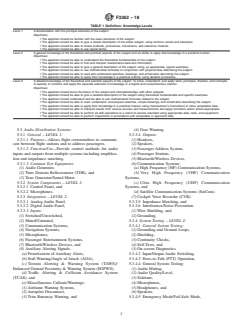
3.2 See Table 1 for knowledge level definitions relating to
1.2 This standard does not purport to address all of the
the education requirements for Onboard Communication &
safety concerns, if any, associated with its use. It is the
Safety Systems (OCSS) professionals.
responsibility of the user of this standard to establish appro-
priate safety, health, and environmental practices and deter-
4. Significance and Use
mine the applicability of regulatory limitations prior to use.
1.3 This international standard was developed in accor-
4.1 The guide is intended to be used to assess competencies
dance with internationally recognized principles on standard-
of qualified individuals who wish to become certified as an
ization established in the Decision on Principles for the
Onboard Communication & Safety Systems (OCSS) Techni-
Development of International Standards, Guides and Recom-
cian through a program such as the National Center for
mendations issued by the World Trade Organization Technical
Aerospace and Transportation Technologies (NCATT).
Barriers to Trade (TBT) Committee.
4.2 The guide is intended to be used in concert with a
certification provider’s structure and materials for
2. Referenced Documents
management, exam delivery, and candidate preparation.
2.1 ASTM Standards:
F3060 Terminology for Aircraft
5. Test Knowledge Requirements
F3245 Guide for Aircraft Electronics Technician Personal
5.1 Thefollowingsubjectknowledgeareasshallbeassessed
Certification
by levels (referenced in Table 1) of competency in the exam
2.2 FAA Standards:
items.
FAA AC43.13-1B Acceptable Methods, Techniques, and
Practices – Aircraft Inspection and Repair
5.2 Risk Management:
FAA AC43.13-2B Acceptable Methods, Techniques, and
5.2.1 Safety – LEVEL 1—See ASTM F3245 Guide for
Practices – Aircraft Alterations
Aircraft Electronics Technician Personal Certification, Section
FAA Regulations for Aviation Maintenance Technicians
6, Core Competencies – Common Maintenance Practices,
FAA-H-8083-30 Aviation Maintenance Technician Hand-
Fundamentals of On-Equipment Maintenance and Aircraft
book – General
Fundamentals.
FAA-H-8083-30 Aviation Maintenance Technician Hand-
5.2.2 Operational Considerations – LEVEL 1:
book – Airframe Volume 1
5.2.2.1 Audio Decibel Level,
5.2.2.2 Radio Communication Etiquette, and
1 5.2.2.3 406 Megahertz Emergency Locator Transmitter
This guide is under the jurisdiction of ASTM Committee F46 on Aerospace
Personnel and is the direct responsibility of Subcommittee F46.02 on Avionics and
(ELT) Inadvertent Alerts.
Information Technology Endorsements.
5.2.3 Shipping/Handling Considerations – LEVEL 1:
Current edition approved Dec. 1, 2018. Published January 2019. DOI: 10.1520/
5.2.3.1 Lithium Batteries,
F3362–18.
5.2.3.2 Battery Disposal, and
For referenced ASTM standards, visit the ASTM website, www.astm.org, or
contact ASTM Customer Service at service@astm.org. For Annual Book of ASTM
5.2.3.3 International Air Transport Association (IATA) Re-
Standards volume information, refer to the standard’s Document Summary page on
quirements.
the ASTM website.
5.2.4 Federal Communication Commission (FCC) Testing
Available from Federal Aviation Administration (FAA), 800 Independence
Ave., SW, Washington, DC 20591, http://www.faa.gov. Requirements – LEVEL 1.
Copyright © ASTM International, 100 Barr Harbor Drive, PO Box C700, West Conshohocken, PA 19428-2959. United States
F3362−18
TABLE 1 Definition: Knowledge Levels
Level 1 A familiarization with the principal elements of the subject.
Objectives:
The applicant should be familiar with the basic elements of the subject.
The applicant should be able to give a simple description of the whole subject, using common words and examples.
The applicant should be able to locate methods, procedures, instructions, and reference material.
The applicant should be able to use typical terms.
Level 2 A general knowledge of the theoretical and practical aspects of the subject and an ability to apply that knowledge in a practical manner.
Objectives:
The applicant should be able to understand the theoretical fundamentals of the subject.
The applicant should be able to find and interpret maintenance data and information.
The applicant should be able to give a general description of the subject using, as appropriate, typical examples.
The applicant should be able to use mathematical formulae in conjunction with physical laws describing the subject.
The applicant should be able to read and understand sketches, drawings, and schematics describing the subject.
The applicant should be able to apply their knowledge in a practical manner using detailed procedures.
Level 3 A detailed knowledge of the theoretical and practical aspects of the subject. To know, understand, and apply facts, principles, theories, and concepts.
A capacity to combine and apply the separate elements of knowledge in a logical and comprehensive manner.
Objectives:
The applicant should know the theory of the subject and interrelationships with other subjects.
The applicant should be able to give a detailed description of the subject using theoretical fundamentals and specific examples.
The applicant should understand and be able to use mathematical formulae related to the subject.
The applicant should be able to read, understand, and prepare sketches, simple drawings, and schematics describing the subject.
The applicant should be able to apply their knowledge in a practical manner using manufacturer’s instructions or other acceptable data.
The applicant should be able to interpret results from various sources and measurements and apply corrective action where appropriate.
The applicant should be able to perform all skill operations to a return-to-service standard using appropriate data, tools, and equipment.
The applicant should be able to perform inspections in accordance with acceptable or approved data.
5.3 Audio Distribution Systems: (4) Gear Warning.
5.3.1 General – LEVEL 1: 5.3.3.4 Outputs:
5.3.1.1 Purpose—Allows flight crewmembers to communi- (1) Headsets,
cate between flight stations and to address passengers. (2) Speakers,
5.3.1.2 Function/Use—Provide control methods for audio (3) Passenger Address System,
inputs and outputs from multiple systems including amplifica- (4) Passenger Stations,
tion and impedance matching. (5) Bluetooth/Wireless Devices,
5.3.1.3 Common Test Equipment: (6) Communication Systems:
(1) Audio Generator, (a) High Frequency (HF) Communication Systems,
(2) Time Domain Reflectometer (TDR), and (b) Very High Frequency (VHF) Communication
(3) Tone Generator/Sound Meter. Systems,
5.3.2 System Components – LEVEL 1: (c) Ultra High Frequency (UHF) Communication
5.3.2.1 Control Panel, and Systems, and
5.3.2.2 Microphones. (d) Satellite Communication Systems (SatCom).
5.3.3 Integration – LEVEL 2: (7) Cockpit Voice Recorder (CVR).
5.3.3.1 Analog Audio Panel, 5.3.3.5 Impedance Matching, and
5.3.3.2 Digital Audio Panel, 5.3.3.6 Interference/Noise Prevention:
5.3.3.3 Inputs: (1) Wire Shielding, and
(1) Switched/Unswitched, (2) Grounding.
(2) Muted/Unmuted, 5.3.4 System Testing – LEVEL 2:
(3) Communication Systems, 5.3.4.1 General System Testing:
(4) Navigation Systems, (1) Grounding and Ground Loops,
(5) Microphones, (2) Shielding,
(6) Passenger Entertainment Systems, (3) Continuity Checks,
(7) Bluetooth/Wireless Devices, and (4) Self-Tests, and
(8) Auxiliary Alerting Signals: (5) On-screen Diagnostics.
(a) Prioritization of Auxiliary Alerts, 5.3.4.2 Input/Output Audio Switching,
(b) Stall Warning/Angle of Attack (AOA), 5.3.4.3 Press-to-Talk (PTT) Operation,
(c) Terrain Alerting & Warning System (TAWS)/ 5.3.4.4 General System Testing:
Enhanced Ground Proximity & Warning System (EGPWS), (1) Audio Muting,
(d) Traffic Alerting & Collision Avoidance System (2) Audio Quality/Level,
(TCAS), and (3) Sidetone,
(e) Miscellaneous Callouts/Warnings: (4) Microphones,
(1) Airframe Warning Systems, (5) Headphones, and
(2) Autopilot Disconnect, (6) Speakers.
(3) Trim Runaway Warning, and 5.3.4.5 Emergency Mode/Fail-Safe Mode,
F3362−18
5.3.4.6 External System Interfaces: 5.5.4.1 Microphones,
(1) Communication Systems, 5.5.4.2 Handsets,
(2) Navigation Systems,
5.5.4.3 Switching,
(3) Cockpit Voice Recorder (CVR), 5.5.4.4 Audio Quality, and
(4) Auxiliary Audio Inputs, and
5.5.4.5 Pre-recorded Messages.
(5) Auxiliary Alerting Inputs.
5.6 Emergency Locator Transmitter (ELT) Systems:
5.3.4.7 Intercom Operation,
5.6.1 General – LEVEL 1:
5.3.4.8 Bluetooth/Wireless
...