

ASTM F3309/F3309M-24
(Practice)Standard Practice for Simplified Safety Assessment of Systems and Equipment in Small Aircraft
General Information
- Abstract
ABSTRACT
This practice describes the methods for conducting a simplified safety assessment of aircraft systems and equipment. Developed through open consensus of international experts in general aviation, this information focused on Level 1 and Level 2 Normal Category aeroplanes employing conventional systems. This practice includes a procedural flowchart that provides an overview of the simplified safety assessment process, failure condition identification and classification, safety objectives, design and installation appraisal, qualitative analysis of failure conditions, common mode analysis, use of similarity, and documentation.
SCOPE
1.1 This practice covers methods for conducting a simplified safety assessment of aircraft systems and equipment. The material was developed through open consensus of international experts in general aviation. This information was created by focusing on Level 1 and Level 2 Normal Category aeroplanes employing conventional systems. The content may be more broadly applicable. It is the responsibility of the Applicant to substantiate broader applicability as a specific means of compliance. If the criteria specified within this simplified practice is deemed not to be relevant to a particular application, the Applicant should use the safety assessment process defined in Practice F3230. The topics covered within this practice are: Procedural Flowchart, Failure Condition Identification and Classification, Safety Objectives, Design and Installation Appraisal, Qualitative Analysis of Failure Conditions, Common Mode Analysis, Use of Similarity, and Documentation.
1.2 An applicant intended to propose this information as Means of Compliance for a design approval must seek guidance from their respective oversight authority (for example, published guidance from applicable CAA) concerning the acceptable use and application thereof. For information on which oversight authorities have accepted this standard (in whole or in part) as an acceptable Means of Compliance to their regulatory requirements (hereinafter “the Rules”), refer to the ASTM Committee F44 web page (www.astm.org/COMMITTEE/F44.htm).
1.3 Units—This practice may present information in SI units, English Engineering units, or both; the values stated in each system may not be exact equivalents. Each system shall be used independently of the other; combining values from the two systems may result in nonconformance with the standard.
1.4 This standard does not purport to address all of the safety concerns, if any, associated with its use. It is the responsibility of the user of this standard to establish appropriate safety, health, and environmental practices and determine the applicability of regulatory limitations prior to use.
1.5 This international standard was developed in accordance with internationally recognized principles on standardization established in the Decision on Principles for the Development of International Standards, Guides and Recommendations issued by the World Trade Organization Technical Barriers to Trade (TBT) Committee.
- Status
- Published
- Publication Date
- 29-Feb-2024
- Technical Committee
- F44 - General Aviation Aircraft
- Drafting Committee
- F44.50 - Systems and Equipment
Buy Documents
ASTM F3309/F3309M-24 - Standard Practice for Simplified Safety Assessment of Systems and Equipment in Small Aircraft
REDLINE ASTM F3309/F3309M-24 - Standard Practice for Simplified Safety Assessment of Systems and Equipment in Small Aircraft
Overview
ASTM F3309/F3309M-24 is a globally recognized standard that provides a practical framework for conducting a simplified safety assessment of systems and equipment in small aircraft, particularly Level 1 and Level 2 Normal Category aeroplanes utilizing conventional systems. Developed by international general aviation experts, this practice is designed to make safety analysis accessible and efficient for small aircraft manufacturers, modifier applicants, and oversight authorities. It ensures that safety principles are upheld while streamlining the evaluation and documentation process for aircraft systems.
This standard supports manufacturers and applicants in using a repeatable, qualitative approach to demonstrate compliance with regulatory requirements and is accepted as a means of compliance by various civil aviation authorities. It emphasizes using documented procedures, system analysis, and risk management while minimizing complexity for small aircraft applications.
Key Topics
ASTM F3309/F3309M-24 addresses all essential aspects of a simplified system safety assessment. Core topics include:
- Procedural Flowchart: Visual overview of the safety assessment steps and key decision points.
- Failure Condition Identification and Classification: Determining various failure scenarios and assigning categories such as Negligible, Minor, Major, Hazardous, and Catastrophic, affecting aircraft safety and function.
- Safety Objectives: Ensuring that identified failure conditions do not exceed acceptable probability thresholds and do not introduce unforeseen hazards.
- Design and Installation Appraisal:
- Qualitative assessment of both the system design and installation, addressing integrity, reliability, and adherence to accepted aviation practices.
- Qualitative Analysis of Failure Conditions: Tailored analytical approaches for different failure severities, emphasizing qualitative and similarity arguments for major and hazardous failures.
- Common Mode Analysis: Identifying shared vulnerabilities or dependencies in design aspects such as power supply or physical configuration that could simultaneously affect multiple systems.
- Use of Similarity: Leveraging prior approvals and service history of similar systems to support compliance for new installations.
- Documentation: Detailed recording of assessment results, analyses, and rationales to satisfy oversight authorities and provide traceability.
Applications
This standard is particularly valuable for stakeholders in the general aviation sector:
- Aircraft Manufacturers and Modifiers: Facilitates a clear, consistent process for system safety assessment during the design, installation, or modification of aircraft systems and equipment.
- Certification Applicants: Provides an authoritative means to demonstrate compliance with regulatory system safety requirements, especially when seeking design approvals.
- Oversight Authorities: Offers a recognized framework for evaluating the adequacy of safety assessments submitted by applicants.
- Small Aircraft Operators: Ensures continued safety and airworthiness by promoting best practices during equipment selection, installation, and ongoing maintenance.
Practical uses include evaluating avionics, mechanical systems, and modifications in new or existing Level 1 and Level 2 Normal Category aircraft. While its primary focus is small aircraft with conventional systems, it may apply more broadly if substantiated to meet regulatory needs.
Related Standards
ASTM F3309/F3309M-24 is often used in conjunction with other industry standards and guidance documents, including:
- ASTM F3230 – Practice for Safety Assessment of Systems and Equipment in Small Aircraft (recommended for more complex evaluation needs)
- ASTM F3060 – Terminology for Aircraft
- ASTM F3061/F3061M – Specification for Systems and Equipment in Aircraft
- ASTM F3232/F3232M – Specification for Flight Controls in Small Aircraft
- SAE ARP4761 – Guidelines and Methods for Conducting the Safety Assessment Process on Civil Airborne Systems and Equipment
- FAA AC 23.1309-1E – System Safety Analysis and Assessment for Part 23 Airplanes
- FAA AC 43.13-1B/2B – Acceptable Methods, Techniques, and Practices for Aircraft Inspection, Repair, and Alterations
These references enhance the robustness and recognition of assessments performed according to ASTM F3309/F3309M-24, supporting international harmonization and acceptance of safety practices in aviation.
For current information on acceptance as a means of compliance with regulatory authorities, consult the ASTM Committee F44 web page.
Keywords: system safety assessment, small aircraft, aviation equipment, simplified safety process, failure classification, general aviation, ASTM F3309/F3309M-24, means of compliance, qualitative analysis, common mode analysis, system reliability, aviation standards.
Relations
- Effective Date
- 01-Mar-2024
- Effective Date
- 01-Mar-2024
- Effective Date
- 01-Mar-2024
- Effective Date
- 01-Mar-2024
- Effective Date
- 01-Mar-2024
Buy Documents
ASTM F3309/F3309M-24 - Standard Practice for Simplified Safety Assessment of Systems and Equipment in Small Aircraft
REDLINE ASTM F3309/F3309M-24 - Standard Practice for Simplified Safety Assessment of Systems and Equipment in Small Aircraft
Get Certified
Connect with accredited certification bodies for this standard

BSI Group
BSI (British Standards Institution) is the business standards company that helps organizations make excellence a habit.

Bureau Veritas
Bureau Veritas is a world leader in laboratory testing, inspection and certification services.

DNV
DNV is an independent assurance and risk management provider.
Sponsored listings
Frequently Asked Questions
ASTM F3309/F3309M-24 is a standard published by ASTM International. Its full title is "Standard Practice for Simplified Safety Assessment of Systems and Equipment in Small Aircraft". This standard covers: ABSTRACT This practice describes the methods for conducting a simplified safety assessment of aircraft systems and equipment. Developed through open consensus of international experts in general aviation, this information focused on Level 1 and Level 2 Normal Category aeroplanes employing conventional systems. This practice includes a procedural flowchart that provides an overview of the simplified safety assessment process, failure condition identification and classification, safety objectives, design and installation appraisal, qualitative analysis of failure conditions, common mode analysis, use of similarity, and documentation. SCOPE 1.1 This practice covers methods for conducting a simplified safety assessment of aircraft systems and equipment. The material was developed through open consensus of international experts in general aviation. This information was created by focusing on Level 1 and Level 2 Normal Category aeroplanes employing conventional systems. The content may be more broadly applicable. It is the responsibility of the Applicant to substantiate broader applicability as a specific means of compliance. If the criteria specified within this simplified practice is deemed not to be relevant to a particular application, the Applicant should use the safety assessment process defined in Practice F3230. The topics covered within this practice are: Procedural Flowchart, Failure Condition Identification and Classification, Safety Objectives, Design and Installation Appraisal, Qualitative Analysis of Failure Conditions, Common Mode Analysis, Use of Similarity, and Documentation. 1.2 An applicant intended to propose this information as Means of Compliance for a design approval must seek guidance from their respective oversight authority (for example, published guidance from applicable CAA) concerning the acceptable use and application thereof. For information on which oversight authorities have accepted this standard (in whole or in part) as an acceptable Means of Compliance to their regulatory requirements (hereinafter “the Rules”), refer to the ASTM Committee F44 web page (www.astm.org/COMMITTEE/F44.htm). 1.3 Units—This practice may present information in SI units, English Engineering units, or both; the values stated in each system may not be exact equivalents. Each system shall be used independently of the other; combining values from the two systems may result in nonconformance with the standard. 1.4 This standard does not purport to address all of the safety concerns, if any, associated with its use. It is the responsibility of the user of this standard to establish appropriate safety, health, and environmental practices and determine the applicability of regulatory limitations prior to use. 1.5 This international standard was developed in accordance with internationally recognized principles on standardization established in the Decision on Principles for the Development of International Standards, Guides and Recommendations issued by the World Trade Organization Technical Barriers to Trade (TBT) Committee.
ABSTRACT This practice describes the methods for conducting a simplified safety assessment of aircraft systems and equipment. Developed through open consensus of international experts in general aviation, this information focused on Level 1 and Level 2 Normal Category aeroplanes employing conventional systems. This practice includes a procedural flowchart that provides an overview of the simplified safety assessment process, failure condition identification and classification, safety objectives, design and installation appraisal, qualitative analysis of failure conditions, common mode analysis, use of similarity, and documentation. SCOPE 1.1 This practice covers methods for conducting a simplified safety assessment of aircraft systems and equipment. The material was developed through open consensus of international experts in general aviation. This information was created by focusing on Level 1 and Level 2 Normal Category aeroplanes employing conventional systems. The content may be more broadly applicable. It is the responsibility of the Applicant to substantiate broader applicability as a specific means of compliance. If the criteria specified within this simplified practice is deemed not to be relevant to a particular application, the Applicant should use the safety assessment process defined in Practice F3230. The topics covered within this practice are: Procedural Flowchart, Failure Condition Identification and Classification, Safety Objectives, Design and Installation Appraisal, Qualitative Analysis of Failure Conditions, Common Mode Analysis, Use of Similarity, and Documentation. 1.2 An applicant intended to propose this information as Means of Compliance for a design approval must seek guidance from their respective oversight authority (for example, published guidance from applicable CAA) concerning the acceptable use and application thereof. For information on which oversight authorities have accepted this standard (in whole or in part) as an acceptable Means of Compliance to their regulatory requirements (hereinafter “the Rules”), refer to the ASTM Committee F44 web page (www.astm.org/COMMITTEE/F44.htm). 1.3 Units—This practice may present information in SI units, English Engineering units, or both; the values stated in each system may not be exact equivalents. Each system shall be used independently of the other; combining values from the two systems may result in nonconformance with the standard. 1.4 This standard does not purport to address all of the safety concerns, if any, associated with its use. It is the responsibility of the user of this standard to establish appropriate safety, health, and environmental practices and determine the applicability of regulatory limitations prior to use. 1.5 This international standard was developed in accordance with internationally recognized principles on standardization established in the Decision on Principles for the Development of International Standards, Guides and Recommendations issued by the World Trade Organization Technical Barriers to Trade (TBT) Committee.
ASTM F3309/F3309M-24 is classified under the following ICS (International Classification for Standards) categories: 49.020 - Aircraft and space vehicles in general. The ICS classification helps identify the subject area and facilitates finding related standards.
ASTM F3309/F3309M-24 has the following relationships with other standards: It is inter standard links to ASTM F3309/F3309M-21, ASTM F3563-22, ASTM F3061/F3061M-23b, ASTM F3367-23, ASTM F3264-23. Understanding these relationships helps ensure you are using the most current and applicable version of the standard.
ASTM F3309/F3309M-24 is available in PDF format for immediate download after purchase. The document can be added to your cart and obtained through the secure checkout process. Digital delivery ensures instant access to the complete standard document.
Standards Content (Sample)
This international standard was developed in accordance with internationally recognized principles on standardization established in the Decision on Principles for the
Development of International Standards, Guides and Recommendations issued by the World Trade Organization Technical Barriers to Trade (TBT) Committee.
Designation: F3309/F3309M − 24
Standard Practice for
Simplified Safety Assessment of Systems and Equipment in
Small Aircraft
This standard is issued under the fixed designation F3309/F3309M; the number immediately following the designation indicates the year
of original adoption or, in the case of revision, the year of last revision. A number in parentheses indicates the year of last reapproval.
A superscript epsilon (´) indicates an editorial change since the last revision or reapproval.
1. Scope priate safety, health, and environmental practices and deter-
mine the applicability of regulatory limitations prior to use.
1.1 This practice covers methods for conducting a simpli-
1.5 This international standard was developed in accor-
fied safety assessment of aircraft systems and equipment. The
dance with internationally recognized principles on standard-
material was developed through open consensus of interna-
ization established in the Decision on Principles for the
tional experts in general aviation. This information was created
Development of International Standards, Guides and Recom-
by focusing on Level 1 and Level 2 Normal Category aero-
mendations issued by the World Trade Organization Technical
planes employing conventional systems. The content may be
Barriers to Trade (TBT) Committee.
more broadly applicable. It is the responsibility of the Appli-
cant to substantiate broader applicability as a specific means of
2. Referenced Documents
compliance. If the criteria specified within this simplified
2.1 Following is a list of external standards referenced
practice is deemed not to be relevant to a particular application,
throughout this practice; the earliest revision acceptable for use
the Applicant should use the safety assessment process defined
is indicated. In all cases later document revisions are accept-
in Practice F3230. The topics covered within this practice are:
able if shown to be equivalent to the listed revision, or if
Procedural Flowchart, Failure Condition Identification and
otherwise formally accepted by the governing civil aviation
Classification, Safety Objectives, Design and Installation
authority; earlier revisions are not acceptable.
Appraisal, Qualitative Analysis of Failure Conditions, Com-
mon Mode Analysis, Use of Similarity, and Documentation.
2.2 ASTM Standards:
F3060 Terminology for Aircraft
1.2 An applicant intended to propose this information as
F3061/F3061M Specification for Systems and Equipment in
Means of Compliance for a design approval must seek guid-
Aircraft
ance from their respective oversight authority (for example,
F3230 Practice for Safety Assessment of Systems and
published guidance from applicable CAA) concerning the
Equipment in Small Aircraft
acceptable use and application thereof. For information on
F3232/F3232M Specification for Flight Controls in Small
which oversight authorities have accepted this standard (in
Aircraft
whole or in part) as an acceptable Means of Compliance to
2.3 SAE Recommended Practices:
their regulatory requirements (hereinafter “the Rules”), refer to
SAE ARP4761 Guidelines and Methods for Conducting the
the ASTM Committee F44 web page (www.astm.org/
Safety Assessment Process on Civil Airborne Systems and
COMMITTEE/F44.htm).
Equipment
1.3 Units—This practice may present information in SI
2.4 Federal Aviation Administration:
units, English Engineering units, or both; the values stated in
AC 23.1309-1E System Safety Analysis and Assessment for
each system may not be exact equivalents. Each system shall
Part 23 Airplanes
be used independently of the other; combining values from the
AC 25.1309-1A System Design and Analysis
two systems may result in nonconformance with the standard.
AC 43.13-1B Acceptable Methods, Techniques and Prac-
1.4 This standard does not purport to address all of the
tices – Aircraft Inspection and Repair
safety concerns, if any, associated with its use. It is the
responsibility of the user of this standard to establish appro-
For referenced ASTM standards, visit the ASTM website, www.astm.org, or
contact ASTM Customer Service at service@astm.org. For Annual Book of ASTM
This practice is under the jurisdiction of ASTM Committee F44 on General Standards volume information, refer to the standard’s Document Summary page on
Aviation Aircraft and is the direct responsibility of Subcommittee F44.50 on the ASTM website.
Systems and Equipment. Available from SAE International (SAE), 400 Commonwealth Dr., Warrendale,
Current edition approved March 1, 2024. Published March 2024. Originally PA 15096, http://www.sae.org.
approved in 2018. Last previous edition approved in 2021 as F3309/F3309M–21. Available from Federal Aviation Administration (FAA), 800 Independence
DOI: 10.1520/F3309_F3309M-24. Ave., SW, Washington, DC 20591, http://www.faa.gov.
Copyright © ASTM International, 100 Barr Harbor Drive, PO Box C700, West Conshohocken, PA 19428-2959. United States
F3309/F3309M − 24
AC 43.13-2B Acceptable Methods, Techniques and Prac- extended FHA table where the effects listed in the approved
tices – Aircraft Alterations FHA can be shown along with the failure mitigations. Integrity
and safety considerations like the use of aerospace
3. Terminology
components, component qualification, independence,
3.1 Terminology specific to the system safety assessment separation, and redundancy should also be discussed as appro-
process is contained in Practice F3230. Terminology specific to
priate.
this standard is provided below. For general terminology, refer
4.4.2 Installation Appraisal—This is a qualitative appraisal
to Terminology F3060.
of the integrity and safety of the installation. An effective
appraisal requires experienced judgment. The installation fea-
3.2 Definitions of Terms Specific to This Standard:
tures must be presented in forms that are easy to follow such as
3.2.1 active failure—a failure is active if it is not latent.
installation drawings, equipment installation requirements, and
3.2.2 attribute—a feature, characteristic, or aspect of a
any required analyses. Deviations from normal, industry-
system or a device, or a condition affecting its operation. Some
accepted installation practices, for example AC 43-13, need to
examples would include design, construction, technology,
be evaluated. The appraisal must consider any potential inter-
installation, functions, applications, operational uses, and en-
ference with other aircraft systems and issues introduced by
vironmental and operational stresses. It would also include
maintenance. In general, common design practice provides
relationships with other systems, functions, and flight or
physical and functional isolation from components contribut-
structural characteristics.
ing to the Negligible or Minor failure conditions from the
3.2.3 latent failure—a failure is latent until it is made known
components that are essential to safe operation. For systems
to the flight crew or maintenance personnel.
with major, hazardous, or catastrophic failure conditions, the
potential for events or influences outside of the systems
4. Procedure
concerned that might invalidate independence must also be
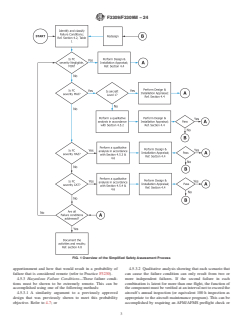
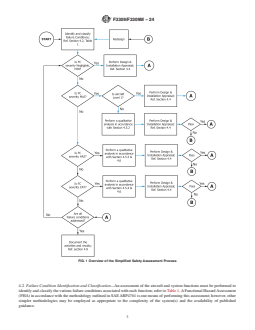
4.1 The flowchart shown in Fig. 1 provides an overview of
considered.
the simplified safety assessment process.
4.5 Qualitative Analysis of Failure Conditions—The follow-
4.1.1 The following abbreviations are used in the flowchart
ing subsections define the requirements that must be addressed
shown in Fig. 1:
for failure conditions identified in 4.2.
4.1.1.1 FC – failure condition
4.5.1 Except as provided in 4.5.2, for failure conditions
4.1.1.2 NSE – Negligible Safety Effect
classified as Negligible, Minor, or Major, no additional quali-
4.1.1.3 MIN – Minor
tative analysis beyond the design and installation appraisals is
4.1.1.4 MAJ – Major
required.
4.1.1.5 HAZ – Hazardous
4.5.2 For Level 2 aircraft, additional substantiation is re-
4.1.1.6 CAT – Catastrophic
quired to show that major failure conditions are remote. This
4.2 Failure Condition Identification and Classification—An
can be accomplished using one of the following methods:
assessment of the aircraft and system functions must be
4.5.2.1 A similarity argument to a previously approved
performed to identify and classify the various failure condi-
design that was previuosly shown to meet this probability
tions associated with each function; refer to Table 1. A
objective. Refer to 4.7; or
Functional Hazard Assessment (FHA) in accordance with the
4.5.2.2 For systems where similarity argument cannot be
methodology outlined in SAE ARP4761 is one means of
used, then compliance to the remote safety objective may be
performing this assessment; however, other simpler method-
shown by means of a qualitative assessment. For “loss of
ologies may be employed as appropriate to the complexity of
function” failure conditions, this can be accomplished by:
the system(s) and the availability of published guidance.
(1) Showing that there is redundancy in the equipment
4.3 Safety Objectives—The assessment described in the
providing that function. An analysis of a redundant system in
subsequent paragraphs of this practice must be completed to:
the airplane is usually complete if it shows isolation between
4.3.1 Show that each failure condition identified by the
redundant system channels and satisfactory reliability for each
analysis specified in 4.2 meets the probability objectives shown
channel; or
in Table 2, and
(2) In the case where single failures can cause the failure
4.3.2 To ensure that no other hazard has been introduced
condition, by showing the system is simple, uses conventional
because of the system installation.
architecture, is appropriately qualified for the installed envi-
ronment and the probability of each single failure is considered
4.4 Design and Installation Appraisal—A design and instal-
remote (refer to Practice F3230).
lation appraisal must be performed for all system and equip-
ment installations. 4.5.2.3 For “malfunction” failure conditions, this can be
4.4.1 Design Appraisal—This is a qualitative appraisal of accomplished by:
the integrity and safety of the system design. An effective (1) Showing that the failure condition requires at least two
appraisal requires experienced judgment. The design features independent failures; or
that provide integrity and safety must be explained in a form (2) In the case where a single component can cause the
that are easy to follow. The use of system architecture/block event, showing that only specific component failure modes or
diagrams are effective ways to aid the understanding of the a subset of a unit’s internal components can result in the failure
system. Other tools that can aid the design appraisal include an condition. Justification must be provided for the failure rate
F3309/F3309M − 24
FIG. 1 Overview of the Simplified Safety Assessment Process
apportionment and how that would result in a probability of 4.5.3.2 Qualitative analysis showing that each scenario that
failure that is considered remote (refer to Practice F3230). can cause the failure condition can only result from two or
4.5.3 Hazardous Failure Conditions—These failure condi- more independent failures. If the second failure in each
tions must be shown to be extremely remote. This can be combination is latent for more than one flight, the function of
accomplished using one of the following methods: the component must be verified at an interval not to exceed the
4.5.3.1 A similarity argument to a previously approved aircraft’s annual inspection (or equivalent 100 h inspection as
design that was previously shown to meet this probability appropriate to the aircraft maintenance program). This can be
objective. Refer to 4.7; or accomplished by requiring an AFM/AFMS preflight check or
F3309/F3309M − 24
TABLE 1 Failure Condition Classifications
Classification of Failure Conditions
Negligible Minor Major Hazardous Catastrophic
Slight reduction in Significant reduction in Large reduction in
No effect on operational
Effect on Aircraft functional capabilities or functional capabilities or functional capabilities or Normally with hull loss
capabilities or safety
safety margins safety margins safety margins
Physical distress to
Inconvenience for Physical discomfort for Serious or fatal injury to
Effect on Occupants passengers, possibly Multiple fatalities
passengers passengers an occupant
including injuries
Physical distress or
Slight increase in Physical discomfort or a
excessive workload Fatal injury or
Effect on Flight Crew No effect on flight crew workload or use of significant increase in
impairs ability to incapacitation
emergency procedures workload
perform tasks
A
These phrases are descriptions of likely consequences for a given failure condition and not necessarily absolute criteria for classifying that failure condition. For example,
the phrase “normally with hull loss” is a description of likely consequences for a catastrophic failure condition and not necessarily criteria for classifying a failure condition
as catastrophic.
TABLE 2 Qualitative Probability Objectives
Classification of Failure Conditions
Negligible Minor Major Hazardous Catastrophic
Qualitative Probability
N/A Probable Remote Extremely Remote Extremely Improbable
Objective
by including an inspection/maintenance task in the Instructions 4.5.4 Catastrophic Failure Conditions—These failure con-
for Continued Airworthiness. If a longer interval is desired, the
ditions must be shown to be extremely improbable and must
methods outlined in Practice F3230 must be used. Common
not occur as the result of a single failure. This can be
modes that could invalidate the independence between these
accomplished using one of the following methods:
failures must be addressed in accordance with 4.6.
4.5.4.1 A similarity argument to a previously approved
4.5.3.3 Single point failures that contribute to hazardous
design that was previously shown to meet this probability
failure conditions must be shown to be extremely remote. If the
objective. Refer to 4.7; or
component is simple and can be shown to meet good design
4.5.4.2 Qualitative analysis shown that each scenario that
practice, it may be possible to qualitatively justify that its
can cause the failure condition requires at least two indepen-
failure is
...
This document is not an ASTM standard and is intended only to provide the user of an ASTM standard an indication of what changes have been made to the previous version. Because
it may not be technically possible to adequately depict all changes accurately, ASTM recommends that users consult prior editions as appropriate. In all cases only the current version
of the standard as published by ASTM is to be considered the official document.
Designation: F3309/F3309M − 21 F3309/F3309M − 24
Standard Practice for
Simplified Safety Assessment of Systems and Equipment in
Small Aircraft
This standard is issued under the fixed designation F3309/F3309M; the number immediately following the designation indicates the year
of original adoption or, in the case of revision, the year of last revision. A number in parentheses indicates the year of last reapproval.
A superscript epsilon (´) indicates an editorial change since the last revision or reapproval.
1. Scope
1.1 This practice covers methods for conducting a simplified safety assessment of aircraft systems and equipment. The material
was developed through open consensus of international experts in general aviation. This information was created by focusing on
Level 1 and Level 2 Normal Category aeroplanes employing conventional systems. The content may be more broadly applicable.
It is the responsibility of the Applicant to substantiate broader applicability as a specific means of compliance. If the criteria
specified within this simplified practice is deemed not to be relevant to a particular application, the Applicant should use the safety
assessment process defined in Practice F3230. The topics covered within this practice are: Procedural Flowchart, Failure Condition
Identification and Classification, Safety Objectives, Design and Installation Appraisal, Qualitative Analysis of Failure Conditions,
Common Mode Analysis, Use of Similarity, and Documentation.
1.2 An applicant intended to propose this information as Means of Compliance for a design approval must seek guidance from
their respective oversight authority (for example, published guidance from applicable CAA) concerning the acceptable use and
application thereof. For information on which oversight authorities have accepted this standard (in whole or in part) as an
acceptable Means of Compliance to their regulatory requirements (hereinafter “the Rules”), refer to the ASTM Committee F44 web
page (www.astm.org/COMMITTEE/F44.htm).
1.3 Units—This practice may present information in SI units, English Engineering units, or both; the values stated in each system
may not be exact equivalents. Each system shall be used independently of the other; combining values from the two systems may
result in nonconformance with the standard.
1.4 This standard does not purport to address all of the safety concerns, if any, associated with its use. It is the responsibility
of the user of this standard to establish appropriate safety, health, and environmental practices and determine the applicability of
regulatory limitations prior to use.
1.5 This international standard was developed in accordance with internationally recognized principles on standardization
established in the Decision on Principles for the Development of International Standards, Guides and Recommendations issued
by the World Trade Organization Technical Barriers to Trade (TBT) Committee.
2. Referenced Documents
2.1 Following is a list of external standards referenced throughout this practice; the earliest revision acceptable for use is indicated.
In all cases later document revisions are acceptable if shown to be equivalent to the listed revision, or if otherwise formally
accepted by the governing civil aviation authority; earlier revisions are not acceptable.
This practice is under the jurisdiction of ASTM Committee F44 on General Aviation Aircraft and is the direct responsibility of Subcommittee F44.50 on Systems and
Equipment.
Current edition approved July 15, 2021March 1, 2024. Published July 2021March 2024. Originally approved in 2018. Last previous edition approved in 20202021 as
F3309/F3309M–20. DOI: 10.1520/F3309_F3309M-21.–21. DOI: 10.1520/F3309_F3309M-24.
Copyright © ASTM International, 100 Barr Harbor Drive, PO Box C700, West Conshohocken, PA 19428-2959. United States
F3309/F3309M − 24
2.2 ASTM Standards:
F3060 Terminology for Aircraft
F3061/F3061M Specification for Systems and Equipment in Aircraft
F3230 Practice for Safety Assessment of Systems and Equipment in Small Aircraft
F3232/F3232M Specification for Flight Controls in Small Aircraft
2.3 SAE Recommended Practices:
SAE ARP4761 Guidelines and Methods for Conducting the Safety Assessment Process on Civil Airborne Systems and
Equipment
2.4 Federal Aviation Administration:
AC 23.1309-1E System Safety Analysis and Assessment for Part 23 Airplanes
AC 25.1309-1A System Design and Analysis
AC 43.13-1B Acceptable Methods, Techniques and Practices – Aircraft Inspection and Repair
AC 43.13-2B Acceptable Methods, Techniques and Practices – Aircraft Alterations
3. Terminology
3.1 Terminology specific to the system safety assessment process is contained in Practice F3230. Terminology specific to this
standard is provided below. For general terminology, refer to Terminology F3060.
3.2 Definitions of Terms Specific to This Standard:
3.2.1 active failure—a failure is active if it is not latent.
3.2.2 attribute—a feature, characteristic, or aspect of a system or a device, or a condition affecting its operation. Some examples
would include design, construction, technology, installation, functions, applications, operational uses, and environmental and
operational stresses. It would also include relationships with other systems, functions, and flight or structural characteristics.
3.2.3 latent failure—a failure is latent until it is made known to the flight crew or maintenance personnel.
3.2.4 on the order of—used to allow some tolerance on meeting the stated quantitative requirement. For purposes of this practice,
a predicted failure rate or probability is considered “on the order of” when the result is calculated to be no more than half an order
of magnitude higher than the stated quantitative objective. The more severe the failure condition being considered is, the more
conservative the analysis is expected to be in order to use this allowance.
4. Procedure
4.1 The flowchart shown in Fig. 1 provides an overview of the simplified safety assessment process.
4.1.1 The following abbreviations are used in the flowchart shown in Fig. 1:
4.1.1.1 FC – failure condition
4.1.1.2 NSE – Negligible Safety Effect
4.1.1.3 MIN – Minor
4.1.1.4 MAJ – Major
4.1.1.5 HAZ – Hazardous
4.1.1.6 CAT – Catastrophic
For referenced ASTM standards, visit the ASTM website, www.astm.org, or contact ASTM Customer Service at service@astm.org. For Annual Book of ASTM Standards
volume information, refer to the standard’s Document Summary page on the ASTM website.
Available from SAE International (SAE), 400 Commonwealth Dr., Warrendale, PA 15096, http://www.sae.org.
Available from Federal Aviation Administration (FAA), 800 Independence Ave., SW, Washington, DC 20591, http://www.faa.gov.
F3309/F3309M − 24
FIG. 1 Overview of the Simplified Safety Assessment Process
4.2 Failure Condition Identification and Classification—An assessment of the aircraft and system functions must be performed to
identify and classify the various failure conditions associated with each function; refer to Table 1. A Functional Hazard Assessment
(FHA) in accordance with the methodology outlined in SAE ARP4761 is one means of performing this assessment; however, other
simpler methodologies may be employed as appropriate to the complexity of the system(s) and the availability of published
guidance.
F3309/F3309M − 24
TABLE 1 Failure Condition Classifications
Classification of Failure Conditions
Negligible Minor Major Hazardous Catastrophic
Slight reduction in Significant reduction in Large reduction in
No effect on operational
Effect on Aircraft functional capabilities or functional capabilities or functional capabilities or Normally with hull loss
capabilities or safety
safety margins safety margins safety margins
Physical distress to
Inconvenience for Physical discomfort for Serious or fatal injury to
Effect on Occupants passengers, possibly Multiple fatalities
passengers passengers an occupant
including injuries
Physical distress or
Slight increase in Physical discomfort or a
excessive workload Fatal injury or
Effect on Flight Crew No effect on flight crew workload or use of significant increase in
impairs ability to incapacitation
emergency procedures workload
perform tasks
A
These phrases are descriptions of likely consequences for a given failure condition and not necessarily absolute criteria for classifying that failure condition. For example,
the phrase “normally with hull loss” is a description of likely consequences for a catastrophic failure condition and not necessarily criteria for classifying a failure condition
as catastrophic.
4.3 Safety Objectives—The assessment described in the subsequent paragraphs of this practice must be completed to:
4.3.1 Show that each failure condition identified by the analysis specified in 4.2 meets the probability objectives shown in Table
2, and
4.3.2 To ensure that no other hazard has been introduced because of the system installation.
4.4 Design and Installation Appraisal—A design and installation appraisal must be performed for all system and equipment
installations.
4.4.1 Design Appraisal—This is a qualitative appraisal of the integrity and safety of the system design. An effective appraisal
requires experienced judgment. The design features that provide integrity and safety must be explained in a form that are easy to
follow. The use of system architecture/block diagrams are effective ways to aid the understanding of the system. Other tools that
can aid the design appraisal include an extended FHA table where the effects listed in the approved FHA can be shown along with
the failure mitigations. Integrity and safety considerations like the use of aerospace components, component qualification,
independence, separation, and redundancy should also be discussed as appropriate.
4.4.2 Installation Appraisal—This is a qualitative appraisal of the integrity and safety of the installation. An effective appraisal
requires experienced judgment. The installation features must be presented in forms that are easy to follow such as installation
drawings, equipment installation requirements, and any required analyses. Deviations from normal, industry-accepted installation
practices, for example AC 43-13, need to be evaluated. The appraisal must consider any potential interference with other aircraft
systems and issues introduced by maintenance. In general, common design practice provides physical and functional isolation from
components contributing to the Negligible or Minor failure conditions from the components that are essential to safe operation.
For systems with major, hazardous, or catastrophic failure conditions, the potential for events or influences outside of the systems
concerned that might invalidate independence must also be considered.
4.5 Qualitative Analysis of Failure Conditions—The following subsections define the requirements that must be addressed for
failure conditions identified in 4.2.
4.5.1 Except as provided in 4.5.2, for failure conditions classified as Negligible, Minor, or Major, no additional qualitative analysis
beyond the design and installation appraisals is required.
4.5.2 For Level 2 aircraft, additional substantiation is required to show that major failure conditions are remote. This can be
accomplished using one of the following methods:
TABLE 2 Qualitative Probability Objectives
Classification of Failure Conditions
Negligible Minor Major Hazardous Catastrophic
Qualitative Probability
N/A Probable Remote Extremely Remote Extremely Improbable
Objective
A
Classification Considerations
F3309/F3309M − 24
4.5.2.1 A similarity argument to a previously approved design that was previuosly shown to meet this probability objective. Refer
to 4.7; or
4.5.2.2 For systems where similarity argument cannot be used, then compliance to the remote safety objective may be shown by
means of a qualitative assessment. For “loss of function” failure conditions, this can be accomplished by:
(1) Showing that there is redundancy in the equipment providing that function. An analysis of a redundant system in the
airplane is usually complete if it shows isolation between redundant system channels and satisfactory reliability for each channel;
or
(2) In the case where single failures can cause the failure condition, by showing the system is simple, uses conventional
architecture, is appropriately qualified for the installed environment and the individual failure rates of its components are
belowprobability of each single failure is considered remote (refer to Practice F3230the objective of 1E-5.).
4.5.2.3 For “malfunction” failure conditions, this can be accomplished by:
(1) Showing that the failure condition requires at least two independent failures; or
(2) In the case where a single component can cause the event, showing that only specific component failure modes or a subset
of a unit’s internal components can result in the failure condition. Justification must be provided for the failure rate apportionment
and how that would result in a failure rate on the order of 1E-5.probability of failure that is considered remote (refer to Practice
F3230).
4.5.3 Hazardous Failure Conditions—These failure conditions must be shown to be extremely remote. This can be accomplished
using one of the following methods:
4.5.3.1 A similarity argument to a previously approved design that was previously shown to meet this probability objective. Refer
to 4.7; or
4.5.3.2 Qualitative analysis showing that each scenario that can cause the failure condition can only result from two or more
independent failures. If the second failure in each combination is latent for more than one flight, the function of the component
must be verified at an interval not to exceed the aircraft’s annual inspection (or equivalent 100 h inspection as appropriate to the
aircraft maintenance program). This can be accomplished by requiring an AFM/AFMS preflight check or by including an
inspection/maintenance task in the Instructions for Continued Airworthiness. If a longer interval is desired, the methods outlined
in Practice F3230 must be used. Common modes that could invalidate the independence between these failures must be addressed
in accordance with 4.6.
4.5.3.3 Single point failures that contribute to hazardous failure conditions must be shown to be extremely remote. If the
component is simple and can be shown to meet good design practice, it may be possible to qualitatively justify that its failure is
extremely remote; see examples below. For all other single point failures that can result in a hazardous failure condition, refer to
Practice F3230.
Ex
...