

ASTM F3232/F3232M-23a
(Specification)Standard Specification for Flight Controls in Small Aircraft
General Information
- Abstract
ABSTRACT
This specification applies to the flight control aspects of airworthiness and design for "small" aircraft. It establishes the Aircraft Type Code (ATC) compliance matrix based on airworthiness level, number of engines, type of engine(s), stall speed, cruise speed, meteorological conditions, altitude, and maneuvers. An ATC is defined by taking into account both the technical considerations regarding the design of the aircraft and the airworthiness level established based upon risk-based criteria. The requirements established by this specification for manual flight control cover control surface installation, operation and arrangement, control system stops, trim systems, control system locks, limit load static tests, operation tests, control system details, spring devices, cable systems, wing flap controls, wing flap position, and flap interconnection. Requirements for automatic flight control cover automatic pilot systems, stability augmentation, and artificial stall barrier system.
SCOPE
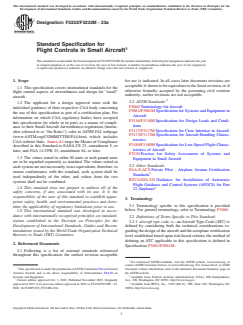
1.1 This specification covers international standards for the flight control aspects of airworthiness and design for “small” aircraft.
1.2 The applicant for a design approval must seek the individual guidance of their respective CAA body concerning the use of this specification as part of a certification plan. For information on which CAA regulatory bodies have accepted this specification (in whole or in part) as a means of compliance to their Small Aircraft Airworthiness regulations (hereinafter referred to as “the Rules”), refer to ASTM F44 webpage (www.ASTM.org/COMMITTEE/F44.htm) which includes CAA website links. Annex A1 maps the Means of Compliance described in this Standard to EASA CS 23, amendment 5, or later, and FAA 14 CFR 23, amendment 64, or later.
1.3 The values stated in either SI units or inch-pound units are to be regarded separately as standard. The values stated in each system are not necessarily exact equivalents; therefore, to ensure conformance with the standard, each system shall be used independently of the other, and values from the two systems shall not be combined.
1.4 This standard does not purport to address all of the safety concerns, if any, associated with its use. It is the responsibility of the user of this standard to establish appropriate safety, health, and environmental practices and determine the applicability of regulatory limitations prior to use.
1.5 This international standard was developed in accordance with internationally recognized principles on standardization established in the Decision on Principles for the Development of International Standards, Guides and Recommendations issued by the World Trade Organization Technical Barriers to Trade (TBT) Committee.
- Status
- Published
- Publication Date
- 30-Sep-2023
- Technical Committee
- F44 - General Aviation Aircraft
- Drafting Committee
- F44.50 - Systems and Equipment
Buy Documents
ASTM F3232/F3232M-23a - Standard Specification for Flight Controls in Small Aircraft
REDLINE ASTM F3232/F3232M-23a - Standard Specification for Flight Controls in Small Aircraft
Overview
ASTM F3232/F3232M-23a, Standard Specification for Flight Controls in Small Aircraft, establishes comprehensive requirements for the design and airworthiness of manual and automatic flight control systems in small aircraft. Developed by ASTM International Committee F44, this international standard provides guidance on flight control installation, operation, system testing, and safety practices, ensuring that small aircraft meet the required levels of performance and regulatory compliance as defined by civil aviation authorities globally.
This specification applies not only to aircraft manufacturers but also to those seeking type certification, retrofit installations, and compliance with small aircraft regulations. The standard supports a structured Aircraft Type Code (ATC) compliance matrix based on critical factors such as airworthiness level, configuration, performance characteristics, and operational environment.
Key Topics
- Aircraft Type Code (ATC) Compliance Matrix: Defines standards based on variables such as number and type of engines, stall speed, cruise speed, altitude capabilities, and permitted maneuvers.
- Manual Flight Controls: Includes requirements for the installation, operation, and arrangement of control surfaces such as ailerons, elevators, rudders, and trim systems. Emphasis is given to safety features like stops, locks, limit load static testing, and prevention of incorrect assembly.
- Automatic Flight Control Systems: Covers autopilot, stability augmentation, and artificial stall barrier systems. Specifies design criteria for system engagement/disengagement, fault notification, and compliance testing to avoid hazardous conditions.
- Cable and Mechanical Systems: Outlines the design, installation, and inspection standards for cable-operated and mechanically linked control systems. Focuses on reliability, prevention of jamming or misrouting, and requirements for visible inspection.
- Wing Flaps and Flap Interconnection: Addresses installation, operation, position indication, and protection against unsafe asymmetry, including both primary and secondary control systems.
- Enhanced Envelope Awareness Systems (EEAS): Defines criteria for systems that alert pilots as aircraft approach operational boundaries, with requirements for feedback, disabling, annunciation, and non-interference with normal operations.
Applications
ASTM F3232/F3232M-23a is vital for:
- Aircraft Designers and Manufacturers: To ensure all new or modified small aircraft flight control systems are compliant with international airworthiness and certification standards.
- Aircraft Certification Applicants: For developing a compliant certification plan and aligning with regulations such as EASA CS-23 and FAA 14 CFR 23.
- Civil Aviation Authorities (CAAs): As a referenced means of compliance for evaluating proposed aircraft type certifications.
- Safety Assessments and Retrofits: For updating or retrofitting existing small aircraft with modern flight control systems that fulfill evolving safety and regulatory expectations.
- Regulatory Harmonization: The standard provides a mapped correlation to global regulatory frameworks, facilitating international acceptance and ease of certification processes.
Related Standards
ASTM F3232/F3232M-23a is closely related to several other documents that provide terminology, system safety, load conditions, and handling characteristics, including:
- ASTM F3060: Terminology for Aircraft
- ASTM F3061/F3061M: Specification for Systems and Equipment in Aircraft
- ASTM F3116/F3116M: Specification for Design Loads and Conditions
- ASTM F3117/F3117M: Specification for Crew Interface in Aircraft
- ASTM F3173/F3173M: Specification for Aircraft Handling Characteristics
- ASTM F3180/F3180M: Specification for Low-Speed Flight Characteristics of Aircraft
- ASTM F3230: Practice for Safety Assessment of Systems and Equipment in Small Aircraft
- FAA-S-ACS: Private Pilot - Airplane Airman Certification Standards
- RTCA/DO-335: Guidance for Installation of Automatic Flight Guidance and Control Systems for Part 23 Airplanes
Practical Value
Implementing ASTM F3232/F3232M-23a ensures that flight control systems in small aircraft are robust, reliable, and safe, aligning aircraft certification with recognized international benchmarks. The standard’s focus on both manual and automatic systems aids in mitigating risk, enhancing pilot situational awareness, and enabling manufacturers and regulatory authorities to streamline certification and approval processes across jurisdictions. This supports safer skies and the continued innovation and adaptability of small aircraft in global aviation.
Relations
- Effective Date
- 01-Oct-2023
- Effective Date
- 01-Oct-2023
- Effective Date
- 01-Sep-2023
- Effective Date
- 15-Mar-2023
- Effective Date
- 01-Oct-2023
- Referred By
ASTM F3180/F3180M-21 - Standard Specification for Low-Speed Flight Characteristics of Aircraft - Effective Date
- 01-Oct-2023
- Effective Date
- 01-Oct-2023
- Effective Date
- 01-Oct-2023
- Effective Date
- 01-Oct-2023
- Effective Date
- 01-Oct-2023
Buy Documents
ASTM F3232/F3232M-23a - Standard Specification for Flight Controls in Small Aircraft
REDLINE ASTM F3232/F3232M-23a - Standard Specification for Flight Controls in Small Aircraft
Get Certified
Connect with accredited certification bodies for this standard

BSI Group
BSI (British Standards Institution) is the business standards company that helps organizations make excellence a habit.

Bureau Veritas
Bureau Veritas is a world leader in laboratory testing, inspection and certification services.

DNV
DNV is an independent assurance and risk management provider.
Sponsored listings
Frequently Asked Questions
ASTM F3232/F3232M-23a is a technical specification published by ASTM International. Its full title is "Standard Specification for Flight Controls in Small Aircraft". This standard covers: ABSTRACT This specification applies to the flight control aspects of airworthiness and design for "small" aircraft. It establishes the Aircraft Type Code (ATC) compliance matrix based on airworthiness level, number of engines, type of engine(s), stall speed, cruise speed, meteorological conditions, altitude, and maneuvers. An ATC is defined by taking into account both the technical considerations regarding the design of the aircraft and the airworthiness level established based upon risk-based criteria. The requirements established by this specification for manual flight control cover control surface installation, operation and arrangement, control system stops, trim systems, control system locks, limit load static tests, operation tests, control system details, spring devices, cable systems, wing flap controls, wing flap position, and flap interconnection. Requirements for automatic flight control cover automatic pilot systems, stability augmentation, and artificial stall barrier system. SCOPE 1.1 This specification covers international standards for the flight control aspects of airworthiness and design for “small” aircraft. 1.2 The applicant for a design approval must seek the individual guidance of their respective CAA body concerning the use of this specification as part of a certification plan. For information on which CAA regulatory bodies have accepted this specification (in whole or in part) as a means of compliance to their Small Aircraft Airworthiness regulations (hereinafter referred to as “the Rules”), refer to ASTM F44 webpage (www.ASTM.org/COMMITTEE/F44.htm) which includes CAA website links. Annex A1 maps the Means of Compliance described in this Standard to EASA CS 23, amendment 5, or later, and FAA 14 CFR 23, amendment 64, or later. 1.3 The values stated in either SI units or inch-pound units are to be regarded separately as standard. The values stated in each system are not necessarily exact equivalents; therefore, to ensure conformance with the standard, each system shall be used independently of the other, and values from the two systems shall not be combined. 1.4 This standard does not purport to address all of the safety concerns, if any, associated with its use. It is the responsibility of the user of this standard to establish appropriate safety, health, and environmental practices and determine the applicability of regulatory limitations prior to use. 1.5 This international standard was developed in accordance with internationally recognized principles on standardization established in the Decision on Principles for the Development of International Standards, Guides and Recommendations issued by the World Trade Organization Technical Barriers to Trade (TBT) Committee.
ABSTRACT This specification applies to the flight control aspects of airworthiness and design for "small" aircraft. It establishes the Aircraft Type Code (ATC) compliance matrix based on airworthiness level, number of engines, type of engine(s), stall speed, cruise speed, meteorological conditions, altitude, and maneuvers. An ATC is defined by taking into account both the technical considerations regarding the design of the aircraft and the airworthiness level established based upon risk-based criteria. The requirements established by this specification for manual flight control cover control surface installation, operation and arrangement, control system stops, trim systems, control system locks, limit load static tests, operation tests, control system details, spring devices, cable systems, wing flap controls, wing flap position, and flap interconnection. Requirements for automatic flight control cover automatic pilot systems, stability augmentation, and artificial stall barrier system. SCOPE 1.1 This specification covers international standards for the flight control aspects of airworthiness and design for “small” aircraft. 1.2 The applicant for a design approval must seek the individual guidance of their respective CAA body concerning the use of this specification as part of a certification plan. For information on which CAA regulatory bodies have accepted this specification (in whole or in part) as a means of compliance to their Small Aircraft Airworthiness regulations (hereinafter referred to as “the Rules”), refer to ASTM F44 webpage (www.ASTM.org/COMMITTEE/F44.htm) which includes CAA website links. Annex A1 maps the Means of Compliance described in this Standard to EASA CS 23, amendment 5, or later, and FAA 14 CFR 23, amendment 64, or later. 1.3 The values stated in either SI units or inch-pound units are to be regarded separately as standard. The values stated in each system are not necessarily exact equivalents; therefore, to ensure conformance with the standard, each system shall be used independently of the other, and values from the two systems shall not be combined. 1.4 This standard does not purport to address all of the safety concerns, if any, associated with its use. It is the responsibility of the user of this standard to establish appropriate safety, health, and environmental practices and determine the applicability of regulatory limitations prior to use. 1.5 This international standard was developed in accordance with internationally recognized principles on standardization established in the Decision on Principles for the Development of International Standards, Guides and Recommendations issued by the World Trade Organization Technical Barriers to Trade (TBT) Committee.
ASTM F3232/F3232M-23a is classified under the following ICS (International Classification for Standards) categories: 49.020 - Aircraft and space vehicles in general. The ICS classification helps identify the subject area and facilitates finding related standards.
ASTM F3232/F3232M-23a has the following relationships with other standards: It is inter standard links to ASTM F3232/F3232M-23, ASTM F3116/F3116M-23a, ASTM F3061/F3061M-23a, ASTM F3116/F3116M-23, ASTM F3563-22, ASTM F3180/F3180M-21, ASTM F3061/F3061M-23b, ASTM F3264-23, ASTM F3309/F3309M-21, ASTM F3173/F3173M-23. Understanding these relationships helps ensure you are using the most current and applicable version of the standard.
ASTM F3232/F3232M-23a is available in PDF format for immediate download after purchase. The document can be added to your cart and obtained through the secure checkout process. Digital delivery ensures instant access to the complete standard document.
Standards Content (Sample)
This international standard was developed in accordance with internationally recognized principles on standardization established in the Decision on Principles for the
Development of International Standards, Guides and Recommendations issued by the World Trade Organization Technical Barriers to Trade (TBT) Committee.
Designation: F3232/F3232M − 23a
Standard Specification for
Flight Controls in Small Aircraft
This standard is issued under the fixed designation F3232/F3232M; the number immediately following the designation indicates the year
of original adoption or, in the case of revision, the year of last revision. A number in parentheses indicates the year of last reapproval.
A superscript epsilon (´) indicates an editorial change since the last revision or reapproval.
1. Scope for use is indicated. In all cases later document revisions are
acceptable if shown to be equivalent to the listed revision, or if
1.1 This specification covers international standards for the
otherwise formally accepted by the governing civil aviation
flight control aspects of airworthiness and design for “small”
authority; earlier revisions are not acceptable.
aircraft.
2.2 ASTM Standards:
1.2 The applicant for a design approval must seek the
F3060 Terminology for Aircraft
individual guidance of their respective CAA body concerning
F3061/F3061M Specification for Systems and Equipment in
the use of this specification as part of a certification plan. For
Aircraft
information on which CAA regulatory bodies have accepted
F3116/F3116M Specification for Design Loads and Condi-
this specification (in whole or in part) as a means of compli-
tions
ance to their Small Aircraft Airworthiness regulations (herein-
F3117/F3117M Specification for Crew Interface in Aircraft
after referred to as “the Rules”), refer to ASTM F44 webpage
F3173/F3173M Specification for Aircraft Handling Charac-
(www.ASTM.org/COMMITTEE/F44.htm) which includes
teristics
CAA website links. Annex A1 maps the Means of Compliance
F3180/F3180M Specification for Low-Speed Flight Charac-
described in this Standard to EASA CS 23, amendment 5, or
teristics of Aircraft
later, and FAA 14 CFR 23, amendment 64, or later.
F3230 Practice for Safety Assessment of Systems and
1.3 The values stated in either SI units or inch-pound units
Equipment in Small Aircraft
are to be regarded separately as standard. The values stated in
2.3 Other Standards:
each system are not necessarily exact equivalents; therefore, to
FAA-S-ACS Private Pilot - Airplane Airman Certification
ensure conformance with the standard, each system shall be
Standards
used independently of the other, and values from the two
RTCA/DO-335 Guidance for Installation of Automatic
systems shall not be combined.
Flight Guidance and Control Systems (AFGCS) for Part
1.4 This standard does not purport to address all of the 4
23 Airplanes
safety concerns, if any, associated with its use. It is the
responsibility of the user of this standard to establish appro-
3. Terminology
priate safety, health, and environmental practices and deter-
3.1 Terminology specific to this specification is provided
mine the applicability of regulatory limitations prior to use.
below. For general terminology, refer to Terminology F3060.
1.5 This international standard was developed in accor-
dance with internationally recognized principles on standard-
3.2 Definitions of Terms Specific to This Standard:
ization established in the Decision on Principles for the
3.2.1 aircraft type code, n—an Aircraft Type Code (ATC) is
Development of International Standards, Guides and Recom-
defined by considering both the technical considerations re-
mendations issued by the World Trade Organization Technical
garding the design of the aircraft and the aeroplane certification
Barriers to Trade (TBT) Committee.
level established based upon risk-based criteria; the method of
defining an ATC applicable to this specification is defined in
2. Referenced Documents
Specification F3061/F3061M.
2.1 Following is a list of external standards referenced
throughout this specification; the earliest revision acceptable
For referenced ASTM standards, visit the ASTM website, www.astm.org, or
contact ASTM Customer Service at service@astm.org. For Annual Book of ASTM
This specification is under the jurisdiction of ASTM Committee F44 on General Standards volume information, refer to the standard’s Document Summary page on
Aviation Aircraft and is the direct responsibility of Subcommittee F44.50 on the ASTM website.
Systems and Equipment. Available from Federal Aviation Administration (FAA), 800 Independence
Current edition approved Oct. 1, 2023. Published November 2023. Originally Ave., SW, Washington, DC 20591, http://www.faa.gov.
approved in 2017. Last previous edition approved in 2023 as F3232/F3232M – 23. Available from RTCA, Inc., 1150 18th St., NW, Suite 910, Washington, DC
DOI: 10.1520/F3232_F3232M-23A. 20036, http://www.rtca.org.
Copyright © ASTM International, 100 Barr Harbor Drive, PO Box C700, West Conshohocken, PA 19428-2959. United States
F3232/F3232M − 23a
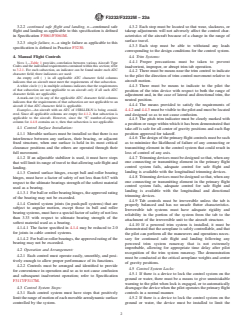
3.2.2 continued safe flight and landing, n—continued safe 4.3.2 Each stop must be located so that wear, slackness, or
flight and landing as applicable to this specification is defined takeup adjustments will not adversely affect the control char-
in Specification F3061/F3061M. acteristics of the aircraft because of a change in the range of
surface travel.
3.2.3 single failure, n—a single failure as applicable to this
4.3.3 Each stop must be able to withstand any loads
specification is defined in Practice F3230.
corresponding to the design conditions for the control system.
4.4 Trim Systems:
4. Manual Flight Controls
4.4.1 Proper precautions must be taken to prevent
NOTE 1—Table 1 provides correlation between various Aircraft Type
Codes and the individual requirements contained within this section; refer inadvertent, improper, or abrupt trim tab operation.
to 3.2.1. For each subsection, an indicator can be found under each ATC
4.4.2 There must be means near the trim control to indicate
character field; three indicators are used:
to the pilot the direction of trim control movement relative to
An empty cell ( ) in all applicable ATC character field columns
aircraft motion.
indicates that an aircraft must meet the requirements of that subsection.
A white circle (○) in multiple columns indicates that the requirements 4.4.3 There must be means to indicate to the pilot the
of that subsection are not applicable to an aircraft only if all such ATC
position of the trim device with respect to both the range of
character fields are applicable.
adjustment and, in the case of lateral and directional trim, the
A mark-out (×) in any of the applicable ATC character field columns
neutral position.
indicates that the requirements of that subsection are not applicable to an
4.4.4 The means provided to satisfy the requirements of
aircraft if that ATC character field is applicable.
Examples—An aircraft with an ATC of 1SRLLDLN is being consid- 4.4.2 and 4.4.3 must be visible to the pilot and must be located
ered. Since all applicable columns are empty for 4.1.2, that subsection is
and designed so as to not cause confusion.
applicable to the aircraft. However, since the “S” number-of-engines
4.4.5 The pitch trim indicator must be clearly marked with
column for 4.4.8 contains an ×, then that subsection is not applicable.
a position or range within which it has been demonstrated that
4.1 Control Surface Installation:
take-off is safe for all center of gravity positions and each flap
position approved for takeoff.
4.1.1 Movable surfaces must be installed so that there is no
interference between any surfaces, their bracing, or adjacent 4.4.6 The design of the primary flight controls must be such
fixed structure, when one surface is held in its most critical as to minimize the likelihood of failure of any connecting or
clearance positions and the others are operated through their transmitting element in the control system that could result in
loss of control of any axis.
full movement.
4.4.7 Trimming devices must be designed so that, when any
4.1.2 If an adjustable stabilizer is used, it must have stops
one connecting or transmitting element in the primary flight
that will limit its range of travel to that allowing safe flight and
control system fails, adequate control for safe flight and
landing.
landing is available with the longitudinal trimming devices.
4.1.3 Control surface hinges, except ball and roller bearing
4.4.8 Trimming devices must be designed so that, when any
hinges, must have a factor of safety of not less than 6.67 with
one connecting or transmitting element in the primary flight
respect to the ultimate bearings strength of the softest material
control system fails, adequate control for safe flight and
used as a bearing.
landing is available with the longitudinal and directional
4.1.3.1 For ball or roller bearing hinges, the approved rating
trimming devices.
of the bearing may not be exceeded.
4.4.9 Tab controls must be irreversible unless the tab is
4.1.4 Control system joints (in push-pull systems) that are
properly balanced and has no unsafe flutter characteristics.
subject to angular motion, except those in ball and roller
Irreversible tab systems must have adequate rigidity and
bearing systems, must have a special factor of safety of not less
reliability in the portion of the system from the tab to the
than 3.33 with respect to ultimate bearing strength of the
attachment of the irreversible unit to the aircraft structure.
softest material used as a bearing.
4.4.10 If a powered trim system is installed, it must be
4.1.4.1 The factor specified in 4.1.4 may be reduced to 2.0
demonstrated that the aeroplane is safely controllable, and that
for joints in cable control systems.
the pilot can perform all the maneuvers and operations neces-
4.1.4.2 For ball or roller bearings, the approved rating of the
sary for continued safe flight and landing following any
bearing may not be exceeded.
powered trim system runaway that is not extremely
improbable, allowing for appropriate time delay after pilot
4.2 Operation and Arrangement:
recognition of the trim system runaway. The demonstration
4.2.1 Each control must operate easily, smoothly, and posi-
must be conducted at the critical aeroplane weights and center
tively enough to allow proper performance of its functions.
of gravity positions.
4.2.2 Controls must be arranged and identified to provide
4.5 Control System Locks:
for convenience in operation and so as to not cause confusion
4.5.1 If there is a device to lock the control system on the
and subsequent inadvertent operation; refer to Specification
ground or water, there must be a means to give unmistakable
F3117/F3117M.
warning to the pilot when lock is engaged, or to automatically
4.3 Control System Stops:
disengage the device when the pilot operates the primary flight
4.3.1 Each control system must have stops that positively controls in a normal manner.
limit the range of motion of each movable aerodynamic surface 4.5.2 If there is a device to lock the control system on the
controlled by the system. ground or water, the device must be installed to limit the
F3232/F3232M − 23a
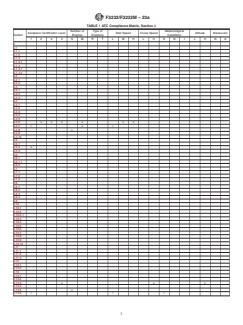
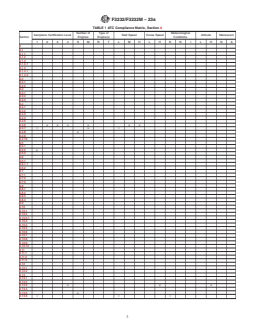
TABLE 1 ATC Compliance Matrix, Section 4
Number of Type of Meteorological
Aeroplane Certification Level Stall Speed Cruise Speed Altitude Maneuvers
Engines Engine(s) Conditions
Section
1 2 3 4 S M R T L M H L H D N I L H N A
4.1
4.1.1
4.1.2
4.1.3
4.1.3.1
4.1.4
4.1.4.1
4.1.4.2
4.2
4.2.1
4.2.2
4.3
4.3.1
4.3.2
4.3.3
4.4
4.4.1
4.4.2
4.4.3
4.4.4
4.4.5
4.4.6 × × × × × ×
4.4.7 C × C
4.4.8 ×
4.4.9
4.4.10
4.5
4.5.1
4.5.2 ×
4.5.3
4.6
4.6.1
4.6.1.1
4.6.2
4.7
4.7.1
4.7.2
4.7.3
4.8
4.8.1
4.8.2
4.8.3
4.8.4
4.9
4.10
4.10.1
4.10.2
4.10.2.1
4.10.3
4.10.4
4.10.5
4.10.6
4.10.7
4.10.8
4.10.9
4.10.10
4.11
4.11.1
4.11.2
4.11.3
4.12
4.12.1
4.12.2
4.13
4.13.1
4.13.2
4.13.3 × × ×
4.13.4
4.13.5 ×
4.13.6 C C C
F3232/F3232M − 23a
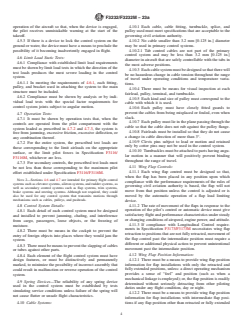
operation of the aircraft so that, when the device is engaged, 4.10.1 Each cable, cable fitting, turnbuckle, splice, and
the pilot receives unmistakable warning at the start of the pulley used must meet specifications that are acceptable to the
takeoff. governing civil aviation authority.
4.10.2 No cable smaller than 3.2 mm [0.125 in.] diameter
4.5.3 If there is a device to lock the control system on the
may be used in primary control systems.
ground or water, the device must have a means to preclude the
4.10.2.1 Tab control cables are not part of the primary
possibility of it becoming inadvertently engaged in flight.
control system and may be less than 3.2 mm [0.125 in.]
4.6 Limit Load Static Tests:
diameter in aircraft that are safely controllable with the tabs in
4.6.1 Compliance with established limit load requirements
the most adverse positions.
must be shown by limit load tests in which the direction of the
4.10.3 Each cable system must be designed so that there will
test loads produces the most severe loading in the control
be no hazardous change in cable tension throughout the range
system.
of travel under operating conditions and temperature varia-
4.6.1.1 In meeting the requirements of 4.6.1, each fitting,
tions.
pulley, and bracket used in attaching the system to the main
4.10.4 There must be means for visual inspection at each
structure must be included.
fairlead, pulley, terminal, and turnbuckle.
4.6.2 Compliance must be shown by analysis or by indi-
4.10.5 Each kind and size of pulley must correspond to the
vidual load tests with the special factor requirements for
cable with which it is used.
control system joints subject to angular motion.
4.10.6 Each pulley must have closely fitted guards to
prevent the cables from being misplaced or fouled, even when
4.7 Operation Tests:
slack.
4.7.1 It must be shown by operation tests that, when the
4.10.7 Each pulley must lie in the plane passing through the
controls are operated from the pilot compartment with the
cable so that the cable does not rub against the pulley flange.
system loaded as prescribed in 4.7.2 and 4.7.3, the system is
4.10.8 Fairleads must be installed so that they do not cause
free from jamming, excessive friction, excessive deflection, or
a change in cable direction of more than 3°.
any combination thereof.
4.10.9 Clevis pins subject to load or motion and retained
4.7.2 For the entire system, the prescribed test loads are
only by cotter pins may not be used in the control system.
those corresponding to the limit airloads on the appropriate
4.10.10 Turnbuckles must be attached to parts having angu-
surface, or the limit pilot forces in Specification F3116/
lar motion in a manner that will positively prevent binding
F3116M, whichever are less.
throughout the range of travel.
4.7.3 For secondary controls, the prescribed test loads must
4.11 Wing Flap Controls:
be not less than those corresponding to the maximum pilot
4.11.1 Each wing flap control must be designed so that,
effort established under Specification F3116/F3116M.
when the flap has been placed in any position upon which
NOTE 2—Sections 4.6 and 4.7 are intended for primary flight control
compliance with the performance requirements of the rules of
systems such as elevator systems, aileron systems, and rudder systems, as
governing civil aviation authority is based, the flap will not
well as secondary control systems such as flap systems, trim systems,
move from that position unless the control is adjusted or is
brake systems and steering systems. Although not required, they could
also be used for any control system that transmits motions through
moved by the automatic operation of a flap load limiting
mechanisms such as cables, pulleys, and pushrods.
device.
4.11.2 The rate of movement of the flaps in response to the
4.8 Control System Details:
operation of the pilot’s control or automatic device must give
4.8.1 Each detail of each control system must be designed
satisfactory flight and performance characteristics under steady
and installed to prevent jamming, chafing, and interference
or changing conditions of airspeed, engine power, and attitude.
from cargo, passengers, loose objects, or the freezing of
4.11.3 If compliance with Longitudinal Control require-
moisture.
ments in Specification F3173/F3173M necessitates wing flap
4.8.2 There must be means in the cockpit to prevent the
retraction to positions that are not fully retracted, movement of
entry of foreign objects into places where they would jam the
the flap control past the intermediate position must require a
system.
different or additional physical action to prevent unintentional
4.8.3 There must be means to prevent the slapping of cables
movement past the intermediate position.
or tubes against other parts.
4.12 Wing Flap Position Information:
4.8.4 Each element of the flight control system must have
4.12.1 There must be a means to provide wing flap position
design features, or must be distinctively and permanently
information for flap installations with only the retracted and
marked, to minimize the possibility of incorrect assembly that
fully extended positions, unless: a direct operating mechanism
could result in malfunction or reverse operation of the control
provides a sense of “feel” and position (such as when a
system.
mechanical linkage is employed); or, the flap position is readily
4.9 Spring Devices—The reliability of any spring device
determined without seriously detracting from other piloting
used in the control system must be established by tests
duties under any flight condition, day or night.
simulating service conditions unless failure of the spring will
4.12.2 There must be a means to provide wing flap position
not cause flutter or unsafe flight characteristics.
information for flap installations with intermediate flap posi-
4.10 Cable Systems: tions if any flap position other than retracted or fully extended
F3232/F3232M − 23a
Flexible shafts are not considered simple and reliable.
is used to show compliance with the performance requirements
of the rules of the governing civil aviation authority, and the
4.13.4 The aircraft must be shown to have safe flight
flap installation does not provide a sense of “feel” and position
characteristics with any combination of extreme positions of
(such as when a mechanical linkage is employed).
individual movable surfaces (surfaces synchronized by a me-
chanical interconnection that is independent of the flap drive
4.13 Flap Interconnection—The aircraft must be designed
system are to be considered as a single surface).
to protect against unsafe wing flap asymmetry using one of the
4.13.5 Except as provided in 4.13.6, if compliance with
following options: 4.13.1, 4.13.2, 4.13.3, or 4.13.4.
4.13.1 through 4.13.4 is met through the use of an
4.13.1 The main wing flaps and related movable surfaces as
interconnection, it must be designed to account for the unsym-
a system must be synchronized by a mechanical interconnec-
metrical loads resulting from flight with the engine(s) on one
tion between the movable flap surfaces that is independent of
side of the plane of symmetry inoperative and the remaining
the flap drive system.
engines at takeoff power.
4.13.2 The aircraft must be designed so that any cata-
4.13.6 For single-engine aircraft and multiengine aircraft
strophic flap system failure condition is extremely improbable
with no slipstream effects on the flaps, if compliance with
(refer to Practice F3230).
4.13.1 through 4.13.4 is met through the use of an
4.13.3 Moveable flap surfaces must be synchronized by a
interconnection, it must be designed to account for unsym-
simple and reliable mechanical interconnection. The entire flap
metrical loads assuming 100 % of the critical air load acts on
system must be designed to withstand the loading, which
one side and 70 % on the other.
would occur due to a jam at any point in the flap system with
a 1.5 factor of safety.
5. Automatic Flight Controls
NOTE 3—For 4.13.3, the mechanical interconnection may be part of the NOTE 4—Table 2 provides correlation between various Aircraft Type
flap actuation system. Some examples of simple and reliable mechanical Codes and the individual requirements contained within this section; refer
interconnections include: to 3.2.1. For each subsection, an indicator can be found under each ATC
(1) Flap surfaces interconnected by a torque tube and bell cranks. character field; three indicators are used:
(2) Flap surfaces interconnected by cables and bell cranks. An empty cell ( ) in all applicable ATC character field columns
(3) Flap surfaces interconnected by pushrods and bell cranks. indicates that an aircraft must meet the requirements of that subsection.
TABLE 2 ATC Compliance Matrix, Section 5
Number of Type of Meteorological
Aeroplane Certification Level Stall Speed Cruise Speed Altitude Maneuvers
Engines Engine(s) Conditions
Section 1 2 3 4 S M R T L M H L H D N I L H N A
5.1
5.1.1
5.1.2
5.1.3
5.1.4
5.1.5
5.1.6
5.1.7
5.1.8
5.1.9
5.2
5.2.1
5.2.2
5.2.3
5.2.4
5.2.5
5.2.6
5.3
5.3.1
5.3.2
5.3.3
5.3.4
5.3.5
5.3.5.1
5.3.6
5.3.6.1
5.3.7
5.3.8
5.4
5.4.1
5.4.2
5.4.2.1
5.4.2.2
5.4.3
5.4.3.1
5.4.3.2
5.4.4
F3232/F3232M − 23a
A white circle (○) in multiple columns indicates that the requirements
5.2 Stability Augmentation—If the functioning of stability
of that subsection are not applicable to an aircraft only if all such ATC
augmentation or other automatic or power-operated systems is
character fields are applicable.
necessary to show compliance with the flight characteristics
A mark-out (×) in any of the applicable ATC character field columns
requirements of the rules of the governing civil aviation
indicates that the requirements of that subsection are not applicable to an
authority, such systems must comply with 4.2 and 5.2.1 – 5.2.6.
aircraft if that ATC character field is applicable.
Example—An aircraft with an ATC of 1SRLLDLN is being considered.
5.2.1 In showing compliance with 5.2, a warning which is
Since all applicable columns are empty for 5.1.1, that subsection is
clearly distinguishable to the pilot under expected flight
applicable to the aircraft.
conditions without requiring the pilot’s attention, must be
5.1 Automatic Pilot Systems: provided for any failure in the stability augmentation system or
in any other automatic or power-operated system that could
5.1.1 If an automatic pilot system is installed, it must be
result in an unsafe condition if the pilot was not aware of the
designed so that: the automatic pilot can be quickly and
failure.
positively disengaged by the pilots to prevent it from interfer-
5.2.2 In showing compliance with 5.2, warning systems
ing with their control of the aircraft; or, be sufficiently
must not activate the control system.
overpowered by one pilot to let him control the aircraft.
5.2.3 In showing compliance with 5.2, the design of the
5.1.2 If an automatic pilot system is installed and is de-
stability augmentation system or of any other automatic or
signed so that it can be quickly and positively disengaged by
power-operated system must permit initial counteraction of
the pilots as described in 5.1.1, the quick release (emergency)
failures without requiring exceptional pilot skill or strength, by
control must be located on the control wheel (both control
either the deactivation of the system or a failed portion thereof,
wheels if the aircraft can be operated from either pilot seat) on
or by overriding the failure by movement of the flight controls
the side opposite the throttles, or on the stick control (both stick
in the normal sense.
controls if the aircraft can be operated from either pilot seat),
5.2.4 In showing compliance with 5.2, it must be shown
such that it can be operated without moving the hand from its
that, after any single failure of the stability augmentation
normal position on the control.
system or any other automatic or power-operated system, the
5.1.3 If an automatic pilot system is installed, unless there is
aircraft is safely controllable when the failure or malfunction
automatic synchronization, each such system must have a
occurs at any speed or altitude within the approved operating
means to readily indicate to the pilot the alignment of the
limitations that is critical for the type of failure being consid-
actuating device in relation to the control system it operates;
ered.
refer to Specification F3117/F3117M.
5.2.5 In showing compliance with 5.2, it must be shown
5.1.4 If an automatic pilot system is installed, each manu-
that, after any single failure of the stability augmentation
ally operated control for the automatic pilot system operation
system or any other automatic or power-operated system, the
must be readily accessible to the pilot. Each control must
controllability and maneuverability requirements of the rules of
operate in the same plane and sense of motion as specified in
the governing civil aviation authority are met within a practical
Specification F3117/F3117M for cockpit controls. The direc-
operational flight envelope (for example, speed, altitude, nor-
tion of motion must be plainly indicated on or near each
mal acceleration, and aircraft configuration) that is described in
control.
the Airplane Flight Manual (AFM).
5.1.5 If an automatic pilot system is installed, it must be
5.2.6 In showing compliance with 5.2, it must be shown
designed and adjusted so that, within the range of adjustment
that, after any single failure of the stability augmentation
available to the pilot, it cannot produce hazardous loads on the
system or any other automatic or power-operated system, the
aircraft or create hazardous deviations in the flight path, under
trim, stability, and stall characteristics are not impaired below
any flight condition appropriate to its use, either during normal
a level needed to permit continued safe flight and landing.
operation or in the event of a malfunction, assuming that
5.3 Artificial Stall Barrier System—If the function of an
corrective action begins within a reasonable period of time.
artificial stall barrier (for example, stick pusher) is used to
5.1.6 If an automatic pilot system is installed, it must be
show compliance with Stall Characteristics requirements in
designed so that a single malfunction will not produce a
Specification F3180/F3180M, the system must meet the re-
hardover signal in more than one control axis.
quirements of 5.3.1 – 5.3.8.
5.1.7 If an automatic pilot is installed and integrates signals
5.3.1 In showing compliance with 5.3, with the system
from auxiliary controls or furnishes signals for operation of
adjusted for operation, the plus and minus airspeeds at which
other equipment, positive interlocks and sequencing of engage-
control input will be provided must be established.
ment to prevent improper operation are required.
5.3.2 In showing compliance with 5.3, considering the plus
5.1.8 If an automatic pilot system is installed, there must be
and minus airspeed tolerances established by 5.3.1, an airspeed
protection against adverse interaction of integrated
must be selected for the activation of the control input that
components, resulting from a malfunction.
provides a safe margin above any airspeed at which any
5.1.9 If the automatic pilot system is installed and can be unsatisfactory stall characteristics occur.
coupled to airborne navigation equipment, means must be 5.3.3 In showing compliance with 5.3, in addition to the
provided to indicate to the flight crew the current mode of Stall Warning required by Specification F3180/F3180M, a
operation. Selector switch position is not acceptable as a means warning that is clearly distinguishable to the pilot under all
of indication; refer to Specification F3117/F3117M. expected flight conditions, without requiring the pilot’s
F3232/F3232M − 23a
attention, must be provided for faults that would prevent the boundary of the established awareness envelope; for example,
system from providing the required control input. approaching a low-speed loss-of-control condition, an exces-
sive attitude condition, etc.
5.3.4 In showing compliance with 5.3, each system must be
designed so that the artificial stall barrier can be quickly and 5.4.2 The amount and gradient of the force feedback re-
quired by 5.4.1 shall be determined by the applicant, but shall
positively disengaged by the pilot to prevent unwanted control
input by a quick release (emergency) control that meets the comply with the provisions of 5.4.2.1 and 5.4.2.2.
5.4.2.1 The total EEAS-induced forces (measured with the
requirements of 5.1.2.
5.3.5 In showing compliance with 5.3, a preflight check of vehicle static on the ground) shall not be greater than the
Control Forces for Prolonged Application as defined in Speci-
the complete system must be established and the procedure for
this check made available in the Airplane Flight Manual fication F3173/F3173M for the lateral, directional, or longitu-
dinal control axes.
(AFM).
5.4.2.2 The total control forces with the EEAS active in
5.3.5.1 In showing compliance with 5.3.5, preflight checks
flight shall allow the pilot to precisely control the aeroplane
that are critical to the safety of the aircraft must be included in
while overpowering the system, if necessary, for the Perfor-
the limitations section of the AFM.
mance Maneuvers and Slow Flight and Stalls maneuvers
5.3.6 In showing compliance with 5.3, for those aircraft
required by the FAA Private Pilot - Airplane Airman Certifi-
whose design includes an autopilot system, a quick release
cation Standards (or other maneuvers acceptable to the gov-
(emergency) control installed in accordance with 5.1.2 may be
erning civil aviation authority).
used to meet the requirements of 5.3.4.
5.3.6.1 For those aircraft showing compliance by utilizing
NOTE 5—With the EEAS active, the control forces may be greater than
the provisions of 5.3.6, the pitch servo for that system may be the Control Forces for Prolonged Application as defined in Specification
F3173/F3173M for the lateral, directional, or longitudinal control axes,
used to provide the control input.
provided that the maneuver can still be precisely flown without excep-
5.3.7 In showing compliance with 5.3 and Specification
tional pilot skill.
F3061/F3061M, the system must be evaluated to determine the
5.4.3 The pilot shall be able to disable or deactivate the
effect that any announced or unannounced failure may have on
EEAS.
the continued safe flight and landing of the aircraft or the
5.4.3.1 The state of the EEAS shall be annunciated to the
ability of the crew to cope with any adverse conditions that
pilot if it is disabled or deactivated.
may result from such failures. This evaluation must consider
5.4.3.2 If the EEAS is used as a Safety-Enhancing Feature
the hazards that would result from the aircraft’s flight charac-
for compliance with the Low-Speed Flight Characteristics
teristics if the system was not provided, and the hazard that
Score in Specification F3180/F3180M, the following condi-
may result from unwanted control input, which could result
tions apply:
from a failure at airspeeds above the selected stall speed.
(a) The instructions in all applicable placards and manuals
5.3.8 In showing compliance with 5.3, the servos for the
shall state that the EEAS shall only be deactivated in the event
artificial stall barrier must be sized such that the control force
of system failure or intentional training activity; and
when activated is not less than 356 N [80 lb ] for wheel control,
f
(b) The EEAS must be re-armed automatically every time
not less than 311 N [70 lb ] for stick controls, and not less than
f
the system is powered on.
178 N [40 lb ] for side stick controls.
f
5.4.4 The EEAS must self-inhibit or otherwise not interfere
5.4 If the function of an Enhanced Envelope Awareness
with normal flight crew actions during taxi, takeoff ground roll,
System (EEAS) is incorporated in accordance with Specifica-
landing flare, and landing ground roll.
tion F3180/F3180M, the system must meet the requirements of
6. Keywords
5.4.1 through 5.4.4.
5.4.1 The EEAS shall provide control force feedback to the 6.1 autopilot; control surface; control system; flap; flight
pilot along the corresponding control axes to provide further controls; interconnect; stability augmentation; stall barrier;
awareness to the pilot that the vehicle is approaching the trim
F3232/F3232M − 23a
ANNEX
(Mandatory Information)
A1. CORRELATION OF STANDARD-CONTENT AND THE RULES
F3232/F3232M − 23a
TABLE A1.1 Means of Compliance Correlation Sorted by Standard Section
Std Rev Section SUB 14 CFR Part 23 SUB EASA CS-23
F3232/F3232M 23 4.1.1 D 23.2300(a)(2) D CS 23.2300(a)(2)
F3232/F3232M 23 4.1.2 D 23.2300(a)(2) D CS 23.2300(a)(2)
F3232/F3232M 23 4.1.3 C 23.2265(a) C CS 23.2265(a)
F3232/F3232M 23 4.1.3 C 23.2265(c) C CS 23.2265(c)
F3232/F3232M 23 4.1.3.1 C 23.2265(a) C CS 23.2265(a)
F3232/F3232M 23 4.1.3.1 C 23.2265(c) C CS 23.2265(c)
F3232/F3232M 23 4.1.4 C 23.2265(a) C CS 23.2265(a)
F3232/F3232M 23 4.1.4 C 23.2265(c) C CS 23.2265(c)
F3232/F3232M 23 4.1.4.1 C 23.2265(a) C CS 23.2265(a)
F3232/F3232M 23 4.1.4.1 C 23.2265(c) C CS 23.2265(c)
F3232/F3232M 23 4.1.4.2 C 23.2265(a) C CS 23.2265(a)
F3232/F3232M 23 4.1.4.2 C 23.2265(c) C CS 23.2265(c)
F3232/F3232M 23 4.2.1 D 23.2300(a)(1) D CS 23.2300(a)(1)
F3232/F3232M 23 4.2.2 G 23.2600(b) G CS 23.2600(b)
F3232/F3232M 23 4.2.2 G 23.2605(a) G CS 23.2605(a)
F3232/F3232M 23 4.3.1 D 23.2300(a) D CS 23.2300(a)
F3232/F3232M 23 4.3.2 D 23.2300(a)(2) D CS 23.2300(a)(2)
F3232/F3232M 23 4.3.3 D 23.2300(a)(2) D CS 23.2300(a)(2)
F3232/F3232M 23 4.4.1 D 23.2300(b) D CS 23.2300(b)
F3232/F3232M 23 4.4.2 D 23.2300(b) D CS 23.2300(b)
F3232/F3232M 23 4.4.3 D 23.2300(b) D CS 23.2300(b)
F3232/F3232M 23 4.4.4 D 23.2300(b) D CS 23.2300(b)
F3232/F3232M 23 4.4.5 D 23.2300(b) D CS 23.2300(b)
F3232/F3232M 23 4.4.6 D 23.2300(a)(2) D CS 23.2300(a)(2)
F3232/F3232M 23 4.4.7 D 23.2300(a)(2) D CS 23.2300(a)(2)
F3232/F3232M 23 4.4.8 C 23.2245(a)(4) C CS 23.2245(a)(4)
F3232/F3232M 23 4.4.9 D 23.2300(b)(1) D CS 23.2300(b)(1)
F3232/F3232M 23 4.4.10 D 23.2300(b)(1) D CS 23.2300(b)(1)
F3232/F3232M 23 4.5.1 G 23.2605(b) G CS 23.2605(b)
F3232/F3232M 23 4.5.2 G 23.2605(b) G CS 23.2605(b)
F3232/F3232M 23 4.5.3 D 23.2300(a)(2) D CS 23.2300(a)(2)
F3232/F3232M 23 4.6.1 C 23.2235(a) C CS 23.2235(a)
F3232/F3232M 23 4.6.1.1 C 23.2235(a) C CS 23.2235(a)
F3232/F3232M 23 4.7.1 C 23.2250(d) C CS 23.2250(d)
F3232/F3232M 23 4.7.2 C 23.2250(d) C CS 23.2250(d)
F3232/F3232M 23 4.7.3 C 23.2250(d) C CS 23.2250(d)
F3232/F3232M 23 4.8.1 D 23.2300(a)(2) D CS 23.2300(a)(2)
F3232/F3232M 23 4.8.2 D 23.2300(a)(2) D CS 23.2300(a)(2)
F3232/F3232M 23 4.8.3 D 23.2300(a)(2) D CS 23.2300(a)(2)
F3232/F3232M 23 4.8.4 D 23.2300(a)(2) D CS 23.2300(a)(2)
F3232/F3232M 23 4.9 C 23.2245(a) C CS 23.2245(a)
F3232/F3232M 23 4.9 C 23.2250(a) C CS 23.2250(a)
F3232/F3232M 23 4.10.1 C 23.2250(c) C CS 23.2250(c)
F3232/F3232M 23 4.10.2 C 23.2250(c) C CS 23.2250(c)
F3232/F3232M 23 4.10.2.1 C 23.2250(c) C CS 23.2250(c)
F3232/F3232M 23 4.10.3 C 23.2250(c) C CS 23.2250(c)
F3232/F3232M 23 4.10.4 C 23.2255(c) C CS 23.2255(c)
F3232/F3232M 23 4.10.5 C 23.2250(c) C CS 23.2250(c)
F3232/F3232M 23 4.10.6 C 23.2250(c) C CS 23.2250(c)
F3232/F3232M 23 4.10.7 C 23.2250(c) C CS 23.2250(c)
F3232/F3232M 23 4.10.8 C 23.2250(c) C CS 23.2250(c)
F3232/F3232M 23 4.10.9 C 23.2250(c) C CS 23.2250(c)
F3232/F3232M 23 4.10.10 C 23.2250(c) C CS 23.2250(c)
F3232/F3232M 23 4.11.1 D 23.2300(a)(2) D CS 23.2300(a)(2)
F3232/F3232M 23 4.11.2 D 23.2300(a)(1) D CS 23.2300(a)(1)
F3232/F3232M 23 4.11.3 D 23.2300(a)(2) D CS 23.2300(a)(2)
F3232/F3232M 23 4.12.1 G 23.2600(b) G CS 23.2600(b)
F3232/F3232M 23 4.12.2 G 23.2600(b) G CS 23.2600(b)
F3232/F3232M 23 4.13.1 D 23.2300(a) D CS 23.2300(a)
F3232/F3232M 23 4.13.2 C 23.2250(a) C CS 23.2250(a)
F3232/F3232M 23 4.13.2 F 23.2510(a) F CS 23.2510(a)
F3232/F3232M 23 4.13.3 C 23.2250(a) C CS 23.2250(a)
F3232/F3232M 23 4.13.3 D 23.2300(a) D CS 23.2300(a)
F3232/F3232M 23 4.13.4 C 23.2250(a) C CS 23.2250(a)
F3232/F3232M 23 4.13.4 D 23.2300(a) D CS 23.2300(a)
F3232/F3232M 23 5.1.1 F 23.2500(a)(2) F CS 23.2500(b)
F3232/F3232M 23 5.1.1 F 23.2500(b) F CS 23.2510(b)
F3232/F3232M 23 5.1.2 D 23.2300(a) D CS 23.2300(a)
F3232/F3232M 23 5.1.2 G 23.2600(a) G CS 23.2600(a)
F3232/F3232M 23 5.1.3 F 23.2500(a)(2) F CS 23.2500(b)
F3232/F3232M 23 5.1.3 F 23.2500(b) F CS 23.2510(b)
F3232/F3232M 23 5.1.3 G 23.2605(b) G CS 23.2605(b)
F3232/F3232M 23 5.1.4 G 23.2605(a) G CS 23.2605(a)
F3232/F3232M 23 5.1.4 G 23.2600(a) G CS 23.2600(a)
F3232/F3232M 23 5.1.5 F 23.2500(a)(2) F CS 23.2500(b)
F3232/F3232M − 23a
TABLE A1.1 Continued
Std Rev Section SUB 14 CFR Part 23 SUB EASA CS-23
F3232/F3232M 23 5.1.5 F 23.2500(b) F CS 23.2510(b)
F3232/F3232M 23 5.1.5 F 23.2510 F CS 23.2510
F3232/F3232M 23 5.1.6 F 23.2500(a)(2) F CS 23.2500(b)
F3232/F3232M 23 5.1.6 F 23.2500(b) F CS 23.2510(b)
F3232/F3232M 23 5.1.7 F 23.2500(a)(2) F CS 23.2500(b)
F3232/F3232M 23 5.1.7 F 23.2500(b) F CS 23.2510(b)
F3232/F3232M 23 5.1.8 F 23.2500(a)(2) F CS 23.2500(b)
F3232/F3232M 23 5.1.8 F 23.2500(b) F CS 23.2510(b)
F3232/F3232M 23 5.1.8 F 23.2510 F CS 23.2510
F3232/F3232M 23 5.1.9 G 23.2605(b) G CS 23.2605(b)
F3232/F3232M 23 5.2.1 G 23.2605(c) G CS 23.2605(c)
F3232/F3232M 23 5.2.2 D 23.2300(a)(2) D CS 23.2300(a)(2)
F3232/F3232M 23 5.2.3 D 23.2300(a)(2) D CS 23.2300(a)(2)
F3232/F3232M 23 5.2.4 D 23.2300(a)(2) D CS 23.2300(a)(2)
F3232/F3232M 23 5.2.5 D 23.2300(a)(2) D CS 23.2300(a)(2)
F3232/F3232M 23 5.2.6 D 23.2300(a)(2) D CS 23.2300(a)(2)
F3232/F3232M 23 5.3.1 B 23.2150(a) B CS 23.2150(a)
F3232/F3232M 23 5.3.1 F 23.2505 { {
F3232/F3232M 23 5.3.2 B 23.2150(a) B CS 23.2150(a)
F3232/F3232M 23 5.3.3 G 23.2605(b) G CS 23.2605(b)
F3232/F3232M 23 5.3.4 G 23.2600(a) G CS 23.2600(a)
F3232/F3232M 23 5.3.4 F 23.2500(a)(2) F CS 23.2500(b)
F3232/F3232M 23 5.3.5 F 23.2500(a)(2) F CS 23.2500(b)
F3232/F3232M 23 5.3.5 G 23.2620(a) G CS 23.2620(a)
F3232/F3232M 23 5.3.5.1 G 23.2620(a) G CS 23.2620(a)
F3232/F3232M 23 5.3.6 G 23.2600(b) G CS 23.2600(b)
F3232/F3232M 23 5.3.6 F 23.2500(a)(2) F CS 23.2500(b)
F3232/F3232M 23 5.3.6.1 G 23.2600(b) G CS 23.2600(b)
F3232/F3232M 23 5.3.6.1 F 23.2500(a)(2) F CS 23.2500(b)
F3232/F3232M 23 5.3.7 D 23.2300(a)(2) D CS 23.2300(a)(2)
F3232/F3232M 23 5.3.7 F 23.2500(a) F CS 23.2500(b)
F3232/F3232M 23 5.3.7 F 23.2500(b) F CS 23.2500(b)
F3232/F3232M 23 5.3.7 F 23.2510(a) F CS 23.2510(a)
F3232/F3232M 23 5.3.7 G 23.2600(a) G CS 23.2600(a)
F3232/F3232M 23 5.3.8 D 23.2300(a) D CS 23.2300(a)
F3232/F3232M 23 5.3.8 F 23.2500(a)(2) F CS 23.2500(b)
F3232/F3232M 23 5.4.1 F 23.2505 { {
F3232/F3232M 23 5.4.2.1 D 23.2300(a) D CS 23.2300(a)
F3232/F3232M 23 5.4.2.2 G 23.2600(a) G CS 23.2600(a)
F3232/F3232M 23 5.4.3 F 23.2500(a) F CS 23.2500(a)
F3232/F3232M 23 5.4.3 F 23.2500(b) F CS 23.2500(b)
F3232/F3232M 23 5.4.3.1 G 23.2605(b) G CS 23.2605(b)
F3232/F3232M 23 5.4.3.2(a) G 23.2610(a) G CS 23.2610(a)
F3232/F3232M 23 5.4.3.2(a) G 23.2620(a) G CS 23.2620(a)
F3232/F3232M 23 5.4.3.2(b) F 23.2500(a) F CS 23.2500(a)
F3232/F3232M 23 5.4.3.2(b) F 23.2500(b) F CS 23.2500(b)
F3232/F3232M 23 5.4.4 G 23.2600(a) G CS 23.2600(a)
F3232/F3232M 23 5.4.4 F 23.2505 { {
F3232/F3232M − 23a
TABLE A1.2 Means of Compliance Correlation Sorted by FAA 14 CFR Rule
SUB 14 CFR Part 23 Std Rev Section
B 23.2150(a) F3232/F3232M 23 5.3.1
B 23.2150(a) F3232/F3232M 23 5.3.2
C 23.2235(a) F3232/F3232M 23 4.6.1
C 23.2235(a) F3232/F3232M 23 4.6.1.1
C 23.2245(a) F3232/F3232M 23 4.9
C 23.2245(a)(4) F3232/F3232M 23 4.4.8
C 23.2250(a) F3232/F3232M 23 4.9
C 23.2250(a) F3232/F3232M 23 4.13.2
C 23.2250(a) F3232/F3232M 23 4.13.3
C 23.2250(a) F3232/F3232M 23 4.13.4
C 23.2250(c) F3232/F3232M 23 4.10.1
C 23.2250(c) F3232/F3232M 23 4.10.2
C 23.2250(c) F3232/F3232M 23 4.10.2.1
C 23.2250(c) F3232/F3232M 23 4.10.3
C 23.2250(c) F3232/F3232M 23 4.10.5
C 23.2250(c) F3232/F3232M 23 4.10.6
C 23.2250(c) F3232/F3232M 23 4.10.7
C 23.2250(c) F3232/F3232M 23 4.10.8
C 23.2250(c) F3232/F3232M 23 4.10.9
C 23.2250(c) F3232/F3232M 23 4.10.10
C 23.2250(d) F3232/F3232M 23 4.7.1
C 23.2250(d) F3232/F3232M 23 4.7.2
C 23.2250(d) F3232/F3232M 23 4.7.3
C 23.2255(c) F3232/F3232M 23 4.10.4
C 23.2265(a) F3232/F3232M 23 4.1.3
C 23.2265(a) F3232/F3232M 23 4.1.3.1
C 23.2265(a) F3232/F3232M 23 4.1.4
C 23.2265(c) F3232/F3232M 23 4.1.3
C 23.2265(c) F3232/F3232M 23 4.1.3.1
C 23.2265(c) F3232/F3232M 23 4.1.4
D 23.2300(a) F3232/F3232M 23 4.3.1
D 23.2300(a) F3232/F3232M 23 4.13.1
D 23.2300(a) F3232/F3232M 23 4.13.3
D 23.2300(a) F3232/F3232M 23 4.13.4
D 23.2300(a) F3232/F3232M 23 5.1.2
D 23.2300(a)(1) F3232/F3232M 23 4.2.1
D 23.2300(a)(1) F3232/F3232M 23 4.11.2
D 23.2300(a)(2) F3232/F3232M 23 4.1.1
D 23.2300(a)(2) F3232/F3232M 23 4.1.2
D 23.2300(a)(2) F3232/F3232M 23 4.3.2
D 23.2300(a)(2) F3232/F3232M 23 4.3.3
D 23.2300(a)(2) F3232/F3232M 23 4.4.6
D 23.2300(a)(2) F3232/F3232M 23 4.4.7
D 23.2300(a)(2) F3232/F3232M 23 4.5.3
D 23.2300(a)(2) F3232/F3232M 23 4.8
D 23.2300(a)(2) F3232/F3232M 23 4.11.1
D 23.2300(a)(2) F3232/F3232M 23 4.11.3
D 23.2300(a)(2) F3232/F3232M 23 5.2.2
D 23.2300(a)(2) F3232/F3232M 23 5.2.3
D 23.2300(a)(2) F3232/F3232M 23 5.2.4
D 23.2300(a)(2) F3232/F3232M 23 5.2.5
D 23.2300(a)(2) F3232/F3232M 23 5.2.6
D 23.2300(a)(2) F3232/F3232M 23 5.3.7
D 23.2300(b) F3232/F3232M 23 4.4.1
D 23.2300(b) F3232/F3232M 23 4.4.2
D 23.2300(b) F3232/F3232M 23 4.4.3
D 23.2300(b) F3232/F3232M 23 4.4.4
D 23.2300(b) F3232/F3232M 23 4.4.5
D 23.2300(b)(1) F3232/F3232M 23 4.4.9
D 23.2300(b)(1) F3232/F3232M 23 4.4.10
D 23.2300(a) F3232/F3232M 23 5.3.8
D 23.2300(a) F3232/F3232M 23 5.4.2.1
F 23.2500(a) F3232/F3232M 23 5.3.7
F 23.2500(a) F3232/F3232M 23 5.4.3
F 23.2500(a) F3232/F3232M 23 5.4.3.2(b)
F 23.2500(a)(2) F3232/F3232M 23 5.1.1
F 23.2500(a)(2) F3232/F3232M 23 5.1.3
F 23.2500(a)(2) F3232/F3232M 23 5.1.5
F 23.2500(a)(2) F3232/F3232M 23 5.1.6
F 23.2500(a)(2) F3232/F3232M 23 5.1.7
F 23.2500(a)(2) F3232/F3232M 23 5.1.8
F 23.2500(a)(2) F3232/F3232M 23 5.3.4
F 23.2500(a)(2) F3232/F3232M 23 5.3.5
F 23.2500(a)(2) F3232/F3232M 23 5.3.6
F 23.2500(a)(2) F3232/F3232M 23 5.3.6.1
F3232/F3232M − 23a
TABLE A1.2 Continued
SUB 14 CFR Part 23 Std Rev Section
F 23.2500(a)(2) F3232/F3232M 23 5.3.8
F 23.2500(b) F3232/F3232M 23 5.1.1
F 23.2500(b) F3232/F3232M 23 5.1.3
F 23.2500(b) F3232/F3232M 23 5.1.5
F 23.2500(b) F3232/F3232M 23 5.1.6
F 23.2500(b) F3232/F3232M 23 5.1.7
F 23.2500(b) F3232/F3232M 23 5.1.8
F 23.2500(b) F3232/F3232M 23 5.3.7
F 23.2500(b) F3232/F3232M 23 5.4.3
F 23.2500(b) F3232/F3232M 23 5.4.3.2(b)
F 23.2505 F3232/F3232M 23 5.3.1
F 23.2505 F3232/F3232M 23 5.4.1
F 23.2505 F3232/F3232M 23 5.4.4
F 23.2510 F3232/F3232M 23 5.1.5
F 23.2510 F3232/F3232M 23 5.1.8
F 23.2510(a) F3232/F3232M 23 4.13.2
F 23.2510(a) F3232/F3232M 23 5.3.7
G 23.2600(a) F3232/F3232M 23 5.1.2
G 23.2600(a) F3232/F3232M 23 5.1.4
G 23.2600(a) F3232/F3232M 23 5.3.4
G 23.2600(a) F3232/F3232M 23 5.3.7
G 23.2600(a) F3232/F3232M 23 5.4.2.2
G 23.2600(a) F3232/F3232M 23 5.4.4
G 23.2600(b) F3232/F3232M 23 4.2.2
G 23.2600(b) F3232/F3232M 23 4.12.1
G 23.2600(b) F3232/F3232M 23 4.12.2
G 23.2600(b) F3232/F3232M 23 5.3.6
G 23.2600(b) F3232/F3232M 23 5.3.6.1
G 23.2605(a) F3232/F3232M 23 4.2.2
G 23.2605(a) F3232/F3232M 23 5.1.4
G 23.2605(b) F3232/F3232M 23 4.5.1
G 23.2605(b) F3232/F3232M 23 4.5.2
G 23.2605(b) F3232/F3232M 23 5.1.3
G 23.2605(b) F3232/F3232M 23 5.1.9
G 23.2605(b) F3232/F3232M 23 5.3.3
G 23.2605(b) F3232/F3232M 23 5.4.3.1
G 23.2605(c) F3232/F3232M 23 5.2.1
G 23.2610(a) F3232/F3232M 23 5.4.3.2(a)
G 23.2620(a) F3232/F3232M 23 5.3.5
G 23.2620(a) F3232/F3232M 23 5.3.5.1
G 23.2620(a) F3232/F3232M 23 5.4.3.2(a)
F3232/F3232M − 23a
TABLE A1.3 Means of Compliance Correlation Sorted by EASA CS-23 Rule
SUB EASA CS-23 Std Rev Section
B CS 23.2150(a) F3232/F3232M 23 5.3.1
B CS 23.2150(a) F3232/F3232M 23 5.3.2
C CS 23.2235(a) F3232/F3232M 23 4.6.1
C CS 23.2235(a) F3232/F3232M 23 4.6.1.1
C CS 23.2245(a) F3232/F3232M 23 4.9
C CS 23.2245(a)(4) F3232/F3232M 23 4.4.8
C CS 23.2250(a) F3232/F3232M 23 4.9
D CS 23.2250(a) F3232/F3232M 23 4.13.2
D CS 23.2250(a) F3232/F3232M 23 4.13.3
D CS 23.2250(a) F3232/F3232M 23 4.13.4
C CS 23.2250(c) F3232/F3232M 23 4.10.1
C CS 23.2250(c) F3232/F3232M 23 4.10.2
C CS 23.2250(c) F3232/F3232M 23 4.10.2.1
C CS 23.2250(c) F3232/F3232M 23 4.10.3
C CS 23.2250(c) F3232/F3232M 23 4.10.5
C CS 23.2250(c) F3232/F3232M 23 4.10.6
C CS 23.2250(c) F3232/F3232M 23 4.10.7
C CS 23.2250(c) F3232/F3232M 23 4.10
...
This document is not an ASTM standard and is intended only to provide the user of an ASTM standard an indication of what changes have been made to the previous version. Because
it may not be technically possible to adequately depict all changes accurately, ASTM recommends that users consult prior editions as appropriate. In all cases only the current version
of the standard as published by ASTM is to be considered the official document.
Designation: F3232/F3232M − 23 F3232/F3232M − 23a
Standard Specification for
Flight Controls in Small Aircraft
This standard is issued under the fixed designation F3232/F3232M; the number immediately following the designation indicates the year
of original adoption or, in the case of revision, the year of last revision. A number in parentheses indicates the year of last reapproval.
A superscript epsilon (´) indicates an editorial change since the last revision or reapproval.
1. Scope
1.1 This specification covers international standards for the flight control aspects of airworthiness and design for “small” aircraft.
1.2 The applicant for a design approval must seek the individual guidance of their respective CAA body concerning the use of
this specification as part of a certification plan. For information on which CAA regulatory bodies have accepted this specification
(in whole or in part) as a means of compliance to their Small Aircraft Airworthiness regulations (hereinafter referred to as “the
Rules”), refer to ASTM F44 webpage (www.ASTM.org/COMMITTEE/F44.htm) which includes CAA website links. Annex A1
maps the Means of Compliance described in this Standard to EASA CS 23, amendment 5, or later, and FAA 14 CFR 23,
amendment 64, or later.
1.3 The values stated in either SI units or inch-pound units are to be regarded separately as standard. The values stated in each
system are not necessarily exact equivalents; therefore, to ensure conformance with the standard, each system shall be used
independently of the other, and values from the two systems shall not be combined.
1.4 This standard does not purport to address all of the safety concerns, if any, associated with its use. It is the responsibility
of the user of this standard to establish appropriate safety, health, and environmental practices and determine the applicability of
regulatory limitations prior to use.
1.5 This international standard was developed in accordance with internationally recognized principles on standardization
established in the Decision on Principles for the Development of International Standards, Guides and Recommendations issued
by the World Trade Organization Technical Barriers to Trade (TBT) Committee.
2. Referenced Documents
2.1 Following is a list of external standards referenced throughout this specification; the earliest revision acceptable for use is
indicated. In all cases later document revisions are acceptable if shown to be equivalent to the listed revision, or if otherwise
formally accepted by the governing civil aviation authority; earlier revisions are not acceptable.
2.2 ASTM Standards:
F3060 Terminology for Aircraft
F3061/F3061M Specification for Systems and Equipment in Aircraft
F3116/F3116M Specification for Design Loads and Conditions
F3117/F3117M Specification for Crew Interface in Aircraft
This specification is under the jurisdiction of ASTM Committee F44 on General Aviation Aircraft and is the direct responsibility of Subcommittee F44.50 on Systems
and Equipment.
Current edition approved May 1, 2023Oct. 1, 2023. Published May 2023November 2023. Originally approved in 2017. Last previous edition approved in 20202023 as
F3232/F3232M – 20.F3232/F3232M – 23. DOI: 10.1520/F3232_F3232M-23.10.1520/F3232_F3232M-23A.
For referenced ASTM standards, visit the ASTM website, www.astm.org, or contact ASTM Customer Service at service@astm.org. For Annual Book of ASTM Standards
volume information, refer to the standard’s Document Summary page on the ASTM website.
Copyright © ASTM International, 100 Barr Harbor Drive, PO Box C700, West Conshohocken, PA 19428-2959. United States
F3232/F3232M − 23a
F3173/F3173M Specification for Aircraft Handling Characteristics
F3180/F3180M Specification for Low-Speed Flight Characteristics of Aircraft
F3230 Practice for Safety Assessment of Systems and Equipment in Small Aircraft
2.3 Other Standards:
FAA-S-ACS Private Pilot - Airplane Airman Certification Standards
RTCA/DO-335 Guidance for Installation of Automatic Flight Guidance and Control Systems (AFGCS) for Part 23 Airplanes
3. Terminology
3.1 Terminology specific to this specification is provided below. For general terminology, refer to Terminology F3060.
3.2 Definitions of Terms Specific to This Standard:
3.2.1 aircraft type code, n—an Aircraft Type Code (ATC) is defined by considering both the technical considerations regarding
the design of the aircraft and the aeroplane certification level established based upon risk-based criteria; the method of defining
an ATC applicable to this specification is defined in Specification F3061/F3061M.
3.2.2 continued safe flight and landing, n—continued safe flight and landing as applicable to this specification is defined in
Specification F3061/F3061M.
3.2.3 single failure, n—a single failure as applicable to this specification is defined in Practice F3230.
4. Manual Flight Controls
NOTE 1—Table 1 provides correlation between various Aircraft Type Codes and the individual requirements contained within this section; refer to 3.2.1.
For each subsection, an indicator can be found under each ATC character field; three indicators are used:
An empty cell ( ) in all applicable ATC character field columns indicates that an aircraft must meet the requirements of that subsection.
A white circle (○) in multiple columns indicates that the requirements of that subsection are not applicable to an aircraft only if all such ATC character
fields are applicable.
A mark-out (×) in any of the applicable ATC character field columns indicates that the requirements of that subsection are not applicable to an aircraft
if that ATC character field is applicable.
Examples—An aircraft with an ATC of 1SRLLDLN is being considered. Since all applicable columns are empty for 4.1.2, that subsection is applicable
to the aircraft. However, since the “S” number-of-engines column for 4.4.8 contains an ×, then that subsection is not applicable.
4.1 Control Surface Installation:
4.1.1 Movable surfaces must be installed so that there is no interference between any surfaces, their bracing, or adjacent fixed
structure, when one surface is held in its most critical clearance positions and the others are operated through their full movement.
4.1.2 If an adjustable stabilizer is used, it must have stops that will limit its range of travel to that allowing safe flight and landing.
4.1.3 Control surface hinges, except ball and roller bearing hinges, must have a factor of safety of not less than 6.67 with respect
to the ultimate bearings strength of the softest material used as a bearing.
4.1.3.1 For ball or roller bearing hinges, the approved rating of the bearing may not be exceeded.
4.1.4 Control system joints (in push-pull systems) that are subject to angular motion, except those in ball and roller bearing
systems, must have a special factor of safety of not less than 3.33 with respect to ultimate bearing strength of the softest material
used as a bearing.
4.1.4.1 The factor specified in 4.1.4 may be reduced to 2.0 for joints in cable control systems.
4.1.4.2 For ball or roller bearings, the approved rating of the bearing may not be exceeded.
4.2 Operation and Arrangement:
4.2.1 Each control must operate easily, smoothly, and positively enough to allow proper performance of its functions.
Available from Federal Aviation Administration (FAA), 800 Independence Ave., SW, Washington, DC 20591, http://www.faa.gov.
Available from RTCA, Inc., 1150 18th St., NW, Suite 910, Washington, DC 20036, http://www.rtca.org.
F3232/F3232M − 23a
TABLE 1 ATC Compliance Matrix, Section 4
Number of Type of Meteorological
Aeroplane Certification Level Stall Speed Cruise Speed Altitude Maneuvers
Engines Engine(s) Conditions
Section
1 2 3 4 S M R T L M H L H D N I L H N A
4.1
4.1.1
4.1.2
4.1.3
4.1.3.1
4.1.4
4.1.4.1
4.1.4.2
4.2
4.2.1
4.2.2
4.3
4.3.1
4.3.2
4.3.3
4.4
4.4.1
4.4.2
4.4.3
4.4.4
4.4.5
4.4.6 × × × × × ×
4.4.7 C × C
4.4.8 ×
4.4.9
4.4.10
4.5
4.5.1
4.5.2 ×
4.5.3
4.6
4.6.1
4.6.1.1
4.6.2
4.7
4.7.1
4.7.2
4.7.3
4.8
4.8.1
4.8.2
4.8.3
4.8.4
4.9
4.10
4.10.1
4.10.2
4.10.2.1
4.10.3
4.10.4
4.10.5
4.10.6
4.10.7
4.10.8
4.10.9
4.10.10
4.11
4.11.1
4.11.2
4.11.3
4.12
4.12.1
4.12.2
4.13
4.13.1
4.13.2
4.13.3 × × ×
4.13.4
4.13.5 ×
4.13.6 C C C
F3232/F3232M − 23a
4.2.2 Controls must be arranged and identified to provide for convenience in operation and so as to not cause confusion and
subsequent inadvertent operation; refer to Specification F3117/F3117M.
4.3 Control System Stops:
4.3.1 Each control system must have stops that positively limit the range of motion of each movable aerodynamic surface
controlled by the system.
4.3.2 Each stop must be located so that wear, slackness, or takeup adjustments will not adversely affect the control characteristics
of the aircraft because of a change in the range of surface travel.
4.3.3 Each stop must be able to withstand any loads corresponding to the design conditions for the control system.
4.4 Trim Systems:
4.4.1 Proper precautions must be taken to prevent inadvertent, improper, or abrupt trim tab operation.
4.4.2 There must be means near the trim control to indicate to the pilot the direction of trim control movement relative to aircraft
motion.
4.4.3 There must be means to indicate to the pilot the position of the trim device with respect to both the range of adjustment and,
in the case of lateral and directional trim, the neutral position.
4.4.4 The means provided to satisfy the requirements of 4.4.2 and 4.4.3 must be visible to the pilot and must be located and
designed so as to not cause confusion.
4.4.5 The pitch trim indicator must be clearly marked with a position or range within which it has been demonstrated that take-off
is safe for all center of gravity positions and each flap position approved for takeoff.
4.4.6 The design of the primary flight controls must be such as to minimize the likelihood of failure of any connecting or
transmitting element in the control system that could result in loss of control of any axis.
4.4.7 Trimming devices must be designed so that, when any one connecting or transmitting element in the primary flight control
system fails, adequate control for safe flight and landing is available with the longitudinal trimming devices.
4.4.8 Trimming devices must be designed so that, when any one connecting or transmitting element in the primary flight control
system fails, adequate control for safe flight and landing is available with the longitudinal and directional trimming devices.
4.4.9 Tab controls must be irreversible unless the tab is properly balanced and has no unsafe flutter characteristics. Irreversible
tab systems must have adequate rigidity and reliability in the portion of the system from the tab to the attachment of the irreversible
unit to the aircraft structure.
4.4.10 If a powered trim system is installed, it must be demonstrated that the aeroplane is safely controllable, and that the pilot
can perform all the maneuvers and operations necessary for continued safe flight and landing following any powered trim system
runaway that is not extremely improbable, allowing for appropriate time delay after pilot recognition of the trim system runaway.
The demonstration must be conducted at the critical aeroplane weights and center of gravity positions.
4.5 Control System Locks:
4.5.1 If there is a device to lock the control system on the ground or water, there must be a means to give unmistakable warning
to the pilot when lock is engaged, or to automatically disengage the device when the pilot operates the primary flight controls in
a normal manner.
4.5.2 If there is a device to lock the control system on the ground or water, the device must be installed to limit the operation of
the aircraft so that, when the device is engaged, the pilot receives unmistakable warning at the start of the takeoff.
F3232/F3232M − 23a
4.5.3 If there is a device to lock the control system on the ground or water, the device must have a means to preclude the possibility
of it becoming inadvertently engaged in flight.
F3232/F3232M − 23a
4.6 Limit Load Static Tests:
4.6.1 Compliance with established limit load requirements must be shown by limit load tests in which the direction of the test
loads produces the most severe loading in the control system.
4.6.1.1 In meeting the requirements of 4.6.1, each fitting, pulley, and bracket used in attaching the system to the main structure
must be included.
4.6.2 Compliance must be shown by analysis or by individual load tests with the special factor requirements for control system
joints subject to angular motion.
4.7 Operation Tests:
4.7.1 It must be shown by operation tests that, when the controls are operated from the pilot compartment with the system loaded
as prescribed in 4.7.2 and 4.7.3, the system is free from jamming, excessive friction, excessive deflection, or any combination
thereof.
4.7.2 For the entire system, the prescribed test loads are those corresponding to the limit airloads on the appropriate surface, or
the limit pilot forces in Specification F3116/F3116M, whichever are less.
4.7.3 For secondary controls, the prescribed test loads must be not less than those corresponding to the maximum pilot effort
established under Specification F3116/F3116M.
NOTE 2—Sections 4.6 and 4.7 are intended for primary flight control systems such as elevator systems, aileron systems, and rudder systems, as well as
secondary control systems such as flap systems, trim systems, brake systems and steering systems. Although not required, they could also be used for
any control system that transmits motions through mechanisms such as cables, pulleys, and pushrods.
4.8 Control System Details:
4.8.1 Each detail of each control system must be designed and installed to prevent jamming, chafing, and interference from cargo,
passengers, loose objects, or the freezing of moisture.
4.8.2 There must be means in the cockpit to prevent the entry of foreign objects into places where they would jam the system.
4.8.3 There must be means to prevent the slapping of cables or tubes against other parts.
4.8.4 Each element of the flight control system must have design features, or must be distinctively and permanently marked, to
minimize the possibility of incorrect assembly that could result in malfunction or reverse operation of the control system.
4.9 Spring Devices—The reliability of any spring device used in the control system must be established by tests simulating service
conditions unless failure of the spring will not cause flutter or unsafe flight characteristics.
4.10 Cable Systems:
4.10.1 Each cable, cable fitting, turnbuckle, splice, and pulley used must meet specifications that are acceptable to the governing
civil aviation authority.
4.10.2 No cable smaller than 3.2 mm [0.125 in.] diameter may be used in primary control systems.
4.10.2.1 Tab control cables are not part of the primary control system and may be less than 3.2 mm [0.125 in.] diameter in aircraft
that are safely controllable with the tabs in the most adverse positions.
4.10.3 Each cable system must be designed so that there will be no hazardous change in cable tension throughout the range of
travel under operating conditions and temperature variations.
4.10.4 There must be means for visual inspection at each fairlead, pulley, terminal, and turnbuckle.
F3232/F3232M − 23a
4.10.5 Each kind and size of pulley must correspond to the cable with which it is used.
4.10.6 Each pulley must have closely fitted guards to prevent the cables from being misplaced or fouled, even when slack.
4.10.7 Each pulley must lie in the plane passing through the cable so that the cable does not rub against the pulley flange.
4.10.8 Fairleads must be installed so that they do not cause a change in cable direction of more than 3°.
4.10.9 Clevis pins subject to load or motion and retained only by cotter pins may not be used in the control system.
4.10.10 Turnbuckles must be attached to parts having angular motion in a manner that will positively prevent binding throughout
the range of travel.
4.11 Wing Flap Controls:
4.11.1 Each wing flap control must be designed so that, when the flap has been placed in any position upon which compliance
with the performance requirements of the rules of governing civil aviation authority is based, the flap will not move from that
position unless the control is adjusted or is moved by the automatic operation of a flap load limiting device.
4.11.2 The rate of movement of the flaps in response to the operation of the pilot’s control or automatic device must give
satisfactory flight and performance characteristics under steady or changing conditions of airspeed, engine power, and attitude.
4.11.3 If compliance with Longitudinal Control requirements in Specification F3173/F3173M necessitates wing flap retraction to
positions that are not fully retracted, movement of the flap control past the intermediate position must require a different or
additional physical action to prevent unintentional movement past the intermediate position.
4.12 Wing Flap Position Information:
4.12.1 There must be a means to provide wing flap position information for flap installations with only the retracted and fully
extended positions, unless: a direct operating mechanism provides a sense of “feel” and position (such as when a mechanical
linkage is employed); or, the flap position is readily determined without seriously detracting from other piloting duties under any
flight condition, day or night.
4.12.2 There must be a means to provide wing flap position information for flap installations with intermediate flap positions if
any flap position other than retracted or fully extended is used to show compliance with the performance requirements of the rules
of the governing civil aviation authority, and the flap installation does not provide a sense of “feel” and position (such as when
a mechanical linkage is employed).
4.13 Flap Interconnection—The aircraft must be designed to protect against unsafe wing flap asymmetry using one of the
following options: 4.13.1, 4.13.2, 4.13.3, or 4.13.4.
4.13.1 The main wing flaps and related movable surfaces as a system must be synchronized by a mechanical interconnection
between the movable flap surfaces that is independent of the flap drive system.
4.13.2 The aircraft must be designed so that any catastrophic flap system failure condition is extremely improbable (refer to
Practice F3230).
4.13.3 Moveable flap surfaces must be synchronized by a simple and reliable mechanical interconnection. The entire flap system
must be designed to withstand the loading, which would occur due to a jam at any point in the flap system with a 1.5 factor of
safety.
NOTE 3—For 4.13.3, the mechanical interconnection may be part of the flap actuation system. Some examples of simple and reliable mechanical
interconnections include:
(1) Flap surfaces interconnected by a torque tube and bell cranks.
(2) Flap surfaces interconnected by cables and bell cranks.
(3) Flap surfaces interconnected by pushrods and bell cranks.
Flexible shafts are not considered simple and reliable.
F3232/F3232M − 23a
4.13.4 The aircraft must be shown to have safe flight characteristics with any combination of extreme positions of individual
movable surfaces (surfaces synchronized by a mechanical interconnection that is independent of the flap drive system are to be
considered as a single surface).
4.13.5 Except as provided in 4.13.6, if compliance with 4.13.1 through 4.13.4 is met through the use of an interconnection, it must
be designed to account for the unsymmetrical loads resulting from flight with the engine(s) on one side of the plane of symmetry
inoperative and the remaining engines at takeoff power.
4.13.6 For single-engine aircraft and multiengine aircraft with no slipstream effects on the flaps, if compliance with 4.13.1 through
4.13.4 is met through the use of an interconnection, it must be designed to account for unsymmetrical loads assuming 100 % of
the critical air load acts on one side and 70 % on the other.
5. Automatic Flight Controls
NOTE 4—Table 2 provides correlation between various Aircraft Type Codes and the individual requirements contained within this section; refer to 3.2.1.
For each subsection, an indicator can be found under each ATC character field; three indicators are used:
An empty cell ( ) in all applicable ATC character field columns indicates that an aircraft must meet the requirements of that subsection.
A white circle (○) in multiple columns indicates that the requirements of that subsection are not applicable to an aircraft only if all such ATC character
fields are applicable.
TABLE 2 ATC Compliance Matrix, Section 5
Number of Type of Meteorological
Aeroplane Certification Level Stall Speed Cruise Speed Altitude Maneuvers
Engines Engine(s) Conditions
Section 1 2 3 4 S M R T L M H L H D N I L H N A
5.1
5.1.1
5.1.2
5.1.3
5.1.4
5.1.5
5.1.6
5.1.7
5.1.8
5.1.9
5.2
5.2.1
5.2.2
5.2.3
5.2.4
5.2.5
5.2.6
5.3
5.3.1
5.3.2
5.3.3
5.3.4
5.3.5
5.3.5.1
5.3.6
5.3.6.1
5.3.7
5.3.8
5.4
5.4.1
5.4.2
5.4.2.1
5.4.2.2
5.4.3
5.4.3.1
5.4.3.2
5.4.4
F3232/F3232M − 23a
A mark-out (×) in any of the applicable ATC character field columns indicates that the requirements of that subsection are not applicable to an aircraft
if that ATC character field is applicable.
Example—An aircraft with an ATC of 1SRLLDLN is being considered. Since all applicable columns are empty for 5.1.1, that subsection is applicable
to the aircraft.
5.1 Automatic Pilot Systems:
5.1.1 If an automatic pilot system is installed, it must be designed so that: the automatic pilot can be quickly and positively
disengaged by the pilots to prevent it from interfering with their control of the aircraft; or, be sufficiently overpowered by one pilot
to let him control the aircraft.
5.1.2 If an automatic pilot system is installed and is designed so that it can be quickly and positively disengaged by the pilots as
described in 5.1.1, the quick release (emergency) control must be located on the control wheel (both control wheels if the aircraft
can be operated from either pilot seat) on the side opposite the throttles, or on the stick control (both stick controls if the aircraft
can be operated from either pilot seat), such that it can be operated without moving the hand from its normal position on the
control.
5.1.3 If an automatic pilot system is installed, unless there is automatic synchronization, each such system must have a means to
readily indicate to the pilot the alignment of the actuating device in relation to the control system it operates; refer to Specification
F3117/F3117M.
5.1.4 If an automatic pilot system is installed, each manually operated control for the automatic pilot system operation must be
readily accessible to the pilot. Each control must operate in the same plane and sense of motion as specified in Specification
F3117/F3117M for cockpit controls. The direction of motion must be plainly indicated on or near each control.
5.1.5 If an automatic pilot system is installed, it must be designed and adjusted so that, within the range of adjustment available
to the pilot, it cannot produce hazardous loads on the aircraft or create hazardous deviations in the flight path, under any flight
condition appropriate to its use, either during normal operation or in the event of a malfunction, assuming that corrective action
begins within a reasonable period of time.
5.1.6 If an automatic pilot system is installed, it must be designed so that a single malfunction will not produce a hardover signal
in more than one control axis.
5.1.7 If an automatic pilot is installed and integrates signals from auxiliary controls or furnishes signals for operation of other
equipment, positive interlocks and sequencing of engagement to prevent improper operation are required.
5.1.8 If an automatic pilot system is installed, there must be protection against adverse interaction of integrated components,
resulting from a malfunction.
5.1.9 If the automatic pilot system is installed and can be coupled to airborne navigation equipment, means must be provided to
indicate to the flight crew the current mode of operation. Selector switch position is not acceptable as a means of indication; refer
to Specification F3117/F3117M.
5.2 Stability Augmentation—If the functioning of stability augmentation or other automatic or power-operated systems is
necessary to show compliance with the flight characteristics requirements of the rules of the governing civil aviation authority, such
systems must comply with 4.2 and 5.2.1 – 5.2.6.
5.2.1 In showing compliance with 5.2, a warning which is clearly distinguishable to the pilot under expected flight conditions
without requiring the pilot’s attention, must be provided for any failure in the stability augmentation system or in any other
automatic or power-operated system that could result in an unsafe condition if the pilot was not aware of the failure.
5.2.2 In showing compliance with 5.2, warning systems must not activate the control system.
5.2.3 In showing compliance with 5.2, the design of the stability augmentation system or of any other automatic or power-operated
system must permit initial counteraction of failures without requiring exceptional pilot skill or strength, by either the deactivation
of the system or a failed portion thereof, or by overriding the failure by movement of the flight controls in the normal sense.
5.2.4 In showing compliance with 5.2, it must be shown that, after any single failure of the stability augmentation system or any
F3232/F3232M − 23a
other automatic or power-operated system, the aircraft is safely controllable when the failure or malfunction occurs at any speed
or altitude within the approved operating limitations that is critical for the type of failure being considered.
5.2.5 In showing compliance with 5.2, it must be shown that, after any single failure of the stability augmentation system or any
other automatic or power-operated system, the controllability and maneuverability requirements of the rules of the governing civil
aviation authority are met within a practical operational flight envelope (for example, speed, altitude, normal acceleration, and
aircraft configuration) that is described in the Airplane Flight Manual (AFM).
5.2.6 In showing compliance with 5.2, it must be shown that, after any single failure of the stability augmentation system or any
other automatic or power-operated system, the trim, stability, and stall characteristics are not impaired below a level needed to
permit continued safe flight and landing.
5.3 Artificial Stall Barrier System—If the function of an artificial stall barrier (for example, stick pusher) is used to show
compliance with Stall Characteristics requirements in Specification F3180/F3180M, the system must meet the requirements of
5.3.1 – 5.3.8.
5.3.1 In showing compliance with 5.3, with the system adjusted for operation, the plus and minus airspeeds at which control input
will be provided must be established.
5.3.2 In showing compliance with 5.3, considering the plus and minus airspeed tolerances established by 5.3.1, an airspeed must
be selected for the activation of the control input that provides a safe margin above any airspeed at which any unsatisfactory stall
characteristics occur.
5.3.3 In showing compliance with 5.3, in addition to the Stall Warning required by Specification F3180/F3180M, a warning that
is clearly distinguishable to the pilot under all expected flight conditions, without requiring the pilot’s attention, must be provided
for faults that would prevent the system from providing the required control input.
5.3.4 In showing compliance with 5.3, each system must be designed so that the artificial stall barrier can be quickly and positively
disengaged by the pilot to prevent unwanted control input by a quick release (emergency) control that meets the requirements of
5.1.2.
5.3.5 In showing compliance with 5.3, a preflight check of the complete system must be established and the procedure for this
check made available in the Airplane Flight Manual (AFM).
5.3.5.1 In showing compliance with 5.3.5, preflight checks that are critical to the safety of the aircraft must be included in the
limitations section of the AFM.
5.3.6 In showing compliance with 5.3, for those aircraft whose design includes an autopilot system, a quick release (emergency)
control installed in accordance with 5.1.2 may be used to meet the requirements of 5.3.4.
5.3.6.1 For those aircraft showing compliance by utilizing the provisions of 5.3.6, the pitch servo for that system may be used to
provide the control input.
5.3.7 In showing compliance with 5.3 and Specification F3061/F3061M, the system must be evaluated to determine the effect that
any announced or unannounced failure may have on the continued safe flight and landing of the aircraft or the ability of the crew
to cope with any adverse conditions that may result from such failures. This evaluation must consider the hazards that would result
from the aircraft’s flight characteristics if the system was not provided, and the hazard that may result from unwanted control input,
which could result from a failure at airspeeds above the selected stall speed.
5.3.8 In showing compliance with 5.3, the servos for the artificial stall barrier must be sized such that the control force when
activated is not less than 356 N [80 lb ] for wheel control, not less than 311 N [70 lb ] for stick controls, and not less than 178
f f
N [40 lb ] for side stick controls.
f
5.4 If the function of an Enhanced Envelope Awareness System (EEAS) is incorporated in accordance with Specification
F3180/F3180M, the system must meet the requirements of 5.4.1 through 5.4.4.
5.4.1 The EEAS shall provide control force feedback to the pilot along the corresponding control axes to provide further
F3232/F3232M − 23a
awareness to the pilot that the vehicle is approaching the boundary of the established awareness envelope; for example,
approaching a low-speed loss-of-control condition, an excessive attitude condition, etc.
5.4.2 The amount and gradient of the force feedback required by 5.4.1 shall be determined by the applicant, but shall comply with
the provisions of 5.4.2.1 and 5.4.2.2.
5.4.2.1 The total EEAS-induced forces (measured with the vehicle static on the ground) shall not be greater than the Control
Forces for Prolonged Application as defined in Specification F3173/F3173M for the lateral, directional, or longitudinal control
axes.
5.4.2.2 The total control forces with the EEAS active in flight shall allow the pilot to precisely control the aeroplane while
overpowering the system, if necessary, for the Performance Maneuvers and Slow Flight and Stalls maneuvers required by the FAA
Private Pilot - Airplane Airman Certification Standards (or other maneuvers acceptable to the governing civil aviation authority).
NOTE 5—With the EEAS active, the control forces may be greater than the Control Forces for Prolonged Application as defined in Specification
F3173/F3173M for the lateral, directional, or longitudinal control axes, provided that the maneuver can still be precisely flown without exceptional pilot
skill.
5.4.3 The pilot shall be able to disable or deactivate the EEAS.
5.4.3.1 The state of the EEAS shall be annunciated to the pilot if it is disabled or deactivated.
5.4.3.2 If the EEAS is used as a Safety-Enhancing Feature for compliance with the Low-Speed Flight Characteristics Score in
Specification F3180/F3180M, the following conditions apply:
(a) The instructions in all applicable placards and manuals shall state that the EEAS shall only be deactivated in the event of
system failure or intentional training activity; and
(b) The EEAS must be re-armed automatically every time the system is powered on.
5.4.4 The EEAS must self-inhibit or otherwise not interfere with normal flight crew actions during taxi, takeoff ground roll,
landing flare, and landing ground roll.
6. Keywords
6.1 autopilot; control surface; control system; flap; flight controls; interconnect; stability augmentation; stall barrier; trim
ANNEX
(Mandatory Information)
A1. CORRELATION OF STANDARD-CONTENT AND THE RULES
F3232/F3232M − 23a
TABLE A1.1 Means of Compliance Correlation Sorted by Standard Section
Std Rev Section SUB 14 CFR Part 23 SUB EASA CS-23
F3232/F3232M 23 4.1.1 D 23.2300(a)(2) D CS 23.2300(a)(2)
F3232/F3232M 23 4.1.2 D 23.2300(a)(2) D CS 23.2300(a)(2)
F3232/F3232M 23 4.1.3 C 23.2265(a) C CS 23.2265(a)
F3232/F3232M 23 4.1.3 C 23.2265(c) C CS 23.2265(c)
F3232/F3232M 23 4.1.3.1 C 23.2265(a) C CS 23.2265(a)
F3232/F3232M 23 4.1.3.1 C 23.2265(c) C CS 23.2265(c)
F3232/F3232M 23 4.1.4 C 23.2265(a) C CS 23.2265(a)
F3232/F3232M 23 4.1.4 C 23.2265(c) C CS 23.2265(c)
F3232/F3232M 23 4.1.4.1 C 23.2265(a) C CS 23.2265(a)
F3232/F3232M 23 4.1.4.1 C 23.2265(c) C CS 23.2265(c)
F3232/F3232M 23 4.1.4.2 C 23.2265(a) C CS 23.2265(a)
F3232/F3232M 23 4.1.4.2 C 23.2265(c) C CS 23.2265(c)
F3232/F3232M 23 4.2.1 D 23.2300(a)(1) D CS 23.2300(a)(1)
F3232/F3232M 23 4.2.2 G 23.2600(b) G CS 23.2600(b)
F3232/F3232M 23 4.2.2 G 23.2605(a) G CS 23.2605(a)
F3232/F3232M 23 4.3.1 D 23.2300(a) D CS 23.2300(a)
F3232/F3232M 23 4.3.2 D 23.2300(a)(2) D CS 23.2300(a)(2)
F3232/F3232M 23 4.3.3 D 23.2300(a)(2) D CS 23.2300(a)(2)
F3232/F3232M 23 4.4.1 D 23.2300(b) D CS 23.2300(b)
F3232/F3232M 23 4.4.2 D 23.2300(b) D CS 23.2300(b)
F3232/F3232M 23 4.4.3 D 23.2300(b) D CS 23.2300(b)
F3232/F3232M 23 4.4.4 D 23.2300(b) D CS 23.2300(b)
F3232/F3232M 23 4.4.5 D 23.2300(b) D CS 23.2300(b)
F3232/F3232M 23 4.4.6 D 23.2300(a)(2) D CS 23.2300(a)(2)
F3232/F3232M 23 4.4.7 D 23.2300(a)(2) D CS 23.2300(a)(2)
F3232/F3232M 23 4.4.8 C 23.2245(a)(4) C CS 23.2245(a)(4)
F3232/F3232M 23 4.4.9 D 23.2300(b)(1) D CS 23.2300(b)(1)
F3232/F3232M 23 4.4.10 D 23.2300(b)(1) D CS 23.2300(b)(1)
F3232/F3232M 23 4.5.1 G 23.2605(b) G CS 23.2605(b)
F3232/F3232M 23 4.5.2 G 23.2605(b) G CS 23.2605(b)
F3232/F3232M 23 4.5.3 D 23.2300(a)(2) D CS 23.2300(a)(2)
F3232/F3232M 23 4.6.1 C 23.2235(a) C CS 23.2235(a)
F3232/F3232M 23 4.6.1.1 C 23.2235(a) C CS 23.2235(a)
F3232/F3232M 23 4.7.1 C 23.2250(d) C CS 23.2250(d)
F3232/F3232M 23 4.7.2 C 23.2250(d) C CS 23.2250(d)
F3232/F3232M 23 4.7.3 C 23.2250(d) C CS 23.2250(d)
F3232/F3232M 23 4.8.1 D 23.2300(a)(2) D CS 23.2300(a)(2)
F3232/F3232M 23 4.8.2 D 23.2300(a)(2) D CS 23.2300(a)(2)
F3232/F3232M 23 4.8.3 D 23.2300(a)(2) D CS 23.2300(a)(2)
F3232/F3232M 23 4.8.4 D 23.2300(a)(2) D CS 23.2300(a)(2)
F3232/F3232M 23 4.9 C 23.2245(a) C CS 23.2245(a)
F3232/F3232M 23 4.9 C 23.2250(a) C CS 23.2250(a)
F3232/F3232M 23 4.10.1 C 23.2250(c) C CS 23.2250(c)
F3232/F3232M 23 4.10.2 C 23.2250(c) C CS 23.2250(c)
F3232/F3232M 23 4.10.2.1 C 23.2250(c) C CS 23.2250(c)
F3232/F3232M 23 4.10.3 C 23.2250(c) C CS 23.2250(c)
F3232/F3232M 23 4.10.4 C 23.2255(c) C CS 23.2255(c)
F3232/F3232M 23 4.10.5 C 23.2250(c) C CS 23.2250(c)
F3232/F3232M 23 4.10.6 C 23.2250(c) C CS 23.2250(c)
F3232/F3232M 23 4.10.7 C 23.2250(c) C CS 23.2250(c)
F3232/F3232M 23 4.10.8 C 23.2250(c) C CS 23.2250(c)
F3232/F3232M 23 4.10.9 C 23.2250(c) C CS 23.2250(c)
F3232/F3232M 23 4.10.10 C 23.2250(c) C CS 23.2250(c)
F3232/F3232M 23 4.11.1 D 23.2300(a)(2) D CS 23.2300(a)(2)
F3232/F3232M 23 4.11.2 D 23.2300(a)(1) D CS 23.2300(a)(1)
F3232/F3232M 23 4.11.3 D 23.2300(a)(2) D CS 23.2300(a)(2)
F3232/F3232M 23 4.12.1 G 23.2600(b) G CS 23.2600(b)
F3232/F3232M 23 4.12.2 G 23.2600(b) G CS 23.2600(b)
F3232/F3232M 23 4.13.1 D 23.2300(a) D CS 23.2300(a)
F3232/F3232M 23 4.13.2 C 23.2250(a) C CS 23.2250(a)
F3232/F3232M 23 4.13.2 F 23.2510(a) F CS 23.2510(a)
F3232/F3232M 23 4.13.3 C 23.2250(a) C CS 23.2250(a)
F3232/F3232M 23 4.13.3 D 23.2300(a) D CS 23.2300(a)
F3232/F3232M 23 4.13.4 C 23.2250(a) C CS 23.2250(a)
F3232/F3232M 23 4.13.4 D 23.2300(a) D CS 23.2300(a)
F3232/F3232M 23 5.1.1 F 23.2500(a)(2) F CS 23.2500(b)
F3232/F3232M 23 5.1.1 F 23.2500(b) F CS 23.2510(b)
F3232/F3232M 23 5.1.2 D 23.2300(a) D CS 23.2300(a)
F3232/F3232M 23 5.1.2 G 23.2600(a) G CS 23.2600(a)
F3232/F3232M 23 5.1.3 F 23.2500(a)(2) F CS 23.2500(b)
F3232/F3232M 23 5.1.3 F 23.2500(b) F CS 23.2510(b)
F3232/F3232M 23 5.1.3 G 23.2605(b) G CS 23.2605(b)
F3232/F3232M 23 5.1.4 G 23.2605(a) G CS 23.2605(a)
F3232/F3232M 23 5.1.4 G 23.2600(a) G CS 23.2600(a)
F3232/F3232M 23 5.1.5 F 23.2500(a)(2) F CS 23.2500(b)
F3232/F3232M − 23a
TABLE A1.1 Continued
Std Rev Section SUB 14 CFR Part 23 SUB EASA CS-23
F3232/F3232M 23 5.1.5 F 23.2500(b) F CS 23.2510(b)
F3232/F3232M 23 5.1.5 F 23.2510 F CS 23.2510
F3232/F3232M 23 5.1.6 F 23.2500(a)(2) F CS 23.2500(b)
F3232/F3232M 23 5.1.6 F 23.2500(b) F CS 23.2510(b)
F3232/F3232M 23 5.1.7 F 23.2500(a)(2) F CS 23.2500(b)
F3232/F3232M 23 5.1.7 F 23.2500(b) F CS 23.2510(b)
F3232/F3232M 23 5.1.8 F 23.2500(a)(2) F CS 23.2500(b)
F3232/F3232M 23 5.1.8 F 23.2500(b) F CS 23.2510(b)
F3232/F3232M 23 5.1.8 F 23.2510 F CS 23.2510
F3232/F3232M 23 5.1.9 G 23.2605(b) G CS 23.2605(b)
F3232/F3232M 23 5.2.1 G 23.2605(c) G CS 23.2605(c)
F3232/F3232M 23 5.2.2 D 23.2300(a)(2) D CS 23.2300(a)(2)
F3232/F3232M 23 5.2.3 D 23.2300(a)(2) D CS 23.2300(a)(2)
F3232/F3232M 23 5.2.4 D 23.2300(a)(2) D CS 23.2300(a)(2)
F3232/F3232M 23 5.2.5 D 23.2300(a)(2) D CS 23.2300(a)(2)
F3232/F3232M 23 5.2.6 D 23.2300(a)(2) D CS 23.2300(a)(2)
F3232/F3232M 23 5.3.1 B 23.2150(a) B CS 23.2150(a)
F3232/F3232M 23 5.3.1 F 23.2505 { {
F3232/F3232M 23 5.3.2 B 23.2150(a) B CS 23.2150(a)
F3232/F3232M 23 5.3.3 G 23.2605(b) G CS 23.2605(b)
F3232/F3232M 23 5.3.4 G 23.2600(a) G CS 23.2600(a)
F3232/F3232M 23 5.3.4 F 23.2500(a)(2) F CS 23.2500(b)
F3232/F3232M 23 5.3.5 F 23.2500(a)(2) F CS 23.2500(b)
F3232/F3232M 23 5.3.5 G 23.2620(a) G CS 23.2620(a)
F3232/F3232M 23 5.3.5.1 G 23.2620(a) G CS 23.2620(a)
F3232/F3232M 23 5.3.6 G 23.2600(b) G CS 23.2600(b)
F3232/F3232M 23 5.3.6 F 23.2500(a)(2) F CS 23.2500(b)
F3232/F3232M 23 5.3.6.1 G 23.2600(b) G CS 23.2600(b)
F3232/F3232M 23 5.3.6.1 F 23.2500(a)(2) F CS 23.2500(b)
F3232/F3232M 23 5.3.7 D 23.2300(a)(2) D CS 23.2300(a)(2)
F3232/F3232M 23 5.3.7 F 23.2500(a) F CS 23.2500(b)
F3232/F3232M 23 5.3.7 F 23.2500(b) F CS 23.2500(b)
F3232/F3232M 23 5.3.7 F 23.2510(a) F CS 23.2510(a)
F3232/F3232M 23 5.3.7 G 23.2600(a) G CS 23.2600(a)
F3232/F3232M 23 5.3.8 D 23.2300(a) D CS 23.2300(a)
F3232/F3232M 23 5.3.8 F 23.2500(a)(2) F CS 23.2500(b)
F3232/F3232M 23 5.4.1 F 23.2505 { {
F3232/F3232M 23 5.4.2.1 D 23.2300(a) D CS 23.2300(a)
F3232/F3232M 23 5.4.2.2 G 23.2600(a) G CS 23.2600(a)
F3232/F3232M 23 5.4.3 F 23.2500(a) F CS 23.2500(a)
F3232/F3232M 23 5.4.3 F 23.2500(b) F CS 23.2500(b)
F3232/F3232M 23 5.4.3.1 G 23.2605(b) G CS 23.2605(b)
F3232/F3232M 23 5.4.3.2(a) G 23.2610(a) G CS 23.2610(a)
F3232/F3232M 23 5.4.3.2(a) G 23.2620(a) G CS 23.2620(a)
F3232/F3232M 23 5.4.3.2(b) F 23.2500(a) F CS 23.2500(a)
F3232/F3232M 23 5.4.3.2(b) F 23.2500(b) F CS 23.2500(b)
F3232/F3232M 23 5.4.4 G 23.2600(a) G CS 23.2600(a)
F3232/F3232M 23 5.4.4 F 23.2505 { {
F3232/F3232M − 23a
TABLE A1.2 Means of Compliance Correlation Sorted by FAA 14 CFR Rule
SUB 14 CFR Part 23 Std Rev Section
B 23.2150(a) F3232/F3232M 23 5.3.1
B 23.2150(a) F3232/F3232M 23 5.3.2
C 23.2235(a) F3232/F3232M 23 4.6.1
C 23.2235(a) F3232/F3232M 23 4.6.1.1
C 23.2245(a) F3232/F3232M 23 4.9
C 23.2245(a)(4) F3232/F3232M 23 4.4.8
C 23.2250(a) F3232/F3232M 23 4.9
C 23.2250(a) F3232/F3232M 23 4.13.2
C 23.2250(a) F3232/F3232M 23 4.13.3
C 23.2250(a) F3232/F3232M 23 4.13.4
C 23.2250(c) F3232/F3232M 23 4.10.1
C 23.2250(c) F3232/F3232M 23 4.10.2
C 23.2250(c) F3232/F3232M 23 4.10.2.1
C 23.2250(c) F3232/F3232M 23 4.10.3
C 23.2250(c) F3232/F3232M 23 4.10.5
C 23.2250(c) F3232/F3232M 23 4.10.6
C 23.2250(c) F3232/F3232M 23 4.10.7
C 23.2250(c) F3232/F3232M 23 4.10.8
C 23.2250(c) F3232/F3232M 23 4.10.9
C 23.2250(c) F3232/F3232M 23 4.10.10
C 23.2250(d) F3232/F3232M 23 4.7.1
C 23.2250(d) F3232/F3232M 23 4.7.2
C 23.2250(d) F3232/F3232M 23 4.7.3
C 23.2255(c) F3232/F3232M 23 4.10.4
C 23.2265(a) F3232/F3232M 23 4.1.3
C 23.2265(a) F3232/F3232M 23 4.1.3.1
C 23.2265(a) F3232/F3232M 23 4.1.4
C 23.2265(c) F3232/F3232M 23 4.1.3
C 23.2265(c) F3232/F3232M 23 4.1.3.1
C 23.2265(c) F3232/F3232M 23 4.1.4
D 23.2300(a) F3232/F3232M 23 4.3.1
D 23.2300(a) F3232/F3232M 23 4.13.1
D 23.2300(a) F3232/F3232M 23 4.13.3
D 23.2300(a) F3232/F3232M 23 4.13.4
D 23.2300(a) F3232/F3232M 23 5.1.2
D 23.2300(a)(1) F3232/F3232M 23 4.2.1
D 23.2300(a)(1) F3232/F3232M 23 4.11.2
D 23.2300(a)(2) F3232/F3232M 23 4.1.1
D 23.2300(a)(2) F3232/F3232M 23 4.1.2
D 23.2300(a)(2) F3232/F3232M 23 4.3.2
D 23.2300(a)(2) F3232/F3232M 23 4.3.3
D 23.2300(a)(2) F3232/F3232M 23 4.4.6
D 23.2300(a)(2) F3232/F3232M 23 4.4.7
D 23.2300(a)(2) F3232/F3232M 23 4.5.3
D 23.2300(a)(2) F3232/F3232M 23 4.8
D 23.2300(a)(2) F3232/F3232M 23 4.11.1
D 23.2300(a)(2) F3232/F3232M 23 4.11.3
D 23.2300(a)(2) F3232/F3232M 23 5.2.2
D 23.2300(a)(2) F3232/F3232M 23 5.2.3
D 23.2300(a)(2) F3232/F3232M 23 5.2.4
D 23.2300(a)(2) F3232/F3232M 23 5.2.5
D 23.2300(a)(2) F3232/F3232M 23 5.2.6
D 23.2300(a)(2) F3232/F3232M 23 5.3.7
D 23.2300(b) F3232/F3232M 23 4.4.1
D 23.2300(b) F3232/F3232M 23 4.4.2
D 23.2300(b) F3232/F3232M 23 4.4.3
D 23.2300(b) F3232/F3232M 23 4.4.4
D 23.2300(b) F3232/F3232M 23 4.4.5
D 23.2300(b)(1) F3232/F3232M 23 4.4.9
D 23.2300(b)(1) F3232/F3232M 23 4.4.10
D 23.2300(a) F3232/F3232M 23 5.3.8
D 23.2300(a) F3232/F3232M 23 5.4.2.1
F 23.2500(a) F3232/F3232M 23 5.3.7
F 23.2500(a) F3232/F3232M 23 5.4.3
F 23.2500(a) F3232/F3232M 23 5.4.3.2(b)
F 23.2500(a)(2) F3232/F3232M 23 5.1.1
F 23.2500(a)(2) F3232/F3232M 23 5.1.3
F 23.2500(a)(2) F3232/F3232M 23 5.1.5
F 23.2500(a)(2) F3232/F3232M 23 5.1.6
F 23.2500(a)(2) F3232/F3232M 23 5.1.7
F 23.2500(a)(2) F3232/F3232M 23 5.1.8
F 23.2500(a)(2) F3232/F3232M 23 5.3.4
F 23.2500(a)(2) F3232/F3232M 23 5.3.5
F 23.2500(a)(2) F3232/F3232M 23 5.3.6
F 23.2500(a)(2) F3232/F3232M 23 5.3.6.1
F3232/F3232M − 23a
TABLE A1.2 Continued
SUB 14 CFR Part 23 Std Rev Section
F 23.2500(a)(2) F3232/F3232M 23 5.3.8
F 23.2500(b) F3232/F3232M 23 5.1.1
F 23.2500(b) F3232/F3232M 23 5.1.3
F 23.2500(b) F3232/F3232M 23 5.1.5
F 23.2500(b) F3232/F3232M 23 5.1.6
F 23.2500(b) F3232/F3232M 23 5.1.7
F 23.2500(b) F3232/F3232M 23 5.1.8
F 23.2500(b) F3232/F3232M 23 5.3.7
F 23.2500(b) F3232/F3232M 23 5.4.3
F 23.2500(b) F3232/F3232M 23 5.4.3.2(b)
F 23.2505 F3232/F3232M 23 5.3.1
F 23.2505 F3232/F3232M 23 5.4.1
F 23.2505 F3232/F3232M 23 5.4.4
F 23.2510 F3232/F3232M 23 5.1.5
F 23.2510 F3232/F3232M 23 5.1.8
F 23.2510(a) F3232/F3232M 23 4.13.2
F 23.2510(a) F3232/F3232M 23 5.3.7
G 23.2600(a) F3232/F3232M 23 5.1.2
G 23.2600(a) F3232/F3232M 23 5.1.4
G 23.2600(a) F3232/F3232M 23 5.3.4
G 23.2600(a) F3232/F3232M 23 5.3.7
G 23.2600(a) F3232/F3232M 23 5.4.2.2
G 23.2600(a) F3232/F3232M 23 5.4.4
G 23.2600(b) F3232/F3232M 23 4.2.2
G 23.2600(b) F3232/F3232M 23 4.12.1
G 23.2600(b) F3232/F3232M 23 4.12.2
G 23.2600(b) F3232/F3232M 23 5.3.6
G 23.2600(b) F3232/F3232M 23 5.3.6.1
G 23.2605(a) F3232/F3232M 23 4.2.2
G 23.2605(a) F3232/F3232M 23 5.1.4
G 23.2605(b) F3232/F3232M 23 4.5.1
G 23.2605(b) F3232/F3232M 23 4.5.2
G 23.2605(b) F3232/F3232M 23 5.1.3
G 23.2605(b) F3232/F3232M 23 5.1.9
G 23.2605(b) F3232/F3232M 23 5.3.3
G 23.2605(b) F3232/F3232M 23 5.4.3.1
G 23.2605(c) F3232/F3232M 23 5.2.1
G 23.2610(a) F3232/F3232M 23 5.4.3.2(a)
G 23.2620(a) F3232/F3232M 23 5.3.5
G 23.2620(a) F3232/F3232M 23 5.3.5.1
G 23.2620(a) F3232/F3232M 23 5.4.3.2(a)
F3232/F3232M − 23a
TABLE A1.3 Means of Compliance Correlation Sorted by EASA CS-23 Rule
SUB EASA CS-23 Std Rev Section
B CS 23.2150(a) F3232/F3232M 23 5.3.1
B CS 23.2150(a) F3232/F3232M 23 5.3.2
C CS 23.2235(a) F3232/F3232M 23 4.6.1
C CS 23.2235(a) F3232/F3232M 23 4.6.1.1
C CS 23.2245(a) F3232/F3232M 23 4.9
C CS 23.2245(a)(4) F3232/F3232M 23 4.4.8
C CS 23.2250(a) F3232/F3232M 23 4.9
D CS 23.2250(a) F3232/F3232M 23 4.13.2
D CS 23.2250(a) F3232/F3232M 2
...