

ASTM F3396/F3396M-23a
(Practice)Standard Practice for Aircraft Simplified Loads Criteria
General Information
- Abstract
SIGNIFICANCE AND USE
4.1 This practice provides one means for determining the aeroplane structural loads for flight, control surfaces, and control systems. This practice satisfies the simplified loads requirements set forth in Specification F3116/F3116M for Normal Category Aeroplanes.
SCOPE
1.1 This practice provides an acceptable means of meeting the airworthiness requirements for the flight design loads and conditions of small normal category level 1 and 2 aeroplanes. The material was developed through open consensus of international experts in general aviation. This information was created by focusing on Normal Category aeroplanes. The content may be more broadly applicable; it is the responsibility of the applicant to substantiate broader applicability as a specific means of compliance. The topics covered within this practice are: Simplified Design Load Criteria, Acceptable Methods for Control Surface Loads Calculations, Acceptable Methods for Primary Control System Loads Calculations, and Control Surface Loading (Level 1 Aeroplanes).
1.2 This practice is applicable to normal category, low-speed, level 1 and 2 aeroplanes. Use of the term aeroplane used throughout this practice will mean “normal category, low-speed, level 1 or 2 aeroplane,” unless otherwise stated.
1.3 An applicant intending to propose this information as means of compliance for a design approval must seek guidance from their respective oversight authority (for example, published guidance from applicable CAAs) concerning the acceptable use and application thereof. For information on which oversight authorities have accepted this standard (in whole or in part) as an acceptable means of compliance to their regulatory requirements (hereinafter “the Rules”), refer to the ASTM Committee F44 web page (www.astm.org/COMMITTEE/F44.htm).
1.4 This document may present information in either SI units, English Engineering units, or both. The values stated in each system are not necessarily exact equivalents; therefore, to ensure conformance with the standard, each system shall be used independently of the other, and values from the two systems shall not be combined.
1.5 This standard does not purport to address all of the safety concerns, if any, associated with its use. It is the responsibility of the user of this standard to establish appropriate safety, health, and environmental practices and determine the applicability of regulatory limitations prior to use.
1.6 This international standard was developed in accordance with internationally recognized principles on standardization established in the Decision on Principles for the Development of International Standards, Guides and Recommendations issued by the World Trade Organization Technical Barriers to Trade (TBT) Committee.
- Status
- Published
- Publication Date
- 30-Sep-2023
- Technical Committee
- F44 - General Aviation Aircraft
- Drafting Committee
- F44.30 - Structures
Overview
ASTM F3396/F3396M-23a: Standard Practice for Aircraft Simplified Loads Criteria establishes a recognized means for determining the structural loads of small, normal category, low-speed aeroplanes-specifically level 1 and 2. Developed through international collaboration, this standard provides industry-accepted guidance for calculating flight loads, control surface loads, and primary control system loads to demonstrate compliance with airworthiness requirements. While focused on normal category aeroplanes, its methods can apply more broadly if properly substantiated.
This practice is widely referenced by designers, manufacturers, and regulatory authorities as an efficient path to meet the simplified loads requirements specified in ASTM F3116/F3116M and relevant airworthiness standards, including those in 14 CFR Part 23 and EASA CS-23.
Key Topics
ASTM F3396/F3396M-23a covers several essential aspects of aircraft structural design:
Simplified Design Load Criteria
Provides methods to calculate design load factors and conditions for small aeroplanes, with specific focus on single-engine, low-speed, level 1 and 2 types.Flight Loads
Sets out requirements for investigating symmetrical and unsymmetrical flight conditions, flight envelopes, minimum and maximum design speeds, and load factors relevant to the aircraft’s structure.Control Surface Loads Calculations
Details acceptable calculation methods for control surfaces such as ailerons, flaps, elevators, and rudders, emphasizing load distribution and pilot force limitations.Primary Control System Loads
Outlines requirements for designing control systems, including reaction to pilot forces, hinge moments, ground gusts, and dual control scenarios.Specific Loading for Level 1 Aeroplanes
Offers dedicated guidance for control surface loading on level 1 aeroplanes, adaptable for seaplane variants pending certain criteria.Limitations and Applicability
Clearly defines the scope, including specific types of wing and tail configurations for which the standard’s methods are valid.
Applications
Practical uses of ASTM F3396/F3396M-23a in the aviation industry include:
Structural Design Compliance:
Aircraft designers can use this practice as a documented means to demonstrate compliance with load requirements for certification of normal category aeroplanes.Regulatory Submissions:
Provides manufacturers and applicants with an accepted framework for substantiating designs in line with authorities such as the FAA (per 14 CFR Part 23) or EASA (per CS-23).Control System Development:
Guides engineers in properly sizing and evaluating the loading capabilities of control surfaces and systems, thereby reducing risk and expediting design processes.Safety Assurance:
Contributes to robust structural integrity and operational safety by detailing practical evaluation methods for critical loading conditions.Unit System Flexibility:
Supports calculations in both SI and English units, ensuring international consistency and acceptance.
Related Standards
ASTM F3396/F3396M-23a is used alongside various related documents and regulations, including:
- ASTM F3116/F3116M: Specification for Design Loads and Conditions for Normal Category Aeroplanes
- ASTM F3060: Terminology for Aircraft
- 14 CFR Part 23: FAA Airworthiness Standards for Normal, Utility, Aerobatic, and Commuter Category Airplanes
- EASA CS-23 / CS-VLA: European certification specifications for normal and very light aeroplanes
For questions on the standard’s acceptance as a means of compliance or for guidance on regulatory use, refer to oversight authorities or the ASTM Committee F44 webpage.
Keywords: aircraft loads, simplified loads criteria, normal category aeroplanes, control surface loads, primary control systems, ASTM F3396/F3396M, aircraft structural design, airworthiness compliance, flight loads, certification.
Relations
- Effective Date
- 01-Oct-2023
- Effective Date
- 01-Oct-2023
- Effective Date
- 15-Mar-2023
- Effective Date
- 01-Oct-2023
Get Certified
Connect with accredited certification bodies for this standard

BSI Group
BSI (British Standards Institution) is the business standards company that helps organizations make excellence a habit.

Bureau Veritas
Bureau Veritas is a world leader in laboratory testing, inspection and certification services.

DNV
DNV is an independent assurance and risk management provider.
Sponsored listings
Frequently Asked Questions
ASTM F3396/F3396M-23a is a standard published by ASTM International. Its full title is "Standard Practice for Aircraft Simplified Loads Criteria". This standard covers: SIGNIFICANCE AND USE 4.1 This practice provides one means for determining the aeroplane structural loads for flight, control surfaces, and control systems. This practice satisfies the simplified loads requirements set forth in Specification F3116/F3116M for Normal Category Aeroplanes. SCOPE 1.1 This practice provides an acceptable means of meeting the airworthiness requirements for the flight design loads and conditions of small normal category level 1 and 2 aeroplanes. The material was developed through open consensus of international experts in general aviation. This information was created by focusing on Normal Category aeroplanes. The content may be more broadly applicable; it is the responsibility of the applicant to substantiate broader applicability as a specific means of compliance. The topics covered within this practice are: Simplified Design Load Criteria, Acceptable Methods for Control Surface Loads Calculations, Acceptable Methods for Primary Control System Loads Calculations, and Control Surface Loading (Level 1 Aeroplanes). 1.2 This practice is applicable to normal category, low-speed, level 1 and 2 aeroplanes. Use of the term aeroplane used throughout this practice will mean “normal category, low-speed, level 1 or 2 aeroplane,” unless otherwise stated. 1.3 An applicant intending to propose this information as means of compliance for a design approval must seek guidance from their respective oversight authority (for example, published guidance from applicable CAAs) concerning the acceptable use and application thereof. For information on which oversight authorities have accepted this standard (in whole or in part) as an acceptable means of compliance to their regulatory requirements (hereinafter “the Rules”), refer to the ASTM Committee F44 web page (www.astm.org/COMMITTEE/F44.htm). 1.4 This document may present information in either SI units, English Engineering units, or both. The values stated in each system are not necessarily exact equivalents; therefore, to ensure conformance with the standard, each system shall be used independently of the other, and values from the two systems shall not be combined. 1.5 This standard does not purport to address all of the safety concerns, if any, associated with its use. It is the responsibility of the user of this standard to establish appropriate safety, health, and environmental practices and determine the applicability of regulatory limitations prior to use. 1.6 This international standard was developed in accordance with internationally recognized principles on standardization established in the Decision on Principles for the Development of International Standards, Guides and Recommendations issued by the World Trade Organization Technical Barriers to Trade (TBT) Committee.
SIGNIFICANCE AND USE 4.1 This practice provides one means for determining the aeroplane structural loads for flight, control surfaces, and control systems. This practice satisfies the simplified loads requirements set forth in Specification F3116/F3116M for Normal Category Aeroplanes. SCOPE 1.1 This practice provides an acceptable means of meeting the airworthiness requirements for the flight design loads and conditions of small normal category level 1 and 2 aeroplanes. The material was developed through open consensus of international experts in general aviation. This information was created by focusing on Normal Category aeroplanes. The content may be more broadly applicable; it is the responsibility of the applicant to substantiate broader applicability as a specific means of compliance. The topics covered within this practice are: Simplified Design Load Criteria, Acceptable Methods for Control Surface Loads Calculations, Acceptable Methods for Primary Control System Loads Calculations, and Control Surface Loading (Level 1 Aeroplanes). 1.2 This practice is applicable to normal category, low-speed, level 1 and 2 aeroplanes. Use of the term aeroplane used throughout this practice will mean “normal category, low-speed, level 1 or 2 aeroplane,” unless otherwise stated. 1.3 An applicant intending to propose this information as means of compliance for a design approval must seek guidance from their respective oversight authority (for example, published guidance from applicable CAAs) concerning the acceptable use and application thereof. For information on which oversight authorities have accepted this standard (in whole or in part) as an acceptable means of compliance to their regulatory requirements (hereinafter “the Rules”), refer to the ASTM Committee F44 web page (www.astm.org/COMMITTEE/F44.htm). 1.4 This document may present information in either SI units, English Engineering units, or both. The values stated in each system are not necessarily exact equivalents; therefore, to ensure conformance with the standard, each system shall be used independently of the other, and values from the two systems shall not be combined. 1.5 This standard does not purport to address all of the safety concerns, if any, associated with its use. It is the responsibility of the user of this standard to establish appropriate safety, health, and environmental practices and determine the applicability of regulatory limitations prior to use. 1.6 This international standard was developed in accordance with internationally recognized principles on standardization established in the Decision on Principles for the Development of International Standards, Guides and Recommendations issued by the World Trade Organization Technical Barriers to Trade (TBT) Committee.
ASTM F3396/F3396M-23a is classified under the following ICS (International Classification for Standards) categories: 49.020 - Aircraft and space vehicles in general. The ICS classification helps identify the subject area and facilitates finding related standards.
ASTM F3396/F3396M-23a has the following relationships with other standards: It is inter standard links to ASTM F3396/F3396M-23, ASTM F3116/F3116M-23a, ASTM F3116/F3116M-23, ASTM F3264-23. Understanding these relationships helps ensure you are using the most current and applicable version of the standard.
ASTM F3396/F3396M-23a is available in PDF format for immediate download after purchase. The document can be added to your cart and obtained through the secure checkout process. Digital delivery ensures instant access to the complete standard document.
Standards Content (Sample)
This international standard was developed in accordance with internationally recognized principles on standardization established in the Decision on Principles for the
Development of International Standards, Guides and Recommendations issued by the World Trade Organization Technical Barriers to Trade (TBT) Committee.
Designation: F3396/F3396M − 23a
Standard Practice for
Aircraft Simplified Loads Criteria
This standard is issued under the fixed designation F3396/F3396M; the number immediately following the designation indicates the year
of original adoption or, in the case of revision, the year of last revision. A number in parentheses indicates the year of last reapproval.
A superscript epsilon (´) indicates an editorial change since the last revision or reapproval.
1. Scope responsibility of the user of this standard to establish appro-
priate safety, health, and environmental practices and deter-
1.1 This practice provides an acceptable means of meeting
mine the applicability of regulatory limitations prior to use.
the airworthiness requirements for the flight design loads and
1.6 This international standard was developed in accor-
conditions of small normal category level 1 and 2 aeroplanes.
dance with internationally recognized principles on standard-
The material was developed through open consensus of inter-
ization established in the Decision on Principles for the
national experts in general aviation. This information was
Development of International Standards, Guides and Recom-
created by focusing on Normal Category aeroplanes. The
mendations issued by the World Trade Organization Technical
content may be more broadly applicable; it is the responsibility
Barriers to Trade (TBT) Committee.
of the applicant to substantiate broader applicability as a
specific means of compliance. The topics covered within this
2. Referenced Documents
practice are: Simplified Design Load Criteria, Acceptable
2.1 ASTM Standards:
Methods for Control Surface Loads Calculations, Acceptable
F3060 Terminology for Aircraft
Methods for Primary Control System Loads Calculations, and
F3116/F3116M Specification for Design Loads and Condi-
Control Surface Loading (Level 1 Aeroplanes).
tions
1.2 This practice is applicable to normal category, low-
2.2 U.S. Code of Federal Regulations:
speed, level 1 and 2 aeroplanes. Use of the term aeroplane used
14 CFR Part 23 Airworthiness Standards: Normal, Utility,
throughout this practice will mean “normal category, low-
Aerobatic and Commuter Category Airplanes (Amend-
speed, level 1 or 2 aeroplane,” unless otherwise stated.
ment 62)
1.3 An applicant intending to propose this information as 4
2.3 European Aviation Safety Agency (EASA) Regulations:
means of compliance for a design approval must seek guidance
CS-23, Amendment 4 Certification Specifications for
from their respective oversight authority (for example, pub-
Normal, Utility, Aerobatic, and Commuter Category Aero-
lished guidance from applicable CAAs) concerning the accept-
planes
able use and application thereof. For information on which
CS-VLA, Amendment 1 Certification Specifications for Very
oversight authorities have accepted this standard (in whole or
Light Aeroplanes
in part) as an acceptable means of compliance to their
regulatory requirements (hereinafter “the Rules”), refer to the
3. Terminology
ASTM Committee F44 web page (www.astm.org/
3.1 A listing of terms, abbreviations, acronyms, and sym-
COMMITTEE/F44.htm).
bols related to aircraft covered by ASTM Committees F37 and
1.4 This document may present information in either SI
F44 airworthiness design standards can be found in Terminol-
units, English Engineering units, or both. The values stated in
ogy F3060. Items listed below are more specific to this
each system are not necessarily exact equivalents; therefore, to
standard.
ensure conformance with the standard, each system shall be
3.2 Definitions of Terms Specific to This Standard:
used independently of the other, and values from the two
3.2.1 chordwise, n—directed, moving, or placed along the
systems shall not be combined.
chord of an airfoil section.
1.5 This standard does not purport to address all of the
safety concerns, if any, associated with its use. It is the
For referenced ASTM standards, visit the ASTM website, www.astm.org, or
contact ASTM Customer Service at service@astm.org. For Annual Book of ASTM
This practice is under the jurisdiction of ASTM Committee F44 on General Standards volume information, refer to the standard’s Document Summary page on
Aviation Aircraft and is the direct responsibility of Subcommittee F44.30 on the ASTM website.
Structures. Available from U.S. Government Publishing Office (GPO), 732 N. Capitol St.,
Current edition approved Oct. 1, 2023. Published November 2023. Originally NW, Washington, DC 20401, http://www.gpo.gov.
approved in 2020. Last previous edition approved in 2023 as F3396/F3396M – 23. Available from the European Aviation Safety Agency (EASA), Postfach 10 12
DOI: 10.1520/F3396_F3396M-23A. 53, D-50452 Koeln, Germany, https://www.easa.europa.eu/.
Copyright © ASTM International, 100 Barr Harbor Drive, PO Box C700, West Conshohocken, PA 19428-2959. United States
F3396/F3396M − 23a
3.2.2 downwash, n—the downward deflection of an air- ance and can only be applied to Normal Category, low-speed,
stream by an aircraft wing. level 1 and level 2 aeroplanes.
5.1.2 These methods may be applied to aeroplanes meeting
3.2.3 flight envelope, n—any combination of airspeed and
the following limitations without further justification:
load factor on and within the boundaries of a flight envelope
5.1.2.1 A single engine excluding turbine powerplants.
that represents the envelope of the flight loading conditions
5.1.2.2 A main wing located closer to the aeroplane’s center
specified by the maneuvering and gust criteria.
of gravity than to the aft, fuselage-mounted, empennage.
3.2.4 flight load factor, n—represents the ratio of the aero-
5.1.2.3 A main wing that contains a quarter-chord sweep
dynamic force component (acting normal to the assumed
angle of not more than 15° fore or aft.
longitudinal axis of the aeroplane) to the weight of the
5.1.2.4 A main wing that is equipped with trailing-edge
aeroplane. A positive flight load factor is one in which the
controls (ailerons or flaps, or both).
aerodynamic force acts upward, with respect to the aeroplane.
5.1.2.5 A main wing aspect ratio not greater than 7.0.
3.2.5 propeller slipstream, n—the airstream pushed back by
5.1.2.6 A main wing that does not have winglets, outboard
a revolving aircraft propeller.
fins, or other wingtip devices.
5.1.2.7 A horizontal tail aspect ratio not greater than 4.0.
3.2.6 spanwise, n—directed, moving, or placed along the
5.1.2.8 A horizontal tail volume coefficient not less than
span of an airfoil.
0.34.
3.2.7 winglet, n—a nearly vertical airfoil at an aeroplane’s
5.1.2.9 A vertical tail aspect ratio not greater than 2.0.
wingtip.
5.1.2.10 A vertical tail planform area not greater than 10 %
3.3 Symbols and Abbreviations:
of the wing planform area.
3.3.1 C —maximum aeroplane normal force coefficient
NA
5.1.2.11 Horizontal and vertical tail airfoil sections must
both be symmetrical.
3.3.2 M —design cruising speed (Mach number)
C
5.1.3 This section may be used outside of the limitations in
3.3.3 MCP—maximum continuous power
5.1.2 when evidence can be provided that the method provides
3.3.4 n —aeroplane positive maneuvering limit load factor
safe and reliable results.
3.3.5 n —aeroplane negative maneuvering limit load factor
5.1.4 Aeroplanes with any of the following design features
shall not use this section:
3.3.6 n —aeroplane positive gust limit load factor at V
3 C
5.1.4.1 Canard, tandem-wing, close-coupled, or tailless ar-
3.3.7 n —aeroplane negative gust limit load factor at V
4 C
rangements of the lifting surfaces;
3.3.8 n —aeroplane positive limit load factor with flaps
flap
5.1.4.2 Biplane or multiplane wing arrangements;
fully extended at V
F
5.1.4.3 V-tail or any arrangement where the horizontal
3.3.9 V —minimum design maneuvering speed = stabilizer is supported by the vertical stabilizer (T-tail,
A min
cruciform-tail (+), etc.);
15.0=n W⁄S knots (however this need not exceed V used in
1 C
5.1.4.4 Wings with slatted lifting surfaces; and
design)
5.1.4.5 Full-flying stabilizing surfaces (horizontal and ver-
3.3.10 V —minimum design cruising speed =
C min
tical).
17.0=n W⁄S knots (however this need not exceed 0.9V , see
1 H
5.2 Flight Loads:
5.2.5.2)
5.2.1 Each flight load may be considered independent of
3.3.11 V —minimum design dive speed = 24.0=n W⁄S
D min 1
altitude and, except for the local supporting structure for dead
knots (however this need not exceed 1.4V =n ⁄3.8)
Cmin 1
weight items, only the maximum design weight conditions
3.3.12 V —design dive speed at zero or negative load must be investigated.
E
factor
5.2.2 Table 1 must be used to determine values of n , n , n ,
1 2 3
and n , corresponding to the maximum design weights. Fig. 1
3.3.13 V —minimum design flap speed = 11.0=n W⁄S
F min 1
presents a generalized flight envelope.
knots
5.2.3 Fig. 2 and Fig. 3 must be used to determine values of
3.3.14 V —stalling speed with flaps fully extended
SF
n and n , corresponding to the minimum flying weights, and,
3 4
if these load factors are greater than the load factors at the
4. Significance and Use
4.1 This practice provides one means for determining the
TABLE 1 Minimum Design Limit Flight Load Factors
aeroplane structural loads for flight, control surfaces, and
Flight Load Factors Not Approved for Approved for
control systems. This practice satisfies the simplified loads
Aerobatics Aerobatics
requirements set forth in Specification F3116/F3116M for
n 3.8 6.0
n –0.5 n
Normal Category Aeroplanes. 2 1
Flaps Up
n Find from Fig. 2
n Find from Fig. 3
5. Simplified Design Load Criteria
n 0.5 n
flap 1
Flaps Down
A
n Zero
flap
5.1 Limitations:
A
Vertical wing load may be assumed equal to zero and only the flap part of the
5.1.1 The methods provided in this section provide one
wing need be checked for this condition.
possible means (but not the only possible means) of compli-
F3396/F3396M − 23a
NOTE 1—Conditions “C” and “F” of Fig. 1 need only be investigated when n W/Sor n W/Sare greater than n W/Sand n W/S, respectively.
3 4 1 2
NOTE 2—Condition “G” need not be investigated when the supplementary condition specified for a rear lift truss is investigated.
FIG. 1 Generalized Flight Envelope
FIG. 2 Chart for Finding n Factor at Speed V
3 C
FIG. 3 Chart for Finding n Factor at Speed V
4 C
F3396/F3396M − 23a
design weight, the supporting structure for dead weight items these latter conditions may be based on a value of C = 6
NA
must be substantiated for the resulting higher load factors. 1.35 and the design speed for condition “A” may be less than
5.2.4 Each specified wing and tail loading is independent of V .
A min
the center of gravity range. However, a center of gravity (c.g.) (3) Conditions “C” and “F” of Fig. 1 need only be
range must be selected for the aeroplane and the basic fuselage investigated when n W/Sor n W/Sare greater than n W/Sor
3 4 1
structure must be investigated for the most adverse dead weight n W/S, respectively.
loading conditions for the c.g. range selected.
5.3.2.2 If flaps or other high lift devices intended for use at
5.2.5 The following loads and loading conditions are the the relatively low airspeed of approach, landing, and takeoff,
minimums for which strength must be provided in the struc-
are installed, the aeroplane must be designed for the two flight
ture: conditions corresponding to the values of limit flap-down
5.2.5.1 Aeroplane Equilibrium—The aerodynamic wing
factors specified in Table 1 with the flaps fully extended at not
loads may be considered to act normal to the relative wind, and less than the design flap speed V from 3.3.
F min
to have a magnitude of 1.05 times the aeroplane normal loads
5.3.3 Unsymmetrical Flight Conditions—Each affected
(as determined from 5.3.2 and 5.3.3) for the positive flight
structure must be designed for unsymmetrical loadings as
conditions and a magnitude equal to the aeroplane normal
follows:
loads for the negative conditions. Each chordwise and normal
5.3.3.1 The aft fuselage-to-wing attachment must be de-
component of this wing load must be considered.
signed for the critical vertical surface load determined in
5.2.5.2 Minimum Design Airspeeds—The minimum design
accordance with 6.2.3.1 and 6.2.3.2.
airspeeds may not be less than the minimum speeds found in
5.3.3.2 The wing and wing carry-through structures must be
3.3. In addition, V need not exceed values of 0.9V
C min H
designed for 100 % of condition “A” loading on one side of the
actually obtained at sea level for the lowest design weight for
plane of symmetry and 70 % on the opposite side, or 60 % on
which certification is desired. In computing these minimum
the opposite side for aeroplanes approved for aerobatics.
design airspeeds, n may not be less than 3.8.
5.3.3.3 The wing and wing carry-through structures must be
5.2.5.3 Flight Load Factor—The limit flight load factors
designed for the loads resulting from a combination of 75 % of
specified in Table 1 represent the ratio of the aerodynamic
the positive maneuvering wing loading on both sides of the
force component (acting normal to the assumed longitudinal
plane of symmetry and the maximum wing torsion resulting
axis of the aeroplane) to the weight of the aeroplane. A positive
from aileron displacement. The effect of aileron displacement
flight load factor is an aerodynamic force acting upward, with
on wing torsion at V or V using the basic airfoil moment
C A
respect to the aeroplane.
coefficient, C , modified over the aileron portion of the span,
mo
5.3 Flight Conditions: must be computed as follows:
5.3.1 General—Each design condition in 5.3.2 and 5.3.3 (1) C = C 6 0.01 δ (up aileron side) wing basic airfoil.
m mo u
must be used to assure sufficient strength for each condition of (2) C = C 6 0.01 δ (down aileron side) wing basic
m mo d
speed and load factor on or within the boundary of a V-n airfoil, where δ is the up aileron deflection and δ is the down
u d
diagram for the aeroplane similar to the diagram in Fig. 1. This aileron deflection.
diagram must also be used to determine the aeroplane struc-
5.3.3.4 ∆ , which is the sum of δ + δ , must be
critical u d
tural operating limitations as specified in 14 CFR Part 23, Sec.
computed as follows:
23.1501 (c) through 23.1513 and 23.1519.
(1) Computeandfrom the formulas:
a b
5.3.2 Symmetrical Flight Conditions—The aeroplane must
V
A
be designed for symmetrical flight conditions as follows: ∆ 5 × ∆ (1)
a P
V
C
5.3.2.1 The aeroplane must be designed for at least the four
V
A
basic flight conditions, “A,” “D,” “E,” and “G” as noted on the
∆ 5 0.5 × ∆ (2)
b P
V
D
flight envelope of Fig. 1. In addition, the following require-
ments apply:
where:
(1) The design limit flight load factors corresponding to
∆ = the maximum total deflection (sum of both aileron
p
conditions “D” and “E” of Fig. 1 must be at least as great as
deflections) at V with V , V , and V described in
A A C D
those specified in Table 1 and Fig. 1, and the design speed for
5.2.5.2.
these conditions must be at least equal to the value of V
D min
(2) Compute K from the formula:
from 3.3.
~C 2 0.01δ !V
(2) For conditions “A” and “G” of Fig. 1, the load factors
mo b D
K 5 (3)
C 2 0.01δ V
~ !
must correspond to those specified in Table 1, and the design
mo a C
speeds must be computed using these load factors with the
where:
maximum static lift coefficient C determined by the appli-
NA
δ = the down aileron deflection corresponding to ∆ , and
a a
cant. However, in the absence of more precise computations,
F3396/F3396M − 23a
6.1.4.3 For vertical stabilizer, any tail arrangement where
δ = the down aileron deflection corresponding to ∆ as
b b
the horizontal stabilizer is supported by the vertical stabilizer
computed in 5.3.3.4(1).
(T-tail, cruciform-tail (+), etc.).
(3) If K is less than 1.0,isand must be used to
a critical
6.1.4.4 For flaps and ailerons, wings with delta planforms.
determine δ and δ . In this case, V is the critical speed which
u d C
must be used in computing the wing torsion loads over the 6.1.4.5 On surfaces and their associated control surface
which employ slatted lifting devices.
aileron span.
(4) If K is equal to or greater than 1.0,isand 6.1.4.6 Full-flying stabilizing surfaces (horizontal and ver-
b critical
must be used to determine δ and δ . In this case, V is the tical).
u d D
critical speed which must be used in computing the wing
6.2 Control Surface Loads:
torsion loads over the aileron span.
6.2.1 General—Each control surface load must be deter-
5.3.4 Supplementary Conditions: Rear Lift Truss; Engine
mined using the criteria of 6.2.2 and must lie within the
Torque; Side Load on Engine Mount—Each of the following
simplified loadings of 6.2.3.
supplementary conditions must be investigated:
6.2.2 Limit Pilot Forces—In eac
...
This document is not an ASTM standard and is intended only to provide the user of an ASTM standard an indication of what changes have been made to the previous version. Because
it may not be technically possible to adequately depict all changes accurately, ASTM recommends that users consult prior editions as appropriate. In all cases only the current version
of the standard as published by ASTM is to be considered the official document.
Designation: F3396/F3396M − 23 F3396/F3396M − 23a
Standard Practice for
Aircraft Simplified Loads Criteria
This standard is issued under the fixed designation F3396/F3396M; the number immediately following the designation indicates the year
of original adoption or, in the case of revision, the year of last revision. A number in parentheses indicates the year of last reapproval.
A superscript epsilon (´) indicates an editorial change since the last revision or reapproval.
1. Scope
1.1 This practice provides an acceptable means of meeting the airworthiness requirements for the flight design loads and
conditions of small normal category level 1 and 2 aeroplanes. The material was developed through open consensus of international
experts in general aviation. This information was created by focusing on Normal Category aeroplanes. The content may be more
broadly applicable; it is the responsibility of the applicant to substantiate broader applicability as a specific means of compliance.
The topics covered within this practice are: Simplified Design Load Criteria, Acceptable Methods for Control Surface Loads
Calculations, Acceptable Methods for Primary Control System Loads Calculations, and Control Surface Loading (Level 1
Aeroplanes).
1.2 This practice is applicable to normal category, low-speed, level 1 and 2 aeroplanes. Use of the term aeroplane used throughout
this practice will mean “normal category, low-speed, level 1 or 2 aeroplane,” unless otherwise stated.
1.3 An applicant intending to propose this information as means of compliance for a design approval must seek guidance from
their respective oversight authority (for example, published guidance from applicable CAAs) concerning the acceptable use and
application thereof. For information on which oversight authorities have accepted this standard (in whole or in part) as an
acceptable means of compliance to their regulatory requirements (hereinafter “the Rules”), refer to the ASTM Committee F44 web
page (www.astm.org/COMMITTEE/F44.htm).
1.4 This document may present information in either SI units, English Engineering units, or both. The values stated in each system
are not necessarily exact equivalents; therefore, to ensure conformance with the standard, each system shall be used independently
of the other, and values from the two systems shall not be combined.
1.5 This standard does not purport to address all of the safety concerns, if any, associated with its use. It is the responsibility
of the user of this standard to establish appropriate safety, health, and environmental practices and determine the applicability of
regulatory limitations prior to use.
1.6 This international standard was developed in accordance with internationally recognized principles on standardization
established in the Decision on Principles for the Development of International Standards, Guides and Recommendations issued
by the World Trade Organization Technical Barriers to Trade (TBT) Committee.
2. Referenced Documents
2.1 ASTM Standards:
F3060 Terminology for Aircraft
This practice is under the jurisdiction of ASTM Committee F44 on General Aviation Aircraft and is the direct responsibility of Subcommittee F44.30 on Structures.
Current edition approved March 15, 2023Oct. 1, 2023. Published June 2023November 2023. Originally approved in 2020. Last previous edition approved in 20202023
as F3396/F3396M – 20.F3396/F3396M – 23. DOI: 10.1520/F3396_F3396M-23.10.1520/F3396_F3396M-23A.
For referenced ASTM standards, visit the ASTM website, www.astm.org, or contact ASTM Customer Service at service@astm.org. For Annual Book of ASTM Standards
volume information, refer to the standard’s Document Summary page on the ASTM website.
Copyright © ASTM International, 100 Barr Harbor Drive, PO Box C700, West Conshohocken, PA 19428-2959. United States
F3396/F3396M − 23a
F3116/F3116M Specification for Design Loads and Conditions
2.2 U.S. Code of Federal Regulations:
14 CFR Part 23 Airworthiness Standards: Normal, Utility, Aerobatic and Commuter Category Airplanes (Amendment 62)
2.3 European Aviation Safety Agency (EASA) Regulations:
CS-23, Amendment 4 Certification Specifications for Normal, Utility, Aerobatic, and Commuter Category Aeroplanes
CS-VLA, Amendment 1 Certification Specifications for Very Light Aeroplanes
3. Terminology
3.1 A listing of terms, abbreviations, acronyms, and symbols related to aircraft covered by ASTM Committees F37 and F44
airworthiness design standards can be found in Terminology F3060. Items listed below are more specific to this standard.
3.2 Definitions of Terms Specific to This Standard:
3.2.1 chordwise, n—directed, moving, or placed along the chord of an airfoil section.
3.2.2 downwash, n—the downward deflection of an air-stream by an aircraft wing.
3.2.3 flight envelope, n—any combination of airspeed and load factor on and within the boundaries of a flight envelope that
represents the envelope of the flight loading conditions specified by the maneuvering and gust criteria.
3.2.4 flight load factor, n—represents the ratio of the aero-dynamic force component (acting normal to the assumed longitudinal
axis of the aeroplane) to the weight of the aeroplane. A positive flight load factor is one in which the aerodynamic force acts
upward, with respect to the aeroplane.
3.2.5 propeller slipstream, n—the airstream pushed back by a revolving aircraft propeller.
3.2.6 spanwise, n—directed, moving, or placed along the span of an airfoil.
3.2.7 winglet, n—a nearly vertical airfoil at an aeroplane’s wingtip.
3.3 Symbols and Abbreviations:
3.3.1 C —maximum aeroplane normal force coefficient
NA
3.3.2 M —design cruising speed (Mach number)
C
3.3.3 MCP—maximum continuous power
3.3.4 n —aeroplane positive maneuvering limit load factor
3.3.5 n —aeroplane negative maneuvering limit load factor
3.3.6 n —aeroplane positive gust limit load factor at V
3 C
3.3.7 n —aeroplane negative gust limit load factor at V
4 C
3.3.8 n —aeroplane positive limit load factor with flaps fully extended at V
flap F
3.3.9 V —minimum design maneuvering speed = 15.0=n W⁄S knots (however this need not exceed V used in design)
A min 1 C
=
3.3.10 V —minimum design cruising speed = 17.0 n W⁄S knots (however this need not exceed 0.9V , see 5.2.5.2)
C min 1 H
Available from U.S. Government Publishing Office (GPO), 732 N. Capitol St., NW, Washington, DC 20401, http://www.gpo.gov.
Available from the European Aviation Safety Agency (EASA), Postfach 10 12 53, D-50452 Koeln, Germany, https://www.easa.europa.eu/.
F3396/F3396M − 23a
3.3.11 V —minimum design dive speed = 24.0=n W⁄S knots (however this need not exceed 1.4V =n ⁄3.8)
D min 1 Cmin 1
3.3.12 V —design dive speed at zero or negative load factor
E
3.3.13 V —minimum design flap speed = 11.0=n W⁄S knots
F min 1
3.3.14 V —stalling speed with flaps fully extended
SF
4. Significance and Use
4.1 This practice provides one means for determining the aeroplane structural loads for flight, control surfaces, and control
systems. This practice satisfies the simplified loads requirements set forth in Specification F3116/F3116M for Normal Category
Aeroplanes.
5. Simplified Design Load Criteria
5.1 Limitations:
5.1.1 The methods provided in this section provide one possible means (but not the only possible means) of compliance and can
only be applied to Normal Category, low-speed, level 1 and level 2 aeroplanes.
5.1.2 These methods may be applied to aeroplanes meeting the following limitations without further justification:
5.1.2.1 A single engine excluding turbine powerplants.
5.1.2.2 A main wing located closer to the aeroplane’s center of gravity than to the aft, fuselage-mounted, empennage.
5.1.2.3 A main wing that contains a quarter-chord sweep angle of not more than 15° fore or aft.
5.1.2.4 A main wing that is equipped with trailing-edge controls (ailerons or flaps, or both).
5.1.2.5 A main wing aspect ratio not greater than 7.0.
5.1.2.6 A main wing that does not have winglets, outboard fins, or other wingtip devices.
5.1.2.7 A horizontal tail aspect ratio not greater than 4.0.
5.1.2.8 A horizontal tail volume coefficient not less than 0.34.
5.1.2.9 A vertical tail aspect ratio not greater than 2.0.
5.1.2.10 A vertical tail planform area not greater than 10 % of the wing planform area.
5.1.2.11 Horizontal and vertical tail airfoil sections must both be symmetrical.
5.1.3 This section may be used outside of the limitations in 5.1.2 when evidence can be provided that the method provides safe
and reliable results.
5.1.4 Aeroplanes with any of the following design features shall not use this section:
5.1.4.1 Canard, tandem-wing, close-coupled, or tailless arrangements of the lifting surfaces;
5.1.4.2 Biplane or multiplane wing arrangements;
5.1.4.3 V-tail or any arrangement where the horizontal stabilizer is supported by the vertical stabilizer (T-tail, cruciform-tail (+),
etc.);
F3396/F3396M − 23a
5.1.4.4 Wings with slatted lifting surfaces; and
5.1.4.5 Full-flying stabilizing surfaces (horizontal and vertical).
5.2 Flight Loads:
5.2.1 Each flight load may be considered independent of altitude and, except for the local supporting structure for dead weight
items, only the maximum design weight conditions must be investigated.
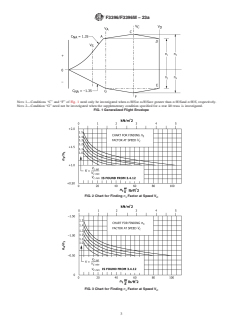
5.2.2 Table 1 must be used to determine values of n ,n ,n , and n , corresponding to the maximum design weights. Fig. 1 presents
1 2 3 4
a generalized flight envelope.
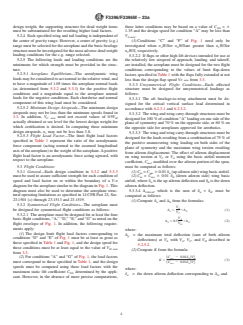
5.2.3 Fig. 2 and Fig. 3 must be used to determine values of n and n , corresponding to the minimum flying weights, and, if these
3 4
load factors are greater than the load factors at the design weight, the supporting structure for dead weight items must be
substantiated for the resulting higher load factors.
5.2.4 Each specified wing and tail loading is independent of the center of gravity range. However, a center of gravity (c.g.) range
must be selected for the aeroplane and the basic fuselage structure must be investigated for the most adverse dead weight loading
conditions for the c.g. range selected.
5.2.5 The following loads and loading conditions are the minimums for which strength must be provided in the structure:
5.2.5.1 Aeroplane Equilibrium—The aerodynamic wing loads may be considered to act normal to the relative wind, and to have
a magnitude of 1.05 times the aeroplane normal loads (as determined from 5.3.2 and 5.3.3) for the positive flight conditions and
a magnitude equal to the aeroplane normal loads for the negative conditions. Each chordwise and normal component of this wing
load must be considered.
5.2.5.2 Minimum Design Airspeeds—The minimum design airspeeds may not be less than the minimum speeds found in 3.3. In
addition, V need not exceed values of 0.9V actually obtained at sea level for the lowest design weight for which certification
C min H
is desired. In computing these minimum design airspeeds, n may not be less than 3.8.
5.2.5.3 Flight Load Factor—The limit flight load factors specified in Table 1 represent the ratio of the aerodynamic force
component (acting normal to the assumed longitudinal axis of the aeroplane) to the weight of the aeroplane. A positive flight load
factor is an aerodynamic force acting upward, with respect to the aeroplane.
5.3 Flight Conditions:
5.3.1 General—Each design condition in 5.3.2 and 5.3.3 must be used to assure sufficient strength for each condition of speed and
load factor on or within the boundary of a V-n diagram for the aeroplane similar to the diagram in Fig. 1. This diagram must also
be used to determine the aeroplane structural operating limitations as specified in 14 CFR Part 23, Sec. 23.1501 (c) through
23.1513 and 23.1519.
5.3.2 Symmetrical Flight Conditions—The aeroplane must be designed for symmetrical flight conditions as follows:
5.3.2.1 The aeroplane must be designed for at least the four basic flight conditions, “A,” “D,” “E,” and “G” as noted on the flight
envelope of Fig. 1. In addition, the following requirements apply:
TABLE 1 Minimum Design Limit Flight Load Factors
Flight Load Factors Not Approved for Approved for
Aerobatics Aerobatics
n 3.8 6.0
n –0.5 n
2 1
Flaps Up
n Find from Fig. 2
n Find from Fig. 3
n 0.5 n
flap 1
Flaps Down
A
n Zero
flap
A
Vertical wing load may be assumed equal to zero and only the flap part of the
wing need be checked for this condition.
F3396/F3396M − 23a
NOTE 1—Conditions “C” and “F” of Fig. 1 need only be investigated when n W/Sor n W/Sare greater than n W/Sand n W/S, respectively.
3 4 1 2
NOTE 2—Condition “G” need not be investigated when the supplementary condition specified for a rear lift truss is investigated.
FIG. 1 Generalized Flight Envelope
FIG. 2 Chart for Finding n Factor at Speed V
3 C
(1) The design limit flight load factors corresponding to conditions “D” and “E” of Fig. 1 must be at least as great as those
specified in Table 1 and Fig. 1, and the design speed for these conditions must be at least equal to the value of V from 3.3.
D min
(2) For conditions “A” and “G” of Fig. 1, the load factors must correspond to those specified in Table 1, and the design speeds
must be computed using these load factors with the maximum static lift coefficient C determined by the applicant. However, in
NA
the absence of more precise computations, these latter conditions may be based on a value of C = 6 1.35 and the design speed
NA
for condition “A” may be less than V .
A min
(3) Conditions “C” and “F” of Fig. 1 need only be investigated when n W/Sor n W/Sare greater than n W/Sor n W/S,
3 4 1 2
respectively.
5.3.2.2 If flaps or other high lift devices intended for use at the relatively low airspeed of approach, landing, and takeoff, are
installed, the aeroplane must be designed for the two flight conditions corresponding to the values of limit flap-down factors
specified in Table 1 with the flaps fully extended at not less than the design flap speed V from 3.3.
F min
5.3.3 Unsymmetrical Flight Conditions—Each affected structure must be designed for unsymmetrical loadings as follows:
5.3.3.1 The aft fuselage-to-wing attachment must be designed for the critical vertical surface load determined in accordance with
6.2.3.1 and 6.2.3.2.
5.3.3.2 The wing and wing carry-through structures must be designed for 100 % of condition “A” loading on one side of the plane
of symmetry and 70 % on the opposite side, or 60 % on the opposite side for aeroplanes approved for aerobatics.
F3396/F3396M − 23a
FIG. 3 Chart for Finding n Factor at Speed V
4 C
5.3.3.3 The wing and wing carry-through structures must be designed for the loads resulting from a combination of 75 % of the
positive maneuvering wing loading on both sides of the plane of symmetry and the maximum wing torsion resulting from aileron
displacement. The effect of aileron displacement on wing torsion at V or V using the basic airfoil moment coefficient, C ,
C A mo
modified over the aileron portion of the span, must be computed as follows:
(1) C = C 6 0.01 δ (up aileron side) wing basic airfoil.
m mo u
(2) C = C 6 0.01 δ (down aileron side) wing basic airfoil, where δ is the up aileron deflection and δ is the down aileron
m mo d u d
deflection.
5.3.3.4 ∆ , which is the sum of δ + δ , must be computed as follows:
critical u d
(1) Computeandfrom the formulas:
a b
V
A
∆ 5 ×∆ (1)
a P
V
C
V
A
∆ 5 0.5 ×∆ (2)
b P
V
D
where:
∆ = the maximum total deflection (sum of both aileron deflections) at V with V ,V , and V described in 5.2.5.2.
p A A C D
(2) Compute K from the formula:
C 2 0.01δ V
~ !
mo b D
K 5 (3)
~C 2 0.01δ !V
mo a C
where:
δ = the down aileron deflection corresponding to ∆ , and
a a
δ = the down aileron deflection corresponding to ∆ as computed in 5.3.3.4(1).
b b
(3) If K is less than 1.0,isand must be used to determine δ and δ . In this case, V is the critical speed which must
a critical u d C
be used in computing the wing torsion loads over the aileron span.
(4) If K is equal to or greater than 1.0,isand must be used to determine δ and δ . In this case, V is the critical
b critical u d D
speed which must be used in computing the wing torsion loads over the aileron span.
5.3.4 Supplementary Conditions: Rear Lift Truss; Engine Torque; Side Load on Engine Mount—Each of the following
supplementary conditions must be investigated:
5.3.4.1 In designing the rear lift truss, the special condition specified in Specification F3116/F3116M may be investigated instead
of condition “G” of Fig. 1.
F3396/F3396M − 23a
5.3.4.2 Each engine mount and its supporting structures must be designed for:
(1) The maximum limit torque corresponding to maximum take-off power (MTO power) and propeller speed acting
simultaneously with 75 % of the limit loads resulting from the maximum positive maneuvering flight load factor n .
(2) The maximum limit t
...