

ASTM F3082/F3082M-23a
(Specification)Standard Specification for Weights and Centers of Gravity of Aircraft
General Information
- Abstract
ABSTRACT
This specification covers airworthiness design standards associated with aeroplane flight. The applicant for a design approval shall seek the individual guidance of their respective civil aviation authority (CAA) body concerning the use of this specification as part of a certification plan.
SCOPE
1.1 This specification establishes the airworthiness design standards associated with aeroplane weight and center of gravity.
1.2 The term “aeroplane” is utilized in this specification as it was originally conceived for normal category fixed wing aircraft with a maximum certificated weight of 19 000 lb or less and a passenger seating configuration up to 19 as defined in the Rules. However, these standards may be more broadly applicable and their usage should not be unnecessarily limited.
1.3 The applicant for a design approval shall seek the individual guidance of their respective civil aviation authority (CAA) body concerning the use of this specification as part of a certification plan. For information on which CAA regulatory bodies have accepted this specification (in whole or in part) as a means of compliance to their small aircraft airworthiness regulations (hereinafter referred to as “the Rules”), refer to ASTM Committee F44 webpage (www.astm.org/COMMITTEE/F44.htm), which includes CAA website links.
1.4 Units—The values stated in either SI units or inch-pound units are to be regarded separately as standard. The values stated in each system may not be exact equivalents; therefore, each system shall be used independently of the other. Combining values from the two systems may result in non-conformance with the standard.
1.5 This standard does not purport to address all of the safety concerns, if any, associated with its use. It is the responsibility of the user of this standard to establish appropriate safety, health, and environmental practices and determine the applicability of regulatory limitations prior to use.
1.6 This international standard was developed in accordance with internationally recognized principles on standardization established in the Decision on Principles for the Development of International Standards, Guides and Recommendations issued by the World Trade Organization Technical Barriers to Trade (TBT) Committee.
- Status
- Published
- Publication Date
- 31-Aug-2023
- Technical Committee
- F44 - General Aviation Aircraft
- Drafting Committee
- F44.20 - Flight
Buy Documents
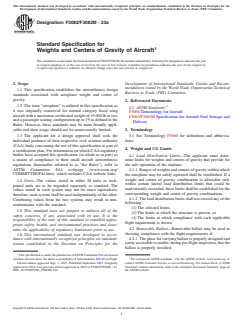
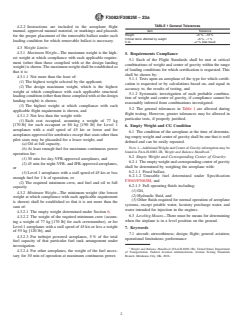
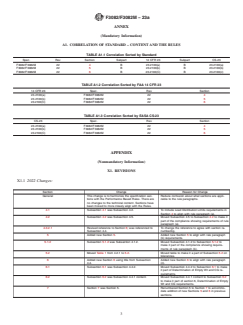

ASTM F3082/F3082M-23a - Standard Specification for Weights and Centers of Gravity of Aircraft
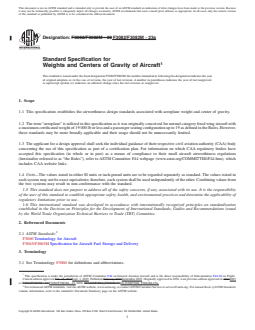
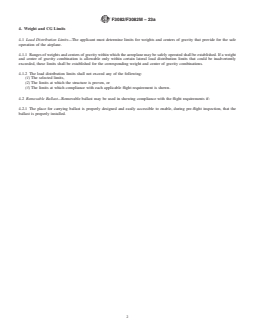
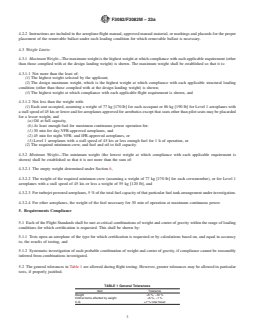
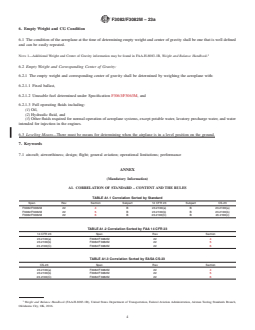
REDLINE ASTM F3082/F3082M-23a - Standard Specification for Weights and Centers of Gravity of Aircraft
Overview
ASTM F3082/F3082M-23a is the Standard Specification for Weights and Centers of Gravity of Aircraft, developed by ASTM International under Committee F44. This standard establishes the requirements for determining and controlling the weights and centers of gravity (CG) for normal category fixed wing aircraft, or aeroplanes, focusing on airworthiness and flight safety. Primarily intended for aircraft with a maximum certificated weight of 19,000 lb (8,618 kg) and up to 19 passenger seats, it outlines essential criteria for safe aircraft operations, with broader applicability as determined by civil aviation authorities (CAAs).
Key Topics
Weight and Center of Gravity Limits
- Establishes the range of weights and CGs for safe operation.
- Specifies allowable combinations of weight and lateral load distribution.
- Outlines methods for determining limits: selected, structural proof, and flight compliance.
Ballast Requirements
- Provisions for the use of removable ballast in compliance with flight requirements.
- Highlights requirements for proper installation, accessibility, and documentation in the aircraft manual.
Maximum and Minimum Weight Determination
- Criteria for establishing both maximum takeoff and minimum operational weights based on regulatory and structural constraints.
- Prescribes the conditions under which weight calculations must be performed, such as occupancy and fuel requirements.
Compliance Methodologies
- Requires testing and/or calculations at critical weight and CG combinations.
- Includes defined tolerances for weight and CG during flight testing.
Empty Weight and CG Condition
- Specifies how to determine the aircraft’s empty weight and corresponding center of gravity, including the inclusion of fixed ballast and essential fluids.
- Requires means for leveling the aircraft for accurate measurement.
Units of Measurement
- Recognizes both SI and inch-pound units but warns against mixing the two systems to prevent non-conformance.
Regulatory Guidance
- Applicants must consult their respective CAA for approval as part of their certification plan.
- References harmonization with global standards, such as FAA 14 CFR 23 and EASA CS-23.
Applications
Aircraft Design and Certification
- Essential for manufacturers and engineers designing fixed wing airplanes within the defined weight and passenger limits.
- Used as a reference for preparing airworthiness certification submissions to regulatory authorities.
Flight Safety and Operational Planning
- Provides operators and flight manual authors with methodologies for maintaining aircraft within safe operational weight and CG limits.
Compliance with International and Local Regulations
- Supports eligibility for certification by global aviation authorities, aiding international market access.
Maintenance and Modification
- Guides maintenance personnel and modification planners in re-establishing correct weight and CG data after structural or layout changes.
Related Standards
- ASTM F3060 - Terminology for Aircraft, providing definitions used in F3082/F3082M-23a.
- ASTM F3063/F3063M - Specification for Aircraft Fuel Storage and Delivery, referenced for unusable fuel requirements.
- FAA-H-8083-1B - Weight and Balance Handbook, offering additional guidance on weight and CG management.
- FAA 14 CFR 23 - Airworthiness standards applicable to small aircraft.
- EASA CS-23 - Certification specifications for small aeroplanes, aligned with ASTM F3082/F3082M-23a.
Practical Value
Implementing ASTM F3082/F3082M-23a helps ensure that aircraft are built and operated within safe weight and balance parameters. It is critical for compliance with airworthiness standards, reducing operational risks, supporting certification processes, and enhancing overall aviation safety and reliability.
Relations
- Effective Date
- 01-Jan-2020
- Refers
ASTM F3063/F3063M-18a - Standard Specification for Aircraft Fuel and Energy Storage and Delivery - Effective Date
- 01-Jul-2018
- Refers
ASTM F3063/F3063M-18 - Standard Specification for Aircraft Fuel and Energy Storage and Delivery - Effective Date
- 01-Jan-2018
- Effective Date
- 15-Dec-2016
- Effective Date
- 01-Nov-2016
- Effective Date
- 01-Apr-2016
- Effective Date
- 01-Feb-2016
- Effective Date
- 15-Sep-2015
- Effective Date
- 01-Jun-2015
- Effective Date
- 01-May-2015
- Effective Date
- 01-Mar-2015
- Effective Date
- 01-Dec-2014
Buy Documents
ASTM F3082/F3082M-23a - Standard Specification for Weights and Centers of Gravity of Aircraft
REDLINE ASTM F3082/F3082M-23a - Standard Specification for Weights and Centers of Gravity of Aircraft
Get Certified
Connect with accredited certification bodies for this standard

BSI Group
BSI (British Standards Institution) is the business standards company that helps organizations make excellence a habit.

Bureau Veritas
Bureau Veritas is a world leader in laboratory testing, inspection and certification services.

DNV
DNV is an independent assurance and risk management provider.
Sponsored listings
Frequently Asked Questions
ASTM F3082/F3082M-23a is a technical specification published by ASTM International. Its full title is "Standard Specification for Weights and Centers of Gravity of Aircraft". This standard covers: ABSTRACT This specification covers airworthiness design standards associated with aeroplane flight. The applicant for a design approval shall seek the individual guidance of their respective civil aviation authority (CAA) body concerning the use of this specification as part of a certification plan. SCOPE 1.1 This specification establishes the airworthiness design standards associated with aeroplane weight and center of gravity. 1.2 The term “aeroplane” is utilized in this specification as it was originally conceived for normal category fixed wing aircraft with a maximum certificated weight of 19 000 lb or less and a passenger seating configuration up to 19 as defined in the Rules. However, these standards may be more broadly applicable and their usage should not be unnecessarily limited. 1.3 The applicant for a design approval shall seek the individual guidance of their respective civil aviation authority (CAA) body concerning the use of this specification as part of a certification plan. For information on which CAA regulatory bodies have accepted this specification (in whole or in part) as a means of compliance to their small aircraft airworthiness regulations (hereinafter referred to as “the Rules”), refer to ASTM Committee F44 webpage (www.astm.org/COMMITTEE/F44.htm), which includes CAA website links. 1.4 Units—The values stated in either SI units or inch-pound units are to be regarded separately as standard. The values stated in each system may not be exact equivalents; therefore, each system shall be used independently of the other. Combining values from the two systems may result in non-conformance with the standard. 1.5 This standard does not purport to address all of the safety concerns, if any, associated with its use. It is the responsibility of the user of this standard to establish appropriate safety, health, and environmental practices and determine the applicability of regulatory limitations prior to use. 1.6 This international standard was developed in accordance with internationally recognized principles on standardization established in the Decision on Principles for the Development of International Standards, Guides and Recommendations issued by the World Trade Organization Technical Barriers to Trade (TBT) Committee.
ABSTRACT This specification covers airworthiness design standards associated with aeroplane flight. The applicant for a design approval shall seek the individual guidance of their respective civil aviation authority (CAA) body concerning the use of this specification as part of a certification plan. SCOPE 1.1 This specification establishes the airworthiness design standards associated with aeroplane weight and center of gravity. 1.2 The term “aeroplane” is utilized in this specification as it was originally conceived for normal category fixed wing aircraft with a maximum certificated weight of 19 000 lb or less and a passenger seating configuration up to 19 as defined in the Rules. However, these standards may be more broadly applicable and their usage should not be unnecessarily limited. 1.3 The applicant for a design approval shall seek the individual guidance of their respective civil aviation authority (CAA) body concerning the use of this specification as part of a certification plan. For information on which CAA regulatory bodies have accepted this specification (in whole or in part) as a means of compliance to their small aircraft airworthiness regulations (hereinafter referred to as “the Rules”), refer to ASTM Committee F44 webpage (www.astm.org/COMMITTEE/F44.htm), which includes CAA website links. 1.4 Units—The values stated in either SI units or inch-pound units are to be regarded separately as standard. The values stated in each system may not be exact equivalents; therefore, each system shall be used independently of the other. Combining values from the two systems may result in non-conformance with the standard. 1.5 This standard does not purport to address all of the safety concerns, if any, associated with its use. It is the responsibility of the user of this standard to establish appropriate safety, health, and environmental practices and determine the applicability of regulatory limitations prior to use. 1.6 This international standard was developed in accordance with internationally recognized principles on standardization established in the Decision on Principles for the Development of International Standards, Guides and Recommendations issued by the World Trade Organization Technical Barriers to Trade (TBT) Committee.
ASTM F3082/F3082M-23a is classified under the following ICS (International Classification for Standards) categories: 49.020 - Aircraft and space vehicles in general. The ICS classification helps identify the subject area and facilitates finding related standards.
ASTM F3082/F3082M-23a has the following relationships with other standards: It is inter standard links to ASTM F3060-20, ASTM F3063/F3063M-18a, ASTM F3063/F3063M-18, ASTM F3063/F3063M-16a, ASTM F3060-16a, ASTM F3060-16, ASTM F3063/F3063M-16, ASTM F3060-15b, ASTM F3063/F3063M-15, ASTM F3060-15a, ASTM F3060-15, ASTM F3060-14. Understanding these relationships helps ensure you are using the most current and applicable version of the standard.
ASTM F3082/F3082M-23a is available in PDF format for immediate download after purchase. The document can be added to your cart and obtained through the secure checkout process. Digital delivery ensures instant access to the complete standard document.
Standards Content (Sample)
This international standard was developed in accordance with internationally recognized principles on standardization established in the Decision on Principles for the
Development of International Standards, Guides and Recommendations issued by the World Trade Organization Technical Barriers to Trade (TBT) Committee.
Designation: F3082/F3082M − 23a
Standard Specification for
Weights and Centers of Gravity of Aircraft
This standard is issued under the fixed designation F3082/F3082M; the number immediately following the designation indicates the year
of original adoption or, in the case of revision, the year of last revision. A number in parentheses indicates the year of last reapproval.
A superscript epsilon (´) indicates an editorial change since the last revision or reapproval.
1. Scope Development of International Standards, Guides and Recom-
mendations issued by the World Trade Organization Technical
1.1 This specification establishes the airworthiness design
Barriers to Trade (TBT) Committee.
standards associated with aeroplane weight and center of
gravity.
2. Referenced Documents
1.2 The term “aeroplane” is utilized in this specification as 2
2.1 ASTM Standards:
it was originally conceived for normal category fixed wing
F3060 Terminology for Aircraft
aircraft with a maximum certificated weight of 19 000 lb or less
F3063/F3063M Specification for Aircraft Fuel Storage and
and a passenger seating configuration up to 19 as defined in the
Delivery
Rules. However, these standards may be more broadly appli-
cable and their usage should not be unnecessarily limited.
3. Terminology
1.3 The applicant for a design approval shall seek the 3.1 See Terminology F3060 for definitions and abbrevia-
individual guidance of their respective civil aviation authority
tions.
(CAA) body concerning the use of this specification as part of
4. Weight and CG Limits
a certification plan. For information on which CAA regulatory
bodies have accepted this specification (in whole or in part) as 4.1 Load Distribution Limits—The applicant must deter-
a means of compliance to their small aircraft airworthiness
mine limits for weights and centers of gravity that provide for
regulations (hereinafter referred to as “the Rules”), refer to the safe operation of the airplane.
ASTM Committee F44 webpage (www.astm.org/
4.1.1 Ranges of weights and centers of gravity within which
COMMITTEE/F44.htm), which includes CAA website links. the aeroplane may be safely operated shall be established. If a
weight and center of gravity combination is allowable only
1.4 Units—The values stated in either SI units or inch-
within certain lateral load distribution limits that could be
pound units are to be regarded separately as standard. The
inadvertently exceeded, these limits shall be established for the
values stated in each system may not be exact equivalents;
corresponding weight and center of gravity combinations.
therefore, each system shall be used independently of the other.
4.1.2 The load distribution limits shall not exceed any of the
Combining values from the two systems may result in non-
following:
conformance with the standard.
(1) The selected limits,
1.5 This standard does not purport to address all of the
(2) The limits at which the structure is proven, or
safety concerns, if any, associated with its use. It is the
(3) The limits at which compliance with each applicable
responsibility of the user of this standard to establish appro-
flight requirement is shown.
priate safety, health, and environmental practices and deter-
4.2 Removable Ballast—Removable ballast may be used in
mine the applicability of regulatory limitations prior to use.
showing compliance with the flight requirements if:
1.6 This international standard was developed in accor-
4.2.1 The place for carrying ballast is properly designed and
dance with internationally recognized principles on standard-
easily accessible to enable, during pre-flight inspection, that the
ization established in the Decision on Principles for the
ballast is properly installed.
This specification is under the jurisdiction of ASTM Committee F44 on General
Aviation Aircraft and is the direct responsibility of Subcommittee F44.20 on Flight. For referenced ASTM standards, visit the ASTM website, www.astm.org, or
Current edition approved Sept. 1, 2023. Published September 2023. Originally contact ASTM Customer Service at service@astm.org. For Annual Book of ASTM
approved in 2016. Last previous edition approved in 2023 as F3082/F3082M – 23. Standards volume information, refer to the standard’s Document Summary page on
DOI: 10.1520/F3082_F3082M-23A. the ASTM website.
Copyright © ASTM International, 100 Barr Harbor Drive, PO Box C700, West Conshohocken, PA 19428-2959. United States
F3082/F3082M − 23a
TABLE 1 General Tolerances
4.2.2 Instructions are included in the aeroplane flight
manual, approved manual material, or markings and placards Item Tolerance
Weight +5 %, –10 %
for the proper placement of the removable ballast under each
Critical items affected by weight +5 %, –1 %
loading condition for which removable ballast is necessary.
C.G. ±7 % total travel
4.3 Weight Limits:
4.3.1 Maximum Weight—The maximum weight is the high-
5. Requirements Compliance
est weight at which compliance with each applicable require-
5.1 Each of the Flight Standards shall be met at critical
ment (other than those complied with at the design landing
combinations of weight and center of gravity within the range
weight) is shown. The maximum weight shall be established so
of loading conditions for which certification is requested. This
that it is:
shall be shown by:
4.3.1.1 Not more than the least of:
5.1.1 Tests upon an aeroplane of the type for which certifi-
(1) The highest weight selected by the applicant;
cation is requested or by calculations based on, and equal in
(2) The design maximum weight, which is the highest
accuracy to, the results of testing, and
weight at which compliance with each applicable structural
5.1.2 Systematic investigation of each probable combina-
loading condition (other than those complied with at the design
tion of weight and center of gravity, if compliance cannot be
landing weight) is shown;
reasonably inferred from combinations investigated.
(3) The highest weight at which compliance with each
5.2 The general tolerances in Table 1 are allowed during
applicable flight requirement is shown, and
flight testing. However, greater tolerances may be allowed in
4.3.1.2 Not less than the weight with:
particular tests, if properly justified.
(1) Each seat occupied, assuming a weight of 77 kg
[170 lb] for each occupant or 86 kg [190 lb] for Level 1
6. Empty Weight and CG Condition
aeroplanes with a stall speed of 4
...
This document is not an ASTM standard and is intended only to provide the user of an ASTM standard an indication of what changes have been made to the previous version. Because
it may not be technically possible to adequately depict all changes accurately, ASTM recommends that users consult prior editions as appropriate. In all cases only the current version
of the standard as published by ASTM is to be considered the official document.
Designation: F3082/F3082M − 23 F3082/F3082M − 23a
Standard Specification for
Weights and Centers of Gravity of Aircraft
This standard is issued under the fixed designation F3082/F3082M; the number immediately following the designation indicates the year
of original adoption or, in the case of revision, the year of last revision. A number in parentheses indicates the year of last reapproval.
A superscript epsilon (´) indicates an editorial change since the last revision or reapproval.
1. Scope
1.1 This specification establishes the airworthiness design standards associated with aeroplane weight and center of gravity.
1.2 The term “aeroplane” is utilized in this specification as it was originally conceived for normal category fixed wing aircraft with
a maximum certificated weight of 19 000 lb or less and a passenger seating configuration up to 19 as defined in the Rules. However,
these standards may be more broadly applicable and their usage should not be unnecessarily limited.
1.3 The applicant for a design approval shall seek the individual guidance of their respective civil aviation authority (CAA) body
concerning the use of this specification as part of a certification plan. For information on which CAA regulatory bodies have
accepted this specification (in whole or in part) as a means of compliance to their small aircraft airworthiness regulations
(hereinafter referred to as “the Rules”), refer to ASTM Committee F44 webpage (www.astm.org/COMMITTEE/F44.htm), which
includes CAA website links.
1.4 Units—The values stated in either SI units or inch-pound units are to be regarded separately as standard. The values stated in
each system may not be exact equivalents; therefore, each system shall be used independently of the other. Combining values from
the two systems may result in non-conformance with the standard.
1.5 This standard does not purport to address all of the safety concerns, if any, associated with its use. It is the responsibility
of the user of this standard to establish appropriate safety, health, and environmental practices and determine the applicability of
regulatory limitations prior to use.
1.6 This international standard was developed in accordance with internationally recognized principles on standardization
established in the Decision on Principles for the Development of International Standards, Guides and Recommendations issued
by the World Trade Organization Technical Barriers to Trade (TBT) Committee.
2. Referenced Documents
2.1 ASTM Standards:
F3060 Terminology for Aircraft
F3063/F3063M Specification for Aircraft Fuel Storage and Delivery
3. Terminology
3.1 See Terminology F3060 for definitions and abbreviations.
This specification is under the jurisdiction of ASTM Committee F44 on General Aviation Aircraft and is the direct responsibility of Subcommittee F44.20 on Flight.
Current edition approved Feb. 15, 2023Sept. 1, 2023. Published February 2023September 2023. Originally approved in 2016. Last previous edition approved in 20222023
as F3082/F3082M – 22.F3082/F3082M – 23. DOI: 10.1520/F3082_F3082M-23.10.1520/F3082_F3082M-23A.
For referenced ASTM standards, visit the ASTM website, www.astm.org, or contact ASTM Customer Service at service@astm.org. For Annual Book of ASTM Standards
volume information, refer to the standard’s Document Summary page on the ASTM website.
Copyright © ASTM International, 100 Barr Harbor Drive, PO Box C700, West Conshohocken, PA 19428-2959. United States
F3082/F3082M − 23a
4. Weight and CG Limits
4.1 Load Distribution Limits—The applicant must determine limits for weights and centers of gravity that provide for the safe
operation of the airplane.
4.1.1 Ranges of weights and centers of gravity within which the aeroplane may be safely operated shall be established. If a weight
and center of gravity combination is allowable only within certain lateral load distribution limits that could be inadvertently
exceeded, these limits shall be established for the corresponding weight and center of gravity combinations.
4.1.2 The load distribution limits shall not exceed any of the following:
(1) The selected limits,
(2) The limits at which the structure is proven, or
(3) The limits at which compliance with each applicable flight requirement is shown.
4.2 Removable Ballast—Removable ballast may be used in showing compliance with the flight requirements if:
4.2.1 The place for carrying ballast is properly designed and easily accessible to enable, during pre-flight inspection, that the
ballast is properly installed.
F3082/F3082M − 23a
4.2.2 Instructions are included in the aeroplane flight manual, approved manual material, or markings and placards for the proper
placement of the removable ballast under each loading condition for which removable ballast is necessary.
4.3 Weight Limits:
4.3.1 Maximum Weight—The maximum weight is the highest weight at which compliance with each applicable requirement (other
than those complied with at the design landing weight) is shown. The maximum weight shall be established so that it is:
4.3.1.1 Not more than the least of:
(1) The highest weight selected by the applicant;
(2) The design maximum weight, which is the highest weight at which compliance with each applicable structural loading
condition (other than those complied with at the design landing weight) is shown;
(3) The highest weight at which compliance with each applicable flight requirement is shown, and
4.3.1.2 Not less than the weight with:
(1) Each seat occupied, assuming a weight of 77 kg [170 lb] for each occupant or 86 kg [190 lb] for Level 1 aeroplanes with
a stall speed of 45 kts or lower and for aeroplanes approved for aerobatics except that seats other than pilot seats may be placarded
for a lesser weight, and
(a) Oil at full capacity,
(b) At least enough fuel for maximum continuous power operation for:
(1) 30 min for day-VFR-approved aeroplanes, and
(2) 45 min for night-VFR- and IFR-approved aeroplanes, or
(3) Level 1 aeroplanes with a stall speed of 45 kts or less enough fuel for 1 h of operation, or
(2) The required minimum crew, and fuel and oil to full capacity.
4.3.2 Minimum Weight—The minimum weight (the lowest weight at which compliance with each applicable requirement is
shown) shall be established so that it is not more than the sum of:
4.3.2.1 The empty weight determined under Section 6,
4.3.2.2 The weight of the required minimum
...