

ASTM F3180/F3180M-21
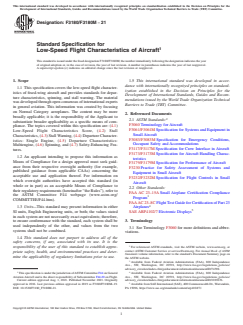
(Specification)Standard Specification for Low-Speed Flight Characteristics of Aircraft
General Information
- Abstract
ABSTRACT
This specification establishes the airworthiness design requirements for low-speed aeroplane flight characteristics. The applicant for a design approval shall seek the individual guidance to their respective civil aviation authority (CAA) body concerning the use of this specification as part of a certification plan.
This specification is applicable to small aeroplanes and covers departure characteristics, spinning, and stall warning.
SCOPE
1.1 This specification covers the low-speed flight characteristics of fixed-wing aircraft and provides standards for departure characteristics, spinning, and stall warning. The material was developed through open consensus of international experts in general aviation. This information was created by focusing on Normal Category aeroplanes. The content may be more broadly applicable; it is the responsibility of the Applicant to substantiate broader applicability as a specific means of compliance. The topics covered within this specification are: (4.1) Low-Speed Flight Characteristics Score, (4.2) Stall Characteristics, (4.3) Stall Warning, (4.4) Departure Characteristics: Single Engine, (4.5) Departure Characteristics: Multiengine, (4.6) Spinning, and (4.7) Safety-Enhancing Features.
1.2 An applicant intending to propose this information as Means of Compliance for a design approval must seek guidance from their respective oversight authority (for example, published guidance from applicable CAAs) concerning the acceptable use and application thereof. For information on which oversight authorities have accepted this standard (in whole or in part) as an acceptable Means of Compliance to their regulatory requirements (hereinafter “the Rules”), refer to the ASTM Committee F44 webpage (www.astm.org/COMMITTEE/F44.htm).
1.3 Units—This standard may present information in either SI units, English Engineering units, or both; the values stated in each system are not necessarily exact equivalents; therefore, to ensure conformance with the standard, each system shall be used independently of the other, and values from the two systems shall not be combined.
1.4 This standard does not purport to address all of the safety concerns, if any, associated with its use. It is the responsibility of the user of this standard to establish appropriate safety, health, and environmental practices and determine the applicability of regulatory limitations prior to use.
1.5 This international standard was developed in accordance with internationally recognized principles on standardization established in the Decision on Principles for the Development of International Standards, Guides and Recommendations issued by the World Trade Organization Technical Barriers to Trade (TBT) Committee.
- Status
- Published
- Publication Date
- 31-Jul-2021
- Technical Committee
- F44 - General Aviation Aircraft
- Drafting Committee
- F44.20 - Flight
Buy Documents
ASTM F3180/F3180M-21 - Standard Specification for Low-Speed Flight Characteristics of Aircraft
REDLINE ASTM F3180/F3180M-21 - Standard Specification for Low-Speed Flight Characteristics of Aircraft
Overview
ASTM F3180/F3180M-21: Standard Specification for Low-Speed Flight Characteristics of Aircraft sets forth comprehensive airworthiness requirements for the low-speed flight characteristics of fixed-wing, small aircraft. The standard, developed through international consensus under ASTM Committee F44, is primarily aimed at normal category aeroplanes in general aviation, but its methodologies may be adopted more broadly upon substantiation by the applicant and acceptance by relevant civil aviation authorities (CAAs).
This specification provides a structured means for aircraft developers, certification applicants, and regulatory authorities to measure, evaluate, and verify safe and controllable aircraft behavior during critical low-speed flight phases such as stalls, spins, and departures from controlled flight. It emphasizes clear guidance for compliance, incorporates a points-based evaluation, and recommends safety-enhancing features to support modern aviation safety practices.
Key Topics
Low-Speed Flight Characteristics
The heart of ASTM F3180/F3180M-21 is its focus on low-speed flight dynamics, including:
- Stall Characteristics: Evaluation of controllability and recovery in straight, turning, and accelerated stalls.
- Stall Warning: Requirements for early, clear warning systems to alert pilots before loss of lift occurs.
- Departure Characteristics: Guidance to prevent inadvertent departures from controlled flight for both single- and multi-engine aircraft, utilizing alternative demonstration and scoring methods.
- Spinning: Criteria for spin entry behavior, spin recovery, and the handling of aeroplanes approved for aerobatics.
- Safety-Enhancing Features: Options for additional onboard systems that improve pilot awareness and reduce loss-of-control risks.
Scoring and Compliance
The standard introduces a points-based system to quantify compliance:
- Low-Speed Flight Characteristics Score: Summed from stall warning, departure characteristics, and safety-enhancing features scores.
- Minimum Scores: Vary according to aircraft certification level, engine number, and aerobatic approval status.
- Means of Compliance: Applicants must consult their CAA about the use and acceptability of this standard in their certification approach.
Guidance and Applicability
- Applicants must use either SI or English units consistently; mixing units is not permitted.
- The Standard applies predominantly to normal category aircraft but can be referenced for broader types with proper justification.
- Not all safety, health, or environmental issues are addressed-users must verify regulatory fit for their region.
Applications
Certification and Aircraft Design
- Regulatory Approval: Serves as a reference or means of compliance for demonstrating low-speed safety in type certification plans, as recognized by CAAs such as the FAA and EASA.
- Aircraft Development: Offers manufacturers a clear framework to design or modify fixed-wing small aircraft, ensuring control and warning systems meet stringent performance criteria.
- Flight Testing: Guides flight test engineers in conducting and documenting specific maneuvers, stall warnings, and recovery scenarios in line with internationally harmonized standards.
Safety and Training
- Pilot Training: Provides a framework for establishing minimum low-speed handling qualities, essential for standardizing flight training curriculum and improving pilot proficiency.
- System Integration: Encourages the incorporation of advanced stall warning, flight envelope protection, and pilot awareness technology to further decrease the risk of loss-of-control accidents.
Related Standards
Referencing and complementing ASTM practices and other international standards, ASTM F3180/F3180M-21 works in conjunction with:
- ASTM F3060: Terminology for Aircraft
- ASTM F3061/F3061M: Systems and Equipment in Small Aircraft
- ASTM F3083/F3083M: Emergency Conditions and Occupant Safety
- ASTM F3117/F3117M: Crew Interface in Aircraft
- ASTM F3173/F3173M: Aircraft Handling Characteristics
- ASTM F3179/F3179M: Performance of Aircraft
- ASTM F3230: Safety Assessment for Systems and Equipment in Small Aircraft
- ASTM F3232/F3232M: Flight Controls in Small Aircraft
- FAA AC 23-15A & AC 23-8C: Guidance on small airplane certification and flight test compliance
Keywords: low-speed flight characteristics, aircraft stall behavior, spin resistance, stall warning systems, aircraft departure characteristics, aircraft certification, ASTM aviation standards, safety-enhancing features, small aircraft airworthiness, aviation compliance.
For updated acceptance of this standard by oversight authorities, refer to the ASTM Committee F44 webpage.
Relations
- Effective Date
- 01-Oct-2023
- Effective Date
- 01-Oct-2023
- Effective Date
- 01-Sep-2023
- Effective Date
- 01-Jan-2020
- Effective Date
- 01-Nov-2019
- Effective Date
- 01-Jun-2019
- Effective Date
- 01-Dec-2018
- Effective Date
- 01-Nov-2018
- Effective Date
- 01-May-2018
- Effective Date
- 01-Sep-2017
- Effective Date
- 15-Feb-2017
- Effective Date
- 01-Dec-2016
- Effective Date
- 01-Nov-2016
- Effective Date
- 01-Aug-2016
- Effective Date
- 01-Jun-2016
Buy Documents
ASTM F3180/F3180M-21 - Standard Specification for Low-Speed Flight Characteristics of Aircraft
REDLINE ASTM F3180/F3180M-21 - Standard Specification for Low-Speed Flight Characteristics of Aircraft
Get Certified
Connect with accredited certification bodies for this standard

BSI Group
BSI (British Standards Institution) is the business standards company that helps organizations make excellence a habit.

Bureau Veritas
Bureau Veritas is a world leader in laboratory testing, inspection and certification services.

DNV
DNV is an independent assurance and risk management provider.
Sponsored listings
Frequently Asked Questions
ASTM F3180/F3180M-21 is a technical specification published by ASTM International. Its full title is "Standard Specification for Low-Speed Flight Characteristics of Aircraft". This standard covers: ABSTRACT This specification establishes the airworthiness design requirements for low-speed aeroplane flight characteristics. The applicant for a design approval shall seek the individual guidance to their respective civil aviation authority (CAA) body concerning the use of this specification as part of a certification plan. This specification is applicable to small aeroplanes and covers departure characteristics, spinning, and stall warning. SCOPE 1.1 This specification covers the low-speed flight characteristics of fixed-wing aircraft and provides standards for departure characteristics, spinning, and stall warning. The material was developed through open consensus of international experts in general aviation. This information was created by focusing on Normal Category aeroplanes. The content may be more broadly applicable; it is the responsibility of the Applicant to substantiate broader applicability as a specific means of compliance. The topics covered within this specification are: (4.1) Low-Speed Flight Characteristics Score, (4.2) Stall Characteristics, (4.3) Stall Warning, (4.4) Departure Characteristics: Single Engine, (4.5) Departure Characteristics: Multiengine, (4.6) Spinning, and (4.7) Safety-Enhancing Features. 1.2 An applicant intending to propose this information as Means of Compliance for a design approval must seek guidance from their respective oversight authority (for example, published guidance from applicable CAAs) concerning the acceptable use and application thereof. For information on which oversight authorities have accepted this standard (in whole or in part) as an acceptable Means of Compliance to their regulatory requirements (hereinafter “the Rules”), refer to the ASTM Committee F44 webpage (www.astm.org/COMMITTEE/F44.htm). 1.3 Units—This standard may present information in either SI units, English Engineering units, or both; the values stated in each system are not necessarily exact equivalents; therefore, to ensure conformance with the standard, each system shall be used independently of the other, and values from the two systems shall not be combined. 1.4 This standard does not purport to address all of the safety concerns, if any, associated with its use. It is the responsibility of the user of this standard to establish appropriate safety, health, and environmental practices and determine the applicability of regulatory limitations prior to use. 1.5 This international standard was developed in accordance with internationally recognized principles on standardization established in the Decision on Principles for the Development of International Standards, Guides and Recommendations issued by the World Trade Organization Technical Barriers to Trade (TBT) Committee.
ABSTRACT This specification establishes the airworthiness design requirements for low-speed aeroplane flight characteristics. The applicant for a design approval shall seek the individual guidance to their respective civil aviation authority (CAA) body concerning the use of this specification as part of a certification plan. This specification is applicable to small aeroplanes and covers departure characteristics, spinning, and stall warning. SCOPE 1.1 This specification covers the low-speed flight characteristics of fixed-wing aircraft and provides standards for departure characteristics, spinning, and stall warning. The material was developed through open consensus of international experts in general aviation. This information was created by focusing on Normal Category aeroplanes. The content may be more broadly applicable; it is the responsibility of the Applicant to substantiate broader applicability as a specific means of compliance. The topics covered within this specification are: (4.1) Low-Speed Flight Characteristics Score, (4.2) Stall Characteristics, (4.3) Stall Warning, (4.4) Departure Characteristics: Single Engine, (4.5) Departure Characteristics: Multiengine, (4.6) Spinning, and (4.7) Safety-Enhancing Features. 1.2 An applicant intending to propose this information as Means of Compliance for a design approval must seek guidance from their respective oversight authority (for example, published guidance from applicable CAAs) concerning the acceptable use and application thereof. For information on which oversight authorities have accepted this standard (in whole or in part) as an acceptable Means of Compliance to their regulatory requirements (hereinafter “the Rules”), refer to the ASTM Committee F44 webpage (www.astm.org/COMMITTEE/F44.htm). 1.3 Units—This standard may present information in either SI units, English Engineering units, or both; the values stated in each system are not necessarily exact equivalents; therefore, to ensure conformance with the standard, each system shall be used independently of the other, and values from the two systems shall not be combined. 1.4 This standard does not purport to address all of the safety concerns, if any, associated with its use. It is the responsibility of the user of this standard to establish appropriate safety, health, and environmental practices and determine the applicability of regulatory limitations prior to use. 1.5 This international standard was developed in accordance with internationally recognized principles on standardization established in the Decision on Principles for the Development of International Standards, Guides and Recommendations issued by the World Trade Organization Technical Barriers to Trade (TBT) Committee.
ASTM F3180/F3180M-21 is classified under the following ICS (International Classification for Standards) categories: 49.020 - Aircraft and space vehicles in general. The ICS classification helps identify the subject area and facilitates finding related standards.
ASTM F3180/F3180M-21 has the following relationships with other standards: It is inter standard links to ASTM F3061/F3061M-23b, ASTM F3232/F3232M-23a, ASTM F3179/F3179M-23, ASTM F3060-20, ASTM F3061/F3061M-19a, ASTM F3061/F3061M-19, ASTM F3083/F3083M-18, ASTM F3117/F3117M-18c, ASTM F3179/F3179M-18, ASTM F3173/F3173M-17, ASTM F3061/F3061M-17, ASTM F3061/F3061M-16b, ASTM F3060-16a, ASTM F3061/F3061M-16a, ASTM F3083/F3083M-16. Understanding these relationships helps ensure you are using the most current and applicable version of the standard.
ASTM F3180/F3180M-21 is available in PDF format for immediate download after purchase. The document can be added to your cart and obtained through the secure checkout process. Digital delivery ensures instant access to the complete standard document.
Standards Content (Sample)
This international standard was developed in accordance with internationally recognized principles on standardization established in the Decision on Principles for the
Development of International Standards, Guides and Recommendations issued by the World Trade Organization Technical Barriers to Trade (TBT) Committee.
Designation:F3180/F3180M −21
Standard Specification for
Low-Speed Flight Characteristics of Aircraft
ThisstandardisissuedunderthefixeddesignationF3180/F3180M;thenumberimmediatelyfollowingthedesignationindicatestheyear
of original adoption or, in the case of revision, the year of last revision. A number in parentheses indicates the year of last reapproval.
A superscript epsilon (´) indicates an editorial change since the last revision or reapproval.
1. Scope 1.5 This international standard was developed in accor-
dance with internationally recognized principles on standard-
1.1 This specification covers the low-speed flight character-
ization established in the Decision on Principles for the
istics of fixed-wing aircraft and provides standards for depar-
Development of International Standards, Guides and Recom-
ture characteristics, spinning, and stall warning. The material
mendations issued by the World Trade Organization Technical
wasdevelopedthroughopenconsensusofinternationalexperts
Barriers to Trade (TBT) Committee.
in general aviation. This information was created by focusing
on Normal Category aeroplanes. The content may be more
2. Referenced Documents
broadly applicable; it is the responsibility of the Applicant to
2.1 ASTM Standards:
substantiate broader applicability as a specific means of com-
F3060 Terminology for Aircraft
pliance. The topics covered within this specification are: (4.1)
F3061/F3061M Specification for Systems and Equipment in
Low-Speed Flight Characteristics Score, (4.2) Stall
Small Aircraft
Characteristics, (4.3) StallWarning, (4.4) Departure Character-
F3083/F3083M Specification for Emergency Conditions,
istics: Single Engine, (4.5) Departure Characteristics:
Occupant Safety and Accommodations
Multiengine, (4.6) Spinning, and (4.7) Safety-Enhancing Fea-
F3117/F3117M Specification for Crew Interface in Aircraft
tures.
F3173/F3173M Specification for Aircraft Handling Charac-
1.2 An applicant intending to propose this information as
teristics
Means of Compliance for a design approval must seek guid-
F3179/F3179M Specification for Performance of Aircraft
ance from their respective oversight authority (for example,
F3230 Practice for Safety Assessment of Systems and
published guidance from applicable CAAs) concerning the
Equipment in Small Aircraft
acceptable use and application thereof. For information on
F3232/F3232M Specification for Flight Controls in Small
which oversight authorities have accepted this standard (in
Aircraft
whole or in part) as an acceptable Means of Compliance to
2.2 Other Standards:
their regulatory requirements (hereinafter “the Rules”), refer to
FAA AC 23–15A Small Airplane Certification Compliance
the ASTM Committee F44 webpage (www.astm.org/
Program
COMMITTEE/F44.htm).
FAAAC23–8C FlightTestGuideforCertificationofPart23
1.3 Units—This standard may present information in either
Airplanes
SI units, English Engineering units, or both; the values stated SAE ARP4102/7 Electronic Displays
in each system are not necessarily exact equivalents; therefore,
3. Terminology
to ensure conformance with the standard, each system shall be
used independently of the other, and values from the two
3.1 See Terminology F3060 for more definitions and abbre-
systems shall not be combined.
viations.
1.4 This standard does not purport to address all of the
safety concerns, if any, associated with its use. It is the
For referenced ASTM standards, visit the ASTM website, www.astm.org, or
responsibility of the user of this standard to establish appro-
contact ASTM Customer Service at service@astm.org. For Annual Book of ASTM
priate safety, health, and environmental practices and deter-
Standards volume information, refer to the standard’s Document Summary page on
mine the applicability of regulatory limitations prior to use.
the ASTM website.
Available from Federal Aviation Administration (FAA), 800 Independence
Ave., SW, Washington, DC 20591, http://www.faa.gov/regulations_policies/
advisory_circulars/index.cfm/go/document.information/documentID/74398.
1 4
ThisspecificationisunderthejurisdictionofASTMCommitteeF44onGeneral Available from Federal Aviation Administration (FAA), 800 Independence
AviationAircraft and is the direct responsibility of Subcommittee F44.20 on Flight. Ave., SW, Washington, DC 20591, http://www.faa.gov/regulations_policies/
Current edition approved Aug. 1, 2021. Published November 2021. Originally advisory_circulars/index.cfm/go/document.information/documentID/1019676.
approved in 2016. Last previous edition approved in 2019 as F3180/F3180M–19. Available from SAE International (SAE), 400 Commonwealth Dr.,Warrendale,
DOI: 10.1520/F3180_F3180M-21. PA 15096, https://www.sae.org/standards/content/arp4102/7/.
Copyright © ASTM International, 100 Barr Harbor Drive, PO Box C700, West Conshohocken, PA 19428-2959. United States
F3180/F3180M−21
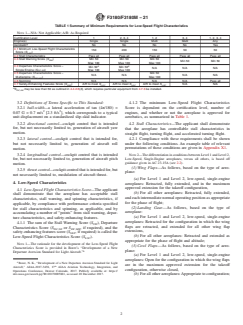
TABLE 1 Summary of Minimum Requirements for Low-Speed Flight Characteristics
NOTE 1—N/A: Not Applicable; A/R: As Required
Certification Level 1 2, 3, 4 1, 2 3, 4 1, 2, 3, 4
Engine(s) Single Single Multi Multi Any
Aerobatic? No No No No Yes
4.1 Minimum Low-Speed Flight Characteristics
150 200 150 50 50
Score (S )
LSC
4.2 Stall Characteristics Pass all Pass all Pass all Pass all Pass all
4.3 Stall Warning Score (S)Min50 Min 50 Min 50
SW
Min 50 Min 50
Max 100 Max 100 Max 100
A A
4.4 Departure Characteristics Score – Min 50 Min 50
N/A N/A N/A
Max 100 Max 100
Single Engine (S )
DC,SE
4.5 Departure Characteristics Score – Min 50
N/A N/A N/A N/A
Multiengine (S ) Max 100
DC,ME
4.6 Spinning N/A N/A N/A N/A Pass all
4.7 Safety-Enhancing Features Score (S ) A/R to meet S A/R to meet S A/R to meet S N/A N/A
SEF LSC LSC LSC
A
S may be less than 50 as outlined in 4.4.2.6(3), which requires particular equipment from 4.7.3 be installed.
DC,SE
3.2 Definitions of Terms Specific to This Standard: 4.1.2 The minimum Low-Speed Flight Characteristics
3.2.1 ball-width—a lateral acceleration of tan (4π/180) = Score is dependent on the certification level, number of
2 2
0.07 G = 0.7 m/s [2.3 ft/s ], which corresponds to a typical engines, and whether or not the aeroplane is approved for
unit displacement on a standardized slip-skid indicator. aerobatics, as summarized in Table 1.
3.2.2 directional control—cockpit control that is intended
4.2 Stall Characteristics—The applicant shall demonstrate
for, but not necessarily limited to, generation of aircraft yaw
that the aeroplane has controllable stall characteristics in
motion.
straight flight, turning flight, and accelerated turning flight.
3.2.3 lateral control—cockpit control that is intended for, 4.2.1 Compliance with these requirements shall be shown
under the following conditions. An example table of relevant
but not necessarily limited to, generation of aircraft roll
motion. permutations of these conditions are given in Appendix X1.
3.2.4 longitudinal control—cockpit control that is intended
NOTE2—ThedifferentiationinconditionsbetweenLevel1andLevel2,
for, but not necessarily limited to, generation of aircraft pitch Low-Speed, Single-Engine aeroplanes, versus all others, is based off
guidance given in AC 23-15A (see 2.2).
motion.
(1) Wing Flaps—As follows, based on the type of aero-
3.2.5 thrust control—cockpitcontrolthatisintendedfor,but
plane:
not necessarily limited to, modulation of aircraft thrust.
(a) For Level 1 and Level 2, low-speed, single-engine
4. Low-Speed Characteristics
aeroplanes: Retracted, fully extended, and in the maximum
approved extension for the takeoff configuration,
4.1 Low-Speed Flight Characteristics Score—The applicant
(b) For all other aeroplanes: Retracted, fully extended,
shall demonstrate that the aeroplane has acceptable stall
and each intermediate normal operating position as appropriate
characteristics, stall warning, and spinning characteristics, if
for the phase of flight;
applicable, by compliance with performance criteria specified
(2) Landing Gear—As follows, based on the type of
for stall characteristics and spinning, as applicable, and by
aeroplane:
accumulating a number of “points” from stall warning, depar-
(a) For Level 1 and Level 2, low-speed, single-engine
ture characteristics, and safety-enhancing features.
aeroplanes: Retracted for the configuration in which the wing
4.1.1 The sum of the Stall Warning Score (S ), Departure
SW
flaps are retracted, and extended for all other wing flap
Characteristics Score (S or S , if required), and the
DC,SE DC,ME
extensions,
safety-enhancing features score (S , if required) is called the
SEF
(b) For all other aeroplanes: Retracted and extended as
Low-Speed Flight Characteristics Score (S ).
LSC
appropriate for the phase of flight and altitude;
NOTE 1—The rationale for the development of the Low-Speed Flight
(3) Cowl Flaps—As follows, based on the type of aero-
Characteristics Score is provided in Borer’s “Development of a New
6 plane:
Departure Aversion Standard for Light Aircraft.”
(a) For Level 1 and Level 2, low-speed, single-engine
aeroplanes: Open for the configuration in which the wing flaps
Borer, N. K., “Development of a New Departure Aversion Standard for Light
are in the maximum approved extension for the takeoff
th
Aircraft,” AIAA-2017-3438, 17 AIAA Aviation Technology, Integration, and
configuration, otherwise closed,
Operations Conference, Denver Colorado, 2017. Publicly available at: https://
ntrs.nasa.gov/search.jsp?R=20170005881, accessed 20 December 2017. (b) For all other aeroplanes:Appropriate to configuration;
F3180/F3180M−21
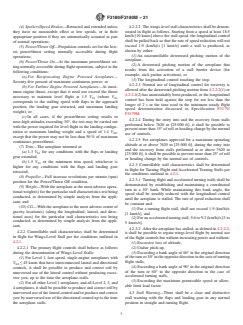
(4) Spoilers/Speed Brakes—Retracted and extended unless 4.2.2.2 The wings-level stall characteristics shall be demon-
they have no measurable effect at low speeds, or in their strated in flight as follows. Starting from a speed at least 18.5
km/h [10 knots] above the stall speed, the longitudinal control
appropriate position if they are automatically actuated as part
shall be pulled back so that the rate of speed reduction will not
of normal operations;
exceed 1.9 (km/h)/s [1 knot/s] until a stall is produced, as
(5) Power/Thrust Off—Propulsion controls set for the low-
shown by either:
est power/thrust setting normally accessible during flight
(1) An uncontrollable downward pitching motion of the
operations;
aeroplane,
(6) Power/Thrust On—At the maximum power/thrust set-
(2) A downward pitching motion of the aeroplane that
ting normally accessible during flight operations, subject to the
results from the activation of a stall barrier device (for
following conditions:
example, stick pusher activation), or
(a) For Reciprocating Engine Powered Aeroplanes—
(3) The longitudinal control reaching the stop.
Seventy-five percent of maximum continuous power; or
4.2.2.3 Normal use of longitudinal control for recovery is
(b) For Turbine Engine Powered Aeroplanes—At maxi-
allowed after the downward pitching motion from 4.2.2.2(1)or
mum engine thrust, except that it need not exceed the thrust
4.2.2.2(2) has unmistakably been produced, or the longitudinal
necessary to maintain level flight at 1.5 V (where V
S1 S1
control has been held against the stop for not less than the
corresponds to the stalling speed with flaps in the approach
longer of2sorthe time used in the minimum steady flight
position, the landing gear retracted, and maximum landing
speed determination discussed in Specification F3179/
weight); or
F3179M.
(c) In all cases, if the power/thrust setting results in
4.2.2.4 During the entry into and the recovery from stalls
nose-high attitudes exceeding 30°, the test may be carried out
performed below 7620 m [25 000 ft], it shall be possible to
with the power required for level flight in the landing configu-
prevent more than 15° of roll or heading change by the normal
ration at maximum landing weight and a speed of 1.4 V ,
S0
use of controls.
except that the power may not be less than 50 % of maximum
4.2.2.5 For aeroplanes approved for a maximum operating
continuous power/thrust.
altitude at or above 7620 m [25 000 ft], during the entry into
(7) Trim—The aeroplane trimmed at:
and the recovery from stalls performed at or above 7620 m
(a) 1.3 V for any conditions with the flaps or landing
S1
[25 000 ft], it shall be possible to prevent more than 25° of roll
gear extended,
or heading change by the normal use of controls.
(b) 1.5 V or the minimum trim speed, whichever is
S1
4.2.3 Controllable stall characteristics shall be determined
higher for any conditions with the flaps and landing gear
in flight for Turning Flight and Accelerated Turning Stalls per
retracted;
the conditions outlined in 4.2.1.
(8) Propeller—Full increase revolutions per minute (rpm)
4.2.3.1 Turning flight and accelerated turning stalls shall be
position for the Power/Thrust Off condition.
demonstrated by establishing and maintaining a coordinated
(9) Weight—With the aeroplane at the most adverse opera-
turn in a 30° bank. While maintaining this bank angle, the
tional weight(s) for the particular stall characteristics test being
speed shall be steadily reduced with the longitudinal control
conducted, as determined by simple analysis from the appli-
until the aeroplane is stalled. The rate of speed reduction shall
cant; and
be constant and:
(10) CG—With the aeroplane at the most adverse center of
(1) For a turning flight stall, shall not exceed 1.9 (km/h)/s
gravity location(s) (along the longitudinal, lateral, and direc-
[1 knot/s], and
tional axes) for the particular stall characteristics test being
(2) Foranacceleratedturningstall,5.6to9.3(km/h)/s[3to
conducted, as determined by simple analysis from the appli-
5 knots/s].
cant.
4.2.3.2 After the aeroplane has stalled, as defined in 4.2.2.2,
4.2.2 Controllable stall characteristics shall be determined
it shall be possible to regain wings-level flight by normal use
in flight for Wings-Level Stall per the conditions outlined in
oftheflightcontrolsbutwithoutincreasingpowerandwithout:
4.2.1.
(1) Excessive loss of altitude,
4.2.2.1 The primary flight controls shall behave as follows (2) Undue pitch-up,
(3) Exceeding a bank angle of 60° in the original direction
during the determination of Wings-Level Stalls:
oftheturnor30°intheoppositedirectioninthecaseofturning
(1) For Level 1, low-speed, single-engine aeroplanes with
flight stalls,
V ≤ 45 knots that have interconnected lateral and directional
S0
(4) Exceeding a bank angle of 90° in the original direction
controls, it shall be possible to produce and correct roll by
of the turn or 60° in the opposite direction in the case of
unreversed use of the lateral control without producing exces-
accelerated turning stalls,
sive yaw, up to the time the aeroplane stalls.
(5) Exceeding the maximum permissible speed or allow-
(2) For all other Level 1 aeroplanes, and all Level 2, 3, and
able limit load factor.
4 aeroplanes, it shall be possible to produce and correct roll by
unreversed use of the lateral control and to produce and correct
4.3 Stall Warning—There shall be a clear and distinctive
yaw by unreversed use of the directional control up to the time
stall warning with the flaps and landing gear in any normal
the aeroplane stalls. position in straight and turning flight.
F3180/F3180M−21
4.3.1 The stall warning shall give clearly distinguishable (1) The stall warning mute status is annunciated to the
indications under expected conditions of flight. The type of flight crew,
warning shall be the same for all normal configurations (2) The stall warning is re-armed automatically prior to the
throughout the flight envelope of the aeroplane. next flight.
4.3.2 When the speed is reduced at rates not exceeding 1.9
4.4 Departure Characteristics: Single Engine—All single-
(km/h)/s [1 knot/s], stall warning shall begin, in each normal
engine aeroplanes that are not approved for aerobatics shall not
configuration, at a speed exceeding the speed at which the stall
have a tendency to inadvertently depart controlled flight.
is identified in accordance with 4.2.2.2 by not less than 9.3
Compliance to these requirements shall be found from the
km/h [5 knots] or 5 % calibrated airspeed (CAS), whichever is
following alternatives. In all cases, maneuvers can be
greater. Once initiated, stall warning shall continue until the
discontinued, and a normal recovery initiated, after a down-
angle of attack is reduced to approximately that at which stall
ward pitching motion of the aeroplane commences due to the
warning began.
activation of a stall barrier device (for example, stick pusher
NOTE3—Forthepurposeofcompliancewiththisspecification,angleof activation).
attack can be measured directly or inferred through other measurements.
4.4.1 Alternative 1—All single-engine aeroplanes may dem-
4.3.2.1 The stall warning system effectiveness score, S , onstrate compliance with 4.4, and yield 100 points for the
SW
shall be determined based on the sum of the point value for
Single-Engine Departure Characteristics Score (S ) for
DC,SE
installed stall warning equipment, X . The maximum allow- compliance with 4.1.2, as follows:
SW
able point values for different implementations of stall warning
4.4.1.1 During the stall maneuver contained in 4.2.2, the
are shown in Table 2. The performance values, indication
longitudinal control shall be pulled back and held against the
options, and test methods for the stall warning equipment shall
stop. Then, using lateral and directional controls in the proper
be proposed by the applicant in a manner acceptable to CAA.
direction, it shall be possible to maintain wings-level flight
within 15° of bank and to roll the aeroplane from a minimum
NOTE 4—New standards are in development that will provide perfor-
of a 30° bank in one direction to a minimum of a 30° bank in
mance values, indication approaches, and test methods that will be
acceptable to this standard in future revisions.
the other direction.
(1) For aeroplanes approved for a maximum operating
4.3.2.2 The Stall Warning Effectiveness Score is subject to
altitude at or above 7620 m [25 000 ft], compliance with
the following limitations:
4.4.1.1 needs only to be shown at the lower altitudes used for
(1) S must be at least 50 for all aeroplanes;
SW
stall characteristics testing.
(2) If S is greater than 100, then it shall be capped at a
SW
4.4.1.2 Reduce the aeroplane speed using the longitudinal
value of 100 for the purpose of compliance with other sections
control at a rate of approximately 1.9 (km/h)/s [1 knot/s] until
of this standard.
the longitudinal control reaches the stop.
4.3.2.3 If more than one implementation in Table 2 is used
(1) With the longitudinal control pulled back and held
for the purposes of compliance with 4.3.2.2, each additional
against the stop, apply full directional control until whichever
implementation must utilize a different human sensory path.
of the following conditions occurs first:
4.3.3 For all aeroplanes other than Level 1, low-speed,
(a) Seven seconds, or
single-engine aeroplanes with V ≤ 45 knots, when following
S0
(b) Through a 360° heading change, which shall take no
aeroplane flight manual (AFM) procedures, stall warning shall
fewer than 4 s.
not occur during:
(2) At the end of the maneuver, the aeroplane shall respond
(1) Takeoff with all engines operating,
immediately and normally to primary flight controls applied to
(2) Takeoff continued with one engine inoperative,
regain coordinated, unstalled flight without reversal of control
(3) Approach to landing.
effect and without exceeding the temporary control forces
4.3.4 During turning and accelerated turning stalls required
specified by Specification F3173/F3173M.
by 4.2.3.1, the stall warning shall begin sufficiently in advance
(3) The following conditions shall be used during the
of the stall for the stall to be averted by pilot action taken after
maneuver discussed in 4.4.1.2(1):
the stall warning first occurs.
(a) Full right and full left directional control,
4.3.5 For aeroplanes approved for aerobatics, an artificial
(b) Lateral control:
stall warning may be mutable provided:
(1) Neutral,
(2) Fully deflected opposite of the direction of the turn;
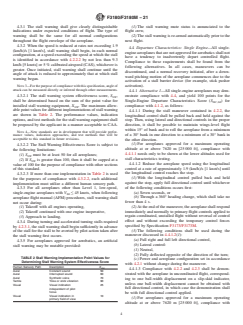
TABLE 2 Stall Warning Implementation Point Values for
(c) Power and aeroplane configuration set in accordance
Determining Stall Warning System Effectiveness Score
with 4.2.1 without change during the maneuver.
Human Sensory Path Description X
SW
4.4.1.3 Compliance with 4.2.2 and 4.2.3 shall be demon-
Aural Constant sound 50
strated with the aeroplane in uncoordinated flight, correspond-
Aural Interrupted sound 60
Aural Synthetic voice 70
ing to one ball-width displacement on a slip-skid indicator,
Tactile Yoke or stick vibration 90
unless one ball-width displacement cannot be obtained with
Visual Visual indication 25
independent of pilot full directional control, in which case the demonstration shall
focus
be with full directional control applied.
Visual Visual indication in 10
(1) For aeroplanes approved for a maximum operating
primary field of view
altitude at or above 7620 m [25 000 ft], compliance with
F3180/F3180M−21
4.4.1.3 needs only to be shown at the lower altitudes used for 4.4.2.4 The aeroplane is considered to have resisted the
stall characteristics testing. maneuvers outlined in 4.4.2.2 and 4.4.2.3 if, for the particular
unique condition tested, the following applies as appropriate:
4.4.2 Alternative 2—The applicant may quantify the resis-
(1) For the wings-level abused stall maneuvers of
tance of a single-engine aeroplane to inadvertent departure
4.4.2.2(1), the aeroplane shall, without reversal of lateral or
from controlled flight by accomplishing a series of low-speed
directional control effect, recover per the criteria in 4.2.2.3 and
maneuversandrecoveryproceduresthatincludedemonstration
4.2.2.4.
of recovery from non-coordinated stall maneuvers. Many of
(2) Fortheabusedturningstallmaneuversof4.4.2.2(1)and
these maneuvers are similar to 4.4.1, but, for this Alternative,
the poorly coordinated accelerated stall maneuvers of
it may not be necessary to demonstrate resistance from
4.4.2.2(2), the aeroplane shall, without reversal of lateral or
departure to controlled flight for all conditions. Rather, sum-
directional control effect, recover per the criteria in 4.2.3.2.
mation of the unique conditions that are successfully resisted
(3) For the post-stall lateral controllability maneuvers of
willyieldascoreforcompliancewith4.1.2asdescribedbelow.
4.4.2.3(1), the aeroplane shall be able to roll from a 30° bank,
Additionally, the maneuvers are re-organized as compared to
to the opposite 30° bank, and back to wings-level flight,
Alternative 1, to emphasize the purpose of the associated
without exceeding 45° of bank in the direction of the applied
demonstration. Example tables of relevant permutations of
lateral control throughout the maneuver. Upon reaching wings
these conditions are given in Appendix X1.
level flight, the aeroplane must maintain 615° for at least 2 s
4.4.2.1 Regardless of certification level, speed
priortorecoveringfromthestall.Inallcases,thecontrolsshall
classification, number of engines, or ceiling, the applicant shall
bemanipulatedwithoutreversaloflateralordirectionalcontrol
only use the configurations as required in 4.2.1 for Level 1 and
effect;
Level2,low-speed,single-engineaeroplanes,withamaximum
(4) For the lateral/directional control balance maneuvers of
operating altitude below 7620 m [25 000 ft], to comply with
4.4.2.3(2), the aeroplane shall respond immediately and nor-
4.4.2.2 and 4.4.2.3.
mally to primary flight controls applied to regain coordinated,
4.4.2.2 The applicant shall demonstrate the aeroplane’s
unstalled flight, without reversal of control effect for the lateral
resistance to poor piloting technique through the following
and directional controls, and without exceeding the temporary
maneuvers:
control forces specified by Specification F3173/F3173M.
(1) Abused Stalls—The wings-level stalls outlined in 4.2.2,
and the unaccelerated turning stalls outlined in 4.2.3, with the NOTE 6—For the purpose of this specification, “immediately and
normally” can coincide to ⁄4 of a turn in an incipient spin.
aeroplane in uncoordinated flight, corresponding to one ball-
width displacement on a slip-skid indicator, unless one ball-
4.4.2.5 If the aeroplane does not meet the criteria of 4.4.2.4
width displacement cannot be obtained with full directional
for any of unique conditions tested under 4.4.2.2 or 4.4.2.3, the
control, in which case the demonstration shall be with full
aeroplane is considered to have recovered from the maneuver
directional control applied.
for the particular condition tested as follows:
(2) Poorly Coordinated Accelerated Stalls—The acceler-
(1) If the aeroplane enters a spin, after the controls are held
ated turning stalls outlined in 4.2.3, with each entry configu-
in the position specified for the maneuver for the longer of one
ration duplicated with the directional control free of any pilot
turn or 3 s after stall identification, if the aeroplane can recover
input throughout the entry.
to wings-level controlled flight in not more than one additional
4.4.2.3 The applicant shall demonstrate the aeroplane’s
turn after initiation of the first control action for recovery,
post-stall controllability through the following maneuvers:
subject to the following conditions:
(1) Post-Stall Lateral Controllability—Duringthestallma-
(a) The applicable airspeed limit and positive limit ma-
neuvers required by 4.2.2, the longitudinal control shall be
neuvering load factors are not exceeded with respect to the
pulled back and held against the aft stop. Using properly
aeroplane’s current configuration;
coordinated lateral and directional controls, the aeroplane shall (b) No control forces or characteristic encountered during
be rolled to a minimum of 30° bank in one direction, to a
the spin or recovery shall adversely affect prompt recovery;
minimum of a 30° bank in the other direction, and back to
and
wings-level flight, prior to normal stall recovery.
(c) For flaps-extended configurations, the flaps may be
(2) Lateral/Directional Control Balance—The maneuvers
retracted during the recovery but not before rotation has
and configurations described in 4.4.1.2, with the following
ceased.
modifications:
(2) If the aeroplane does not enter a spin, the aeroplane can
(a) Omission of the conditions with the lateral control
recover to wings-level controlled flight with normal use of the
fully deflected opposite of the direction of the turn,
controls subject to the following conditions:
(b) The lateral control may be used throughout the
(a) The applicable airspeed limit and positive limit ma-
maneuvertopreventdeparture,providedthatthelateralcontrol
neuvering load factors are not exceeded with respect to the
does not reverse normal control effect or exceed the temporary
aeroplane’s current configuration.
control forces specified in Specification F3173/F3173M.
(b) No control forces or characteristic encountered during
the recovery shall adversely affect prompt recovery; and
NOTE 5—The use of the lateral control per 4.4.2.3(2)(b) is not intended
(c) No more than 366 m [1200 ft] of altitude is lost from
to allow for quasi-coordinated flight as a means to pass the maneuver.
the moment that the aeroplane fails the departure resistance
Rather, the intent is to simulate the response of the average pilot to resist
excessive bank angles. criteriain4.4.2.2untilcontrolledwings-levelflightisresumed.
F3180/F3180M−21
4.4.2.6 Scoring—The Single-Engine Departure Characteris- 4.4.3.4 After the conditions of 4.4.3.3 have been met, it
tics Score (S ), shall be the product of 100 times the ratio must be possible to regain wings-level flight according to the
DC,SE
criteria in 4.2.2 for wings-level stalls, and 4.2.3 for turning and
of the number of unique conditions that pass the criteria in
accelerated stalls.
4.4.2.4 to the total number of unique conditions tested in
4.4.2.2 and 4.4.2.3, rounded to the nearest whole number,
4.5 Departure Characteristics: Multiengine—All Level 1
meaning the score can be no greater than 100. The total score
and 2 multiengine aeroplanes that are not approved for
is subject to the following conditions:
aerobatics shall not have a tendency to inadvertently depart
(1) The minimum allowable score for the purposes of
controlled flight due to a critical loss of thrust. Compliance
compliance with 4.1.2 is 50 (for example, the aeroplane must
may be shown by one of the following three alternatives:
resist, per 4.4.2.4, at least 50 % of the unique conditions tested
4.5.1 Alternative 1—Level 1 and 2 multiengine aeroplanes,
in 4.4.2.2 and 4.4.2.3);
regardless of speed classification or V , that meet the climb
S0
(2) The aeroplane shall resist, per 4.4.2.4, or recover, per
gradient requirement described in Climb after Partial Loss of
4.4.2.5, for at least 95 % of the unique conditions tested in Thrust in Specification F3179/F3179M for Level 1 and 2,
4.4.2.1;or
low-speed multiengine aeroplanes that do not meet the single-
(3) If the aeroplane cannot comply with 4.4.2.6(1) and engine crashworthiness requirements, yield 100 points for the
4.4.2.6(2), it shall have a DescentArrest System installed that, MultiengineDepartureCharacteristicsScore(S )forcom-
DC,ME
pliance with 4.1.2.
as a minimum, meets the performance requirements in
4.7.3.2(2), in addition to other features discussed in 4.3 and 4.5.2 Alternative 2—Level 1 and 2 multiengine aeroplanes
that have a V defined by Minimum Control Speed in
4.7, to meet the Low-Speed Flight Characteristics Score
MC
Specification F3179/F3179M such that V < V , yield 100
required by 4.1.2.
MC S1
points for the Multiengine Departure Characteristics Score
4.4.3 Alternative 3—Level 1, single-engine, low-speed
(S ) for compliance with 4.1.2.
DC,ME
aeroplanes, with V ≤ 45 knots may comply with 4.4, and
S0
4.5.3 Alternative 3—The applicant may incorporate an ap-
yield 100 points for the Single-Engine Departure Characteris-
proach acceptable to the local CAA that may utilize aerody-
tics Score (S ) for compliance with 4.1.2 as follows:
DC,SE
namic design characteristics, systems-based protection
4.4.3.1 The aeroplane shall fly a series of maneuvers ac-
features, or a combination thereof to lower the probability of
cording to the entry procedures described in 4.2.2.2 and
departure from controlled flight after a critical loss of thrust to
4.2.3.1.
an acceptable level. The resulting Multiengine Departure
4.4.3.2 The aeroplane shall be configured as per 4.2.1,
Characteristics Score (S ) used for compliance in 4.1.2
DC,ME
except that the configurations will be modified as follows:
shall be proposed by the applicant and accepted by the CAA,
(1) The aeroplane weight shall be 5 % more than the
and must be at least 50 and no more than 100.
highest weight for which approval is requested;
NOTE 7—Proposals are in development for alternate means of compli-
(2) The aeroplane center of gravity shall be at least 3 % of
ance with the parent requirement in 4.5. Future revisions of this standard
the mean aerodynamic chord aft of the rearmost position for
will include those alternate approaches.
which approval is requested;
4.6 Spinning—Aeroplanescertifiedforaerobaticsshallmeet
(3) The available longitudinal control up-travel is set 4° in
the following spin recovery requirements in each configuration
excess of that to which the longitudinal control travel is to be
for which approval for spinning is requested:
limited for approval; and
4.6.1 The aeroplane shall recover from any point in a spin
(4) For aeroplanes that have independent lateral and direc-
uptoandincludingsixturns,oranygreaternumberofturnsfor
tional controls, the lateral control travel set 7° in both
which certification is requested, in not more than one-and-one-
directions, in excess of that to which the lateral control travel
half additional turns after initiation of the first control action
is to be limited for approval, or
for recovery. However, beyond three turns, the spin may be
(5) For aeroplanes with interconnected lateral and direc-
discontinued if spiral characteristics appear;
tional controls, the lateral-directional control travel set 7° in
4.6.2 The applicable airspeed limits and limit maneuvering
both directions, in excess of that to which the lateral-
load factors shall not be exceeded. For flaps-extended configu-
directional control travel is to be limited for approval.
rations for which approval is requested, the flaps shall not be
4.4.3.3 The maneuvers specified in 4.4.3.1 shall continue
retracted during the recovery;
until the longitudinal control reaches the aft stop. The aft stop
4.6.3 The aeroplane must be recoverable with any typical
shall be held for a period of 4 s with the following additional
useoftheflightorenginepowercontrolseitherattheentryinto
control inputs:
or during the spin;
(1) For aeroplanes with independent lateral and directional
4.6.4 There shall be no characteristics during the spin (such
controls:
as excessive rates of rotation or extreme oscillatory motion)
(a) Lateral control neutral, that might prevent a successful recovery because of disorien-
(b) Directional control full left and right; or
tation or incapacitation of the pilot;
(2) For aeroplanes with interconnected lateral and direc-
4.6.5 If the applicant does not seek approval for spinning in
tional controls, the lateral-directional control full left and full all of the conditions specified in 4.2.1, then the aeroplane shall
right, though the control may be neutralized if the aeroplane
recover from a one-turn spin or a 3 s spin, whichever takes
exceeds 60° of bank. longer, in not more than one additional turn after initiation of
F3180/F3180M−21
the first control action for recovery for the conditions in 4.2.1 4.7.1.3 If an applicant wishes to install one or more of the
that are not approved for spinning. items described in Table 3, but does not wish to declare such
4.6.5.1 The following conditions apply to one-turn or 3 s equipment as Safety-Enhancing Features for compliance with
spins: 4.1.2, then this equipment may be considered as non-required
(a) For both the flaps-retracted and flaps-extended equipment for the purposes of compliance with Specification
conditions, the applicable airspeed limit and positive limit F3061/F3061M, and the resulting point value, X , for the
EI
maneuvering load factor shall not be exceeded; purposes of calculation of S per 4.7.1.2 for that system is 0.
EI
(b) No control forces or characteristic encountered during
4.7.2 Enhanced Envelope Awareness—Enhanced envelope
the spin or recovery shall adversely affect prompt recovery;
awareness systems (EEAS) are intended to provide effective
(c) It shall be impossible to obtain unrecoverable spins
control feedback when the flight crew provides control inputs
with any use of the flight or engine power controls either at the
that place the aeroplane in flight conditions that have reduced
entry into or during the spin; and
margin over loss-of-control. Stall barrier devices (such as stick
(d) For flaps-extended configurations, the flaps may be
pushers) and envelope-limiting control systems are not consid-
retracted during the recovery but not before rotation has
ered here; such devices may instead be used for compliance
ceased.
with the maneuvers in 4.2 and 4.4. More detailed requirements
for EEAS systems may be found in Specification F3232/
4.7 Safety-Enhancing Features—The applicant may elect to
F3232M.
install safety-enhancing features to make up for the shortfall in
4.7.2.1 The enhanced envelope awareness score, S , shall
total score required from 4.1.2. The performance values,
EEA
be the sum of:
indication approaches, and test methods for the systems shall
(a) 5 points for a system that acts on the lateral control;
be proposed by the applicant in a manner acceptable to CAA.
(b) 15 points for a system that acts on the longitudinal
NOTE 8—New standards are in development that will provide perfor-
control;
mance values, indication options, and test methods that will be acceptable
(c) 10 points for a system that acts on the directional
to this standard in future revisions.
control;
4.7.1 Enhanced Indication—Enhanced indication systems
(d) 10 points for a system that acts on the thrust control;
are intended to provide additional information regarding the
4.7.2.2 If an applicant wishes to install one or more systems
low-speedaeroplanecontrolandperformancestate,beyondthe
defined in 4.7.2.1, but does not wish to declare such equipment
requirements of the Flight Instrumentation described in Speci-
as Safety-Enhancing Features for compliance with 4.1.2, then
fication F3061/F3061M and the Markings and Placards de-
this equipment can be considered as non-required equipment
scribed in Specification F3117/F3117M. The maximum allow-
for the purposes of compliance with Specification F3061/
able point values, X for various types of enhanced indication
EI
F3061M.
systems are given in Table 3.
4.7.3 Descent Arrest Systems—Descent arrest systems are
4.7.1.1 The information defined in Table 3 must be pre-
intended to slow the descent of an aeroplane that has departed
sented to the pilot in a manner acceptable to the local CAA,
controlled flight, and place the aeroplane in an attitude and at
such as SAE ARP4102/7 (2.2). When aplicable, acceptable
an appropriate velocity such that the resulting impact with the
display methods are given in Specification F3117/F3117M.
grounddoesnotviolatethemaximumimpactloadsspecifiedin
Additional suggested approaches are described in Appendix
Specification F3083/F3083M.
X2 (soon to be one or more new work items).
4.7.3.1 The applicant shall determine, in a manner accept-
4.7.1.2 The total enhanced indication feature score, S ,
EI
able to the CAA, the following values:
shall be the sum of all the features in Table 3 for which the
(a) The steady-state attitude and descent velocity with the
applicant wishes to take credit.
descent arrest system deployed; and
(1) If the applicant wishes to use multiple items from Table
(b) The altitude lost from the onset of a one-turn spin (if
3 as Safety-Enhancing Features for compliance with 4.1.2,
possible) or other adverse deployment situation until the
each system must be a unique “Type” (for example, the
steady-stateattitudeanddescentvelocitiesarereachedwiththe
applicant cannot install two systems of type “Angle ofAttack”
descent arrest system deployed.
and receive credit for both).
4.7.3.2 The Descent Arrest System score, S , shall be:
DAS
(1) 0 points if the altitude loss from 4.7.3.1 exceeds 366 m
TABLE 3 Enhanced Indication System Options and Point Values
[1200 ft];
Type Description X
EI
(2) 10pointsifaltitudelossfrom4.7.3.1isnolessthan244
Angle of Attack Angle of attack indication 5
Angle of Attack Angle of attack indication with trend marker 7
m [800 ft] and no more than 366 m [1200 ft];
Pitch Limit Pitch limit indication displayed on attitude 5
(3) 10+40(1–h /244) if altitude loss from 4.7.3.1 is less
loss
indication
than 244 m [800 ft], where h is altitude loss in meters (score
Dynamic Low- Indicated airspeed markings that change 10 loss
Speed Markings with flight condition
is 10+40(1–h /800) if h is the altitude loss in feet).
loss loss
Airspeed Trend Indicated airspeed trend marker displayed 5
4.7.4 The safety-enhancing feature score, S , shall be the
SEF
on airspeed indication
Flight Path Marker Flight path marker displayed on attitude 5 sum of all installed equipment for which the applicant wishes
indication
to take credit, with the caveat that such systems will be part of
LOC Alert Alert issued when loss of control likely 5
the required equipment list for all approved types of opera-
within trend window
tions. Hence, the total score is S = S + S + S .
SEF EI EEA DAS
F3180/F3180M−21
5. Keywords
5.1 airworthiness; flight; general aviation
APPENDIXES
(Nonmandatory Information)
X1. EXAMPLE PERMUTATIONS OF CONDITIONS USED TO COMPLY WITH 4.2 STALL CHARACTERISTICS AND 4.4
DEPARTURE CHARACTERISTICS (SINGLE ENGINE) FOR NOTIONAL AEROPLANES
X1.1 This appendix develops a number of different tables of tionalcontrolisfullydisplaced.If“NoInput,”indicatesthatno
conditions that must be uniquely tested as part of the compli- pilot input is made to the control.
ance with 4.2 of this standard, as well as the alternatives (9) CG – center of gravity position. Currently “most
presented in 4.4 for single-engine aeroplanes, not approved for adverse” for all cases per 4.2.1(10).
aerobatics. The column headers for each table assume the (10) Weight – aeroplane weight at start of maneuver.
following, for now: Currently “most adverse” for all cases per 4.2.1(9).
(1) No.–numericidentifierforseriesinthatparticulartype (11) Gear – landing gear up or down. For the low-speed L1
of maneuver (Wings-Level stalls, etc.) and L2 aeroplanes, uses the conditions as specified in
(2) Flaps – flap position. These tables assume three posi- 4.2.1(2)(a). For the others, 4.2.1(2)(b) notes that gear shall be
tions possible: Up, Maximum Takeoff (“Max TO”), and Land- “appropriate to phase of flight and altitude,” so the table only
ing. Per 4.2.1(1), for other than Level 1 and 2, low-speed, shows gear up for the flaps up and flaps at max takeoff
single-engine aeroplanes, other intermediate flap conditions condition.
need to be tested as well. (12) Altitude – Per 4.2.2.5, aeroplane with altitudes ap-
(3) Cowl Flaps – Cowl flap position as specified per proved above 7620 m [25 000 ft] need to do some stall testing
4.2.1(3). at altitude. “Low” means only at the appropriate lower altitude
(4) Speed Brakes – Speed brake position: “Ret/Ext or for testing. “Low/High” indicates the conditions that shall be
Auto,” meaning that if they have an effect on stall tested at this “low” altitude as well as the “high” altitude,
characteristics, this condition must be duplicated for retracted whichAC-23-8C indicates shall be near the maximum altitude
and extended. If they deploy automatically, then the system capability of the aeroplane. Hence, if “low/high” is present,
shall be armed and the maneuver does not need to be that means the condition is duplicated at low and high altitude.
duplicated. Ref 4.2.1(4). (13) Decel–decelerationrateofthemaneuver.Generally1
(5) Trim V – trim setting, in terms of speed of multiples kt/sec for unaccelerated, and 3 to 5 kts/sec for accelerated
S1
of V , per 4.2.1(7). configurations.
S1
(6) Power – “Off” per 4.2.1(5) and “On” per 4.2.1(6).
X1.2 All aeroplanes are required to demonstrate acceptable
(7) Entry bank – If bank angle given (“Wings Level,” “Left
stall characteristics. These include wings-level stalls (4.2.2),
30 deg,” etc.) then the entry bank angle per the appropriate
turning stalls and accelerated turning stalls (4.2.3).
stall/departure resistance maneuver. If “Neutral,” “Full Left,”
or “Full Right,” indicates position of lateral control. X1.2.1 The conditions applicable to wings-level stalls are
(8) Ball – lateral acceleration, in terms of slip/skid indica- given in Table X1.1 for Level 1 and Level 2, low-speed,
torperinstructionsfortheappropriatestall/departureresistance single-engine aeroplanes, and in Table X1.2 for all other
maneuver. If “Full Left” or “Full Right,” indicates that direc- aeroplanes.
TABLE X1.1 Notional Wings-Level Stall Conditions for Level 1 and Level 2, Low-Speed, Single-Engine Aeroplanes
(4.2.2, also appropriate for 4.4.1.1 and 4.4.2.3(1))
No. Flaps Cowl Speed Trim V Power Entry Ball CG Weight Gear Altitude Decel
S1
Flaps Brakes Bank
1 Up Closed Ret/Ext 1.5 On Wings Centered Most Most Up Low/ 1 kt/sec
or Auto Level adverse adverse High
2 Up Closed Ret/Ext 1.5 Off Wings Centered Most Most Up Low/ 1 kt/sec
or Auto Level adverse adverse High
3 Max TO Open Ret/Ext 1.3 On Wings Centered Most Most Down Low 1 kt/sec
or Auto Level adverse adverse
4 Max TO Open Ret/Ext 1.3 Off Wings Centered Most Most Down Low 1 kt/sec
or Auto Level adverse adverse
5 Full Closed Ret/Ext 1.3 On Wings Centered Most Most Down Low 1 kt/sec
or Auto Level adverse adverse
6 Full Closed Ret/Ext 1.3 Off Wings Centered Most Most Down Low 1 kt/sec
or Auto Level adverse adverse
F3180/F3180M−21
TABLE X1.2 Notional Wings-Level Stall Conditions for All Other Aeroplanes (4.2.2, also appropriate for 4.4.1.1)
No. Flaps Cowl Speed Trim V Power Entry Bank Ball CG Weight Gear Altitude Decel
S1
Flaps Brakes
1 Up Appropriate Ret/Ext or 1.5 On
...
This document is not an ASTM standard and is intended only to provide the user of an ASTM standard an indication of what changes have been made to the previous version. Because
it may not be technically possible to adequately depict all changes accurately, ASTM recommends that users consult prior editions as appropriate. In all cases only the current version
of the standard as published by ASTM is to be considered the official document.
Designation: F3180/F3180M − 19 F3180/F3180M − 21
Standard Specification for
Low-Speed Flight Characteristics of Aircraft
This standard is issued under the fixed designation F3180/F3180M; the number immediately following the designation indicates the year
of original adoption or, in the case of revision, the year of last revision. A number in parentheses indicates the year of last reapproval.
A superscript epsilon (´) indicates an editorial change since the last revision or reapproval.
1. Scope
1.1 This specification covers the low-speed flight characteristics of fixed-wing aircraft and provides standards for departure
characteristics, spinning, and stall warning. The material was developed through open consensus of international experts in general
aviation. This information was created by focusing on Normal Category aeroplanes. The content may be more broadly applicable;
it is the responsibility of the Applicant to substantiate broader applicability as a specific means of compliance. The topics covered
within this specification are: (4.1) Low-Speed Flight Characteristics Score, (4.2) Stall Characteristics, (4.3) Stall Warning, (4.4)
Departure Characteristics: Single Engine, (4.5) Departure Characteristics: Multiengine, (4.6) Spinning, and (4.7) Safety-Enhancing
Features.
1.2 An applicant intending to propose this information as Means of Compliance for a design approval must seek guidance from
their respective oversight authority (for example, published guidance from applicable CAAs) concerning the acceptable use and
application thereof. For information on which oversight authorities have accepted this standard (in whole or in part) as an
acceptable Means of Compliance to their regulatory requirements (hereinafter “the Rules”), refer to the ASTM Committee F44
webpage (www.astm.org/COMMITTEE/F44.htm).
1.3 Units—This standard may present information in either SI units, English Engineering units, or both; the values stated in each
system mayare not be exact equivalents. Each necessarily exact equivalents; therefore, to ensure conformance with the standard,
each system shall be used independently of the other; combiningother, and values from the two systems may result in
nonconformance with the standard.shall not be combined.
1.4 This standard does not purport to address all of the safety concerns, if any, associated with its use. It is the responsibility
of the user of this standard to establish appropriate safety, health, and environmental practices and determine the applicability of
regulatory limitations prior to use.
1.5 This international standard was developed in accordance with internationally recognized principles on standardization
established in the Decision on Principles for the Development of International Standards, Guides and Recommendations issued
by the World Trade Organization Technical Barriers to Trade (TBT) Committee.
2. Referenced Documents
2.1 ASTM Standards:
F3060 Terminology for Aircraft
F3061/F3061M Specification for Systems and Equipment in Small Aircraft
F3083/F3083M Specification for Emergency Conditions, Occupant Safety and Accommodations
This specification is under the jurisdiction of ASTM Committee F44 on General Aviation Aircraft and is the direct responsibility of Subcommittee F44.20 on Flight.
Current edition approved May 1, 2019Aug. 1, 2021. Published May 2019November 2021. Originally approved in 2016. Last previous edition approved in 20182019 as
F3180/F3180M–18.–19. DOI: 10.1520/F3180_F3180M–19.10.1520/F3180_F3180M-21.
For referenced ASTM standards, visit the ASTM website, www.astm.org, or contact ASTM Customer Service at service@astm.org. For Annual Book of ASTM Standards
volume information, refer to the standard’s Document Summary page on the ASTM website.
Copyright © ASTM International, 100 Barr Harbor Drive, PO Box C700, West Conshohocken, PA 19428-2959. United States
F3180/F3180M − 21
F3117/F3117M Specification for Crew Interface in Aircraft
F3173/F3173M Specification for Aircraft Handling Characteristics
F3179/F3179M Specification for Performance of Aircraft
F3230 Practice for Safety Assessment of Systems and Equipment in Small Aircraft
F3232/F3232M Specification for Flight Controls in Small Aircraft
2.2 Other Standards:
FAA AC 23–15A Small Airplane Certification Compliance Program
FAA AC 23–8C Flight Test Guide for Certification of Part 23 Airplanes
SAE ARP4102/7 Electronic Displays
3. Terminology
3.1 See Terminology F3060 for more definitions and abbreviations.
3.2 Definitions of Terms Specific to This Standard:
2 2
3.2.1 ball-width—a lateral acceleration of tan (4π/180) = 0.07 G = 0.7 m/s [2.3 ft/s ], which corresponds to a typical unit
displacement on a standardized slip-skid indicator.
3.2.2 directional control—cockpit control that is intended for, but not necessarily limited to, generation of aircraft yaw motion.
3.2.3 lateral control—cockpit control that is intended for, but not necessarily limited to, generation of aircraft roll motion.
3.2.4 longitudinal control—cockpit control that is intended for, but not necessarily limited to, generation of aircraft pitch motion.
3.2.5 thrust control—cockpit control that is intended for, but not necessarily limited to, modulation of aircraft thrust.
4. Low-Speed Characteristics
4.1 Low-Speed Flight Characteristics Score—The applicant shall demonstrate that the aeroplane has acceptable stall
TABLE 1 Summary of Minimum Requirements for Low-Speed Flight Characteristics
NOTE 1—N/A: Not Applicable; A/R: As Required
Certification Level 1 2, 3, 4 1, 2 3, 4 1, 2, 3, 4
Engine(s) Single Single Multi Multi Any
Aerobatic? No No No No Yes
4.1 Minimum Low-Speed Flight Characteristics
A
150 200 150 50 50
Score (S )
LSC
4.1 Minimum Low-Speed Flight Characteristics
150 200 150 50 50
Score (S )
LSC
4.2 Stall Characteristics Pass all Pass all Pass all Pass all Pass all
4.3 Stall Warning Score (S ) Min 50 Min 50 Min 50
SW
Min 50 Min 50
Max 100 Max 100 Max 100
B B
4.4 Departure Characteristics Score –
Min 50 Min 50
A
N/A N/A N/A
Max 100 Max 100
Single Engine (S )
DC,SE
A A
4.4 Departure Characteristics Score –
Min 50 Min 50
N/A N/A N/A
Max 100 Max 100
Single Engine (S )
DC,SE
4.5 Departure Characteristics Score – Min 50
N/A N/A N/A N/A
Multiengine (S ) Max 100
DC,ME
A
4.6 Spinning N/A N/A N/A N/A Pass all
4.6 Spinning N/A N/A N/A N/A Pass all
A
4.7 Safety-Enhancing Features Score (S ) A/R to meet S A/R to meet S A/R to meet S N/A N/A
SEF LSC LSC LSC
4.7 Safety-Enhancing Features Score (S ) A/R to meet S A/R to meet S A/R to meet S N/A N/A
SEF LSC LSC LSC
A
If spinning is requested for fewer than all possible conditions in 4.2.1 for single-engine aeroplanes, the scores and requirements are pro-rated based on the number of
conditions approved for spinning vs. not approved for spinning, as appropriate to Certification Level and Engines.
A
S may be less than 50 as outlined in 4.4.2.6(3), which requires particular equipment from 4.7.3 be installed.
DC,SE
Available from Federal Aviation Administration (FAA), 800 Independence Ave., SW, Washington, DC 20591, http://www.faa.gov/regulations_policies/advisory_circulars/
index.cfm/go/document.information/documentID/74398.
Available from Federal Aviation Administration (FAA), 800 Independence Ave., SW, Washington, DC 20591, http://www.faa.gov/regulations_policies/advisory_circulars/
index.cfm/go/document.information/documentID/1019676.
Available from SAE International (SAE), 400 Commonwealth Dr., Warrendale, PA 15096, http://standards.sae.org/arp4102/7/.https://www.sae.org/standards/content/
arp4102/7/.
F3180/F3180M − 21
characteristics, stall warning, and spinning characteristics, if applicable, by compliance with performance criteria specified for stall
characteristics and spinning, as applicable, and by accumulating a number of “points” from stall warning, departure characteristics,
and safety-enhancing features.
4.1.1 The sum of the Stall Warning Score (S ), Departure Characteristics Score (S or S , if required), and the
SW DC,SE DC,ME
safety-enhancing features score (S , if required) is called the Low-Speed Flight Characteristics Score (S ).
SEF LSC
NOTE 1—The rationale for the development of the Low-Speed Flight Characteristics Score is provided in Borer’s “Development of a New Departure
Aversion Standard for Light Aircraft.”
4.1.2 The minimum Low-Speed Flight Characteristics Score is dependent on the certification level, number of engines, and
whether or not the aeroplane is approved for aerobatics, as summarized in Table 1.
4.2 Stall Characteristics—The applicant shall demonstrate that the aeroplane has controllable stall characteristics in straight flight,
turning flight, and accelerated turning flight.
4.2.1 Compliance with these requirements shall be shown under the following conditions. An example table of relevant
permutations of these conditions are given in Appendix X1.
NOTE 2—The differentiation in conditions between Level 1 and Level 2, Low-Speed, Single Engine Single-Engine aeroplanes, vs.versus all others, is
based off guidance given in AC 23-15A (see 2.2).
(1) Wing Flaps—As follows, based on the type of aeroplane:
(a) For Level 1 and Level 2, low-speed, single-engine aeroplanes: Retracted, fully extended, and in the maximum approved
extension for the takeoff configuration,
(b) For all other aeroplanes: Retracted, fully extended, and each intermediate normal operating position as appropriate for the
phase of flight;
(2) Landing Gear—As follows, based on the type of aeroplane:
(a) For Level 1 and Level 2, low-speed, single-engine aeroplanes: Retracted for the configuration in which the wing flaps are
retracted, and extended for all other wing flap extensions,
(b) For all other aeroplanes: Retracted and extended as appropriate for the phase of flight and altitude;
(3) Cowl Flaps—As follows, based on the type of aeroplane:
(a) For Level 1 and Level 2, low-speed, single-engine aeroplanes: Open for the configuration in which the wing flaps are in
the maximum approved extension for the takeoff configuration, otherwise closed,
(b) For all other aeroplanes: Appropriate to configuration;
(4) Spoilers/Speed Brakes—Retracted and extended unless they have no measurable effect at low speeds, or in their appropriate
position if they are automatically actuated as part of normal operations;
(5) Power/Thrust Off—Propulsion controls set for the lowest power/thrust setting normally accessible during flight operations;
(6) Power/Thrust On—At the maximum power/thrust setting normally accessible during flight operations, subject to the
following conditions:
(a) For Reciprocating Engine Powered Aeroplanes—Seventy-five percent of maximum continuous power; or
(b) For Turbine Engine Powered Aeroplanes—At maximum engine thrust, except that it need not exceed the thrust necessary
to maintain level flight at 1.5 V (where V corresponds to the stalling speed with flaps in the approach position, the landing gear
S1 S1
retracted, and maximum landing weight); or
(c) In all cases, if the power/thrust setting results in nose-high altitudesattitudes exceeding 30°, the test may be carried out
with the power required for level flight in the landing configuration at maximum landing weight and a speed of 1.4 V , except
S0
that the power may not be less than 50 % of maximum continuous power/thrust.
(7) Trim—The aeroplane trimmed at:
(a) 1.3 V for any conditions with the flaps or landing gear extended,
S1
(b) 1.5 V or the minimum trim speed, whichever is higher for any conditions with the flaps and landing gear retracted;
S1
(8) Propeller—Full increase revolutions per minute (rpm) position for the Power/Thrust Off condition.
(9) Weight—With the aeroplane at the most adverse operational weight(s) for the particular stall characteristics test being
conducted, as determined by simple analysis from the applicant; and
(10) CG—With the aeroplane at the most adverse center of gravity location(s) (along the longitudinal, lateral, and directional
axes) for the particular stall characteristics test being conducted, as determined by simple analysis from the applicant.
th
Borer, N. K., “Development of a New Departure Aversion Standard for Light Aircraft,” AIAA-2017-3438, 17 AIAA Aviation Technology, Integration, and Operations
Conference, Denver Colorado, 2017. Publicly available at: https://ntrs.nasa.gov/search.jsp?R=20170005881, accessed 20 December 2017.
F3180/F3180M − 21
4.2.2 Controllable stall characteristics shall be determined in flight for Wings-Level Stall per the conditions outlined in 4.2.1.
4.2.2.1 The primary flight controls shall behave as follows during the determination of Wings-Level Stalls:
(1) For Level 1, low-speed, single-engine aeroplanes with V ≤ 45 knots that have interconnected lateral and directional
S0
controls, it shall be possible to produce and correct roll by unreversed use of the lateral control without producing excessive yaw,
up to the time the aeroplane stalls.
(2) For all other Level 1 aeroplanes, and all Level 2, 3, and 4 aeroplanes, it shall be possible to produce and correct roll by
unreversed use of the lateral control and to produce and correct yaw by unreversed use of the directional control up to the time
the aeroplane stalls.
4.2.2.2 The wings-level stall characteristics shall be demonstrated in flight as follows. Starting from a speed at least 18.5 km/h
[10 knots] above the stall speed, the longitudinal control shall be pulled back so that the rate of speed reduction will not exceed
1.9 (km/h)/s [1 knot/s] until a stall is produced, as shown by either:
(1) An uncontrollable downward pitching motion of the aeroplane,
(2) A downward pitching motion of the aeroplane that results from the activation of a stall barrier device (for example, stick
pusher activation), or
(3) The longitudinal control reaching the stop.
4.2.2.3 Normal use of longitudinal control for recovery is allowed after the downward pitching motion from 4.2.2.2(1) or
4.2.2.2(2) has unmistakably been produced, or the longitudinal control has been held against the stop for not less than the longer
of 2 s or the time used in the minimum steady flight speed determination discussed in Specification F3179/F3179M.
4.2.2.4 During the entry into and the recovery from stalls performed below 7620 m [25 000 ft], it shall be possible to prevent more
than 15° of roll or heading change by the normal use of controls.
4.2.2.5 For aeroplanes approved for a maximum operating altitude at or above 7620 m [25 000 ft], during the entry into and the
recovery from stalls performed at or above 7620 m [25 000 ft], it shall be possible to prevent more than 25° of roll or heading
change by the normal use of controls.
4.2.3 Controllable stall characteristics shall be determined in flight for Turning Flight and Accelerated Turning Stalls per the
conditions outlined in 4.2.1.
4.2.3.1 Turning flight and accelerated turning stalls shall be demonstrated by establishing and maintaining a coordinated turn in
a 30° bank. While maintaining this bank angle, the speed shall be steadily reduced with the longitudinal control until the aeroplane
is stalled. The rate of speed reduction shall be constant and:
(1) For a turning flight stall, shall not exceed 1.9 (km/h)/s [1 knot/s], and
(2) For an accelerated turning stall, 5.6 to 9.3 (km/h)/s [3 to 5 knots/s].
4.2.3.2 After the aeroplane has stalled, as defined in 4.2.2.2, it shall be possible to regain wings-level flight by normal use of the
flight controls but without increasing power and without:
(1) Excessive loss of altitude,
(2) Undue pitch-up,
(3) Exceeding a bank angle of 60° in the original direction of the turn or 30° in the opposite direction in the case of turning
flight stalls,
(4) Exceeding a bank angle of 90° in the original direction of the turn or 60° in the opposite direction in the case of accelerated
turning stalls,
(5) Exceeding the maximum permissible speed or allowable limit load factor.
4.3 Stall Warning—There shall be a clear and distinctive stall warning with the flaps and landing gear in any normal position in
straight and turning flight.
4.3.1 The stall warning shall give clearly distinguishable indications under expected conditions of flight. The type of warning shall
be the same for all normal configurations throughout the flight envelope of the aeroplane.
4.3.2 When the speed is reduced at rates not exceeding 1.9 (km/h)/s [1 knot/s], stall warning shall begin, in each normal
configuration, at a speed exceeding the speed at which the stall is identified in accordance with 4.2.2.2 by not less than 9.3 km/h
F3180/F3180M − 21
[5 knots] or 5 % calibrated airspeed (CAS), whichever is greater. Once initiated, stall warning shall continue until the angle of
attack is reduced to approximately that at which stall warning began.
NOTE 3—For the purpose of compliance with this specification, angle of attack can be measured directly or inferred through other measurements.
4.3.2.1 The stall warning system effectiveness score, S , shall be determined based on the sum of the point value for installed
SW
stall warning equipment, X . The maximum allowable point values for different implementations of stall warning are shown in
SW
Table 2. The performance values, indication options, and test methods for the stall warning equipment shall be proposed by the
applicant in a manner acceptable to CAA.
NOTE 4—New standards are in development that will provide performance values, indication approaches, and test methods that will be acceptable to this
standard in future revisions.
4.3.2.2 The Stall Warning Effectiveness Score is subject to the following limitations:
(1) S must be at least 50 for all aeroplanes;
SW
(2) If S is greater than 100, then it shall be capped at a value of 100 for the purpose of compliance with other sections of
SW
this standard.
4.3.2.3 If more than one implementation in Table 2 is used for the purposes of compliance with 4.3.2.2, each additional
implementation must utilize a different human sensory path.
4.3.3 For all aeroplanes other than Level 1, low-speed, single-engine aeroplanes with V ≤ 45 knots, when following aeroplane
S0
flight manual (AFM) procedures, stall warning shall not occur during:
(1) Takeoff with all engines operating,
(2) Takeoff continued with one engine inoperative,
(3) Approach to landing.
4.3.4 During turning and accelerated turning stalls required by 4.2.3.1, the stall warning shall begin sufficiently in advance of the
stall for the stall to be averted by pilot action taken after the stall warning first occurs.
4.3.5 For aeroplanes approved for aerobatics, an artificial stall warning may be mutable provided:
(1) The stall warning mute status is annunciated to the flight crew,
(2) The stall warning is re-armed automatically prior to the next flight.
4.4 Departure Characteristics: Single Engine—All single engine single-engine aeroplanes that are not approved for aerobatics
shall not have a tendency to inadvertently depart controlled flight. Compliance to these requirements shall be found from the
following alternatives. In all cases, maneuvers can be discontinued, and a normal recovery initiated, after a downward pitching
motion of the aeroplane commences due to the activation of a stall barrier device (for example, stick pusher activation).
4.4.1 Alternative 1—All single engine single-engine aeroplanes may demonstrate compliance with 4.4, and yield 100 points for
the Single Engine Single-Engine Departure Characteristics Score (S ) for compliance with 4.1.2, as follows:
DC,SE
4.4.1.1 During the stall maneuver contained in 4.2.2, the longitudinal control shall be pulled back and held against the stop. Then,
TABLE 2 Stall Warning Implementation Point Values for
Determining Stall Warning System Effectiveness Score
Human Sensory Path Description X
SW
Aural Constant tone 50
Aural Constant sound 50
Aural Interrupted tone 60
Aural Interrupted sound 60
Aural Synthetic voice 70
Tactile Yoke or stick vibration 90
Visual Visual indication 25
independent of pilot
focus
Visual Visual indication in 10
primary field of view
F3180/F3180M − 21
using lateral and directional controls in the proper direction, it shall be possible to maintain wings-level flight within 15° of bank
and to roll the aeroplane from a minimum of a 30° bank in one direction to a minimum of a 30° bank in the other direction.
(1) For aeroplanes approved for a maximum operating altitude at or above 7620 m [25 000 ft], compliance with 4.4.1.1 needs
only to be shown at the lower altitudes used for stall characteristics testing.
4.4.1.2 Reduce the aeroplane speed using the longitudinal control at a rate of approximately 1.9 (km/h)/s [1 knot/s] until the
longitudinal control reaches the stop.
(1) With the longitudinal control pulled back and held against the stop, apply full directional control until whichever of the
following conditions occurs first:
(a) Seven seconds, or
(b) Through a 360° heading change, which shall take no fewer than 4 s.
(2) At the end of the maneuver, the aeroplane shall respond immediately and normally to primary flight controls applied to
regain coordinated, unstalled flight without reversal of control effect and without exceeding the temporary control forces specified
by Specification F3173/F3173M.
(3) The following conditions shall be used during the maneuver discussed in 4.4.1.2(1):
(a) Full right and full left directional control,
(b) Lateral control:
(1) Neutral,
(2) Fully deflected opposite of the direction of the turn;
(c) Power and aeroplane configuration set in accordance with 4.2.1 without change during the maneuver.
4.4.1.3 Compliance with 4.2.2 and 4.2.3 shall be demonstrated with the aeroplane in uncoordinated flight, corresponding to one
ball-width displacement on a slip-skid indicator, unless one ball-width displacement cannot be obtained with full directional
control, in which case the demonstration shall be with full directional control applied.
(1) For aeroplanes approved for a maximum operating altitude at or above 7620 m [25 000 ft], compliance with 4.4.1.3 needs
only to be shown at the lower altitudes used for stall characteristics testing.
4.4.2 Alternative 2—The applicant may quantify the resistance of a single engine single-engine aeroplane to inadvertent departure
from controlled flight by accomplishing a series of low-speed maneuvers and recovery procedures that include demonstration of
recovery from non-coordinated stall maneuvers. Many of these maneuvers are similar to 4.4.1, but, for this Alternative, it may not
be necessary to demonstrate resistance from departure to controlled flight for all conditions. Rather, summation of the unique
conditions that are successfully resisted will yield a score for compliance with 4.1.2 as described below. Additionally, the
maneuvers are re-organized as compared to Alternative 1, to emphasize the purpose of the associated demonstration. Example
tables of relevant permutations of these conditions are given in Appendix X1.
4.4.2.1 Regardless of certification level, speed classification, number of engines, or ceiling, the applicant shall only use the
configurations as required in 4.2.1 for Level 1 and Level 2, low-speed, single-engine aeroplanes, with a maximum operating
altitude below 7620 m [25 000 ft], to comply with 4.4.2.2 and 4.4.2.3.
4.4.2.2 The applicant shall demonstrate the aeroplane’s resistance to poor piloting technique through the following maneuvers:
(1) Abused Stalls—The wings-level stalls outlined in 4.2.2, and the unaccelerated turning stalls outlined in 4.2.3, with each
condition duplicated with the directional control positioned at stall identification at a deflection that corresponds to the amount of
deflection required to sustain 1 ball-width of lateral acceleration, the aeroplane in uncoordinated flight, corresponding to one
ball-width displacement on a slip-skid indicator, unless one ball-width displacement cannot be obtained with full directional
control, in which case the demonstration shall be with full directional control shall be applied;applied.
(2) Poorly Coordinated Accelerated Stalls—The accelerated turning stalls outlined in 4.2.3, with each entry configuration
duplicated with the directional control free of any pilot input throughout the entry.
4.4.2.3 The applicant shall demonstrate the aeroplane’s post-stall controllability through the following maneuvers:
(1) Post-Stall Lateral Controllability—During the stall maneuvers required by 4.2.2, the longitudinal control shall be pulled
back and held against the aft stop. Using properly coordinated lateral and directional controls, the aeroplane shall be rolled to a
minimum of 30° bank in one direction, to a minimum of a 30° bank in the other direction, and back to wings-level flight, prior
to normal stall recovery.
(2) Lateral/Directional Control Balance—The maneuvers and configurations described in 4.4.1.2, with the following
modifications:
(a) Omission of the conditions with the lateral control fully deflected opposite of the direction of the turn,
(b) The lateral control may be used throughout the maneuver to prevent departure, provided that the lateral control does not
reverse normal control effect or exceed the temporary control forces specified in Specification F3173/F3173M.
F3180/F3180M − 21
NOTE 5—The use of the lateral control per 4.4.2.3(2)(b) is not intended to allow for quasi-coordinated flight as a means to pass the maneuver. Rather,
the intent is to simulate the response of the average pilot to resist excessive bank angles.
4.4.2.4 The aeroplane is considered to have resisted the maneuvers outlined in 4.4.2.2 and 4.4.2.3 if, for the particular unique
condition tested, the following applies as appropriate:
(1) For the wings-level abused stall maneuvers of 4.4.2.2(1), the aeroplane shall, without reversal of lateral or directional
control effect, recover per the criteria in 4.2.2.3 and 4.2.2.4.
(2) For the abused turning stall maneuvers of 4.4.2.2(1) and the poorly coordinated accelerated stall maneuvers of 4.4.2.2(2),
the aeroplane shall, without reversal of lateral or directional control effect, recover per the criteria in 4.2.3.2.
(3) For the post-stall lateral controllability maneuvers of 4.4.2.3(1), the aeroplane shall be able to roll from a 30° bank, to the
opposite 30° bank, and back to wings-level flight, without exceeding 45° of bank in the direction of the applied lateral control
throughout the maneuver. Upon reaching wings level flight, the aeroplane must maintain 615° for at least 2 s prior to recovering
from the stall. In all cases, the controls shall be manipulated without reversal of lateral or directional control effect;
(4) For the lateral/directional control balance maneuvers of 4.4.2.3(2), the aeroplane shall respond immediately and normally
to primary flight controls applied to regain coordinated, unstalled flight, without reversal of control effect for the lateral and
directional controls, and without exceeding the temporary control forces specified by Specification F3173/F3173M.
NOTE 6—For the purpose of this specification, “immediately and normally” can coincide to ⁄4 of a turn in an incipient spin.
4.4.2.5 If the aeroplane does not meet the criteria of 4.4.2.4 for any of unique conditions tested under 4.4.2.2 or 4.4.2.3, the
aeroplane is considered to have recovered from the maneuver for the particular condition tested as follows:
(1) If the aeroplane enters a spin, after the controls are held in the position specified for the maneuver for the longer of one
turn or 3 s after stall identification, if the aeroplane can recover to wings-level controlled flight in not more than one additional
turn after initiation of the first control action for recovery, subject to the following conditions:
(a) The applicable airspeed limit and positive limit maneuvering load factors are not exceeded with respect to the aeroplane’s
current configuration;
(b) No control forces or characteristic encountered during the spin or recovery shall adversely affect prompt recovery; and
(c) For flaps-extended configurations, the flaps may be retracted during the recovery but not before rotation has ceased.
(2) If the aeroplane does not enter a spin, the aeroplane can recover to wings-level controlled flight with normal use of the
controls subject to the following conditions:
(a) The applicable airspeed limit and positive limit maneuvering load factors are not exceeded with respect to the aeroplane’s
current configuration.
(b) No control forces or characteristic encountered during the recovery shall adversely affect prompt recovery; and
(c) No more than 366 m [1200 ft] of altitude is lost from the moment that the aeroplane fails the departure resistance criteria
in 4.4.2.2 until controlled wings-level flight is resumed.
4.4.2.6 Scoring—The Single Engine Single-Engine Departure Characteristics Score (S ), shall be the product of 100 times the
DC,SE
ratio of the number of unique conditions that pass the criteria in 4.4.2.4 to the total number of unique conditions tested in 4.4.2.2
and 4.4.2.3, rounded to the nearest whole number, meaning the score can be no greater than 100. The total score is subject to the
following conditions:
(1) The minimum allowable score for the purposes of compliance with 4.1.2 is 50 (for example, the aeroplane must resist, per
4.4.2.4, at least 50 % of the unique conditions tested in 4.4.2.2 and 4.4.2.3);
(2) The aeroplane shall resist, per 4.4.2.4, or recover, per 4.4.2.5, for at least 95 % of the unique conditions tested in 4.4.2.1;
or
(3) If the aeroplane cannot comply with 4.4.2.6(1) and 4.4.2.6(2), it shall have a Descent Arrest System installed that, as a
minimum, meets the performance requirements in 4.7.3.2(2), in addition to other features discussed in 4.3 and 4.7, to meet the
Low-Speed Flight Characteristics Score required by 4.1.2.
4.4.3 Alternative 3—Level 1, single-engine, low-speed aeroplanes, with V ≤ 45 knots may comply with 4.4, and yield 100 points
S0
for the Single Engine Single-Engine Departure Characteristics Score (S ) for compliance with 4.1.2 as follows:
DC,SE
4.4.3.1 The aeroplane shall fly a series of maneuvers according to the entry procedures described in 4.2.2.2 and 4.2.3.1.
4.4.3.2 The aeroplane shall be configured as per 4.2.1, except that the configurations will be modified as follows:
(1) The aeroplane weight shall be 5 % more than the highest weight for which approval is requested;
F3180/F3180M − 21
(2) The aeroplane center of gravity shall be at least 3 % of the mean aerodynamic chord aft of the rearmost position for which
approval is requested;
(3) The available longitudinal control up-travel is set 4° in excess of that to which the longitudinal control travel is to be limited
for approval; and
(4) For aeroplanes that have independent lateral and directional controls, the lateral control travel set 7° in both directions, in
excess of that to which the lateral control travel is to be limited for approval, or
(5) For aeroplanes with interconnected lateral and directional controls, the lateral-directional control travel set 7° in both
directions, in excess of that to which the lateral-directional control travel is to be limited for approval.
4.4.3.3 The maneuvers specified in 4.4.3.1 shall continue until the longitudinal control reaches the aft stop. The aft stop shall be
held for a period of 4 s with the following additional control inputs:
(1) For aeroplanes with independent lateral and directional controls:
(a) Lateral control neutral,
(b) Directional control full left and right; or
(2) For aeroplanes with interconnected lateral and directional controls, the lateral-directional control full left and full right,
though the control may be neutralized if the aeroplane exceeds 60° of bank.
4.4.3.4 After the conditions of 4.4.3.3 have been met, it must be possible to regain wings-level flight according to the criteria in
4.2.2 for wings-level stalls, and 4.2.3 for turning and accelerated stalls.
4.5 Departure Characteristics: Multi-engine—Multiengine—All Level 1 and 2 multi-enginemultiengine aeroplanes that are not
approved for aerobatics shall not have a tendency to inadvertently depart controlled flight due to a critical loss of thrust.
Compliance may be shown by one of the following three alternatives:
4.5.1 Alternative 1—Level 1 and 2 multiengine aeroplanes, regardless of speed classification or V , that meet the climb gradient
S0
requirement described in Climb after Partial Loss of Thrust in Specification F3179/F3179M for Level 1 and 2, low-speed
multiengine aeroplanes that do not meet the single-engine crashworthiness requirements, yield 100 points for the Multiengine
Departure Characteristics Score (S ) for compliance with 4.1.2.
DC,ME
4.5.2 Alternative 2—Level 1 and 2 multiengine aeroplanes that have a V defined by Minimum Control Speed in Specification
MC
F3179/F3179M such that V < V , yield 100 points for the Multiengine Departure Characteristics Score (S ) for compliance
MC S1 DC,ME
with 4.1.2.
4.5.3 Alternative 3—The applicant may incorporate an approach acceptable to the local CAA that may utilize aerodynamic design
characteristics, systems-based protection features, or a combination thereof to lower the probability of departure from controlled
flight after a critical loss of thrust to an acceptable level. The resulting Multiengine Departure Characteristics Score (S ) used
DC,ME
for compliance in 4.1.2 shall be proposed by the applicant and accepted by the CAA, and must be at least 50 and no more than
100.
NOTE 7—Proposals are in development for alternate means of compliance with the parent requirement in 4.5. Future revisions of this standard will include
those alternate approaches.
4.6 Spinning—Aeroplanes certified for aerobatics shall meet the following spin recovery requirements in each configuration for
which approval for spinning is requested:
4.6.1 The aeroplane shall recover from any point in a spin up to and including six turns, or any greater number of turns for which
certification is requested, in not more than one-and-one-half additional turns after initiation of the first control action for recovery.
However, beyond three turns, the spin may be discontinued if spiral characteristics appear;
4.6.2 The applicable airspeed limits and limit maneuvering load factors shall not be exceeded. For flaps-extended configurations
for which approval is requested, the flaps shall not be retracted during the recovery;
4.6.3 The aeroplane must be recoverable with any typical use of the flight or engine power controls either at the entry into or
during the spin;
4.6.4 There shall be no characteristics during the spin (such as excessive rates of rotation or extreme oscillatory motion) that might
prevent a successful recovery because of disorientation or incapacitation of the pilot;
F3180/F3180M − 21
4.6.5 If the applicant does not seek approval for spinning in all of the conditions specified in 4.2.1, then the aeroplane shall comply
withrecover from 4.4a one-turn spin or 4.5 of this standard, as applicable for a 3 s spin, whichever takes longer, in not more than
one additional turn after initiation of the first control action for recovery for the conditions in 4.2.1 that are not approved for
spinning.
4.6.5.1 The following conditions apply to one-turn or 3 s spins:
(a) For both the flaps-retracted and flaps-extended conditions, the applicable airspeed limit and positive limit maneuvering load
factor shall not be exceeded;
(b) No control forces or characteristic encountered during the spin or recovery shall adversely affect prompt recovery;
(c) It shall be impossible to obtain unrecoverable spins with any use of the flight or engine power controls either at the entry
into or during the spin; and
(d) For flaps-extended configurations, the flaps may be retracted during the recovery but not before rotation has ceased.
4.7 Safety-Enhancing Features—The applicant may elect to install safety-enhancing features to make up for the shortfall in total
score required from 4.1.2. The performance values, indication approaches, and test methods for the systems shall be proposed by
the applicant in a manner acceptable to CAA.
F3180/F3180M − 21
NOTE 8—New standards are in development that will provide performance values, indication options, and test methods that will be acceptable to this
standard in future revisions.
4.7.1 Enhanced Indication—Enhanced indication systems are intended to provide additional information regarding the low-speed
aeroplane control and performance state, beyond the requirements of the Flight Instrumentation described in Specification
F3061/F3061M and the Markings and Placards described in Specification F3117/F3117M. The maximum allowable point values,
X for various types of enhanced indication systems are given in Table 3.
EI
4.7.1.1 The information defined in Table 3 must be presented to the pilot in a manner acceptable to the local CAA, such as SAE
ARP4102/7 (2.2). When aplicable, acceptable display methods are given in Specification F3117/F3117M. Additional suggested
approaches are described in Appendix X2 (soon to be one or more new work items).
4.7.1.2 The total enhanced indication feature score, S , shall be the sum of all the features in Table 3 for which the applicant
EI
wishes to take credit.
(1) If the applicant wishes to use multiple items from Table 3 as Safety-Enhancing Features for compliance with 4.1.2, each
system must be a unique “Type” (for example, the applicant cannot install two systems of type “Angle of Attack” and receive credit
for both).
4.7.1.3 If an applicant wishes to install one or more of the items described in Table 3, but does not wish to declare such equipment
as Safety-Enhancing Features for compliance with 4.1.2, then this equipment may be considered as non-required equipment for
the purposes of compliance with Specification F3061/F3061M, and the resulting point value, X , for the purposes of calculation
EI
of S per 4.7.1.2 for that system is 0.
EI
4.7.2 Enhanced Envelope Awareness—Enhanced envelope awareness systems (EEAS) are intended to provide effective control
feedback when the flight crew provides control inputs that place the aeroplane in flight conditions that have reduced margin over
loss-of-control. Stall barrier devices (such as stick pushers) and envelope-limiting control systems are not considered here; such
devices may instead be used for compliance with the maneuvers in 4.2 and 4.4. The performance values, crew interface protocols,
and test methods for any EEAS systems shall be proposed by the applicant in aMore detailed requirements for EEAS systems may
be found in Specification F3232/F3232Mmanner acceptable to CAA. Suggested guidance for EEAS is given in .Appendix X3
(soon to be a new work item).
NOTE 9—New standards are in development that will provide performance values, crew interface protocols, and test methods that will be acceptable to
this standard in future revisions.
4.7.2.1 The enhanced envelope awareness score, S , shall be the sum ofof:
EEA
(a) 5 points for a system that acts aroundon the lateral control axis;control;
(b) 15 points for a system that acts aroundon the longitudinal control axis;control;
(c) 10 points for a system that acts aroundon the directional control axis;control;
(d) 10 points for a system that acts alongon the thrust control axis;control;
4.7.2.2 If an applicant wishes to install one or more systems defined in 4.7.2.1, but does not wish to declare such equipment as
TABLE 3 Enhanced Indication System Options and Point Values
Type Description X
EI
Angle of Attack Angle of attack indication 5
Angle of Attack Angle of attack indication with trend marker 7
Pitch Limit Pitch limit indication displayed on attitude 5
indication
Pitch Limit Pitch limit indication displayed on attitude 7
indication with trend marker
Dynamic Low- Indicated airspeed markings that change 10
Speed Markings with flight condition
Airspeed Trend Indicated airspeed trend marker displayed 5
on airspeed indication
Flight Path Marker Flight path marker displayed on attitude 5
indication
LOC Alert Alert issued when loss of control likely 5
within trend window
F3180/F3180M − 21
Safety-Enhancing Features for compliance with 4.1.2, then this equipment can be considered as non-required equipment for the
purposes of compliance with Specification F3061/F3061M.
4.7.3 Descent Arrest Systems—Descent arrest systems are intended to slow the descent of an aeroplane that has departed controlled
flight, and place the aeroplane in an attitude and at an appropriate velocity such that the resulting impact with the ground does not
violate the maximum impact loads specified in Specification F3083/F3083M.
4.7.3.1 The applicant shall determine, in a manner acceptable to the CAA, the following values:
(a) The steady-state attitude and descent velocity with the descent arrest system deployed; and
(b) The altitude lost from the onset of a one-turn spin (if possible) or other adverse deployment situation until the steady-state
attitude and descent velocities are reached with the descent arrest system deployed.
4.7.3.2 The Descent Arrest System score, S , shall be:
DAS
(1) 0 points if the altitude loss from 4.7.3.1 exceeds 366 m [1200 ft];
(2) 10 points if altitude loss from 4.7.3.1 is no less than 244 m [800 ft] and no more than 366 m [1200 ft];
(3) 10+40(1–h /244) if altitude loss from 4.7.3.1 is less than 244 m [800 ft], where h is altitude loss in meters (score is
loss loss
10+40(1–h /800) if h is the altitude loss in feet).
loss loss
4.7.4 The safety-enhancing feature score, S , shall be the sum of all installed equipment for which the applicant wishes to take
SEF
credit, with the caveat that such systems will be part of the required equipment list for all approved types of operations. Hence,
the total score is S = S + S + S .
SEF EI EEA DAS
5. Keywords
5.1 airworthiness; flight; general aviation
APPENDIXES
(Nonmandatory Information)
X1. EXAMPLE PERMUTATIONS OF CONDITIONS USED TO COMPLY WITH 4.2 STALL CHARACTERISTICS AND 4.4
DEPARTURE CHARACTERISTICS (SINGLE ENGINE) FOR NOTIONAL AEROPLANES
X1.1 This appendix develops a number of different tables of conditions that must be uniquely tested as part of the compliance with
4.2 of this standard, as well as the alternatives presented in 4.4 for single-engine aeroplanes, not approved for aerobatics. The
column headers for each table assume the following, for now:
(1) No. – numeric identifier for series in that particular type of maneuver (Wings-Level stalls, etc.)
(2) Flaps – flap position. These tables assume three positions possible: Up, Maximum Takeoff (“Max TO”), and Landing. Per
4.2.1(1), for other than Level 1 and 2, low-speed, single-engine aeroplanes, other intermediate flap conditions need to be tested
as well.
(3) Cowl Flaps – Cowl flap position as specified per 4.2.1(3).
(4) Speed Brakes – Speed brake position: “Ret/Ext or Auto,” meaning that if they have an effect on stall characteristics, this
condition must be duplicated for retracted and extended. If they deploy automatically, then the system shall be armed and the
maneuver does not need to be duplicated. Ref 4.2.1(4).
(5) Trim V – trim setting, in terms of speed of multiples of V , per 4.2.1(7).
S1 S1
(6) Power – “Off” per 4.2.1(5) and “On” per 4.2.1(6).
(7) Entry bank – If bank angle given (“Wings Level,” “Left 30 deg,” etc.) then the entry bank angle per the appropriate
stall/departure resistance maneuver. If “Neutral,” “Full Left,” or “Full Right,” indicates position of lateral control.
(8) Ball – lateral acceleration, in terms of slip/skid indicator per instructions for the appropriate stall/departure resistance
maneuver. If “Full Left” or “Full Right,” indicates that directional control is fully displaced. If “No Input,” indicates that no pilot
input is made to the control.
(9) CG – center of gravity position. Currently “most adverse” for all cases per 4.2.1(10).
(10) Weight – aeroplane weight at start of maneuver. Currently “most adverse” for all cases per 4.2.1(9).
(11) Gear – landing gear up or down. For the low-speed L1 and L2 aeroplanes, uses the conditions as specified in 4
...