


ASTM E1030/E1030M-21
(Practice)Standard Practice for Radiographic Examination of Metallic Castings
Standard Practice for Radiographic Examination of Metallic Castings
SIGNIFICANCE AND USE
4.1 The requirements expressed in this practice are intended to control the quality of the radiographic images, to produce satisfactory and consistent results, and are not intended for controlling the acceptability or quality of materials or products.
SCOPE
1.1 This practice2 provides a uniform procedure for radiographic examination of metallic castings using radiographic film as the recording medium.
1.2 This standard addresses the achievement of, or protocols for achieving, common or practical levels of radiographic coverage for castings, to detect primarily volumetric discontinuities to sensitivity levels measured by nominated image quality indicators. All departures, including alternate means or methods to increase coverage, or address challenges of detecting non-volumetric planar-type discontinuities, shall be agreed upon between the purchaser and supplier and shall consider Appendix X1 and Appendix X2.
1.3 The radiographic techniques stated herein provide adequate assurance for defect detectability; however, it is recognized that, for special applications, specific techniques using more or less stringent requirements may be required than those specified. In these cases, the use of alternate radiographic techniques shall be as agreed upon between purchaser and supplier (also see Section 5).
1.4 Units—The values stated in either SI units or inch-pound units are to be regarded separately as standard. The values stated in each system are not necessarily exact equivalents; therefore, to ensure conformance with the standard, each system shall be used independently of the other, and values from the two systems shall not be combined.
1.5 This standard does not purport to address all of the safety concerns, if any, associated with its use. It is the responsibility of the user of this standard to establish appropriate safety, health, and environmental practices and determine the applicability of regulatory limitations prior to use.
1.6 This international standard was developed in accordance with internationally recognized principles on standardization established in the Decision on Principles for the Development of International Standards, Guides and Recommendations issued by the World Trade Organization Technical Barriers to Trade (TBT) Committee.
General Information
- Status
- Published
- Publication Date
- 31-May-2021
- Technical Committee
- E07 - Nondestructive Testing
- Drafting Committee
- E07.01 - Radiography (X and Gamma) Method
Relations
- Effective Date
- 01-Feb-2024
- Effective Date
- 15-Dec-2023
- Effective Date
- 01-Dec-2019
- Effective Date
- 01-Mar-2019
- Effective Date
- 01-Mar-2018
- Effective Date
- 01-Feb-2018
- Effective Date
- 01-Jan-2018
- Effective Date
- 15-Jun-2017
- Effective Date
- 01-Feb-2017
- Effective Date
- 01-Aug-2016
- Effective Date
- 01-Feb-2016
- Effective Date
- 01-Dec-2015
- Effective Date
- 01-Sep-2015
- Refers
ASTM E999-15 - Standard Guide for Controlling the Quality of Industrial Radiographic Film Processing - Effective Date
- 01-Jun-2015
- Effective Date
- 01-Jun-2014
Overview
ASTM E1030/E1030M-21: Standard Practice for Radiographic Examination of Metallic Castings sets forth a uniform procedure for the nondestructive radiographic testing of metallic castings using radiographic film. Issued by ASTM International, this practice guides users in achieving satisfactory, reliable, and consistent radiographic images to support quality assurance in manufacturing, especially where defect detectability is critical.
This standard is intended for controlling the quality of radiographic images but is not a specification for the acceptance or rejection of castings. Applications include a broad range of industries where metallic castings must be inspected for volumetric discontinuities and internal flaws, enhancing both product reliability and supplier-consumer confidence.
Key Topics
- Radiographic Methods: Provides structured guidance for radiographic examination using film, covering protocols for obtaining practical levels of image coverage and sensitivity.
- Volumetric Discontinuity Detection: Emphasis on identifying internal defects such as shrinkages, voids, and inclusions, using image quality indicators (IQIs) for sensitivity assessment.
- Procedure Agreement: Stipulates that any deviations or alternative methods need mutual agreement between purchaser and supplier, considering special cases like complex geometries or planar discontinuities.
- Equipment & Materials:
- Selection and handling of X-ray or gamma-ray sources
- Requirements for film holders, cassettes, and intensifying screens
- Use of filters, masking, and protection against back-scattered radiation
- Penetrameters (IQIs): Guidelines for placement, quantity, and type per casting geometry and radiographic setup.
- Quality Control: Instructions for film handling, processing environments, film viewing conditions, and storage to ensure optimal radiographic results.
- Documentation: Requires maintenance of thorough radiography records, including shooting sketches, interpretation records, and identification protocols.
Applications
- Quality Assurance in Manufacturing: Essential for sectors such as aerospace, automotive, energy, and heavy machinery, where the internal integrity of metal castings directly impacts the safety and reliability of the final product.
- Supplier-Purchaser Agreements: Offers a standard framework for radiographic examinations, reducing ambiguity and supporting negotiation on inspection extent, methods, and quality.
- Personnel Qualification and Agency Evaluation: Suggests alignment with internationally recognized certifications (e.g., ISO 9712, SNT-TC-1A, NAS 410), ensuring that examinations are conducted by competent professionals.
- Reference for Regulatory Compliance: The standard supports adherence to national and international regulations, including health, safety, and environmental requirements associated with radiographic testing.
Related Standards
ASTM E1030/E1030M-21 references and complements several other key standards in the field of nondestructive testing and radiographic examination of metallic castings, including:
- ASTM E94 - Guide for Radiographic Examination Using Industrial Radiographic Film
- ASTM E155, E186, E192, E272, E280, E310, E446, E505, E689, E747, E802, E999, E1025, E1079, E1254, E1316, E1320, E1742/E1742M, E1815
- ANSI/ASNT CP-189, SNT-TC-1A - Personnel Qualification and Certification in Nondestructive Testing
- NAS 410 - National Aerospace Standard for NDT Personnel Qualification
- ISO 5579, ISO 9712 - Radiographic Testing of Metallic Materials and Personnel Certification
These standards form a comprehensive framework to ensure best practices in nondestructive testing and radiographic inspection of metallic castings.
Keywords: radiographic examination, metallic castings, nondestructive testing, ASTM E1030, X-ray, gamma-ray, radiographic film, internal defects, image quality indicator, industrial quality assurance.
Buy Documents
ASTM E1030/E1030M-21 - Standard Practice for Radiographic Examination of Metallic Castings
REDLINE ASTM E1030/E1030M-21 - Standard Practice for Radiographic Examination of Metallic Castings
Get Certified
Connect with accredited certification bodies for this standard

Element Materials Technology
Materials testing and product certification.

Inštitut za kovinske materiale in tehnologije
Institute of Metals and Technology. Materials testing, metallurgical analysis, NDT.
Sponsored listings
Frequently Asked Questions
ASTM E1030/E1030M-21 is a standard published by ASTM International. Its full title is "Standard Practice for Radiographic Examination of Metallic Castings". This standard covers: SIGNIFICANCE AND USE 4.1 The requirements expressed in this practice are intended to control the quality of the radiographic images, to produce satisfactory and consistent results, and are not intended for controlling the acceptability or quality of materials or products. SCOPE 1.1 This practice2 provides a uniform procedure for radiographic examination of metallic castings using radiographic film as the recording medium. 1.2 This standard addresses the achievement of, or protocols for achieving, common or practical levels of radiographic coverage for castings, to detect primarily volumetric discontinuities to sensitivity levels measured by nominated image quality indicators. All departures, including alternate means or methods to increase coverage, or address challenges of detecting non-volumetric planar-type discontinuities, shall be agreed upon between the purchaser and supplier and shall consider Appendix X1 and Appendix X2. 1.3 The radiographic techniques stated herein provide adequate assurance for defect detectability; however, it is recognized that, for special applications, specific techniques using more or less stringent requirements may be required than those specified. In these cases, the use of alternate radiographic techniques shall be as agreed upon between purchaser and supplier (also see Section 5). 1.4 Units—The values stated in either SI units or inch-pound units are to be regarded separately as standard. The values stated in each system are not necessarily exact equivalents; therefore, to ensure conformance with the standard, each system shall be used independently of the other, and values from the two systems shall not be combined. 1.5 This standard does not purport to address all of the safety concerns, if any, associated with its use. It is the responsibility of the user of this standard to establish appropriate safety, health, and environmental practices and determine the applicability of regulatory limitations prior to use. 1.6 This international standard was developed in accordance with internationally recognized principles on standardization established in the Decision on Principles for the Development of International Standards, Guides and Recommendations issued by the World Trade Organization Technical Barriers to Trade (TBT) Committee.
SIGNIFICANCE AND USE 4.1 The requirements expressed in this practice are intended to control the quality of the radiographic images, to produce satisfactory and consistent results, and are not intended for controlling the acceptability or quality of materials or products. SCOPE 1.1 This practice2 provides a uniform procedure for radiographic examination of metallic castings using radiographic film as the recording medium. 1.2 This standard addresses the achievement of, or protocols for achieving, common or practical levels of radiographic coverage for castings, to detect primarily volumetric discontinuities to sensitivity levels measured by nominated image quality indicators. All departures, including alternate means or methods to increase coverage, or address challenges of detecting non-volumetric planar-type discontinuities, shall be agreed upon between the purchaser and supplier and shall consider Appendix X1 and Appendix X2. 1.3 The radiographic techniques stated herein provide adequate assurance for defect detectability; however, it is recognized that, for special applications, specific techniques using more or less stringent requirements may be required than those specified. In these cases, the use of alternate radiographic techniques shall be as agreed upon between purchaser and supplier (also see Section 5). 1.4 Units—The values stated in either SI units or inch-pound units are to be regarded separately as standard. The values stated in each system are not necessarily exact equivalents; therefore, to ensure conformance with the standard, each system shall be used independently of the other, and values from the two systems shall not be combined. 1.5 This standard does not purport to address all of the safety concerns, if any, associated with its use. It is the responsibility of the user of this standard to establish appropriate safety, health, and environmental practices and determine the applicability of regulatory limitations prior to use. 1.6 This international standard was developed in accordance with internationally recognized principles on standardization established in the Decision on Principles for the Development of International Standards, Guides and Recommendations issued by the World Trade Organization Technical Barriers to Trade (TBT) Committee.
ASTM E1030/E1030M-21 is classified under the following ICS (International Classification for Standards) categories: 77.140.80 - Iron and steel castings. The ICS classification helps identify the subject area and facilitates finding related standards.
ASTM E1030/E1030M-21 has the following relationships with other standards: It is inter standard links to ASTM E1316-24, ASTM E1742/E1742M-23, ASTM E1316-19b, ASTM E1316-19, ASTM E1742/E1742M-18, ASTM E1025-18, ASTM E1316-18, ASTM E1316-17a, ASTM E1316-17, ASTM E1316-16a, ASTM E1316-16, ASTM E1316-15a, ASTM E1316-15, ASTM E999-15, ASTM E1316-14. Understanding these relationships helps ensure you are using the most current and applicable version of the standard.
ASTM E1030/E1030M-21 is available in PDF format for immediate download after purchase. The document can be added to your cart and obtained through the secure checkout process. Digital delivery ensures instant access to the complete standard document.
Standards Content (Sample)
This international standard was developed in accordance with internationally recognized principles on standardization established in the Decision on Principles for the
Development of International Standards, Guides and Recommendations issued by the World Trade Organization Technical Barriers to Trade (TBT) Committee.
Designation: E1030/E1030M − 21
Standard Practice for
Radiographic Examination of Metallic Castings
ThisstandardisissuedunderthefixeddesignationE1030/E1030M;thenumberimmediatelyfollowingthedesignationindicatestheyear
of original adoption or, in the case of revision, the year of last revision. A number in parentheses indicates the year of last reapproval.
A superscript epsilon (´) indicates an editorial change since the last revision or reapproval.
1. Scope* Development of International Standards, Guides and Recom-
mendations issued by the World Trade Organization Technical
1.1 This practice provides a uniform procedure for radio-
Barriers to Trade (TBT) Committee.
graphic examination of metallic castings using radiographic
film as the recording medium.
2. Referenced Documents
1.2 Thisstandardaddressestheachievementof,orprotocols
2.1 ASTM Standards:
for achieving, common or practical levels of radiographic
E94 Guide for Radiographic Examination Using Industrial
coverage for castings, to detect primarily volumetric disconti-
Radiographic Film
nuities to sensitivity levels measured by nominated image
E155 Reference Radiographs for Inspection of Aluminum
quality indicators.All departures, including alternate means or
and Magnesium Castings
methods to increase coverage, or address challenges of detect-
E186 Reference Radiographs for Heavy-Walled (2 to 4 ⁄2 in.
ing non-volumetric planar-type discontinuities, shall be agreed
(50.8 to 114 mm)) Steel Castings
upon between the purchaser and supplier and shall consider
E192 Reference Radiographs of Investment Steel Castings
Appendix X1 and Appendix X2.
for Aerospace Applications
1.3 The radiographic techniques stated herein provide ad-
E272 Reference Radiographs for High-Strength Copper-
equate assurance for defect detectability; however, it is recog-
Base and Nickel-Copper Alloy Castings
nized that, for special applications, specific techniques using
E280 Reference Radiographs for Heavy-Walled (4 ⁄2 to 12
more or less stringent requirements may be required than those
in. (114 to 305 mm)) Steel Castings
specified. In these cases, the use of alternate radiographic
E310 Reference Radiographs for Tin Bronze Castings
techniques shall be as agreed upon between purchaser and
E446 Reference Radiographs for Steel Castings Up to 2 in.
supplier (also see Section 5).
(50.8 mm) in Thickness
E505 Reference Radiographs for Inspection of Aluminum
1.4 Units—The values stated in either SI units or inch-
and Magnesium Die Castings
pound units are to be regarded separately as standard. The
E543 Specification for Agencies Performing Nondestructive
values stated in each system are not necessarily exact equiva-
Testing
lents; therefore, to ensure conformance with the standard, each
E689 Reference Radiographs for Ductile Iron Castings
system shall be used independently of the other, and values
E747 Practice for Design, Manufacture and Material Group-
from the two systems shall not be combined.
ing Classification of Wire Image Quality Indicators (IQI)
1.5 This standard does not purport to address all of the
Used for Radiology
safety concerns, if any, associated with its use. It is the
E802 Reference Radiographs for Gray Iron Castings Up to
responsibility of the user of this standard to establish appro-
4 ⁄2 in. (114 mm) in Thickness
priate safety, health, and environmental practices and deter-
E999 Guide for Controlling the Quality of Industrial Radio-
mine the applicability of regulatory limitations prior to use.
graphic Film Processing
1.6 This international standard was developed in accor-
E1025 Practice for Design, Manufacture, and Material
dance with internationally recognized principles on standard-
Grouping Classification of Hole-Type Image Quality In-
ization established in the Decision on Principles for the
dicators (IQI) Used for Radiography
E1079 Practice for Calibration of Transmission Densitom-
eters
This practice is under the jurisdiction of ASTM Committee E07 on Nonde-
E1254 Guide for Storage of Radiographs and Unexposed
structive Testing and is the direct responsibility of Subcommittee E07.01 on
Radiology (X and Gamma) Method.
CurrenteditionapprovedJune1,2021.PublishedJuly2021.Originallyapproved
in 1984. Last previous edition approved in 2015 as E1030/E1030M – 15. DOI: For referenced ASTM standards, visit the ASTM website, www.astm.org, or
10.1520/E1030_E1030M-21. contact ASTM Customer Service at service@astm.org. For Annual Book of ASTM
For ASME Boiler and Pressure Vessel Code applications see related Test Standards volume information, refer to the standard’s Document Summary page on
Method SE-1030 in Section II of that Code. the ASTM website.
*A Summary of Changes section appears at the end of this standard
Copyright © ASTM International, 100 Barr Harbor Drive, PO Box C700, West Conshohocken, PA 19428-2959. United States
E1030/E1030M − 21
Industrial Radiographic Films 5.1.4 Requirements—General requirements (see 8.1, 8.2,
E1316 Terminology for Nondestructive Examinations 8.5, and 8.7.4) shall be specified.
E1320 Reference Radiographs for Titanium Castings 5.1.5 ProcedureRequirements(see9.1,9.1.1,9.3,9.7.4,and
E1742/E1742M Practice for Radiographic Examination 9.7.7) shall be specified.
E1815 Test Method for Classification of Film Systems for 5.1.6 Records—Record retention (see 12.1) shall be speci-
Industrial Radiography fied.
2.2 ASNT/ANSI Standards:
6. Apparatus
SNT-TC-1A Recommended Practice for Personnel Qualifi-
cation and Certification in Nondestructive Testing 6.1 Radiation Sources:
6.1.1 X Radiation Sources—Selection of appropriate X-ray
CP-189 Qualification and Certification of Nondestructive
Testing Personnel voltage and current levels is dependent upon variables regard-
ing the specimen being examined (material type and thickness)
2.3 AIA Standard:
and economically permissible exposure time.The suitability of
NAS 410 National Aerospace Standard Certification and
these X-ray parameters shall be demonstrated by attainment of
Qualification of Nondestructive Test Personnel
6 requiredpenetrameter(IQI)sensitivityandcompliancewithall
2.4 ISO Standards:
other requirements stipulated herein. Guide E94 contains
ISO 5579 Non-Destructive Testing—Radiographic Testing
provisions concerning exposure calculations and charts for the
of Metallic Materials Using Film and X- or Gamma-
use of X-ray sources.
rays—Basic Rules
6.1.2 Gamma Radiation Sources—Isotope sources, when
ISO 9712 Non-Destructive Testing—Qualification and Cer-
used, shall be capable of demonstrating the required radio-
tification of NDT Personnel
graphic sensitivity.
3. Terminology
6.2 Film Holders and Cassettes—Film holders and cassettes
shall be light-tight and shall be handled properly to reduce the
3.1 Definitions—For definitions of terms used in this
likelihood that they may be damaged. They may be flexible
practice, see Terminology E1316.
vinyl, plastic, or any durable material; or, they may be made
from metallic materials. In the event that light leaks into the
4. Significance and Use
film holder and produces images on the film extending into the
4.1 The requirements expressed in this practice are intended
area of interest, the film shall be rejected. If the film holder
to control the quality of the radiographic images, to produce
exhibits light leaks, it shall be repaired before reuse or
satisfactory and consistent results, and are not intended for
discarded. Film holders and cassettes should be routinely
controllingtheacceptabilityorqualityofmaterialsorproducts.
examined to minimize the likelihood of light leaks.
5. Basis of Application 6.3 Intensifying Screens:
6.3.1 Lead-Foil Screens:
5.1 The following items shall be agreed upon by the
6.3.1.1 Intensifying screens of the lead-foil type are gener-
purchaser and supplier:
allyusedforallproductionradiography.Lead-foilscreensshall
5.1.1 Nondestructive Testing Agency Evaluation—If speci-
be of the same approximate area dimensions as the film being
fiedinthecontractualagreement,nondestructivetesting(NDT)
used and they shall be in direct contact with the film during
agencies shall be qualified and evaluated in accordance with
exposure.
PracticeE543.TheapplicableversionofPracticeE543shallbe
6.3.1.2 Recommended screen thicknesses are listed in Table
specified in the contractual agreement.
1 for the applicable voltage range being used.
5.1.2 Personnel Qualification—Personnel performing ex-
6.3.1.3 Sheetlead,withorwithoutbacking,usedforscreens
aminations to this standard shall be qualified in accordance
should be visually examined for dust, dirt, oxidation, cracking
with a nationally or internationally recognized NDT personnel
or creasing, foreign material or other condition that could
qualification practice or standard such asANSI/ASNTCP-189,
render undesirable nonrelevant images on the film.
SNT-TC-1A, NAS 410, ISO 9712, or a similar document and
6.3.2 Fluorescent, Fluorometallic, or Other Metallic
certified by the employer or certifying agency, as applicable.
Screens:
The practice or standard used and its applicable revision shall
6.3.2.1 Fluorescent,fluorometallic,orothermetallicscreens
be identified in the contractual agreement between the using
may be used. However, they must be capable of demonstrating
parties.
the required penetrameter (IQI) sensitivity. Fluorescent or
5.1.3 Apparatus—General requirements (see 6.1 through
fluorometallic screens may cause limitations in image quality
6.9) shall be specified.
(see Guide E94, Appendix X1.)
6.3.2.2 Screen Care—All screens should be handled care-
4 fully to avoid dents, scratches, grease, or dirt on active
Available from the American Society for Nondestructive Testing, (ASNT),
surfaces. Screens that render false indications on radiographs
1711 Arlingate Plaza, P.O. Box 28518, Columbus, OH 43228.
Available fromAerospace IndustriesAssociation ofAmerica, Inc. (AIA), 1000
shall be discarded or reworked to eliminate the artifact.
Wilson Blvd Suite 1700, Arlington, VA 22209-3928.
6.3.3 Other Screens—International Standard ISO 5579 con-
Available from International Organization for Standardization (ISO), ISO
tainssimilarprovisionsforintensifyingscreensasthispractice.
Central Secretariat, BIBC II, Chemin de Blandonnet 8, CP 401, 1214 Vernier,
Geneva, Switzerland, http://www.iso.org. International users of these type screens who prefer the use of
E1030/E1030M − 21
A
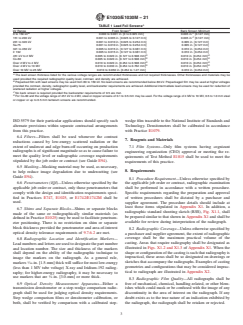
TABLE 1 Lead Foil Screens
A
kV Range Front Screen Back Screen Minimum
B C
0 to 150 kV 0.000 to 0.001 in. [0 to 0.025 mm] 0.005 in. [0.127 mm]
C
151 to 200 kV 0.001 to 0.005 in. [0.025 to 0.127 mm] 0.005 in. [0.127 mm]
201 to 320 kV 0.001 to 0.010 in. [0.025 to 0.254 mm] 0.005 in. [0.127 mm]
Se-75 0.001 to 0.010 in. [0.025 to 0.254 mm] 0.005 in. [0.127 mm]
321 to 450 kV 0.005 to 0.015 in. [0.127 to 0.381 mm] 0.010 in. [0.254 mm]
Ir 192 0.005 to 0.015 in. [0.127 to 0.381 mm] 0.010 in. [0.254 mm]
D D
451 kV to 2 MV 0.005 to 0.020 in. [0.127 to 0.508 mm] 0.010 in. [0.254 mm]
D D
Co-60 0.005 to 0.020 in. [0.127 to 0.508 mm] 0.010 in. [0.254 mm]
D D
Over 2 MV to 4 MV 0.010 to 0.020 in. [0.254 to 0.508 mm] 0.010 in. [0.254 mm]
D D
Over 4 MV to 10 MV 0.010 to 0.030 in. [0.254 to 0.762 mm] 0.010 in. [0.254 mm]
Over 10 MV to 25 MV 0.010 to 0.050 in. [0.254 to 1.27 mm] 0.010 in. [0.254 mm]
A
The lead screen thickness listed for the various voltage ranges are recommended thicknesses and not required thicknesses. Other thicknesses and materials may be
used provided the required radiographic quality level, contrast, and density are achieved.
B
Prepacked film with lead screens may be used from 80 to 150 kV. No lead screens are recommended below 80 kV. Prepackaged film may be used at higher voltages
provided the contrast, density, radiographic quality level, and backscatter requirements are achieved. Additional intermediate lead screens may be used for reduction of
scattered radiation at higher voltages.
C
No back screen is required provided the backscatter requirements of 9.5 are met.
D
For Co-60 and the voltage range of 451 kV to 4 MV, steel or copper screens of 0.1 to 0.5 mm may be used. For the voltage range of 4 MV to 10 MV, 0.5 to 1.0 mm steel
or copper or up to 0.5 mm tantalum screens are recommended.
ISO 5579 for their particular applications should specify such wedge film traceable to the National Institute of Standards and
alternate provisions within separate contractual arrangements Technology. Densitometers shall be calibrated in accordance
from this practice. with Practice E1079.
6.4 Filters—Filters shall be used whenever the contrast
7. Reagents and Materials
reductions caused by low-energy scattered radiation or the
extent of undercut and edge burn-off occurring on production
7.1 Film Systems—Only film systems having cognizant
radiographs is of significant magnitude so as to cause failure to
engineering organization (CEO) approval or meeting the re-
meet the quality level or radiographic coverage requirements
quirements of Test Method E1815 shall be used to meet the
stipulated by the job order or contract (see Guide E94).
requirements of this practice.
6.5 Masking—Masking material may be used, as necessary,
8. Requirements
to help reduce image degradation due to undercutting (see
Guide E94).
8.1 Procedure Requirement—Unless otherwise specified by
6.6 Penetrameters (IQI)—Unless otherwise specified by the the applicable job order or contract, radiographic examination
applicable job order or contract, only those penetrameters that
shall be performed in accordance with a written procedure.
comply with the design and identification requirements speci- Specific requirements regarding the preparation and approval
fied in Practices E747, E1025,or E1742/E1742M shall be
of written procedures shall be dictated by a purchaser and
used. supplier agreement. The procedure details should include at
least those items stipulated in Appendix X1. In addition, a
6.7 Shims and Separate Blocks—Shims or separate blocks
radiographic standard shooting sketch (RSS), Fig. X1.1, shall
made of the same or radiographically similar materials (as
be prepared similar to that shown in Appendix X1 and shall be
defined in Practice E1025) may be used to facilitate penetram-
available for review during interpretation of the radiograph.
eter positioning. There is no restriction on shim or separate
block thickness provided the penetrameter and area-of-interest
8.2 Radiographic Coverage—Unless otherwise specified by
optical density tolerance requirements of 9.7.6.2 are met.
a purchaser and supplier agreement, the extent of radiographic
coverage shall be the maximum practical volume of the
6.8 Radiographic Location and Identification Markers—
casting. Areas that require radiography shall be designated as
Lead numbers and letters are used to designate the part number
illustrated in Figs. X1.2 and X1.3 of Appendix X1. When the
and location number. The size and thickness of the markers
shapeorconfigurationofthecastingissuchthatradiographyis
shall depend on the ability of the radiographic technique to
impractical, these areas shall be so designated on drawings or
image the markers on the radiograph. As a general rule,
1 sketches that accompany the radiographs. Examples of casting
markers ⁄16-in.[1.5-mm]thickwillsufficeformostlow-energy
geometries and configurations that may be considered imprac-
(less than 1 MV tube voltage) X-ray and Iridium-192 radiog-
tical to radiograph are illustrated in Appendix X2.
raphy; for higher-energy radiography, it may be necessary to
use markers that are ⁄8-in. [3.0-mm] or more thick.
8.3 Radiographic Film Quality—All radiographs shall be
6.9 Optical Density Measurement Apparatus—Either a free of mechanical, chemical, handling-related, or other blem-
transmission densitometer or a step-wedge comparison radio- ishes which could mask or be confused with the image of any
graph shall be used for judging optical density requirements. discontinuity in the area of interest on the radiograph. If any
Step wedge comparison films or densitometer calibration, or doubt exists as to the true nature of an indication exhibited by
both, shall be verified by comparison with a calibrated step- the radiograph, the radiograph shall be retaken or rejected.
E1030/E1030M − 21
8.4 Radiographic Quality Level—The applicable job order piece by more than 20 % or ⁄4 in. [6.35 mm], whichever is
or contract shall dictate the requirements for radiographic greater.Innocaseshallthepenetrameter(IQI)sizebebasedon
quality level. (See Practice E1025 or Practice E747 for
a thickness greater than the thickness to be radiographed.
guidance in selection of quality level.)
9.2 Surface Preparation—The casting surfaces shall be
8.5 Acceptance Level—Radiographic acceptance levels and
prepared as necessary to remove any conditions that could
associated severity levels shall be stipulated by the applicable
mask or be confused with internal casting discontinuities.
contract, job order, drawing, or other purchaser and supplier
9.3 Source-to-Film Distance—Unless otherwise specified in
agreement.
the applicable job order or contract, geometric unsharpness
8.6 Optical Density Limitations—Optical density in the area
(Ug) shall not exceed the following in Table 2.The user should
of interest shall be within 1.5 to 4.0 for either single or
be aware that exposures utilizing the maximum geometric
superimposed viewing.
unsharpness permitted by Table 2 may not produce acceptable
8.7 Film Handling:
sensitivity and the unsharpness should be reduced in order to
8.7.1 Darkroom Facilities—Darkroom facilities should be
achieve the required sensitivity.
kept clean and as dust-free as practical. Safelights should be
thoserecommendedbyfilmmanufacturersfortheradiographic
9.4 Direction of Radiation—The direction of radiation shall
materials used and should be positioned in accordance with the
be governed by the geometry of the casting and the radio-
manufacturer’s recommendations. All darkroom equipment
graphic coverage and quality requirements stipulated by the
and materials should be capable of producing radiographs that
applicable job order or contract. Whenever practicable, place
are suitable for interpretation.
thecentralbeamoftheradiationperpendiculartothesurfaceof
8.7.2 Film Processing—GuideE999shouldbeconsultedfor
the film. Appendix X2 provides examples of preferred source
guidance on film processing.
and film orientations and examples of casting geometries and
8.7.3 Radiographic Viewing Facilities—Viewing facilities
configurations on which radiography is impractical or very
shall provide subdued background lighting of an intensity that
difficult.
willnotcausetroublesomereflections,shadows,orglareonthe
radiograph. The viewing light shall be of sufficient intensity to 9.5 Back-Scattered Radiation Protection:
review optical densities up to 4.0 and be appropriately con-
9.5.1 Back-Scattered Radiation—(secondary radiation ema-
trolledsothattheoptimumintensityforsingleorsuperimposed
nating from surfaces behind the film, that is, walls, floors, etc.)
viewing of radiographs may be selected.
serves to reduce radiographic contrast and may produce
8.7.4 Storage of Radiographs—When storage is required by
undesirable effects on radiographic quality. A ⁄8-in. (3.2-mm)
the applicable job order or con
...
This document is not an ASTM standard and is intended only to provide the user of an ASTM standard an indication of what changes have been made to the previous version. Because
it may not be technically possible to adequately depict all changes accurately, ASTM recommends that users consult prior editions as appropriate. In all cases only the current version
of the standard as published by ASTM is to be considered the official document.
Designation: E1030/E1030M − 15 E1030/E1030M − 21
Standard Practice for
Radiographic Examination of Metallic Castings
This standard is issued under the fixed designation E1030/E1030M; the number immediately following the designation indicates the year
of original adoption or, in the case of revision, the year of last revision. A number in parentheses indicates the year of last reapproval.
A superscript epsilon (´) indicates an editorial change since the last revision or reapproval.
1. Scope Scope*
1.1 This practice provides a uniform procedure for radiographic examination of metallic castings using radiographic film as the
recording medium.
1.2 This standard addresses the achievement of, or protocols for achieving, common or practical levels of radiographic coverage
for castings, to detect primarily volumetric discontinuities to sensitivity levels measured by nominated image quality indicators.
All departures, including alternate means or methods to increase coverage, or address challenges of detecting non-volumetric
planar-type discontinuities, shall be agreed upon between the purchaser and supplier and shall consider Appendix X1 and
Appendix X2.
1.3 The radiographic techniques stated herein provide adequate assurance for defect detectability; however, it is recognized that,
for special applications, specific techniques using more or less stringent requirements may be required than those specified. In these
cases, the use of alternate radiographic techniques shall be as agreed upon between purchaser and supplier (also see Section 5).
1.4 Units—The values stated in either SI units or inch-pound units are to be regarded separately as standard. The values stated in
each system are not necessarily exact equivalents; therefore, to ensure conformance with the standard, each system shall be used
independently of the other, and values from the two systems shall not be combined.
1.5 This standard does not purport to address all of the safety concerns, if any, associated with its use. It is the responsibility
of the user of this standard to establish appropriate safety safety, health, and healthenvironmental practices and determine the
applicability of regulatory limitations prior to use.
1.6 This international standard was developed in accordance with internationally recognized principles on standardization
established in the Decision on Principles for the Development of International Standards, Guides and Recommendations issued
by the World Trade Organization Technical Barriers to Trade (TBT) Committee.
2. Referenced Documents
2.1 ASTM Standards:
E94 Guide for Radiographic Examination Using Industrial Radiographic Film
E155 Reference Radiographs for Inspection of Aluminum and Magnesium Castings
E186 Reference Radiographs for Heavy-Walled (2 to 4 ⁄2 in. (50.8 to 114 mm)) Steel Castings
This practice is under the jurisdiction of ASTM Committee E07 on Nondestructive Testing and is the direct responsibility of Subcommittee E07.01 on Radiology (X and
Gamma) Method.
Current edition approved Dec. 1, 2015June 1, 2021. Published January 2016July 2021. Originally approved in 1984. Last previous edition approved in 20112015 as
E1030 - 05E1030/E1030M – 15.(2011). DOI: 10.1520/E1030_E1030M-15.10.1520/E1030_E1030M-21.
For ASME Boiler and Pressure Vessel Code applications see related Test Method SE-1030 in Section II of that Code.
For referenced ASTM standards, visit the ASTM website, www.astm.org, or contact ASTM Customer Service at service@astm.org. For Annual Book of ASTM Standards
volume information, refer to the standard’s Document Summary page on the ASTM website.
*A Summary of Changes section appears at the end of this standard
Copyright © ASTM International, 100 Barr Harbor Drive, PO Box C700, West Conshohocken, PA 19428-2959. United States
E1030/E1030M − 21
E192 Reference Radiographs of Investment Steel Castings for Aerospace Applications
E272 Reference Radiographs for High-Strength Copper-Base and Nickel-Copper Alloy Castings
E280 Reference Radiographs for Heavy-Walled (4 ⁄2 to 12 in. (114 to 305 mm)) Steel Castings
E310 Reference Radiographs for Tin Bronze Castings
E446 Reference Radiographs for Steel Castings Up to 2 in. (50.8 mm) in Thickness
E505 Reference Radiographs for Inspection of Aluminum and Magnesium Die Castings
E543 Specification for Agencies Performing Nondestructive Testing
E689 Reference Radiographs for Ductile Iron Castings
E747 Practice for Design, Manufacture and Material Grouping Classification of Wire Image Quality Indicators (IQI) Used for
Radiology
E802 Reference Radiographs for Gray Iron Castings Up to 4 ⁄2 in. (114 mm) in Thickness
E999 Guide for Controlling the Quality of Industrial Radiographic Film Processing
E1025 Practice for Design, Manufacture, and Material Grouping Classification of Hole-Type Image Quality Indicators (IQI)
Used for Radiography
E1079 Practice for Calibration of Transmission Densitometers
E1254 Guide for Storage of Radiographs and Unexposed Industrial Radiographic Films
E1316 Terminology for Nondestructive Examinations
E1320 Reference Radiographs for Titanium Castings
E1742E1742/E1742M Practice for Radiographic Examination
E1815 Test Method for Classification of Film Systems for Industrial Radiography
2.2 ASNT/ANSI Standards:
SNT-TC-1A Recommended Practice for Personnel Qualification and Certification in Nondestructive Testing
CP-189 Qualification and Certification of Nondestructive Testing Personnel
2.3 Other Standards:AIA Standard:
NAS 410 National Aerospace Standard Certification and Qualification of Nondestructive Test Personnel
2.4 ISO Standards:
ISO 5579 Non-Destructive Testing—Radiographic Testing of Metallic Materials Using Film and X- or Gamma-rays—Basic
Rules
ISO 9712 Non-Destructive Testing—Qualification and Certification of NDT Personnel
3. Terminology
3.1 Definitions—For definitions of terms used in this practice, see Terminology E1316.
4. Significance and Use
4.1 The requirements expressed in this practice are intended to control the quality of the radiographic images, to produce
satisfactory and consistent results, and are not intended for controlling the acceptability or quality of materials or products.
5. Basis of Application
5.1 The following items shall be agreed upon by the purchaser and supplier:
5.1.1 Nondestructive Testing Agency Evaluation—If specified in the contractual agreement, nondestructive testing (NDT) agencies
shall be qualified and evaluated in accordance with Practice E543. The applicable version of Practice E543 shall be specified in
the contractual agreement.
5.1.2 Personnel Qualification—Personnel performing examinations to this standard shall be qualified in accordance with a
nationally or internationally recognized NDT personnel qualification practice or standard such as ANSI/ASNT CP-189,
SNT-TC-1A, NAS 410, ISO 9712, or a similar document and certified by the employer or certifying agency, as applicable. The
practice or standard used and its applicable revision shall be identified in the contractual agreement between the using parties.
5.1.3 Apparatus—General requirements (see 6.1 through 6.9) shall be specified.
5.1.4 Requirements—General requirements (see 8.1, 8.2, 8.5, and 8.7.4) shall be specified.
Available from the American Society for Nondestructive Testing, (ASNT), 1711 Arlingate Plaza, P.O. Box 28518, Columbus, OH 43228.
Available from Aerospace Industries Association of America, Inc., Inc. (AIA), 1000 Wilson Blvd Suite 1700, Arlington, VA 22209-3928.
Available from International Organization for Standardization (ISO), ISO Central Secretariat, BIBC II, Chemin de Blandonnet 8, CP 401, 1214 Vernier, Geneva,
Switzerland, http://www.iso.org.
E1030/E1030M − 21
5.1.5 Procedure Requirements (see 9.1, 9.1.1, 9.3, 9.7.4, and 9.7.7) shall be specified.
5.1.6 Records—Record retention (see 12.1) shall be specified.
6. Apparatus
6.1 Radiation Sources:
6.1.1 X Radiation Sources—Selection of appropriate X-ray voltage and current levels is dependent upon variables regarding the
specimen being examined (material type and thickness) and economically permissible exposure time. The suitability of these X-ray
parameters shall be demonstrated by attainment of required penetrameter (IQI) sensitivity and compliance with all other
requirements stipulated herein. Guide E94 contains provisions concerning exposure calculations and charts for the use of X-ray
sources.
6.1.2 Gamma Radiation Sources—Isotope sources, when used, shall be capable of demonstrating the required radiographic
sensitivity.
6.2 Film Holders and Cassettes—Film holders and cassettes shall be light-tight and shall be handled properly to reduce the
likelihood that they may be damaged. They may be flexible vinyl, plastic, or any durable material; or, they may be made from
metallic materials. In the event that light leaks into the film holder and produces images on the film extending into the area of
interest, the film shall be rejected. If the film holder exhibits light leaks, it shall be repaired before reuse or discarded. Film holders
and cassettes should be routinely examined to minimize the likelihood of light leaks.
6.3 Intensifying Screens:
6.3.1 Lead-Foil Screens:
6.3.1.1 Intensifying screens of the lead-foil type are generally used for all production radiography. Lead-foil screens shall be of
the same approximate area dimensions as the film being used and they shall be in direct contact with the film during exposure.
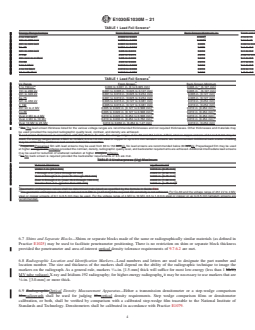
6.3.1.2 Recommended screen thicknesses are listed in Table 1 for the applicable voltage range being used.
6.3.1.3 Sheet lead, with or without backing, used for screens should be visually examined for dust, dirt, oxidation, cracking or
creasing, foreign material or other condition that could render undesirable nonrelevant images on the film.
6.3.2 Fluorescent, Fluorometallic, or Other Metallic Screens:
6.3.2.1 Fluorescent, fluorometallic, or other metallic screens may be used. However, they must be capable of demonstrating the
required penetrameter (IQI) sensitivity. Fluorescent or fluorometallic screens may cause limitations in image quality (see Guide
E94, Appendix X1.)
6.3.2.2 Screen Care—All screens should be handled carefully to avoid dents, scratches, grease, or dirt on active surfaces. Screens
that render false indications on radiographs shall be discarded or reworked to eliminate the artifact.
6.3.3 Other Screens—International Standard ISO 5579 contains similar provisions for intensifying screens as this practice.
International users of these type screens who prefer the use of ISO 5579 for their particular applications should specify such
alternate provisions within separate contractual arrangements from this practice.
6.4 Filters—Filters shall be used whenever the contrast reductions caused by low-energy scattered radiation or the extent of
undercut and edge burn-off occurring on production radiographs is of significant magnitude so as to cause failure to meet the
quality level or radiographic coverage requirements stipulated by the job order or contract (see Guide E94).
6.5 Masking—Masking material may be used, as necessary, to help reduce image degradation due to undercutting (see Guide E94).
6.6 Penetrameters (IQI)—Unless otherwise specified by the applicable job order or contract, only those penetrameters that comply
with the design and identification requirements specified in Practices E747, E1025, or E1742E1742/E1742M shall be used.
E1030/E1030M − 21
A
TABLE 1 Lead Foil Screens
A
Energy Range/Isotope Front Screen, in. Back Screen Minimum, in. Front and Back
C D
0 to 150 keV 0.000 to 0.001 0.005 0 to 0.15
D
151 to 200 keV 0.000 to 0.005 0.005 0 to 0.15
201 to 320 keV 0.001 to 0.010 0.005 0.02 to 0.2
Se-75 0.001 to 0.010 0.005 0.1 to 0.2
321 to 450 keV 0.05 to 0.015 0.010 0.1 to 0.2
Ir-192 0.05 to 0.015 0.010 0.02 to 0.2
451 keV to 2 MeV 0.05 to 0.020 0.010 0.1 to 0.5
Co-60 0.05 to 0.020 0.010 0.1 to 0.5
2 to 4 MeV 0.010 to 0.020 0.010 0.1 to 0.5
4 to 10 MeV 0.010 to 0.030 0.010 0.5 to 1.0
10 to 25 MeV 0.010 to 0.050 0.010 1.0 to 2.0
A
TABLE 1 Lead Foil Screens
A
kV Range Front Screen Back Screen Minimum
B C
0 to 150 kV 0.000 to 0.001 in. [0 to 0.025 mm] 0.005 in. [0.127 mm]
C
151 to 200 kV 0.001 to 0.005 in. [0.025 to 0.127 mm] 0.005 in. [0.127 mm]
201 to 320 kV 0.001 to 0.010 in. [0.025 to 0.254 mm] 0.005 in. [0.127 mm]
Se-75 0.001 to 0.010 in. [0.025 to 0.254 mm] 0.005 in. [0.127 mm]
321 to 450 kV 0.005 to 0.015 in. [0.127 to 0.381 mm] 0.010 in. [0.254 mm]
Ir 192 0.005 to 0.015 in. [0.127 to 0.381 mm] 0.010 in. [0.254 mm]
D D
451 kV to 2 MV 0.005 to 0.020 in. [0.127 to 0.508 mm] 0.010 in. [0.254 mm]
D D
Co-60 0.005 to 0.020 in. [0.127 to 0.508 mm] 0.010 in. [0.254 mm]
D D
Over 2 MV to 4 MV 0.010 to 0.020 in. [0.254 to 0.508 mm] 0.010 in. [0.254 mm]
D D
Over 4 MV to 10 MV 0.010 to 0.030 in. [0.254 to 0.762 mm] 0.010 in. [0.254 mm]
Over 10 MV to 25 MV 0.010 to 0.050 in. [0.254 to 1.27 mm] 0.010 in. [0.254 mm]
A
The The lead screen thickness listed for the various voltage ranges are recommended thicknesses and not required thicknesses. Other thicknesses and materials may
be used provided the required radiographic quality level, contrast, and density are achieved.
B
Lead screen thicknesses in accordance with ISO 5579 in SI units. For energy ranges of Co-60 and 451 keV to 4 MeV, steel or copper screens of 0.1 to 0.5 mm may be
used. For energy ranges above 4 MeV to 10 MeV, 0.5 to 1.0 mm steel or copper or up to 0.5 mm tantalum screens are recommended. Additional back scatter shielding
may be achieved by additional lead screen behind the cassettes.
B
Prepacked Prepacked film with lead screens may be used from 80 to 150 keV.kV. No lead screens are recommended below 80 keV.kV. Prepackaged film may be used
at higher energy levels voltages provided the contrast, density, radiographic quality level, and backscatter requirements are achieved. Additional intermediate lead screens
may be used for reduction of scattered radiation at higher energies.voltages.
C
No No back screen is required provided the backscatter requirements of 9.5 are met.
TABLE 2 Unsharpness (Ug) Maximum
A
Material Thickness Ug Maximum
Under 1 in. [25.4 mm] 0.010 in. [0.25 mm]
1 through 2 in. [25.4 through 51 mm] 0.020 in. [0.50 mm]
Over 2 through 3 in. [over 51 through 76.0 mm] 0.030 in. [0.76 mm]
Over 3 through 4 in. [over 76.0 through 100 mm] 0.040 in. [1.00 mm]
B
Greater than 4 in. [greater than 100 mm] 0.070 in. [1.78 mm]
A
Geometric unsharpness values shall be determined (calculated) as specified by the formula in Guide E94.
D
The geometric unsharpness should be reduced to 0.050 in. [1.27 mm] if the required IQI sensitivity is not achieved. For Co-60 and the voltage range of 451 kV to 4 MV,
steel or copper screens of 0.1 to 0.5 mm may be used. For the voltage range of 4 MV to 10 MV, 0.5 to 1.0 mm steel or copper or up to 0.5 mm tantalum screens are
recommended.
6.7 Shims and Separate Blocks—Shims or separate blocks made of the same or radiographically similar materials (as defined in
Practice E1025) may be used to facilitate penetrameter positioning. There is no restriction on shim or separate block thickness
provided the penetrameter and area-of-interest optical density tolerance requirements of 9.7.6.2 are met.
6.8 Radiographic Location and Identification Markers—Lead numbers and letters are used to designate the part number and
location number. The size and thickness of the markers shall depend on the ability of the radiographic technique to image the
markers on the radiograph. As a general rule, markers ⁄16-in. [1.5-mm] thick will suffice for most low-energy (less than 1 MeV)
MV tube voltage) X-ray and Iridium-192 radiography; for higher-energy radiography, it may be necessary to use markers that are
⁄8-in. [3.0-mm] or more thick.
6.9 RadiographicOptical Density Measurement Apparatus—Either a transmission densitometer or a step-wedge comparison
filmradiograph shall be used for judging filmoptical density requirements. Step wedge comparison films or densitometer
calibration, or both, shall be verified by comparison with a calibrated step-wedge film traceable to the National Institute of
Standards and Technology. Densitometers shall be calibrated in accordance with Practice E1079.
E1030/E1030M − 21
7. Reagents and Materials
7.1 Film Systems—Only film systems having cognizant engineering organization (CEO) approval or meeting the requirements of
Test Method E1815 shall be used to meet the requirements of this practice.
8. Requirements
8.1 Procedure Requirement—Unless otherwise specified by the applicable job order or contract, radiographic examination shall
be performed in accordance with a written procedure. Specific requirements regarding the preparation and approval of written
procedures shall be dictated by a purchaser and supplier agreement. The procedure details should include at least those items
stipulated in Appendix X1. In addition, a radiographic standard shooting sketch (RSS), Fig. X1.1, shall be prepared similar to that
shown in Appendix X1 and shall be available for review during interpretation of the film.radiograph.
8.2 Radiographic Coverage—Unless otherwise specified by a purchaser and supplier agreement, the extent of radiographic
coverage shall be the maximum practical volume of the casting. Areas that require radiography shall be designated as illustrated
in Figs. X1.2 and X1.3 of Appendix X1. When the shape or configuration of the casting is such that radiography is impractical,
these areas shall be so designated on drawings or sketches that accompany the radiographs. Examples of casting geometries and
configurations that may be considered impractical to radiograph are illustrated in Appendix X2.
8.3 Radiographic Film Quality—All radiographs shall be free of mechanical, chemical, handling-related, or other blemishes which
could mask or be confused with the image of any discontinuity in the area of interest on the radiograph. If any doubt exists as to
the true nature of an indication exhibited by the film,radiograph, the radiograph shall be retaken or rejected.
8.4 Radiographic Quality Level—The applicable job order or contract shall dictate the requirements for radiographic quality level.
(See Practice E1025 or Practice E747 for guidance in selection of quality level.)
8.5 Acceptance Level—Radiographic acceptance levels and associated severity levels shall be stipulated by the applicable contract,
job order, drawing, or other purchaser and supplier agreement.
8.6 RadiographicOptical Density Limitations—RadiographicOptical density in the area of interest shall be within 1.5 to 4.0 for
either single or superimposed viewing.
8.7 Film Handling:
8.7.1 Darkroom Facilities—Darkroom facilities should be kept clean and as dust-free as practical. Safelights should be those
recommended by film manufacturers for the radiographic materials used and should be positioned in accordance with the
manufacturer’s recommendations. All darkroom equipment and materials should be capable of producing radiographs that are
suitable for interpretation.
8.7.2 Film Processing—Guide E999 should be consulted for guidance on film processing.
8.7.3 FilmRadiographic Viewing Facilities—Viewing facilities shall provide subdued background lighting of an intensity that will
not cause troublesome reflections, shadows, or glare on the radiograph. The viewing light shall be of sufficient intensity to review
optical densities up to 4.0 and be appropriately controlled so that the optimum intensity for single or superimposed viewing of
radiographs may be selected.
8.7.4 Storage of Radiographs—When storage is required by the applicable job order or contract, the radiographs should be stored
in an area with sufficient environmental control to preclude image deterioration or other damage. The radiograph storage duration
and location after casting delivery shall be as agreed upon between purchaser and supplier. (See Guide E1254 for storage
information.)
9. Procedure
9.1 Time of Examination—Unless otherwise specified by the applicable job order or contract, radiography may be performed prior
to heat treatment and in the as-cast, rough-machined, or finished-machined condition.
E1030/E10
...
Questions, Comments and Discussion
Ask us and Technical Secretary will try to provide an answer. You can facilitate discussion about the standard in here.
Loading comments...