

ASTM D5854-19a
(Practice)Standard Practice for Mixing and Handling of Liquid Samples of Petroleum and Petroleum Products
General Information
- Abstract
SIGNIFICANCE AND USE
4.1 Representative samples of petroleum and petroleum products are required for the determination of chemical and physical properties used to establish standard volumes, prices, and compliance with commercial and regulatory specifications. The handling of samples from the time of collection until they are analyzed requires care and effort to maintain their compositional integrity. Samples of high RVP (unstabilized) hydrocarbons are required at many measurement points, for example offshore production, at the outlets of test separators or to allow calibration of a flowmeter. This practice also describes requirements associated with handling and mixing samples held within pressurized cylinders.
4.2 Practice D4057 (API MPMS Chapter 8.1), Practice D4177 (API MPMS Chapter 8.2), Practice D5854 (API MPMS Chapter 8.3), Practice D5842 (API MPMS Chapter 8.4), and Practice D8009 (API MPMS Chapter 8.5). The primary purpose of this suite of standards, is to ensure proper sampling and handling for custody transfer applications. There are a significant number of test methods that may be used to analyze the samples taken by techniques described in API MPMS Chapter 8.1 and 8.2. For samples that are taken for test methods outside the general scope of custody transfer covered by this practice, the personnel assigned to take the sample are responsible to refer to the test methods for additional critical information that may impact the sampling process, that is, specific container selection, transport methods, storage times, etc. Those requirements should be found in the appropriate test method.
SCOPE
1.1 This practice covers handling, mixing, and conditioning procedures that are required to ensure that a representative sample of the liquid petroleum or petroleum product is delivered from the primary sample container or container or both into the analytical apparatus or into intermediate containers.
1.2 Appendix X1 details the background information on the development of Table 1 used in performance testing. Appendix X2 provides guidance in the acceptance testing for water in crude oil. Appendix X3 provides a guide for materials of sample containers. Appendix X4 provides a summary of recommended mixing procedures. Appendix X5 provides a flow chart for sample container/mixing system acceptance test.
1.3 For sampling procedures, refer to Practices D4057 (API MPMS Chapter 8.1) and D4177 (API MPMS Chapter 8.2). Practice D5842 (API MPMS Chapter 8.4) covers sampling and handling of light fuels for volatility measurement, and D8009 (API MPMS Chapter 8.5).
1.4 It is recommended that the users of this practice perform the tests in Practice D4177 (API MPMS Chapter 8.2) before performing the test in this practice.
1.5 This standard does not purport to address all of the safety concerns, if any, associated with its use. It is the responsibility of the user of this standard to establish appropriate safety, health, and environmental practices and determine the applicability of regulatory limitations prior to use.
1.6 This international standard was developed in accordance with internationally recognized principles on standardization established in the Decision on Principles for the Development of International Standards, Guides and Recommendations issued by the World Trade Organization Technical Barriers to Trade (TBT) Committee.
- Status
- Published
- Publication Date
- 30-Apr-2019
- Technical Committee
- D02 - Petroleum Products, Liquid Fuels, and Lubricants
- Drafting Committee
- D02.02 - Hydrocarbon Measurement for Custody Transfer (Joint ASTM-API)
Buy Documents
ASTM D5854-19a - Standard Practice for Mixing and Handling of Liquid Samples of Petroleum and Petroleum Products
REDLINE ASTM D5854-19a - Standard Practice for Mixing and Handling of Liquid Samples of Petroleum and Petroleum Products
Overview
ASTM D5854-19a: Standard Practice for Mixing and Handling of Liquid Samples of Petroleum and Petroleum Products is a critical ASTM standard that ensures the integrity, accuracy, and representativeness of liquid petroleum and petroleum product samples throughout the chain of custody. Developed and maintained by ASTM in coordination with the API Manual of Petroleum Measurement Standards (MPMS Chapter 8.3), this practice covers procedures for the proper mixing, handling, and conditioning of samples from the point of collection to analysis. Adherence to this standard supports compliance with commercial, regulatory, and safety requirements in the petroleum industry.
Key Topics
- Representative Sampling: Emphasizes the need to collect and maintain representative samples, preserving chemical and physical integrity for accurate analysis and decision making related to standard volumes, pricing, and regulatory compliance.
- Sample Container Selection and Handling:
- Guidance on container material (glass, plastic, metal, stainless steel), configuration (reusable vs. disposable, cylindrical design), and volume considerations to minimize contamination and preserve sample composition.
- Requirements for cleanliness and appropriate closure of containers to prevent contamination and vapor loss.
- Emphasis on regulatory compliance when transporting hazardous materials (e.g., DOT regulations for sample containers).
- Mixing Procedures:
- Categorizes mixing methods as no mixing, manual or mechanical shaking, and power mixing (mechanical, insertion, or closed-loop mixers).
- Stresses the importance of choosing a method suitable for sample type (e.g., avoiding over-mixing with crude oil and water to prevent emulsion formation).
- Guidelines for maintaining homogeneity and compositional integrity during transfer, minimizing the number of transfers, and controlling temperature and pressure effects.
- Labeling and Transportation:
- Mandates proper sample labeling including compliance with commercial agreements and regulatory requirements.
- Discusses safe handling, sealing, and use of protective enclosures for transporting samples.
- Sample Integrity, Storage, and Preservation:
- Recommendations to avoid sample loss, weathering, or alteration due to light, heat, or external contamination.
- Chain of custody and record-keeping for sample tracking and audit readiness.
- Safety and Environmental Considerations:
- Highlights user responsibility to address all safety, health, and environmental risks associated with sample handling, in accordance with local, national, and international regulations.
Applications
ASTM D5854-19a is essential in numerous sectors within the petroleum industry, including:
- Upstream Operations: Used during crude oil and condensate sampling at production wells, test separators, and offshore platforms where high RVP hydrocarbons are prevalent.
- Custody Transfer: Ensures accurate and legally-defensible transaction records between parties by maintaining sample integrity throughout transfer points, pipelines, storage tanks, and delivery systems.
- Laboratory Testing: Provides procedures for preparing samples for a wide range of analyses (e.g., sediment and water content, density, volatility) critical for product quality control and compliance.
- Regulatory Compliance and Dispute Resolution: Establishes standardized practices that meet government legislations, international trade requirements, and serve as references in case of disputes.
Related Standards
For comprehensive sampling and handling in petroleum operations, ASTM D5854-19a should be used alongside several related standards:
- ASTM D4057 / API MPMS 8.1: Manual Sampling of Petroleum and Petroleum Products
- ASTM D4177 / API MPMS 8.2: Automatic Sampling of Petroleum and Petroleum Products
- ASTM D5842 / API MPMS 8.4: Sampling and Handling of Fuels for Volatility Measurement
- ASTM D8009 / API MPMS 8.5: Manual Piston Cylinder Sampling of Volatile Crude Oils
- ASTM D3700: Obtaining LPG Samples Using a Floating Piston Cylinder
- ASTM D4306: Aviation Fuel Sample Containers
- API MPMS Chapter 10: Sediment and Water in Crude Oil
- Relevant DOT and OSHA regulations for transport and hazardous materials handling
Implementing ASTM D5854-19a ensures robust, consistent, and safe procedures for mixing and handling liquid samples, underpinning quality, reliability, and regulatory compliance in petroleum measurement and analysis.
Relations
- Refers
ASTM D5842-23 - Standard Practice for Sampling and Handling of Fuels for Volatility Measurement - Effective Date
- 01-Oct-2023
- Refers
ASTM D5842-19 - Standard Practice for Sampling and Handling of Fuels for Volatility Measurement - Effective Date
- 01-Nov-2019
- Effective Date
- 01-Oct-2015
- Refers
ASTM D5842-14 - Standard Practice for Sampling and Handling of Fuels for Volatility Measurement - Effective Date
- 15-Jan-2014
- Effective Date
- 01-Dec-2012
- Effective Date
- 01-Nov-2012
- Effective Date
- 01-Jun-2012
- Effective Date
- 15-Apr-2012
- Effective Date
- 01-Feb-2012
- Refers
ASTM D4057-06(2011) - Standard Practice for Manual Sampling of Petroleum and Petroleum Products - Effective Date
- 01-Jun-2011
- Effective Date
- 01-Jul-2009
- Effective Date
- 01-Jul-2007
- Effective Date
- 15-Feb-2007
- Refers
ASTM D5842-04 - Standard Practice for Sampling and Handling of Fuels for Volatility Measurement - Effective Date
- 01-Dec-2004
- Effective Date
- 10-Dec-2001
Buy Documents
ASTM D5854-19a - Standard Practice for Mixing and Handling of Liquid Samples of Petroleum and Petroleum Products
REDLINE ASTM D5854-19a - Standard Practice for Mixing and Handling of Liquid Samples of Petroleum and Petroleum Products
Get Certified
Connect with accredited certification bodies for this standard

Element Materials Technology
Materials testing and product certification.

ABS Group Brazil
ABS Group certification services in Brazil.

ABS Quality Evaluations Inc.
American Bureau of Shipping quality certification.
Sponsored listings
Frequently Asked Questions
ASTM D5854-19a is a standard published by ASTM International. Its full title is "Standard Practice for Mixing and Handling of Liquid Samples of Petroleum and Petroleum Products". This standard covers: SIGNIFICANCE AND USE 4.1 Representative samples of petroleum and petroleum products are required for the determination of chemical and physical properties used to establish standard volumes, prices, and compliance with commercial and regulatory specifications. The handling of samples from the time of collection until they are analyzed requires care and effort to maintain their compositional integrity. Samples of high RVP (unstabilized) hydrocarbons are required at many measurement points, for example offshore production, at the outlets of test separators or to allow calibration of a flowmeter. This practice also describes requirements associated with handling and mixing samples held within pressurized cylinders. 4.2 Practice D4057 (API MPMS Chapter 8.1), Practice D4177 (API MPMS Chapter 8.2), Practice D5854 (API MPMS Chapter 8.3), Practice D5842 (API MPMS Chapter 8.4), and Practice D8009 (API MPMS Chapter 8.5). The primary purpose of this suite of standards, is to ensure proper sampling and handling for custody transfer applications. There are a significant number of test methods that may be used to analyze the samples taken by techniques described in API MPMS Chapter 8.1 and 8.2. For samples that are taken for test methods outside the general scope of custody transfer covered by this practice, the personnel assigned to take the sample are responsible to refer to the test methods for additional critical information that may impact the sampling process, that is, specific container selection, transport methods, storage times, etc. Those requirements should be found in the appropriate test method. SCOPE 1.1 This practice covers handling, mixing, and conditioning procedures that are required to ensure that a representative sample of the liquid petroleum or petroleum product is delivered from the primary sample container or container or both into the analytical apparatus or into intermediate containers. 1.2 Appendix X1 details the background information on the development of Table 1 used in performance testing. Appendix X2 provides guidance in the acceptance testing for water in crude oil. Appendix X3 provides a guide for materials of sample containers. Appendix X4 provides a summary of recommended mixing procedures. Appendix X5 provides a flow chart for sample container/mixing system acceptance test. 1.3 For sampling procedures, refer to Practices D4057 (API MPMS Chapter 8.1) and D4177 (API MPMS Chapter 8.2). Practice D5842 (API MPMS Chapter 8.4) covers sampling and handling of light fuels for volatility measurement, and D8009 (API MPMS Chapter 8.5). 1.4 It is recommended that the users of this practice perform the tests in Practice D4177 (API MPMS Chapter 8.2) before performing the test in this practice. 1.5 This standard does not purport to address all of the safety concerns, if any, associated with its use. It is the responsibility of the user of this standard to establish appropriate safety, health, and environmental practices and determine the applicability of regulatory limitations prior to use. 1.6 This international standard was developed in accordance with internationally recognized principles on standardization established in the Decision on Principles for the Development of International Standards, Guides and Recommendations issued by the World Trade Organization Technical Barriers to Trade (TBT) Committee.
SIGNIFICANCE AND USE 4.1 Representative samples of petroleum and petroleum products are required for the determination of chemical and physical properties used to establish standard volumes, prices, and compliance with commercial and regulatory specifications. The handling of samples from the time of collection until they are analyzed requires care and effort to maintain their compositional integrity. Samples of high RVP (unstabilized) hydrocarbons are required at many measurement points, for example offshore production, at the outlets of test separators or to allow calibration of a flowmeter. This practice also describes requirements associated with handling and mixing samples held within pressurized cylinders. 4.2 Practice D4057 (API MPMS Chapter 8.1), Practice D4177 (API MPMS Chapter 8.2), Practice D5854 (API MPMS Chapter 8.3), Practice D5842 (API MPMS Chapter 8.4), and Practice D8009 (API MPMS Chapter 8.5). The primary purpose of this suite of standards, is to ensure proper sampling and handling for custody transfer applications. There are a significant number of test methods that may be used to analyze the samples taken by techniques described in API MPMS Chapter 8.1 and 8.2. For samples that are taken for test methods outside the general scope of custody transfer covered by this practice, the personnel assigned to take the sample are responsible to refer to the test methods for additional critical information that may impact the sampling process, that is, specific container selection, transport methods, storage times, etc. Those requirements should be found in the appropriate test method. SCOPE 1.1 This practice covers handling, mixing, and conditioning procedures that are required to ensure that a representative sample of the liquid petroleum or petroleum product is delivered from the primary sample container or container or both into the analytical apparatus or into intermediate containers. 1.2 Appendix X1 details the background information on the development of Table 1 used in performance testing. Appendix X2 provides guidance in the acceptance testing for water in crude oil. Appendix X3 provides a guide for materials of sample containers. Appendix X4 provides a summary of recommended mixing procedures. Appendix X5 provides a flow chart for sample container/mixing system acceptance test. 1.3 For sampling procedures, refer to Practices D4057 (API MPMS Chapter 8.1) and D4177 (API MPMS Chapter 8.2). Practice D5842 (API MPMS Chapter 8.4) covers sampling and handling of light fuels for volatility measurement, and D8009 (API MPMS Chapter 8.5). 1.4 It is recommended that the users of this practice perform the tests in Practice D4177 (API MPMS Chapter 8.2) before performing the test in this practice. 1.5 This standard does not purport to address all of the safety concerns, if any, associated with its use. It is the responsibility of the user of this standard to establish appropriate safety, health, and environmental practices and determine the applicability of regulatory limitations prior to use. 1.6 This international standard was developed in accordance with internationally recognized principles on standardization established in the Decision on Principles for the Development of International Standards, Guides and Recommendations issued by the World Trade Organization Technical Barriers to Trade (TBT) Committee.
ASTM D5854-19a is classified under the following ICS (International Classification for Standards) categories: 19.020 - Test conditions and procedures in general; 75.080 - Petroleum products in general. The ICS classification helps identify the subject area and facilitates finding related standards.
ASTM D5854-19a has the following relationships with other standards: It is inter standard links to ASTM D5842-23, ASTM D5842-19, ASTM D4306-15, ASTM D5842-14, ASTM D4306-12c, ASTM D3700-12, ASTM D4306-12b, ASTM D4306-12a, ASTM D4306-12, ASTM D4057-06(2011), ASTM D5842-04(2009), ASTM D4306-07, ASTM D3700-07, ASTM D5842-04, ASTM D3700-01. Understanding these relationships helps ensure you are using the most current and applicable version of the standard.
ASTM D5854-19a is available in PDF format for immediate download after purchase. The document can be added to your cart and obtained through the secure checkout process. Digital delivery ensures instant access to the complete standard document.
Standards Content (Sample)
This international standard was developed in accordance with internationally recognized principles on standardization established in the Decision on Principles for the
Development of International Standards, Guides and Recommendations issued by the World Trade Organization Technical Barriers to Trade (TBT) Committee.
Designation: D5854 − 19a
Manual of Petroleum Measurement Standards (MPMS), Chapter 8.3
Standard Practice for
Mixing and Handling of Liquid Samples of Petroleum and
Petroleum Products
This standard is issued under the fixed designation D5854; the number immediately following the designation indicates the year of
original adoption or, in the case of revision, the year of last revision.Anumber in parentheses indicates the year of last reapproval.A
superscript epsilon (´) indicates an editorial change since the last revision or reapproval.
1. Scope* Development of International Standards, Guides and Recom-
mendations issued by the World Trade Organization Technical
1.1 This practice covers handling, mixing, and conditioning
Barriers to Trade (TBT) Committee.
procedures that are required to ensure that a representative
sample of the liquid petroleum or petroleum product is
2. Referenced Documents
delivered from the primary sample container or container or
2.1 ASTM Standards:
both into the analytical apparatus or into intermediate contain-
D3700Practice for Obtaining LPG Samples Using a Float-
ers.
ing Piston Cylinder
1.2 Appendix X1 details the background information on the
D4057Practice for Manual Sampling of Petroleum and
developmentofTable1usedinperformancetesting.Appendix
Petroleum Products
X2 provides guidance in the acceptance testing for water in
D4177Practice for Automatic Sampling of Petroleum and
crude oil. Appendix X3 provides a guide for materials of
Petroleum Products
sample containers. Appendix X4 provides a summary of
D4306Practice for Aviation Fuel Sample Containers for
recommended mixing procedures. Appendix X5 provides a
Tests Affected by Trace Contamination
flowchartforsamplecontainer/mixingsystemacceptancetest.
D5842Practice for Sampling and Handling of Fuels for
1.3 For sampling procedures, refer to Practices D4057 (API Volatility Measurement
MPMS Chapter 8.1) and D4177 (API MPMS Chapter 8.2). D8009Practice for Manual Piston Cylinder Sampling for
PracticeD5842(API MPMSChapter8.4)coverssamplingand Volatile Crude Oils, Condensates, and Liquid Petroleum
handling of light fuels for volatility measurement, and D8009 Products
(API MPMS Chapter 8.5).
2.2 API Documents:
Manual of Petroleum Measurement Standards,Chapter 10,
1.4 Itisrecommendedthattheusersofthispracticeperform
Sediment and Water (all sections)
the tests in Practice D4177 (API MPMS Chapter 8.2) before
Publication 2003,Protection Against Ignitions Arising Out
performing the test in this practice.
of Static, Lighting, and Stray Currents
1.5 This standard does not purport to address all of the
Publication 2026,Safe Descent onto Floating Roofs of
safety concerns, if any, associated with its use. It is the
Storage Tanks in Petroleum Service
responsibility of the user of this standard to establish appro-
Publication 2217,Guideline for Confined SpaceWork in the
priate safety, health, and environmental practices and deter-
Petroleum Industry
mine the applicability of regulatory limitations prior to use.
2.3 Department of Transportation:
1.6 This international standard was developed in accor-
Code of Federal Regulations, Title 49,Section 173
dance with internationally recognized principles on standard-
2.4 Occupational Safety and Health Standards:
ization established in the Decision on Principles for the
29 Code of Federal Regulations, Subpart Z, “Toxic and
Hazardous Substances,” Part 1910.1000 and following
This practice is under the jurisdiction ofASTM Committee D02 on Petroleum
Products, Liquid Fuels, and Lubricants and the API Committee on Petroleum For referenced ASTM standards, visit the ASTM website, www.astm.org, or
Measurement, and is the direct responsibility of Subcommittee D02.02 the joint contact ASTM Customer Service at service@astm.org. For Annual Book of ASTM
ASTM-API committee on Hydrocarbon Measurement for Custody Transfer (Joint Standards volume information, refer to the standard’s Document Summary page on
ASTM-API). This practice has been approved by the sponsoring committees and the ASTM website.
accepted by the Cooperating Societies in accordance with established procedures. Available from American Petroleum Institute (API), 1220 L. St., NW,
CurrenteditionapprovedMay1,2019.PublishedJuly2019.Originallyapproved Washington, DC 20005-4070, http://www.api.org.
in 1996. Last previous edition approved in 2019 as D5854–19. DOI: 10.1520/ Available from the Superintendent of Documents, U.S. Government Printing
D5854-19A. Office, Washington, DC 20402.
*A Summary of Changes section appears at the end of this standard
© Jointly copyrighted by ASTM International, 100 Barr Harbor Drive, PO Box C700, West Conshohocken, PA 19428-2959, USA and the American Petroleum Institute (API), 1220 L Street NW, Washington DC 20005, USA
D5854 − 19a
3. Terminology 4.2 Practice D4057 (API MPMS Chapter 8.1), Practice
D4177 (API MPMS Chapter 8.2), Practice D5854 (API MPMS
3.1 Definitions of Terms Specific to This Standard:
Chapter 8.3), Practice D5842 (API MPMS Chapter 8.4), and
3.1.1 aliquot, n—a small portion of a larger sample that is
Practice D8009 (API MPMS Chapter 8.5). The primary pur-
analyzed and assumed to represent the whole sample.
poseofthissuiteofstandards,istoensurepropersamplingand
3.1.2 composite sample, n—a sample prepared by combin-
handling for custody transfer applications. There are a signifi-
ing a number of samples and treated as a single sample; also
cant number of test methods that may be used to analyze the
refer to tank composite sample, volumetric composite sample,
samples taken by techniques described inAPI MPMS Chapter
deck composite sample, and multiple tank composite sample.
8.1and8.2.Forsamplesthataretakenfortestmethodsoutside
3.1.3 crude petroleum sampling, n—sampling of unrefined
the general scope of custody transfer covered by this practice,
crude oil.
the personnel assigned to take the sample are responsible to
refer to the test methods for additional critical information that
3.1.4 liquid petroleum sampling, n—sampling of refined or
may impact the sampling process, that is, specific container
unrefined hydrocarbon liquids.
selection, transport methods, storage times, etc.Those require-
3.1.5 intermediate sample receiver/container, n—a sample
ments should be found in the appropriate test method.
container into which all or part of the sample from a primary
sample receiver/container is transferred for transport, storage,
5. Safety and Health Precautions
or ease of handling.
5.1 Potential health and safety hazards may be associated
3.1.6 petroleum, n—a substance, generally liquid, occurring
with the handling and mixing of petroleum samples.
naturally in the earth and composed mainly of mixtures of
chemical compounds of carbon and hydrogen with or without
5.2 All sample handling and mixing equipment should be
other nonmetallic elements such as sulfur, oxygen, and nitro- approved by the parties involved. All equipment should be
gen; the compounds that compose petroleum may be in the
installed, operated, and maintained in a manner to minimize
gaseous, liquids, or solid state, depending on their nature and
potential health and safety hazards.
on the existent conditions of temperature and pressure.
6. Sample Containers
3.1.7 primary sample container, n—a container in which a
sample is initially collected, such as a glass or plastic bottle, a
6.1 No single container type will meet requirements of all
can, a core-type thief, a high-pressure cylinder, a floating
petroleum sampling operations. The following are general
pistoncylinder,orasamplecontainerinanautomaticsampling
design and construction considerations for sample containers.
system.
6.2 Container Configuration—Containers may be dispos-
3.1.8 retain sample, n—a sample that is stored for future
able or recyclable. Due care should be taken to ensure that
use.
samples extracted are representative before a subsample is
3.1.9 sample container, n—receptacle used for storage and
removed or that the entirety of the sample may be removed for
transport of the sample. further processing.
6.2.1 If a container is to be reused, it should drain continu-
3.1.10 sample handling and mixing, n—the conditioning,
ously toward the outlet to ensure liquid withdrawal or incor-
transferring,andtransportingofasampleinamannerthatdoes
porate a sump and dip tube to ensure complete evacuation of
not compromise the integrity of the sample.
the composite sample.
3.1.11 sampling, n—allthestepsrequiredtoobtainasample
6.2.2 Cylindrical containers are better suited for samples
that is representative of the contents of any pipe, tank, or other
that are to be tested for free water or sediment and water.
vessel, and to place that sample in a container from which a
6.2.3 Containers should not have internal pockets or dead
representative test specimen can be taken for analysis.
spots that can create a bias to the overall result. (For example,
3.1.12 test specimen, n—a representative sub-sample taken
give due consideration to sight glasses or float indicator
fromtheprimaryorintermediatesamplecontainerforanalysis.
mechanics that can retain sample that is not then mixed.)
6.2.4 Internal surfaces of containers should minimize
4. Significance and Use
corrosion, incrustation, water, adsorption of elements of
interest, or clingage.
4.1 Representative samples of petroleum and petroleum
products are required for the determination of chemical and 6.2.5 Container configuration should allow for the transfer
of samples from one container to another or to the analytical
physical properties used to establish standard volumes, prices,
andcompliancewithcommercialandregulatoryspecifications. apparatus while maintaining the integrity of the sample’s
composition. It may be desirable to reduce or increase the
The handling of samples from the time of collection until they
are analyzed requires care and effort to maintain their compo- temperature of the sample prior to transfer (that is, reducing
temperature to minimize the loss of light ends).
sitional integrity. Samples of high RVP (unstabilized) hydro-
carbonsarerequiredatmanymeasurementpoints,forexample 6.2.6 Containers should have an inspection cover/closure/
offshore production, at the outlets of test separators or to allow cap of sufficient size to facilitate filling, inspection, and
calibrationofaflowmeter.Thispracticealsodescribesrequire- cleaning. Where a sample represents a high value transaction,
ments associated with handling and mixing samples held ameansofinstallingsecuritysealstopreventtamperingshould
within pressurized cylinders. be provided.
D5854 − 19a
6.2.7 If the sample is likely to separate because it contains consideration given to storage space requirements, shipping
immiscible fluids (for example, water or sediment in oil), the rules and regulations, availability, and other practicalities.
containers should be designed to allow for homogenization
6.3.4 RefertoAPI8.2forcompositesamplevolumeandthe
while preventing the loss of any constituents that affect the
number of samples when using automatic sampling systems.
representativeness of the sample and the accuracy of the
6.4 Container Material:
analytical tests.
6.4.1 Sample containers are normally made of glass, metal,
6.2.8 Containers should be made so as to avoid contamina-
or plastic. Exercise care in the selection of container material
tionfromexternalforeignmaterial(forexample,theingressof
as it could affect the test results obtained from the sample.
water or other contaminants). When the sample contains
Containers acceptable for samples to be tested immediately
immiscible fluids, care shall be taken to adequately homog-
may not be acceptable for storage of sample.
enize the content so that any extracted sample is within the
allowed repeatability of the bulk value of that property. Note
6.4.2 Glasscontainersaresuitableformanysampletestand
that in the case of hydrocarbon and water, adequate mixing to
storage requirements. Clear glass bottles may be examined
determine water content is likely to irreversibly damage other
visually for cleanliness and allow for visual inspection of the
properties of interest such as density.
sample for free water or solid impurities. Some petroleum
6.2.9 Containers used with closed loop mixers may need a
samples are affected by exposure to sunlight or fluorescent
pressure/vacuum relief valve set so as not to exceed the design
lampUVemissionsifclearglassisused.Inthesecases,brown
pressure of the container. A pressure gauge may also be
glass bottles may afford the necessary protection. Care should
incorporated.
be taken to ensure the necessary protection is provided when
6.2.10 Containers used with closed loop mixers for non-
selecting a container.
homogeneous fluids shall have a suction port at or near the
6.4.3 Sample containers coated with tin shall have seams
bottom.
that have been soldered on the exterior surfaces with a flux of
6.2.11 ConstantpressurecylindersarereferredtoinPractice
rosin cleaned in a suitable solvent. Such a flux is easily
D3700, Practice D4057 (API MPMS Chapter 8.1), Practice
removed with gasoline, whereas many others are very difficult
D4177 (API MPMS Chapter 8.2), and Practice D8009 (API
to remove. Minute traces of flux may contaminate the sample
MPMS Chapter 8.5) discusses the merits of the constant
so that results obtained on tests such as dielectric strength,
pressure cylinder for the sampling of rail cars and the like.
oxidation resistance, and sludge formation may be erroneous.
These cylinders are designed to allow spot or composite
Exercise care also to ensure that samples containing free or
samples to be taken from a pressurized tank or pipeline at full
entrained water are not corrosive to the metal. Internally
line conditions and maintain the sample at those conditions
epoxy-lined tin cans may have residual contamination and
until analyzed.
precaution should be taken to ensure its removal.
6.2.12 The laboratory container shall be selected such that
6.4.4 Samplecontainersmadeofstainlesssteelwithwelded
its construction material does not affect sample compositional
seams are suitable for many sampling operations. Other than
integrity and its volume and its dimensions are sufficient to
ensuring the cleanliness, use of these containers presents no
allow for adequate mixing. In selecting the laboratory test
unusual concerns.
container, take particular care in respect of the following:
6.4.5 Plastic bottles shall be of a material that is impervious
6.2.12.1 Liquids containing volatile materials, as loss by
to attack from the sample. This is especially a consideration
evaporation can occur;
when using plastic for long term storage of certain petroleum
6.2.12.2 Liquids suspected to contain sediment and/or
products. Clear plastic bottles are unsuitable for samples
water, as separation can occur;
sensitive to light.
6.2.12.3 Samples with potential wax deposition, as separa-
6.4.6 When sampling aviation fuels, Practice D4306 should
tion can occur if a sufficient temperature is not maintained;
be consulted for guidance on container selection.This practice
6.2.12.4 Samples of high viscosity and/or density, as both
gives information on the types of containers that have been
temperatureandmixerplacementmaybeaffectedtoobtainthe
found satisfactory for tests to determine water separation,
required homogenization; and
copper corrosion, electrical conductivity, thermal stability,
6.2.12.5 Make sure constituents are compatible with the
lubricity, and trace metal content.
container material (that is, mercury readily forms an amalgam
6.4.7 Appendix X3 is a guide for selecting the material of
with aluminum).
which sample containers may be made. It is impossible to
6.3 Container Volume:
cover all petroleum sampling container requirements;
6.3.1 A general rule is that both primary and intermediate
therefore, when questions arise as to a container’s suitability
containers should be large enough to hold the required sample
foragivenapplication,experienceandtestingshouldberelied
sizewithin60%to80%ofthetotalcapacity.Thisprovidesfor
upon.
thermal expansion.
6.5 Container Closures:
6.3.2 The size of primary containers is determined from the
sampling operation as described in Practices D4057 (API
6.5.1 Stoppersmadeofamaterialthatwillnotdeteriorateor
MPMS Chapter 8.1) and D4177 (API MPMS Chapter 8.2). contaminate the sample may be used. Care should be used
6.3.3 The size of intermediate containers should be as large whenusingcorkstoppers.Situationswherecorksshouldnotbe
as practical to minimize surface tension effects with due used include liquids where loss of light ends may affect the
D5854 − 19a
test’sresultsandliquidsthatarehygroscopicorthathavealow 6.6.2 Depending on service, containers used in conjunction
water content specification. Rubber stoppers should never be with automatic samplers may need to be washed with solvent
used. anddriedbetweenuses.Inmostapplications,itisnotdesirable
6.5.2 Screw caps for containers used to store or transport or practical to wash these receivers using soap and water as
samples should be protected by a disk faced with a material outlined above for cans and bottles. The cleanliness and
that will not deteriorate or contaminate the sample. Consider- integrity of all sample containers/receivers shall be verified
ationofclosuretypeisimportantforsampleswherevaporloss prior to use.
will affect the test results. Other containers should be closed 6.6.3 When sampling aviation fuel, Practice D4306 should
with screw caps. Caps should provide a vapor tight seal. be consulted for recommended cleaning procedures for con-
6.5.3 Federal Container Requirements—In addition to the tainers that are to be used in tests for determination of water
requirements listed above, any sample container that contains separation, copper corrosion, electrical conductivity, thermal
hazardous materials or the residue of hazardous material stability, lubricity, and trace metal content.
offered for shipment or transportation by air, public roadway, 6.6.4 When sampling from rail cars, Practice D8009 (API
rail, or water, or any combination thereof, shall meet the MPMS Chapter 8.5), should be consulted for specific applica-
requirements set forth in applicable regulations such as DOT tion recommendations.
regulations in the Code of Federal Regulations, Title 49,
7. Labeling
Section 173.
7.1 Each sample container shall have a label attached to it
6.6 Container Cleanliness:
that meets the requirements of the parties involved.
6.6.1 Sample containers shall be clean and free from all
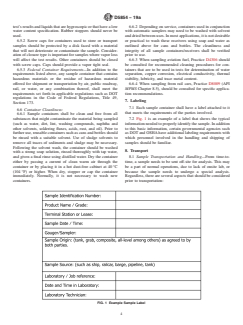
substances that might contaminate the material being sampled 7.2 Fig. 1 is an example of a label that shows the typical
(such as water, dirt, lint, washing compounds, naphtha and informationneededtoproperlyidentifythesample.Inaddition
other solvents, soldering fluxes, acids, rust, and oil). Prior to to this basic information, certain governmental agencies such
furtheruse,reusablecontainerssuchascansandbottlesshould as DOTand OSHAhave additional labeling requirements with
be rinsed with a suitable solvent. Use of sludge solvents to which personnel involved in the handling and shipping of
remove all traces of sediments and sludge may be necessary. samples should be familiar.
Following the solvent wash, the container should be washed
8. Transport
with a strong soap solution, rinsed thoroughly with tap water,
and given a final rinse using distilled water. Dry the container 8.1 Sample Transportation and Handling—From time-to-
either by passing a current of clean warm air through the time, a sample needs to be sent off-site for analysis. This may
container or by placing it in a hot dust-free cabinet at 40°C be a part of normal operations, due to lack of onsite lab, or
(104°F) or higher. When dry, stopper or cap the container because the sample needs to undergo a special analysis.
immediately. Normally, it is not necessary to wash new Regardless, there are several aspects that should be considered
containers. prior to transportation:
FIG. 1 Example Sample Label
D5854 − 19a
8.1.1 Local Hazardous Goods Regulations—Most jurisdic- particularly those that may expose the sample to air may
tions have limits on what can be transported on public roads influence the representivity of the final result.
and allow for exemptions for small hydrocarbon samples. 9.1.5 The ideal method would be to withdraw the sample
8.1.2 The Container Selected—It is crucial that the con- from the primary container directly into the analytical glass-
tainer selected complies with local transportation regulations ware. However, it is recognized that not all sampling methods
and does not affect the results of the pending analysis. or operational constraints permit this, nor do the requirements
Additionally, consider using a protective case for the sample to transport, store and distribute the same sample to various
container to avoid damage during transportation. Section 6 interested parties.
contains advice related to container material, maximum fill, 9.1.6 Where a number of containers (or samples, for ex-
size, and so forth. ample running samples, spot samples) are to be mixed prior to
8.1.3 Container Labeling—If applicable, consult the local extractionofsamplesforanalysisthatis,acomposite,beaware
transportation company to determine what is required on the that these samples may not proportionately represent the
container’s label especially related to hazardous goods. Other overall bulk that they are intended to represent.
labeling advice is found in Section 7. 9.1.7 This section refers to all sample containers and all
8.1.4 Sub-sampling—It is likely that the primary sample processes where a sample is handled prior to representative
will need to be subsampled into a secondary container. If so, extraction of the aliquot that is utilized for the analytical
proper mixing of the primary sample may be crucial. See measurement and therefore includes any intermediate contain-
Section 9 for more details. ers between the field and the laboratory analysis equipment.
8.1.5 Container Sealing—There may be a requirement to 9.1.8 Each sample container and mixing/transfer system
seal the container against potential tampering. If they exist, shall be tested and verified independently as suited to provide
these requirements are likely to be found in commercial the required uncertainty for the properties of interest.
agreements or regulatory guidelines. 9.1.9 Nothing in this practice should preclude the use of
technologies that can be proven within the required uncertain-
8.2 Shipping Enclosures—Many sample containers require
ties of the analytical methods used.
special shipping enclosures before they can be transported
fromthepointofcollection.Regulationscoveringthetransport 9.2 Sample Container Types:
of samples should be consulted. (for example, Code of Federal 9.2.1 Sample containers of any style may be stationary (for
Regulations, Title 49, section 173). example, fixed in place on a metering skid or lease automatic
custody transfer (LACT) unit), or they may be portable (for
example, taken to an offsite laboratory for mixing and analy-
9. Mixing
sis). Other examples of portable sample containers would be
9.1 General Considerations:
samples obtained from marine or shore tanks by “running,”
9.1.1 It is essential to ensure that any mixer or mixing
“all-levels,” and spot “core thief” samples or the containers
method applied to the sample does not materially change the
used within the laboratory (typically glassware/plastic/plated
properties of interest. Ullage space available in the sample
metals) or for sample retention.
container and type of mixing employed can affect the proper-
9.2.2 Sample containers may also be designed to retain
ties of interest for the sample in question. Mixing may affect
samples at elevated pressures, including full process pressure.
changes in temperature and pressure, which might influence
These can be fixed volume (such as a spun cylinder) or
the properties for which the sample is being analyzed.
constant pressure with a moveable partition, typically a piston
9.1.2 Somesamplesmaynotrequiremixing,howeverinthe
or bladder.
majority of instances some degree of mixing may be required
9.2.3 Sample containers may be for one-time use, or re-
toensurethatthealiquotremovedforanalysisisrepresentative
usable.Ineithercasethematerialsusedforconstructionshould
of the bulk properties of the sample.
not materially affect the sample properties, for example
9.1.3 Sample mixing is typically required to obtain a test
through adsorption, clingage or perhaps light for the period of
portion representative of the bulk sample to be tested. Precau-
use for that they are intended.
tions shall be taken to maintain the integrity of the sample
9.2.4 In the case of multiple stationary containers on a
during this operation. If a sample is transferred from one
common skid with either a separate pump/motor circulating
container to another, a homogeneous mix shall be created and
system for each container, or a single pump/motor circulating
maintainedthroughoutthetransfer.Topreservetheintegrityof
system for all containers, each container pump/motor circula-
the sample, the number of transfers of the sample, before
tion system configuration to be utilized should be tested
analysis, should be minimized to reduce the chances of: (a)
independently. In the case of portable containers of the same
loss of key properties such as light hydrocarbons in handling;
designwithacommonmixingsysteminalaboratory,onlyone
(b)insomecases,“loss”ofcomponentselementsofthesample
container shall be tested with the common mixing system.
for example, through clingage, adsorption or loss in dead
However, if a container of a different design is brought to the
pockets and, (c) interference from external sources including
laboratory, it shall be tested independently.
the local environment to which that sample may be exposed
during any transfer processes. 9.3 Sample Mixing Methods:
9.1.4 Transferringasamplebetweencontainers(thenumber 9.3.1 Sample mixing methods can be divided into three
of transfers between the primary container and the final general categories that should be used as appropriate to the
analytical equipment) should be minimized. Each transfer, and initial homogeneity and properties of interest.
D5854 − 19a
9.3.1.1 No mixing. analytical methods used. Where the fluid to be mixed com-
9.3.1.2 Shaking (by hand or with a shaking device). prises insoluble elements (such as water/sediment in oil), hand
9.3.1.3 Power mixing/mechanical. shaking is generally considered unsuitable but may be proven
9.3.2 These categories vary greatly in energy addition de- to meet the test criteria as defined in Table 1.
pending on the type of analytical test to be conducted and the (3)Hand shaking is typically used on samples that are
characteristics of the sample. Appendix X2 describes an essentially homogenous in regard to the property of interest.
acceptance testing method for mixing systems used for deter- (4)In some cases, magnetic stirrers or paddles may be
mining water in crude oil. Methods for determination of other permanently installed in the sample container.
properties will follow a similar format. 9.3.4.3 Power Mixing:
9.3.3 The addition of energy during the mixing process (1)Power mixers currently fall into two general groups:
(particularly using power mixers/mechanical) may result in insertion or closed loop. Single sample container/mixer sys-
temperature and potentially pressure rise. Many standards tems do not have to be tested individually if they are of the
define limitations on acceptable changes, for example for same mechanical design and operate within the demonstrated
mixing water into crude oil a limit of 10°C is allowed. If the service range (for example, in the determination of crude oil
temperature rise exceeds the allowed limits, some method will properties, water concentration, density, viscosity of product,
be required to prevent this. RVP, product purity, contaminant detection and sample vol-
9.3.4 The following is a brief discussion of each category: ume).
9.3.4.1 None (no mixing if not required)—If a sample is (2)Over-mixing with power mixers on non-homogeneous
known to be homogeneous regarding the property of interest, fluids(forexample,oilandwater)maycreateanemulsionthat
no mixing is required. Samples should not be mixed where the will affect the accuracy of certain analytical tests. Refer toAPI
analyticalteststobeconductedmaybeaffectedbyinductionof MPMS 10.9.
air or a secondary phase found within the sample container of (3)Power mixers may entrain air or gases into the sample
mixingsystemorwhereapropertycouldmateriallybeaffected thatcouldaffectcertainanalyticaltests.Lossofvapornormally
by excess mixing (for example RVP). associated with rise in temperature as the sample is transferred
9.3.4.2 Shaking: from mixer loop may also occur, which could affect tests
(1)Shakinginvolvesmanuallyormechanicallyshakingthe results for example for water, RVP, and density. Temperature
sample container to eliminate stratification. It is generally rise during mixing may impact the measurement because of
difficult to manually agitate laboratory samples of dense or potential condensation in cold spots. Over-mixing may com-
heavy petroleum liquids sufficiently to disperse contaminants, promise the analysis method, for example, oil and water
such as sediment and water, homogeneously throughout the mixtures, if over-mixed will destroy the density and RVP
liquid. Mechanical or hydraulic mixing will be necessary to values as well as provide erroneous water content values.
ensure an even distribution. Generally, the amount of energy that is required to be dissi-
(2) Internal Mechanical Mixers—Some mixing devices patedwilldependonthefluidpropertiesandvolume,therefore
use baffles, agitators or balls inside the container that can be any method used to verify mixing must recognize that either
moved by hand. Such designs provide a variety of levels of extended testing must be performed or a clear physical
energydissipationasappropriatetothefluidscontainedandthe understanding of the process must be applied.
TABLE 1 Maximum Permissible Difference between Test Specimens and Maximum Permissible Difference between the Average of All
Test Specimens and Total Water Concentration (Based upon Three Test Specimens)
0.5
NOTE 1—Values in Column A are calculated from the larger of 0.05% or 2.92 × 0.064 × (Wk %) .
0.5
NOTE 2—Values in Column B are calculated from the larger of 0.05% or 1.96 × 0.064 × ((Wk %) )/(√3).
NOTE 3—Values in Wk not shown in the table may be obtained by interpolation.
Wk Column A Repeatability Check Column B Bias Check
Total Water Concentration Based upon the Maximum Permissible Difference Between Three (3) Maximum Permissible Difference Between Average of
Average of Three (3) Test Specimens Consecutive Test Specimens All Test Specimens and Total Water Concentration
0.00 % 0.05 % 0.05 %
0.05 % 0.05 % 0.05 %
0.10 % 0.06 % 0.05 %
0.15 % 0.07 % 0.05 %
0.20 % 0.08 % 0.05 %
0.25 % 0.09 % 0.05 %
0.50 % 0.13 % 0.05 %
1.00 % 0.19 % 0.07 %
1.50 % 0.23 % 0.09 %
2.00 % 0.26 % 0.10 %
2.50 % 0.30 % 0.11 %
3.00 % 0.32 % 0.13 %
3.50 % 0.35 % 0.14 %
4.00 % 0.37 % 0.14 %
4.50 % 0.40 % 0.15 %
5.00 % 0.42 % 0.16 %
D5854 − 19a
(4) Insertion Mixers—These mixers are stand-alone de- (1)Power mixing, and in some cases, mechanical mixing,
vicesthatarenotanintegralpartofagivensamplingormixing is required for all crude oil samples to be tested for sediment
system. These mixers can be used on a variety of different and water unless the results would be adversely affected (for
types and sizes of sample containers. Non-aerating or high- example, small sample size), as well as a number of petroleum
productsbeingtestedforavarietyofanalyticaltestprocedures.
speed shear mixers are examples of insertion mixers.
(5)In some cases, magnetic stirrers, paddles, or insertion Power mixing is also required when the sample has been
transported or stored in either a primary or intermediate
mixing devices may be permanently installed in the sample
container. container. Note that density results are best determined before
full mixing for water.
(6) Closed Loop Mixers—These mixers are typically used
(2)Mixing is not required if a representative sample is
in conjunction with an automatic pipeline sampling system.
directly transferred from the sample extractor to the analytical
The mixer may be an integral part of a stationary sample
test device at the time of extraction.
container or a stand-alone unit used for portable sample
(3)Themixingmethodshallbecompatiblewiththetypeof
containers. Jets are sometimes used within the sample con-
analysis and the volumes being analyzed.
tainer that may be permanently mounted.
(4) Homogenization of Viscous Samples—If the sample is
9.3.4.4 Improper Mixing:
not sufficiently fluid to withdraw a test portion in a syringe for
(1)The following are considerations when using mixers:
Karl Fisher analysis at ambient temperatures, utilize a safe
(a)Under-mixing may result in a non-representative
external warming method or a constant temperature bath to
sample.
obtain a temperature approximately 10°C above the minimum
(2) If the sampling procedure requires that multiple
temperature at which it becomes possible to obtain a test
samples be taken from a single process line, storage tank, or in
portion by syringe, but not exceeding 60°C. Maintain the
the case of marine vessels, multiple or single samples from
samples at this temperature during homogenization.
multiple tanks, analytical tests may be performed on each
(5)Certain analytical tests require the sample to be ana-
sample or on a composite of the various samples. Note that
lyzed at temperatures either above or below common ambient
compositing of samples results in the analysis of one or more
conditions, due care should be taken not to transfer samples
aliquots,allofwhichwill,inbestcircumstances,beanaverage
between containers and/or the analytical equipment in such a
value of the bulk composite. A composite technique is gener-
way as to compromise the properties of interest.
ally considered inappropriate for properties that vary signifi-
cantly through the volumes collected if the bulk volume
10. Sample Integrity and Storage, Preservation, and
properties are likely to vary significantly unless the composite
Audit
iscreatedinproportiontothevolumestowhicheachcontainer
10.1 There are many governmental agencies and jurisdic-
relates.
tions that have regulations governing the storage and disposal
(3)When analytical tests are performed on individual
of petroleum samples and containers that can be classified as
samples,whichistherecommendedprocedure(butnotalways
hazardous materials or hazardous wastes. Those who handle
available), the test results are averaged. Depending on the
petroleum samples may be familiar with these regulations in
particularapplication,theresultsshouldbeaveragedarithmeti-
addition to their own company policies and procedures. “Re-
callyoronaproportionalbasisbyweightorvolumeaccording
tainSamples”shallnotbedisposedofuntiltheprimarysample
to the proportion of the total liquid that the sample represents.
results are known to all interested parties, and/or as per
9.3.4.5 Composite Samples:
contractual agreements.
(1)A composite sample may be prepared from individual
10.2 Sample Integrity and Storage:
samples taken from the same process line or storage tank, and
10.2.1 Except when being transferred, samples should be
itshallconsistofproportionalpartsfromeachzoneifitisfrom
maintained in a closed container in order to prevent loss of
a single tank. If the composite is from multiple tanks, it shall
light components. Samples should be protected during storage
consist of proportional parts from each tank sampled.
to prevent weathering or degradation from light, heat, or other
(2)Composite samples from multiple tanks should be
potential detrimental conditions.
prepared, in the laboratory or other controlled environment, in
10.2.2 Maintain sample integrity as required by contract.
proportion to the volume in each tank. Samples to be compos-
10.2.3 Maintain control of the sample as required by con-
ited should be submitted to the laboratory along with a list of
tract.
each tank and the volume represented by each sample. The
10.2.4 If a composite sample is to be transferred from a
method of compositing should be documented and care taken
primary container to a secondary container, then both contain-
to preserve the integrity and that the composite sample is
ers should be under collector control.
representative.
10.2.4.1 Consider sealing the sample container that will be
(3)Individual samples that make up the composite sample
transported to the analysis location.
may be retained separately for retesting, if necessary.
10.2.4.2 Ensure that no external substance can enter a
(4)After a composite sample has been mixed, it is impor-
sample container so the sample cannot be contaminated.
tant to note that it will likely separate quickly (for example,
water in oil). The analysis or transfer should therefore be
10.3 Preservation:
performed immediately after the mixing has taken place.
10.3.1 The sample storage location should:
9.3.4.6 Selection of Sample Mixing Method: 10.3.1.1 Preserve the integrity of the samples.
D5854 − 19a
10.3.1.2 Allow no direct sunlight on the samples. 11.2.2.3 Higherwaterconcentration(HW)isdeterminedfor
10.3.1.3 Be ventilated sufficiently to prevent a hazardous a total water concentration that is:
(1)1.0 % when the lower water (LW) is equal to 0.5 %.
atmosphere.
(2)0.5 % + lower water (LW) when the lower water (LW)
10.3.2 Chain of Custody:
is greater than 0.5 %.
10.3.2.1 The sample records should be kept in a safe
location away from the samples. 11.2.2.4 For example, a crude oil with a baseline of 0.3%
10.3.2.2 A copy should be sent with the sample if it is should be tested with a minimum lower total water concentra-
transferred. tionof0.55%andaminimumhighertotalwaterconcentration
of 1.05%. On the other hand, if enough water were added to
10.4 Audit—If an audit trail is required, these should be
make the lower total water concentration 0.7%, then the
kept:
minimum higher total water concentration should be 1.2%.
10.4.1 “Sample” records.
11.2.2.5 Separate complete sets of tests should be consid-
10.4.2 “Chain of custody” documents.
ered for crudes exhibiting very different physical properties.
10.4.3 Sample storage (retain) records.
For example, consider a set of three (3) crude oils, at sample
10.4.4 Sample results.
temperature, in which the one with the highest density is also
the one with the highest viscosity, the one with the lowest
11. Testing—Acceptance Test for Sample Container/
density is also the one with the lowest viscosity, and the third
Mixing Systems for Water in Crude Oil
crude lies somewhere in between for both density and viscos-
11.1 Introduction:
ity:
11.1.1 The acceptance test described is applicable to both (1)Gravity of 20° API (highest density) and highest
fixed sample container/mixing systems and portable sample
viscosity of 25 centipoise (cP).
container/mixing systems. The test criteria is not dependent (2)Gravityof44°API(inbetweendensity)andinbetween
uponthetypeordesignofthesamplecontainer/mixingsystem.
viscosity of 7 centipoise (cP).
11.1.2 Before a sample is transferred from one container to (3)Gravity of 48°API (lowest density) and lowest viscos-
another, a homogeneous mixture shall be created and main-
ity of 5 centipoise (cP).
tained until the transfer is completed. A sample container/
11.2.2.6 In the example above, a complete set of tests
mixing system should be tested, using the acceptance criteria
should be made for both the 20° API crude and the 48° API
shown in Table 1. The criteria for acceptance for custody
crudeoil.Onrareoccasions,athirdcrudeoil(forexample,one
transfer, with an example of test procedures and calculations,
in which the heaviest crude is not necessarily the most viscous
are presented below.
orthelightestcrudeisnotnecessarilytheleastviscous)should
11.1.3 The purpose of the test is to determine whether a
be considered for tested.
container/mixing system can produce a representative sample
11.2.2.7 If sample volumes in a container are constant in
of crude oil with varying amounts of water. The tests also
normal operations (for example, 70% of fill for all batches),
determine the effective mixing times required to produce a
the test should be conducted at that single sample volume (for
representative sample of crude oil and water. It is understood
example, 70% of fill). In cases where the sample volume
that the proper mixing time is determined by testing. It is
varies from batch to batch, the test should be conducted at a
possible to overmix as well as under mix in certain circum-
lower sample volume (for example, 25% to 30% of fill) and
stances.
a higher sample volume (for example, 75% to 80% of fill).
11.2.2.8 When transitioning from a lower water concentra-
11.2 General Guidelines:
tion to a higher water concentration for any given sample
11.2.1 Each sample container/mixing and water concentra-
volume being tested, the total higher water concentration is
tion test (that is, water determination by centrifuge or Karl
equaltotheoriginalbaselinevolumeofwater,plustheamount
Fischer), whether conducted at a low volume (LV), a normal
of water added for the lower water concentration, plus the
volume (NV), or a high volume (HV) of sample in the
amount of water added for the higher water concentration.
container, will consist of: (a) an analysis for total water in the
Therefore, to account for these volumes of water, any amounts
baseline(BL)oil;(b)ananalysisfortotalwaterafteraddingan
used in purging the withdrawal port (in the case of closed loop
amount of water to the oil for the lower water (LW) determi-
mixing) shall be preserved and reintroduced into the container
nation; and, (c) an analysis for total water after adding an
at the time of adding more water into the container.
amount of water for the higher water (HW) determination.
11.2.2.9 When transitioning from the lower sample volume
11.2.2 For any given oil sample amount (LV, NV, HV), the
MINIMUM levels of water should be as follows: (LV) to the higher sample volume (HV), a new baseline value
is established by test.
11.2.2.1 Baselinewaterconcentration(BL)isdeterminedas
found. 11.2.2.10 The mixing times used in the test, whether for the
11.2.2.2 Lower water concentration (LW) is determined for baseline or for higher concentrations of water, should overlap
a total water concentration that is: the normal mixing times as nearly as practical. Thus, for any
(1)0.5 % when the baseline (BL) is less than 0.25%. givenwaterconcentration(thatis,baselinewater(BL)percent,
(2)0.5 % when the baseline (BL) is equal to 0.25%. lower water (LW) percent, and higher water (HW) percent):
(3)0.25 % + baseline (BL) when the baseline (BL) is (1)Mixing Time 1 is slightly less than or equal to the
greater than 0.25%. Normal Time (NT).
D5854 − 19a
(2)Mixing Time 2 is approximately equal to the Normal 11.3.5 Determine the mixing time(s) normally used at this
Time (NT). site.
(3)Mixing Time 3 is slightly greater than or equal to the
11.3.6 Select the test mixing times based upon the times
Normal Time (NT). normally used.
11.2.2.11 The three (3) tests shall have a range of repeat- 11.3.7 Design the test plan according to Scenarios 1, 2, or 3
ability within the limits of ColumnAin Table 1 (repeatability (see Appendix X2 for calculation examples).
check). In the tests with concentrations of water above the
11.3.8 Fill the container with baseline crude oil to the test
baseline, the average of the three (3) tests shall also have a volume (that is, low, normal, or high volume).
deviation from the known concentration within the limits of
11.3.9 Mix and determine the percent water in the baseline
Column B in Table 1 (bias check).
crude oil.
11.2.2.12 Ifafailureoftherepeatabilitycheckorbiascheck
11.3.10 Evaluate results using Table 1, Column A, and if
at any stage of the process results in a failure, the reason shall
they pass, proceed with test.
be determined and rem
...
This document is not an ASTM standard and is intended only to provide the user of an ASTM standard an indication of what changes have been made to the previous version. Because
it may not be technically possible to adequately depict all changes accurately, ASTM recommends that users consult prior editions as appropriate. In all cases only the current version
of the standard as published by ASTM is to be considered the official document.
Designation: D5854 − 19 D5854 − 19a
Manual of Petroleum Measurement Standards (MPMS), Chapter 8.3
Standard Practice for
Mixing and Handling of Liquid Samples of Petroleum and
Petroleum Products
This standard is issued under the fixed designation D5854; the number immediately following the designation indicates the year of
original adoption or, in the case of revision, the year of last revision. A number in parentheses indicates the year of last reapproval. A
superscript epsilon (´) indicates an editorial change since the last revision or reapproval.
1. Scope*
1.1 This practice covers handling, mixing, and conditioning procedures that are required to ensure that a representative sample
of the liquid petroleum or petroleum product is delivered from the primary sample container or container or both into the analytical
apparatus or into intermediate containers.
1.2 Appendix X1 details the background information on the development of Table 1 used in performance testing. Appendix X2
provides guidance in the acceptance testing for water in crude oil. Appendix X3 provides a guide for materials of sample
containers. Appendix X4 provides a summary of recommended mixing procedures. Appendix X5 provides a flow chart for sample
container/mixing system acceptance test.
1.3 For sampling procedures, refer to Practices D4057 (API MPMS Chapter 8.1) and D4177 (API MPMS Chapter 8.2). Practice
D5842 (API MPMS Chapter 8.4) covers sampling and handling of light fuels for volatility measurement, and D8009 (API MPMS
Chapter 8.5).
1.4 It is recommended that the users of this practice perform the tests in Practice D4177 (API MPMS Chapter 8.2) before
performing the test in this practice.
1.5 This standard does not purport to address all of the safety concerns, if any, associated with its use. It is the responsibility
of the user of this standard to establish appropriate safety, health, and environmental practices and determine the applicability of
regulatory limitations prior to use.
1.6 This international standard was developed in accordance with internationally recognized principles on standardization
established in the Decision on Principles for the Development of International Standards, Guides and Recommendations issued
by the World Trade Organization Technical Barriers to Trade (TBT) Committee.
2. Referenced Documents
2.1 ASTM Standards:
D3700 Practice for Obtaining LPG Samples Using a Floating Piston Cylinder
D4057 Practice for Manual Sampling of Petroleum and Petroleum Products
D4177 Practice for Automatic Sampling of Petroleum and Petroleum Products
D4306 Practice for Aviation Fuel Sample Containers for Tests Affected by Trace Contamination
D5842 Practice for Sampling and Handling of Fuels for Volatility Measurement
D8009 Practice for Manual Piston Cylinder Sampling for Volatile Crude Oils, Condensates, and Liquid Petroleum Products
2.2 API Documents:
Manual of Petroleum Measurement Standards, Chapter 10, Sediment and Water (all sections)
Publication 2003, Protection Against Ignitions Arising Out of Static, Lighting, and Stray Currents
This practice is under the jurisdiction of ASTM Committee D02 on Petroleum Products, Liquid Fuels, and Lubricants and the API Committee on Petroleum Measurement,
and is the direct responsibility of Subcommittee D02.02.08D02.02 the joint ASTM-API committee on Sampling (API MPMS Chapter 8.0)Hydrocarbon Measurement for
Custody Transfer (Joint ASTM-API). This practice has been approved by the sponsoring committees and accepted by the Cooperating Societies in accordance with established
procedures.
Current edition approved Feb. 1, 2019May 1, 2019. Published July 2019. Originally approved in 1996. Last previous edition approved in 20152019 as D5854 – 96
(2015).D5854 – 19. DOI: 10.1520/D5854-19.10.1520/D5854-19A.
For referenced ASTM standards, visit the ASTM website, www.astm.org, or contact ASTM Customer Service at service@astm.org. For Annual Book of ASTM Standards
volume information, refer to the standard’s Document Summary page on the ASTM website.
Available from American Petroleum Institute (API), 1220 L. St., NW, Washington, DC 20005-4070, http://www.api.org.
*A Summary of Changes section appears at the end of this standard
© Jointly copyrighted by ASTM International, 100 Barr Harbor Drive, PO Box C700, West Conshohocken, PA 19428-2959, USA and the American Petroleum Institute (API), 1220 L Street NW, Washington DC 20005, USA
D5854 − 19a
Publication 2026, Safe Descent onto Floating Roofs of Storage Tanks in Petroleum Service
Publication 2217, Guideline for Confined Space Work in the Petroleum Industry
2.3 Department of Transportation:
Code of Federal Regulations, Title 49, Section 173
2.4 Occupational Safety and Health Standards:
29 Code of Federal Regulations, Subpart Z, “Toxic and Hazardous Substances,” Part 1910.1000 and following
3. Terminology
3.1 Definitions of Terms Specific to This Standard:
3.1.1 aliquot, n—a small portion of a larger sample that is analyzed and assumed to represent the whole sample.
3.1.2 composite sample, n—a sample prepared by combining a number of samples and treated as a single sample; also refer to
tank composite sample, volumetric composite sample, deck composite sample, and multiple tank composite sample.
3.1.3 crude petroleum sampling, n—sampling of unrefined crude oil.
3.1.4 liquid petroleum sampling, n—sampling of refined or unrefined hydrocarbon liquids.
3.1.5 intermediate sample receiver/container, n—a sample container into which all or part of the sample from a primary sample
receiver/container is transferred for transport, storage, or ease of handling.
3.1.6 petroleum, n—a substance, generally liquid, occurring naturally in the earth and composed mainly of mixtures of chemical
compounds of carbon and hydrogen with or without other nonmetallic elements such as sulfur, oxygen, and nitrogen; the
compounds that compose petroleum may be in the gaseous, liquids, or solid state, depending on their nature and on the existent
conditions of temperature and pressure.
3.1.7 primary sample container, n—a container in which a sample is initially collected, such as a glass or plastic bottle, a can,
a core-type thief, a high-pressure cylinder, a floating piston cylinder, or a sample container in an automatic sampling system.
3.1.8 retain sample, n—a sample that is stored for future use.
3.1.9 sample container, n—receptacle used for storage and transport of the sample.
3.1.10 sample handling and mixing, n—the conditioning, transferring, and transporting of a sample in a manner that does not
compromise the integrity of the sample.
3.1.11 sampling, n—all the steps required to obtain a sample that is representative of the contents of any pipe, tank, or other
vessel, and to place that sample in a container from which a representative test specimen can be taken for analysis.
3.1.12 test specimen, n—a representative sub-sample taken from the primary or intermediate sample container for analysis.
4. Significance and Use
4.1 Representative samples of petroleum and petroleum products are required for the determination of chemical and physical
properties used to establish standard volumes, prices, and compliance with commercial and regulatory specifications. The
treatmenthandling of samples from the time of collection until they are analyzed requires care and effort to maintain their
compositional integrity. Samples of high RVP (unstabilized) hydrocarbons are required at many measurement points, for example
offshore production, at the outlets of test separators or to allow calibration of a flowmeter. This practice also describes requirements
associated with handling and mixing samples held within pressurized cylinders.
4.2 Practice D4057 (API MPMS Chapter 8.1), Practice D4177 (API MPMS Chapter 8.2), Practice D5854 (API MPMS Chapter
8.3), Practice D5842 (API MPMS Chapter 8.4), and Practice D8009 (API MPMS Chapter 8.5). The primary purpose of this suite
of standards, is to ensure proper sampling and handling for custody transfer applications. There are a significant number of test
methods that may be used to analyze the samples taken by techniques described in API MPMS Chapter 8.1 and 8.2. For samples
that are taken for test methods outside the general scope of custody transfer covered by this practice, the personnel assigned to take
the sample are responsible to refer to the test methods for additional critical information that may impact the sampling process,
that is, specific container selection, transport methods, storage times, etc. Those requirements should be found in the appropriate
test method.
5. Safety and Health Precautions
5.1 Potential health and safety hazards may be associated with the handling and mixing of petroleum samples.
5.2 All sample handling and mixing equipment should be approved by the parties involved. All equipment should be installed,
operated, and maintained in a manner to minimize potential health and safety hazards.
Available from the Superintendent of Documents, U.S. Government Printing Office, Washington, DC 20402.
D5854 − 19a
6. Sample Containers
6.1 No single container type will meet requirements of all petroleum sampling operations. The following are general design and
construction considerations for sample containers.
6.2 Container Configuration—Containers may be disposable or recyclable. Due care should be taken to ensure that samples
extracted are representative before a subsample is removed or that the entirety of the sample may be removed for further
processing.
6.2.1 If a container is to be reused, it should drain continuously toward the outlet to ensure liquid withdrawal or incorporate a
sump and dip tube to ensure complete evacuation of the composite sample.
6.2.2 Cylindrical containers are better suited for samples that are to be tested for free water or sediment and water.
6.2.3 Containers should not have internal pockets or dead spots that can create a bias to the overall result. (For example, give
due consideration to sight glasses or float indicator mechanics that can retain sample that is not then mixed.)
6.2.4 Internal surfaces of containers should minimize corrosion, incrustation, water, adsorption of elements of interest, or
clingage.
6.2.5 Container configuration should allow for the transfer of samples from one container to another or to the analytical
apparatus while maintaining the integrity of the sample’s composition. It may be desirable to reduce or increase the temperature
of the sample prior to transfer (that is, reducing temperature to minimize the loss of light ends).
6.2.6 Containers should have an inspection cover/closure/cap of sufficient size to facilitate filling, inspection, and cleaning.
Where a sample represents a high value transaction, a means of installing security seals to prevent tampering should be provided.
6.2.7 If the sample is likely to separate because it contains immiscible fluids (for example, water or sediment in oil), the
containers should be designed to allow for homogenization while preventing the loss of any constituents that affect the
representativeness of the sample and the accuracy of the analytical tests.
6.2.8 Containers should be made so as to avoid contamination from external foreign material (for example, the ingress of water
or other contaminants). When the sample contains immiscible fluids, care shall be taken to adequately homogenize the content so
that any extracted sample is within the allowed repeatability of the bulk value of that property. Note that in the case of hydrocarbon
and water, adequate mixing to determine water content is likely to irreversibly damage other properties of interest such as density.
6.2.9 Containers used with closed loop mixers may need a pressure/vacuum relief valve set so as not to exceed the design
pressure of the container. A pressure gauge may also be incorporated.
6.2.10 Containers used with closed loop mixers for non-homogeneous fluids shall have a suction port at or near the bottom.
6.2.11 Constant pressure cylinders are referred to in Practice D3700, Practice D4057 (API MPMS Chapter 8.1), Practice D4177
(API MPMS Chapter 8.2), and Practice D8009 (API MPMS Chapter 8.5) discusses the merits of the constant pressure cylinder for
the sampling of rail cars and the like. These cylinders are designed to allow spot or composite samples to be taken from a
pressurized tank or pipeline at full line conditions and maintain the sample at those conditions until analyzed.
6.2.12 The laboratory container shall be selected such that its construction material does not affect sample compositional
integrity and its volume and its dimensions are sufficient to allow for adequate mixing. In selecting the laboratory test container,
take particular care in respect of the following:
6.2.12.1 Liquids containing volatile materials, as loss by evaporation can occur;
6.2.12.2 Liquids suspected to contain sediment and/or water, as separation can occur;
6.2.12.3 Samples with potential wax deposition, as separation can occur if a sufficient temperature is not maintained;
6.2.12.4 Samples of high viscosity and/or density, as both temperature and mixer placement may be affected to obtain the
required homogenization; and
6.2.12.5 Make sure constituents are compatible with the container material (that is, mercury readily forms an amalgam with
aluminum).
6.3 Container Volume:
6.3.1 A general rule is that both primary and intermediate containers should be large enough to hold the required sample size
within 60 % to 80 % of the total capacity. This provides for thermal expansion.
6.3.2 The size of primary containers is determined from the sampling operation as described in Practices D4057 (API MPMS
Chapter 8.1) and D4177 (API MPMS Chapter 8.2).
6.3.3 The size of intermediate containers should be as large as practical to minimize surface tension effects with due
consideration given to storage space requirements, shipping rules and regulations, availability, and other practicalities.
6.3.4 Refer to API 8.2 for composite sample volume and the number of samples when using automatic sampling systems.
6.4 Container Material:
6.4.1 Sample containers are normally made of glass, metal, or plastic. Exercise care in the selection of container material as it
could affect the test results obtained from the sample. Containers acceptable for samples to be tested immediately may not be
acceptable for storage of sample.
6.4.2 Glass containers are suitable for many sample test and storage requirements. Clear glass bottles may be examined visually
for cleanliness and allow for visual inspection of the sample for free water or solid impurities. Some petroleum samples are affected
D5854 − 19a
by exposure to sunlight or fluorescent lamp UV emissions if clear glass is used. In these cases, brown glass bottles may afford the
necessary protection. Care should be taken to ensure the necessary protection is provided when selecting a container.
6.4.3 Sample containers coated with tin shall have seams that have been soldered on the exterior surfaces with a flux of rosin
cleaned in a suitable solvent. Such a flux is easily removed with gasoline, whereas many others are very difficult to remove. Minute
traces of flux may contaminate the sample so that results obtained on tests such as dielectric strength, oxidation resistance, and
sludge formation may be erroneous. Exercise care also to ensure that samples containing free or entrained water are not corrosive
to the metal. Internally epoxy-lined tin cans may have residual contamination and precaution should be taken to ensure its removal.
6.4.4 Sample containers made of stainless steel with welded seams are suitable for many sampling operations. Other than
ensuring the cleanliness, use of these containers presents no unusual concerns.
6.4.5 Plastic bottles shall be of a material that is impervious to attack from the sample. This is especially a consideration when
using plastic for long term storage of certain petroleum products. Clear plastic bottles are unsuitable for samples sensitive to light.
6.4.6 When sampling aviation fuels, Practice D4306 should be consulted for guidance on container selection. This practice gives
information on the types of containers that have been found satisfactory for tests to determine water separation, copper corrosion,
electrical conductivity, thermal stability, lubricity, and trace metal content.
6.4.7 Appendix X3 is a guide for selecting the material of which sample containers may be made. It is impossible to cover all
petroleum sampling container requirements; therefore, when questions arise as to a container’s suitability for a given application,
experience and testing should be relied upon.
6.5 Container Closures:
6.5.1 Stoppers made of a material that will not deteriorate or contaminate the sample may be used. Care should be used when
using cork stoppers. Situations where corks should not be used include liquids where loss of light ends may affect the test’s results
and liquids that are hygroscopic or that have a low water content specification. Rubber stoppers should never be used.
6.5.2 Screw caps for containers used to store or transport samples should be protected by a disk faced with a material that will
not deteriorate or contaminate the sample. Consideration of closure type is important for samples where vapor loss will affect the
test results. Other containers should be closed with screw caps. Caps should provide a vapor tight seal.
6.5.3 Federal Container Requirements—In addition to the requirements listed above, any sample container that contains
hazardous materials or the residue of hazardous material offered for shipment or transportation by air, public roadway, rail, or
water, or any combination thereof, shall meet the requirements set forth in applicable regulations such as DOT regulations in the
Code of Federal Regulations, Title 49, Section 173.
6.6 Container Cleanliness:
6.6.1 Sample containers shall be clean and free from all substances that might contaminate the material being sampled (such
as water, dirt, lint, washing compounds, naphtha and other solvents, soldering fluxes, acids, rust, and oil). Prior to further use,
reusable containers such as cans and bottles should be rinsed with a suitable solvent. Use of sludge solvents to remove all traces
of sediments and sludge may be necessary. Following the solvent wash, the container should be washed with a strong soap solution,
rinsed thoroughly with tap water, and given a final rinse using distilled water. Dry the container either by passing a current of clean
warm air through the container or by placing it in a hot dust-free cabinet at 40 °C (104 °F) or higher. When dry, stopper or cap
the container immediately. Normally, it is not necessary to wash new containers.
6.6.2 Depending on service, containers used in conjunction with automatic samplers may need to be washed with solvent and
dried between uses. In most applications, it is not desirable or practical to wash these receivers using soap and water as outlined
above for cans and bottles. The cleanliness and integrity of all sample containers/receivers shall be verified prior to use.
6.6.3 When sampling aviation fuel, Practice D4306 should be consulted for recommended cleaning procedures for containers
that are to be used in tests for determination of water separation, copper corrosion, electrical conductivity, thermal stability,
lubricity, and trace metal content.
6.6.4 When sampling from rail cars, Practice D8009 (API MPMS Chapter 8.5), should be consulted for specific application
recommendations.
7. Labeling
7.1 Each sample container shall have a label attached to it that meets the requirements of the parties involved.
7.2 Fig. 1 is an example of a label that shows the typical information needed to properly identify the sample. In addition to this
basic information, certain governmental agencies such as DOT and OSHA have additional labeling requirements with which
personnel involved in the handling and shipping of samples should be familiar.
8. Transport
8.1 Sample Transportation and Handling—From time-to-time, a sample needs to be sent off-site for analysis. This may be a part
of normal operations, due to lack of onsite lab, or because the sample needs to undergo a special analysis. Regardless, there are
several aspects that should be considered prior to transportation:
8.1.1 Local Hazardous Goods Regulations—Most jurisdictions have limits on what can be transported on public roads and allow
for exemptions for small hydrocarbon samples.
D5854 − 19a
FIG. 1 Example Sample Label
8.1.2 The Container Selected—It is crucial that the container selected complies with local transportation regulations and does
not affect the results of the pending analysis. Additionally, consider using a protective case for the sample container to avoid
damage during transportation. Section 6 contains advice related to container material, maximum fill, size, and so forth.
8.1.3 Container Labeling—If applicable, consult the local transportation company to determine what is required on the
container’s label especially related to hazardous goods. Other labeling advice is found in Section 7.
8.1.4 Sub-sampling—It is likely that the primary sample will need to be subsampled into a secondary container. If so, proper
mixing of the primary sample may be crucial. See Section 9 for more details.
8.1.5 Container Sealing—There may be a requirement to seal the container against potential tampering. If they exist, these
requirements are likely to be found in commercial agreements or regulatory guidelines.
8.2 Shipping Enclosures—Many sample containers require special shipping enclosures before they can be transported from the
point of collection. Regulations covering the transport of samples should be consulted. (for example, Code of Federal Regulations,
Title 49, section 173).
9. Mixing
9.1 General Considerations:
9.1.1 It is essential to ensure that any mixer or mixing method applied to the sample does not materially change the properties
of interest. Ullage space available in the sample container and type of mixing employed can affect the properties of interest for
the sample in question. Mixing may affect changes in temperature and pressure, which might influence the properties for which
the sample is being analyzed.
9.1.2 Some samples may not require mixing, however in the majority of instances some degree of mixing may be required to
ensure that the aliquot removed for analysis is representative of the bulk properties of the sample.
9.1.3 Sample mixing is typically required to obtain a test portion representative of the bulk sample to be tested. Precautions shall
be taken to maintain the integrity of the sample during this operation. If a sample is transferred from one container to another, a
homogeneous mix shall be created and maintained throughout the transfer. To preserve the integrity of the sample, the number of
transfers of the sample, before analysis, should be minimized to reduce the chances of: (a) loss of key properties such as light
hydrocarbons in handling; (b) in some cases, “loss” of components elements of the sample for example, through clingage,
adsorption or loss in dead pockets and, (c) interference from external sources including the local environment to which that sample
may be exposed during any transfer processes.
9.1.4 Transferring a sample between containers (the number of transfers between the primary container and the final analytical
equipment) mustshould be minimized. Each transfer, and particularly those that may expose the sample to air may influence the
representivity of the final result.
D5854 − 19a
9.1.5 The ideal method would be to withdraw the sample from the primary container directly into the analytical glassware.
However, it is recognized that not all sampling methods or operational constraints permit this, nor do the requirements to transport,
store and distribute the same sample to various interested parties.
9.1.6 Where a number of containers (or samples, for example running samples, spot samples) are to be mixed prior to extraction
of samples for analysis that is, a composite, be aware that these samples may not proportionately represent the overall bulk that
they are intended to represent.
9.1.7 This section refers to all sample containers and all processes where a sample is handled prior to representative extraction
of the aliquot that is utilized for the analytical measurement and therefore includes any intermediate containers between the field
and the laboratory analysis equipment.
9.1.8 Each sample container and mixing/transfer system shall be tested and verified independently as suited to provide the
required uncertainty for the properties of interest.
9.1.9 Nothing in this practice should preclude the use of technologies that can be proven within the required uncertainties of
the analytical methods used.
9.2 Sample Container Types:
9.2.1 Sample containers of any style may be stationary (for example, fixed in place on a metering skid or lease automatic
custody transfer (LACT) unit), or they may be portable (for example, taken to an offsite laboratory for mixing and analysis). Other
examples of portable sample containers would be samples obtained from marine or shore tanks by “running,” “all-levels,” and spot
“core thief” samples or the containers used within the laboratory (typically glassware/plastic/plated metals) or for sample retention.
9.2.2 Sample containers may also be designed to retain samples at elevated pressures, including full process pressure. These can
be fixed volume (such as a spun cylinder) or constant pressure with a moveable partition, typically a piston or bladder.
9.2.3 Sample containers may be for one-time use, or re-usable. In either case the materials used for construction should not
materially affect the sample properties, for example through adsorption, clingage or perhaps light for the period of use for that they
are intended.
9.2.4 In the case of multiple stationary containers on a common skid with either a separate pump/motor circulating system for
each container, or a single pump/motor circulating system for all containers, each container pump/motor circulation system
configuration to be utilized should be tested independently. In the case of portable containers of the same design with a common
mixing system in a laboratory, only one container shall be tested with the common mixing system. However, if a container of a
different design is brought to the laboratory, it shall be tested independently.
9.3 Sample Mixing Methods:
9.3.1 Sample mixing methods can be divided into three general categories that should be used as appropriate to the initial
homogeneity and properties of interest.
9.3.1.1 No mixing.
9.3.1.2 Shaking (by hand or with a shaking device).
9.3.1.3 Power mixing/mechanical.
9.3.2 These categories vary greatly in energy addition depending on the type of analytical test to be conducted and the
characteristics of the sample. Appendix X2 describes an acceptance testing method for mixing systems used for determining water
in crude oil. Methods for determination of other properties will follow a similar format.
9.3.3 The addition of energy during the mixing process (particularly using power mixers/mechanical) may result in temperature
and potentially pressure rise. Many standards define limitations on acceptable changes, for example for mixing water into crude
oil a limit of 10 °C is allowed. If the temperature rise exceeds the allowed limits, some method will be required to prevent this.
9.3.4 The following is a brief discussion of each category:
9.3.4.1 None (no mixing if not required)—If a sample is known to be homogeneous regarding the property of interest, no mixing
is required. Samples should not be mixed where the analytical tests to be conducted may be affected by induction of air or a
secondary phase found within the sample container of mixing system or where a property could materially be affected by excess
mixing (for example RVP).
9.3.4.2 Shaking:
(1) Shaking involves manually or mechanically shaking the sample container to eliminate stratification. It is generally difficult
to manually agitate laboratory samples of dense or heavy petroleum liquids sufficiently to disperse contaminants, such as sediment
and water, homogeneously throughout the liquid. Mechanical or hydraulic mixing will be necessary to ensure an even distribution.
(2) Internal Mechanical Mixers—Some mixing devices use baffles, agitators or balls inside the container that can be moved
by hand. Such designs provide a variety of levels of energy dissipation as appropriate to the fluids contained and the analytical
methods used. Where the fluid to be mixed comprises insoluble elements (such as water/sediment in oil), hand shaking is generally
considered unsuitable but may be proven to meet the test criteria as defined in Table 1.
(3) Hand shaking is typically used on samples that are essentially homogenous in regard to the property of interest.
(4) In some cases, magnetic stirrers or paddles may be permanently installed in the sample container.
9.3.4.3 Power Mixing:
D5854 − 19a
TABLE 1 Maximum Permissible Difference between Test Specimens and Maximum Permissible Difference between the Average of All
Test Specimens and Total Water Concentration (Based upon Three Test Specimens)
0.5
NOTE 1—Values in Column A are calculated from the larger of 0.05 % or 2.92 × 0.064 × (Wk %) .
0.5
NOTE 2—Values in Column B are calculated from the larger of 0.05 % or 1.96 × 0.064 × ((Wk %) )/(√3).
NOTE 3—Values in Wk not shown in the table may be obtained by interpolation.
NOTE 4—Values in bold were changed slightly since the previous edition.
Wk Column A Repeatability Check Column B Bias Check
Total Water Concentration Based upon the Maximum Permissible Difference Between Three (3) Maximum Permissible Difference Between Average of
Average of Three (3) Test Specimens Consecutive Test Specimens All Test Specimens and Total Water Concentration
0.00 % 0.05 % 0.05 %
0.05 % 0.05 % 0.05 %
0.10 % 0.06 % 0.05 %
0.15 % 0.07 % 0.05 %
0.20 % 0.08 % 0.05 %
0.25 % 0.09 % 0.05 %
0.50 % 0.13 % 0.05 %
1.00 % 0.19 % 0.07 %
1.50 % 0.23 % 0.09 %
2.00 % 0.26 % 0.10 %
2.50 % 0.30 % 0.11 %
3.00 % 0.32 % 0.13 %
3.50 % 0.35 % 0.14 %
4.00 % 0.37 % 0.14 %
4.50 % 0.40 % 0.15 %
5.00 % 0.42 % 0.16 %
(1) Power mixers currently fall into two general groups: insertion or closed loop. Single sample container/mixer systems do
not have to be tested individually if they are of the same mechanical design and operate within the demonstrated service range (for
example, in the determination of crude oil properties, water concentration, density, viscosity of product, RVP, product purity,
contaminant detection and sample volume).
(2) Over-mixing with power mixers on non-homogeneous fluids (for example, oil and water) may create an emulsion that will
affect the accuracy of certain analytical tests. Refer to API MPMS 10.9.
(3) Power mixers may entrain air or gases into the sample that could affect certain analytical tests. Loss of vapor normally
associated with rise in temperature as the sample is transferred from mixer loop may also occur, which could affect tests results
for example for water, RVP, and density. Temperature rise during mixing may impact the measurement because of potential
condensation in cold spots. Over-mixing may compromise the analysis method, for example, oil and water mixtures, if over-mixed
will destroy the density and RVP values as well as provide erroneous water content values. Generally, the amount of energy that
is required to be dissipated will depend on the fluid properties and volume, therefore any method used to verify mixing must
recognize that either extended testing must be performed or a clear physical understanding of the process must be applied.
(4) Internal Mechanical Mixers—Some mixing devices use baffles or agitators inside the container that use external power
sources. Such designs provide a variety of levels of energy dissipation as appropriate to the fluids contained and the analytical
methods used.
(4) Insertion Mixers—These mixers are stand-alone devices that are not an integral part of a given sampling or mixing system.
These mixers can be used on a variety of different types and sizes of sample containers. Non-aerating or high-speed shear mixers
are examples of insertion mixers.
(5) In some cases, magnetic stirrers, paddles, or insertion mixing devices may be permanently installed in the sample container.
(6) Closed Loop Mixers—These mixers are typically used in conjunction with an automatic pipeline sampling system. The
mixer may be an integral part of a stationary sample container or a stand-alone laboratory unit used for portable sample containers.
Jets are sometimes used within the sample container that may be permanently mounted.
9.3.4.4 Improper Mixing:
(1) The following are considerations when using mixers:
(a) Over-mixing may create an emulsion (most commonly crude oil with water), which will cause most current analytical
methods to understate water content.
(b) Over-mixing may entrain air or gas into the sample that could affect certain analytical tests.
(c) Over-mixing may cause a rise in temperature, which could result in loss of light components and affect test results for
water, density, and RVP and related analyses.
(a) Under-mixing may result in a non-representative sample.
(2) If the sampling procedure requires that multiple samples be taken from a single process line, storage tank, or in the case
of marine vessels, multiple or single samples from multiple tanks, analytical tests may be performed on each sample or on a
composite of the various samples. Note that compositing of samples results in the analysis of one or more aliquots, all of which
D5854 − 19a
will, in best circumstances, be an average value of the bulk composite. A composite technique is generally considered inappropriate
for properties that vary significantly through the volumes collected if the bulk volume properties are likely to vary significantly
unless the composite is created in proportion to the volumes to which each container relates.
(3) When analytical tests are performed on individual samples, which is the recommended procedure (but not always
available), the test results are averaged. Depending on the particular application, the results should be averaged arithmetically or
on a proportional basis by weight or volume according to the proportion of the total liquid that the sample represents.
9.3.4.5 Composite Samples:
(1) A composite sample may be prepared from individual samples taken from the same process line or storage tank, and it shall
consist of proportional parts from each zone if it is from a single tank. If the composite is from multiple tanks, it shall consist of
proportional parts from each tank sampled.
(2) Composite samples from multiple tanks should be prepared, in the laboratory or other controlled environment, in proportion
to the volume in each tank. Samples to be composited should be submitted to the laboratory along with a list of each tank and the
volume represented by each sample. The method of compositing should be documented and care taken to preserve the integrity
and that the composite sample is representative.
(3) Individual samples that make up the composite sample may be retained separately for retesting, if necessary.
(4) After a composite sample has been mixed, it is important to note that it will likely separate quickly (for example, water
in oil). The analysis or transfer should therefore be performed immediately after the mixing has taken place.
9.3.4.6 Selection of Sample Mixing Method:
(1) Power mixing, and in some cases, mechanical mixing, is required for all crude oil samples to be tested for sediment and
water unless the results would be adversely affected (for example, small sample size), as well as a number of petroleum products
being tested for a variety of analytical test procedures. Power mixing is also required when the sample has been transported or
stored in either a primary or intermediate container. Note that density results are best determined before full mixing for water.
(2) Mixing is not required if a representative sample is directly transferred from the sample extractor to the analytical test
device at the time of extraction.
(3) The mixing method shall be compatible with the type of analysis and the volumes being analyzed.
(4) Homogenization of Viscous Samples—If the sample is not sufficiently fluid at ambient temperatures to withdraw a test
portion using a syringe, in a syringe for Karl Fisher analysis at ambient temperatures, utilize a safe external warming method or
a constant temperature bath to attainobtain a temperature approximately 10 °C above the minimum temperature at which it
becomes possible to just obtain a test portion by syringe, but not exceeding 60 °C. Maintain the samples at this temperature during
homogenization.
(5) Certain analytical tests require the sample to be analyzed at temperatures either above or below common ambient
conditions, due care should be taken not to transfer samples between containers and/or the analytical equipment in such a way as
to compromise the properties of interest.
10. Sample Integrity and Storage, Preservation, and Audit
10.1 There are many governmental agencies and jurisdictions that have regulations governing the storage and disposal of
petroleum samples and containers that can be classified as hazardous materials or hazardous wastes. Those who handle petroleum
samples must may be familiar with these regulations in addition to their own company policies and procedures. “Retain Samples”
shouldshall not be disposed of until the primary sample results are known to all interested parties, and/or as per contractual
agreements.
10.2 Sample Integrity and Storage:
10.2.1 Except when being transferred, samples should be maintained in a closed container in order to prevent loss of light
components. Samples should be protected during storage to prevent weathering or degradation from light, heat, or other potential
detrimental conditions.
10.2.2 Maintain sample integrity as required by contract.
10.2.3 Maintain control of the sample as required by contract.
10.2.4 If a composite sample is to be transferred from a primary container to a secondary container, then both containers should
be under collector control.
10.2.4.1 Consider sealing the sample container that will be transported to the analysis location.
10.2.4.2 Ensure that no external substance can enter a sample container so the sample cannot be contaminated.
10.3 Preservation:
10.3.1 The sample storage location should:
10.3.1.1 Preserve the integrity of the samples.
10.3.1.2 Allow no direct sunlight on the samples.
10.3.1.3 Be ventilated sufficiently to prevent a hazardous atmosphere.
10.3.2 Chain of Custody:
10.3.2.1 The sample records should be kept in a safe location away from the samples.
10.3.2.2 A copy should be sent with the sample if it is transferred.
D5854 − 19a
10.4 Audit—If an audit trail is required, these should be kept:
10.4.1 “Sample” records.
10.4.2 “Chain of custody” documents.
10.4.3 Sample storage (retain) records.
10.4.4 Sample results.
11. Testing—Acceptance Test for Sample Container/Mixing Systems for Water in Crude Oil
11.1 Introduction:
11.1.1 The acceptance test described is applicable to both fixed sample container/mixing systems and portable sample
container/mixing systems. The test criteria is not dependent upon the type or design of the sample container/mixing system.
11.1.2 Before a sample is transferred from one container to another, a homogeneous mixture shall be created and maintained
until the transfer is completed. A sample container/mixing system should be tested, using the acceptance criteria shown in Table
1. The criteria for acceptance for custody transfer, with an example of test procedures and calculations, are presented below.
11.1.3 The purpose of the test is to determine whether a container/mixing system can produce a representative sample of crude
oil with varying amounts of water. The tests also determine the effective mixing times required to produce a representative sample
of crude oil and water. It is understood that the proper mixing time is determined by testing. It is possible to overmix as well as
under mix in certain circumstances.
11.2 General Guidelines:
11.2.1 Each sample container/mixing and water concentration test (that is, water determination by centrifuge or Karl Fischer),
whether conducted at a low volume (LV), a normal volume (NV), or a high volume (HV) of sample in the container, will consist
of: (a) an analysis for total water in the baseline (BL) oil; (b) an analysis for total water after adding an amount of water to the
oil for the lower water (LW) determination; and, (c) an analysis for total water after adding an amount of water for the higher water
(HW) determination.
11.2.2 For any given oil sample amount (LV, NV, HV), the MINIMUM levels of water should be as follows:
11.2.2.1 Baseline water concentration (BL) is determined as found.
11.2.2.2 Lower water concentration (LW) is determined for a total water concentration that is:
(1) 0.5 % when the baseline (BL) is less than 0.25 %.
(2) 0.5 % when the baseline (BL) is equal to 0.25 %.
(3) 0.25 % + baseline (BL) when the baseline (BL) is greater than 0.25 %.
11.2.2.3 Higher water concentration (HW) is determined for a total water concentration that is:
(1) 1.0 % when the lower water (LW) is equal to 0.5 %.
(2) 0.5 % + lower water (LW) when the lower water (LW) is greater than 0.5 %.
11.2.2.4 For example, a crude oil with a baseline of 0.3 % should be tested with a minimum lower total water concentration of
0.55 % and a minimum higher total water concentration of 1.05 %. On the other hand, if enough water were added to make the
lower total water concentration 0.7 %, then the minimum higher total water concentration should be 1.2 %.
11.2.2.5 Separate complete sets of tests should be considered for crudes exhibiting very different physical properties. For
example, consider a set of three (3) crude oils, at sample temperature, in which the one with the highest density is also the one
with the highest viscosity, the one with the lowest density is also the one with the lowest viscosity, and the third crude lies
somewhere in between for both density and viscosity:
(1) Gravity of 20° API (highest density) and highest viscosity of 25 centipoise (cP).
(2) Gravity of 44° API (in between density) and in between viscosity of 7 centipoise (cP).
(3) Gravity of 48° API (lowest density) and lowest viscosity of 5 centipoise (cP).
11.2.2.6 In the example above, a complete set of tests should be made for both the 20° API crude and the 48° API crude oil.
On rare occasions, a third crude oil (for example, one in which the heaviest crude is not necessarily the most viscous or the lightest
crude is not necessarily the least viscous) should be considered for tested.
11.2.2.7 If sample volumes in a container are constant in normal operations (for example, 70 % of fill for all batches), the test
should be conducted at that single sample volume (for example, 70 % of fill). In cases where the sample volume varies from batch
to batch, the test should be conducted at a lower sample volume (for example, 25 % to 30 % of fill) and a higher sample volume
(for example, 75 % to 80 % of fill).
11.2.2.8 When transitioning from a lower water concentration to a higher water concentration for any given sample volume
being tested, the total higher water concentration is equal to the original baseline volume of water, plus the amount of water added
for the lower water concentration, plus the amount of water added for the higher water concentration. Therefore, to account for
these volumes of water, any amounts used in purging the withdrawal port (in the case of closed loop mixing) shall be preserved
and reintroduced into the container at the time of adding more water into the container.
11.2.2.9 When transitioning from the lowe
...