

ASTM E2350-19
(Guide)Standard Guide for Integration of Ergonomics/Human Factors into New Occupational Systems
General Information
- Abstract
SIGNIFICANCE AND USE
5.1 Integrating ergonomic principles into new occupational systems may help businesses develop processes that do not exceed worker capabilities and limitations.
5.2 Jobs and tasks that conform to worker capabilities and limitations may be performed more efficiently, safely, and consistently than those that do not.
5.3 The application of ergonomic principles to the processes involved in occupational systems may help avoid system failures and inefficiencies.
5.4 The integration of ergonomic principles at the earliest stages of process concept and design may facilitate appropriate design, layout, and allocation of resources and may reduce or eliminate the necessity for later redesign that could have been foreseen.
5.5 Designing jobs that fit the capabilities of larger population segments may increase an organization's accessibility to the available labor pool.
5.6 The integration of ergonomic principles into occupational systems may increase profit by lowering direct and indirect costs associated with preventable losses, injuries, and illnesses.
5.7 The bibliography contains a list of reference materials that may be useful in particular applications. All appendixes are nonmandatory.
SCOPE
1.1 This guide is intended to assist in the integration of ergonomic principles into the design and planning of new occupational systems from the earliest design stages through implementation. Doing so may reduce or eliminate the necessity for later redesign that could have been foreseen.
1.2 This standard does not purport to address all of the safety concerns, if any, associated with its use. It is the responsibility of the user of this standard to establish appropriate safety, health, and environmental practices and determine the applicability of regulatory limitations prior to use.
1.3 This international standard was developed in accordance with internationally recognized principles on standardization established in the Decision on Principles for the Development of International Standards, Guides and Recommendations issued by the World Trade Organization Technical Barriers to Trade (TBT) Committee.
- Status
- Published
- Publication Date
- 14-Aug-2019
- Technical Committee
- E34 - Occupational Health and Safety
- Drafting Committee
- E34.80 - Industrial Health
Buy Documents
ASTM E2350-19 - Standard Guide for Integration of Ergonomics/Human Factors into New Occupational Systems
REDLINE ASTM E2350-19 - Standard Guide for Integration of Ergonomics/Human Factors into New Occupational Systems
Overview
ASTM E2350-19: Standard Guide for Integration of Ergonomics/Human Factors into New Occupational Systems is an internationally recognized standard that assists organizations in systematically incorporating ergonomic principles into the design and planning of new occupational systems. Developed by ASTM International, this guide aims to enhance worker safety, efficiency, and job satisfaction by aligning job demands with human capabilities and limitations. By addressing ergonomics and human factors from the earliest design stages through implementation, ASTM E2350-19 helps to reduce the need for costly redesigns, supports compliance with regulatory expectations, and contributes to operational excellence.
Key Topics
Ergonomic Principles in System Design: Encourages organizations to account for human physical and cognitive capabilities when designing processes, facilities, equipment, and tasks. This proactive approach reduces the risk of injury and inefficiency.
Worker Capabilities and Limitations: Promotes designing work tasks that do not exceed the physical or mental abilities of the majority of the workforce, supporting inclusion and broader labor pool accessibility.
Iterative Evaluation and Knowledge Management:
- Validates designs through multiple iterations, each focusing on more detailed aspects of system functionality, physical components, and job allocation.
- Builds a formal knowledge base that captures and utilizes past experiences, general ergonomic guidelines, and project-specific insights to inform ongoing and future projects.
Risk and Process Analysis: Provides guidance on occupational ergonomic risk analysis, including evaluating force, repetition, posture, and environmental factors.
Implementation Controls:
- Engineering Controls: Modifications in equipment or workplace layout.
- Administrative Controls: Adjustments in work practices, schedules, or policy implementations to optimize human-system interactions.
Operational and Periodic Audits: Recommends routine audits to identify unresolved ergonomic issues and ensure system performance meets established ergonomic benchmarks.
Applications
Industrial and Manufacturing Settings: Applied in the design of assembly lines, material handling processes, and manual tasks, ensuring all jobs are within ergonomic tolerances and can be safely performed by a diverse workforce.
Service and Distribution Organizations: Used to optimize workflows and job allocations in logistics, warehousing, and delivery systems by minimizing physical strain and maximizing operational efficiency.
Administrative and Office Environments: Guides the ergonomic design of workstations, job tasks, and digital interfaces to prevent workplace discomfort and repetitive strain injuries.
Product Development and Infrastructure Projects: Incorporates ergonomic analysis into the planning of new systems, plants, and equipment installations, reducing later modification costs and improving user satisfaction.
Practical Value:
- Enhanced worker productivity, safety, and satisfaction
- Fewer work-related injuries, lowering costs associated with workers’ compensation, turnover, and downtime
- Improved quality and consistency of output by aligning job demands with human strengths
- Increased organizational adaptability and access to a wider labor market
Related Standards
- ASTM E1542: Terminology Relating to Occupational Health and Safety - provides definitions and consistent language that complements E2350-19.
- ISO 6385: Ergonomic principles in the design of work systems - offers international consensus on work system ergonomics.
- Additional ergonomic and human factors standards as referenced in the ASTM E2350-19 bibliography, including comprehensive guides on workplace layout, job design, and health and safety practices.
Relevant Keywords: ergonomics, human factors, occupational systems, job design, workplace safety, process design, risk analysis, worker capabilities, system efficiency, operational audit.
By following ASTM E2350-19, organizations can ensure their workplace and system designs prioritize ergonomics from the outset, delivering tangible improvements in efficiency, safety, and workforce satisfaction.
Relations
- Effective Date
- 15-Aug-2019
- Effective Date
- 01-Jan-2020
- Effective Date
- 01-Feb-2018
- Effective Date
- 01-Aug-2010
- Effective Date
- 01-Apr-2004
- Effective Date
- 01-Jan-1998
- Effective Date
- 15-Aug-2019
Buy Documents
ASTM E2350-19 - Standard Guide for Integration of Ergonomics/Human Factors into New Occupational Systems
REDLINE ASTM E2350-19 - Standard Guide for Integration of Ergonomics/Human Factors into New Occupational Systems
Get Certified
Connect with accredited certification bodies for this standard

BSI Group
BSI (British Standards Institution) is the business standards company that helps organizations make excellence a habit.

Bureau Veritas
Bureau Veritas is a world leader in laboratory testing, inspection and certification services.

DNV
DNV is an independent assurance and risk management provider.
Sponsored listings
Frequently Asked Questions
ASTM E2350-19 is a guide published by ASTM International. Its full title is "Standard Guide for Integration of Ergonomics/Human Factors into New Occupational Systems". This standard covers: SIGNIFICANCE AND USE 5.1 Integrating ergonomic principles into new occupational systems may help businesses develop processes that do not exceed worker capabilities and limitations. 5.2 Jobs and tasks that conform to worker capabilities and limitations may be performed more efficiently, safely, and consistently than those that do not. 5.3 The application of ergonomic principles to the processes involved in occupational systems may help avoid system failures and inefficiencies. 5.4 The integration of ergonomic principles at the earliest stages of process concept and design may facilitate appropriate design, layout, and allocation of resources and may reduce or eliminate the necessity for later redesign that could have been foreseen. 5.5 Designing jobs that fit the capabilities of larger population segments may increase an organization's accessibility to the available labor pool. 5.6 The integration of ergonomic principles into occupational systems may increase profit by lowering direct and indirect costs associated with preventable losses, injuries, and illnesses. 5.7 The bibliography contains a list of reference materials that may be useful in particular applications. All appendixes are nonmandatory. SCOPE 1.1 This guide is intended to assist in the integration of ergonomic principles into the design and planning of new occupational systems from the earliest design stages through implementation. Doing so may reduce or eliminate the necessity for later redesign that could have been foreseen. 1.2 This standard does not purport to address all of the safety concerns, if any, associated with its use. It is the responsibility of the user of this standard to establish appropriate safety, health, and environmental practices and determine the applicability of regulatory limitations prior to use. 1.3 This international standard was developed in accordance with internationally recognized principles on standardization established in the Decision on Principles for the Development of International Standards, Guides and Recommendations issued by the World Trade Organization Technical Barriers to Trade (TBT) Committee.
SIGNIFICANCE AND USE 5.1 Integrating ergonomic principles into new occupational systems may help businesses develop processes that do not exceed worker capabilities and limitations. 5.2 Jobs and tasks that conform to worker capabilities and limitations may be performed more efficiently, safely, and consistently than those that do not. 5.3 The application of ergonomic principles to the processes involved in occupational systems may help avoid system failures and inefficiencies. 5.4 The integration of ergonomic principles at the earliest stages of process concept and design may facilitate appropriate design, layout, and allocation of resources and may reduce or eliminate the necessity for later redesign that could have been foreseen. 5.5 Designing jobs that fit the capabilities of larger population segments may increase an organization's accessibility to the available labor pool. 5.6 The integration of ergonomic principles into occupational systems may increase profit by lowering direct and indirect costs associated with preventable losses, injuries, and illnesses. 5.7 The bibliography contains a list of reference materials that may be useful in particular applications. All appendixes are nonmandatory. SCOPE 1.1 This guide is intended to assist in the integration of ergonomic principles into the design and planning of new occupational systems from the earliest design stages through implementation. Doing so may reduce or eliminate the necessity for later redesign that could have been foreseen. 1.2 This standard does not purport to address all of the safety concerns, if any, associated with its use. It is the responsibility of the user of this standard to establish appropriate safety, health, and environmental practices and determine the applicability of regulatory limitations prior to use. 1.3 This international standard was developed in accordance with internationally recognized principles on standardization established in the Decision on Principles for the Development of International Standards, Guides and Recommendations issued by the World Trade Organization Technical Barriers to Trade (TBT) Committee.
ASTM E2350-19 is classified under the following ICS (International Classification for Standards) categories: 03.100.30 - Management of human resources; 13.180 - Ergonomics. The ICS classification helps identify the subject area and facilitates finding related standards.
ASTM E2350-19 has the following relationships with other standards: It is inter standard links to ASTM E2350-07(2013)e1, ASTM E1542-20, ASTM E1542-18, ASTM E1542-10, ASTM E1542-93(2004), ASTM E1542-93(1998), ASTM E1542-21. Understanding these relationships helps ensure you are using the most current and applicable version of the standard.
ASTM E2350-19 is available in PDF format for immediate download after purchase. The document can be added to your cart and obtained through the secure checkout process. Digital delivery ensures instant access to the complete standard document.
Standards Content (Sample)
This international standard was developed in accordance with internationally recognized principles on standardization established in the Decision on Principles for the
Development of International Standards, Guides and Recommendations issued by the World Trade Organization Technical Barriers to Trade (TBT) Committee.
Designation: E2350 − 19
Standard Guide for
Integration of Ergonomics/Human Factors into New
Occupational Systems
This standard is issued under the fixed designation E2350; the number immediately following the designation indicates the year of
original adoption or, in the case of revision, the year of last revision. A number in parentheses indicates the year of last reapproval. A
superscript epsilon (´) indicates an editorial change since the last revision or reapproval.
1. Scope 3.2.2 benchmarking, v—identifying of best practices against
which to compare the effectiveness of a process or design;
1.1 This guide is intended to assist in the integration of
examples may be found in Appendix X1.
ergonomic principles into the design and planning of new
3.2.3 business outcome, n—required products or services or
occupational systems from the earliest design stages through
both,thatis,thedesiredandessentialqualitiesandquantitiesof
implementation. Doing so may reduce or eliminate the neces-
the end product of the occupational system.
sity for later redesign that could have been foreseen.
3.2.4 design team, n—departments or individuals or both
1.2 This standard does not purport to address all of the
involved in or consulted during the design process, including
safety concerns, if any, associated with its use. It is the
representatives of those who are involved or affected by the
responsibility of the user of this standard to establish appro-
design; examples may be found in Appendix X1.
priate safety, health, and environmental practices and deter-
mine the applicability of regulatory limitations prior to use. 3.2.5 engineering controls, n—physical changes to jobs that
1.3 This international standard was developed in accor-
are implemented with the objective of enhancing human
dance with internationally recognized principles on standard- well-being and overall system performance through the design
ization established in the Decision on Principles for the
and modification of the work equipment, facilities, or
Development of International Standards, Guides and Recom- processes, or combinations thereof; examples may be found in
mendations issued by the World Trade Organization Technical
Appendix X1.
Barriers to Trade (TBT) Committee.
3.2.6 ergonomics/human factors, n—scientific discipline
concerned with the understanding of interactions among hu-
2. Referenced Documents
mans and other elements of a system and the profession that
2.1 ASTM Standards:
applies theory, principles, data, and methods to design to
E1542 Terminology Relating to Occupational Health and
optimize human well-being and overall system performance.
Safety
(International Ergonomics Society)
3.2.7 job, n—set of tasks performed by one or more work-
3. Terminology
ers.
3.1 For definitions not in this standard related to this guide,
3.2.8 knowledge base, n—organized body of information
refer to Terminology E1542.
applicable to the integration of ergonomics into new occupa-
3.2 Definitions: tional systems, including both general ergonomic resources,
3.2.1 administrative controls, n—work practices and poli-
such as those found in the bibliography, and the experiences of
cies that are implemented with the objective of enhancing
the organization.
human well-being and overall system performance through the
3.2.8.1 general knowledge base, n—ergonomic textbooks,
way work is assigned or scheduled; examples may be found in
guidelines, recommendations, reports of other companies’
Appendix X1.
ergonomic programs, and so forth.
3.2.8.2 internal knowledge base, n—organized account of
the organization’s positive and negative experiences with
This guide is under the jurisdiction ofASTM Committee E34 on Occupational
Health and Safety and is the direct responsibility of Subcommittee E34.80 on
occupational processes.
Industrial Heath.
3.2.8.3 project knowledge base, n—working collection of
Current edition approved Aug. 15, 2019. Published August 2019. Originally
experiences for the current project in which decisions made at
approved in 2007. Last previous edition approved in 2013 as E2350 – 07 (2013).
DOI: 10.1520/E2350-19.
each stage are added to the project knowledge base for use at
For referenced ASTM standards, visit the ASTM website, www.astm.org, or
later design stages, and after the completion of a project, the
contact ASTM Customer Service at service@astm.org. For Annual Book of ASTM
project knowledge base is integrated into the internal knowl-
Standards volume information, refer to the standard’s Document Summary page on
the ASTM website. edge base.
Copyright © ASTM International, 100 Barr Harbor Drive, PO Box C700, West Conshohocken, PA 19428-2959. United States
E2350 − 19
3.2.9 occupational ergonomic risk analysis, 5.3 Theapplicationofergonomicprinciplestotheprocesses
n—occupational ergonomic risk analysis may include, but is involved in occupational systems may help avoid system
not limited to, the evaluation of force (including dynamic failures and inefficiencies.
motion), repetition, awkward or static postures, contact stress,
5.4 The integration of ergonomic principles at the earliest
vibration, and physiological and environmental factors such as
stages of process concept and design may facilitate appropriate
temperature and other ambient air conditions and occupational
design, layout, and allocation of resources and may reduce or
ergonomic risks can be affected by workers’ lifestyles and
eliminate the necessity for later redesign that could have been
other nonoccupational risk elements.
foreseen.
3.2.10 occupational system, n—integrated collection of
5.5 Designing jobs that fit the capabilities of larger popula-
personnel, facilities, equipment, tools, raw materials,
tion segments may increase an organization’s accessibility to
techniques, and other resources organized to produce a product
the available labor pool.
or service.
5.6 The integration of ergonomic principles into occupa-
3.2.11 task, n—group of related activities that comprises a
tional systems may increase profit by lowering direct and
component of a job.
indirect costs associated with preventable losses, injuries, and
3.2.12 workers’ capabilities and limitations, n—those per-
illnesses.
sonal characteristics that workers bring to a job, such as:
5.7 The bibliography contains a list of reference materials
Physical strength, endurance, agility, and skill and
that may be useful in particular applications. All appendixes
Mental abilities, techniques, and knowledge developed
are nonmandatory.
through training, experience, and education. Examples may be
found in Appendix X1.
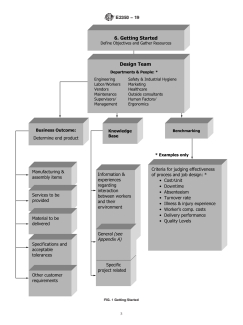
6. Getting Started (see Fig. 1)
6.1 Design Team—Identify the departments or individuals
4. Summary of Guide
or both who should be on the design team or consulted during
4.1 This guide facilitates the integration of ergonomic the design process. They include representatives of those who
principles into the design of occupational systems. It is are involved or affected by the design. Design team members
assumed that there will be more than one iteration of the may include representatives from engineering, labor,
process, proceeding from the general and becoming more maintenance, marketing, vendors, safety and health
detailed with each iteration. The number of iterations will professionals, and so forth, as appropriate.
depend on the complexity of the process.
6.2 Allocate Responsibility—Appoint members of the de-
sign team to be responsible for maintaining the knowledge
4.2 Theevaluationbeginsbydefiningthebusinessoutcome,
bases, benchmarking, and the scheduling and performing of
that is, the essential qualities and quantities of the end product
periodic audits.
or service.
6.3 Business Outcome—Determine the desired and essential
4.3 After identifying the required process elements (physi-
attributes of the end product or service of the occupational
cal and operational components), tasks are allocated to ma-
system. The essential attributes of the end product or service
chines or workers.
determine what can and cannot be altered during the design
4.4 The jobs are then analyzed to determine if they exceed
process. They may include:
worker capabilities and limitations.
6.3.1 Manufacturing and assembly items,
4.5 Depending on the results of the analysis, the business
6.3.2 Services to be provided,
outcome or jobs may be modified or action deferred to a later 6.3.3 Material to be delivered to the customer,
iteration. 6.3.4 Specifications and acceptable tolerances,
6.3.5 Quality levels (allowable percentage of defects), and
4.6 Throughout the process, the knowledge gained is added
6.3.6 The quantity of the product to be produced, including
to the knowledge base.
projections of future requirements.
4.7 The operational audit evaluates the system as the design
6.4 Knowledge Base—Establish a knowledge base. Once a
nears completion. It identifies and evaluates those issues either
formal knowledge base exists, it will be used as a resource for
not considered or not apparent in previous stages. After the
the design project. Because experience gained during each
systemisoperational,periodicauditsevaluatetheeffectiveness
project will be added to the knowledge base, it will grow and
of the design.
become essential to the design process. It includes the general,
internal, and project knowledge bases. When first beginning to
5. Significance and Use
use this guide, it will be helpful to investigate similar occupa-
5.1 Integrating ergonomic principles into new occupational
tional processes to see how problems were resolved and to
systems may help businesses develop processes that do not
identify experiences not added to the knowledge base. See
exceed worker capabilities and limitations.
Section 3 for more information.
5.2 Jobs and tasks that conform to worker capabilities and 6.5 Benchmarking—Identify benchmarks by which to judge
limitations may be performed more efficiently, safely, and the effectiveness of the process or design. Benchmarks may
consistently than those that do not. include cost per unit, downtime, absenteeism, turnover rate,
E2350 − 19
FIG. 1 Getting Started
E2350 − 19
workers’ compensation costs, illness and injury experience, tion so that the requirements do not exceed worker capabilities
and delivery performance. and limitations, plan for controls at a later stage, or include
other considerations that may help decide if changes are
7. Evaluation of Process Elements needed. In this event, several steps can be taken:
(1) Estimate the relative likelihood or severity of loss or
7.1 The evaluation of process elements is iterative (see Fig.
failure.
2). It begins with a broad identification of the issues and
(2) Determine if controls are feasible.
becomes more detailed with each iteration. Because each
(3) Determineifcontrolscanbeaddedatalaterstageinthe
process is unique, this guide does not specify the number of
process so that action is not required during this stage.
iterations or what should be addressed in each iteration.
(4) Identifypossiblebenefitsofmodificationorchangethat
Examples of issues to address may be found in Appendix X1.
could generate a value added return when combined with
7.1.1 Identify Physical Components—Identify equipment,
worker performance gains.
machinery, materials, facilities, work environment, and so
(5) Reexamine the business outcome.
forth. Examples of elements to consider may be found in
(6) Assess validity of underlying assumptions to future
Appendix X1.
business.
7.1.2 Identify Operational Components—Identify opera-
tional procedures and process elements: production methods,
8. Audit
manufacturing and assembly activities, cycle times, materials
8.1 At the completion of the evaluation, perform an audit of
handling, quality control, and so forth. Examples of elements
the business outcome; all processes, steps, and activities; and
to consider may be found in Appendix X1.
task allocations. This check will help determine if earlier
7.1.3 Task Allocation—Allocate tasks to workers or ma-
evaluations correctly identified and controlled the ergonomic
chines. This will be based primarily on the knowledge base,
issues. If decisions made in the evaluation of process elements
that is, experience with similar designs.
result in jobs that exceed or might exceed workers’ capabilities
7.1.4 Job Evaluation—Determinetheworkforcecapabilities
and limitations, the steps in Section 7 shall be repeated and
and limitations that will be required by the process. Analyze
appropriate corrections made.
the anticipated performance requirements of the processes.
8.1.1 Operational and Physical Components Audit—Does
Evaluate the jobs and conduct an occupational ergonomic risk
the project knowledge base identify any issues not addressed
analysis. Examples of elements to consider may be found in
during earlier stages?
Appendix X1.
8.1.2 Worker-Task Interaction Audit—Have all jobs and
7.1.4.1 If worker capabilities or limitations are not
tasks been evaluated for performance requirements and com-
exceeded—Add the information to the project knowledge base
pared to the knowledge base?
and continue to the next level of evaluation.
8.1.2.1 If worker capabilities or limitations are not
7.1.4.2 If worker capabilities or limitations are exceeded—
exceeded—Addthisinformationtotheprojectknowledgebase,
Modify the business outcome, task allocation, or add controls
and complete the evaluation by scheduling a follow-up audit.
(engineering or administrative or both).
8.1.2.2 If worker capabilities or limitations are exceeded—
(1) Change the business outcome—It may be possible to
Makechangestobringperformancewithinworkercapabilities.
modify the product or service as defined in the business
outcome.
9. Periodic Audit
(2) Modify the task allocation—Review the task allocation
9.1 Schedule audits on a periodic basis.
and, if possible, modify those issues that have caused the
9.2 Compare the performance of the system to the bench-
conflict, including engineering or administrative controls, or
marks established in 6.5.
both, or reallocation of tasks to machines.After modifying the
task allocation, repeat the analysis.
9.3 Particular attention should be paid to monitoring those
(3) Defer action—If the task allocation cannot be altered,
jobs or tasks where changes have resulted in conditions that
defer action to a later iteration.
may exceed workers’ capabilities and limitations.
7.1.4.3 If no conclusion can be easily reached or if the
10. Keywords
extent of worker interaction has not yet been determined—If
there is insufficient knowledge or if the job demands appear to 10.1 ergonomics; human factors; occupational system; pro-
be close to performance limits, either modify the task alloca- cess design; work; work evaluation
E2350 − 19
FIG. 2 Evaluation of Process Elements
E2350 − 19
APPENDIXES
(Nonmandatory Information)
X1. TERMINOLOGY EXAMPLES
X1.1 Benchmarks Physical components
Forming equipment
X1.1.1 The following is a nonexclusive list of benchmarks
Fastening equipment
that may be appropriate to consider in the implementation of
Materials-handling equipment
this guide.
Packaging equipment
Cost per unit
Assembly stations or lines
Downtime
Materials storage
Absenteeism
Work area layout and interface with other equipment, such
Turnover rate
as conveyors or other process machinery
Delivery performance
Forces anticipated in handling and assembly
Workers’ compensation, illness, and injury experience
Walking/standing surfaces
Other
Clearances
X1.1.2 Design Team—The following is a nonexclusive list
Process equipment
of potential members of the design team.
Tools, tool design, tool specifications, and tool application
Engineering
Storage location, heights, depths
Human factors and ergonomics
Transport and materials movement equipment
Labor/workers
Weights and dimensions of incoming materials
Maintenance
Weightsanddimensionsofcompletedproductsorsubcom-
Marketing
ponents
Supervisors/managers
Lighting
Vendors
Heating
Healthcare providers
Workstations
Other
Visual display terminals
Seating
X1.1.3 Administrative Controls—The following is a nonex-
Keyboards and other input devices
clusive list of administrative controls that may be appropriate
Other
to consider in the implementation of the guideline.
X1.1.5.2 Operational Factors:
Employee rotation
Job enlargement Raw material receiving
Material handling
Employer-authorized changes in the pace of work
Other Assembly activities
Production methods
X1.1.4 Engineering Controls—Thefollowingisanonexclu-
Packaging and shipping
sive list of engineering controls that may be appropriate to
Inspection and quality control
consider in the implementation of the guideline.
Machine operation
Workstation modifications
Transportation needs
Changes to tools or equipment
Work organization, including training and individual and
Facility redesigns
supervisory responsibilities
Altering production p
...
This document is not an ASTM standard and is intended only to provide the user of an ASTM standard an indication of what changes have been made to the previous version. Because
it may not be technically possible to adequately depict all changes accurately, ASTM recommends that users consult prior editions as appropriate. In all cases only the current version
of the standard as published by ASTM is to be considered the official document.
´1
Designation: E2350 − 07 (Reapproved 2013) E2350 − 19
Standard Guide for
Integration of Ergonomics/Human Factors into New
Occupational Systems
This standard is issued under the fixed designation E2350; the number immediately following the designation indicates the year of
original adoption or, in the case of revision, the year of last revision. A number in parentheses indicates the year of last reapproval. A
superscript epsilon (´) indicates an editorial change since the last revision or reapproval.
ε NOTE—Editorially corrected the Appendix in February 2015.
1. Scope
1.1 This guide is intended to assist in the integration of ergonomic principles into the design and planning of new occupational
systems from the earliest design stages through implementation. Doing so may reduce or eliminate the necessity for later redesign
that could have been foreseen.
1.2 This standard does not purport to address all of the safety concerns, if any, associated with its use. It is the responsibility
of the user of this standard to establish appropriate safety safety, health, and healthenvironmental practices and determine the
applicability of regulatory limitations prior to use.
1.3 This international standard was developed in accordance with internationally recognized principles on standardization
established in the Decision on Principles for the Development of International Standards, Guides and Recommendations issued
by the World Trade Organization Technical Barriers to Trade (TBT) Committee.
2. Referenced Documents
2.1 ASTM Standards:
E1542 Terminology Relating to Occupational Health and Safety
3. Terminology
3.1 For definitions not in this standard related to this guide, refer to Terminology E1542.
3.2 Definitions:
3.2.1 administrative controls, n—work practices and policies that are implemented with the objective of enhancing human
well-being and overall system performance through the way work is assigned or scheduled; examples may be found in Appendix
X1.
3.2.2 benchmarking, v—identifying of best practices against which to compare the effectiveness of a process or design;
examples may be found in Appendix X1.
3.2.3 business outcome, n—required products or services or both, that is, the desired and essential qualities and quantities of the
end product of the occupational system.
3.2.4 design team, n—departments or individuals or both involved in or consulted during the design process, including
representatives of those who are involved or affected by the design; examples may be found in Appendix X1.
3.2.5 engineering controls, n—physical changes to jobs that are implemented with the objective of enhancing human well-being
and overall system performance through the design and modification of the work equipment, facilities, or processes, or
combinations thereof; examples may be found in Appendix X1.
3.2.6 ergonomics/human factors, n—scientific discipline concerned with the understanding of interactions among humans and
other elements of a system and the profession that applies theory, principles, data, and methods to design to optimize human
well-being and overall system performance. (International Ergonomics Society) (International Ergonomics Society)
This guide is under the jurisdiction of ASTM Committee E34 on Occupational Health and Safety and is the direct responsibility of Subcommittee E34.80 on Industrial
Heath.
Current edition approved July 1, 2013Aug. 15, 2019. Published July 2013August 2019. Originally approved in 2007. Last previous edition approved in 20072013 as E2350
- 07. DOI: 10.1520/E2350-07R13E01.– 07 (2013). DOI: 10.1520/E2350-19.
For referenced ASTM standards, visit the ASTM website, www.astm.org, or contact ASTM Customer Service at service@astm.org. For Annual Book of ASTM Standards
volume information, refer to the standard’s Document Summary page on the ASTM website.
Copyright © ASTM International, 100 Barr Harbor Drive, PO Box C700, West Conshohocken, PA 19428-2959. United States
E2350 − 19
3.2.7 job, n—set of tasks performed by one or more workers.
3.2.8 knowledge base, n—organized body of information applicable to the integration of ergonomics into new occupational
systems, including both general ergonomic resources, such as those found in the bibliography, and the experiences of the
organization.
3.2.8.1 general knowledge base, n—ergonomic textbooks, guidelines, recommendations, reports of other companies’ ergonomic
programs, and so forth.
3.2.8.2 internal knowledge base, n—organized account of the organization’s positive and negative experiences with
occupational processes.
3.2.8.3 project knowledge base, n—working collection of experiences for the current project in which decisions made at each
stage are added to the project knowledge base for use at later design stages, and after the completion of a project, the project
knowledge base is integrated into the internal knowledge base.
3.2.9 occupational ergonomic risk analysis, n—occupational ergonomic risk analysis may include, but is not limited to, the
evaluation of force (including dynamic motion), repetition, awkward or static postures, contact stress, vibration, and physiological
and environmental factors such as temperature and other ambient air conditions and occupational ergonomic risks can be affected
by workers’ lifestyles and other nonoccupational risk elements.
3.2.10 occupational system, n—integrated collection of personnel, facilities, equipment, tools, raw materials, techniques, and
other resources organized to produce a product or service.
3.2.11 task, n—group of related activities that comprises a component of a job.
3.2.12 workers’ capabilities and limitations, n—those personal characteristics that workers bring to a job, such as:
Physical strength, endurance, agility, and skill and
Mental abilities, techniques, and knowledge developed through training, experience, and education. Examples may be found in
Appendix X1.
4. Summary of Guide
4.1 This guide facilitates the integration of ergonomic principles into the design of occupational systems. It is assumed that there
will be more than one iteration of the process, proceeding from the general and becoming more detailed with each iteration. The
number of iterations will depend on the complexity of the process.
4.2 The evaluation begins by defining the business outcome, that is, the essential qualities and quantities of the end product or
service.
4.3 After identifying the required process elements (physical and operational components), tasks are allocated to machines or
workers.
4.4 The jobs are then analyzed to determine if they exceed worker capabilities and limitations.
4.5 Depending on the results of the analysis, the business outcome or jobs may be modified or action deferred to a later iteration.
4.6 Throughout the process, the knowledge gained is added to the knowledge base.
4.7 The operational audit evaluates the system as the design nears completion. It identifies and evaluates those issues either not
considered or not apparent in previous stages. After the system is operational, periodic audits evaluate the effectiveness of the
design.
5. Significance and Use
5.1 Integrating ergonomic principles into new occupational systems may help businesses develop processes that do not exceed
worker capabilities and limitations.
5.2 Jobs and tasks that conform to worker capabilities and limitations may be performed more efficiently, safely, and
consistently than those that do not.
5.3 The application of ergonomic principles to the processes involved in occupational systems may help avoid system failures
and inefficiencies.
5.4 The integration of ergonomic principles at the earliest stages of process concept and design may facilitate appropriate
design, layout, and allocation of resources and may reduce or eliminate the necessity for later redesign that could have been
foreseen.
5.5 Designing jobs that fit the capabilities of larger population segments may increase an organization’s accessibility to the
available labor pool.
5.6 The integration of ergonomic principles into occupational systems may increase profit by lowering direct and indirect costs
associated with preventable losses, injuries, and illnesses.
E2350 − 19
5.7 The bibliography contains a list of reference materials that may be useful in particular applications. All appendixes are
nonmandatory.
6. Getting Started (see Fig. 1)
6.1 Design Team—Identify the departments or individuals or both who should be on the design team or consulted during the
design process. They include representatives of those who are involved or affected by the design. Design team members may
include representatives from engineering, labor, maintenance, marketing, vendors, safety and health professionals, and so forth, as
appropriate.
6.2 Allocate Responsibility—Appoint members of the design team to be responsible for maintaining the knowledge bases,
benchmarking, and the scheduling and performing of periodic audits.
6.3 Business Outcome—Determine the desired and essential attributes of the end product or service of the occupational system.
The essential attributes of the end product or service determine what can and cannot be altered during the design process. They
may include:
6.3.1 Manufacturing and assembly items,
6.3.2 Services to be provided,
6.3.3 Material to be delivered to the customer,
6.3.4 Specifications and acceptable tolerances,
6.3.5 Quality levels (allowable percentage of defects), and
6.3.6 The quantity of the product to be produced, including projections of future requirements.
6.4 Knowledge Base—Establish a knowledge base. Once a formal knowledge base exists, it will be used as a resource for the
design project. Because experience gained during each project will be added to the knowledge base, it will grow and become
essential to the design process. It includes the general, internal, and project knowledge bases. When first beginning to use this
guide, it will be helpful to investigate similar occupational processes to see how problems were resolved and to identify
experiences not added to the knowledge base. See Section 23 for more information.
6.5 Benchmarking—Identify benchmarks by which to judge the effectiveness of the process or design. Benchmarks may include
cost per unit, downtime, absenteeism, turnover rate, workers’ compensation costs, illness and injury experience, and delivery
performance.
7. Evaluation of Process Elements
7.1 The evaluation of process elements is iterative (see Fig. 2). It begins with a broad identification of the issues and becomes
more detailed with each iteration. Because each process is unique, this guide does not specify the number of iterations or what
should be addressed in each iteration. Examples of issues to address may be found in Appendix X1.
7.1.1 Identify Physical Components—Identify equipment, machinery, materials, facilities, work environment, and so forth.
Examples of elements to consider may be found in Appendix X1.
7.1.2 Identify Operational Components—Identify operational procedures and process elements: production methods, manufac-
turing and assembly activities, cycle times, materials handling, quality control, and so forth. Examples of elements to consider may
be found in Appendix X1.
7.1.3 Task Allocation—Allocate tasks to workers or machines. This will be based primarily on the knowledge base, that is,
experience with similar designs.
7.1.4 Job Evaluation—Determine the workforce capabilities and limitations that will be required by the process. Analyze the
anticipated performance requirements of the processes. Evaluate the jobs and conduct an occupational ergonomic risk analysis.
Examples of elements to consider may be found in Appendix X1.
7.1.4.1 If worker capabilities or limitations are not exceeded—Add the information to the project knowledge base and continue
to the next level of evaluation.
7.1.4.2 If worker capabilities or limitations are exceeded—Modify the business outcome, task allocation, or add controls
(engineering or administrative or both).
(1) Change the business outcome—It may be possible to modify the product or service as defined in the business outcome.
(2) Modify the task allocation—Review the task allocation and, if possible, modify those issues that have caused the conflict,
including engineering or administrative controls, or both, or reallocation of tasks to machines. After modifying the task allocation,
repeat the analysis.
(3) Defer action—If the task allocation cannot be altered, defer action to a later iteration.
7.1.4.3 If no conclusion can be easily reached or if the extent of worker interaction has not yet been determined—If there is
insufficient knowledge or if the job demands appear to be close to performance limits, either modify the task allocation so that the
requirements do not exceed worker capabilities and limitations, plan for controls at a later stage, or include other considerations
that may help decide if changes are needed. In this event, several steps can be taken:
(1) Estimate the relative likelihood or severity of loss or failure.
(2) Determine if controls are feasible.
E2350 − 19
FIG. 1 Getting Started
E2350 − 19
FIG. 2 Evaluation of Process Elements
E2350 − 19
(3) Determine if controls can be added at a later stage in the process so that action is not required during this stage.
(4) Identify possible benefits of modification or change that could generate a value added return when combined with worker
performance gains.
(5) Reexamine the business outcome.
(6) Assess validity of underlying assumptions to future business.
8. Audit
8.1 At the completion of the evaluation, perform an audit of the business outcome; all processes, steps, and activities; and task
allocations. This check will help determine if earlier evaluations correctly identified and controlled the ergonomic issues. If
decisions made in the evaluation of process elements result in jobs that exceed or might exceed workers’ capabilities and
limitations, the steps in Section 67 shall be repeated and appropriate corrections made.
8.1.1 Operational and Physical Components Audit—Does the project knowledge base identify any issues not addressed during
earlier stages?
8.1.2 Worker-Task Interaction Audit—Have all jobs and tasks been evaluated for performance requirements and compared to the
knowledge base?
8.1.2.1 If worker capabilities or limitations are not exceeded—Add this information to the project knowledge base, and
complete the evaluation by scheduling a follow up follow-up audit.
8.1.2.2 If worker capabilities or limitations are exceeded—Make changes to bring performance within worker capabilities.
9. Periodic Audit
9.1 Schedule audits on a periodic basis.
9.2 Compare the performance of the system to the benchmarks established in 5.56.5.
9.3 Particular attention should be paid to monitoring those jobs or tasks where changes have resulted in conditions that may
exceed workers’ capabilities and limitations.
10. Keywords
10.1 ergonomics; human factors; occupational system; process design; work; work evaluation
E2350 − 19
APPENDIXES
(Nonmandatory Information)
X1. TERMINOLOGY EXAMPLES
X1.1 Benchmarks
X1.1.1 The following is a nonexclusive list of benchmarks that may be appropriate to consider in the implementation of this guide.
Cost per unit
Downtime
Absenteeism
Turnover rate
Delivery performance
Workers’ compensation, illness, and injury experience
Other
X1.1.2 Design Team Team—The following is a nonexclusive list of potential members of the design team.
engineeringEngineering
humanHuman factors and ergonomics
labor/workersLabor/workers
maintenanceMaintenance
marketingMarketing
supervisors/managersSupervisors/managers
vendorsVendors
healthcareHealthcare providers
otherOther
X1.1.3 Administrative Controls Controls—The following is a nonexclusive list of administrative controls that may be appropriate
to consider in the implementation of the guideline.
employeeEmployee rotation
jobJob enlargement
employer-authorizedEmployer-authorized changes in the pace of work
otherOther
X1.1.4 Engineering Controls Controls—The following is a nonexclusive list of engineering controls that may be appropriate to
consider in the implementation of the guideline.
workstationWorkstation modifications
changesChanges to tools or equipment
facilityFacility redesigns
alteringAltering production processes
changingChanging or modifying the materials used in the process
otherOther
X1.1.5 Operational and Physical Factors Factors—The following is a nonexclusive list of operational and physical factors that
may be appropriate to consider in the implementation of this guide.
X1.1.5.1 Physical Factors:
productProduct and subassembly quality issues and needs
productionProduction demands and production output needs
materialsMaterials
equipmentEquipment
spaceSpace and storage requirements
productProduct assembly or subassembly size, shape, and weight
physicalPhysical components
E2350 − 19
formingForming equipment
fasteningFastening equipment
materials handling Materials-handling equipment
packagingPackaging equipment
assemblyAssembly stations or lines
materialsMaterials storage
workWork area layout and interface with other equipment, such as conveyors or other process machinery
forcesForces anticipated in handling and assembly
walking/standingWalking/standing surfaces
clearancesClearances
processProcess equipment
tools,Tools, tool design, tool specifications, and tool application
storageStorage
...