


ASTM B354-23
(Terminology)Standard Terminology Relating to Uninsulated Metallic Electrical Conductors
Standard Terminology Relating to Uninsulated Metallic Electrical Conductors
SCOPE
1.1 This terminology standard defines abbreviations and terms specific to uninsulated electrical conductors. For terms relating to superconductors, see Terminology B713.
1.2 This international standard was developed in accordance with internationally recognized principles on standardization established in the Decision on Principles for the Development of International Standards, Guides and Recommendations issued by the World Trade Organization Technical Barriers to Trade (TBT) Committee.
General Information
- Status
- Published
- Publication Date
- 31-Mar-2023
- Technical Committee
- B01 - Electrical Conductors
- Drafting Committee
- B01.01 - Editorial and Records
Relations
- Effective Date
- 01-Apr-2024
- Effective Date
- 01-Jan-2024
- Effective Date
- 01-Aug-2020
- Effective Date
- 01-Feb-2017
- Effective Date
- 01-Feb-2017
- Effective Date
- 15-Jul-2016
- Effective Date
- 01-Apr-2016
- Effective Date
- 01-Feb-2015
- Effective Date
- 01-Sep-2014
- Effective Date
- 01-Apr-2014
- Effective Date
- 01-Apr-2014
- Effective Date
- 01-Jun-2013
- Effective Date
- 01-Apr-2013
- Effective Date
- 01-Apr-2012
- Effective Date
- 01-Apr-2012
Overview
ASTM B354-23: Standard Terminology Relating to Uninsulated Metallic Electrical Conductors establishes a comprehensive set of definitions and abbreviations specific to the field of uninsulated electrical conductors made of metal. Developed by ASTM International, this standard serves as a critical reference for professionals involved in manufacturing, testing, specifying, and procuring metallic electrical conductors. The terminology aligns with internationally recognized principles of standardization, facilitating consistent communication across the electrical conductor industry and supporting compliance with regulatory and technical requirements worldwide.
Key Topics
ASTM B354-23 covers a broad array of terminology related to uninsulated metallic conductors, ensuring uniform understanding of essential concepts. Key topics include:
- Abbreviations and Acronyms: Standardizes commonly used terms, such as AAC (aluminum conductor), ACCR (aluminum conductor composite reinforced), and ACSR (aluminum conductor, steel reinforced), among many others.
- Definitions of Key Terms: Clarifies technical concepts, including conductors, wires, strands, annealing, breaking strength, lay, core, compact stranded conductor, and composite conductor.
- Stranding and Construction Types: Details various stranded conductor designs such as concentric-lay, bunch-stranded, rope-lay, unilay, and compact constructions.
- Material Properties: Explains important material characteristics, including conductivity (often referenced as % IACS), tensile strength, annealing, and resistivity.
- Testing and Processing Terms: Defines terms relevant to production and quality assurance, such as cold drawing, solution heat treatment, tensile tests, and solderability.
- Suffix Modifiers and Material Identifiers: Illustrates identification practices for differentiating conductor types by aluminum or core material, reinforcing the traceability of specific conductor constructions.
- Conductor Surface and Finish: Addresses non-specular finishes, galvanization, and coated or clad wire distinctions.
Applications
The terminology defined in ASTM B354-23 is fundamental for a wide spectrum of activities in the electrical conductor industry. Key applications include:
- Design and Specification: Assists engineers and designers in accurately specifying conductor types, constructions, and material requirements for power transmission, distribution, and other electrical installations.
- Procurement and Quality Control: Enables clear communication and purchasing specifications among manufacturers, suppliers, and buyers, reducing ambiguity and preventing errors.
- Manufacturing and Processing: Guides production personnel in interpreting construction methods, material treatments, and product labeling, ensuring products meet industry standards.
- Testing and Inspection: Supports laboratories and inspection agencies in applying consistent test methods and interpreting results as prescribed in referenced ASTM methods.
- Technical Documentation and Training: Acts as a reference in technical manuals, product datasheets, and educational programs, promoting shared understanding and upskilling within the sector.
Related Standards
ASTM B354-23 is part of a broader portfolio of standards related to the properties and testing of electrical conductors. Notable related standards include:
- ASTM B193: Test Method for Resistivity of Electrical Conductor Materials
- ASTM B230: Specification for Aluminum 1350–H19 Wire for Electrical Purposes
- ASTM B398/B398M: Specification for Aluminum-Alloy 6201 Wire for Electrical Purposes
- ASTM B609/B609M: Specification for Aluminum 1350 Round Wire
- ASTM B941: Specification for Heat Resistant Aluminum-Zirconium Alloy Wire
- ASTM B976: Specification for Fiber Reinforced Aluminum Matrix Composite Core Wire
- ASTM B978/B978M: Specification for Concentric-Lay-Stranded Aluminum Conductors, Composite Reinforced
- ASTM B987/B987M: Specification for Carbon Fiber Thermoset Polymer Matrix Composite Core
- ASTM E8/E8M: Test Methods for Tension Testing of Metallic Materials
For terms and definitions set specifically for superconductors, refer to ASTM B713, Terminology Relating to Superconductors.
ASTM B354-23 is an essential resource for maintaining precise, standardized communication in the field of uninsulated metallic electrical conductors, supporting interoperability, safety, and quality across the industry.
Buy Documents
ASTM B354-23 - Standard Terminology Relating to Uninsulated Metallic Electrical Conductors
REDLINE ASTM B354-23 - Standard Terminology Relating to Uninsulated Metallic Electrical Conductors
Get Certified
Connect with accredited certification bodies for this standard

Intertek Testing Services NA Inc.
Intertek certification services in North America.

UL Solutions
Global safety science company with testing, inspection and certification.

ANCE
Mexican certification and testing association.
Sponsored listings
Frequently Asked Questions
ASTM B354-23 is a standard published by ASTM International. Its full title is "Standard Terminology Relating to Uninsulated Metallic Electrical Conductors". This standard covers: SCOPE 1.1 This terminology standard defines abbreviations and terms specific to uninsulated electrical conductors. For terms relating to superconductors, see Terminology B713. 1.2 This international standard was developed in accordance with internationally recognized principles on standardization established in the Decision on Principles for the Development of International Standards, Guides and Recommendations issued by the World Trade Organization Technical Barriers to Trade (TBT) Committee.
SCOPE 1.1 This terminology standard defines abbreviations and terms specific to uninsulated electrical conductors. For terms relating to superconductors, see Terminology B713. 1.2 This international standard was developed in accordance with internationally recognized principles on standardization established in the Decision on Principles for the Development of International Standards, Guides and Recommendations issued by the World Trade Organization Technical Barriers to Trade (TBT) Committee.
ASTM B354-23 is classified under the following ICS (International Classification for Standards) categories: 01.040.29 - Electrical engineering (Vocabularies); 29.050 - Superconductivity and conducting materials. The ICS classification helps identify the subject area and facilitates finding related standards.
ASTM B354-23 has the following relationships with other standards: It is inter standard links to ASTM B941-24, ASTM E8/E8M-24, ASTM B987/B987M-20, ASTM B987/B987M-17, ASTM B987/B987M-17e1, ASTM E8/E8M-16, ASTM B193-16, ASTM E8/E8M-15, ASTM B987/B987M-14, ASTM B193-02(2014), ASTM B398/B398M-14, ASTM E8/E8M-13, ASTM B398/B398M-02(2013), ASTM B609/B609M-12, ASTM B609/B609M-12e1. Understanding these relationships helps ensure you are using the most current and applicable version of the standard.
ASTM B354-23 is available in PDF format for immediate download after purchase. The document can be added to your cart and obtained through the secure checkout process. Digital delivery ensures instant access to the complete standard document.
Standards Content (Sample)
This international standard was developed in accordance with internationally recognized principles on standardization established in the Decision on Principles for the
Development of International Standards, Guides and Recommendations issued by the World Trade Organization Technical Barriers to Trade (TBT) Committee.
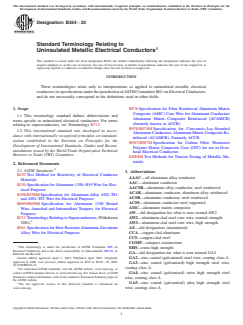
Designation: B354 − 23
Standard Terminology Relating to
Uninsulated Metallic Electrical Conductors
This standard is issued under the fixed designation B354; the number immediately following the designation indicates the year of
original adoption or, in the case of revision, the year of last revision. A number in parentheses indicates the year of last reapproval. A
superscript epsilon (´) indicates an editorial change since the last revision or reapproval.
INTRODUCTION
These terminologies relate only to interpretations as applied to uninsulated metallic electrical
conductors in specifications under the jurisdiction of ASTM Committee B01 on Electrical Conductors,
and do not necessarily correspond to the definitions used in other fields.
1. Scope B976 Specification for Fiber Reinforced Aluminum Matrix
Composite (AMC) Core Wire for Aluminum Conductors
1.1 This terminology standard defines abbreviations and
Aluminum Matrix Composite Reinforced (ACAMCR)
terms specific to uninsulated electrical conductors. For terms
(formerly known as ACCR)
relating to superconductors, see Terminology B713.
B978/B978M Specification for Concentric-Lay-Stranded
1.2 This international standard was developed in accor-
Aluminum Conductors, Aluminum Matrix Composite Re-
dance with internationally recognized principles on standard-
inforced (ACAMCR), Formerly ACCR
ization established in the Decision on Principles for the
B987/B987M Specification for Carbon Fiber Thermoset
Development of International Standards, Guides and Recom-
Polymer Matrix Composite Core (CFC) for use in Over-
mendations issued by the World Trade Organization Technical
head Electrical Conductors
Barriers to Trade (TBT) Committee.
E8/E8M Test Methods for Tension Testing of Metallic Ma-
terials
2. Referenced Documents
2.1 ASTM Standards:
3. Abbreviations
B193 Test Method for Resistivity of Electrical Conductor
AAAC—all aluminum alloy conductor
Materials
AAC—aluminum conductor
B230 Specification for Aluminum 1350–H19 Wire for Elec-
AACSR—aluminum alloy conductor, steel reinforced
trical Purposes
ACAR—aluminum conductor, aluminum alloy reinforced
B398/B398M Specification for Aluminum-Alloy 6201-T81
ACSR—aluminum conductor, steel reinforced
and 6201-T83 Wire for Electrical Purposes
ACSS—aluminum conductor steel supported
B609/B609M Specification for Aluminum 1350 Round
AMC—aluminum matrix composite
Wire, Annealed and Intermediate Tempers, for Electrical
AW—old designation for what is now termed AW2
Purposes
AW2—aluminum-clad steel core wire, normal strength
B713 Terminology Relating to Superconductors (Withdrawn
AW3—aluminum-clad steel core wire, high strength
2001)
B941 Specification for Heat Resistant Aluminum-Zirconium
AZ—old designation (aluminized)
Alloy Wire for Electrical Purposes
CCA—copper-clad aluminum
CCS—copper-clad steel
COMP—compact construction
This terminology is under the jurisdiction of ASTM Committee B01 on
EHS—extra high strength
Electrical Conductors and is the direct responsibility of Subcommittee B01.01 on
GA—old designation for what is now termed GA2
Editorial and Records.
Current edition approved April 1, 2023. Published April 2023. Originally
GA2—zinc coated (galvanized) steel wire, coating class A
approved in 1960. Last previous edition approved in 2019 as B354 – 19. DOI:
GA3—zinc coated (galvanized) high strength steel wire,
10.1520/B0354-23.
2 coating class A
For referenced ASTM standards, visit the ASTM website, www.astm.org, or
contact ASTM Customer Service at service@astm.org. For Annual Book of ASTM
GA4—zinc coated (galvanized) extra high strength steel
Standards volume information, refer to the standard’s Document Summary page on
wire, coating class A
the ASTM website.
GA5—zinc coated (galvanized) ultra high strength steel
The last approved version of this historical standard is referenced on
www.astm.org. wire, coating class A
Copyright © ASTM International, 100 Barr Harbor Drive, PO Box C700, West Conshohocken, PA 19428-2959. United States
B354 − 23
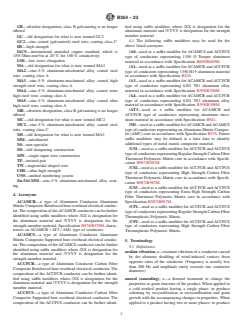
GB—obsolete designation, class B galvanizing is no longer fied using suffix modifiers where /XX is designation for the
offered aluminum material and /YYYY is designation for the strength
member material.
GC—old designation for what is now termed GC2
4.1 The following suffix modifiers may be used for the
GC2—zinc coated (galvanized) steel wire, coating class C
above listed acronyms.
HS—high strength
IACS—international annealed copper standard, which is
/A0—used as a suffix modifier for ACAMCS and ACCFCS
1/58 Ohm-mm /m at 20 °C for 100 % conductivity
type of conductors representing 1350 O Temper aluminum
LSE—low stress elongation
material in accordance with Specification B609/B609M.
MA—old designation for what is now termed MA2
/A1—used as a suffix modifier for ACAMCR and ACCFCR
MA2—zinc-5 % aluminum-mischmetal alloy coated steel type of conductors representing 1350 H19 aluminum material
wire, coating class A
in accordance with Specification B230.
MA3—zinc-5 % aluminum-mischmetal alloy coated high
/A3—used as a suffix modifier for ACAMCR and ACCFCR
strength steel wire, coating class A type of conductors representing 6201 T81 aluminum alloy
material in accordance with Specification B398/B398M.
MA4—zinc-5 % aluminum-mischmetal alloy coated extra
high steel wire, coating class A /A4—used as a suffix modifier for ACAMCR and ACCFCR
MA5—zinc-5 % aluminum-mischmetal alloy coated ultra type of conductors representing 6201 T83 aluminum alloy
material in accordance with Specification B398/B398M.
high steel wire, coating class A
/AT3—used as a suffix modifier for ACAMCR and
MB—obsolete designation, class B galvanizing is no longer
offered ACCFCR type of conductors representing aluminum zirco-
nium material in accordance with Specification B941.
MC—old designation for what is now termed MC2
/M1—used as a suffix modifier for ACAMCR and ACAMCS
MC2—zinc-5 % aluminum-mischmetal alloy coated steel
type of conductors representing an Aluminum Matrix Compos-
wire, coating class C
ite (AMC) core in accordance with Specification B976. Future
MS—old designation for what is now termed MA3
suffix modifiers may be defined at a later date to identify
MM—mischmetal
additional types of metal matrix composite material.
NS—non-specular
/CS1—used as a suffix modifier for ACCFCR and ACCFCS
SD—self dampening construction
type of conductors representing Regular Strength Carbon Fiber
SIW—single input wire construction
Thermoset Polymeric Matrix core in accordance with Specifi-
TP—twisted pair
cation B987/B987M.
TW—trapezoidal shaped wire
/CS2—used as a suffix modifier for ACCFCR and ACCFCS
UHS—ultra high strength
type of conductors representing High Strength Carbon Fiber
UNS—unified numbering system
Thermoset Polymeric Matrix core in accordance with Specifi-
Zn-5Al-MM—zinc-5 % aluminum-mischmetal alloy coat-
cation B987/B987M.
ing
/CS3—used as a suffix modifier for ACCFCR and ACCFCS
type of conductors representing Extra High Strength Carbon
4. Acronyms
Fiber Thermoset Polymeric Matrix core in accordance with
ACAMCR—a type of Aluminum Conductor Aluminum
Specification B987/B987M.
Matrix Composite Reinforced bare overhead electrical conduc-
/CP1—used as a suffix modifier for ACCFCR and ACCFCS
tor. The composition of the ACAMCR conductor can be further
type of conductors representing Regular Strength Carbon Fiber
identified using suffix modifiers where /XX is designation for
Thermoplastic Polymeric Matrix.
the aluminum material and /YYYY is designation for the
/CP2—used as a suffix modifier for ACCFCR and ACCFCS
strength member material. Specification B978/B978M charac-
type of conductors representing High Strength Carbon Fiber
terizes an ACAMCR / AT3 / AM1 type of conductor.
Thermoplastic Polymeric Matrix.
ACAMCS—a type of Aluminum Conductor Aluminum
Matrix Composite Supported bare overhead electrical conduc-
5. Terminology
tor. The composition of the ACAMCS conductor can be further
5.1 Definitions:
identified using suffix modifiers where /XX is designation for
aeolian vibration, n—resonant vibration of a conductor caused
the aluminum material and /YYYY is designation for the
by the alternate shedding of wind-induced vortices from
strength member material.
opposite sides of the conductor. (Frequency is usually less
ACCFCR—a type of Aluminum Conductor Carbon Fiber
than 200 Hz and amplitude rarely exceeds one conductor
Composite Reinforced bare overhead electrical conductor. The
diameter.)
composition of the ACCFCR conductor can be further identi-
fied using suffix modifiers where /XX is designation for the
anneal (annealing), n—a thermal treatment to change the
aluminum material and /YYYY is designation for the strength
properties or grain structure of the product. When applied to
member material.
a cold-worked product having a single phase: to produce
ACCFCS—a type of Aluminum Conductor Carbon Fiber softening by recystallization or recrystallization and grain
Composite Supported bare overhead electrical conductor. The growth with the accompanying changes in properties. When
composition of the ACCFCS conductor can be further identi- applied to a product having two or more phases: to produce
B354 − 23
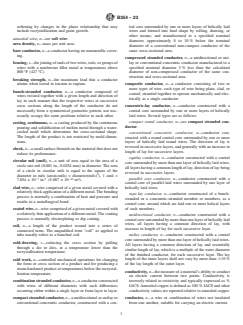
softening by changes in the phase relationship that may tral core surrounded by one or more layers of helically laid
include recrystallization and grain growth. wires and formed into final shape by rolling, drawing, or
other means; and manufactured to a specified nominal
annealed wire, n—see soft wire.
diameter, approximately 8 to 10 % below the nominal
area density, n—mass per unit area.
diameter of a conventional non-compact conductor of the
bare conductor, n—a conductor having no nonmetallic cover- same cross-sectional area.
ing.
compressed stranded conductor, n—a unidirectional or uni-
brazing, v—the joining of ends of two wires, rods, or groups of lay or conventional concentric conductor manufactured to a
specified nominal diameter 3 % less than the calculated
wires with a nonferrous filler metal at temperatures above
800 °F (427 °C). diameter of non-compressed conductor of the same con-
struction and cross-sectional area.
breaking strength, n—the maximum load that a conductor
attains when tested in tension to rupture. composite conductor, n—a conductor consisting of two or
more types of wire, each type of wire being plain, clad, or
bunch-stranded conductor, n—a conductor composed of
coated; stranded together to operate mechanically and elec-
wires twisted together with a given length and direction of
trically as a single conductor.
lay in such manner that the respective wires at successive
cross sections along the length of the conductor do not
concentric-lay conductor, n—conductor constructed with a
necessarily form a symmetrical geometric pattern, nor nec-
central core surrounded by one or more layers of helically
essarily occupy the same positions relative to each other. laid wires. Several types are as follows:
compact round conductor, n—see compact stranded con-
casting, continuous, n—a casting produced by the continuous
ductor.
pouring and solidification of molten metal through a water-
cooled mold which determines the cross-sectional shape.
conventional concentric conductor, n—conductor con-
The length of the product is not restricted by mold dimen-
structed with a round central core surrounded by one or more
sions.
layers of helically laid round wires. The direction of lay is
reversed in successive layers, and generally with an increase in
check, n—a small surface blemish on the material that does not
length of lay for successive layers.
reduce its performance.
equilay conductor, n—conductor constructed with a central
circular mil (cmil), n—a unit of area equal to the area of a
core surrounded by more than one layer of helically laid wires,
circle one mil (0.001 in., 0.0254 mm) in diameter. The area
all layers having a common length of lay, direction of lay being
of a circle in circular mils is equal to the square of the
reversed in successive layers.
diameter in mils (area(cmils) = diameter(mils) ), 1 cmil =
−7 2 −10 2
parallel core conductor, n—conductor constructed with a
7.854 × 10 in. (5.067 × 10 m ).
central core of parallel-laid wires surrounded by one layer of
clad wire, n—wire comprised of a given metal covered with a
helically laid wires.
relatively thick application of a different metal. The bonding
rope-lay conductor, n—conductor constructed of a bunch-
process is normally a combination of heat and pressure and
stranded or a concentric-stranded member or members, as a
results in a metallurgical bond.
central core, around which are laid one or more helical layers
of such members.
coated wire, n—wire comprised of a given metal covered with
a relatively thin application of a different metal. The coating
unidirectional conductor, n—conductor constructed with a
process is normally electroplating or dip coating.
central core surrounded by more than one layer of helically laid
wires, all layers having a common direction of lay, with
coil, n—a length of the product wound into a series of
increase in length of lay for each successive layer.
connected turns. The unqualified term “coil” as applied to
tube usually refers to a bunched coil. unilay conductor, n—conductor constructed with a central
core surrounded by more than one layer of helically laid wires.
cold-drawing, v—reducing the cross section by pulling
All layers having a common direction of lay and essentially
through a die or dies, at a temperature lower than the
similar length of lay, which is a multiple of the outer diameter
recrystallization temperature.
of the finished conductor, for each successive layer. The lay
length of the inner layers shall not vary by more than 610 %
cold work, n—controlled mechanical operations for changing
of the lay length of the outer layer.
the form or cross section of a product and for producing a
strain-hardened product at temperatures below the recrystal-
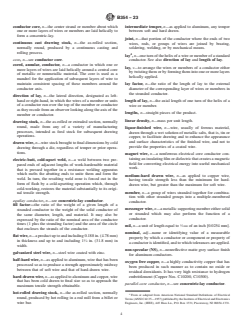
conductivity, n—the measure of a material’s ability to conduct
lization temperature.
an electric current between two points.
...
This document is not an ASTM standard and is intended only to provide the user of an ASTM standard an indication of what changes have been made to the previous version. Because
it may not be technically possible to adequately depict all changes accurately, ASTM recommends that users consult prior editions as appropriate. In all cases only the current version
of the standard as published by ASTM is to be considered the official document.
Designation: B354 − 19 B354 − 23
Standard Terminology Relating to
Uninsulated Metallic Electrical Conductors
This standard is issued under the fixed designation B354; the number immediately following the designation indicates the year of
original adoption or, in the case of revision, the year of last revision. A number in parentheses indicates the year of last reapproval. A
superscript epsilon (´) indicates an editorial change since the last revision or reapproval.
INTRODUCTION
These terminologies relate only to interpretations as applied to uninsulated metallic electrical
conductors in specifications under the jurisdiction of ASTM Committee B01 on Electrical Conductors,
and do not necessarily correspond to the definitions used in other fields.
1. Scope
1.1 This terminology standard defines abbreviations and terms specific to uninsulated electrical conductors. For terms relating to
superconductors, see Terminology B713.
1.2 This international standard was developed in accordance with internationally recognized principles on standardization
established in the Decision on Principles for the Development of International Standards, Guides and Recommendations issued
by the World Trade Organization Technical Barriers to Trade (TBT) Committee.
2. Referenced Documents
2.1 ASTM Standards:
B193 Test Method for Resistivity of Electrical Conductor Materials
B230 Specification for Aluminum 1350–H19 Wire for Electrical Purposes
B398/B398M Specification for Aluminum-Alloy 6201-T81 and 6201-T83 Wire for Electrical Purposes
B609/B609M Specification for Aluminum 1350 Round Wire, Annealed and Intermediate Tempers, for Electrical Purposes
B713 Terminology Relating to Superconductors (Withdrawn 2001)
B941 Specification for Heat Resistant Aluminum-Zirconium Alloy Wire for Electrical Purposes
B976 Specification for Fiber Reinforced Aluminum Matrix Composite (AMC) Core Wire for Aluminum Conductors Aluminum
Matrix Composite Reinforced (ACAMCR) (formerly known as ACCR)
B978/B978M Specification for Concentric-Lay-Stranded Aluminum Conductors, Aluminum Matrix Composite Reinforced
(ACAMCR), Formerly ACCR
B987/B987M Specification for Carbon Fiber Thermoset Polymer Matrix Composite Core (CFC) for use in Overhead Electrical
Conductors
E8/E8M Test Methods for Tension Testing of Metallic Materials
3. Abbreviations
AAAC—all aluminum alloy conductor
AAC—aluminum conductor
This terminology is under the jurisdiction of ASTM Committee B01 on Electrical Conductors and is the direct responsibility of Subcommittee B01.01 on Editorial and
Records.
Current edition approved Feb. 1, 2019April 1, 2023. Published February 2019April 2023. Originally approved in 1960. Last previous edition approved in 20162019 as
B354 – 16.B354 – 19. DOI: 10.1520/B0354-19.10.1520/B0354-23.
For referenced ASTM standards, visit the ASTM website, www.astm.org, or contact ASTM Customer Service at service@astm.org. For Annual Book of ASTM Standards
volume information, refer to the standard’s Document Summary page on the ASTM website.
The last approved version of this historical standard is referenced on www.astm.org.
Copyright © ASTM International, 100 Barr Harbor Drive, PO Box C700, West Conshohocken, PA 19428-2959. United States
B354 − 23
AACSR—aluminum alloy conductor, steel reinforced
ACAR—aluminum conductor, aluminum alloy reinforced
ACSR—aluminum conductor, steel reinforced
ACSS—aluminum conductor steel supported
AMC—aluminum matrix composite
AW—old designation for what is now termed AW2
AW2—aluminum-clad steel core wire, normal strength
AW3—aluminum-clad steel core wire, high strength
AZ—old designation (aluminized)
CCA—copper-clad aluminum
CCS—copper-clad steel
COMP—compact construction
EHS—extra high strength
GA—old designation for what is now termed GA2
GA2—zinc coated (galvanized) steel wire, coating class A
GA3—zinc coated (galvanized) high strength steel wire, coating class A
GA4—zinc coated (galvanized) extra high strength steel wire, coating class A
GA5—zinc coated (galvanized) ultra high strength steel wire, coating class A
GB—obsolete designation, class B galvanizing is no longer offered
GC—old designation for what is now termed GC2
GC2—zinc coated (galvanized) steel wire, coating class C
HS—high strength
IACS—international annealed copper standard, which is 1/58 Ohm-mm /m at 20°C20 °C for 100 % conductivity
LSE—low stress elongation
MA—old designation for what is now termed MA2
MA2—zinc-5 % aluminum-mischmetal alloy coated steel wire, coating class A
MA3—zinc-5 % aluminum-mischmetal alloy coated high strength steel wire, coating class A
MA4—zinc-5 % aluminum-mischmetal alloy coated extra high steel wire, coating class A
MA5—zinc-5 % aluminum-mischmetal alloy coated ultra high steel wire, coating class A
MB—obsolete designation, class B galvanizing is no longer offered
MC—old designation for what is now termed MC2
MC2—zinc-5 % aluminum-mischmetal alloy coated steel wire, coating class C
MS—old designation for what is now termed MA3
MM—mischmetal
NS—non-specular
SD—self dampening construction
SIW—single input wire construction
TP—twisted pair
TW—trapezoidal shaped wire
UHS—ultra high strength
UNS—unified numbering system
Zn-5Al-MM—zinc-5 % aluminum-mischmetal alloy coating
4. Acronyms
ACAMCR—a type of Aluminum Conductor Aluminum Matrix Composite Reinforced bare overhead electrical conductor. The
composition of the ACAMCR conductor can be further identified using suffix modifiers where /XX is designation for the aluminum
material and /YYYY is designation for the strength member material. Specification B978/B978M characterizes an ACAMCR / AT3
/ AM1 type of conductor.
ACAMCS—a type of Aluminum Conductor Aluminum Matrix Composite Supported bare overhead electrical conductor. The
composition of the ACAMCS conductor can be further identified using suffix modifiers where /XX is designation for the aluminum
material and /YYYY is designation for the strength member material.
ACCFCR—a type of Aluminum Conductor Carbon Fiber Composite Reinforced bare overhead electrical conductor. The
composition of the ACCFCR conductor can be further identified using suffix modifiers where /XX is designation for the aluminum
material and /YYYY is designation for the strength member material.
ACCFCS—a type of Aluminum Conductor Carbon Fiber Composite Supported bare overhead electrical conductor. The
composition of the ACCFCS conductor can be further identified using suffix modifiers where /XX is designation for the aluminum
material and /YYYY is designation for the strength member material.
4.1 The following suffix modifiers may be used for the above listed acronyms.
B354 − 23
/A0—used as a suffix modifier for ACAMCS and ACCFCS type of conductors representing 1350 O Temper aluminum material
in accordance with Specification B609/B609M.
/A1—used as a suffix modifier for ACAMCR and ACCFCR type of conductors representing 1350 H19 aluminum material in
accordance with Specification B230.
/A3—used as a suffix modifier for ACAMCR and ACCFCR type of conductors representing 6201 T81 aluminum alloy material
in accordance with Specification B398/B398M.
/A4—used as a suffix modifier for ACAMCR and ACCFCR type of conductors representing 6201 T83 aluminum alloy material
in accordance with Specification B398/B398M.
/AT3—used as a suffix modifier for ACAMCR and ACCFCR type of conductors representing aluminum zirconium material in
accordance with Specification B941.
/M1—used as a suffix modifier for ACAMCR and ACAMCS type of conductors representing an Aluminum Matrix Composite
(AMC) core in accordance with Specification B976. Future suffix modifiers may be defined at a later date to identify additional
types of metal matrix composite material.
/CS1—used as a suffix modifier for ACCFCR and ACCFCS type of conductors representing Regular Strength Carbon Fiber
Thermoset Polymeric Matrix core in accordance with Specification B987/B987M.
/CS2—used as a suffix modifier for ACCFCR and ACCFCS type of conductors representing High Strength Carbon Fiber
Thermoset Polymeric Matrix core in accordance with Specification B987/B987M.
/CS3—used as a suffix modifier for ACCFCR and ACCFCS type of conductors representing Extra High Strength Carbon Fiber
Thermoset Polymeric Matrix core in accordance with Specification B987/B987M.
/CP1—used as a suffix modifier for ACCFCR and ACCFCS type of conductors representing Regular Strength Carbon Fiber
Thermoplastic Polymeric Matrix.
/CP2—used as a suffix modifier for ACCFCR and ACCFCS type of conductors representing High Strength Carbon Fiber
Thermoplastic Polymeric Matrix.
5. Terminology
5.1 Definitions:
aeolian vibration—vibration, n—resonant vibration of a conductor caused by the alternate shedding of wind-induced vortices
from opposite sides of the conductor. (Frequency is usually less than 200 Hz and amplitude rarely exceeds one conductor
diameter.)
anneal (annealing), n—a thermal treatment to change the properties or grain structure of the product. When applied to a
cold-worked product having a single phase: to produce softening by recystallization or recrystallization and grain growth with
the accompanying changes in properties. When applied to a product having two or more phases: to produce softening by changes
in the phase relationship that may include recrystallization and grain growth.
annealed wire,—n—see soft wire.
area density—density, n—mass per unit area.
bare conductor—conductor, n—a conductor having no nonmetallic covering.
brazing—brazing, v—the joining of ends of two wires, rods, or groups of wires with a nonferrous filler metal at temperatures
above 800°F (427°C).800 °F (427 °C).
breaking strength—strength, n—the maximum load that a conductor attains when tested in tension to rupture.
bunch-stranded conductor—conductor, n—a conductor composed of wires twisted together with a given length and direction
of lay in such manner that the respective wires at successive cross sections along the length of the conductor do not necessarily
form a symmetrical geometric pattern, nor necessarily occupy the same positions relative to each other.
casting, continuous, n—a casting produced by the continuous pouring and solidification of molten metal through a water-cooled
mold which determines the cross-sectional shape. The length of the product is not restricted by mold dimensions.
B354 − 23
check, n—a small surface blemish on the material that does not reduce its performance.
circular mil (cmil)—(cmil), n—a unit of area equal to the area of a circle one mil (0.001 in., 0.0254 mm) in diameter. The area
2 −7
of a circle in circular mils is equal to the square of the diameter in mils (area(cmils) = diameter(mils) ), 1 cmil = 7.854 × 10
2 −10 2
in. (5.067 × 10 m ).
clad wire—wire, n—wire comprised of a given metal covered with a relatively thick application of a different metal. The
bonding process is normally a combination of heat and pressure and results in a metallurgical bond.
coated wire—wire, n—wire comprised of a given metal covered with a relatively thin application of a different metal. The
coating process is normally electroplating or dip coating.
coil, n—a length of the product wound into a series of connected turns. The unqualified term “coil” as applied to tube usually
refers to a bunched coil.
cold-drawing—cold-drawing, v—reducing the cross section by pulling through a die or dies, at a temperature lower than the
recrystallization temperature.
cold work, n—controlled mechanical operations for changing the form or cross section of a product and for producing a
strain-hardened product at temperatures below the recrystallization temperature.
combination stranded conductor—conductor, n—a conductor constructed with wires of different diameters with such
differences occurring either within a single layer or from layer to layer.
compact stranded conductor—conductor, n—a unidirectional or unilay or conventional concentric conductor, constructed
with a central core surrounded by one or more layers of helically laid wires and formed into final shape by rolling, drawing, or
other means; and manufactured to a specified nominal diameter, approximately 8 to 10 % below the nominal diameter of a
conventional non-compact conductor of the same cross-sectional area.
compressed stranded conductor—conductor, n—a unidirectional or unilay or conventional concentric conductor manufac-
tured to a specified nominal diameter 3 % less than the calculated diameter of non-compressed conductor of the same
construction and cross-sectional area.
composite conductor—conductor, n—a conductor consisting of two or more types of wire, each type of wire being plain, clad,
or coated; stranded together to operate mechanically and electrically as a single conductor.
concentric-lay conductor—conductor, n—conductor constructed with a central core surrounded by one or more layers of
helically laid wires. Several types are as follows:
compact round conductor—conductor, n—see compact stranded conductor.
conventional concentric conductor—conductor, n—conductor constructed with a round central core surrounded by one or more
layers of helically laid round wires. The direction of lay is reversed in successive layers, and generally with an increase in length
of lay for successive layers.
equilay conductor—conductor, n—conductor constructed with a central core surrounded by more than one layer of helically laid
wires, all layers having a common length of lay, direction of lay being reversed in successive layers.
parallel core conductor—conductor, n—conductor constructed with a central core of parallel-laid wires surrounded by one layer
of helically laid wires.
rope-lay conductor—conductor, n—conductor constructed of a bunch-stranded or a concentric-stranded member or members, as
a central core, around which are laid one or more helical layers of such members.
unidirectional conductor—conductor, n—conductor constructed with a central core surrounded by more than one layer of
helically laid wires, all layers having a common direction of lay, with increase in length of lay for each successive layer.
B354 − 23
unilay conductor—conductor, n—conductor constructed with a central core surrounded by more than one layer of helically laid
wires. All layers having a common direction of lay and essentially similar length of lay, which
...
Questions, Comments and Discussion
Ask us and Technical Secretary will try to provide an answer. You can facilitate discussion about the standard in here.
Loading comments...