

ASTM E2825-21
(Guide)Standard Guide for Forensic Digital Image Processing
General Information
- Abstract
SIGNIFICANCE AND USE
5.1 Processed images are used for many purposes by the forensic science community. They can yield information not readily apparent in the original image, which can assist an expert in drawing a conclusion that might not otherwise be reached.
5.2 This guide addresses image processing and related legal considerations in the following three categories:
5.2.1 Image enhancement,
5.2.2 Image restoration, and
5.2.3 Image compression.
SCOPE
1.1 This guide provides digital image processing guidelines to ensure the production of quality forensic imagery for use as evidence in a court of law.
1.2 This guide briefly describes advantages, disadvantages, and potential limitations of each major process.
1.3 This standard cannot replace knowledge, skills, or abilities acquired through education, training, and experience, and is to be used in conjunction with professional judgment by individuals with such discipline-specific knowledge, skills, and abilities.
1.4 This standard does not purport to address all of the safety concerns, if any, associated with its use. It is the responsibility of the user of this standard to establish appropriate safety, health, and environmental practices and determine the applicability of regulatory limitations prior to use.
1.5 This international standard was developed in accordance with internationally recognized principles on standardization established in the Decision on Principles for the Development of International Standards, Guides and Recommendations issued by the World Trade Organization Technical Barriers to Trade (TBT) Committee.
- Status
- Published
- Publication Date
- 30-Sep-2021
- Technical Committee
- E30 - Forensic Sciences
- Drafting Committee
- E30.12 - Digital and Multimedia Evidence
Overview
ASTM E2825-21: Standard Guide for Forensic Digital Image Processing provides essential guidelines for processing digital imagery within forensic science. Developed by ASTM International, this standard outlines best practices to ensure the quality, integrity, and admissibility of forensic images, especially when used as evidence in legal proceedings. The guide covers key aspects of digital image processing, focusing on image enhancement, image restoration, and image compression, while emphasizing the importance of professional judgment and validated procedures.
Key Topics
1. Image Enhancement
Digital image enhancement improves the visibility and interpretability of evidence by adjusting various image parameters:
- Brightness and contrast adjustment to refine image visibility
- Color processing to modify color characteristics, recognizing risk to color fidelity
- Cropping to focus on regions of interest
- Filtering (sharpening, deblurring, edge enhancement) to highlight small details
- Nonlinear contrast adjustments (gamma correction, curves)
- Noise reduction (pattern and random noise filters)
- Warping for spatial corrections
Careful application is required to avoid excessive changes that could distort the image or introduce misleading artifacts.
2. Image Restoration
Image restoration techniques address degradations caused by known sources, such as defocus or motion blur:
- Blur removal tailored to specific sources of blur
- Color balancing for accurate color rendition
- Grayscale linearization to preserve brightness relationships
- Geometric restoration to correct spatial distortions
These processes help recover useful information, though they cannot restore data lost during original image capture.
3. Image Compression
Digital forensic images often require compression to facilitate storage and transfer:
- Lossless compression preserves all image data and is suitable for archiving and analysis.
- Lossy compression significantly reduces file size but may result in loss of information and the introduction of artifacts, especially at high compression ratios.
Selection of compression methods should always prioritize preservation of evidentiary value, with records maintained on the compression used.
4. Operating Procedures and Documentation
Laboratories are encouraged to establish validated standard operating procedures (SOPs), addressing:
- Image capture, processing, storage, management, and output
- Minimum equipment requirements (hardware and software)
- Calibration, safety, and documentation of limitations
- Staff training requirements
All processing steps and modifications must be fully documented to uphold transparency and reproducibility for legal scrutiny.
Applications
Forensic digital image processing, as detailed in ASTM E2825-21, is fundamental for:
- Law enforcement agencies analyzing surveillance, crime scene, and evidential photographs
- Legal professionals examining image-based evidence in courtrooms
- Forensic laboratories conducting image enhancement and authentication
- Digital evidence specialists handling chain-of-custody and data integrity issues
By following this standard, organizations ensure that digital images remain reliable, relevant, and admissible as forensic evidence, thereby aiding the criminal justice process.
Related Standards
ASTM E2825-21 is designed for use alongside other key standards and reference documents, including:
- ASTM E1732: Terminology Relating to Forensic Science
- ASTM E2916: Terminology for Digital and Multimedia Evidence Examination
- ISO/IEC 10918-1:1994 (JPEG): Digital compression and coding of continuous-tone still images
For additional best practices, consult resources from the Scientific Working Group on Imaging Technology (SWGIT) and the Scientific Working Group on Digital Evidence (SWGDE).
Keywords: forensic digital image processing, ASTM E2825-21, image enhancement, image restoration, image compression, forensic evidence, digital forensics, standard operating procedures, forensic science, legal evidence integrity
Relations
- Effective Date
- 01-Feb-2024
- Effective Date
- 01-Mar-2019
- Effective Date
- 15-Jan-2019
- Effective Date
- 01-Nov-2018
- Effective Date
- 01-Nov-2018
- Effective Date
- 01-Jun-2018
- Effective Date
- 15-May-2018
- Effective Date
- 01-Sep-2017
- Effective Date
- 01-Jun-2013
- Effective Date
- 15-Jun-2012
- Effective Date
- 01-Oct-2011
- Effective Date
- 01-Oct-2011
- Effective Date
- 01-Jun-2011
- Effective Date
- 15-Jul-2009
- Effective Date
- 01-Apr-2005
Get Certified
Connect with accredited certification bodies for this standard

BSI Group
BSI (British Standards Institution) is the business standards company that helps organizations make excellence a habit.

NYCE
Mexican standards and certification body.
Sponsored listings
Frequently Asked Questions
ASTM E2825-21 is a guide published by ASTM International. Its full title is "Standard Guide for Forensic Digital Image Processing". This standard covers: SIGNIFICANCE AND USE 5.1 Processed images are used for many purposes by the forensic science community. They can yield information not readily apparent in the original image, which can assist an expert in drawing a conclusion that might not otherwise be reached. 5.2 This guide addresses image processing and related legal considerations in the following three categories: 5.2.1 Image enhancement, 5.2.2 Image restoration, and 5.2.3 Image compression. SCOPE 1.1 This guide provides digital image processing guidelines to ensure the production of quality forensic imagery for use as evidence in a court of law. 1.2 This guide briefly describes advantages, disadvantages, and potential limitations of each major process. 1.3 This standard cannot replace knowledge, skills, or abilities acquired through education, training, and experience, and is to be used in conjunction with professional judgment by individuals with such discipline-specific knowledge, skills, and abilities. 1.4 This standard does not purport to address all of the safety concerns, if any, associated with its use. It is the responsibility of the user of this standard to establish appropriate safety, health, and environmental practices and determine the applicability of regulatory limitations prior to use. 1.5 This international standard was developed in accordance with internationally recognized principles on standardization established in the Decision on Principles for the Development of International Standards, Guides and Recommendations issued by the World Trade Organization Technical Barriers to Trade (TBT) Committee.
SIGNIFICANCE AND USE 5.1 Processed images are used for many purposes by the forensic science community. They can yield information not readily apparent in the original image, which can assist an expert in drawing a conclusion that might not otherwise be reached. 5.2 This guide addresses image processing and related legal considerations in the following three categories: 5.2.1 Image enhancement, 5.2.2 Image restoration, and 5.2.3 Image compression. SCOPE 1.1 This guide provides digital image processing guidelines to ensure the production of quality forensic imagery for use as evidence in a court of law. 1.2 This guide briefly describes advantages, disadvantages, and potential limitations of each major process. 1.3 This standard cannot replace knowledge, skills, or abilities acquired through education, training, and experience, and is to be used in conjunction with professional judgment by individuals with such discipline-specific knowledge, skills, and abilities. 1.4 This standard does not purport to address all of the safety concerns, if any, associated with its use. It is the responsibility of the user of this standard to establish appropriate safety, health, and environmental practices and determine the applicability of regulatory limitations prior to use. 1.5 This international standard was developed in accordance with internationally recognized principles on standardization established in the Decision on Principles for the Development of International Standards, Guides and Recommendations issued by the World Trade Organization Technical Barriers to Trade (TBT) Committee.
ASTM E2825-21 is classified under the following ICS (International Classification for Standards) categories: 07.140 - Forensic science; 35.140 - Computer graphics. The ICS classification helps identify the subject area and facilitates finding related standards.
ASTM E2825-21 has the following relationships with other standards: It is inter standard links to ASTM E1732-24, ASTM E2916-19, ASTM E1732-19, ASTM E2916-18, ASTM E1732-18b, ASTM E1732-18a, ASTM E1732-18, ASTM E1732-17, ASTM E2916-13, ASTM E1732-12, ASTM E1732-11a, ASTM E1732-11b, ASTM E1732-11, ASTM E1732-09, ASTM E1732-96a(2005). Understanding these relationships helps ensure you are using the most current and applicable version of the standard.
ASTM E2825-21 is available in PDF format for immediate download after purchase. The document can be added to your cart and obtained through the secure checkout process. Digital delivery ensures instant access to the complete standard document.
Standards Content (Sample)
This international standard was developed in accordance with internationally recognized principles on standardization established in the Decision on Principles for the
Development of International Standards, Guides and Recommendations issued by the World Trade Organization Technical Barriers to Trade (TBT) Committee.
Designation: E2825 − 21 An American National Standard
Standard Guide for
Forensic Digital Image Processing
This standard is issued under the fixed designation E2825; the number immediately following the designation indicates the year of
original adoption or, in the case of revision, the year of last revision. A number in parentheses indicates the year of last reapproval. A
superscript epsilon (´) indicates an editorial change since the last revision or reapproval.
1. Scope 2.2 ISO/IEC Standard:
ISO/IEC 10918-1:1994 Information technology—Digital
1.1 This guide provides digital image processing guidelines
compression and coding of continuous-tone still images:
to ensure the production of quality forensic imagery for use as
Requirements and guidelines (JPEG) (also published as
evidence in a court of law.
CCITT Recommendation T.81 (1992))
1.2 This guide briefly describes advantages, disadvantages,
3. Terminology
and potential limitations of each major process.
3.1 Definitions—For definitions of terms relating to this
1.3 This standard cannot replace knowledge, skills, or
standard, refer to Terminologies E1732 and E2916.
abilities acquired through education, training, and experience,
and is to be used in conjunction with professional judgment by
4. Summary of Practice
individuals with such discipline-specific knowledge, skills, and
4.1 The original image shall be preserved. Any image
abilities.
processing should be applied only to a working copy of the
1.4 This standard does not purport to address all of the
image.
safety concerns, if any, associated with its use. It is the
4.2 Any changes made through image processing shall meet
responsibility of the user of this standard to establish appro-
the following criteria:
priate safety, health, and environmental practices and deter-
4.2.1 Processing steps are documented in a manner suffi-
mine the applicability of regulatory limitations prior to use.
cient to permit a comparably trained person to understand the
1.5 This international standard was developed in accor-
steps taken, the techniques used, and extract comparable
dance with internationally recognized principles on standard-
information from the image; and
ization established in the Decision on Principles for the
4.2.2 The end result is presented as a processed or working
Development of International Standards, Guides and Recom-
copy of the image.
mendations issued by the World Trade Organization Technical
Barriers to Trade (TBT) Committee.
4.3 Avoid the introduction of artifacts that add misleading
information to the image or the loss of image detail that could
2. Referenced Documents
lead to an erroneous interpretation.
2.1 ASTM Standards:
5. Significance and Use
E1732 Terminology Relating to Forensic Science
E2916 Terminology for Digital and Multimedia Evidence 5.1 Processed images are used for many purposes by the
Examination forensic science community. They can yield information not
readily apparent in the original image, which can assist an
expert in drawing a conclusion that might not otherwise be
reached.
5.2 This guide addresses image processing and related legal
considerations in the following three categories:
5.2.1 Image enhancement,
5.2.2 Image restoration, and
This guide is under the jurisdiction of ASTM Committee E30 on Forensic
5.2.3 Image compression.
Sciences and is the direct responsibility of Subcommittee E30.12 on Digital and
Multimedia Evidence.
6. Image Enhancement
Current edition approved Oct. 1, 2021. Published October 2021. Originally
approved in 2012. Last previous edition approved in 2019 as E2825 – 19. DOI:
6.1 Image enhancement is any process intended to improve
10.1520/E2825-21.
the visual appearance of an image.
For referenced ASTM standards, visit the ASTM website, www.astm.org, or
contact ASTM Customer Service at service@astm.org. For Annual Book of ASTM
Standards volume information, refer to the standard’s Document Summary page on Available from American National Standards Institute (ANSI), 25 W. 43rd St.,
the ASTM website. 4th Floor, New York, NY 10036, http://www.ansi.org.
Copyright © ASTM International, 100 Barr Harbor Drive, PO Box C700, West Conshohocken, PA 19428-2959. United States
E2825 − 21
6.1.1 Use brightness adjustment when the image is too 6.1.7 Use nonlinear contrast adjustments to adjust the con-
bright or too dark. If the image is made too bright, there is a trast in selected brightness ranges within the image. These
risk of loss of detail in light areas. If the image is made too include gamma correction, grayscale transformation, and the
dark, there is a risk of loss of detail in the dark areas. use of curves or look-up tables, or both.
6.1.2 Use color processing to modify the color characteris-
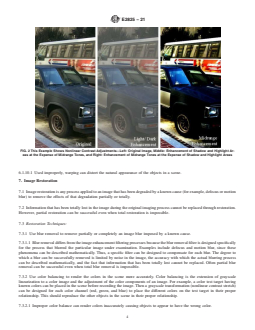
6.1.7.1 Anonlinear contrast adjustment can be used to bring
tics of objects within an image. This includes color space
out details in the shadow areas of an image without affecting
transformations, pseudocoloring, and hue and saturation ad-
the highlight areas.
justments.
6.1.7.2 A severe adjustment can cause loss of detail, color
6.1.2.1 Application of these techniques can compromise the
reversal, or the introduction of artifacts, or a combination
color fidelity of the image.
thereof. (See Fig. 2.)
6.1.3 Use contrast adjustment when the image lacks suffi-
6.1.8 Usepatternnoisereductionfilterstoidentifyrepeating
cient contrast. If the image contrast is increased too much,
patterns in an image and selectively remove them. This type of
there is a risk of loss of detail in both light and dark areas.
filter can be used to remove patterns such as fabric weaves,
6.1.4 Use cropping to remove that portion of the image that
window screens, security patterns, and halftone dots.
is outside the area of interest.
6.1.8.1 Overuse of this technique will remove material
6.1.5 Use brightness and contrast adjustments in localized
image detail.
areas.
6.1.9 Use random noise reduction techniques to reduce the
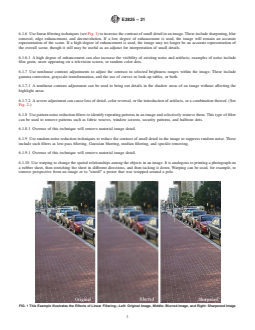
6.1.6 Use linear filtering techniques (see Fig. 1) to increase
contrast of small detail in the image to suppress random noise.
the contrast of small detail in an image. These include
These include such filters as low-pass filtering, Gaussian
sharpening, blur removal, edge enhancement, and deconvolu-
blurring, median filtering, and speckle removing.
tion. If a low degree of enhancement is used, the image will
6.1.9.1 Overuse of this technique will remove material
remain an accurate representation of the scene. If a high degree
image detail.
of enhancement is used, the image may no longer be an
accurate representation of the overall scene, though it still may 6.1.10 Use warping to change the spatial relationships
be useful as an adjunct for interpretation of small details. among the objects in an image. It is analogous to printing a
6.1.6.1 Ahigh degree of enhancement can also increase the photograph on a rubber sheet, then stretching the sheet in
visibility of existing noise and artifacts; examples of noise different directions, and then tacking it down. Warping can be
include film grain, snow appearing on a television screen, or used, for example, to remove perspective from an image or to
random color dots. "unroll" a poster that was wrapped around a pole.
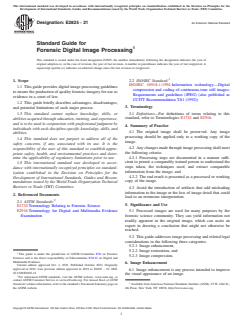
FIG. 1 This Example Illustrates the Effects of Linear Filtering—Left: Original Image, Middle: Blurred Image, and Right: Sharpened Image
E2825 − 21
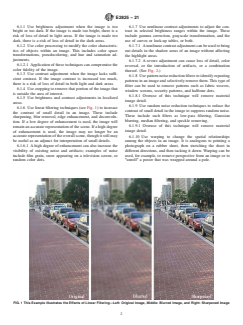
FIG. 2 This Example Shows Nonlinear Contrast Adjustments—Left: Original Image, Middle: Enhancement of Shadow and Highlight Ar-
eas at the Expense of Midrange Tones, and Right: Enhancement of Midrange Tones at the Expense of Shadow and Highlight Areas
6.1.10.1 Used improperly, warping can distort the natural linearization to a color image and the adjustment of the color
appearance of the objects in a scene. components of an image. For example, a color test target
having known colors can be placed in the scene before
7. Image Restoration
recording the image. Then a grayscale transformation (nonlin-
7.1 Imagerestorationisanyprocessappliedtoanimagethat ear contrast stretch) can be designed for each color channel
has been degraded by a known cause (for example, defocus or
(red, green, and blue) to place the different colors on the test
motion blur) to remove the effects of that degradation partially
target in their proper relationship. This should reproduce the
or totally.
other objects in the scene in their proper relationship.
7.2 Information that has been totally lost in the image 7.3.2.1 Improper color balance can render colors inaccu-
duringtheoriginalimagingprocesscannotbereplacedthrough
rately causing objects to appear to have the wrong color.
restoration.However,partialrestorationcanbesuccessfuleven
7.3.3 Use grayscale linearization to render faithfully the
when total restoration is impossible.
different brightness values in the scene. This adjusts the
7.3 Restoration Techniques: brightness relationships among the objects in a scene. For
7.3.1 Use blur removal to remove partially or completely an
example, a monochrome test target having known gray values
image blur imposed by a known cause.
can be placed in the scene before recording the image. Then a
7.3.1.1 Blur removal differs from the image enhancement
grayscale transformation (nonlinear contrast stretch) can be
filtering processes because the blur removal filter is designed
designed to place the different gray values on the test target in
specifically for the process that blurred the particular image
their proper relationship. This should put the other objects in
underexamination.Examplesincludedefocusandmotionblur,
the scene in their proper brightness relationship as well.
since these p
...
This document is not an ASTM standard and is intended only to provide the user of an ASTM standard an indication of what changes have been made to the previous version. Because
it may not be technically possible to adequately depict all changes accurately, ASTM recommends that users consult prior editions as appropriate. In all cases only the current version
of the standard as published by ASTM is to be considered the official document.
Designation: E2825 − 19 E2825 − 21
Standard Guide for
Forensic Digital Image Processing
This standard is issued under the fixed designation E2825; the number immediately following the designation indicates the year of
original adoption or, in the case of revision, the year of last revision. A number in parentheses indicates the year of last reapproval. A
superscript epsilon (´) indicates an editorial change since the last revision or reapproval.
1. Scope
1.1 This guide provides digital image processing guidelines to ensure the production of quality forensic imagery for use as
evidence in a court of law.
1.2 This guide briefly describes advantages, disadvantages, and potential limitations of each major process.
1.3 This standard cannot replace knowledge, skills, or abilities acquired through education, training, and experience, and is to
be used in conjunction with professional judgment by individuals with such discipline-specific knowledge, skills, and abilities.
1.4 This standard does not purport to address all of the safety concerns, if any, associated with its use. It is the responsibility
of the user of this standard to establish appropriate safety, health, and environmental practices and determine the applicability of
regulatory limitations prior to use.
1.5 This international standard was developed in accordance with internationally recognized principles on standardization
established in the Decision on Principles for the Development of International Standards, Guides and Recommendations issued
by the World Trade Organization Technical Barriers to Trade (TBT) Committee.
2. Referenced Documents
2.1 ASTM Standards:
E1732 Terminology Relating to Forensic Science
E2916 Terminology for Digital and Multimedia Evidence Examination
This guide is under the jurisdiction of ASTM Committee E30 on Forensic Sciences and is the direct responsibility of Subcommittee E30.12 on Digital and Multimedia
Evidence.
Current edition approved June 1, 2019Oct. 1, 2021. Published June 2019October 2021. Originally approved in 2012. Last previous edition approved in 20182019 as E2825
– 18.19. DOI: 10.1520/E2825-19.10.1520/E2825-21.
For referenced ASTM standards, visit the ASTM website, www.astm.org, or contact ASTM Customer Service at service@astm.org. For Annual Book of ASTM Standards
volume information, refer to the standard’s Document Summary page on the ASTM website.
Copyright © ASTM International, 100 Barr Harbor Drive, PO Box C700, West Conshohocken, PA 19428-2959. United States
E2825 − 21
2.2 ISO/IEC Standard:
ISO/IEC 10918-1:1994 Information technology—Digital compression and coding of continuous-tone still images: Requirements
and guidelines (JPEG) (also published as CCITT Recommendation T.81 (1992))
3. Terminology
3.1 Definitions—For definitions of terms relating to this standard, refer to Terminologies E1732 and E2916.
4. Summary of Practice
4.1 The original image shall be preserved. Any image processing should be applied only to a working copy of the image.
4.2 Any changes made through image processing shall meet the following criteria:
4.2.1 Processing steps are documented in a manner sufficient to permit a comparably trained person to understand the steps taken,
the techniques used, and extract comparable information from the image; and
4.2.2 The end result is presented as a processed or working copy of the image.
4.3 Avoid the introduction of artifacts that add misleading information to the image or the loss of image detail that could lead to
an erroneous interpretation.
5. Significance and Use
5.1 Processed images are used for many purposes by the forensic science community. They can yield information not readily
apparent in the original image, which can assist an expert in drawing a conclusion that might not otherwise be reached.
5.2 This guide addresses image processing and related legal considerations in the following three categories:
5.2.1 Image enhancement,
5.2.2 Image restoration, and
5.2.3 Image compression.
6. Image Enhancement
6.1 Image enhancement is any process intended to improve the visual appearance of an image.
6.1.1 Use brightness adjustment when the image is too bright or too dark. If the image is made too bright, there is a risk of loss
of detail in light areas. If the image is made too dark, there is a risk of loss of detail in the dark areas.
6.1.2 Use color processing to modify the color characteristics of objects within an image. This includes color space
transformations, pseudocoloring, and hue and saturation adjustments.
6.1.2.1 Application of these techniques can compromise the color fidelity of the image.
6.1.3 Use contrast adjustment when the image lacks sufficient contrast. If the image contrast is increased too much, there is a risk
of loss of detail in both light and dark areas.
6.1.4 Use cropping to remove that portion of the image that is outside the area of interest.
6.1.5 Use dodging and burning to adjust brightness brightness and contrast adjustments in localized areas.
Available from American National Standards Institute (ANSI), 25 W. 43rd St., 4th Floor, New York, NY 10036, http://www.ansi.org.
E2825 − 21
6.1.6 Use linear filtering techniques (see Fig. 1) to increase the contrast of small detail in an image. These include sharpening, blur
removal, edge enhancement, and deconvolution. If a low degree of enhancement is used, the image will remain an accurate
representation of the scene. If a high degree of enhancement is used, the image may no longer be an accurate representation of
the overall scene, though it still may be useful as an adjunct for interpretation of small details.
6.1.6.1 A high degree of enhancement can also increase the visibility of existing noise and artifacts; examples of noise include
film grain, snow appearing on a television screen, or random color dots.
6.1.7 Use nonlinear contrast adjustments to adjust the contrast in selected brightness ranges within the image. These include
gamma correction, grayscale transformation, and the use of curves or look-up tables, or both.
6.1.7.1 A nonlinear contrast adjustment can be used to bring out details in the shadow areas of an image without affecting the
highlight areas.
6.1.7.2 A severe adjustment can cause loss of detail, color reversal, or the introduction of artifacts, or a combination thereof. (See
Fig. 2.)
6.1.8 Use pattern noise reduction filters to identify repeating patterns in an image and selectively remove them. This type of filter
can be used to remove patterns such as fabric weaves, window screens, security patterns, and halftone dots.
6.1.8.1 Overuse of this technique will remove material image detail.
6.1.9 Use random noise reduction techniques to reduce the contrast of small detail in the image to suppress random noise. These
include such filters as low-pass filtering, Gaussian blurring, median filtering, and speckle removing.
6.1.9.1 Overuse of this technique will remove material image detail.
6.1.10 Use warping to change the spatial relationships among the objects in an image. It is analogous to printing a photograph on
a rubber sheet, then stretching the sheet in different directions, and then tacking it down. Warping can be used, for example, to
remove perspective from an image or to "unroll" a poster that was wrapped around a pole.
FIG. 1 This Example Illustrates the Effects of Linear Filtering—Left: Original Image, Middle: Blurred Image, and Right: Sharpened Image
E2825 − 21
FIG. 2 This Example Shows Nonlinear Contrast Adjustments—Left: Original Image, Middle: Enhancement of Shadow and Highlight Ar-
eas at the Expense of Midrange Tones, and Right: Enhancement of Midrange Tones at the Expense of Shadow and Highlight Areas
6.1.10.1 Used improperly, warping can distort the natural appearance of the objects in a scene.
7. Image Restoration
7.1 Image restoration is any process applied to an image that has been degraded by a known cause (for example, defocus or motion
blur) to remove the effects of that degradation partially or totally.
7.2 Information that has been totally lost in the image during the original imaging process cannot be replaced through restoration.
However, partial restoration can be successful even when total restoration is impossible.
7.3 Restoration Techniques:
7.3.1 Use blur removal to remove partially or completely an image blur imposed by a known cause.
7.3.1.1 Blur removal differs from the image enhancement filtering processes because the blur removal filter is designed specifically
for the process that blurred the particular image under examination. Examples include defocus and motion blur, since these
phenomena can be described mathematically. Thus, a specific filter can be designed to compensate for each blur. The degree to
which a blur can be successfully removed is limited by noise in the image, the accuracy with which the actual blurring process
can be described mathematically, and the fact that information that has been totally lost cannot be replaced. Often partial blur
removal can be successful even when total blur removal is impossible.
7.3.2 Use color balancing to render the colors in the scene more accurately. Color balancing is the extension of grayscale
linearization to a color image and the adjustment of the color components of an image. For example, a color test target having
known colors can be placed in the scene before recording the image. Then a grayscale transformation (nonlinear contrast stretch)
can be designed for each color channel (red, green, and blue) to place the different colors on the test target in their proper
relationship. This should reproduce the other objects in the scene in their proper relatio
...