

ASTM F2096-11(2019)
(Test Method)Standard Test Method for Detecting Gross Leaks in Packaging by Internal Pressurization (Bubble Test)
General Information
- Abstract
SIGNIFICANCE AND USE
5.1 The internal pressurization test method provides a practical way to examine packages for gross leaks.
5.2 This test method is extremely useful in a test laboratory environment where no common package material/size exists.
5.3 This test method may apply to large or long packages that do not fit into any other package integrity test method apparatus.
5.4 This test method may be used as a means to evaluate package integrity. Package integrity is crucial to consumer safety since heat sealed packages are designed to provide a contamination free or sterile environment, or both, to the product.
5.5 This test method may be used to detect substrate holes and channels.
SCOPE
1.1 This test method covers the detection of gross leaks in packaging. Method sensitivity is down to 250 μm (0.010 in.) with an 81 % probability (see Section 11). This test method may be used for tray and pouch packages.
1.2 The sensitivity of this test method has not been evaluated for use with porous materials other than spunbonded polyolefin or with nonporous packaging.
1.3 This test method is destructive in that it requires entry into the package to supply an internal air pressure
1.4 The values stated in SI units are to be regarded as the standard. The values given in parentheses are for information only.
1.5 This standard does not purport to address all of the safety concerns, if any, associated with its use. It is the responsibility of the user of this standard to establish appropriate safety, health, and environmental practices and determine the applicability of regulatory limitations prior to use.
1.6 This international standard was developed in accordance with internationally recognized principles on standardization established in the Decision on Principles for the Development of International Standards, Guides and Recommendations issued by the World Trade Organization Technical Barriers to Trade (TBT) Committee.
- Status
- Published
- Publication Date
- 31-Oct-2019
- Technical Committee
- F02 - Primary Barrier Packaging
- Drafting Committee
- F02.40 - Package Integrity
Overview
ASTM F2096-11(2019) is the internationally recognized standard test method for detecting gross leaks in packaging by internal pressurization, often referred to as the bubble test. Developed by ASTM International, this standard provides guidance for evaluating package integrity, particularly for tray and pouch packages used in various industries such as medical device manufacturing and food packaging.
Package integrity is essential for maintaining sterility and preventing contamination. The bubble test offers a destructive, yet practical, laboratory-based approach for identifying gross leaks, such as holes, channels, and faulty seals, by visually observing air bubbles emerging from packaging submerged under water during pressurization.
Key Topics
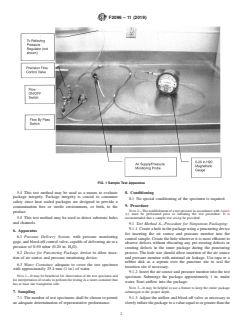
- Test Method Principle: The bubble test is based on inflating the package underwater to a specified pressure and inspecting for continuous streams of air bubbles that indicate leakage points.
- Applicability: Suitable for both porous (e.g., spunbonded polyolefin) and nonporous tray and pouch packaging materials, especially large or long packages not suitable for other integrity tests.
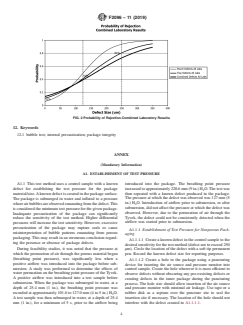
- Test Sensitivity: Capable of detecting defects down to 250 microns (0.010 inch) with an 81% probability.
- Destructive Testing: The method requires puncturing the package to introduce internal air pressure, making tested packages unsuitable for use.
- Pressure Establishment: Proper test pressure is determined using a control sample with a known defect to ensure accurate and repeatable results.
- Inspection Criteria: Thorough examination of all package surfaces for leaks, with attention to both upper and lower faces by rotating the package during the test.
- Reporting: Comprehensive documentation of test parameters, results, defect size, package identification, and observed leakage locations is required.
Applications
The ASTM F2096 bubble test is widely used across industries where package integrity is critical:
- Medical Device Packaging: Ensures that tray and pouch medical device packages maintain sterility, protecting patient health and complying with regulatory requirements.
- Pharmaceutical Packaging: Confirms barrier performance for drug products, especially those requiring contamination-free environments.
- Food Packaging: Detects gross leaks in sealed packaging to maintain product quality, safety, and shelf life.
- Laboratory Quality Assurance: Useful in environments where package materials and sizes vary and standard test fixtures may not be suitable.
The method is particularly valuable for:
- Validating package integrity during design verification and routine quality control.
- Evaluating new packaging materials or seals.
- Troubleshooting packaging failures or product recalls linked to seal integrity or gross defects.
Related Standards
ASTM F2096 complements other packaging and integrity test standards. Key related references include:
- ASTM F17 - Terminology Relating to Primary Barrier Packaging, providing essential vocabulary for packaging specifications and test methods.
- ISO Standards on package integrity and testing, offering compatibility for international trade and regulatory compliance.
- Standards referenced by the World Trade Organization’s Technical Barriers to Trade (TBT) Committee, ensuring harmonized approaches to quality and safety.
Practical Value
Adopting ASTM F2096 improves confidence in package seal and barrier performance and helps companies meet regulatory and customer requirements. The method’s flexibility ensures applicability to a diverse range of package types and sizes, supporting robust quality assurance programs and minimizing risks associated with package failure.
Keywords: ASTM F2096, bubble test, package integrity, gross leaks detection, pressurization, packaging standards, tray packages, pouch packages, medical device packaging, laboratory testing, sterile packaging.
Relations
- Effective Date
- 01-Nov-2019
- Effective Date
- 01-May-2020
- Effective Date
- 01-Oct-2018
- Effective Date
- 15-Aug-2018
- Effective Date
- 01-Jun-2017
- Effective Date
- 01-Aug-2013
- Effective Date
- 15-Apr-2013
- Effective Date
- 01-Nov-2012
- Effective Date
- 01-Aug-2008
- Effective Date
- 01-Sep-2007
- Effective Date
- 01-May-2007
- Effective Date
- 01-Dec-2006
- Effective Date
- 10-Oct-2002
- Effective Date
- 10-Oct-1998
- Effective Date
- 01-Nov-2019
Get Certified
Connect with accredited certification bodies for this standard

BRCGS (Brand Reputation Compliance Global Standards)
Global food safety and quality standards owner.
IMP NDT d.o.o.
Non-destructive testing services. Radiography, ultrasonic, magnetic particle, penetrant, visual inspection.
Inštitut za kovinske materiale in tehnologije
Institute of Metals and Technology. Materials testing, metallurgical analysis, NDT.
Sponsored listings
Frequently Asked Questions
ASTM F2096-11(2019) is a standard published by ASTM International. Its full title is "Standard Test Method for Detecting Gross Leaks in Packaging by Internal Pressurization (Bubble Test)". This standard covers: SIGNIFICANCE AND USE 5.1 The internal pressurization test method provides a practical way to examine packages for gross leaks. 5.2 This test method is extremely useful in a test laboratory environment where no common package material/size exists. 5.3 This test method may apply to large or long packages that do not fit into any other package integrity test method apparatus. 5.4 This test method may be used as a means to evaluate package integrity. Package integrity is crucial to consumer safety since heat sealed packages are designed to provide a contamination free or sterile environment, or both, to the product. 5.5 This test method may be used to detect substrate holes and channels. SCOPE 1.1 This test method covers the detection of gross leaks in packaging. Method sensitivity is down to 250 μm (0.010 in.) with an 81 % probability (see Section 11). This test method may be used for tray and pouch packages. 1.2 The sensitivity of this test method has not been evaluated for use with porous materials other than spunbonded polyolefin or with nonporous packaging. 1.3 This test method is destructive in that it requires entry into the package to supply an internal air pressure 1.4 The values stated in SI units are to be regarded as the standard. The values given in parentheses are for information only. 1.5 This standard does not purport to address all of the safety concerns, if any, associated with its use. It is the responsibility of the user of this standard to establish appropriate safety, health, and environmental practices and determine the applicability of regulatory limitations prior to use. 1.6 This international standard was developed in accordance with internationally recognized principles on standardization established in the Decision on Principles for the Development of International Standards, Guides and Recommendations issued by the World Trade Organization Technical Barriers to Trade (TBT) Committee.
SIGNIFICANCE AND USE 5.1 The internal pressurization test method provides a practical way to examine packages for gross leaks. 5.2 This test method is extremely useful in a test laboratory environment where no common package material/size exists. 5.3 This test method may apply to large or long packages that do not fit into any other package integrity test method apparatus. 5.4 This test method may be used as a means to evaluate package integrity. Package integrity is crucial to consumer safety since heat sealed packages are designed to provide a contamination free or sterile environment, or both, to the product. 5.5 This test method may be used to detect substrate holes and channels. SCOPE 1.1 This test method covers the detection of gross leaks in packaging. Method sensitivity is down to 250 μm (0.010 in.) with an 81 % probability (see Section 11). This test method may be used for tray and pouch packages. 1.2 The sensitivity of this test method has not been evaluated for use with porous materials other than spunbonded polyolefin or with nonporous packaging. 1.3 This test method is destructive in that it requires entry into the package to supply an internal air pressure 1.4 The values stated in SI units are to be regarded as the standard. The values given in parentheses are for information only. 1.5 This standard does not purport to address all of the safety concerns, if any, associated with its use. It is the responsibility of the user of this standard to establish appropriate safety, health, and environmental practices and determine the applicability of regulatory limitations prior to use. 1.6 This international standard was developed in accordance with internationally recognized principles on standardization established in the Decision on Principles for the Development of International Standards, Guides and Recommendations issued by the World Trade Organization Technical Barriers to Trade (TBT) Committee.
ASTM F2096-11(2019) is classified under the following ICS (International Classification for Standards) categories: 19.060 - Mechanical testing; 55.040 - Packaging materials and accessories. The ICS classification helps identify the subject area and facilitates finding related standards.
ASTM F2096-11(2019) has the following relationships with other standards: It is inter standard links to ASTM F2096-11, ASTM F17-20, ASTM F17-18a, ASTM F17-18, ASTM F17-17, ASTM F17-13a, ASTM F17-13, ASTM F17-12, ASTM F17-08, ASTM F17-07a, ASTM F17-07, ASTM F17-06, ASTM F17-02, ASTM F17-98, ASTM F2097-20. Understanding these relationships helps ensure you are using the most current and applicable version of the standard.
ASTM F2096-11(2019) is available in PDF format for immediate download after purchase. The document can be added to your cart and obtained through the secure checkout process. Digital delivery ensures instant access to the complete standard document.
Standards Content (Sample)
This international standard was developed in accordance with internationally recognized principles on standardization established in the Decision on Principles for the
Development of International Standards, Guides and Recommendations issued by the World Trade Organization Technical Barriers to Trade (TBT) Committee.
Designation: F2096 − 11 (Reapproved 2019)
Standard Test Method for
Detecting Gross Leaks in Packaging by Internal
Pressurization (Bubble Test)
This standard is issued under the fixed designation F2096; the number immediately following the designation indicates the year of
original adoption or, in the case of revision, the year of last revision. A number in parentheses indicates the year of last reapproval. A
superscript epsilon (´) indicates an editorial change since the last revision or reapproval.
1. Scope 3.2 Definitions of Terms Specific to This Standard:
3.2.1 breathing point pressure, n—pressure at which perme-
1.1 This test method covers the detection of gross leaks in
ation of air through the porous material begins.
packaging. Method sensitivity is down to 250 µm (0.010 in.)
with an 81 % probability (see Section 11). This test method
4. Summary of Test Method
may be used for tray and pouch packages.
4.1 The package is inflated underwater to a predetermined
1.2 The sensitivity of this test method has not been evalu-
pressure. The package is then observed for a steady stream of
ated for use with porous materials other than spunbonded
air bubbles indicating a failure area.
polyolefin or with nonporous packaging.
4.2 The sensitivity of this test method is dependent on the
1.3 This test method is destructive in that it requires entry
differential pressure and method of pressurization. Establish-
into the package to supply an internal air pressure
ment of a test pressure for each package material/size is critical
1.4 The values stated in SI units are to be regarded as the
for obtaining repeatable results (see Annex A1 for the proce-
standard. The values given in parentheses are for information
dure on establishing test pressure). Inadequate pressurization
only.
of the package can significantly reduce the sensitivity of this
test method. Higher differential pressures will increase the test
1.5 This standard does not purport to address all of the
sensitivity. However, excessive pressurization of the package
safety concerns, if any, associated with its use. It is the
may rupture seals or cause misinterpretation of bubble patterns
responsibility of the user of this standard to establish appro-
emanating from porous packaging. This may result in an
priate safety, health, and environmental practices and deter-
erroneous conclusion regarding the presence or absence of
mine the applicability of regulatory limitations prior to use.
package defects. While not required, use of a bleed-off control
1.6 This international standard was developed in accor-
valve in line with the pressure monitoring device, will aid in
dance with internationally recognized principles on standard-
stabilizing the test pressure, and help eliminate excessive
ization established in the Decision on Principles for the
pressurization of the package (see Fig. 1).
Development of International Standards, Guides and Recom-
mendations issued by the World Trade Organization Technical
4.3 Two different test methods are presented for the testing
Barriers to Trade (TBT) Committee.
of porous and nonporous packaging. The key difference
between the test methods (as described in Annex A1)isin
2. Referenced Documents
allowing time for the water to saturate the porous material.
2.1 ASTM Standards:
F17 Terminology Relating to Primary Barrier Packaging
5. Significance and Use
5.1 The internal pressurization test method provides a prac-
3. Terminology
tical way to examine packages for gross leaks.
3.1 Definitions—General terms relating to barrier materials
5.2 This test method is extremely useful in a test laboratory
for medical packaging are found in Terminology F17.
environment where no common package material/size exists.
5.3 This test method may apply to large or long packages
This test method is under the jurisdiction ofASTM Committee F02 on Primary
Barrier Packaging and is the direct responsibility of Subcommittee F02.40 on
that do not fit into any other package integrity test method
Package Integrity.
apparatus.
Current edition approved Nov. 1, 2019. Published December 2019. Originally
approved in 2001. Last previous edition approved in 2011 as F2096–11. DOI:
10.1520/F2096-11R19.
2 3
For referenced ASTM standards, visit the ASTM website, www.astm.org, or All porous packaging by definition will permit the passage of air. At a given
contact ASTM Customer Service at service@astm.org. For Annual Book of ASTM internal pressure it will therefore exhibit an emanating stream of air bubbles
Standards volume information, refer to the standard’s Document Summary page on dependent on the pore size. A stream of bubbles identified at a lower internal
the ASTM website. pressure than the breathing pressure point may indicate a defect in the packaging.
Copyright © ASTM International, 100 Barr Harbor Drive, PO Box C700, West Conshohocken, PA 19428-2959. United States
F2096 − 11 (2019)
FIG. 1 Sample Test Apparatus
5.4 This test method may be used as a means to evaluate 8. Conditioning
package integrity. Package integrity is crucial to consumer
8.1 No special conditioning of the specimen is required.
safety since heat sealed packages are designed to provide a
9. Procedure
contamination free or sterile environment, or both, to the
NOTE2—TheestablishmentofatestpressureinaccordancewithAnnex
product.
A1 must be performed prior to initiating the test procedure. It is
5.5 This test method may be used to detect substrate holes
recommended that a sample test set-up be provided.
and channels.
9.1 Test Method A—Procedure for Nonporous Packaging:
9.1.1 Create a hole in the package using a puncturing device
6. Apparatus
for inserting the air source and pressure monitor into the
6.1 Pressure Delivery System, with pressure monitoring
control sample. Create the hole wherever it is most efficient to
gage, and bleed-off control valve, capable of delivering air at a
observe defects without obscuring any pre-existing defects or
pressure of 0-50 mbar (0-20 in. H O).
creating defects in the inner package during the puncturing
process. The hole size should allow insertion of the air source
6.2 Device for Puncturing Package, device to allow inser-
and pressure monitor with minimal air leakage. Use tape or a
tion of air source and pressure monitoring device.
rubber disk as a septum over the puncture site to seal the
6.3 Water Container, adequate to cover the test specimen
insertion site if necessary.
with approximately 25.4 mm (1 in.) of water.
9.1.2 Insert the air source and pressure monitor into the test
NOTE 1—It may be beneficial for observation of the test specimen and
specimen. Submerge the package approximately 1 in. under
for interpretation of results to perform the testing in a water container that
water. Start airflow into the package.
has at least one transparent side.
NOTE 3—It may be helpful to use a fixture to keep the entire package
7. Sampling
submerged at the proper depth.
7.1 The number of test specimens shall be chosen to permit 9.1.3 Adjust the airflow and bleed-off valve as necessary to
an adequate determination of representative performance. slowlyinflatethepackagetoavalueequaltoorgreaterthanthe
F2096 − 11 (2019)
minimum test pressure as established in accordance with 9.2.6 Remove the package from the water and mark any
AnnexA1.Adjust the bleed-off valve and pressure regulator as observed area(s) of failure.
necessary to maintain constant pressure.
10. Report
9.1.4 Thoroughly inspect one side of the package facing
upwards for a constant stream of bubbles indicating a specific
10.1 Report the following information:
area of failure (seal channels, pinholes, cracks, tears, and so
10.1.1 Date and operator’s name or initials.
forth). Then repeat the process by rotating the package 180º so
10.1.2 Package type and any applicable traceable identifi-
the opposite side of the package is facing upwards. Inspection
cation numbers.
time will vary depending on package size.
10.1.3 Established defect size used to establish the test
9.1.5 Remove the package from water and mark any ob-
sensitivity, test pressure, and use of any blocking agent.
served area(s) of failure.
10.1.4 Number of test packages, number of packages that
passed, number of packages exhibiting leaks, and location of
9.2 Test Method B—Procedure for Porous Packaging:
each leak
9.2.1 Apply blocking agent to samples if required in accor-
10.1.5 Record the instrument used to create the opening of
dance with A1.1.2.4.
the package.
9.2.2 Create a hole in the package using a puncturing device
for inserting the air source and pressure monitor into the
11. Precision and Bias
control sample. Create the hole wherever it is most efficient to
observe defects without obscuring any pre-existing defects or
11.1 A round-robin study was conducted in 2000, which
creating defects in the inner package during the puncturing
included 5 laboratories, two package types, and two defect
process. The hole size should allow insertion of the air source
types. The defects consisted of a channel through the seal area
and pressure monitor with minimal air leakage. Use tape or a
on the pouch samples and a puncture through the porous
rubber disk as a septum over the puncture site to seal the
material,onboththetrayandpouchsamples.Alldefectsample
insertion site if necessary.
groups were created with a 125-µm (0.005 in.) and 250-µm
9.2.3 Insert the air source and pressure monitor into the
(0.010in.)wire.Thefirstpackagetypeconsistedofa4by6-in.
package.Submergethepackageapproximately25.4mm(1in.)
heat-sealed pouch, made from a combination clear film and
under water with the porous part of the package in the up
uncoated Tyvek. The second package type consisted ofa3by
position (if one side is porous) and hold for a minimum of 5 s.
5-in. thermoformed p
...