

ASTM B953-21
(Practice)Standard Practice for Sampling Magnesium and Magnesium Alloys for Spectrochemical Analysis
General Information
- Abstract
SIGNIFICANCE AND USE
4.1 This practice, used in conjunction with the following quantitative atomic emission spectrochemical test method, B954, is suitable for use in manufacturing control, material or product acceptance, certification, and research and development.
SCOPE
1.1 This practice describes the sampling of magnesium and magnesium-base alloys to obtain a chill-cast sample suitable for quantitative atomic emission spectrochemical analysis. The disk in the region to be excited is representative of the melt and gives a repeatability of results that approach that of the reference materials used.
1.2 This practice describes the procedure for representative sampling of molten metal.
1.3 The values stated in SI units are to be regarded as standard. The values given in parentheses after SI units are provided for information only and are not considered standard.
1.4 This standard does not purport to address all of the safety concerns, if any, associated with its use. It is the responsibility of the user of this standard to establish appropriate safety, health, and environmental practices and determine the applicability of regulatory limitations prior to use. Specific Warning Statements are given in 5.1.
1.5 This international standard was developed in accordance with internationally recognized principles on standardization established in the Decision on Principles for the Development of International Standards, Guides and Recommendations issued by the World Trade Organization Technical Barriers to Trade (TBT) Committee.
- Status
- Published
- Publication Date
- 30-Apr-2021
- Technical Committee
- B07 - Light Metals and Alloys
- Drafting Committee
- B07.04 - Magnesium Alloy Cast and Wrought Products
Buy Documents

ASTM B953-21 - Standard Practice for Sampling Magnesium and Magnesium Alloys for Spectrochemical Analysis
REDLINE ASTM B953-21 - Standard Practice for Sampling Magnesium and Magnesium Alloys for Spectrochemical Analysis
Overview
ASTM B953-21: Standard Practice for Sampling Magnesium and Magnesium Alloys for Spectrochemical Analysis provides guidelines for obtaining representative samples of magnesium and magnesium-base alloys for quantitative atomic emission spectrochemical analysis. Developed by ASTM International, this standard is essential for ensuring reliable and repeatable results in both manufacturing environments and laboratory settings.
This practice focuses on producing chill-cast samples from molten magnesium and its alloys, ensuring that the samples accurately reflect the composition of the original melt. The document also addresses safety considerations and emphasizes the use of appropriate equipment and methodologies.
Key Topics
- Representative Sampling: Outlines procedures for collecting molten magnesium and magnesium alloy samples that truly represent the bulk material, which is critical for accurate spectrochemical analysis.
- Chill-Cast Sample Preparation: Details the use of specialized molds (Types A, B, and U) to produce homogeneous and defect-free chill-cast disks. These molds are designed to replicate conditions used for reference materials and facilitate precise quantitative analysis.
- Machining and Surface Preparation: Provides requirements for machining sample surfaces to remove oxidation and potential contamination, recommending the use of lathes, milling machines, or metallographic grinders.
- Direct Excitation for Fabricated Products: Discusses procedures for analyzing fabricated, cast, or wrought magnesium products without the need for remelting, while addressing limitations related to elemental segregation.
- Safety Measures: Highlights the importance of safety, health, and environmental practices when sampling and preparing magnesium and magnesium alloys, including precautions against moisture-induced spattering during the casting process.
- International Compliance: Confirms adherence to globally recognized standardization principles in line with WTO Technical Barriers to Trade (TBT) guidelines.
Applications
ASTM B953-21 is widely used in scenarios that require precise and consistent material analysis:
- Manufacturing Control: Enables producers of magnesium alloys to monitor and control melt composition during manufacturing, supporting quality assurance.
- Product Acceptance and Certification: Facilitates the verification of material composition for product acceptance, certifying that alloys meet specified standards and customer requirements.
- Research and Development: Supports the development of new magnesium alloys and the refinement of production processes through reliable analytical data.
- Quality Assurance Laboratories: Provides laboratories with standardized protocols for sampling and sample preparation, ensuring reproducible results in atomic emission spectrochemical analysis.
Proper implementation of this practice contributes to reliable results, minimized analytical variation, and enhanced confidence in the material certification process.
Related Standards
For a comprehensive approach to magnesium alloy analysis, consult the following ASTM standards:
- ASTM B954: Test Method for Analysis of Magnesium and Magnesium Alloys by Atomic Emission Spectrometry - the companion analysis method to B953 for quantitative spectrochemical analysis.
- ASTM B881: Terminology Relating to Aluminum- and Magnesium-Alloy Products - provides key terminology for understanding standardized alloy products.
- ASTM E135: Terminology Relating to Analytical Chemistry for Metals, Ores, and Related Materials - foundational definitions for chemical analysis in the metals industry.
- ASTM E1257: Guide for Evaluating Grinding Materials Used for Surface Preparation in Spectrochemical Analysis - ensures correct surface finishing practices during sample preparation.
Conclusion
ASTM B953-21 is an essential standard for industries and laboratories involved in the production, analysis, and certification of magnesium and magnesium alloys. By following its recommended practices, organizations can ensure representative sampling and consistent, accurate results in spectrochemical analysis, leading to enhanced product quality and compliance with international standards. For authoritative guidelines and industry best practices, always refer to the most current version available from ASTM International.
Relations
- Effective Date
- 01-Feb-2016
- Effective Date
- 01-May-2008
- Effective Date
- 01-Jun-2007
- Effective Date
- 10-Jun-2003
- Effective Date
- 10-Oct-1998
Buy Documents
ASTM B953-21 - Standard Practice for Sampling Magnesium and Magnesium Alloys for Spectrochemical Analysis
REDLINE ASTM B953-21 - Standard Practice for Sampling Magnesium and Magnesium Alloys for Spectrochemical Analysis
Get Certified
Connect with accredited certification bodies for this standard

Element Materials Technology
Materials testing and product certification.

Inštitut za kovinske materiale in tehnologije
Institute of Metals and Technology. Materials testing, metallurgical analysis, NDT.
Sponsored listings
Frequently Asked Questions
ASTM B953-21 is a standard published by ASTM International. Its full title is "Standard Practice for Sampling Magnesium and Magnesium Alloys for Spectrochemical Analysis". This standard covers: SIGNIFICANCE AND USE 4.1 This practice, used in conjunction with the following quantitative atomic emission spectrochemical test method, B954, is suitable for use in manufacturing control, material or product acceptance, certification, and research and development. SCOPE 1.1 This practice describes the sampling of magnesium and magnesium-base alloys to obtain a chill-cast sample suitable for quantitative atomic emission spectrochemical analysis. The disk in the region to be excited is representative of the melt and gives a repeatability of results that approach that of the reference materials used. 1.2 This practice describes the procedure for representative sampling of molten metal. 1.3 The values stated in SI units are to be regarded as standard. The values given in parentheses after SI units are provided for information only and are not considered standard. 1.4 This standard does not purport to address all of the safety concerns, if any, associated with its use. It is the responsibility of the user of this standard to establish appropriate safety, health, and environmental practices and determine the applicability of regulatory limitations prior to use. Specific Warning Statements are given in 5.1. 1.5 This international standard was developed in accordance with internationally recognized principles on standardization established in the Decision on Principles for the Development of International Standards, Guides and Recommendations issued by the World Trade Organization Technical Barriers to Trade (TBT) Committee.
SIGNIFICANCE AND USE 4.1 This practice, used in conjunction with the following quantitative atomic emission spectrochemical test method, B954, is suitable for use in manufacturing control, material or product acceptance, certification, and research and development. SCOPE 1.1 This practice describes the sampling of magnesium and magnesium-base alloys to obtain a chill-cast sample suitable for quantitative atomic emission spectrochemical analysis. The disk in the region to be excited is representative of the melt and gives a repeatability of results that approach that of the reference materials used. 1.2 This practice describes the procedure for representative sampling of molten metal. 1.3 The values stated in SI units are to be regarded as standard. The values given in parentheses after SI units are provided for information only and are not considered standard. 1.4 This standard does not purport to address all of the safety concerns, if any, associated with its use. It is the responsibility of the user of this standard to establish appropriate safety, health, and environmental practices and determine the applicability of regulatory limitations prior to use. Specific Warning Statements are given in 5.1. 1.5 This international standard was developed in accordance with internationally recognized principles on standardization established in the Decision on Principles for the Development of International Standards, Guides and Recommendations issued by the World Trade Organization Technical Barriers to Trade (TBT) Committee.
ASTM B953-21 is classified under the following ICS (International Classification for Standards) categories: 77.040.30 - Chemical analysis of metals; 77.120.20 - Magnesium and magnesium alloys. The ICS classification helps identify the subject area and facilitates finding related standards.
ASTM B953-21 has the following relationships with other standards: It is inter standard links to ASTM E1257-16, ASTM E1257-93(2008), ASTM B954-07, ASTM E1257-93(2003), ASTM E1257-93(1998)e1. Understanding these relationships helps ensure you are using the most current and applicable version of the standard.
ASTM B953-21 is available in PDF format for immediate download after purchase. The document can be added to your cart and obtained through the secure checkout process. Digital delivery ensures instant access to the complete standard document.
Standards Content (Sample)
This international standard was developed in accordance with internationally recognized principles on standardization established in the Decision on Principles for the
Development of International Standards, Guides and Recommendations issued by the World Trade Organization Technical Barriers to Trade (TBT) Committee.
Designation: B953 − 21
Standard Practice for
Sampling Magnesium and Magnesium Alloys for
Spectrochemical Analysis
This standard is issued under the fixed designation B953; the number immediately following the designation indicates the year of
original adoption or, in the case of revision, the year of last revision. A number in parentheses indicates the year of last reapproval. A
superscript epsilon (´) indicates an editorial change since the last revision or reapproval.
1. Scope* 3. Summary of Practice
1.1 This practice describes the sampling of magnesium and 3.1 Molten metal representative of the furnace melt is
magnesium-base alloys to obtain a chill-cast sample suitable poured directly into a specified mold (described in 5.2.1)to
for quantitative atomic emission spectrochemical analysis. The produce a chill-cast disk. The disk is machined to a specific
disk in the region to be excited is representative of the melt and depth that represents the average melt composition and pro-
gives a repeatability of results that approach that of the duces an acceptable surface for excitation.
reference materials used.
3.2 Fabricated, cast, or wrought products may be excited
1.2 This practice describes the procedure for representative directly without remelting; however, accuracy of results may
sampling of molten metal. suffer in highly alloyed samples due to the potential for
elemental segregation.
1.3 The values stated in SI units are to be regarded as
standard. The values given in parentheses after SI units are
4. Significance and Use
provided for information only and are not considered standard.
4.1 This practice, used in conjunction with the following
1.4 This standard does not purport to address all of the
quantitative atomic emission spectrochemical test method,
safety concerns, if any, associated with its use. It is the
B954, is suitable for use in manufacturing control, material or
responsibility of the user of this standard to establish appro-
product acceptance, certification, and research and develop-
priate safety, health, and environmental practices and deter-
ment.
mine the applicability of regulatory limitations prior to use.
5. Apparatus
Specific Warning Statements are given in 5.1.
1.5 This international standard was developed in accor-
5.1 Ladle, capable of holding a minimum of 400 g (7.7 oz)
dance with internationally recognized principles on standard-
of molten metal, with a handle of sufficient length to reach into
ization established in the Decision on Principles for the
a furnace, trough, or crucible sufficiently deep to obtain a
Development of International Standards, Guides and Recom-
sample representative of the melt being cast. The ladle may be
mendations issued by the World Trade Organization Technical
lightly coated with a tightly adhering ladle wash that will not
Barriers to Trade (TBT) Committee.
contaminate the sample. Boron nitride can be applied at
elevated temperatures to form a tenacious coating.
2. Referenced Documents
(Warning—Trace moisture in the coating or on the tool may
2.1 ASTM Standards: cause dangerous spattering. Preheat all sampling tools and
molds prior to use.)
B954 Test Method for Analysis of Magnesium and Magne-
sium Alloys by Atomic Emission Spectrometry
5.2 Sample Molds, capable of producing homogeneous
E1257 Guide for Evaluating Grinding Materials Used for
chill-cast disks having smooth surfaces, free of surface pockets
Surface Preparation in Spectrochemical Analysis
and porosity. These castings should have a spectrochemical
response similar to the reference materials used in preparing
the analytical curves and must have a repeatability from
These practices are under the jurisdiction of ASTM Committee B07 on Light
excitation-to-excitation of no more than 2 % relative on major
Metals and Alloys and are the direct responsibility of Subcommittee B07.04 on
alloying elements. They must be representative of the melt in
Magnesium Alloy Cast and Wrought Products.
the region excited. Several types of molds have been found
Current edition approved May 1, 2021. Published June 2021. Originally
acceptable:
approved in 2007. Last previous edition approved in 2013 as B953 – 13. DOI:
10.1520/B0953-21.
5.2.1 Type A, Open Cavity Mold, is shown in Fig. 1. The
For referenced ASTM standards, visit the ASTM website, www.astm.org, or
advantage of this mold is its simple design and ability to
contact ASTM Customer Service at service@astm.org. For Annual Book of ASTM
produce a sample disk that can be excited around the entire
Standards volume information, refer to the standard’s Document Summary page on
the ASTM website. annular area. Mold dimensions can be modified to produce a
*A Summary of Changes section appears at the end of this standard
Copyright © ASTM International, 100 Barr Harbor Drive, PO Box C700, West Conshohocken, PA 19428-2959. United States
B953 − 21
FIG. 1 Type A Mold—Open Cavity Mold and Sample
FIG. 2 Type B Mold—Center Pour Mold and Sample
disk size ranging from approximately 44 to 64 mm (1.75 to
2.5 in.)indiameterby10to15mm(0.4to0.6in.)inthickness.
A circular central recess 10 to 20 mm (0.4 to 0.8 in.) in
diameter on one side of the disk (analytical side) facilitates
machining of that side in preparation for excitation. It also
promotesamoreuniformfreezingoftheraisedperipheralarea.
The mold material should be mild steel and should weigh
approximately 2 to 3 kg (4.5 to 6.5 lb).
5.2.2 Type B, Center Pour Mold, is shown in Fig. 2. The
advantage of this mold is that the sample obtained may be
excited around the entire annular area. This mold produces a
horizontally cast disk with the sprue over the center on the
backside. The mold dimensions are such as to produce a disk
approximately 64 mm (2.5 in.) in diameter by 13 mm (0.5 in.)
in thickness. A circular central recess 10 to 13 mm (0.4 to
FIG. 3 Type U Mold—U-Block Mold and Sample
0.5 in.) in diameter on one side of the disk (analytical side)
facilitates machining of that side in preparation for excitation.
It also promotes more uniform freezing of the raised peripheral
area, but the corresponding raised portion of the mold must not
diameter by 50 mm (2.0 in.) thick copper chill plate with a
be so large as to restrict the throat for the sprue.Aslight taper,
knurled working surface. The mold material is mild steel. The
1 to 2°, on the hinged portion of the mold facilitates opening
downsprue directionally choked side gate promotes a con-
when a disk has been cast. The mold material should be mild
trolled fill.The strong directional solidification provided by the
steelandshouldweighapproximately3.5to4.5kg(8to10lb).
chill plate produces a spectrochemically homogenous sample
5.2.3 Type U, U-Block Mold, is shown in Fig. 3. This side
for at least the first third and usually up to two thirds of the
gated block mold produces a cylindrical block sample of
length of the U-block sample from chill the cast face (Note 1).
approximately 40 mm (1.6 in.) in diameter by 60 mm (2.4 in.)
high. The mold is placed on top of a massive 150 mm (5.9 in.) NOTE 1—To improve the performance and durability of the molds
B953 − 21
described above, prepare the surface of the mold cavity to minimize the
6.1.1.3 For samples obtained from the TypeAmold, using a
formationofgaspocketsonthesurfaceofthecastingsandtoresistrusting
lathe or milling machine removea2to3mm (0.1- to 0.15-in.)
of the mold cavity surface. To do this, blast the inner surface with a sharp
layer from the mold-chilled surface of the sample to eliminate
grit that cuts rather than peens. The resulting finely roughened face is
theoxidizedandcontaminatedarea.Forsamplesobtainedfrom
essential f
...
This document is not an ASTM standard and is intended only to provide the user of an ASTM standard an indication of what changes have been made to the previous version. Because
it may not be technically possible to adequately depict all changes accurately, ASTM recommends that users consult prior editions as appropriate. In all cases only the current version
of the standard as published by ASTM is to be considered the official document.
Designation: B953 − 13 B953 − 21
Standard Practice for
Sampling Magnesium and Magnesium Alloys for
Spectrochemical Analysis
This standard is issued under the fixed designation B953; the number immediately following the designation indicates the year of
original adoption or, in the case of revision, the year of last revision. A number in parentheses indicates the year of last reapproval. A
superscript epsilon (´) indicates an editorial change since the last revision or reapproval.
1. Scope*
1.1 This practice describes the sampling of magnesium and magnesium-base alloys to obtain a chill-cast sample suitable for
quantitative atomic emission spectrochemical analysis. The disk in the region to be excited is representative of the melt and gives
a repeatability of results that approach that of the reference materials used.
1.2 This practice describes the procedure for representative sampling of molten metal.
1.3 The values stated in SI units are to be regarded as the standard. The values given in parentheses are for information only.after
SI units are provided for information only and are not considered standard.
1.4 This standard does not purport to address all of the safety concerns, if any, associated with its use. It is the responsibility
of the user of this standard to establish appropriate safety safety, health, and healthenvironmental practices and determine the
applicability of regulatory limitations prior to use. Specific precautionary statementsWarning Statements are given in 5.1.
1.5 This international standard was developed in accordance with internationally recognized principles on standardization
established in the Decision on Principles for the Development of International Standards, Guides and Recommendations issued
by the World Trade Organization Technical Barriers to Trade (TBT) Committee.
2. Referenced Documents
2.1 ASTM Standards:
B954 Test Method for Analysis of Magnesium and Magnesium Alloys by Atomic Emission Spectrometry
B881 Terminology Relating to Aluminum- and Magnesium-Alloy Products
E135 Terminology Relating to Analytical Chemistry for Metals, Ores, and Related Materials
E1257 Guide for Evaluating Grinding Materials Used for Surface Preparation in Spectrochemical Analysis
3. Summary of Practice
3.1 Molten metal representative of the furnace melt is poured directly into a specified mold (described in 5.2.1) to produce a
chill-cast disk. The disk is machined to a specific depth that represents the average melt composition and produces an acceptable
surface for excitation.
These practices are under the jurisdiction of ASTM Committee B07 on Light Metals and Alloys and are the direct responsibility of Subcommittee B07.04 on Magnesium
Alloy Cast and Wrought Products.
Current edition approved May 1, 2013May 1, 2021. Published June 2013June 2021. Originally approved in 2007. Last previous edition approved in 20072013 as
B953 – 07.B953 – 13. DOI: 10.1520/B0953-13.10.1520/B0953-21.
For referenced ASTM standards, visit the ASTM website, www.astm.org, or contact ASTM Customer Service at service@astm.org. For Annual Book of ASTM Standards
volume information, refer to the standard’s Document Summary page on the ASTM website.
*A Summary of Changes section appears at the end of this standard
Copyright © ASTM International, 100 Barr Harbor Drive, PO Box C700, West Conshohocken, PA 19428-2959. United States
B953 − 21
3.2 Fabricated, cast, or wrought products may be excited directly without remelting; however, accuracy of results may suffer in
highly alloyed samples due to the potential for elemental segregation.
4. Significance and Use
4.1 This practice, used in conjunction with the following quantitative atomic emission spectrochemical test method, B954, is
suitable for use in manufacturing control, material or product acceptance, certification, and research and development.
5. Apparatus
5.1 Ladle, capable of holding a minimum of 400 g (7.7 oz) of molten metal, with a handle of sufficient length to reach into a
furnace, trough, or crucible sufficiently deep to obtain a sample representative of the melt being cast. The ladle may be lightly
coated with a tightly adhering ladle wash that will not contaminate the sample. Boron nitride can be applied at elevated
temperatures to form a tenacious coating. Warning(Warning—Trace moisture in the coating or on the tool may cause dangerous
spattering. Preheat all sampling tools and molds prior to use.—Trace moisture in the coating or on the tool may cause dangerous
spattering. Preheat all sampling tools and molds prior to use.)
5.2 Sample Molds, capable of producing homogeneous chill-cast disks having smooth surfaces, free of surface pockets and
porosity. These castings should have a spectrochemical response similar to the reference materials used in preparing the analytical
curves and must have a repeatability from excitation-to-excitation of no more than 2%2 % relative on major alloying elements.
They must be representative of the melt in the region excited. Several types of molds have been found acceptable:
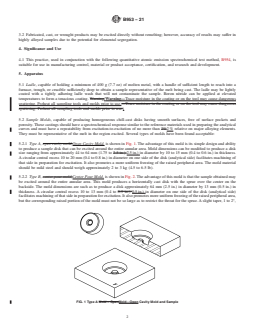
5.2.1 Type A, open cavity mold,Open Cavity Mold, is shown in Fig. 1. The advantage of this mold is its simple design and ability
to produce a sample disk that can be excited around the entire annular area. Mold dimensions can be modified to produce a disk
size ranging from approximately 44 to 64 mm (1.75 to 2.5 in.) 2.5 in.) in diameter by 10 to 15 mm (0.4 to 0.6 in.) in thickness.
A circular central recess 10 to 20 mm (0.4 to 0.8 in.) in diameter on one side of the disk (analytical side) facilitates machining of
that side in preparation for excitation. It also promotes a more uniform freezing of the raised peripheral area. The mold material
should be mild steel and should weigh approximately 2 to 3 kg (4.5 to 6.5 lb).
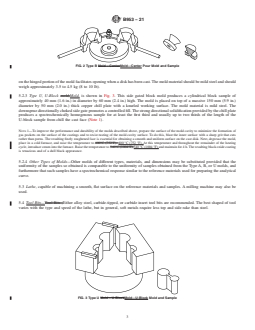
5.2.2 Type B, center pour mold,Center Pour Mold, is shown in Fig. 2. The advantage of this mold is that the sample obtained may
be excited around the entire annular area. This mold produces a horizontally cast disk with the sprue over the center on the
backside. The mold dimensions are such as to produce a disk approximately 64 mm (2.5 in.) in diameter by 13 mm (0.5 in.) in
thickness. A circular central recess 10 to 13 mm (0.4 to 0.5 in.) 0.5 in.) in diameter on one side of the disk (analytical side)
facilitates machining of that side in preparation for excitation. It also promotes more uniform freezing of the raised peripheral area,
but the corresponding raised portion of the mold must not be so large as to restrict the throat for the sprue. A slight taper, 1 to 2°,
FIG. 1 Type A Mold – OpenMold—Open Cavity Mold and Sample
B953 − 21
FIG. 2 Type B Mold – CenterMold—Center Pour Mold and Sample
on the hinged portion of the mold facilitates opening when a disk has been cast. The mold material should be mild steel and should
weigh approximately 3.5 to 4.5 kg (8 to 10 lb).
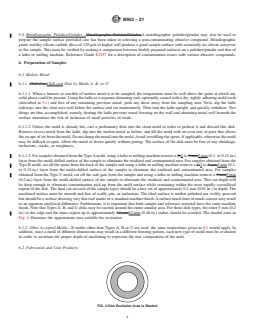
5.2.3 Type U, U-Block mold,Mold, is shown in Fig. 3. This side gated block mold produces a cylindrical block sample of
approximately 40 mm (1.6 in.) in diameter by 60 mm (2.4 in.) high. The mold is placed on top of a massive 150 mm (5.9 in.)
diameter by 50 mm (2.0 in.) thick copper chill plate with a knurled working surface. The mold material is mild steel. The
downsprue directionally choked side gate promotes a controlled fill. The strong directional solidification provided by the chill plate
produces a spectrochemically homogenous sample for at least the first third and usually up to two thirds of the length of the
U-block sample from chill the cast face (Note 1).
NOTE 1—To improve the performance and durability of the molds described above, prepare the surface of the mold cavity to minimize the formation of
gas pockets on the surface of the castings and to resist rusting of the mold cavity surface. To do this, blast the inner surface with a sharp grit that cuts
rather than peens. The resulting finely roughened face is essential for obtaining a smooth and uniform surface on the cast disk. Next, degrease the mold,
place in a cold furnace, and raise the temperature to 400°C (752°F). 400 °C (752 °F). At this temperature and throughout the remainder of the heating
cycle, introduce steam into
...