

SIST EN 13454-1:2004
(Main)Binders, composite binders and factory made mixtures for floor screeds based on calcium sulfate - Part 1: Definitions and requirements
General Information
- Abstract
This document applies to calcium sulphate binders and composite binders made of calcium sulphate used for the manufacture of floor screeds for interior use in buildings. It also includes requirements for factory made mixtures made of calcium sulphate used for the manufacture of floor screeds which are given in EN 13813. This document does not cover the application of floor screeds. Floor screeds made with products covered by this document may contribute to thermal and sound insulation and fire protection of the floor.
- Status
- Published
- Publication Date
- 30-Nov-2004
- Technical Committee
- CAA - Mineral binders and masonry
- Current Stage
- 6060 - National Implementation/Publication (Adopted Project)
- Start Date
- 01-Dec-2004
- Due Date
- 01-Dec-2004
- Completion Date
- 01-Dec-2004
- Directive
- 305/2011 - Regulation (eu) No 305/2011 of the European Parliament and of the Council of 9 march 2011 laying down harmonised conditions for the marketing of construction products and repealing council directive 89/106/eecOJ Ref: C 259 OJ Date: 08-Aug-2014
89/106/EEC - Construction productsOJ Ref: C 139 OJ Date: 08-Jun-2005

Overview
EN 13454-1:2004 - CEN standard for Binders, composite binders and factory made mixtures for floor screeds based on calcium sulfate (Part 1: Definitions and requirements).
This part defines terminology and sets requirements for calcium sulfate binders (CAB), calcium sulfate composite binders (CAC) and factory made calcium sulfate mixtures (CA) used to manufacture internal floor screeds in buildings. It covers product characteristics and conformity procedures but does not cover screed application or installation. Products covered may contribute to thermal and sound insulation and fire protection of floors.
Key topics and technical requirements
- Scope and definitions: Clear definitions for calcium sulfate constituents, binders, composite binders, admixtures, additives, aggregates and screed types.
- Types and formats: Distinguishes CAB, CAC and factory made mixtures (CA); CA can be supplied as prebatched (dry), premixed (dry) or ready-mixed (wet).
- Consistency classes: Requirements for stiff, highly plastic and flowing mixtures (flow/spread/flow diameter concepts).
- Chemical and physical properties: Requirements include content of calcium sulfate (CaSO4), pH, setting times, strength (compressive and flexural), shrinkage and swelling, and chemical resistance.
- Performance characteristics: Water vapour permeability, thermal resistance, impact sound insulation, and reaction to fire (CAB/CAC are generally A1fl when organic content <1% - otherwise EN 13501-1 applies).
- Health & environmental: Release of regulated substances is addressed for conformity and CE marking purposes.
- Conformity and marking: Procedures for initial type testing, factory production control, conformity criteria, and CE marking (see Annex ZA).
- Test linkage: Part 1 requirements are intended to be verified using the test methods in EN 13454-2 and performance clauses reference EN 13813 where applicable.
Practical applications
- Specification and quality control of materials used to manufacture interior calcium sulfate floor screeds.
- Product development and formulation for manufacturers of binders, composite binders and factory-made screed mixtures.
- Pre-production and factory production control to ensure consistent screed product performance.
- Assessing material suitability for acoustic, thermal and fire-related floor performance.
Who uses this standard
- Manufacturers of calcium sulfate binders, composite binders and ready-mixed screed materials.
- Product certification and testing laboratories performing type testing and factory production control.
- Specifiers, architects and construction engineers drafting material and performance requirements.
- Regulatory and conformity assessment bodies involved with CE marking and Construction Products Directive compliance.
Related standards
- EN 13454-2 (Test methods for calcium sulfate binders/mixtures)
- EN 13813 (Screed material - properties and requirements)
- EN 13501-1 (Fire classification)
- Other referenced standards on vapour transmission, strength testing and acoustics.
Keywords: EN 13454-1:2004, calcium sulfate binders, factory made mixtures, floor screeds, CAB, CAC, EN 13813, screed consistency, CE marking, conformity assessment.
Relations
- Effective Date
- 28-Jan-2026
- Effective Date
- 28-Jan-2026
- Effective Date
- 28-Jan-2026
- Effective Date
- 28-Jan-2026
- Effective Date
- 28-Jan-2026
- Effective Date
- 28-Jan-2026
- Effective Date
- 28-Jan-2026
- Effective Date
- 28-Jan-2026
- Effective Date
- 28-Jan-2026
- Effective Date
- 28-Jan-2026
- Referred By
SIST EN 13454-2:2019 - Binders for floor screeds based on calcium sulphate - Part 2: Test methods - Effective Date
- 28-Jan-2026
- Effective Date
- 18-Jan-2023
- Effective Date
- 01-Sep-2017
Get Certified
Connect with accredited certification bodies for this standard

DIBt (Deutsches Institut für Bautechnik)
German Institute for Building Technology.
DIN CERTCO
DIN Group product certification.

Aboma Certification B.V.
Specialized in construction, metal, and transport sectors.
Sponsored listings
Frequently Asked Questions
SIST EN 13454-1:2004 is a standard published by the Slovenian Institute for Standardization (SIST). Its full title is "Binders, composite binders and factory made mixtures for floor screeds based on calcium sulfate - Part 1: Definitions and requirements". This standard covers: This document applies to calcium sulphate binders and composite binders made of calcium sulphate used for the manufacture of floor screeds for interior use in buildings. It also includes requirements for factory made mixtures made of calcium sulphate used for the manufacture of floor screeds which are given in EN 13813. This document does not cover the application of floor screeds. Floor screeds made with products covered by this document may contribute to thermal and sound insulation and fire protection of the floor.
This document applies to calcium sulphate binders and composite binders made of calcium sulphate used for the manufacture of floor screeds for interior use in buildings. It also includes requirements for factory made mixtures made of calcium sulphate used for the manufacture of floor screeds which are given in EN 13813. This document does not cover the application of floor screeds. Floor screeds made with products covered by this document may contribute to thermal and sound insulation and fire protection of the floor.
SIST EN 13454-1:2004 is classified under the following ICS (International Classification for Standards) categories: 01.040.91 - Construction materials and building (Vocabularies); 91.100.10 - Cement. Gypsum. Lime. Mortar; 91.100.50 - Binders. Sealing materials. The ICS classification helps identify the subject area and facilitates finding related standards.
SIST EN 13454-1:2004 has the following relationships with other standards: It is inter standard links to SIST EN ISO 10140-2:2021, SIST EN 13813:2003, SIST EN 13454-2:2004, SIST EN ISO 10140-3:2021, SIST EN ISO 10140-5:2021, SIST EN 12086:2013, SIST EN ISO 10140-1:2021, SIST EN ISO 10140-4:2021, SIST EN 13892-2:2003, SIST EN 13501-1:2019, SIST EN 13454-2:2019, oSIST prEN 13454-1:2017, oSIST prEN 13454-1:2017. Understanding these relationships helps ensure you are using the most current and applicable version of the standard.
SIST EN 13454-1:2004 is associated with the following European legislation: EU Directives/Regulations: 305/2011, 89/106/EEC; Standardization Mandates: M/132. When a standard is cited in the Official Journal of the European Union, products manufactured in conformity with it benefit from a presumption of conformity with the essential requirements of the corresponding EU directive or regulation.
SIST EN 13454-1:2004 is available in PDF format for immediate download after purchase. The document can be added to your cart and obtained through the secure checkout process. Digital delivery ensures instant access to the complete standard document.
Standards Content (Sample)
2003-01.Slovenski inštitut za standardizacijo. Razmnoževanje celote ali delov tega standarda ni dovoljeno.Binders, composite binders and factory made mixtures for floor screeds based on calcium sulfate - Part 1: Definitions and requirementsVeziva, sestavljena veziva in industrijsko pripravljene mešanice za estrihe na osnovi kalcijevega sulfata – 1. del: Definicije in zahteveLiants, liants composites et mélanges fabriqués en usine a base de sulfate de calcium pour chapes - Partie 1: Définitions et spécificationsCalciumsulfat-Binder, Calciumsulfat-Compositbinder und Calciumsulfat-Werkmörtel für Estriche - Teil 1: Begriffe und Anforderungen91.100.50Veziva. Tesnilni materialiBinders. Sealing materials91.100.10Cement. Mavec. Apno. MaltaCement. Gypsum. Lime. Mortar01.040.91Gradbeni materiali in gradnja (Slovarji)Construction materials and building (Vocabularies)ICS:SIST EN 13454-1:2004enTa slovenski standard je istoveten z:EN 13454-1:200401-december-2004SIST EN 13454-1:2004SLOVENSKI
STANDARD
EUROPEAN STANDARDNORME EUROPÉENNEEUROPÄISCHE NORMEN 13454-1September 2004ICS 01.040.91; 91.100.10; 91.100.50 English versionBinders, composite binders and factory made mixtures for floorscreeds based on calcium sulfate - Part 1: Definitions andrequirementsLiants, liants composites et mélanges fabriqués en usine àbase de sulfate de calcium pour chapes de sol - Partie 1:Définitions et spécificationsCalciumsulfat-Binder, Calciumsulfat-Compositbinder undCalciumsulfat-Werkmörtel für Estriche - Teil 1: Begriffe undAnforderungenThis European Standard was approved by CEN on 24 June 2004.CEN members are bound to comply with the CEN/CENELEC Internal Regulations which stipulate the conditions for giving this EuropeanStandard the status of a national standard without any alteration. Up-to-date lists and bibliographical references concerning such nationalstandards may be obtained on application to the Central Secretariat or to any CEN member.This European Standard exists in three official versions (English, French, German). A version in any other language made by translationunder the responsibility of a CEN member into its own language and notified to the Central Secretariat has the same status as the officialversions.CEN members are the national standards bodies of Austria, Belgium, Cyprus, Czech Republic, Denmark, Estonia, Finland, France,Germany, Greece, Hungary, Iceland, Ireland, Italy, Latvia, Lithuania, Luxembourg, Malta, Netherlands, Norway, Poland, Portugal, Slovakia,Slovenia, Spain, Sweden, Switzerland and United Kingdom.EUROPEAN COMMITTEE FOR STANDARDIZATIONCOMITÉ EUROPÉEN DE NORMALISATIONEUROPÄISCHES KOMITEE FÜR NORMUNGManagement Centre: rue de Stassart, 36
B-1050 Brussels© 2004 CENAll rights of exploitation in any form and by any means reservedworldwide for CEN national Members.Ref. No. EN 13454-1:2004: E
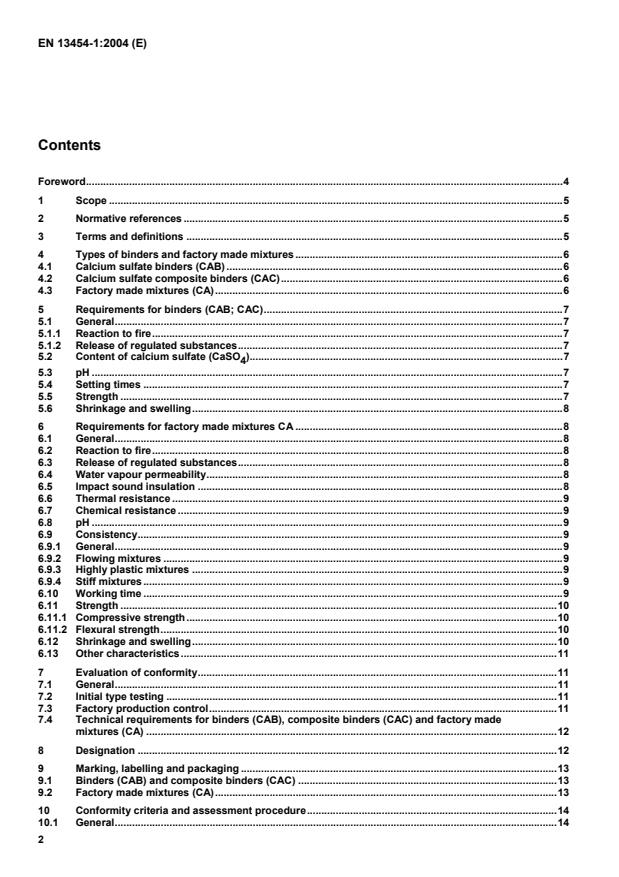
Clauses of this European Standard addressing the provisions of the EU Construction Products Directive.19 ZA.1 Scope and relevant characteristics.19 ZA.2 Procedures for attestation of conformity of binders and composite binders based on calcium sulfate.20 ZA.2.1 Systems of attestation of conformity.20 ZA.2.2 EC Certificate and declaration of conformity.23 ZA.3 CE marking and labelling.24 Bibliography.27
Part 1: Definitions and requirements
Part 2: Test methods This document specifies binders, composite binders and factory made mixtures where the principal active constitu-ent is calcium sulfate. The requirements in EN 13454-1 on binders and composite binders are based on the results of tests according to EN 13454-2.
The requirements on factory made mixtures for floor screeds based on calcium sulfate are in accordance with
EN 13813. According to the CEN/CENELEC Internal Regulations, the national standards organizations of the following coun-tries are bound to implement this European Standard: Austria, Belgium, Cyprus, Czech Republic, Denmark, Esto-nia, Finland, France, Germany, Greece, Hungary, Iceland, Ireland, Italy, Latvia, Lithuania, Luxembourg, Malta, Netherlands, Norway, Poland, Portugal, Slovakia, Slovenia, Spain, Sweden, Switzerland and United Kingdom.
1 Scope This document applies to calcium sulfate binders and composite binders made of calcium sulfate used for the manufacture of floor screeds for interior use in buildings. It also includes requirements for factory made mixtures made of calcium sulfate used for the manufacture of floor screeds which are given in EN 13813. This document does not cover the application of floor screeds. Floor screeds made with products covered by this document may contribute to thermal and sound insulation and fire protection of the floor. 2 Normative references The following referenced documents are indispensable for the application of this document. For dated references, only the edition cited applies. For undated references, the latest edition of the referenced document (including any amendments) applies. EN 12086, Thermal insulating products for building applications - Determination of water vapour transmission prop-erties. EN 13454-2:2003, Binders, composite binders and factory made mixtures for floor screeds based on calcium sul-fate - Part 2: Test methods. EN 13501-1, Fire classification of construction products and building elements - Part 1:Classification using test data from reaction to fire tests. EN 13813:2002, Screed material and floor screeds - Screed material - Properties and requirements. EN 13892-2, Methods of test for screed materials - Part 2: Determination of flexural and compressive strength. EN ISO 140-6, Acoustics - Measurement of sound insulation in buildings and of building elements - Part 6: Labora-tory measurements of impact sound insulation of floors (ISO 140-6:1998). 3 Terms and definitions For the purposes of this document, the following terms and definitions apply. 3.1 calcium sulfate constituents calcium sulfate in its various dehydration phases, for example hemihydrate and anhydrite 3.2 additives materials added to calcium sulfate binder or mixture by the manufacturer to influence the chemical and/or the physical properties NOTE Additives are, for example, fillers, pozzolans, pigments and artificial resins 3.3 admixtures materials added to the binder or mixture in small quantities and which, by chemical or physical action or both, change the properties of the calcium sulfate constituent, e.g. its workability, hardening or setting NOTE Admixtures are, for example accelerators, retarders and plasticizers
With respect to the manufacturing methods, factory made mixtures shall be suitable for application in one of the three consistencies: stiff, highly plastic or flowing (see 6.9). If calcium sulfate binders or calcium sulfate composite binders, as specified in this document, are used for the manufacture of factory made mixtures, the tests specified in EN 13454-2 for determination of the pH value and for determination of shrinkage and swelling need not to be carried out. Factory made mixtures can be produced and delivered as:
Table 1 — Strengths of binders (CAB) and (CAC) defined as characteristics values Strength class Minimum flexural strength N/mm2 Minimum compressive strength N/mm2 Tested after 3 days 28 days 3 days 28 days
1,5
4,0
8,0
20,0 30 2,0 5,0 12,0 30,0 40 2,5 6,0 16,0 40,0
The strength of binders shall be determined as specified in EN 13454-2. 5.6 Shrinkage and swelling The values for shrinkage and swelling shall not exceed 0,2 mm/m. Shrinkage and swelling shall be determined as specified in EN 13454-2. 6 Requirements for factory made mixtures CA
6.1 General NOTE Factory made mixtures placed on the market of the European Economic Area, and therefore subject to conformity with the construction Products Directive, are covered by EN 13813; tests performed to EN 13454-2 may, however, be taken into account to demonstrate conformity to EN 13813. Factory made mixtures are, though, marked in accordance with EN 13813. 6.2 Reaction to fire Factory made mixtures (CA) are reaction to fire Class A1fl without testing according to Commission Decision 96/603/EC as amended, provided that they contain less than 1 % by mass or volume of organic material, whichever is the more onerous. Products which contain 1 % or more of organic material shall be tested and classified in ac-cordance with EN 13501-1. 6.3 Release of regulated substances NOTE For CE marking purposes see Annex ZA of EN 13813:2002. 6.4 Water vapour permeability Where the intended use of a factory made mixture is for moisture diffusion control, the permeability to water vapour of the factory made mixture shall be determined in accordance with EN 12086. 6.5 Impact sound insulation Impact sound insulation is a property of the assembled system and not of the product itself.
EN 13454-2. Where the consistency value is greater than 300 mm, it may be determined in accordance with
EN 12706. For premixed and prebatched mixtures the consistency is determined with a given water to solid ratio as specified by the supplier. 6.9.2 Flowing mixtures The spread shall be ≥ 220 mm. The spread shall be determined as specified in EN 13454-2. With this consistency the mixtures shall not segregate (no visual sedimentation, no visual development of layers). 6.9.3 Highly plastic mixtures The spread shall be between 150 mm and less than 220 mm and determined as specified in EN 13454-2. 6.9.4 Stiff mixtures The flow diameter shall be 110 mm to 140 mm. The flow diameter shall be determined as specified in EN 13454-2. 6.10 Working time The minimum working time for flowing, highly plastic and stiff mixtures shall be ≥ 30 min. The working time shall be determined as specified in EN 13454-2.
C5 C7 C12C16C20C25C30C35C40 C50 C60C80Compressive strength in N/mm2 5 7 12 16 20 25 30 35 40 50 60 80 a For calcium sulfate the classes C12 to C60 are recommended.
The compressive strength shall be determined as specified in EN 13892-2. NOTE A description of the test is given in EN 13454-2. 6.11.2 Flexural strength The flexural strength is designated with "F" (for Flexural) followed by the flexural strength in N/mm2 given in Table 3 (in accordance with EN 13813).
Table 3 — Flexural strength of factory made mixtures (CA) defined as characteristic values Classa
F1 F2 F3 F4 F5 F6 F7 F10F15F20 F30 F40F50Flexural strength in N/mm2 1 2 3 4 5 6 7 10 15 20 30 40 50 a For calcium sulfate the classes F3 to F20 are recommended.
The flexural strength shall be determined as specified in EN 13892-2. NOTE A description of the test is given in EN 13454-2. 6.12 Shrinkage and swelling A manufacturer of screed materials may declare the shrinkage value and swelling value of the screed material in mm/m, determined in accordance with EN 13454-2 or in accordance with EN 13872 where the product is intended to be applied at a thickness less than 10 mm. The values for shrinkage and swelling shall not exceed 0,2 mm/m.
...