

SIST EN 13760:2022
(Main)LPG equipment and accessories - Automotive LPG filling system for light and heavy duty vehicles - Nozzle, test requirements and dimensions
General Information
- Abstract
This document specifies the minimum design, construction, test requirements and the critical dimensions for filling nozzles for the dispensing of automotive Liquefied Petroleum Gas (LPG) to vehicles of categories M and N, as defined in Regulation (EU) 2018/858 [2], that are fitted with the Euro filling unit (light duty or heavy duty).
- Status
- Published
- Public Enquiry End Date
- 02-Apr-2020
- Publication Date
- 12-Dec-2021
- Technical Committee
- TLP - Pressure vessels
- Current Stage
- 6060 - National Implementation/Publication (Adopted Project)
- Start Date
- 08-Dec-2021
- Due Date
- 12-Feb-2022
- Completion Date
- 13-Dec-2021
- Directive
- 2014/34/EU - Directive 2014/34/EU Of The European Parliament And Of The Council of 26 February 2014 on the harmonisation of the laws of the Member States relating to equipment and protective systems intended for use in potentially explosive atmospheres (recast)OJ Ref: L 140, L 251 (bil že prej) OJ Date: 19-May-2022



Overview
EN 13760:2021 (CEN) - "LPG equipment and accessories - Automotive LPG filling system for light and heavy duty vehicles - Nozzle, test requirements and dimensions" specifies the minimum design, construction, testing and critical dimensions for filling nozzles used to dispense automotive Liquefied Petroleum Gas (LPG) to vehicles of categories M and N fitted with the Euro filling unit (light or heavy duty). Approved by CEN in 2021 and superseding EN 13760:2003, the standard supports conformity with relevant EU directives (see Annex ZA) and clarifies safety, interchangeability and performance criteria for LPG filling nozzles.
Key topics and technical requirements
EN 13760:2021 addresses both geometric and functional requirements, including:
- Design & construction requirements and critical dimensions (normative Annexes A and B) for light- and heavy-duty filling nozzles.
- Sealing and materials: service gasket specifications and rules for non-metallic materials (compatibility with LPG, ageing and ozone resistance).
- Connection/disconnection modes: requirements for rotation-based and longitudinal (push/pull) operations and lever-actuated mechanisms.
- Comprehensive test procedures, including:
- Endurance (mechanical lifecycle) tests
- Overpressure and external leak tests (connected and unconnected states)
- Electrical continuity checks
- Drop, freezing and temperature cycle tests
- Corrosion resistance and salt-mist testing
- LPG compatibility tests for rubber materials, ozone ageing, dry-heat resistance and oxygen ageing
- Marking requirements and conformity assessment notes, plus an informative Annex ZA describing relationships with EU Directive 2014/34/EU (explosive atmospheres) and references to pressure equipment considerations.
Practical applications
This standard ensures safe, reliable and interoperable LPG filling nozzles across refuelling stations and vehicle fleets. Use cases:
- Design and manufacture of LPG filling nozzles and Euro filling units
- Type-testing and production testing by certification bodies and independent test laboratories
- Component selection and compliance checks by OEMs, fuel system integrators and installers
- Regulatory assessment and market surveillance by authorities enforcing fuel safety and equipment standards
- Procurement specifications for fuel retailers and fleet operators
Who should use EN 13760:2021
- LPG equipment manufacturers and designers
- Test houses and conformity assessment bodies
- Automotive OEMs and aftermarket suppliers for LPG systems
- Station equipment suppliers and fuel operators
- Safety and compliance engineers working with LPG refuelling systems
Related standards and references
Relevant normative references cited in EN 13760 include EN 589 (LPG fuel requirements), EN 1762 (LPG hoses), EN 549 (rubber seals), EN ISO 11114‑2, EN ISO 9227 and environmental/testing standards (IEC/ISO). These should be consulted alongside EN 13760 for full compliance and material qualification.
Keywords: EN 13760:2021, LPG filling nozzle, Euro filling unit, LPG nozzle dimensions, LPG nozzle test requirements, automotive LPG filling system.
Relations
- Effective Date
- 01-Jan-2022
- Effective Date
- 09-Feb-2026
- Effective Date
- 28-Jan-2026
- Effective Date
- 28-Jan-2026
- Effective Date
- 28-Jan-2026
- Effective Date
- 28-Jan-2026
- Effective Date
- 28-Jan-2026
- Refers
SIST EN ISO 9227:2017 - Corrosion tests in artificial atmospheres - Salt spray tests (ISO 9227:2017) - Effective Date
- 28-Jan-2026
- Refers
SIST EN 549:2019 - Rubber materials for seals and diaphragms for gas appliances and gas equipment - Effective Date
- 28-Jan-2026
- Effective Date
- 28-Jan-2026
- Effective Date
- 28-Jan-2026
- Effective Date
- 28-Jan-2026
Get Certified
Connect with accredited certification bodies for this standard

TÜV Rheinland
TÜV Rheinland is a leading international provider of technical services.

TÜV SÜD
TÜV SÜD is a trusted partner of choice for safety, security and sustainability solutions.

DEKRA Certification Inc.
DEKRA US certification services.
Sponsored listings
Frequently Asked Questions
SIST EN 13760:2022 is a standard published by the Slovenian Institute for Standardization (SIST). Its full title is "LPG equipment and accessories - Automotive LPG filling system for light and heavy duty vehicles - Nozzle, test requirements and dimensions". This standard covers: This document specifies the minimum design, construction, test requirements and the critical dimensions for filling nozzles for the dispensing of automotive Liquefied Petroleum Gas (LPG) to vehicles of categories M and N, as defined in Regulation (EU) 2018/858 [2], that are fitted with the Euro filling unit (light duty or heavy duty).
This document specifies the minimum design, construction, test requirements and the critical dimensions for filling nozzles for the dispensing of automotive Liquefied Petroleum Gas (LPG) to vehicles of categories M and N, as defined in Regulation (EU) 2018/858 [2], that are fitted with the Euro filling unit (light duty or heavy duty).
SIST EN 13760:2022 is classified under the following ICS (International Classification for Standards) categories: 43.060.40 - Fuel systems; 75.200 - Petroleum products and natural gas handling equipment. The ICS classification helps identify the subject area and facilitates finding related standards.
SIST EN 13760:2022 has the following relationships with other standards: It is inter standard links to SIST EN 13760:2004, SIST EN IEC 60068-2-52:2018, SIST EN 12806:2003, SIST EN ISO 15721:2002, SIST EN 589:2019, SIST EN ISO 80079-36:2016, SIST EN 1762:2019, SIST EN ISO 9227:2017, SIST EN 549:2019, SIST EN ISO 11114-2:2013, SIST EN 14678-1:2013, SIST EN 14678-1:2006+A1:2009. Understanding these relationships helps ensure you are using the most current and applicable version of the standard.
SIST EN 13760:2022 is associated with the following European legislation: EU Directives/Regulations: 2014/34/EU; Standardization Mandates: M/BC/CEN/92/46. When a standard is cited in the Official Journal of the European Union, products manufactured in conformity with it benefit from a presumption of conformity with the essential requirements of the corresponding EU directive or regulation.
SIST EN 13760:2022 is available in PDF format for immediate download after purchase. The document can be added to your cart and obtained through the secure checkout process. Digital delivery ensures instant access to the complete standard document.
Standards Content (Sample)
SLOVENSKI STANDARD
01-januar-2022
Nadomešča:
SIST EN 13760:2004
Oprema in pribor za utekočinjeni naftni plin (UNP) - Sistem za polnjenje
utekočinjenega naftnega plina za lahka in težka vozila - Šoba, preskuševalne
zahteve in mere
LPG equipment and accessories - Automotive LPG filling system for light and heavy duty
vehicles - Nozzle, test requirements and dimensions
Flüssiggas-Geräte und Ausrüstungsteile - Füllsysteme an Autogasanlagen für leichte
und schwere Fahrzeuge - Anschlussstutzen, Prüfanforderungen und Abmessungen
Équipements GPL et leurs accessoires - Dispositif de remplissage GPL pour véhicules
légers et poids lourds - Pistolet: conditions d'essais et dimensions
Ta slovenski standard je istoveten z: EN 13760:2021
ICS:
43.060.40 Sistemi za gorivo Fuel systems
75.200 Oprema za skladiščenje Petroleum products and
nafte, naftnih proizvodov in natural gas handling
zemeljskega plina equipment
2003-01.Slovenski inštitut za standardizacijo. Razmnoževanje celote ali delov tega standarda ni dovoljeno.
EN 13760
EUROPEAN STANDARD
NORME EUROPÉENNE
November 2021
EUROPÄISCHE NORM
ICS 43.060.40; 75.200 Supersedes EN 13760:2003
English Version
LPG equipment and accessories - Automotive LPG filling
system for light and heavy duty vehicles - Nozzle, test
requirements and dimensions
Équipements pour GPL et leurs accessoires - Dispositif Flüssiggas-Geräte und Ausrüstungsteile - Füllsysteme
de remplissage GPL pour véhicules légers et poids an Autogasanlagen für leichte und schwere Fahrzeuge -
lourds - Pistolet : conditions d'essais et dimensions Anschlussstutzen, Prüfanforderungen und
Abmessungen
This European Standard was approved by CEN on 23 May 2021.
CEN members are bound to comply with the CEN/CENELEC Internal Regulations which stipulate the conditions for giving this
European Standard the status of a national standard without any alteration. Up-to-date lists and bibliographical references
concerning such national standards may be obtained on application to the CEN-CENELEC Management Centre or to any CEN
member.
This European Standard exists in three official versions (English, French, German). A version in any other language made by
translation under the responsibility of a CEN member into its own language and notified to the CEN-CENELEC Management
Centre has the same status as the official versions.
CEN members are the national standards bodies of Austria, Belgium, Bulgaria, Croatia, Cyprus, Czech Republic, Denmark, Estonia,
Finland, France, Germany, Greece, Hungary, Iceland, Ireland, Italy, Latvia, Lithuania, Luxembourg, Malta, Netherlands, Norway,
Poland, Portugal, Republic of North Macedonia, Romania, Serbia, Slovakia, Slovenia, Spain, Sweden, Switzerland, Turkey and
United Kingdom.
EUROPEAN COMMITTEE FOR STANDARDIZATION
COMITÉ EUROPÉEN DE NORMALISATION
EUROPÄISCHES KOMITEE FÜR NORMUNG
CEN-CENELEC Management Centre: Rue de la Science 23, B-1040 Brussels
© 2021 CEN All rights of exploitation in any form and by any means reserved Ref. No. EN 13760:2021 E
worldwide for CEN national Members.
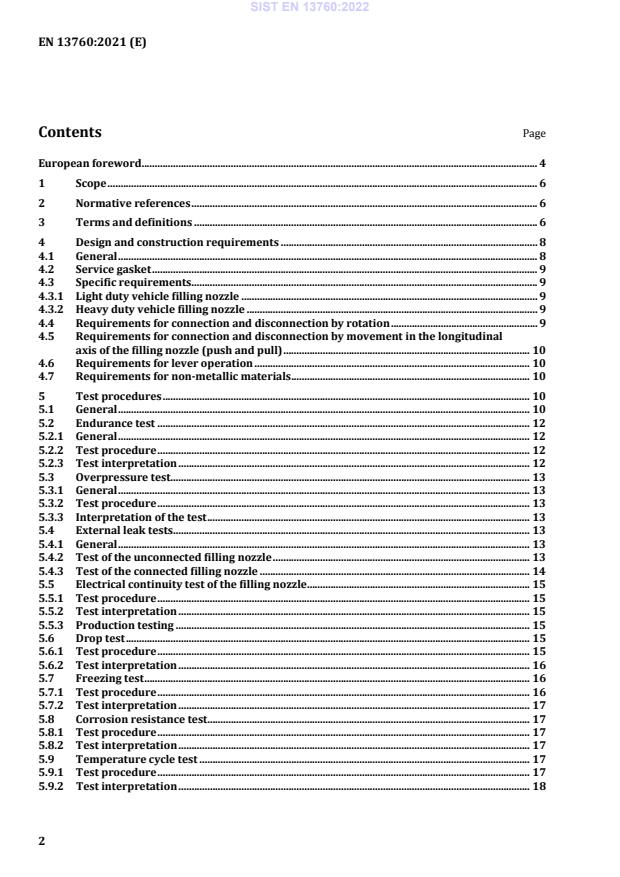
Contents Page
European foreword . 4
1 Scope . 6
2 Normative references . 6
3 Terms and definitions . 6
4 Design and construction requirements . 8
4.1 General . 8
4.2 Service gasket . 9
4.3 Specific requirements . 9
4.3.1 Light duty vehicle filling nozzle . 9
4.3.2 Heavy duty vehicle filling nozzle . 9
4.4 Requirements for connection and disconnection by rotation . 9
4.5 Requirements for connection and disconnection by movement in the longitudinal
axis of the filling nozzle (push and pull) . 10
4.6 Requirements for lever operation . 10
4.7 Requirements for non-metallic materials . 10
5 Test procedures . 10
5.1 General . 10
5.2 Endurance test . 12
5.2.1 General . 12
5.2.2 Test procedure . 12
5.2.3 Test interpretation . 12
5.3 Overpressure test . 13
5.3.1 General . 13
5.3.2 Test procedure . 13
5.3.3 Interpretation of the test . 13
5.4 External leak tests. 13
5.4.1 General . 13
5.4.2 Test of the unconnected filling nozzle . 13
5.4.3 Test of the connected filling nozzle . 14
5.5 Electrical continuity test of the filling nozzle . 15
5.5.1 Test procedure . 15
5.5.2 Test interpretation . 15
5.5.3 Production testing . 15
5.6 Drop test . 15
5.6.1 Test procedure . 15
5.6.2 Test interpretation . 16
5.7 Freezing test . 16
5.7.1 Test procedure . 16
5.7.2 Test interpretation . 17
5.8 Corrosion resistance test . 17
5.8.1 Test procedure . 17
5.8.2 Test interpretation . 17
5.9 Temperature cycle test . 17
5.9.1 Test procedure . 17
5.9.2 Test interpretation . 18
5.10 LPG compatibility test (for rubber materials) . 18
5.10.1 Test procedure . 18
5.10.2 Test interpretation . 18
5.11 Ozone ageing test . 18
5.11.1 General . 18
5.11.2 Test procedure . 18
5.11.3 Test interpretation . 18
5.12 Resistance to dry heat test . 18
5.12.1 General . 18
5.12.2 Test procedure . 18
5.12.3 Test interpretation . 18
5.13 Oxygen ageing . 19
6 Markings . 19
Annex A (normative) Critical dimensions of the filling nozzles . 20
Annex B (normative) Critical dimensions of the filling units . 22
Annex ZA (informative) Relationship between this European Standard and the essential
requirements of EU Directive 2014/34/EU aimed to be covered . 24
Bibliography . 26
European foreword
This document (EN 13760:2021) has been prepared by Technical Committee CEN/TC 286 “Liquefied
petroleum gas equipment and accessories”, the secretariat of which is held by NSAI.
This European Standard shall be given the status of a national standard, either by publication of an
identical text or by endorsement, at the latest by May 2022, and conflicting national standards shall be
withdrawn at the latest by May 2022.
Attention is drawn to the possibility that some of the elements of this document may be the subject of
patent rights. CEN shall not be held responsible for identifying any or all such patent rights.
This document supersedes EN 13760:2003.
This document includes the following significant technical changes with respect to EN 13760:2003:
— Updated normative references;
— Revised definitions;
— Revised test procedures;
— Removal of re-testing step from each test procedure;
— Addition of oxygen ageing test;
— Revised critical dimensions of Figure B.2;
— Revised Annex ZA.
This document has been prepared under a standardization request given to CEN by the European
Commission and the European Free Trade Association, and supports essential requirements of
EU Directive(s).
For relationship with EU Directive(s), see informative Annex ZA, which is an integral part of this
document.
This document does not deal with the essential safety requirements of the DIRECTIVE 2014/68/EU of the
European Parliament and of the Council of 15 May 2014 on the harmonization of the laws of the Member
States relating to the making available on the market of pressure equipment.
This document addresses the essential health and safety requirements of DIRECTIVE 2014/34/EU OF
THE EUROPEAN PARLIAMENT AND OF THE COUNCIL of 26 February 2014 on the harmonization of the
laws of the Member States relating to equipment and protective systems intended for use in potentially
explosive atmospheres.
In the Pressure Equipment Directive (PED) the nozzle is classified as a “pressure accessory”. It is intended
to be connected to a hose, which is classified as “piping”.
— The category 1 limit is defined in Annex 2 Table 6 of the PED and is a function of the product of
nominal size (DN) and maximum allowable pressure (PS) with a limit of 1 000.
— Because PS in this document is 2 500 kPa and the DN of the intended hose is less than 40, the figure
of 1 000 in Table 6 is not reached.
Protection of the environment is a key political issue in Europe and elsewhere. For CEN/TC 286 this is
covered in CEN/TS 16765 and this Technical Specification should be read in conjunction with this
document. This Technical Specification provides guidance on the environmental aspects to be considered
regarding equipment and accessories produced for the LPG industry and the following is addressed:
a) design;
b) manufacture;
c) packaging;
d) use and operation;
e) disposal.
Any feedback and questions on this document should be directed to the users’ national standards body.
A complete listing of these bodies can be found on the CEN website.
According to the CEN-CENELEC Internal Regulations, the national standards organisations of the
following countries are bound to implement this European Standard: Austria, Belgium, Bulgaria, Croatia,
Cyprus, Czech Republic, Denmark, Estonia, Finland, France, Germany, Greece, Hungary, Iceland, Ireland,
Italy, Latvia, Lithuania, Luxembourg, Malta, Netherlands, Norway, Poland, Portugal, Republic of North
Macedonia, Romania, Serbia, Slovakia, Slovenia, Spain, Sweden, Switzerland, Turkey and the United
Kingdom.
1 Scope
This document specifies the minimum design, construction, test requirements and the critical dimensions
for filling nozzles for the dispensing of automotive Liquefied Petroleum Gas (LPG) to vehicles of
categories M and N, as defined in Regulation (EU) 2018/858 [2], that are fitted with the Euro filling unit
(light duty or heavy duty).
2 Normative references
The following documents are referred to in the text in such a way that some or all of their content
constitutes requirements of this document. For dated references, only the edition cited applies. For
undated references, the latest edition of the referenced document (including any amendments) applies.
EN 549:2019, Rubber materials for seals and diaphragms for gas appliances and gas equipment
EN 589:2018, Automotive fuels — LPG — Requirements and test methods
EN 12806:2003, Automotive liquefied petroleum gas components — Other than containers
EN 1762:2018, Rubber hoses and hose assemblies for liquefied petroleum gas, LPG (liquid or gaseous phase),
and natural gas up to 25 bar (2,5 MPa) — Specification
EN ISO 9227:2017, Corrosion tests in artificial atmospheres — Salt spray tests (ISO 9227:2017)
EN ISO 11114-2:2013, Gas cylinders — Compatibility of cylinder and valve materials with gas contents —
Part 2: Non-metallic materials (ISO 11114-2:2013)
EN ISO 80079-36:2016, Explosive atmospheres — Part 36: Non-electrical equipment for explosive
atmospheres — Basic method and requirements (ISO 80079-36:2016)
EN IEC 60068-2-52:2018, Environmental testing — Part 2-52: Tests — Test Kb: Salt mist, cyclic (sodium
chloride solution) (IEC 60068-2-52:2017)
ISO 188:2011, Rubber, vulcanized or thermoplastic — Accelerated ageing and heat resistance tests
ISO 1431-1:2012, Rubber, vulcanized or thermoplastic — Resistance to ozone cracking — Part 1: Static and
dynamic strain testing
ISO 6957:1988, Copper alloys — Ammonia test for stress corrosion resistance
3 Terms and definitions
For the purposes of this document, the following terms and definitions apply.
ISO and IEC maintain terminological databases for use in standardization at the following addresses:
— IEC Electropedia: available at https://www.electropedia.org/
— ISO Online browsing platform: available at https://www.iso.org/obp
3.1
pressure
gauge pressure, unless otherwise stated
3.2
maximum allowable pressure
maximum pressure for which the equipment is designed
Note 1 to entry: All pressures are gauge pressures, unless otherwise stated.
3.3
test pressure
pressure to which the component, or an assembly of components, is subjected during the tests
3.4
filling nozzle
mechanical system, fitted to the hose of the dispensing system, consisting of a filling nozzle body,
operating mechanism, including sealing elements and a service gasket if required
3.5
light duty vehicle filling nozzle
filling nozzle intended to fuel vehicles fitted with the light duty vehicle Euro filling unit (K15)
3.6
heavy duty vehicle filling nozzle
filling nozzle intended to fuel vehicles fitted with the heavy duty vehicle Euro filling unit
3.7
locking mechanism
component allowing the locking or unlocking operation of the filling nozzle to the filling unit
3.8
service gasket
replaceable gasket ensuring tightness of the connection between the filling nozzle outlet and the filling
unit inlet
3.9
torque for connection
torque required to connect the filling nozzle to the filling unit
3.10
torque for disconnection
torque required to disconnect the filling nozzle from the filling unit
3.11
push-on force
force applied in the longitudinal axis of the filling unit to connect the filling nozzle to the filling unit
3.12
pull-off force
force applied in the longitudinal axis of the filling unit to disconnect the filling nozzle from the filling unit
3.13
grip
area where the filling nozzle is held for connection or disconnection
3.14
filling unit
device installed on the outside of the vehicle to receive the filling nozzle and enable the filling of the LPG
container
Note 1 to entry: The filling nozzle as prescribed in this document is only intended to be used with the Euro filling
unit.
4 Design and construction requirements
4.1 General
Any non-electrical equipment, intended for use in a potentially explosive atmosphere, shall comply with
the requirements of EN ISO 80079-36:2016. The filling nozzle shall be designed and constructed
according to good engineering practice and in conformity with the required categories for group II
equipment to ensure avoidance of any ignition source.
To classify the category of the equipment it shall be subjected to an ignition hazard assessment in
accordance with EN ISO 80079-36:2016.
If the filling nozzle does not contain any effective ignition sources in normal operation it shall be classified
as Group II, gas group IIA, category 3G.
The design of the filling nozzle shall ensure that:
a) it is suitable for use with automotive LPG as specified in EN 589:2018;
b) it is compatible with the relevant filling unit as specified in EN 12806:2003;
c) entrapment of fingers and/or cold burns are not possible;
d) it is not possible to open the valve in the filling nozzle if the filling nozzle is not properly locked and
sealed on the filling unit;
e) it locks in the connected position;
f) it is not possible to disconnect the filling nozzle from the filling unit unless the filling nozzle valve is
closed;
g) blocking due to internal freezing does not occur, according to 5.7;
h) it is tolerant to the effect of dirt;
i) it will withstand a torque of 150 % of the mounting torque specified by the manufacturer without
damage;
j) the electrical resistance is 1 kΩ maximum;
k) the materials in contact with LPG are LPG-compatible;
l) the external surfaces of the filling nozzle are corrosion resistant or protected against corrosion and
are made of materials that do not cause sparks when dropped on a surface;
m) the minimum lifetime is 100 000 cycles;
n) the climate conditions of the geographic area where they will operate are taken into account as
follows:
— Moderate Climate conditions: −20 °C to +65 °C;
— Cold Climate conditions: −40 °C to +65 °C;
o) the maximum allowable pressure is 2 500 kPa;
p) a latching mechanism is incorporated;
q) the filling nozzle is provided with a means to securely attach it to the delivery hose;
r) filling nozzle shall not exceed critical dimensions specified in Annex A, Figures A.1 or A.2.
4.2 Service gasket
The service gasket between the filling nozzle and the filling unit, if required, shall be fitted in the nozzle.
Changing the service gasket shall not result in any LPG release.
The minimum lifetime of the service gasket shall be 20 000 cycles.
4.3 Specific requirements
4.3.1 Light duty vehicle filling nozzle
The release of LPG during disconnection shall be less than 1 cm liquid.
The maximum weight of the filling nozzle shall be 2 kg (including swivel, if fitted).
The external diameter of the filling nozzle s
...