

SIST EN 581-3:2026
(Main)Outdoor furniture - Mechanical safety requirements and test methods - Part 3: Tables for camping, domestic and contract use
- Abstract
This document specifies requirements for the general safety and structural safety which include strength, reliability and stability for outdoor tables for camping use, for domestic use and for contract use, used by adults, including those with glass in their construction.
It does not apply to street furniture.
It does not apply to office tables, worktables, desks and laboratory worktops for educational institutions for which other EN standards exist.
With exception of the stability tests, this document does not provide assessment of the suitability of any storage features included in outdoor tables for which other EN standards can be applied.
It does not include requirements for electrical safety.
It does not include requirements for the resistance to ageing, degradation.
- Status
- Published
- Public Enquiry End Date
- 01-Nov-2024
- Publication Date
- 10-Jun-2026
- Technical Committee
- POH - Furniture
- Current Stage
- 6060 - National Implementation/Publication (Adopted Project)
- Start Date
- 02-Jun-2026
- Due Date
- 07-Aug-2026
- Completion Date
- 11-Jun-2026

SIST EN 581-3:2026 is the Slovenian adoption of European Standard EN 581-3:2026 from the European Committee for Standardization (CEN). It specifies mechanical safety requirements and test methods for outdoor tables for camping, domestic and contract use, including tables with glass in their construction, for use by adults. In practice, it is the document used to check strength, stability and reliability, and to define the user and test information that goes with these tables.
What does SIST EN 581-3:2026 specify?
SIST EN 581-3:2026 covers general safety and structural safety for outdoor tables used for camping, domestic and contract use. It also tells readers what is outside its scope, so it is easier to see whether a product belongs here or in another EN standard.
It is organized into clauses 1 to 7 and two informative annexes.
| Annex | What it covers |
|---|---|
| Annex A | Additional test recommendations, including tabletop deflection, tables with castors, and folding tables |
| Annex B | Purchase information guidelines, including point-of-sale information and a parasol warning |
The scope excludes street furniture, office tables, worktables, desks and laboratory worktops for educational institutions. It also excludes electrical safety and resistance to ageing or degradation. For a buyer or test lab, that means the standard focuses on mechanical performance of outdoor tables, not on electrical or long-term material durability.
What are the key requirements of SIST EN 581-3:2026?
SIST EN 581-3:2026 builds on general outdoor-furniture safety, then adds table-specific stability, structural and glass-related requirements. The document uses EN 1730:2012 test methods through most of the mechanical checks.
General safety and stability
- Clause 5.1 requires the table to meet EN 581-1. In practice, the table must first satisfy the broader safety rules for outdoor seating and tables.
- Clause 5.2 uses EN 1730:2012 for stability checks. Tables adjustable above and below 950 mm are tested in both height ranges, so height-adjustable products have to remain stable in each intended setting.
- Tables with extension elements are tested with the extension parts loaded, and tables designed to support a parasol are tested for overturning. This matters for products with added features that can change the balance of the table.
Structural safety and glass
- Clause 5.3.1 classifies tables as Type 1, Type 2 or Type 3 based on tabletop area and height. This classification sets the test loads and cycles, so manufacturers need to identify the product type before testing.
- Clause 5.3.2 allows no glass or glass mirrors in camping tables. If glass is used in a tabletop, it must meet the document’s safety-glass or other-glass conditions.
- The glass provisions refer to EN 12150-1, EN 12600 and EN 14072. In practice, this links the table test to established glass breakage and impact methods.
Test sequence, pass criteria, use information and reporting
- Clause 5.3.3 requires testing on the same sample, in the order given in Table 2, according to the intended use. Table 2 sets the loads, cycles and impact conditions for camping, domestic and contract severity.
- Clause 5.3.4 requires no fracture of any member, joint or component, no loosening of rigid joints, and continued function after test. The table must still work after the sequence.
- Clause 6 requires user instructions in the language of the country of delivery, with the specified warning heading unless the information is permanently marked. It also requires use conditions, assembly instructions, tightening frequency, maintenance instructions and, where relevant, a parasol warning.
- Clause 7 sets the minimum test-report contents, including the standard reference, the item tested, defects seen before testing, test results, severity level, test facility and test date. This is the evidence a buyer, auditor or certification body will look for.
What terms does SIST EN 581-3:2026 define?
- table for camping use - a light outdoor table intended for occasional camping or travelling use and able to be reduced in volume for transport or storage.
- table for domestic use - an outdoor table intended for private use in places without public access.
- table for contract use - an outdoor table intended for non-private use in places with public access.
- street furniture - outdoor furniture in public space that is permanently fixed or cannot be manually removed.
- accessible part - a part that the user can easily reach in the intended use position, including areas 100 mm in from the edges.
- extension element - a component that can be pulled out and pushed in.
- ancillary surface - a surface added to the main tabletop for occasional use.
Who uses SIST EN 581-3:2026?
SIST EN 581-3:2026 is used by manufacturers of outdoor tables, especially those making camping, domestic and contract products. It is also used by test laboratories, quality managers, conformity assessment bodies and buyers who need a clear basis for mechanical safety checks.
It is particularly relevant where tables include glass, folding parts, castors, extension leaves or parasol openings. For procurement and product approval, it helps users match the intended use with the right test severity and documentation.
What changed in SIST EN 581-3:2026 from the previous edition?
SIST EN 581-3:2026 supersedes SIST EN 581-3:2017 / EN 581-3:2017. The European foreword states these technical changes:
- general safety requirements were added;
- tests on glass tops were modified;
- different table types were added and the surface-area threshold changed from 0,25 m to 0,30 m;
- the load mass for horizontal durability tests at camping level was modified;
- the concept of cantilever tables was clarified;
- a vertical durability test for cantilever or pedestal tables was added;
- a vertical impact test was added;
- additional test recommendations were added in Annex B;
- former Annex A was moved to Annex B;
- new definitions were added for table for camping use, table for domestic use and table for contract use.
Which standards are used with SIST EN 581-3:2026?
- EN 581-1 - provides the general safety requirements that the table must meet.
- EN 1730:2012 - provides the test conditions and the stability, strength and durability methods used throughout the document.
- EN 12150-1:2015+A1:2019 - provides the fragmentation test and definition/description used for safety glass.
- EN 12600:2002 - provides the pendulum impact classification for flat glass.
- EN 14072:2003 - provides glass test methods used for glass tabletops.
What does the SIST EN 581-3:2026 document contain?
The document contains the main test sequence in Table 2, which links table type and intended use to the relevant static, durability, impact and stability tests. It also contains the stability checks for vertical load, extension elements and parasol-supporting tables, plus the glass-specific requirements for tabletops.
Annex A adds optional recommendations for tabletop deflection, castor durability and folding-table durability. Annex B gives purchase-information guidance for point of sale, including product identification, use conditions, maintenance information and a warning for tables with parasol openings.
Relations
- Effective Date
- 01-Jul-2026
- Effective Date
- 01-Jul-2026
- Effective Date
- 01-Jul-2026
- Effective Date
- 01-Jul-2026
- Effective Date
- 01-Jul-2026
- Effective Date
- 01-Jul-2026
- Effective Date
- 27-May-2026
- Effective Date
- 27-May-2026
Frequently Asked Questions
SIST EN 581-3:2026 is a standard published by the Slovenian Institute for Standardization (SIST). Its full title is "Outdoor furniture - Mechanical safety requirements and test methods - Part 3: Tables for camping, domestic and contract use". This standard covers: This document specifies requirements for the general safety and structural safety which include strength, reliability and stability for outdoor tables for camping use, for domestic use and for contract use, used by adults, including those with glass in their construction. It does not apply to street furniture. It does not apply to office tables, worktables, desks and laboratory worktops for educational institutions for which other EN standards exist. With exception of the stability tests, this document does not provide assessment of the suitability of any storage features included in outdoor tables for which other EN standards can be applied. It does not include requirements for electrical safety. It does not include requirements for the resistance to ageing, degradation.
This document specifies requirements for the general safety and structural safety which include strength, reliability and stability for outdoor tables for camping use, for domestic use and for contract use, used by adults, including those with glass in their construction. It does not apply to street furniture. It does not apply to office tables, worktables, desks and laboratory worktops for educational institutions for which other EN standards exist. With exception of the stability tests, this document does not provide assessment of the suitability of any storage features included in outdoor tables for which other EN standards can be applied. It does not include requirements for electrical safety. It does not include requirements for the resistance to ageing, degradation.
SIST EN 581-3:2026 is classified under the following ICS (International Classification for Standards) categories: 97.140 - Furniture; 97.200.30 - Camping equipment and camp-sites. The ICS classification helps identify the subject area and facilitates finding related standards.
SIST EN 581-3:2026 has the following relationships with other standards: It is inter standard links to SIST EN 581-3:2017, SIST EN 1730:2012, SIST EN 12150-1:2015+A1:2019, SIST EN 12600:2004, SIST EN 14072:2004, SIST EN 581-1:2017, SIST-TP CEN/TR 581-4:2006, SIST EN 581-1:2006. Understanding these relationships helps ensure you are using the most current and applicable version of the standard.
SIST EN 581-3:2026 is available in PDF format for immediate download after purchase. The document can be added to your cart and obtained through the secure checkout process. Digital delivery ensures instant access to the complete standard document.
Standards Content (Sample)
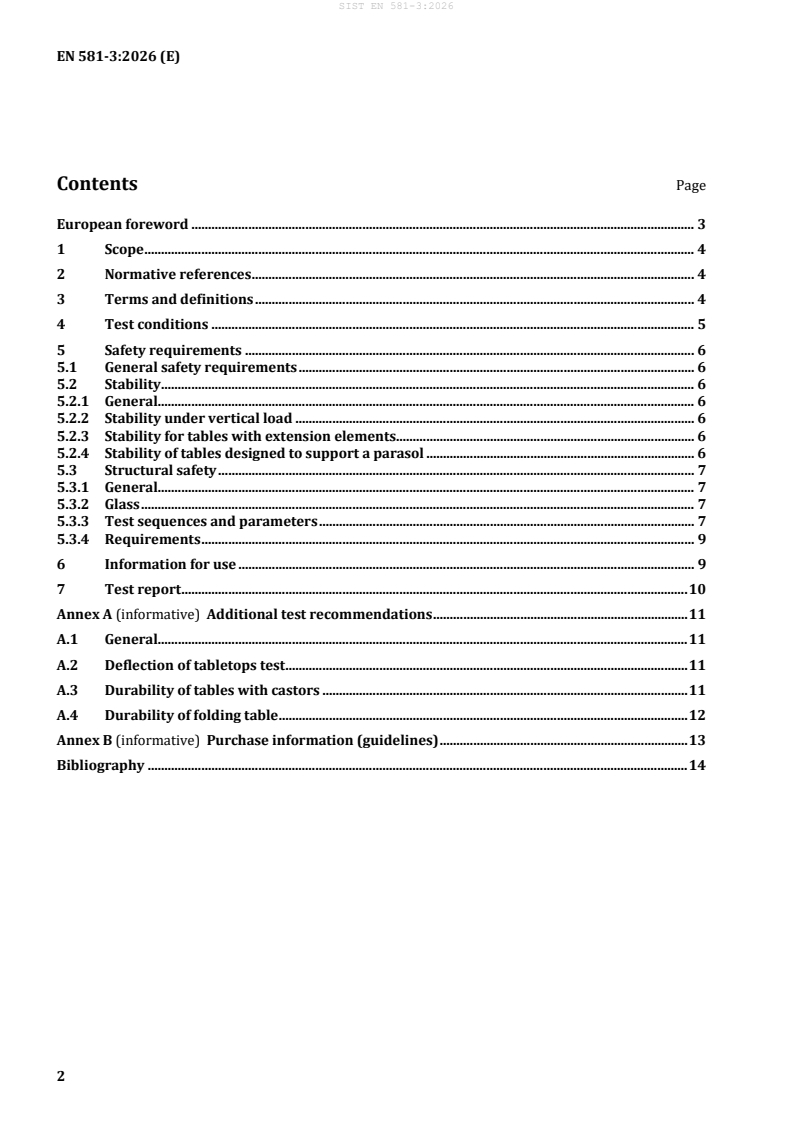
Contents
- 1 Scope
- 2 Normative references
- 3 Terms and definitions
- 3.1 table for camping use
- 3.2 table for domestic use
- 3.3 table for contract use
- 3.4 street furniture
- 3.5 accessible part
- 3.6 extension element
- 3.7 ancillary surface
- 4 Test conditions
- 5 Safety requirements
- 5.1 General safety requirements
- 5.2 Stability
- 5.3 Structural safety
- 1. Vertical static load EN 1730:2012, Specified force, N
- 4. Horizontal durability EN 1730:2012, Specified mass, kg
- 8. Stability under EN 1730:2012, Test force, N
- 6 Information for use
- 7 Test report
- Annex A
- Annex B
- Bibliography
1 Scope
This document specifies requirements for the general safety and structural safety which include strength, reliability and stability for outdoor tables for camping use, for domestic use and for contract use, used by adults, including those with glass in their construction.
It does not apply to street furniture.
It does not apply to office tables, worktables, desks and laboratory worktops for educational institutions for which other EN standards exist.
With exception of the stability tests, this document does not provide assessment of the suitability of any storage features included in outdoor tables for which other EN standards can be applied. It does not include requirements for electrical safety.
It does not include requirements for the resistance to ageing, degradation.
2 Normative references
The following documents are referred to in the text in such a way that some or all of their content constitutes requirements of this document. For dated references, only the edition cited applies. For undated references, the latest edition of the referenced document (including any amendments) applies. EN 581-1, Outdoor furniture — Seating and tables for camping, domestic and contract use — Part 1:
General safety requirements EN 1730:2012, Furniture — Tables — Test methods for the determination of stability, strength and durability EN 12150-1:2015+A1:2019, Glass in building — Thermally toughened soda lime silicate safety glass — Part 1: Definition and description EN 12600:2002, Glass in building — Pendulum test — Impact test method and classification for flat glass EN 14072:2003, Glass in furniture — Test methods
3 Terms and definitions
For the purposes of this document, the following terms and definitions apply. ISO and IEC maintain terminology databases for use in standardization at the following addresses:
- ISO Online browsing platform: available at https://www.iso.org/obp/
- IEC Electropedia: available at https://www.electropedia.org/
3.1 table for camping use
table for outdoor use light in weight, intended for occasional use in connection with camping and travelling and can be reduced in volume for transporting and storing Note 1 to entry: Such products are often foldable or knock-down.
SIST EN 581-3:2026 EN 581-3:2026 (E)
3.2 table for domestic use
table for outdoor use intended for private use in places without public access Note 1 to entry: Such products can be foldable or knock-down.
3.3 table for contract use
table for outdoor use intended for non-private use in places with public access Note 1 to entry: Such products can be foldable or knock-down.
3.4 street furniture
outdoor furniture used in public space, permanently fixed to the ground or any structure or not able to be manually removed Note 1 to entry: Examples of structure where the outdoor street furniture is attached include bus stop shelter, wall and art structure.
3.5 accessible part
part to which access can easily be gained by the user when the table is in its intended configuration of use and for which the probability of unintentional user contact is high, including all parts 100 mm in from the edges [SOURCE: EN 12521:2023, definition 3.1]
3.6 extension element
component that can be pulled out and pushed in EXAMPLE Drawers, suspended pocket files, keyboard trays.
[SOURCE: EN 16122:2012, definition 3.4]
3.7 ancillary surface
surface additional to the main surface intending for occasional use as part of a tabletop [SOURCE: EN 1730:2012, definition 3.2]
4 Test conditions
General test conditions shall be in accordance with EN 1730:2012, Clause 4.
SIST EN 581-3:2026 EN 581-3:2026 (E)
5 Safety requirements
5.1 General safety requirements
The table shall fulfil the EN 581-1 requirements.
5.2 Stability
5.2.1 General
When assessing the stability of a table, reference shall be made to EN 1730:2012, 7.1. Tables that can be set to heights both above and below 950 mm shall be tested to both 5.2.2.1 and 5.2.2.2.
5.2.2 Stability under vertical load
5.2.2.1 Test for tables that are or can be set to a height ≤ 950 mm
The table shall be set to the height most likely to cause overturning, but not more than 950 mm. The table shall not overturn when tested according to EN 1730:2012, 7.2.2 using the forces specified within Table 2.
For height adjustable table; the height set shall be recorded in the test report.
5.2.2.2 Test for tables that are or can be set to a height > 950 mm
The table shall be set to the height most likely to cause overturning, but not less than 950 mm. The table shall not overturn when tested according to EN 1730:2012, 7.2.3 using 50 % of the forces specified within Table 2.
For height adjustable table; the height set shall be recorded in the test report.
5.2.3 Stability for tables with extension elements
Load each extension element with the load specified in Table 1. The table shall not overturn when tested according to EN 1730:2012, 7.3 using the forces specified within Table 2.
Table 1 — Loads in extension elements Components Load Camping Domestic Contract 3 3 extension elements / 0,2 kg/dm 0,5 kg/dm
5.2.4 Stability of tables designed to support a parasol
The table shall not overturn when tested according to EN 1730:2012, 7.4 using the forces specified within Table 2.
SIST EN 581-3:2026 EN 581-3:2026 (E)
5.3 Structural safety
5.3.1 General
The requirement depends on the type of table:
...