

SIST EN 581-2:2026
(Main)Outdoor furniture - Mechanical safety requirements and test methods - Part 2: Seating for camping, domestic and contract use
- Abstract
This document specifies the minimum requirements for general safety and structural safety which include strength, reliability and stability of all types of outdoor seating for camping use, for domestic use and for contract use, for adults, without regard to materials, design or manufacturing processes.
It does not apply to street furniture.
It does not include requirements for removable upholstery, including the cover and filling.
It does not include requirements for the durability of castors/wheels and height adjustment mechanisms.
It does not include requirements for electrical safety.
It does not include requirements for the resistance to ageing and degradation caused by light, temperature and moisture.
The test requirements contained within this document are based on use by persons weighing up to 110 kg.
- Status
- Published
- Public Enquiry End Date
- 01-Nov-2024
- Publication Date
- 10-Jun-2026
- Technical Committee
- POH - Furniture
- Current Stage
- 6060 - National Implementation/Publication (Adopted Project)
- Start Date
- 02-Jun-2026
- Due Date
- 07-Aug-2026
- Completion Date
- 11-Jun-2026

SIST EN 581-2:2026 is the Slovenian identical adoption of EN 581-2:2026 from CEN. It specifies minimum mechanical safety requirements and test methods for outdoor seating for camping, domestic use and contract use, for adults, so manufacturers, test laboratories and buyers can check strength, stability and reliability before use.
What does SIST EN 581-2:2026 specify?
SIST EN 581-2:2026 covers the mechanical safety of outdoor seating for camping use, domestic use and contract use. It focuses on general safety and structural safety, including strength, reliability and stability, and it is based on use by persons weighing up to 110 kg.
The document does not cover street furniture, removable upholstery, castors or wheels durability, height adjustment mechanisms durability, electrical safety, or resistance to ageing and degradation caused by light, temperature and moisture. In practice, that means it is aimed at the seat structure and its stability, not at every accessory or environmental ageing issue.
The document is organized into clauses 1 to 10 and four annexes.
| Annex | What it covers |
|---|---|
| Annex A | Normative test method for deckchair |
| Annex B | Informative test method for folding lounger |
| Annex C | Informative guide to help identify deckchairs |
| Annex D | Informative purchase information guidelines |
What are the key requirements of SIST EN 581-2:2026?
SIST EN 581-2:2026 requires testing to be carried out using EN 1728:2012 and EN 1022:2023, with the special rules in this document applied where needed. That matters because the standard is not a free choice of tests - it ties outdoor seating assessment to defined seating and stability methods.
General testing setup
SIST EN 581-2:2026 requires the tests to be carried out on the same sample in the stated sequence for loungers and for other seating. For folding products, the intended use must match the manufacturer’s declared use within camping, domestic or contract use. Where a product might already fail stability, the stability tests may be run before the other tests.
Load points and special product forms
SIST EN 581-2:2026 gives a special method for determining the seat loading point for seating with a frame that supports a flexible sheet suspended at the backrest and front of the seat. The document also defines a small cylinder used for this purpose. In practice, this affects products such as deckchairs and similar designs, because the load has to be applied where the seat actually carries the user.
Loungers
SIST EN 581-2:2026 requires loungers to meet EN 581-1 and then pass a sequence of static load, durability, impact, lifting and stability tests. The main outcomes are that no joint, member or component may fracture, rigid joints may not loosen, the lounger must still function after load removal, and it must not overturn in the stability tests.
For loungers with an adjustable backrest, moving the backrest can count as a setting-up and folding operation when the user must leave the product to change position. This matters for product design because the adjustment mechanism is treated as part of the product’s normal handling.
Other seating
SIST EN 581-2:2026 requires other outdoor seating to meet EN 581-1 and then pass a sequence of static, durability and stability tests. The sequence includes seat, front edge, foot rest, armrest, leg and stability checks, and the product must again remain intact, functional and stable after testing.
For deckchairs, the standard adds specific locking-bar requirements. The locking bar must engage correctly, the manual force to engage or disengage it must not exceed 250 N, and the locking system must not disengage during the vertical and horizontal force tests or the impact test. This is important because deckchairs can collapse if the locking system slips.
Stability exceptions and product limits
SIST EN 581-2:2026 exempts some low, light seating from the stability tests if it has both a seat height below 200 mm and a mass below 5 kg. The test height is measured with a 600 N vertical load applied at the centre of the seating area. That means very small lightweight products are handled differently from full-size seating.
What terms does SIST EN 581-2:2026 define?
Seating for camping use is outdoor seating that is light in weight, intended for occasional use with camping and travelling, and can be reduced in volume for transport and storage.
Seating for domestic use is outdoor seating intended for private use in places without public access.
Seating for contract use is outdoor seating intended for non-private use in places with public access.
Lounger is seating intended for a reclined posture, with at least one backrest position between 0° and 45°, and an integral leg rest that supports the full body weight.
Street furniture is outdoor furniture used in public space that is permanently fixed to the ground or another structure, or cannot be manually removed.
Deckchair is foldable seating with an articulated cross-shaped frame, predefined positions set by a locking system at the locking bar, and a flexible sheet suspended in the upper backrest and front of the seat.
Median plane is the vertical plane running from front to rear through the centre of the seat and dividing the chair into two equal parts.
Who uses SIST EN 581-2:2026?
SIST EN 581-2:2026 is used by outdoor furniture manufacturers, importers, and product designers who need to build seating that passes mechanical safety testing. It is also used by test laboratories, quality managers, and conformity assessment teams that run the required load, stability and durability tests.
Buyers, retailers and procurement teams use it when specifying camping seating, domestic outdoor seating, contract seating, loungers and deckchairs. It is particularly relevant for products that must be verified before market release, tender acceptance or internal quality approval.
What changed in SIST EN 581-2:2026 from the previous edition?
SIST EN 581-2:2026 supersedes SIST EN 581-2:2016 and SIST EN 581-2:2016/AC:2016. Compared with EN 581-2:2015, the foreword states these changes:
- new definitions for camping use, domestic use and contract use
- general safety requirements added
- seating stability requirements updated to reflect EN 1022:2023
- updated seating requirements and clarification of how certain tests apply, with footnotes to tables
- Annex A, the normative test method for deckchair, added
- Annex B, the informative test method for folding lounger, added
- Annex C, the informative guide to facilitate identification of deckchairs, added
- Annex D, informative purchase information guidelines, replaced the former Annex B
- the previous annex on forward and sideways stability tests for loungers was deleted
- instruction-for-use text clarified
- rearward stability test for camping use clarified
Which standards are used with SIST EN 581-2:2026?
SIST EN 581-2:2026 uses three normative references that supply the general seating methods and stability basis:
- EN 581-1 - provides the general safety requirements for seating and tables for camping, domestic and contract use
- EN 1022:2023 - provides the stability determination methods used for forward, sideways, rearward and related stability checks
- EN 1728:2012 - provides the strength and durability test methods used for static loads, durability, impact and related checks
What does the SIST EN 581-2:2026 document contain?
SIST EN 581-2:2026 contains the full test framework for mechanical safety of outdoor seating, including how to choose load points, how to run the test sequence, and how to judge pass or fail. It includes tables for test sequences and parameters, and annexes with dedicated methods for deckchairs and folding loungers.
It also includes figures that show the lounger angle, deckchair construction, locking systems, the median plane, and the different test arrangements. Those figures help users set up the sample correctly and apply loads in the right place.
The document gives a step-by-step deckchair method in Annex A, including disengagement, locking durability, side impact and vertical load checks. Annex B gives a folding-lounger method that focuses on leg folding under horizontal force. Annex D gives purchase information guidance for product selection, while Clause 9 sets instruction-for-use and marking requirements.
Relations
- Effective Date
- 01-Jul-2026
- Effective Date
- 01-Jul-2026
- Effective Date
- 10-Jun-2026
- Effective Date
- 10-Jun-2026
- Effective Date
- 10-Jun-2026
- Effective Date
- 27-May-2026
- Effective Date
- 27-May-2026
Frequently Asked Questions
SIST EN 581-2:2026 is a standard published by the Slovenian Institute for Standardization (SIST). Its full title is "Outdoor furniture - Mechanical safety requirements and test methods - Part 2: Seating for camping, domestic and contract use". This standard covers: This document specifies the minimum requirements for general safety and structural safety which include strength, reliability and stability of all types of outdoor seating for camping use, for domestic use and for contract use, for adults, without regard to materials, design or manufacturing processes. It does not apply to street furniture. It does not include requirements for removable upholstery, including the cover and filling. It does not include requirements for the durability of castors/wheels and height adjustment mechanisms. It does not include requirements for electrical safety. It does not include requirements for the resistance to ageing and degradation caused by light, temperature and moisture. The test requirements contained within this document are based on use by persons weighing up to 110 kg.
This document specifies the minimum requirements for general safety and structural safety which include strength, reliability and stability of all types of outdoor seating for camping use, for domestic use and for contract use, for adults, without regard to materials, design or manufacturing processes. It does not apply to street furniture. It does not include requirements for removable upholstery, including the cover and filling. It does not include requirements for the durability of castors/wheels and height adjustment mechanisms. It does not include requirements for electrical safety. It does not include requirements for the resistance to ageing and degradation caused by light, temperature and moisture. The test requirements contained within this document are based on use by persons weighing up to 110 kg.
SIST EN 581-2:2026 is classified under the following ICS (International Classification for Standards) categories: 97.140 - Furniture; 97.200.30 - Camping equipment and camp-sites. The ICS classification helps identify the subject area and facilitates finding related standards.
SIST EN 581-2:2026 has the following relationships with other standards: It is inter standard links to SIST EN 581-2:2016/AC:2016, SIST EN 581-2:2016, SIST EN 1728:2012, SIST EN 581-1:2017, SIST EN 1022:2024, SIST EN 581-1:2006, SIST-TP CEN/TR 581-4:2006. Understanding these relationships helps ensure you are using the most current and applicable version of the standard.
SIST EN 581-2:2026 is available in PDF format for immediate download after purchase. The document can be added to your cart and obtained through the secure checkout process. Digital delivery ensures instant access to the complete standard document.
Standards Content (Sample)
SLOVENSKI STANDARD
01-julij-2026
Nadomešča:
SIST EN 581-2:2016
SIST EN 581-2:2016/AC:2016
Zunanje pohištvo - Mehanske varnostne zahteve in preskusne metode - 2. del:
Sedežno pohištvo za domačo in javno uporabo ter taborjenje
Outdoor furniture - Mechanical safety requirements and test methods - Part 2: Seating
for camping, domestic and contract use
Außenmöbel - Mechanische Sicherheitsanforderungen und Prüfverfahren - Teil 2:
Sitzmöbel für Camping-, Wohn- und Objektbereich
Mobilier d'extérieur - Sièges et tables à usages domestique, collectif et de camping -
Partie 2 : Exigences de sécurité mécanique et méthodes d’essai des sièges
Ta slovenski standard je istoveten z: EN 581-2:2026
ICS:
97.140 Pohištvo Furniture
97.200.30 Oprema za taborjenje in Camping equipment and
tabori camp-sites
2003-01.Slovenski inštitut za standardizacijo. Razmnoževanje celote ali delov tega standarda ni dovoljeno.
EN 581-2
EUROPEAN STANDARD
NORME EUROPÉENNE
May 2026
EUROPÄISCHE NORM
ICS 97.140; 97.200.30 Supersedes EN 581-2:2015
English Version
Outdoor furniture - Mechanical safety requirements and
test methods - Part 2: Seating for camping, domestic and
contract use
Mobilier d'extérieur - Sièges et tables à usages Außenmöbel - Mechanische Sicherheitsanforderungen
domestique, collectif et de camping - Partie 2 : und Prüfverfahren - Teil 2: Sitzmöbel für Camping-,
Exigences de sécurité mécanique et méthodes d'essai Wohn- und Objektbereich
des sièges
This European Standard was approved by CEN on 13 April 2026.
CEN members are bound to comply with the CEN/CENELEC Internal Regulations which stipulate the conditions for giving this
European Standard the status of a national standard without any alteration. Up-to-date lists and bibliographical references
concerning such national standards may be obtained on application to the CEN-CENELEC Management Centre or to any CEN
member.
This European Standard exists in three official versions (English, French, German). A version in any other language made by
translation under the responsibility of a CEN member into its own language and notified to the CEN-CENELEC Management
Centre has the same status as the official versions.
CEN members are the national standards bodies of Austria, Belgium, Bulgaria, Croatia, Cyprus, Czech Republic, Denmark, Estonia,
Finland, France, Germany, Greece, Hungary, Iceland, Ireland, Italy, Latvia, Lithuania, Luxembourg, Malta, Netherlands, Norway,
Poland, Portugal, Republic of North Macedonia, Romania, Serbia, Slovakia, Slovenia, Spain, Sweden, Switzerland, Türkiye and
United Kingdom.
EUROPEAN COMMITTEE FOR STANDARDIZATION
COMITÉ EUROPÉEN DE NORMALISATION
EUROPÄISCHES KOMITEE FÜR NORMUNG
CEN-CENELEC Management Centre: Rue de la Science 23, B-1040 Brussels
© 2026 CEN All rights of exploitation in any form and by any means reserved Ref. No. EN 581-2:2026 E
worldwide for CEN national Members.
Contents Page
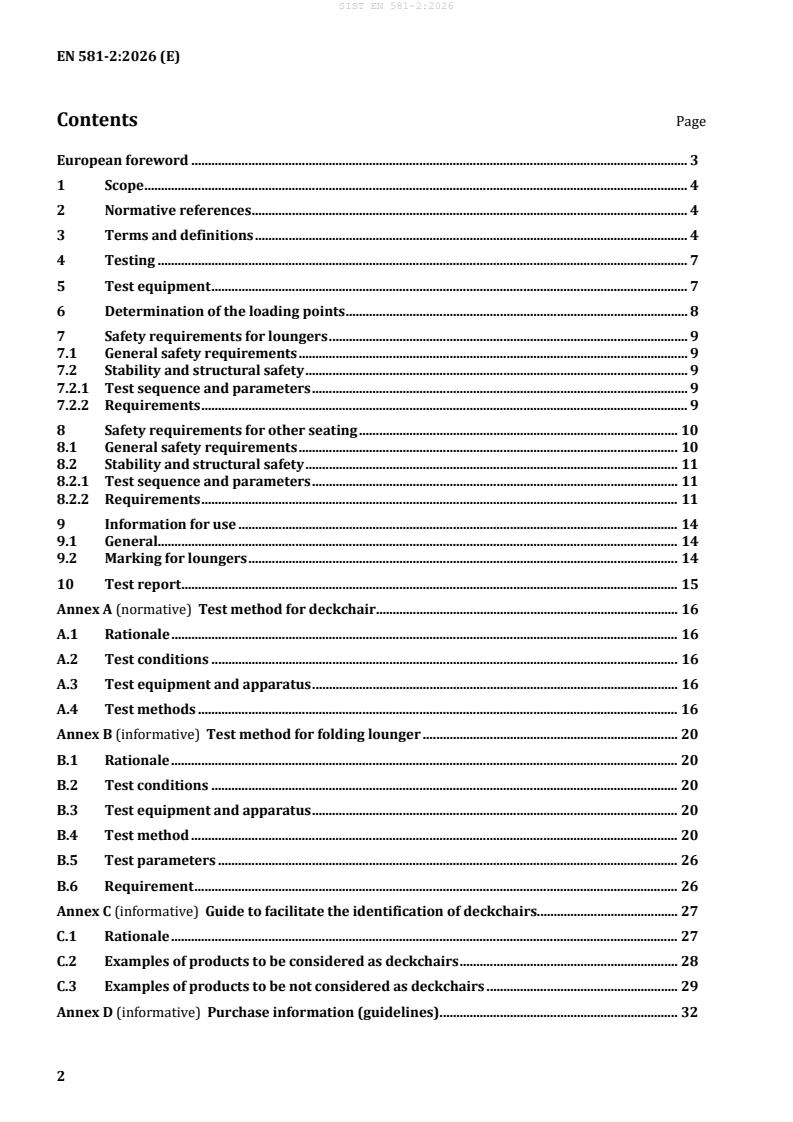
European foreword . 3
1 Scope . 4
2 Normative references . 4
3 Terms and definitions . 4
4 Testing . 7
5 Test equipment . 7
6 Determination of the loading points . 8
7 Safety requirements for loungers . 9
7.1 General safety requirements . 9
7.2 Stability and structural safety . 9
7.2.1 Test sequence and parameters . 9
7.2.2 Requirements . 9
8 Safety requirements for other seating . 10
8.1 General safety requirements . 10
8.2 Stability and structural safety . 11
8.2.1 Test sequence and parameters . 11
8.2.2 Requirements . 11
9 Information for use . 14
9.1 General. 14
9.2 Marking for loungers . 14
10 Test report . 15
Annex A (normative) Test method for deckchair . 16
A.1 Rationale . 16
A.2 Test conditions . 16
A.3 Test equipment and apparatus . 16
A.4 Test methods . 16
Annex B (informative) Test method for folding lounger . 20
B.1 Rationale . 20
B.2 Test conditions . 20
B.3 Test equipment and apparatus . 20
B.4 Test method . 20
B.5 Test parameters . 26
B.6 Requirement . 26
Annex C (informative) Guide to facilitate the identification of deckchairs. 27
C.1 Rationale . 27
C.2 Examples of products to be considered as deckchairs . 28
C.3 Examples of products to be not considered as deckchairs . 29
Annex D (informative) Purchase information (guidelines) . 32
European foreword
This document (EN 581-2:2026) has been prepared by Technical Committee CEN/TC 207 “Furniture”,
the secretariat of which is held by UNI.
This European Standard shall be given the status of a national standard, either by publication of an
identical text or by endorsement, at the latest by November 2026, and conflicting national standards shall
be withdrawn at the latest by November 2026.
Attention is drawn to the possibility that some of the elements of this document may be the subject of
patent rights. CEN shall not be held responsible for identifying any or all such patent rights.
This document supersedes EN 581-2:2015.
a) new definitions for camping use, domestic use for contract use have been added;
b) general safety requirements has been added;
c) updated seating requirements for stability to take into account new edition of EN 1022:2023;
d) updated requirements for seating and clarification of the application of certain tests with footnote to
tables;
e) Annex A (normative) “Test method for deckchair” has been added;
f) Annex B (informative) “Test method for folding lounger” has been added;
g) Annex C (informative) “Guide to facilitate the identification of deckchairs” has been added;
h) Annex D (informative) “Purchase information (guidelines)” has replaced Annex B;
i) Annex A “Forward and sideways stability tests for loungers” has been deleted;
j) clarification of the instruction for use;
k) clarification of the rearward stability test for camping use.
Any feedback and questions on this document should be directed to the users’ national standards body.
A complete listing of these bodies can be found on the CEN website.
According to the CEN-CENELEC Internal Regulations, the national standards organisations of the
following countries are bound to implement this European Standard: Austria, Belgium, Bulgaria, Croatia,
Cyprus, Czech Republic, Denmark, Estonia, Finland, France, Germany, Greece, Hungary, Iceland, Ireland,
Italy, Latvia, Lithuania, Luxembourg, Malta, Netherlands, Norway, Poland, Portugal, Republic of North
Macedonia, Romania, Serbia, Slovakia, Slovenia, Spain, Sweden, Switzerland, Türkiye and the United
Kingdom.
1 Scope
This document specifies the minimum requirements for general safety and structural safety which
include strength, reliability and stability of all types of outdoor seating for camping use, for domestic use
and for contract use, for adults, without regard to materials, design or manufacturing processes.
It does not apply to street furniture.
It does not include requirements for removable upholstery, including the cover and filling.
It does not include requirements for the durability of castors/wheels and height adjustment mechanisms.
It does not include requirements for electrical safety.
It does not include requirements for the resistance to ageing and degradation caused by light,
temperature and moisture.
The test requirements contained within this document are based on use by persons weighing up
to 110 kg.
2 Normative references
The following documents are referred to in the text in such a way that some or all of their content
constitutes requirements of this document. For dated references, only the edition cited applies. For
undated references, the latest edition of the referenced document (including any amendments) applies.
EN 581-1, Outdoor furniture — Seating and tables for camping, domestic and contract use — Part 1:
General safety requirements
EN 1022:2023, Furniture — Seating — Determination of stability
EN 1728:2012, Furniture — Seating — Test methods for the determination of strength and durability
3 Terms and definitions
For the purposes of this document, the following terms and definitions apply.
ISO and IEC maintain terminology databases for use in standardization at the following addresses:
— ISO Online browsing platform: available at https://www.iso.org/obp/
— IEC Electropedia: available at https://www.electropedia.org/
3.1
seating for camping use
seating for outdoor light in weight, intended for occasional use in connection with camping and travelling
and can be easily reduced in volume for transporting and storing
Note 1 to entry: Such products are often foldable or knock-down.
3.2
seating for domestic use
outdoor seating intended for private use in places without public access
Note 1 to entry: Such products can be foldable or knock-down.
3.3
seating for contract use
outdoor seating intended for non-private use in places with public access
Note 1 to entry: Such products can be foldable or knock-down.
3.4
lounger
seating intended for reclined posture with at least one backrest position with an angle θ between 0° and
45° and a leg rest which is integral part of the product and which is intended to support the full body
weight of a user
Note 1 to entry: Figure 1 shows θ angle in lounger.
Figure 1 — θ angle in lounger
3.5
street furniture
outdoor furniture used in public space, permanently fixed to the ground or any structure (e.g. bus stop,
wall…) or not able to be manually removed
3.6
deckchair
foldable seating with articulated cross-shaped frame capable of being folded in completely that can be set
to one or more predefined positions by means of a locking system at the locking bar and having a frame
which supports a flexible sheet suspended in the upper part of the backrest and the front of the seat
Note 1 to entry: Figure 2 shows an example of a typical deckchair.
Note 2 to entry: Figure 3 shows an example of locking system.
Note 3 to entry: A guide to facilitate the identification of deckchairs is provided in Annex C.
Key
1 upper transverse bar
2 locking bar
3 see Figure 3 for clarification
Figure 2 — Example of a deckchair
Key
1 locking position
2 locking bar
3 lower transverse bar
Figure 3 — Example of locking system
3.7
median plane
vertical plane running from front to rear through the centre of the seat, dividing the chair into two equal
parts
Note 1 to entry: See Figure 4.
[SOURCE: EN 1335-1:2020+A1:2022, definition 3.9]
Key
1 median plane
Figure 4 — Illustration of the median plane
4 Testing
Testing shall be carried out as specified in EN 1728:2012 and EN 1022:2023.
5 Test equipment
5.1 General
Test equipment is specified in EN 1728:2012 and EN 1022:2023.
5.2 Small cylinder to determine the loading point for seating with a frame which supports a flexible
sheet suspended in the upper part of the backrest and at the front of the seat
Cylinder shall have a mass of (1 ± 0,5) kg and a diameter of (70 ± 10) mm.
NOTE A suitable length of the cylinder is 200 mm.
6 Determination of the loading points
6.1 General
Seat and back loading points are determined in accordance with EN 1728:2012 and EN 1022:2023 except
for seating with a frame which supports a flexible sheet suspended in the upper part of the backrest and
at the front of the seat.
6.2 Seat loading point for seating with a frame which supports a flexible sheet suspended in the
upper part of the backrest and at the front of the seat.
The fully horizontal backrest’s position is not considered the rearmost inclination.
Place the seat on the floor.
If the seat has several pre-determined positions on inclination, put the product with the backrest in the
rearmost inclination.
Axis of the cylinder (5.2) shall be perpendicular to the median plane of the seat. Let the cylinder roll from
the higher part of the flexible part. Where the cylinder stops, this is the seat load point. See Figure 5.
If the flexible sheet is more than 1,1 m wide, by derogation from EN 1728:2012, the two load points are
located at the height previously defined by the cylinder (5.2) at a quarter of the width of the piece of
flexible material, on either side of the median plane.
Key
1 line of median plane
2 cylinder
3 axis of rotation of cylinder (perpendicular to the median plane)
4 seat loading point
Figure 5 — Seat loading point for seating with suspended flexible material
7 Safety requirements for loungers
7.1 General safety requirements
The lounger shall fulfil the EN 581-1 requirements.
For products with adjustable backrest where the modification in inclination requires user to leave the
product, the modification of inclination of the backrest shall be considered as a setting up and folding
operation.
7.2 Stability and structural safety
7.2.1 Test sequence and parameters
The tests shall be carried out on the same sample, in the order listed in Table 1 and in accordance with
the intended use as defined in 3.1 to 3.3.
NOTE The intended use of a folding products is the relevant use as defined by the manufacturer in line with
the definitions 3.1 to 3.3.
The stability tests defined in Table 1 are not applicable to loungers which have both a seat
height < 200 mm and a mass < 5 kg. The height shall be determined by measuring from the floor to the
upper surface of the seat at the geometrical centre of the lounger seat loaded with 600 N applied vertically
downward using the seat loading pad.
In the case of seating which might not fulfil the stability requirements before carrying out any tests, the
applicable stability tests may be carried out before starting the sequence of tests specified in this table.
Table 1 — Test sequence and test parameters for loungers
Test References Test parameters
Camping Domestic Contract
1. Seat and back static EN 1728:2012, 8.2 Specified seat force, N 1 100 1 600 2 000
a
load test
Maximum force (seat), N - 2 000 2 500
Specified backrest force, N - 410 560
Minimum force (back), N 410 410
Cycles 10 10 10
Additional cycle 30 min ± 10 s 1 1 1
2. Additional seat and leg EN 1728:2012, 8.3 Seat load on loading point, N 750 750 750
rest static load test
Force applied at the most adverse 600 900 900
position between point D and E, N
Cycles 10 10 10
3. Seat and back EN 1728:2012, 8.4.1 Specified seat load, N 750 1 000 1 000
durability test
Specified backrest load, N 250 300 300
Cycles 12 500 25 000 50 000
4. Additional seat EN 1728:2012, 8.4.2 Specified force, N 750 1 000 1 000
durability test
Cycles 5 000 10 000 20 000
5. Durability test on back EN 1728:2012, 8.5 Specified force, N 190 250 250
rest mechanism
Seat load, N 1 000 1 000 1 000
Cycles 5 000 10 000 20 000
Test References Test parameters
Camping Domestic Contract
6. Arm rest downwards EN 1728:2012, 8.6 Vertical specified Force, N - 700 900
b
static load test
Cycles 10 10
7. Arm rest durability test EN 1728:2012, 8.7 Specified force, N 400 400 400
Cycles 5 000 10 000 30 000
8. Impact test EN 1728:2012, 8.8 Drop height, mm 140 180 240
Cycles 10 10 10
9. Lifting test for mobile EN 1728:2012, 8.9 Load, N 1 000 1 000 1 000
loungers
Cycles 500 1 000 2 000
10. Forward stability EN 1022:2023, 8.3.1 F , N 600
B3
FB4, N 20
11. Sideways stability FB1, N 600
EN 1022:2023, 8.3.2
F , N 250
B2
c
12. Rearward stability F1, N 600
F2, N:
EN 1022:2023, 8.3.3 -
Upright position c
If H ≥ 720 mm 80
c c
If H < 720 mm 0,285 7 × (1 000-H )
Number of discs - backrest 5 8
EN 1022:2023, 8.3.4 -
Reclined position
Number of discs - leg rest 3 3
a
For seating with adjustable backrest the additional test of 30 min is carried out with a backrest in middle position.
b
For contract use, if armrest is less than 15 mm wide, carry out test with 700 N.
c
Height of the loaded seat above the floor in millimetres.
7.2.2 Requirements
The safety, structural safety requirements are fulfilled after testing in accordance with Table 1 when:
a) there are no fractures of any joint, member or component;
b) there is no loosening of joints intended to be rigid;
c) the lounger fulfils its function after removal of the test loads;
d) the lounger fulfils the safety requirements;
e) the product does not overturn when subjected to the stability tests.
8 Safety requirements for other seating
8.1 General safety requirements
The seating shall fulfil the EN 581-1 requirements.
8.2 Stability and structural safety
8.2.1 Test sequence and parameters
The tests shall be carried out on the same sample, in the order listed in Table 2 and in accordance with
the intended use as defined in 3.1 to 3.3.
NOTE The intended use of a folding product is the relevant use as defined by the manufacturer in line with the
definitions 3.1 to 3.3.
If not specified in test methods, the deckchair shall be tested in the most reclined position.
The stability tests defined in Table 2 are not applicable to seating which have both a seat height < 200 mm
and a mass < 5 kg. The height shall be determined by measuring from the floor to the upper surface of the
seating area at the geometrical centre of the seating loaded with 600 N applied vertically downward using
the seat loading pad.
In the case of seating which might not fulfil the stability requirements before carrying out any tests, the
applicable stability tests may be carried out before starting the sequence of tests specified in this table.
Table 2 — Test sequence and test parameters for other seating
Test Reference Test parameters
Camping Domestic Contract
1. Seat static load and back
EN 1728:2012, 6.4 Specified seat force, N 1 100 1 600 2 000
a, b
static load test
Maximum force (seat), N 2 000 2 500
Force applied on seat not 750 750 750
being tested, N
Specified backrest force, N - 410 560
Minimum force (back), N - 410 410
Cycles 10 10 10
Additional cycle 30 1 1 1
min ± 10 s
2. Seat front edge static load EN 1728:2012, 6.5 Specified force, N 1 100 1 300 1 300
Force applied on seat not 750 750 750
being tested, N
Cycles 10 10 10
c
3. Foot rest static load test EN 1728:2012, 6.8 Vertical specified force, N - 1 000 1 200
Seat force, N 750 750
Maximum seat force, N 1 600 2 000
Cycles 10 10
4. Arm rest downwards static EN 1728:2012, 6.11
...