


kSIST FprEN ISO 10012:2025
(Main)Quality management - Requirements for measurement management systems (ISO/FDIS 10012:2025)
Quality management - Requirements for measurement management systems (ISO/FDIS 10012:2025)
ISO 10012:2003 specifies generic requirements and provides guidance for the management of measurement processes and metrological confirmation of measuring equipment used to support and demonstrate compliance with metrological requirements. It specifies quality management requirements of a measurement management system that can be used by an organization performing measurements as part of the overall management system, and to ensure metrological requirements are met.
ISO 10012:2003 is not intended to be used as a requisite for demonstrating conformance with ISO 9001, ISO 14001 or any other standard. Interested parties can agree to use ISO 10012:2003 as an input for satisfying measurement management system requirements in certification activities. Other standards and guides exist for particular elements affecting measurement results, for example, details of measurement methods, competence of personnel, interlaboratory comparisons.
ISO 10012:2003 is not intended as a substitute for, or as an addition to, the requirements of ISO/IEC 17025.
Qualitätsmanagement - Anforderungen an Messmanagementsysteme (ISO/FDIS 10012:2025)
Management de la qualité - Exigences pour les systèmes de management de la mesure (ISO/FDIS 10012:2025)
L'ISO 10012:2003 est destinée à fournir des exigences génériques et des guides d'application pour le management des processus de mesure et pour la confirmation des équipements de mesure utilisés pour démontrer la conformité aux exigences métrologiques. Elle spécifie les exigences qualité relatives au système de management de la mesure qu'un organisme effectuant des mesures peut utiliser et intégrer dans le cadre du système de management global et qui est destiné à garantir que les exigences métrologiques sont satisfaites.
L'ISO 10012:2003 n'est pas destinée à être requise pour démontrer la conformité avec l'ISO 9001, avec l'ISO 14001 ou avec toute autre norme. Les parties intéressées peuvent convenir d'utiliser la présente Norme internationale comme point d'entrée à la satisfaction des exigences relatives au système de management de la mesure dans des activités de certification.
L'ISO 10012:2003 n'est destinée ni à être substituée ni à être ajoutée aux exigences de l'ISO/IEC 17025.
Vodenje kakovosti - Zahteve za sisteme vodenja meritev (ISO/FDIS 10012:2025)
General Information
Relations
Standards Content (Sample)
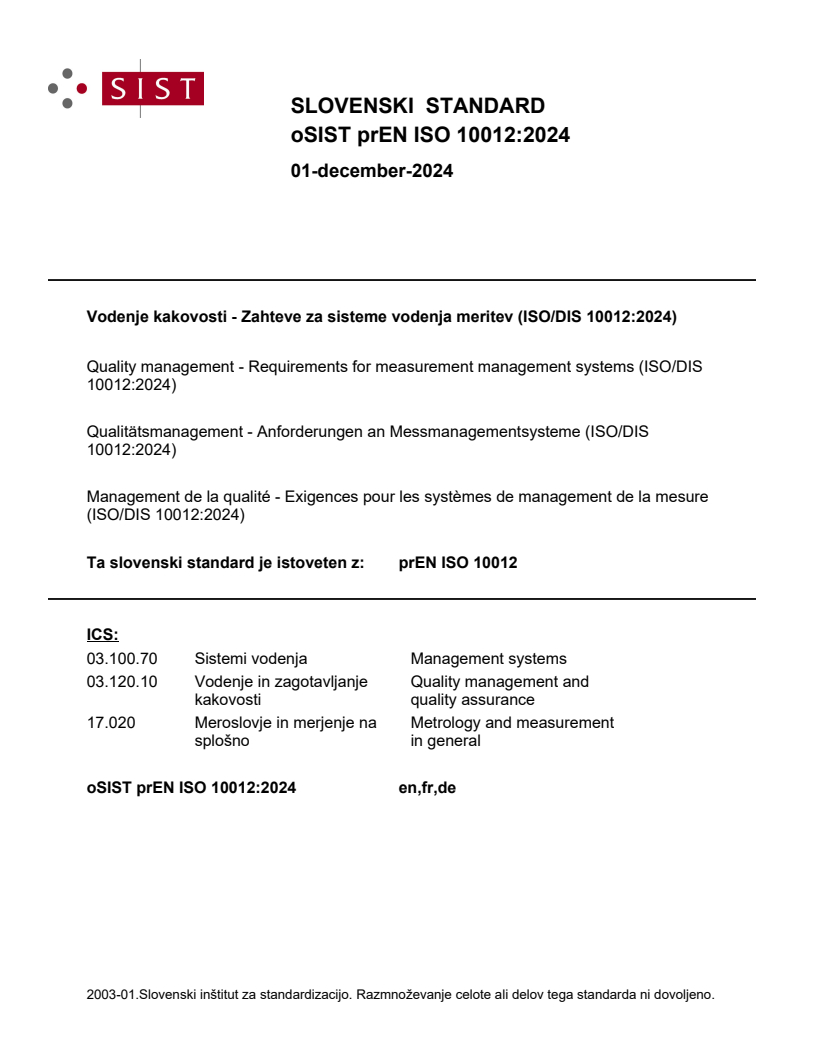
SLOVENSKI STANDARD
oSIST prEN ISO 10012:2024
01-december-2024
Vodenje kakovosti - Zahteve za sisteme vodenja meritev (ISO/DIS 10012:2024)
Quality management - Requirements for measurement management systems (ISO/DIS
10012:2024)
Qualitätsmanagement - Anforderungen an Messmanagementsysteme (ISO/DIS
10012:2024)
Management de la qualité - Exigences pour les systèmes de management de la mesure
(ISO/DIS 10012:2024)
Ta slovenski standard je istoveten z: prEN ISO 10012
ICS:
03.100.70 Sistemi vodenja Management systems
03.120.10 Vodenje in zagotavljanje Quality management and
kakovosti quality assurance
17.020 Meroslovje in merjenje na Metrology and measurement
splošno in general
oSIST prEN ISO 10012:2024 en,fr,de
2003-01.Slovenski inštitut za standardizacijo. Razmnoževanje celote ali delov tega standarda ni dovoljeno.
oSIST prEN ISO 10012:2024
oSIST prEN ISO 10012:2024
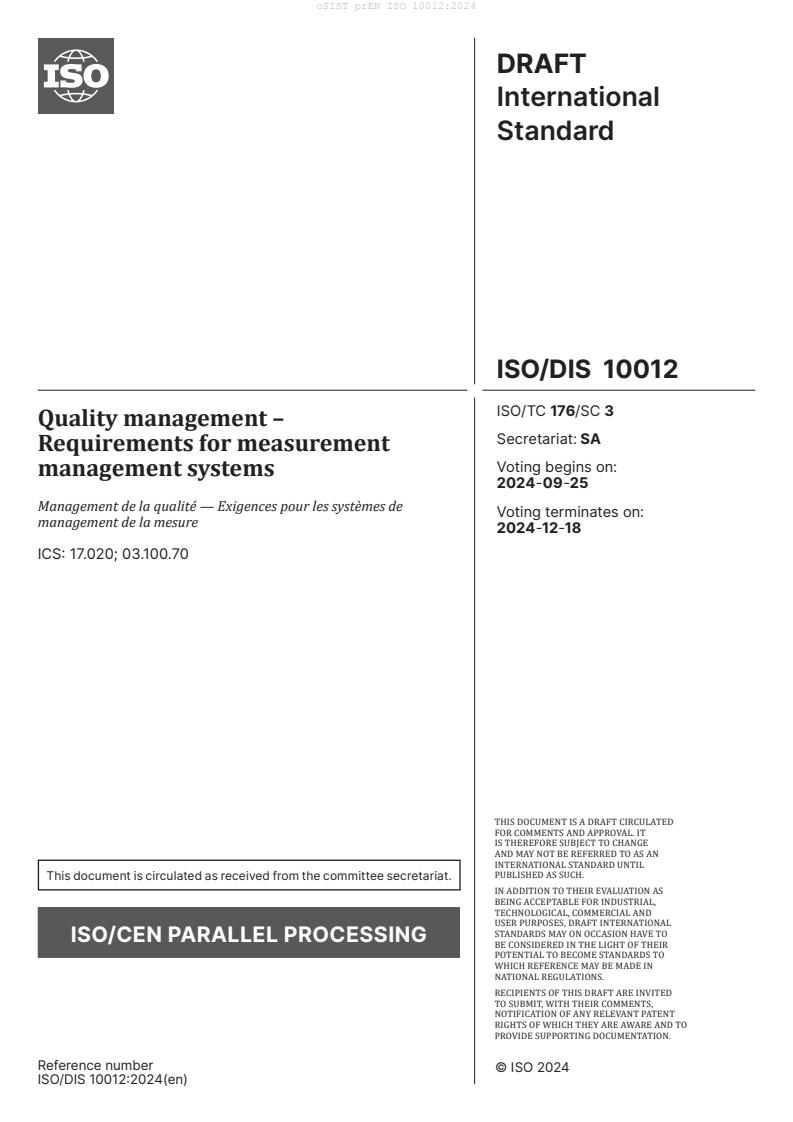
DRAFT
International
Standard
ISO/DIS 10012
ISO/TC 176/SC 3
Quality management –
Secretariat: SA
Requirements for measurement
Voting begins on:
management systems
2024-09-25
Management de la qualité — Exigences pour les systèmes de
Voting terminates on:
management de la mesure
2024-12-18
ICS: 17.020; 03.100.70
THIS DOCUMENT IS A DRAFT CIRCULATED
FOR COMMENTS AND APPROVAL. IT
IS THEREFORE SUBJECT TO CHANGE
AND MAY NOT BE REFERRED TO AS AN
INTERNATIONAL STANDARD UNTIL
PUBLISHED AS SUCH.
This document is circulated as received from the committee secretariat.
IN ADDITION TO THEIR EVALUATION AS
BEING ACCEPTABLE FOR INDUSTRIAL,
TECHNOLOGICAL, COMMERCIAL AND
USER PURPOSES, DRAFT INTERNATIONAL
STANDARDS MAY ON OCCASION HAVE TO
ISO/CEN PARALLEL PROCESSING
BE CONSIDERED IN THE LIGHT OF THEIR
POTENTIAL TO BECOME STANDARDS TO
WHICH REFERENCE MAY BE MADE IN
NATIONAL REGULATIONS.
RECIPIENTS OF THIS DRAFT ARE INVITED
TO SUBMIT, WITH THEIR COMMENTS,
NOTIFICATION OF ANY RELEVANT PATENT
RIGHTS OF WHICH THEY ARE AWARE AND TO
PROVIDE SUPPORTING DOCUMENTATION.
Reference number
ISO/DIS 10012:2024(en)
oSIST prEN ISO 10012:2024
DRAFT
ISO/DIS 10012:2024(en)
International
Standard
ISO/DIS 10012
ISO/TC 176/SC 3
Quality Management –
Secretariat: SA
Requirements for Measurement
Voting begins on:
Management Systems
Management de la qualité - Exigences pour les systèmes de
Voting terminates on:
management de la mesure
ICS: 17.020; 03.100.70
THIS DOCUMENT IS A DRAFT CIRCULATED
FOR COMMENTS AND APPROVAL. IT
IS THEREFORE SUBJECT TO CHANGE
AND MAY NOT BE REFERRED TO AS AN
INTERNATIONAL STANDARD UNTIL
PUBLISHED AS SUCH.
This document is circulated as received from the committee secretariat.
IN ADDITION TO THEIR EVALUATION AS
BEING ACCEPTABLE FOR INDUSTRIAL,
© ISO 2024
TECHNOLOGICAL, COMMERCIAL AND
USER PURPOSES, DRAFT INTERNATIONAL
All rights reserved. Unless otherwise specified, or required in the context of its implementation, no part of this publication may
STANDARDS MAY ON OCCASION HAVE TO
ISO/CEN PARALLEL PROCESSING
be reproduced or utilized otherwise in any form or by any means, electronic or mechanical, including photocopying, or posting on
BE CONSIDERED IN THE LIGHT OF THEIR
the internet or an intranet, without prior written permission. Permission can be requested from either ISO at the address below
POTENTIAL TO BECOME STANDARDS TO
WHICH REFERENCE MAY BE MADE IN
or ISO’s member body in the country of the requester.
NATIONAL REGULATIONS.
ISO copyright office
RECIPIENTS OF THIS DRAFT ARE INVITED
CP 401 • Ch. de Blandonnet 8
TO SUBMIT, WITH THEIR COMMENTS,
CH-1214 Vernier, Geneva
NOTIFICATION OF ANY RELEVANT PATENT
Phone: +41 22 749 01 11
RIGHTS OF WHICH THEY ARE AWARE AND TO
PROVIDE SUPPORTING DOCUMENTATION.
Email: copyright@iso.org
Website: www.iso.org
Published in Switzerland Reference number
ISO/DIS 10012:2024(en)
ii
oSIST prEN ISO 10012:2024
ISO/DIS 10012:2024(en)
ISO 10012:2023(X)
Contents
Foreword . vi
Introduction . vii
1 Scope . 1
2 Normative references . 1
3 Terms and definitions . 1
4 Context of the organization . 6
4.1 Understanding the organization and its context . 6
4.2 Understanding the needs and expectations of interested parties . 6
4.3 Determining the scope of the measurement management system. 6
4.4 Measurement management system . 7
5 Leadership . 7
5.1 Leadership and commitment . 7
5.1.1 General . 7
5.1.2 Interested party focus . 8
5.2 Measurement management policy . 8
5.3 Roles, responsibilities and authorities . 8
6 Planning . 9
6.1 Actions to address risks and opportunities . 9
6.2 Measurement management objectives and planning to achieve them . 9
6.3 Planning of changes . 10
7 Support . 10
7.1 Resources . 10
7.1.1 General . 10
7.1.2 Personnel . 10
7.1.3 Environment and facilities . 10
7.1.4 Equipment . 11
7.1.5 Organizational knowledge . 11
7.2 Competence . 11
7.3 Awareness . 12
7.4 Communication. 12
7.5 Documented information . 13
7.5.1 General . 13
7.5.2 Creating and updating documented information . 13
7.5.3 Control of documented information . 13
8 Operation . 14
8.1 Operational planning and control . 14
8.1.1 General . 14
8.1.2 Risk management . 14
8.2 Requirements for measurement processes . 15
8.2.1 General . 15
8.2.2 Customer communications . 15
8.2.3 Determination of requirements related to the measurement processes . 15
8.2.4 Review of customer requirements for measurement processes . 16
8.2.5 Changes to requirements for measurement processes . 16
8.3 Design and development of measurement processes . 16
8.3.1 General . 16
8.3.2 Design and development planning . 17
© ISO 10012 – All rights reserved iii
iii
oSIST prEN ISO 10012:2024
ISO/DIS 10012:2024(en)
ISO 10012:2023(X)
8.3.3 Design and development inputs .18
8.3.4 Design and development controls .19
8.3.5 Design and development outputs .20
8.3.6 Design and development changes .22
8.4 Control of externally provided processes, products and services .22
8.4.1 General .22
8.4.2 Type and extent of control .23
8.4.3 Information for external providers .24
8.5 Measurement process implementation .24
8.5.1 Control of measurement processes .24
8.5.2 Identification and traceability .26
8.5.3 Property belonging to customers or external providers .27
8.5.4 Preservation.27
8.5.5 Measurement process post-delivery activities .27
8.6 Release of measurement process results .28
8.6.1 Planned arrangements for release of results .28
8.6.2 Documented information relating to release of results .28
8.7 Control of non-conforming outputs .29
8.7.1 Handling nonconforming outputs .29
8.7.2 Documented information .30
9 Performance evaluation .30
9.1 Monitoring, measurement, analysis, and evaluation .30
9.1.1 General .30
9.1.2 Customer satisfaction .30
9.1.3 Analysis and evaluation .30
9.2 Internal audit .31
9.2.1 General .31
9.2.2 Internal audit programme .31
9.3 Management review .31
9.3.1 General .31
9.3.2 Management review inputs .31
9.3.3 Management review results .32
10 Improvement .32
10.1 Improvement .32
10.2 Nonconformity and corrective action .33
Annex A (informative) Calibration intervals optimization .34
A.1 General .34
A.2 Calibration interval .34
A.3 Calibration interval optimization .35
A.4 Strategies .36
A.4.1 Monitoring .36
A.4.2 Conditional calibration .36
A.4.3 Abeyance .36
A.4.4 Existing approaches .37
A.4.4.1 Drift method .37
A.4.4.2 Periodicity ratio approach .37
A.4.4.3 OPPERET approach.37
iv © ISO 10012 – All rights reserved
iv
oSIST prEN ISO 10012:2024
ISO/DIS 10012:2024(en)
ISO 10012:2023(X)
A.4.4.4 Risk-based approach . 38
Annex B (informative) Uncertainty of measurements . 39
B.1 General . 39
B.2 Concepts . 39
B.3 Quantification of the measurement uncertainty . 40
Annex C (informative) Measurement decision risk and rules . 41
C.1 General . 41
C.2 Measurement decision risk . 41
C.3 Decision rule . 42
C.4 Decision Rule Example . 43
Bibliography . 45
© ISO 10012 – All rights reserved v
v
oSIST prEN ISO 10012:2024
ISO/DIS 10012:2024(en)
ISO 10012:2023(X)
Foreword
ISO (the International Organization for Standardization) is a worldwide federation of national standards
bodies (ISO member bodies). The work of preparing International Standards is normally carried out
through ISO technical committees. Each member body interested in a subject for which a technical
committee has been established has the right to be represented on that committee. International
organizations, governmental and non-governmental, in liaison with ISO, also take part in the work. ISO
collaborates closely with the International Electrotechnical Commission (IEC) on all matters of
electrotechnical standardization.
The procedures used to develop this document and those intended for its further maintenance are
described in the ISO/IEC Directives, Part 1. In particular, the different approval criteria needed for the
different types of ISO documents should be noted. This document was drafted in accordance with the
editorial rules of the ISO/IEC Directives, Part 2 (see www.iso.org/directives).
ISO draws attention to the possibility that the implementation of this document may involve the use of
(a) patent(s). ISO takes no position concerning the evidence, validity or applicability of any claimed
patent rights in respect thereof. As of the date of publication of this document, ISO had not received notice
of (a) patent(s) which may be required to implement this document. However, implementers are
cautioned that this may not represent the latest information, which may be obtained from the patent
database available at www.iso.org/patents. ISO shall not be held responsible for identifying any or all
such patent rights.
Any trade name used in this document is information given for the convenience of users and does not
constitute an endorsement.
For an explanation of the voluntary nature of standards, the meaning of ISO specific terms and
expressions related to conformity assessment, as well as information about ISO's adherence to the World
Trade Organization (WTO) principles in the Technical Barriers to Trade (TBT), see
www.iso.org/iso/foreword.html.
This document was prepared by Technical Committee ISO/TC 176, Quality management and quality
assurance, Subcommittee SC 3, Supporting technologies.
This second edition cancels and replaces the first edition (ISO 10012: 2003), which has been technically
revised.
This is a major revision of the ISO 10012:2003, whose purpose is to establish the basis for an organization
to develop a measurement management systems.
Any feedback or questions on this document should be directed to the user’s national standards body. A
complete listing of these bodies can be found at www.iso.org/members.html.
ISO 10012 was prepared by a multi-national, multi-disciplinary working group (WG27) convened by ISO
Technical Committee 176, Subcommittee SC3.
vi © ISO 10012 – All rights reserved
vi
oSIST prEN ISO 10012:2024
ISO/DIS 10012:2024(en)
ISO 10012:2023(X)
Introduction
The main objective of a measurement management system (MMS) is to have confidence in the validity
and reliability of the measurement results. This includes managing the risk of measurement processes
that could produce incorrect results affecting the quality of an organization’s products and/or services.
The purpose of ISO 10012 is to provide an organization with the appropriate framework for
implementing measurement management system requirements.
ISO 10012 standard assists organizations who have or would like to establish a measurement
management system. This standard provides the necessary framework for an organization in designing,
maintaining and continually improving the measurement management system capability of supporting
the measurement of the organization’s delivered products and/or services at the required quality level.
This is a major revision of the ISO 10012:2003, whose purpose is to establish the basis for an organization
to develop a measurement management system for end-to-end application of measurement processes in
the organization (see Figure 1). ISO 10012 is implemented in process design and development, test,
monitoring and delivering of valid measurement results. This revision also provides an organization the
basis to demonstrate conformity to measurement management system requirements.
This standard can be used by any industrial sectors requiring a measurement management system, and
is complementary to the requirements of ISO 9001, ISO 14001 or any other management system
standard.
The implementation of a management system for confirmation of validity of measurements is an
important decision for an organization to establish a robust measurement management system that will
provide a consistent level of measurement quality for an organization’s products and services.
The notes, examples and annexes are not mandatory requirements of the standard, but are provided to
assist users in understanding concepts and terms presented in the standard.
Various informative documents are referenced in this standard. The references to these standards and
industry documents are provided so that users of this standard can find further information on specific
topics and industry best practices.
In this document the following verbal forms are used:
— ‘shall’ indicates a requirement;
— ‘should’ indicates a non-mandatory recommendation;
— ‘may’ indicates a permission for use;
— “can” indicates a possibility or a capability.
Information marked as “NOTE” is for guidance in understanding or clarifying the associated requirement.
© ISO 10012 – All rights reserved vii
vii
oSIST prEN ISO 10012:2024
oSIST prEN ISO 10012:2024
ISO/DIS 10012:2024(en)
ISO 10012:2023(X)
Quality Management – Requirements for Measurement
Management Systems
1 Scope
This International Standard specifies the requirements for a measurement management system (MMS)
when an organization:
a. needs to demonstrate its ability to consistently ensure confidence in validity and reliability of
measurement results and thereby to provide a consistent level of measurement quality for an
organization’s products and services,
b. aims to rely on reliable and valid measurement results useful to enhance customer satisfaction
and effectively apply its measurement management system processes,
c. implements processes for a measurement management system that enhance conformity with
customer, statutory and regulatory requirements.
All the requirements of this International Standard are generic and intended to apply to any organization,
whatever its type or size, or the products and services it provides.
This International Standard is not intended to substitute requirements for, or to add requirements to the
general requirements for the competence of testing and calibration laboratories specified in ISO/IEC
17025.
2 Normative references
The following documents are referred to in the text in such a way that some or all of their content
constitutes requirements of this document. For dated references, only the edition cited applies. For
undated references, the latest edition of the referenced document (including any amendments) applies.
ISO 9000:2015, Quality management systems — Fundamentals and vocabulary
ISO 9001:2015, Quality management systems
ISO/IEC GUIDE 99: 2012, International vocabulary of metrology - Basic and general concepts and
associated terms
ISO/ IEC guide, 98-4:2012 , uncertainty of measurement
3 Terms and definitions
For the purposes of this document, the terms and definitions given in ISO 9000: 2015 and ISO/IEC GUIDE
99 and the following apply.
ISO and IEC maintain terminology databases for use in standardization at the following addresses:
— ISO Online browsing platform: available at https://www.iso.org/obp
— IEC Electropedia: available at https://www.electropedia.org/
3.1
organization
person or group of people that has its own functions with responsibilities, authorities and relationships
to achieve its objectives (3.6)
Note 1 to entry: The concept of organization includes, but is not limited to, sole-trader (single person company),
company, corporation, firm, enterprise, authority, partnership, charity or institution, or part or combination thereof,
whether incorporated or not, public or private.
© ISO 10012 – All rights reserved 1
oSIST prEN ISO 10012:2024
ISO/DIS 10012:2024(en)
ISO 10012:2023(X)
Note 2 to entry: If the organization is part of a larger entity, the term “organization” refers only to the part of the
larger entity that is within the scope of the management system (3.4).
3.2
interested party (preferred term)
stakeholder (admitted term)
person or organization (3.1) that can affect, be affected by, or perceive itself to be affected by a decision
or activity
EXAMPLE Customers, owners, people in an organization, suppliers, metrologists, regulators, unions,
partners, or society.
3.3
top management
person or group of people who directs and controls an organization (3.1) at the highest level
Note 1 to entry: Top management has the power to delegate authority and provide resources within the
organization.
Note 2 to entry: If the scope of the management system (3.4) covers only part of an organization, then top
management refers to those who direct and control that part of the organization.
3.4
management system
set of interrelated or interacting elements of an organization (3.1) to establish policies (3.5) and objectives
(3.6) as well of processes (3.8) to achieve those objectives
Note 1 to entry: A management system can address a single discipline or several disciplines.
Note 2 to entry: The system elements include the organization’s structure, roles and responsibilities, planning and
operation.
Note 3 to entry: The scope of a management system can include the whole of the organization, specific and identified
functions of the organization, specific and identified sections of the organization, or one or more functions across a
group of organizations.
3.5
policy
intentions and direction of an organization (3.1), as formally expressed by its top management (3.3)
3.6
objective
result to be achieved
Note 1 to entry: An objective can be strategic, tactical, or operational.
Note 2 to entry: Objectives can relate to different disciplines (such as financial, health and safety, and environment
) and can apply at different levels (such as strategic, organization-wide, project, product and process (3.8)).
Note 3 to entry: An objective can be expressed in other ways, e.g. as an intended result, a purpose, an operational
criterion, as a measurement objective, or by the use of other words with similar meaning (e.g., aim, goal, or target).
Note 4 to entry: In the context of measurement management systems, measurement objectives are set by the
organization (3.1) , consistent with the measurement policy (3.5), to achieve specific results.
3.7
risk
effect of uncertainty
Note 1 to entry: An effect is a deviation from the expected — positive or negative.
2 © ISO 10012 – All rights reserved
oSIST prEN ISO 10012:2024
ISO/DIS 10012:2024(en)
ISO 10012:2023(X)
Note 2 to entry: Uncertainty is the state, even partial, of deficiency of information related to, understanding or
knowledge of, an event, its consequence, or likelihood.
Note 3 to entry: Risk is often characterized by reference to potential events (as defined in ISO Guide 73) and
“consequences” (as defined in ISO Guide 73), or a combination of these.
Note 4 to entry: Risk is often expressed in terms of a combination of the consequences of an event (including changes
in circumstances) and the associated likelihood (as defined in ISO Guide 73) of occurrence.
Note 5 to entry: In application with metrology, risk refers to the impact of uncertainty in a measurement quantity
as determined by the metrological methods used.
3.8
process
set of interrelated or interacting activities which transforms inputs into result
Note 1 to entry: Whether the result of a process is called an output, a product, or a service depends on the context
of the reference.
3.9
competence
ability to apply knowledge and skills to achieve intended results
3.10
documented information
information required to be controlled and maintained by an organization (3.1) and the medium on which
it is contained
Note 1 to entry: Documented information can be in any format and media, and from any source.
Note 2 to entry: Documented information can refer to:
— the management system (3.4), including related processes (3.8);
— information created in order for the organization to operate (documentation);
— evidence of results achieved (records (3.23)).
Note 3 to entry: In many standards and quality documents, documented information is referred to as records.
3.11
performance
measurable result
Note 1 to entry: Performance can relate either to quantitative or qualitative findings.
Note 2 to entry: Performance can relate to managing activities, processes (3.8), products, services systems, or
organizations (3.1).
Note 3 to entry: In the metrological context, performance relates to the application of a process to obtain
appropriate or measurable results.
3.12
continual improvement
recurring activity to enhance performance (3.11)
3.13
effectiveness
extent to which planned activities are realized and planned results are achieved
© ISO 10012 – All rights reserved 3
oSIST prEN ISO 10012:2024
ISO/DIS 10012:2024(en)
ISO 10012:2023(X)
3.14
requirement
need or expectation that is stated, generally implied or obligatory
Note 1 to entry: “Generally implied” means that it is custom or common practice for the organization (3.1) and
interested parties (3.2) that the need or expectation under consideration is implied.
Note 2 to entry: A specified requirement is one that is stated, e.g., in documented information (3.10).
3.15
conformity
fulfilment of a requirement (3.14)
3.16
nonconformity
non-fulfilment of a requirement (3.14)
3.17
corrective action
action to eliminate the cause(s) of a nonconformity (3.16) and to prevent recurrence
3.18
audit
systematic, independent and documented process (3.8) for obtaining evidence and evaluating it
objectively to determine the extent to which the audit criteria are fulfilled
Note 1 to entry: An audit can be an internal audit (first party) or an external audit (second party or third party), and
it can be a combined audit (combining two or more disciplines).
Note 2 to entry: An internal audit is conducted by the organization (3.1) itself, or by an external party on its behalf.
Note 3 to entry: “Audit evidence” and “audit criteria” are defined in ISO 19011.
3.19
measurement result
result of measurement
set of quantity values being attributed to a measurand together with any other available relevant
information
Note 1 to entry A measurement result generally contains “relevant information” about the set of quantity values,
such that some may be more representative of the measurand than others. This may be expressed in the form of a
probability density function (PDF).
SOURCE: ISO GUIDE 99
3.20
measurement
process (3.8) to determine a value
Note 1 to entry: According to ISO 3534-2, the value determined is generally the value of a quantity.
Note 2 to entry: In metrological processes, this refers to experimentally obtain one or more quantity values that can
reasonably be attributed to a quantity. For further details, refer to ISO GUIDE 99.
3.21
measurement process
set of operations to determine the value of a quantity
SOURCE: ISO 9000
4 © ISO 10012 – All rights reserved
oSIST prEN ISO 10012:2024
ISO/DIS 10012:2024(en)
ISO 10012:2023(X)
3.22
monitoring
determining the status of a system, a process (3.8) or an activity
Note 1 to entry: To determine the status, there can be a need to check, supervise or critically observe.
3.23
provider
organization (3.1) that provides a product or a service
EXAMPLE Producer, distributor, retailer or vendor of a product or a service.
Note 1 to entry: A provider can be internal or external to the organization.
Note 2 to entry: In a contractual situation, a provider is sometimes called “contractor”.
3.25
measurement management system
part of a management system (3.4) with regard to measurement (3.20)
3.26
measuring equipment
measuring instrument, software, measurement standard, reference material or auxiliary apparatus, or a
combination thereof, necessary to realize a measurement process (3.21)
SOURCE: ISO 9000:2015, 3.11.6.
3.27
metrological confirmation
set of operations required to ensure that measuring equipment conforms to the requirements (3.14) for
its intended use
Note 1 to entry: Metrological confirmation generally includes calibration or verification, any necessary adjustment
or repair, and subsequent recalibration, comparison with the metrological requirements for the intended use of the
equipment, as well as any required sealing and labelling.
Note 2 to entry: Metrological confirmation is not achieved until and unless the fitness of the measuring equipment
for the intended use has been demonstrated and documented.
Note 3 to entry: The requirements for intended use include such considerations as range, resolution, and maximum
permissible errors.
Note 4 to entry: Metrological requirements are usually distinct from, and are not specified in, product requirements.
Note 5 to entry: A diagram of the processes involving metrological confirmation is given in The intent of the
measurement management standard is to achieve the intended results, including enhancing its measurement
performance.
© ISO 10012 – All rights reserved 5
oSIST prEN ISO 10012:2024
ISO/DIS 10012:2024(en)
ISO 10012:2023(X)
Figure 1.
3.28
metrological function
function with administrative and technical responsibility for defining and implementing the
measurement management system (3.26)
4 Context of the organization
4.1 Understanding the organization and its context
The organization shall determine, external and internal issues that are relevant to its purpose and that
affect its ability to achieve the intended result(s) of its measurement management system.
It is important to understand and define the structure of the organization and how it impacts on
measurements and their intended outcomes.
The measurement management system enables the transfer of information within the entire
organization, so that each department or function is working with the same information.
The Measurement management system shall apply metrological concepts to achieve the assurance of the
reliability of the measurement and related risks.
The organization shall determine whether climate change is a relevant issue.
All external and internal issues shall be reviewed.
NOTE 1 Understanding the external context can be facilitated by considering issues arising from legal,
technological, competitive, market, cultural, social and economic environments, whether international,
national, regional, or local.
6 © ISO 10012 – All rights reserved
oSIST prEN ISO 10012:2024
ISO/DIS 10012:2024(en)
ISO 10012:2023(X)
NOTE 2 Understanding the internal context can be facilitated by considering issues related to values,
culture, knowledge, and impartiality.
4.2 Understanding the needs and expectations of interested parties
The organization shall determine:
a) the interested parties that are relevant to the measurement management system;
b) the relevant requirements of these interested parties;
c) which of these requirements will be addressed through the measurement management system;
d) the continuous monitoring of the needs and requirements of the interested parties and maintain
those changes in the management process as appropriate.
4.3 Determining the scope of the measurement management system
The organization shall determine the boundaries and applicability of the measurement management
system to establish its scope.
When determining this scope, the organization shall consider:
a) the external and internal issues referred to in 4.1;
b) the requirements referred to in 4.2.
The scope shall be available as documented information.
The scope shall state the types of measurement activities related to product and services provided, and
provide justification for any requirement of this International Standard that the organization determines
is not applicable to the scope of its measurement management system.
NOTE 1 This document only treats monitoring and measurements within the technical context
(included metrological issues) and not the monitoring for financial or other performance strategy indices
out of the context of this measurement management system.
NOTE 2 A large part of monitoring and measurements are related to quality assurance for
product/services and their processes but equally applicable to include other disciplines such as the need
of valid/reliable results from the measurement processes.
4.4 Measurement management system
The organization shall establish, implement, maintain, and continually improve a measurement
management system, including the processes needed and their interactions, in accordance with the
requirements of this document (See Figure 1).The intent of the measurement management standard is
to achieve the intended results, including enhancing its measurement performance.
© ISO 10012 – All rights reserved 7
oSIST prEN ISO 10012:2024
ISO/DIS 10012:2024(en)
ISO 10012:2023(X)
Figure 1The intent of the measurement management standard is to achieve the intended results,
including enhancing its measurement performance.
Figure 1 — Measurement management relationship to quality system management
8 © ISO 10012 – All rights reserved
oSIST prEN ISO 10012:2024
ISO/DIS 10012:2024(en)
ISO 10012:2023(X)
5 Leadership
5.1 Leadership and commitment
5.1.1 General
Top management shall demonstrate leadership and commitment with respect to the measurement
management system by:
a) ensuring that the measurement management system policy and measurement management
system objectives are established and are compatible with the strategic direction of the
organization;
b) ensuring the integration of the measurement management system requirements into the
organization’s business processes;
c) ensuring that the resources needed for the measurement management system are available;
d) communicating the importance of effective measurement management and of conforming to the
measurement management system requirements;
e) ensuring that the measurement management system achieves its intended results;
f) directing and supporting persons to contribute to the effectiveness of the measurement
management system;
g) promoting continual improvement;
h) supporting other relevant roles to demonstrate their leadership as it applies to their areas of
responsibility.
i) taking accountability for the effectiveness and relevance of the measurement management
system;
j) promoting risk-based thinking;
NOTE Reference to “business” in this document can be interpreted broadly to mean those activities that
are core to the purposes of the organization’s existence.
5.1.2 Interested party focus
Top management shall demonstrate leadership and commitment with respect to interested partyfocus
by ensuring that:
a) interested party measurement requirements are determined and converted into metrological
requirements;
b) the measurement management system meets the interested party’s metrological requirements;
c) conformity to interest
...
Questions, Comments and Discussion
Ask us and Technical Secretary will try to provide an answer. You can facilitate discussion about the standard in here.
Loading comments...