

SIST EN IEC 60027-2:2019
(Main)Letter symbols to be used in electrical technology - Part 2: Telecommunications and electronics (IEC 60027-2:2019)
General Information
- Abstract
Defines rules for the use and writing of letter symbols for telecommunications and electronics.
- Status
- Published
- Publication Date
- 08-May-2019
- Technical Committee
- I11 - Imaginarni 11
- Current Stage
- 6060 - National Implementation/Publication (Adopted Project)
- Start Date
- 17-Apr-2019
- Due Date
- 22-Jun-2019
- Completion Date
- 09-May-2019


Overview
SIST EN IEC 60027-2:2019 (IEC 60027-2:2019) - Letter symbols to be used in electrical technology, Part 2: Telecommunications and electronics - is the international European-adopted standard that defines rules for the use and writing of letter symbols for quantities and units specific to telecommunications and electronics. This fourth edition (2019) replaces earlier editions and aligns symbol usage with related IEC/ISO nomenclature to promote uniform technical communication.
Key topics and requirements
- Scope and purpose: Gives names and recommended letter symbols for quantities used in telecommunications and electronics and the corresponding units.
- Notation rules: Guidance on representing complex quantities (commonly by underlining), preferred vs. reserve symbols, and use of specific qualifiers enclosed in angle brackets to avoid ambiguity.
- Unit conventions: The first listed unit is the coherent SI unit; for logarithmic ratios (power and field quantities) the decibel (dB) is generally preferred.
- Tables of quantities: Comprehensive tables cover general concepts and domain-specific quantities, including:
- Linear time-independent networks under sinusoidal conditions (two‑port and n‑port networks)
- Line transmission and telephony
- Waveguide propagation (frequency, wavelength, impedance/admittance)
- Radiocommunications (tropospheric/ionospheric propagation, antennas, radio links)
- Optical fibre communication and television
- Dependability, piezoelectric resonators, semiconductor devices and electroacoustics
- Harmonization and references: Aligns or references IEC/ISO documents (e.g., IEC 60027‑1, IEC 80000‑13, IEC 60050 series, ISO 80000‑8) for consistency across standards.
- Editorial updates: Simplified and corrected tables, deletion of obsolete columns for clearer presentation.
Practical applications
- Ensures consistent symbol usage in design documents, datasheets, technical reports, academic papers, and software that model or simulate electronic and telecommunication systems.
- Facilitates clear communication between engineers, manufacturers, test laboratories, regulators and standards bodies, reducing errors from ambiguous notation.
- Supports interoperability in system specifications (antennas, waveguides, optical fibres, two‑port network models) and in the presentation of measurement results (use of dB for logarithmic ratios).
- Useful for preparing standardized documentation, training materials, and international technical publications.
Who should use this standard
- Electrical and electronics engineers (telecom, RF, optical, audio)
- Technical authors and document controllers
- Product manufacturers and component suppliers
- Test and certification laboratories
- Educators and researchers in telecommunications and electronics
Related standards
- IEC 60027-1 (General letter symbols)
- IEC 60027-3 (Logarithmic quantities - related guidance)
- IEC 80000 series / ISO 80000 (quantities and units)
- IEC 60050 (International Electrotechnical Vocabulary)
Using SIST EN IEC 60027-2:2019 helps organizations maintain precise, internationally recognized symbol conventions across telecommunications and electronics documentation.
Relations
- Effective Date
- 12-Apr-2019
- Refers
SIST EN 60027-1:2007/A2:2008 - Letter symbols to be used in electrical technology -- Part 1: General - Effective Date
- 03-Feb-2026
- Effective Date
- 03-Feb-2026
- Effective Date
- 03-Feb-2026
- Effective Date
- 03-Feb-2026
- Effective Date
- 03-Feb-2026
- Effective Date
- 03-Feb-2026
- Referred By
SIST EN IEC 60477-1:2022 - Laboratory resistors - Part 1: Laboratory DC resistors (IEC 60477-1:2022) - Effective Date
- 03-Feb-2026
- Effective Date
- 03-Feb-2026
- Effective Date
- 03-Feb-2026
- Effective Date
- 03-Feb-2026
- Effective Date
- 03-Feb-2026
- Effective Date
- 31-Mar-2015
Get Certified
Connect with accredited certification bodies for this standard

ANCE
Mexican certification and testing association.

Intertek Slovenia
Intertek testing, inspection, and certification services in Slovenia.

LNE (Laboratoire National de Métrologie et d'Essais)
French national laboratory for metrology and testing.
Sponsored listings
Frequently Asked Questions
SIST EN IEC 60027-2:2019 is a standard published by the Slovenian Institute for Standardization (SIST). Its full title is "Letter symbols to be used in electrical technology - Part 2: Telecommunications and electronics (IEC 60027-2:2019)". This standard covers: Defines rules for the use and writing of letter symbols for telecommunications and electronics.
Defines rules for the use and writing of letter symbols for telecommunications and electronics.
SIST EN IEC 60027-2:2019 is classified under the following ICS (International Classification for Standards) categories: 01.075 - Character symbols; 31.020 - Electronic components in general; 33.020 - Telecommunications in general. The ICS classification helps identify the subject area and facilitates finding related standards.
SIST EN IEC 60027-2:2019 has the following relationships with other standards: It is inter standard links to SIST EN 60027-2:2008, SIST EN 60027-1:2007/A2:2008, SIST EN IEC 60938-1:2021, SIST EN IEC 61020-1:2019, SIST EN IEC 61010-2-010:2020, SIST EN IEC 60122-4:2019, SIST EN 60027-7:2010, SIST EN IEC 60477-1:2022, SIST EN IEC 61010-031:2023, SIST EN IEC 63032:2018, SIST EN 61082-1:2015, SIST EN 50065-4-1:2023, SIST EN 60027-2:2008. Understanding these relationships helps ensure you are using the most current and applicable version of the standard.
SIST EN IEC 60027-2:2019 is available in PDF format for immediate download after purchase. The document can be added to your cart and obtained through the secure checkout process. Digital delivery ensures instant access to the complete standard document.
Standards Content (Sample)
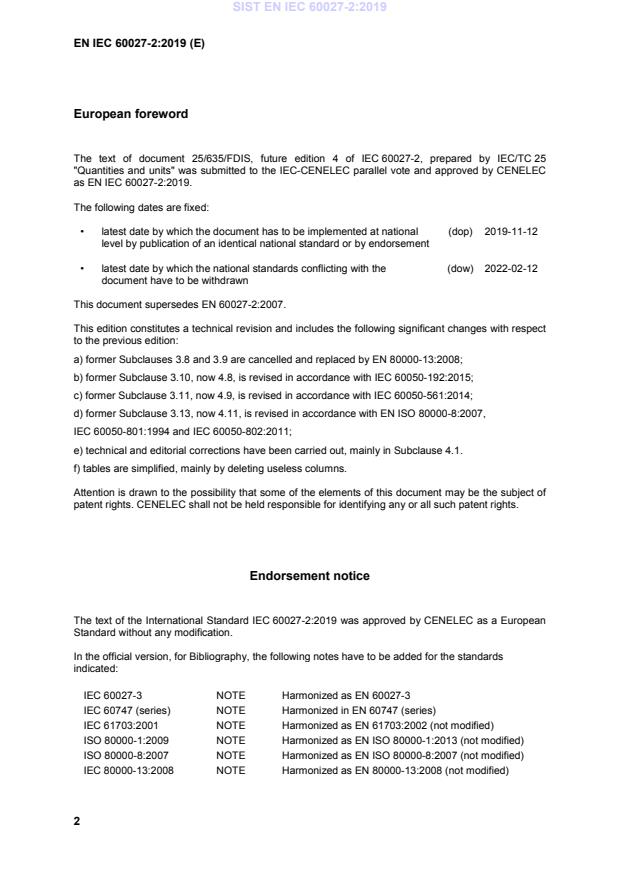
SLOVENSKI STANDARD
01-junij-2019
Nadomešča:
SIST EN 60027-2:2008
Črkovni simboli za uporabo v elektrotehniki - 2. del: Telekomunikacije in
elektronika (IEC 60027-2:2019)
Letter symbols to be used in electrical technology - Part 2: Telecommunications and
electronics (IEC 60027-2:2019)
Formelzeichen für die Elektrotechnik - Teil 2: Telekommunikation und Elektronik (IEC
60027-2:2019)
Symboles littéraux à utiliser en électrotechnique - Partie 2: Télécommunications et
électronique (IEC 60027-2:2019)
Ta slovenski standard je istoveten z: EN IEC 60027-2:2019
ICS:
01.075 Simboli za znake Character symbols
31.020 Elektronske komponente na Electronic components in
splošno general
33.020 Telekomunikacije na splošno Telecommunications in
general
2003-01.Slovenski inštitut za standardizacijo. Razmnoževanje celote ali delov tega standarda ni dovoljeno.
EUROPEAN STANDARD EN IEC 60027-2
NORME EUROPÉENNE
EUROPÄISCHE NORM
April 2019
ICS 01.060, 33.020 Supersedes EN 60027-2:2007
English Version
Letter symbols to be used in electrical technology - Part 2:
Telecommunications and electronics
(IEC 60027-2:2019)
Symboles littéraux à utiliser en électrotechnique - Partie 2: Formelzeichen für die Elektrotechnik - Teil 2:
Télécommunications et électronique Telekommunikation und Elektronik
(IEC 60027-2:2019) (IEC 60027-2:2019)
This European Standard was approved by CENELEC on 2019-02-12. CENELEC members are bound to comply with the CEN/CENELEC
Internal Regulations which stipulate the conditions for giving this European Standard the status of a national standard without any alteration.
Up-to-date lists and bibliographical references concerning such national standards may be obtained on application to the CEN-CENELEC
Management Centre or to any CENELEC member.
This European Standard exists in three official versions (English, French, German). A version in any other language made by translation
under the responsibility of a CENELEC member into its own language and notified to the CEN-CENELEC Management Centre has the
same status as the official versions.
CENELEC members are the national electrotechnical committees of Austria, Belgium, Bulgaria, Croatia, Cyprus, the Czech Republic,
Denmark, Estonia, Finland, Former Yugoslav Republic of Macedonia, France, Germany, Greece, Hungary, Iceland, Ireland, Italy, Latvia,
Lithuania, Luxembourg, Malta, the Netherlands, Norway, Poland, Portugal, Romania, Serbia, Slovakia, Slovenia, Spain, Sweden,
Switzerland, Turkey and the United Kingdom.
European Committee for Electrotechnical Standardization
Comité Européen de Normalisation Electrotechnique
Europäisches Komitee für Elektrotechnische Normung
CEN-CENELEC Management Centre: Rue de la Science 23, B-1040 Brussels
© 2019 CENELEC All rights of exploitation in any form and by any means reserved worldwide for CENELEC Members.
Ref. No. EN IEC 60027-2:2019 E
European foreword
The text of document 25/635/FDIS, future edition 4 of IEC 60027-2, prepared by IEC/TC 25
"Quantities and units" was submitted to the IEC-CENELEC parallel vote and approved by CENELEC
as EN IEC 60027-2:2019.
The following dates are fixed:
• latest date by which the document has to be implemented at national (dop) 2019-11-12
level by publication of an identical national standard or by endorsement
• latest date by which the national standards conflicting with the (dow) 2022-02-12
document have to be withdrawn
This document supersedes EN 60027-2:2007.
This edition constitutes a technical revision and includes the following significant changes with respect
to the previous edition:
a) former Subclauses 3.8 and 3.9 are cancelled and replaced by EN 80000-13:2008;
b) former Subclause 3.10, now 4.8, is revised in accordance with IEC 60050-192:2015;
c) former Subclause 3.11, now 4.9, is revised in accordance with IEC 60050-561:2014;
d) former Subclause 3.13, now 4.11, is revised in accordance with EN ISO 80000-8:2007,
IEC 60050-801:1994 and IEC 60050-802:2011;
e) technical and editorial corrections have been carried out, mainly in Subclause 4.1.
f) tables are simplified, mainly by deleting useless columns.
Attention is drawn to the possibility that some of the elements of this document may be the subject of
patent rights. CENELEC shall not be held responsible for identifying any or all such patent rights.
Endorsement notice
The text of the International Standard IEC 60027-2:2019 was approved by CENELEC as a European
Standard without any modification.
In the official version, for Bibliography, the following notes have to be added for the standards
indicated:
IEC 60027-3 NOTE Harmonized as EN 60027-3
IEC 60747 (series) NOTE Harmonized in EN 60747 (series)
IEC 61703:2001 NOTE Harmonized as EN 61703:2002 (not modified)
ISO 80000-1:2009 NOTE Harmonized as EN ISO 80000-1:2013 (not modified)
ISO 80000-8:2007 NOTE Harmonized as EN ISO 80000-8:2007 (not modified)
IEC 80000-13:2008 NOTE Harmonized as EN 80000-13:2008 (not modified)
Annex ZA
(normative)
Normative references to international publications
with their corresponding European publications
The following documents are referred to in the text in such a way that some or all of their content
constitutes requirements of this document. For dated references, only the edition cited applies. For
undated references, the latest edition of the referenced document (including any amendments)
applies.
NOTE 1 Where an International Publication has been modified by common modifications, indicated by (mod), the relevant
EN/HD applies.
NOTE 2 Up-to-date information on the latest versions of the European Standards listed in this annex is available here:
www.cenelec.eu.
Publication Year Title EN/HD Year
IEC 60027-1 1992 Letters symbols to be used in electrical
technology - Part 1: General
+ A1 1997 EN 60027-1 2006
+ A2 2005 + A2 2007
IEC 60027-2 ®
Edition 4.0 2019-01
INTERNATIONAL
STANDARD
NORME
INTERNATIONALE
Letter symbols to be used in electrical technology –
Part 2: Telecommunications and electronics
Symboles littéraux à utiliser en électrotechnique –
Partie 2: Télécommunications et électronique
INTERNATIONAL
ELECTROTECHNICAL
COMMISSION
COMMISSION
ELECTROTECHNIQUE
INTERNATIONALE
ICS 01.060; 33.020 ISBN 978-2-8322-6346-4
– 2 – IEC 60027-2:2019 © IEC 2019
CONTENTS
FOREWORD . 3
1 Scope . 5
2 Normative references . 5
3 Terms and definitions . 5
4 Introduction to tables . 5
5 Quantities and units . 6
5.1 General concepts . 6
5.2 Linear time-independent networks under sinusoidal conditions . 20
5.2.1 General . 20
5.2.2 Two-port networks . 20
5.2.3 n-port networks . 28
5.3 Line transmission of signals and telephony . 34
5.3.1 Quantities and units in line transmission . 34
5.3.2 Subscripts for line transmission . 35
5.3.3 Quantities and units in telephony . 36
5.3.4 Subscripts for telephony . 36
5.4 Waveguide propagation . 37
5.4.1 Frequency and wavelength in a waveguide . 37
5.4.2 Characteristic and normalized impedance and admittance in general. 38
5.4.3 Impedance and admittance at a point in a substance . 39
5.4.4 Impedance and admittance at a point in vacuum . 40
5.4.5 Impedance and admittance of a waveguide . 41
5.5 Radiocommunications . 42
5.5.1 General and tropospheric propagation . 42
5.5.2 Ionospheric propagation . 45
5.5.3 Antennas . 46
5.5.4 Radio links. 51
5.6 Optical fibre communication . 53
5.7 Television . 59
5.8 Dependability . 61
5.9 Piezoelectric resonators . 62
5.10 Semiconductor devices . 68
5.11 Electroacoustics . 68
Bibliography . 73
Figure 1 – Conventions concerning signs in electric circuits . 20
Figure 2 – Conventions for n-port linear networks . 28
Figure 3 – Equivalent circuits of a one-port piezoelectric resonator . 62
IEC 60027-2:2019 © IEC 2019 – 3 –
INTERNATIONAL ELECTROTECHNICAL COMMISSION
____________
LETTER SYMBOLS TO BE USED IN ELECTRICAL TECHNOLOGY –
Part 2: Telecommunications and electronics
FOREWORD
1) The International Electrotechnical Commission (IEC) is a worldwide organization for standardization comprising
all national electrotechnical committees (IEC National Committees). The object of IEC is to promote
international co-operation on all questions concerning standardization in the electrical and electronic fields. To
this end and in addition to other activities, IEC publishes International Standards, Technical Specifications,
Technical Reports, Publicly Available Specifications (PAS) and Guides (hereafter referred to as "IEC
Publication(s)"). Their preparation is entrusted to technical committees; any IEC National Committee interested
in the subject dealt with may participate in this preparatory work. International, governmental and non-
governmental organizations liaising with the IEC also participate in this preparation. IEC collaborates closely
with the International Organization for Standardization (ISO) in accordance with conditions determined by
agreement between the two organizations.
2) The formal decisions or agreements of IEC on technical matters express, as nearly as possible, an international
consensus of opinion on the relevant subjects since each technical committee has representation from all
interested IEC National Committees.
3) IEC Publications have the form of recommendations for international use and are accepted by IEC National
Committees in that sense. While all reasonable efforts are made to ensure that the technical content of IEC
Publications is accurate, IEC cannot be held responsible for the way in which they are used or for any
misinterpretation by any end user.
4) In order to promote international uniformity, IEC National Committees undertake to apply IEC Publications
transparently to the maximum extent possible in their national and regional publications. Any divergence
between any IEC Publication and the corresponding national or regional publication shall be clearly indicated in
the latter.
5) IEC itself does not provide any attestation of conformity. Independent certification bodies provide conformity
assessment services and, in some areas, access to IEC marks of conformity. IEC is not responsible for any
services carried out by independent certification bodies.
6) All users should ensure that they have the latest edition of this publication.
7) No liability shall attach to IEC or its directors, employees, servants or agents including individual experts and
members of its technical committees and IEC National Committees for any personal injury, property damage or
other damage of any nature whatsoever, whether direct or indirect, or for costs (including legal fees) and
expenses arising out of the publication, use of, or reliance upon, this IEC Publication or any other IEC
Publications.
8) Attention is drawn to the Normative references cited in this publication. Use of the referenced publications is
indispensable for the correct application of this publication.
9) Attention is drawn to the possibility that some of the elements of this IEC Publication may be the subject of
patent rights. IEC shall not be held responsible for identifying any or all such patent rights.
International Standard IEC 60027-2 has been prepared by IEC technical committee 25:
Quantities and units.
This fourth edition cancels and replaces the third edition published in 2005. This fourth edition
constitutes a technical revision.
This edition includes the following significant changes with respect to the previous edition:
a) former Subclauses 3.8 and 3.9 are cancelled and replaced by IEC 80000-13:2008;
b) former Subclause 3.10, now 4.8, is revised in accordance with IEC 60050-192:2015;
c) former Subclause 3.11, now 4.9, is revised in accordance with IEC 60050-561:2014;
d) former Subclause 3.13, now 4.11, is revised in accordance with ISO 80000-8:2007,
IEC 60050-801:1994 and IEC 60050-802:2011;
e) technical and editorial corrections have been carried out, mainly in Subclause 4.1.
f) tables are simplified, mainly by deleting useless columns.
– 4 – IEC 60027-2:2019 © IEC 2019
The text of this standard is based on the following documents:
FDIS Report on voting
25/635/FDIS 25/640/RVD
Full information on the voting for the approval of this International Standard can be found in
the report on voting indicated in the above table.
This document has been drafted in accordance with the ISO/IEC Directives, Part 2.
A list of all parts in the IEC 60027 series, published under the general title Letter symbols to
be used in electrical technology, can be found on the IEC website.
The committee has decided that the contents of this document will remain unchanged until the
stability date indicated on the IEC website under "http://webstore.iec.ch" in the data related to
the specific document. At this date, the document will be
• reconfirmed,
• withdrawn,
• replaced by a revised edition, or
• amended.
IEC 60027-2:2019 © IEC 2019 – 5 –
LETTER SYMBOLS TO BE USED IN ELECTRICAL TECHNOLOGY –
Part 2: Telecommunications and electronics
1 Scope
This part of IEC 60027 is applicable to telecommunications and electronics. It gives names
and symbols for quantities and their units.
2 Normative references
The following documents are referred to in the text in such a way that some or all of their
content constitutes requirements of this document. For dated references, only the edition
cited applies. For undated references, the latest edition of the referenced document (including
any amendments) applies.
IEC 60027-1:1992, Letter symbols to be used in electrical technology – Part 1: General
IEC 60027-1:1992/AMD1:1997
IEC 60027-1:1992/AMD2:2005
3 Terms and definitions
No terms and definitions are listed in this document.
ISO and IEC maintain terminological databases for use in standardization at the following
addresses:
• IEC Electropedia: available at http://www.electropedia.org/
• ISO Online browsing platform: available at http://www.iso.org/obp
4 Introduction to tables
In this part of IEC 60027, complex quantities are in general denoted by underlining their
symbols. However, this does not constitute a compulsory rule in applications (see
IEC 60027-1).
To avoid any ambiguity, some quantity names are followed by a specific use, enclosed in
angle brackets "<…>" after a comma.
When several symbols are indicated for a given quantity, the first is the preferred symbol and
the others are reserve symbols, unless otherwise stated.
When several units are indicated for a given quantity, the first is the coherent SI unit, unless
otherwise stated. For logarithmic ratios, the first mentioned unit is the decibel.
For quantities defined as a logarithm of the ratio of two power quantities or two root-power
quantities (also known as field quantities), the submultiple decibel (dB) of the bel (B) is
generally used, rather than the neper (Np). The bel is not explicitly mentioned in the tables.
See IEC 60027-3 and ISO 80000-1:2009, Annex C.
– 6 – IEC 60027-2:2019 © IEC 2019
5 Quantities and units
5.1 General concepts
Quantity Units
Item
Entry
number
number in Name Symbol Definition and remarks Name Symbol Remarks
IEC 60050
101 101-12-02 signal S A signal is any physical phenomenon whose presence, absence or variation is The unit depends on the
considered as representing information. In general, a signal is a quantity, one or kind of quantity
s
more parameters of which represent information. constituting the signal
(electric current,
In this document, S and S are used for input and output signals respectively.
1 2
voltage, pressure, etc.).
See IEC 60027-1 for other suitable subscripts.
In cases where the type of signal quantity is known, for example, electric current,
voltage, pressure, etc., use the appropriate symbol.
With respect to capital and lower-case letters, see IEC 60027-1:1992, 2.1.
102 signal power P "s" (lower case, upright) is used as subscript for "signal". watt W
s
P In signal theory, the term "instantaneous power" is by convention used for the
sig
square of the instantaneous value of a signal. This square is proportional to a
physical power if the signal is a root-power quantity (or field quantity)
(see Note 1 to entry of IEC 60050-103:2009, 103-09-05).
In a physical system, a signal power is always a physical power.
103 signal level L decibel dB
S 1 S
L =10 lg dB= ln Np
L S 2 S neper Np
ref ref
s
L
sig
where S and S are two signals of the same kind, S being a reference signal.
ref ref
104 702-07-04 absolute L decibel dB
P 1 P
P
L =10 lg dB= ln Np
power level;
P
P 2 P neper Np
ref ref
power level
where P is a power and P is a reference power.
ref
105 702-07-06 absolute decibel dB
U U
L
U
L =20 lg dB=ln Np
voltage level;
U
U U neper Np
ref ref
voltage level
where U is a voltage and U is a reference voltage.
ref
The synonym "voltage level" may be used only where there is no ambiguity.
IEC 60027-2:2019 © IEC 2019 – 7 –
Quantity Units
Item
Entry
number
number in
Name Symbol Definition and remarks Name Symbol Remarks
IEC 60050
106 702-07-05 relative decibel dB
L L = L −L
r,x r,x P,x P,0
power level
neper Np
where L and L are the absolute power levels (104) at the measuring point
L
P,x P,0
r
and at a reference point, respectively.
107 702-08-03 noise A noise is any variable physical phenomenon, generally a quantity, apparently The unit depends on the
N
not conveying information and which can be superimposed on, or combined with, kind of quantity
n a wanted signal. constituting the noise
(electric current,
Concerning upper and lower-case letters, see IEC 60027-1:1992, 2.1.
S
n voltage, pressure, etc.).
"n" (lower case, upright) is used as subscript for "noise".
s
n
In cases where the type of noise quantity is known, use the appropriate symbol
(for example, I, i for electric current) with n as subscript (e.g. I , i ).
n n
108 103-09-05 power w(f) watt per W/Hz
∞
spectral hertz
P = wf( )d f
∫
density,
or noise>
where f is the frequency and P is the total power.
In signal theory, the term "instantaneous power" is by convention used for the
square of the instantaneous value of a signal or noise. This square is
proportional to a physical power if the signal or the noise is a root-power (or field
quantity). See Note 1 to entry of 103-09-05 in IEC 60050-103:2009.
In a physical system, the power spectral density is always a physical power
spectral density.
109 power N The power spectral density (108) is frequency-independent: watt per W/Hz
spectral w(f) = N hertz
density of
white noise
110 702-08-51 equivalent U Applies to a one-port network. volt V
n
noise
U is an RMS voltage.
voltage n
– 8 – IEC 60027-2:2019 © IEC 2019
Quantity Units
Item
Entry
number
number in
Name Symbol Definition and remarks Name Symbol Remarks
IEC 60050
111 702-08-52 equivalent Applies to a one-port network. ohm Ω
R
eq
noise
resistance; U
n
R
R =
n
eq
4 kT ∆f
ref
noise
resistance
is the equivalent noise voltage (110), k is the Boltzmann constant, T
where U
n ref
is a reference temperature and ∆f is the frequency bandwidth (154) considered.
The synonym "noise resistance" may be used only where there is no ambiguity.
112 702-08-54 spot noise T(f) Applies to a one-port network. kelvin K
temperature f is frequency.
113 702-08-55 mean noise Applies to a one-port network. kelvin K
T
temperature
114 702-08-56 equivalent Applies to a two-port network. kelvin K
T ( f )
eq
spot noise f is frequency.
temperature
115 702-08-58 mean Applies to a two-port network. kelvin K
T
eq
equivalent
The synonym "mean noise temperature" may be used only where there is no
noise
ambiguity.
temperature;
mean noise
temperature
116 702-08-57 spot noise Applies to a two-port network. one 1
Ff()
factor The noise factor is the ratio of the exchangeable power spectral density (108) of
output noise to the power spectral density that would be present at the output if
the only source of noise were input thermal noise at a reference temperature
:
T
ref
Tf()
eq
Ff() 1+
T
ref
where T ( f ) is the equivalent spot noise temperature (114).
eq
For exchangeable power, see IEC 60050-702:1992, 702-07-11.
=
IEC 60027-2:2019 © IEC 2019 – 9 –
Quantity Units
Item
Entry
number
number in
Name Symbol Definition and remarks Name Symbol Remarks
IEC 60050
117 702-08-57 spot noise decibel dB
F ( f ) 1
n
F f = 10 lg Ff dB = ln Ff Np
figure ( ) ( ) ( )
n
neper Np
F ()f
where is the spot noise factor (116).
In English, "noise factor" is generally used for the arithmetic expression and
"noise figure" is used for the logarithmic expression. See IEC 60050-702:1992,
702-08-57, Note 2.
In French, "facteur de bruit" is generally used in both cases.
118 702-08-59 mean noise Applies to a two-port network. one 1
F
factor;
T
eq
F 1+
noise factor
T
ref
where T is the mean equivalent noise temperature (115) and T is a reference
eq
ref
temperature.
The synonym "noise factor" may be used only where there is no ambiguity.
119 702-08-59 mean noise decibel dB
F 1
n
FF10 lg dB ln F Np
figure;
n
neper Np
noise figure
where F is the mean noise factor (118).
In English, "noise factor" is generally used for the arithmetic expression and
"noise figure" is used for the logarithmic expression. See IEC 60050-702:1992,
702-08-59, Note 2.
In French, "facteur de bruit" is generally used in both cases and the adjective
"logarithmique" is omitted in practice.
The synonym "noise figure" may be used only where there is no ambiguity.
120 702-08-61 signal-to- k Signal power (102) divided by noise power. one 1
SN
noise ratio;
In practice, the symbol S/N is generally used.
SNR
==
=
– 10 – IEC 60027-2:2019 © IEC 2019
Quantity Units
Item
Entry
number
number in
Name Symbol Definition and remarks Name Symbol Remarks
IEC 60050
121 702-08-61 signal-to- K decibel dB
SN
Kk= 10 lg dB = ln k Np
noise
SN SN SN
neper Np
logarithmic
ratio
where k is the signal-to-noise ratio (120).
SN
In practice, the term "signal-to-noise ratio" and the symbol S/N are generally
used.
σ
122 103-07-17 growth Example: decibel dB/s
coefficient per
Np/s
σ t
second
ˆ
ut = u e sin ω t
( )
neper
where u(t) is a sinusoidal function of time t, with angular frequency ω and per
second
uˆ
amplitude .
123 103-05-24 damping δ =−σ decibel dB/s
δ
coefficient per
Np/s
where is the growth coefficient (122).
σ
second
neper
per
second
–1
124 103-07-16 complex s second s Special units are only
s =σ + jjω =−+δω
angular to the used when the real and
p
power imaginary parts are
frequency;
where is the angular frequency, is the growth coefficient (122) and δ is
ω σ
of treated separately.
complex
the damping coefficient (123).
minus
frequency
one
IEC 60027-2:2019 © IEC 2019 – 11 –
Quantity Units
Item
Entry
number
number in
Name Symbol Definition and remarks Name Symbol Remarks
IEC 60050
125 131-15-20 transfer H The unit of the quantity
Ss()
function H is the quotient of the
Hs() =
T
unit of s (t) by the unit
Ss()
of s (t).
and S , respectively, are the complex representations of the input and
where S
1 2
output signals, respectively, as functions of the complex angular frequency s
(124).
The complex quantities are generally the Laplace transforms of the time-varying
quantities:
Lst()
H =
Lst()
where Ls (t) and Ls (t) are the Laplace transforms of the signals s (t) and s (t)
1 2 1 2
and t is time.
126 transfer gain The unit is the same as
G()ω
GH(ωω) = (j )
for H.
where H (σω+ j ) is the transfer function (125).
127 transfer The unit is the
A()ω AG()ωω= 1 / ()
attenuation reciprocal of the unit of
H.
G(ω)
where is the transfer gain (126).
128 transfer If the transfer function H (125) is of dimension one (see IEC 60050-112:2010, one 1 Special units are only
Γ
exponent 112-01-13): used when the real and
imaginary parts are
HG(jωω) ( )exp[−=jB(ω)] exp[Γ (ω)]
treated separately.
Γ AB− j (see 129 and 130).
See also image transfer coefficient (IEC 60050-131:2002, 131-15-25).
129 logarithmic A decibel dB
A 20 (lg e) Re ()ΓΓdB Re () Np
transfer
neper Np
attenuation
where Γ is the transfer exponent (128) and e is the base of the natural
logarithm.
In practice, "transfer attenuation" is used.
==
=
=
– 12 – IEC 60027-2:2019 © IEC 2019
Quantity Units
Item
Entry
number
number in
Name Symbol Definition and remarks Name Symbol Remarks
IEC 60050
130 phase radian rad
B
B(ωω) = Im(ΓH) = − arg (j )
π
change; 1° = rad
°
degree
ϕ 180
where is the transfer function (125) and Γ is the transfer exponent
H (σω+ j )
phase shift
(128).
131 voltage one 1
U
a
U
a =
attenuation U
U
factor
where U and U are two voltages. Subscripts 1 and 2 can for example designate
1 1
the input port and the output port, respectively, of a two-port network. The
inverse of the voltage attenuation factor is the voltage gain factor (133).
In practice, "voltage attenuation" is used.
132 logarithmic
decibel dB
A A =20 lg a dB=ln a Np
U U U U
voltage
neper Np
attenuation
where is voltage attenuation factor (131). When the logarithmic voltage
a
U
attenuation is negative, its absolute value is the logarithmic voltage gain (134).
In practice, "voltage attenuation" is used.
133 voltage gain one 1
g U
U 2
g =
factor
U
U
where U and U are two voltages. Subscripts 1 and 2 can, for example,
1 1
designate the input port and the output port, respectively, of a two-port network.
The inverse of the voltage gain factor is the voltage attenuation factor (131).
In practice, "voltage gain" is used.
134 logarithmic decibel dB
G G =20 lg g dB=ln g Np
U U U U
voltage gain
neper Np
where g is the voltage gain factor (133). When the logarithmic voltage gain is
U
negative, its absolute value is the logarithmic voltage attenuation (132).
In practice, "voltage gain" is used.
IEC 60027-2:2019 © IEC 2019 – 13 –
Quantity Units
Item
Entry
number
number in
Name Symbol Definition and remarks Name Symbol Remarks
IEC 60050
135 702-02-10 power loss S instead of P in the case of apparent powers. one 1
Use subscript
a
P
factor;
P
power a =
P
P
attenuation 2
factor
Subscripts 1 and 2 are used to designate the power of a signal at two points, for
example, input and output of a two-port network, or the power of a signal in two
specified conditions, for example, for defining insertion attenuation or insertion
loss (IEC 60050-131:2002, 131-15-30).
The inverse of the power loss factor is the power gain factor (137).
In practice, "power loss" or "power attenuation" are used.
136 702-02-10 logarithmic Use subscript S instead of P in the case of apparent powers. decibel dB
A
P
power loss;
neper Np
logarithmic
Aa10lg dB ln a Np
P PP
power 2
attenuation;
where is the power loss factor (135).
a
P
loss;
When the logarithmic power loss is negative, its absolute value is the logarithmic
attenuation
power gain (138).
In practice, "logarithmic" is omitted in the terms.
137 702-02-11 power gain one 1
Use subscript S instead of P in the case of apparent powers.
g
P
factor;
P
gain factor g =
P
P
Subscripts 1 and 2 are used to designate the power of a signal at two points, for
example, input and output of a two-port network, or the power of a signal in two
specified conditions, for example, for defining available power gain
(IEC 60050-702:1992, 702-07-12).
The inverse of the power gain factor is the power loss factor (135).
In practice, "factor" is omitted in the terms.
==
– 14 – IEC 60027-2:2019 © IEC 2019
Quantity Units
Item
Entry
number
number in
Name Symbol Definition and remarks Name Symbol Remarks
IEC 60050
138 702-02-11 logarithmic S instead of P in the case of apparent powers. decibel dB
Use subscript
G
P
power gain;
neper Np
logarithmic
Gg10 lg dB ln g Np
P PP
gain 2
gain
where g is the power gain factor (137). When the logarithmic power gain is
P
negative, its absolute value is the logarithmic power loss (136).
In practice, "logarithmic" is omitted in the terms.
139 702-08-60 effective Applies to a two-port network. hertz Hz
B
n
noise
∞
bandwidth
B = g( f )d f
n ∫
g
max
g( f )
where is the available power gain (IEC 60050-702:1992, 702-07-12) as a
function of frequency f and g is the maximum available power gain.
max
−1
140 103-10-18 propagation metre Special units are only
m
Coefficient of the distance in the complex representation of a wave
γ
coefficient to the used when the real and
A exp ()−γ x + jωt + jϑ
0 0 power imaginary parts are
of treated separately. See
minus 119 and 120.
where x is the distance in the direction of propagation, ω is the angular
one
frequency, t is time and is the initial phase (IEC 60050-103:2009, 103-07-05).
ϑ
γ =α + jβ
(see 141 and 142).
141 103-10-19 attenuation α neper Np/m
α = Reγ
coefficient per
dB/m
metre
where γ is the propagation coefficient (140).
decibel
per
metre
==
IEC 60027-2:2019 © IEC 2019 – 15 –
Quantity Units
Item
Entry
number
number in
Name Symbol Definition and remarks Name Symbol Remarks
IEC 60050
142 103-10-20 phase radian rad/m
β
β =Imγ
change per
°/m
coefficient; metre
γ
where is the propagation coefficient (140).
phase degree
coefficient
per
metre
143 702-02-16 phase delay second s
t
ϕ
τ
ϕ
144 702-02-20 group delay See also 608. second s
t
g
τ
g
145 103-10-13 phase Phase velocity is defined for waves only. If both waves and moving particles are metre m/s
c
ϕ
velocity per
involved, use c for the former and v for the latter.
second
v
φ
The phase velocity is a vector quantity with magnitude
c
ω
c = f λ =
ϕ
v k
where f is the frequency, λ is the wavelength (147), ω is the angular frequency
k
(IEC 60050-103:2009, 103-07-03), and is angular wavenumber
(IEC 60050-103:2009, 103-10-12).
– 16 – IEC 60027-2:2019 © IEC 2019
Quantity Units
Item
Entry
number
number in
Name Symbol Definition and remarks Name Symbol Remarks
IEC 60050
146 103-10-15 group Group velocity is defined for waves only. metre m/s
c
g
velocity per
The group velocity is a vector quantity with magnitude
second
v
g
d f dω
c = =
g
dk
d
λ
where f is the frequency, λ is the wavelength (147), ω is the angular frequency
(IEC 60050-103:2009, 103-07-03), and k is the angular wavenumber
(IEC 60050-103:2009, 103-10-12).
See also 607, where the group velocity is defined as the speed of light in vacuum
divided by the group index (606).
147 103-10-10 wavelength metre m
λ
c
ϕ
λ =
f
c
where is the phase velocity (145) and f is the frequency.
ϕ
See also 602.
148 702-07-24 complex one 1
r
S
r
reflection r =
S
i
factor;
reflection
where S and S are the complex amplitudes (IEC 60050-103:2009, 103-07-13)
i r
factor
of the incident and reflected wave, respectively.
Z −Z
2 1
r =
Z +Z
2 1
where is the characteristic impedance (307, 407) of a transmission line
Z
ahead of a discontinuity or the impedance of a source; and Z is the impedance
after the discontinuity or the load impedance seen from the junction between the
source and the load.
IEC 60027-2:2019 © IEC 2019 – 17 –
Quantity Units
Item
Entry
number
number in
Name Symbol Definition and remarks Name Symbol Remarks
IEC 60050
149 726-07-09 standing s one 1
1+ r
S
max
s = =
wave ratio
S 1− r
min
where S and S are the maximum and minimum amplitudes, respectively, of
max min
the superposition of two waves and is complex reflection factor (148).
r
150 726-07-07 complex one 1
S
τ
t
τ =
transmission
S
i
factor;
transmission
where S and are the complex amplitudes (IEC 60050-103:2009, 103-07-13)
S
i t
factor
of the incident and transmitted wave, respectively.
151 reference Frequency used as a reference. hertz Hz
f
ref
frequency
f
152 resonance Frequency of a forced oscillation at resonance (see IEC 60050-103:2009, hertz Hz
f
r
frequency 103-05-07).
f
rsn
153 151-13-54 cut-off See also 402. hertz Hz
f
c
frequency
154 103-09-02 frequency hertz Hz
f The bandwidth of the frequency interval ( f , f ) is f = f − f .
B 1 2 B 2 1
bandwidth;
B
bandwidth
∆f
155 702-06-19 modulation m ˆ
s(t)= s(1+msinωt)sinΩt one 1
factor,
where Ω is the angular frequency of the carrier oscillation and ω is the angular
amplitude frequency of the modulation oscillation.
modulation>
– 18 – IEC 60027-2:2019 © IEC 2019
Quantity Units
Item
Entry
number
number in
Name Symbol Definition and remarks Name Symbol Remarks
IEC 60050
jϑ(t)
156 702-04-54 amplitude, A(t) The unit depends on the
S(t)= A(t)e
kind of the quantity
constituting the signal or
where S(t) is the analytic signal associated with the given real signal (see
noise (electric current,
IEC 60050-702:1992, 702-04-52).
voltage, pressure, etc.).
jϑ(t)
157 702-04-55 phase, radian rad
ϑ(t)
S(t)= A(t)e π
1 rad
°=
degree °
ψ (t) 180
where S(t) is the analytic signal associated with the given real signal (see
IEC 60050-702:1992, 702-04-52).
158 702-04-56 instantaneous f (t) hertz Hz
1 dϑ(t)
frequency f (t)=
2π dt
where is the phase (157) of the signal.
ϑ(t)
159 702-06-33 instantaneous ∆ f (t) hertz Hz
∆ f (t) = f (t) −Ω
frequency
deviation;
where is the instantaneous frequency (158) and Ω is the angular frequency
f (t)
of the carrier oscillation.
frequency
deviation
160 702-06-34 peak hertz Hz
(∆ f ) (∆ f ) = max ∆ f (t)
mm mm
frequency
deviation;
f where ∆ f (t) is the instantaneous frequency deviation (159).
d
peak
The synonym "peak deviation" may be used only where there is no ambiguity.
deviation
161 702-06-38 frequency one 1
δ
2(π ∆ f )
deviation
mm
δ =
ratio;
η
ω
deviation
ratio where (∆ f ) is the peak frequency deviation (160) and ω is the angular
mm
frequency of the modulating oscillation.
The synonym "deviation ratio" may be used only where there is no ambiguity.
IEC 60027-2:2019 © IEC 2019 – 19 –
Quantity Units
Item
Entry
number
number in
Name Symbol Definition and remarks Name Symbol Remarks
IEC 60050
162 702-06-31 instantaneous In angular modulation, difference between the phase of the modulated signal and radian rad
∆ϑ(t) π
phase the phase of the carrier in the absence of modulation: 1°= rad
degree
°
deviation;
ˆ
s(t)= s sin (Ω t +∆ϑ(t))
phase
deviation
ˆ
where s(t) is an angular modulated signal with peak value s and Ω is the
angular frequency of the carrier oscillation.
163 702-06-32 peak phase
radian rad
(∆ϑ) (∆ϑ) = max ∆ϑ(t) π
mm mm
deviation; 1°= rad
degree
° 180
ϑ
where ∆ϑ(t) is the instantaneous phase deviation (162).
peak d
deviation
The synonym "peak deviation" may be used only where there is no ambiguity.
164 103-07-32 total one 1
2 2
d
(U −U )
harmonic
d =
U
factor
k
where U is the RMS value of a periodic quantity and U is the RMS value of its
fundamental component.
The given symbols are also recommended for quantities characterizing distortion
in general without regard to the cause or the kind of the distortion considered. In
special cases, it shall be mentioned explicitly which kind of distortion is meant,
using the given symbols with suitable subscripts if necessary. Example: total
harmonic distortion (or ), see IEC 60050-702:1992, 702-07-62.
d k
h h
– 20 – IEC 60027-2:2019 © IEC 2019
5.2 Linear time-independent networks under sinusoidal conditions
5.2.1 General
Subclause 5.2 applies to networks consisting of linear time-invariant elements and not
containing voltage or current sources. Quantities considered are defined under sinusoidal
conditions and are functions of the frequency. They are generally complex; however, they are
not underlined.
For indicating the matrix character of a quantity, bold face italic type for letter symbols is
recommended, for example Z. Parentheses may also be placed around the letter symbol, for
example .
(Z )
ij
Only upper-case letters are indicated for the quantity symbols, but lower-case letters may also
be used if necessary.
5.2.2 Two-port networks
To determine the signs of matrix elements, the convention indicated in Figure 1 below is used.
Figure 1 – Conventions concerning signs in electric circuits
For the representation of two-port matrices, capital letter symbols are preferred in the general
case. If a two-port network contains internal two-ports (such as electronic devices),
preference is given to lower-case symbols for the internal two-ports. See also IEC 60747-1.
IEC 60027-2:2019 © IEC 2019 – 21 –
Quantity Units
Item
Entry
number
number in
Name Symbol Definition and remarks Name Symbol Remarks
IEC 60050
201.1 131-14-08 input impedance ohm Ω
is the input impedance at port 1. When 1 and 2 are not
Z Z
1 1
suitable subscripts for input and output, other subscripts are "in"
and "ex", or "i" and "o", respectively.
201.2 131-14-11 output impedance ohm
Ω
Z Z is the input impedance at port 2. When 1 and 2 are not
2 2
suitable subscripts for input and output, other subscripts are "in"
and "ex", or "i" and "o", respectively.
202.1 131-14-09 input admittance siemens S
is the input admittance at port 1. When 1 and 2 are not suitable
Y Y
1 1
subscripts for input and output, other subscripts are "in" and "ex",
or "i" and "o", respectively.
202.2 131-14-12 output admittance siemens S
Y Y is the input admittance at port 2. When 1 and 2 are not suitable
2 2
subscripts for input and output, other subscripts are "in" and "ex",
or "i" and "o", respectively.
203 131-15-28 characteristic The symbol for the corresponding admittance has the same ohm
Ω
Z
impedance subscript (see 408, 412, 418).
Z
c See also 307, 407, 411, 417, 501, 502.
Z
ch
204 131-15-23 image impedance The symbol for the corresponding admittance has the same ohm Ω
Z
i
subscript.
Z
im
205 131-15-24 iterative impedance The symbol for the corresponding admittance has the same ohm
Ω
Z
k
subscript.
Z
it
206 131-14-24 impedance matrix ohm
Z Ω
U I Z Z
1 1 11 12
where
= Z Z =
U I Z Z
2 2 21 22
206.1 open-circuit input ohm Ω
Z U
11 1
Z =
impedance 11
I
1
I =0
– 22 – IEC 60027-2:2019 © IEC 20198
Quantity Units
Item
Entry
number
number in
Name Symbol Definition and remarks Name Symbol Remarks
IEC 60050
206.2 open-circuit input ohm Ω
Z U
12 1
Z =
reverse transfer 12
I
2
I = 0
impedance 1
See also "reverse transfer impedance" (IEC 60050-131:2002,
131-14-14).
206.3 open-circuit input ohm
Ω
Z
U
21 2
Z =
forward transfer 21
I
1
I =0
impedance;
open-circuit input See also "forward transfer impedance" (IEC 60050-131:2002,
transfer impedance 131-14-13).
206.4 open-circuit output ohm
Ω
Z U
22 2
Z =
impedance 22
I
I =0
207 131-14-25 admittance m
...