

SIST EN 16604-30-03:2020
(Main)Space - Space Situational Awareness Monitoring - Part 30-03: Observation System Data Message (OSDM)
General Information
- Abstract
1.1 Purpose:
The Observing System Data Message (OSDM) is a standard message format to be used in the exchange of optical telescope, laser ranging station, and radar (observing systems) information between Space Situational Awareness (SSA) data providers, owners/operators of observing systems, and other parties. These messages can inform SSA data providers, which are the consumers of observing system output data, on the parameters of the observing systems.
The OSDM standard will:
a) enable consistent data exchange between observation data providers and SSA systems;
b) facilitate data exchange automation and ingestion of observation data from different providers;
c) facilitate SSA system architecture performance simulations; and
d) provide a quick way to estimate the expected performance from one observing system.
1.2 Applicability:
The Observing System Data Message standard is applicable to all SSA activities, especially Space Surveillance and Tracking (SST) as well as near-Earth objects (NEO), and other fields where the acquisition of astrometric and photometric data plays a role (e.g. space debris, observational astronomy). The standard contains a message designed to contain observing system parameters exchanged between producers and consumers of astrometric and/or photometric data. These data include observing system name, location, type (optical/radar), operator and tracking/survey performance.
The OSDM is suitable for both manual and automated interaction, but will not contain a large amount of data. The message is self contained and can be paired with several Tracking Data Messages (TDM – specified reference [1]), FITS images (specified in reference [2]), or other formats containing the observation data.
The OSDM standard only applies to the message format, structure and content. The exchange method is beyond the scope of the standard, and it is due to be specified in an ICD, though an ICD is not always required. The methods used to produce the data in the message are also beyond the scope of the standard.
1.3 Document structure:
Clause 5 provides an overview of the OSDM.
Clause 6 described the structure and content of the 'keyword = value' (KVN) version of the OSDM.
Clause 7 described the structure and content of the XML version of the OSDM.
Clause 8 describes the data and syntax of OSDM messages, in both KVN and XML.
Annex A lists agreed values for some of the OSDM keywords.
Annex B presents some examples of OSDMs.
- Status
- Published
- Public Enquiry End Date
- 31-Aug-2019
- Publication Date
- 26-Jul-2020
- Technical Committee
- I13 - Imaginarni 13
- Current Stage
- 6060 - National Implementation/Publication (Adopted Project)
- Start Date
- 20-Jul-2020
- Due Date
- 24-Sep-2020
- Completion Date
- 27-Jul-2020


Overview
EN 16604-30-03:2020 - Observation System Data Message (OSDM) defines a standardized message format for exchanging observing-system parameters between Space Situational Awareness (SSA) stakeholders. The OSDM covers optical telescopes, laser (SLR) ranging stations and radars, supplying consumers of observation data with machine- and human-readable metadata about an observing system’s identity, location, type, operator and tracking/survey performance. The standard exists in two syntaxes: a compact KVN (keyword = value) format and an XML schema, and is intended to be lightweight, self-contained and suitable for both manual and automated workflows.
Key topics and requirements
- Message scope and purpose
- Provide consistent describing metadata to enable automated ingestion, interoperability and performance estimation across SSA systems.
- Supported observing-system types
- Optical telescopes, radars and laser ranging stations (SLR).
- Data content
- System name, location (including agreed location type and reference frame), system type, operator, and tracking/survey performance indicators (astrometric/photometric capabilities).
- Formats and syntax
- KVN (keyword = value) structure and a corresponding XML schema; clauses detail structure, data types, units and comment conventions.
- Interoperability features
- Small, self-contained messages that can be paired with Tracking Data Messages (TDM), FITS images or other observation data formats for full observational context.
- Limitations
- The standard defines only message content, structure and syntax - exchange protocols (ICDs) and data production methods are explicitly out of scope.
- Normative references
- Includes ISO 17107 (XML spec for navigation data messages) and XML Schema datatype guidance.
Practical applications
- Space Surveillance and Tracking (SST) systems: standardize incoming sensor descriptions to improve cataloging and tracking workflows.
- Near-Earth Object (NEO) monitoring and space debris observation: convey sensor capabilities for tasking and data fusion.
- Data ingestion pipelines: enable automated onboarding of multi-vendor observation sources (optical, radar, SLR) into SSA data platforms.
- System performance simulation and planning: supply parameters needed for architecture performance models and quick estimation of expected observing performance.
- Observatory and sensor operators: publish consistent metadata about instruments for downstream consumers and collaborators.
Who should use this standard
- SSA data providers and consumers, observatory owners/operators, space agencies, satellite operators, software developers building ingestion services or simulation tools, and systems integrators working on SST/NEO and astrometric/photometric data exchange.
Related standards
- Tracking Data Message (TDM) formats (referenced for observation data pairing)
- FITS image format (for associated imaging data)
- ISO 17107 (XML spec for navigation data messages)
Keywords: EN 16604-30-03, OSDM, Space Situational Awareness, SSA, SST, observing system, optical telescope, radar, SLR, KVN, XML, TDM, FITS.
Relations
- Effective Date
- 28-Jan-2026
Get Certified
Connect with accredited certification bodies for this standard

BSI Group
BSI (British Standards Institution) is the business standards company that helps organizations make excellence a habit.

BUREAU VERITAS Certification Germany
Bureau Veritas certification in Germany.

Element Materials Technology
Materials testing and product certification.
Sponsored listings
Frequently Asked Questions
SIST EN 16604-30-03:2020 is a standard published by the Slovenian Institute for Standardization (SIST). Its full title is "Space - Space Situational Awareness Monitoring - Part 30-03: Observation System Data Message (OSDM)". This standard covers: 1.1 Purpose: The Observing System Data Message (OSDM) is a standard message format to be used in the exchange of optical telescope, laser ranging station, and radar (observing systems) information between Space Situational Awareness (SSA) data providers, owners/operators of observing systems, and other parties. These messages can inform SSA data providers, which are the consumers of observing system output data, on the parameters of the observing systems. The OSDM standard will: a) enable consistent data exchange between observation data providers and SSA systems; b) facilitate data exchange automation and ingestion of observation data from different providers; c) facilitate SSA system architecture performance simulations; and d) provide a quick way to estimate the expected performance from one observing system. 1.2 Applicability: The Observing System Data Message standard is applicable to all SSA activities, especially Space Surveillance and Tracking (SST) as well as near-Earth objects (NEO), and other fields where the acquisition of astrometric and photometric data plays a role (e.g. space debris, observational astronomy). The standard contains a message designed to contain observing system parameters exchanged between producers and consumers of astrometric and/or photometric data. These data include observing system name, location, type (optical/radar), operator and tracking/survey performance. The OSDM is suitable for both manual and automated interaction, but will not contain a large amount of data. The message is self contained and can be paired with several Tracking Data Messages (TDM – specified reference [1]), FITS images (specified in reference [2]), or other formats containing the observation data. The OSDM standard only applies to the message format, structure and content. The exchange method is beyond the scope of the standard, and it is due to be specified in an ICD, though an ICD is not always required. The methods used to produce the data in the message are also beyond the scope of the standard. 1.3 Document structure: Clause 5 provides an overview of the OSDM. Clause 6 described the structure and content of the 'keyword = value' (KVN) version of the OSDM. Clause 7 described the structure and content of the XML version of the OSDM. Clause 8 describes the data and syntax of OSDM messages, in both KVN and XML. Annex A lists agreed values for some of the OSDM keywords. Annex B presents some examples of OSDMs.
1.1 Purpose: The Observing System Data Message (OSDM) is a standard message format to be used in the exchange of optical telescope, laser ranging station, and radar (observing systems) information between Space Situational Awareness (SSA) data providers, owners/operators of observing systems, and other parties. These messages can inform SSA data providers, which are the consumers of observing system output data, on the parameters of the observing systems. The OSDM standard will: a) enable consistent data exchange between observation data providers and SSA systems; b) facilitate data exchange automation and ingestion of observation data from different providers; c) facilitate SSA system architecture performance simulations; and d) provide a quick way to estimate the expected performance from one observing system. 1.2 Applicability: The Observing System Data Message standard is applicable to all SSA activities, especially Space Surveillance and Tracking (SST) as well as near-Earth objects (NEO), and other fields where the acquisition of astrometric and photometric data plays a role (e.g. space debris, observational astronomy). The standard contains a message designed to contain observing system parameters exchanged between producers and consumers of astrometric and/or photometric data. These data include observing system name, location, type (optical/radar), operator and tracking/survey performance. The OSDM is suitable for both manual and automated interaction, but will not contain a large amount of data. The message is self contained and can be paired with several Tracking Data Messages (TDM – specified reference [1]), FITS images (specified in reference [2]), or other formats containing the observation data. The OSDM standard only applies to the message format, structure and content. The exchange method is beyond the scope of the standard, and it is due to be specified in an ICD, though an ICD is not always required. The methods used to produce the data in the message are also beyond the scope of the standard. 1.3 Document structure: Clause 5 provides an overview of the OSDM. Clause 6 described the structure and content of the 'keyword = value' (KVN) version of the OSDM. Clause 7 described the structure and content of the XML version of the OSDM. Clause 8 describes the data and syntax of OSDM messages, in both KVN and XML. Annex A lists agreed values for some of the OSDM keywords. Annex B presents some examples of OSDMs.
SIST EN 16604-30-03:2020 is classified under the following ICS (International Classification for Standards) categories: 35.240.99 - IT applications in other fields; 49.140 - Space systems and operations. The ICS classification helps identify the subject area and facilitates finding related standards.
SIST EN 16604-30-03:2020 has the following relationships with other standards: It is inter standard links to SIST EN ISO 5182:2016. Understanding these relationships helps ensure you are using the most current and applicable version of the standard.
SIST EN 16604-30-03:2020 is associated with the following European legislation: Standardization Mandates: M/496. When a standard is cited in the Official Journal of the European Union, products manufactured in conformity with it benefit from a presumption of conformity with the essential requirements of the corresponding EU directive or regulation.
SIST EN 16604-30-03:2020 is available in PDF format for immediate download after purchase. The document can be added to your cart and obtained through the secure checkout process. Digital delivery ensures instant access to the complete standard document.
Standards Content (Sample)
SLOVENSKI STANDARD
01-oktober-2020
Vesolje - Nadzorovanje in spremljanje razmer v vesolju - 30-03. del: Sporočilo o
podatkih opazovalnega sistema
Space - Space Situational Awareness Monitoring - Part 30-03: Observation System Data
Message (OSDM)
Raumfahrt - Überwachung der Weltraumlageerfassung - Teil 30-03:
Beobachtungssystembeschreibungs-Nachricht
Espace - Surveillance de la représentation situationnelle de l'espace - Partie 30-03 :
Message de données des systèmes d'observation (OSDM)
Ta slovenski standard je istoveten z: EN 16604-30-03:2020
ICS:
35.240.99 Uporabniške rešitve IT na IT applications in other fields
drugih področjih
49.140 Vesoljski sistemi in operacije Space systems and
operations
2003-01.Slovenski inštitut za standardizacijo. Razmnoževanje celote ali delov tega standarda ni dovoljeno.
EUROPEAN STANDARD
EN 16604-30-03
NORME EUROPÉENNE
EUROPÄISCHE NORM
July 2020
ICS 35.240.99; 49.140
English version
Space - Space Situational Awareness Monitoring - Part 30-
03: Observation System Data Message (OSDM)
Espace - Surveillance de la représentation Raumfahrt - Überwachung der Weltraumlageerfassung
situationnelle de l'espace - Partie 30-03 : Message de - Teil 30-03: Beobachtungssystembeschreibungs-
données des systèmes d'observation (OSDM) Nachricht
This European Standard was approved by CEN on 17 May 2020.
CEN and CENELEC members are bound to comply with the CEN/CENELEC Internal Regulations which stipulate the conditions for
giving this European Standard the status of a national standard without any alteration. Up-to-date lists and bibliographical
references concerning such national standards may be obtained on application to the CEN-CENELEC Management Centre or to
any CEN and CENELEC member.
This European Standard exists in three official versions (English, French, German). A version in any other language made by
translation under the responsibility of a CEN and CENELEC member into its own language and notified to the CEN-CENELEC
Management Centre has the same status as the official versions.
CEN and CENELEC members are the national standards bodies and national electrotechnical committees of Austria, Belgium,
Bulgaria, Croatia, Cyprus, Czech Republic, Denmark, Estonia, Finland, France, Germany, Greece, Hungary, Iceland, Ireland, Italy,
Latvia, Lithuania, Luxembourg, Malta, Netherlands, Norway, Poland, Portugal, Republic of North Macedonia, Romania, Serbia,
Slovakia, Slovenia, Spain, Sweden, Switzerland, Turkey and United Kingdom.
CEN-CENELEC Management Centre:
Rue de la Science 23, B-1040 Brussels
© 2020 CEN/CENELEC All rights of exploitation in any form and by any means Ref. No. EN 16604-30-03:2020 E
reserved worldwide for CEN national Members and for
CENELEC Members.
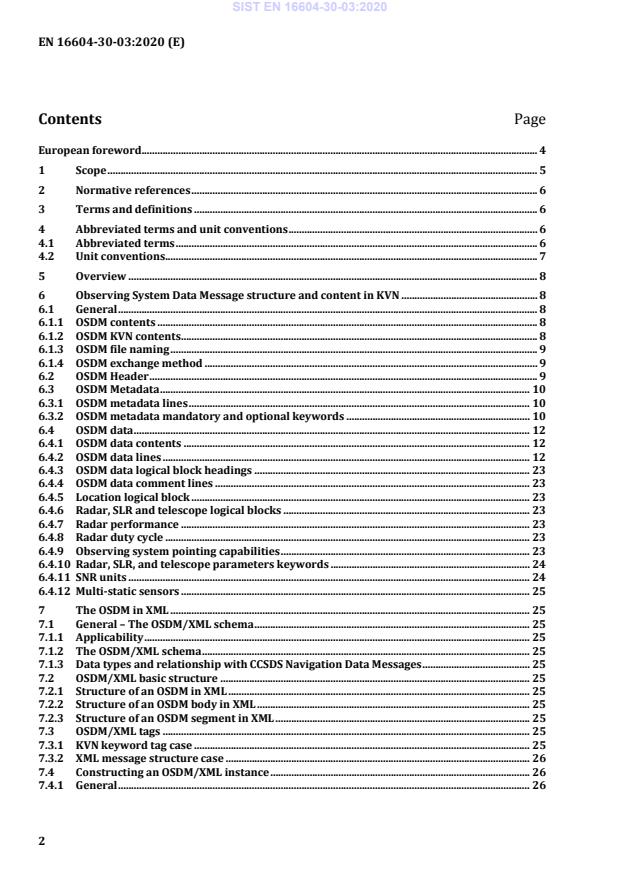
Contents Page
European foreword . 4
1 Scope . 5
2 Normative references . 6
3 Terms and definitions . 6
4 Abbreviated terms and unit conventions . 6
4.1 Abbreviated terms . 6
4.2 Unit conventions . 7
5 Overview . 8
6 Observing System Data Message structure and content in KVN . 8
6.1 General . 8
6.1.1 OSDM contents . 8
6.1.2 OSDM KVN contents . 8
6.1.3 OSDM file naming . 9
6.1.4 OSDM exchange method . 9
6.2 OSDM Header . 9
6.3 OSDM Metadata . 10
6.3.1 OSDM metadata lines . 10
6.3.2 OSDM metadata mandatory and optional keywords . 10
6.4 OSDM data . 12
6.4.1 OSDM data contents . 12
6.4.2 OSDM data lines . 12
6.4.3 OSDM data logical block headings . 23
6.4.4 OSDM data comment lines . 23
6.4.5 Location logical block . 23
6.4.6 Radar, SLR and telescope logical blocks . 23
6.4.7 Radar performance . 23
6.4.8 Radar duty cycle . 23
6.4.9 Observing system pointing capabilities . 23
6.4.10 Radar, SLR, and telescope parameters keywords . 24
6.4.11 SNR units . 24
6.4.12 Multi-static sensors . 25
7 The OSDM in XML . 25
7.1 General – The OSDM/XML schema . 25
7.1.1 Applicability . 25
7.1.2 The OSDM/XML schema . 25
7.1.3 Data types and relationship with CCSDS Navigation Data Messages . 25
7.2 OSDM/XML basic structure . 25
7.2.1 Structure of an OSDM in XML . 25
7.2.2 Structure of an OSDM body in XML . 25
7.2.3 Structure of an OSDM segment in XML . 25
7.3 OSDM/XML tags . 25
7.3.1 KVN keyword tag case . 25
7.3.2 XML message structure case . 26
7.4 Constructing an OSDM/XML instance . 26
7.4.1 General . 26
7.4.2 XML version . 26
7.4.3 The root data element . 26
7.4.4 OSDM/XML header section . 26
7.4.5 OSDM/XML body section . 27
7.4.6 The OSDM/XML metadata section . 27
7.4.7 The OSDM/XML data section . 27
7.4.8 Units in the OSDM/XML . 28
7.4.9 Local operations . 28
8 Observing System Data Message data and syntax . 28
8.1 Common OSDM syntax . 28
8.1.1 OSDM lines . 28
8.1.2 OSDM values . 29
8.1.3 OSDM units . 29
8.1.4 OSDM comments . 29
8.2 The OSDM in KVN . 30
8.2.1 OSDM lines in KVN . 30
8.2.2 OSDM keywords in KVN . 30
8.2.3 OSDM units in KVN . 32
8.2.4 OSDM comments in KVN . 32
8.3 The OSDM in XML . 32
8.3.1 OSDM lines in XML . 32
8.3.2 OSDM values in XML . 32
8.3.3 OSDM/XML comments . 33
Annex A (normative) Values for the LOCATION_TYPE, REF_FRAME, SURVEY_TYPE,
TRACKING_TYPE, and OUTPUT_DATA_TYPES keywords . 34
Annex B (informative) Observing System Data Message examples . 37
Bibliography . 43
European foreword
This document (EN 16604-30-03:2020) has been prepared by Technical Committee CEN/CLC/JTC 5
“Space”, the secretariat of which is held by DIN.
This European Standard shall be given the status of a national standard, either by publication of an
identical text or by endorsement, at the latest by January 2021, and conflicting national standards shall
be withdrawn at the latest by January 2021.
Attention is drawn to the possibility that some of the elements of this document may be the subject of
patent rights. CEN shall not be held responsible for identifying any or all such patent rights.
This document has been prepared under a mandate given to CEN by the European Commission and the
European Free Trade Association.
According to the CEN-CENELEC Internal Regulations, the national standards organisations of the
following countries are bound to implement this European Standard: Austria, Belgium, Bulgaria,
Croatia, Cyprus, Czech Republic, Denmark, Estonia, Finland, France, Germany, Greece, Hungary, Iceland,
Ireland, Italy, Latvia, Lithuania, Luxembourg, Malta, Netherlands, Norway, Poland, Portugal, Republic of
North Macedonia, Romania, Serbia, Slovakia, Slovenia, Spain, Sweden, Switzerland, Turkey and the
United Kingdom.
1 Scope
1.1 Purpose:
The Observing System Data Message (OSDM) is a standard message format to be used in the exchange
of optical telescope, laser ranging station, and radar (observing systems) information between Space
Situational Awareness (SSA) data providers, owners/operators of observing systems, and other parties.
These messages can inform SSA data providers, which are the consumers of observing system output
data, on the parameters of the observing systems.
The OSDM standard will:
a) enable consistent data exchange between observation data providers and SSA systems;
b) facilitate data exchange automation and ingestion of observation data from different providers;
c) facilitate SSA system architecture performance simulations; and
d) provide a quick way to estimate the expected performance from one observing system.
1.2 Applicability:
The Observing System Data Message standard is applicable to all SSA activities, especially Space
Surveillance and Tracking (SST) as well as near-Earth objects (NEO), and other fields where the
acquisition of astrometric and photometric data plays a role (e.g. space debris, observational
astronomy). The standard contains a message designed to contain observing system parameters
exchanged between producers and consumers of astrometric and/or photometric data. These data
include observing system name, location, type (optical/radar), operator and tracking/survey
performance.
The OSDM is suitable for both manual and automated interaction, but will not contain a large amount of
data. The message is self contained and can be paired with several Tracking Data Messages (TDM –
specified reference [1]), FITS images (specified in reference [2]), or other formats containing the
observation data.
The OSDM standard only applies to the message format, structure and content. The exchange method is
beyond the scope of the standard, and it is due to be specified in an ICD, though an ICD is not always
required. The methods used to produce the data in the message are also beyond the scope of the
standard.
1.3 Document structure:
Clause 5 provides an overview of the OSDM.
Clause 6 described the structure and content of the 'keyword = value' (KVN) version of the OSDM.
Clause 7 described the structure and content of the XML version of the OSDM.
Clause 8 describes the data and syntax of OSDM messages, in both KVN and XML.
Annex A lists agreed values for some of the OSDM keywords.
Annex B presents some examples of OSDMs.
2 Normative references
The following documents are referred to in the text in such a way that some or all of their content
constitutes requirements of this document. For dated references, only the edition cited applies. For
undated references, the latest edition of the referenced document (including any amendments) applies.
ISO 17107, Space data and information transfer systems — XML specification for navigation data
messages
Paul V. Biron and Ashok Malhotra, eds. XML Schema Part 2: Datatypes. 2nd ed. W3C Recommendation.
N.p.: W3C, October 2004
3 Terms and definitions
For the purposes of this document, the following terms and definitions apply.
ISO and IEC maintain terminological databases for use in standardization at the following addresses:
— IEC Electropedia: available at http://www.electropedia.org/
— ISO Online browsing platform: available at http://www.iso.org/obp
NOTE For more information on terms and nomenclature, the CEN/CENELEC SST/NEO glossary of terms [3]
will be consulted.
3.1
observation
unique measurement of an object's location from a single observing system at a single time
EXAMPLE azimuth from a single radar at a single time
3.2
observing system
system (telescope, radar or SLR station) capable of acquiring observations (usually called 'sensor' in
SST)
4 Abbreviated terms and unit conventions
4.1 Abbreviated terms
The following abbreviated terms will be used in this document:
ASCII American Standard Code for Information Interchange
CCSDS Consultative Committee for Space Data Systems
ID IDentifier
ISO International Organization for Standardization
KVN Keyword Value Notation
n/a not applicable or not available
NEO Near Earth Object(s)
OD Orbit Determination
SANA Space Assigned Numbers Authority
SLR Satellite Laser Ranging
SSA Space Situational Awareness
SST Space Surveillance and Tracking
TDM Tracking Data Message
UTC Coordinated Universal Time
XML eXtensible Markup Language
4.2 Unit conventions
The OSDM generally uses units that are part of the International System of Units (SI), either base,
derived, or non-SI units that are accepted for use within the SI (see [4]). The following units are used in
the OSDM:
— km: kilometres;
— m: metres;
— mm: millimetre;
— mcm: micrometre;
— nm: nanometre;
— h: hour (3600 s);
— s: second;
— ps: picosecond;
— K: kelvin;
— dB: decibel;
— Hz: hertz;
— kW: kilowatt;
— mJ: millijoule;
— deg: degree of arc; and
— arcsec: second of arc.
The following conventions are used for compound units:
— a single asterisk for multiplication: '*' (eg 'kg*s');
— a single forward slash for division: '/' (eg 'm/s'); and
— a double asterisk for exponents: '**' (eg 'mm**2').
The usual mathematical conventions for operation order apply.
5 Overview
The OSDM is an ASCII format file, encode as either plain text (referred to as KVN – Keyword Value
Notation) or XML (see Paul V. Biron and Ashok Malhotra, eds. XML Schema Part 2: Datatypes, and also
Bibliographical Entries [5] and [6]).
The OSDM contains information about one observing system:
— information about the message itself (creation date, creator, etc.);
— identification of the observing system (name, owner, operator, etc.);
— reference performance (success rate, MTBF, etc.);
— observing system location (whether ground-based or in orbit, x/y/z, etc.); and
— observing system performance parameters (max elevation, minimum Sun/Moon distance, etc.).
This type of information is used by SSA operators, space agencies and spacecraft operators to determine
proper OD configuration or to simulate observing system performance. The OSDM can be used for
passive optical telescopes, SLR stations, and radars; both on ground and in orbit.
6 Observing System Data Message structure and content in KVN
6.1 General
6.1.1 OSDM contents
The OSDM shall be plain text consisting of information on one observing system. It shall be readable by
both humans and computers.
6.1.2 OSDM KVN contents
The OSDM in KVN shall consist of digital data represented as ASCII text lines. The OSDM shall contain:
a) a header; and
b) a metadata/data section.
NOTE
1) KVN messages contain one keyword per line (see 8.2.1.4).
2) The standard order of keywords in the KVN representation is fixed in this standard, as listed in Tables 1, 2,
and 3 (see 8.2.1.7).
6.1.3 OSDM file naming
A naming scheme should be agreed on a case-by-base basis between the entities exchanging the
message. The file name syntax and length shall not violate the computer environment contraints.
6.1.4 OSDM exchange method
The OSDM exchange method should be determined on a case-by-case basis and should be documented
in an ICD.
6.2 OSDM Header
The header shall only consist of the KVN elements defined in Table 1, which specifies for each element:
a) the keyword;
b) a short description;
c) examples of allowed values; and
d) whether the keyword is mandatory (M) or optional (O).
Table 1 — OSDM KVN header
Keyword Description of values Example of values M/O
CEN_OSDM_VERS Format version in the form of ‘x.y’, where ‘y’ is 0.6 M
incremented for corrections and minor changes,
1.0
and ‘x’ is incremented for major changes.
COMMENT Comments (allowed in the SDM Header only COMMENT This is a O
immediately after the SDM version number). comment
CREATION_DATE File creation date and time in UTC. For format 2001–11– M
specification see 8.2.2.5. 06T11:17:33
2002–204T15:56:23
ORIGINATOR Creating agency or operator. If the originator is CNES, ESOC, GSFC, M
listed in the SANA organizations registry [7], the GSOC, JPL, JAXA,
value should be taken from the abbreviation INTELSAT/USA
column there. The country of origin should also be
provided where the originator is not a national
space agency.
MESSAGE_ID ID that uniquely identifies a message from a given 20170823AA456 M
originator. The format and content of the message
identifier value are at the discretion of the
originator.
6.3 OSDM Metadata
6.3.1 OSDM metadata lines
The OSDM metadata shall only consist of the KVN elements defined in Table 2, where the following are
specified:
a) keyword;
b) a short description;
c) normative values or example of values;
d) whether the values listed are normative (N – all the values allowed are present in the third column)
or examples (E); and
e) whether the keyword is mandatory (M) or optional (O).
6.3.2 OSDM metadata mandatory and optional keywords
Mandatory keywords shall appear in every OSDM's metadata section. Optional keywords may or may
not appear, based on the message producer's requirements and the particular application.
Table 2 — OSDM KVN metadata
Keyword Description of values Examples N/E M/O
COMMENT Comments (allowed only at COMMENT This is a E O
the beginning of the OSDM comment
metadata).
SYSTEM_NAME Observing system for which OGS TELESCOPE E M
the information is provided.
SPADE
SYSTEM_ID Observing system identifier IAC-80 E O
(if any exists):
2012–068A
— the COSPAR ID should be
used for an orbiting
sensor;
— The Observatory ID from
the IAU should be used
for ground-based
telescopes, if one exists.
SITE_NAME Name of the site where the TEIDE OBSERVATORY E O
observing system is located.
SITE_ID Identifier of the site where OAM1 E O
the observing system is
located (if any exists).
SYSTEM_TYPE Type of the observing ACTIVE OPTICAL N M
system: radar, optical
PASSIVE OPTICAL
telescope (passive optical),
RADAR
SLR station (active optical).
SYSTEM_OWNER Entity owning the observing ESA E M
system. If the originator is
IAC
listed in the SANA
Organizations Registry [7],
the value should be taken
from the abbreviation
column there. The country of
origin should also be
provided where the
originator is not a national
space agency.
Keyword Description of values Examples N/E M/O
SYSTEM_OPERATOR Entity operating the ESA E M
observing system. If the
NASA
originator is listed in the
ESO
SANA Organizations Registry
[7], the value should be taken
from the abbreviation
column there. The country of
origin should also be
provided where the
originator is not a national
space agency.
OPERATOR_CONTACT_POSITION Position of the contact person STAFF ASTRONOMER E O
at the sensor operator.
NETWORK
CONTROLLER
OPERATOR_PHONE The contact person's phone +123456789 E O
number.
OPERATOR_EMAIL The contact person's email JOHN.DOE@ESA.NET E O
address.
6.4 OSDM data
6.4.1 OSDM data contents
The OSDM data section shall be formatted as logical blocks:
— reference performance;
— location;
— pointing performance and restrictions;
— radar parameters;
— telescope parameters;
— SLR parameters; and
— expected observation accuracy.
6.4.2 OSDM data lines
The logical blocks of the OSDM data section shall consist of KVN lines defined in Table 3, which
specifies:
a) keyword;
b) description of the content;
c) units to be used; and
d) whether the keyword is mandatory (M), or optional (O).
NOTE Due to limited space some keywords are split into multiple lines. There are no line breaks in keywords
in OSDM messages.
Table 3 — OSDM KVN data
Keyword Description of values Examples units M/O
Reference performance and general capabilities
COMMENT Comments (allowed only at COMMENT This is a n/a O
the beginning of each OSDM comment
data logical block).
SUCCESS_RATE Statistical success rate of the 0.994 n/a O
observing system (0 to 1).
0.341
MTBF Mean Time Between Failures 3394494934 h O
in hours.
MTTR Mean Time To Recover from a 0.44 h O
failure in hours.
AVAILABILITY System availability (as a 100 % O
percentage of total
observation time) for the
intended task.
DATA_LATENCY Mean time between aquiring 2 h O
an observation and delivering
it in the OUTPUT_FORMAT to
the consumer (in hours).
OUTPUT_DATA_TYPES Comma separated list of the AZEL, RANGE n/a M
observation types the system
DOPPLER_INTEGRATED
can generate. Use of values
other than those listed in
Table A.5 in Annex A should
be documented in an ICD.
OUTPUT_FORMAT Comma separated list of the TDM n/a M
formats in which the
FITS
observations can be delivered.
INPUT_FORMAT The format the system can OEM, TLE n/a M
receive observation request,
TSM, OEM
either specific
PRM
scheduling/pointing or orbit
formats.
Keyword Description of values Examples units M/O
CORRECTIONS_APPLIED Comma-separated list of the ANNUAL ABERRATION, n/a M
corrections applied to the TIME BIAS
output data by the system.
Location
COMMENT Comments (allowed only at COMMENT This is a n/a O
the beginning of each OSDM comment
data logical block).
LOCATION_TYPE The sensor location type, GROUND-BASED n/a M
whether ground-based, in
ORBIT
orbit, or mounted on a ship or
SHIPBORNE
aeroplane. Values other than
AIRBORNE
those listed in Table A.1 in
Annex A should be
documented in an ICD.
CENTER_NAME The celestial body on which EARTH n/a M
the observing system is
MARS
located or which the
observing system is orbiting.
REF_FRAME Reference frame in which the ITRF-97 n/a O
observing system's
GCRF
coordinates are given. Use of
values other than those listed
in Table A.2 in Annex A should
be documented in an ICD.
Unless an external epehemeris
file is give, this keyword is
mandatory.
REF_FRAME_EPOCH Epoch of reference frame, if 2001–11–06T11:17:33 n/a O
not intrinsic to the definition
2002–204T15:56:23
of the reference frame
(see 8.2.2.5 for formatting
rules).
EPOCH Epoch at which the state 2001–11–06T11:17:33 n/a O
vector was
2002–204T15:56:23
measured/determined. For
space-based or air-/shipborne
sensors this information shall
be contained in an external
epehemeris file. Note that in
the area of NEOs, this
keyword may have a different
meaning and should not be
used.
Keyword Description of values Examples units M/O
REFERENCE_POINT The specific point on the RX ANTENNA PHASE n/a O
sensor where the coordinates CENTRE
are measured.
CCD CENTRE
CENTRE OF MASS
X The x-component of the 3145.122 km O
observing system’s position
vector.
Y The y-component of the 2341.23 km O
observing system’s position
vector.
Z The z-component of the 1231.234 km O
observing system’s position
vector.
LON Observing system location 3.452 deg O
longitude for ground based
sensors.
LAT Observing system location 25.234 deg O
latitude for ground based
sensors.
ALT Observing system location 2245 m O
altitude for ground based
sensors.
EPHEMERIS_FILE The identifier of an ODM ORBIT_FILE.OPM n/a O
(OPM/OEM/OMM) file
OPM/JSPOC/20170
containing the orbit of a
space-based sensor or any
coordinates file for an air-
/shipborne sensor.
WEATHER_PREDICTION Probability of bad visibility 0.00007 n/a O
due to bad weather (from 0 to
0.898
1)
Pointing performance and restrictions
COMMENT Comments (allowed only at COMMENT This is a n/a O
the beginning of each OSDM comment
data logical block).
MIN_ELEVATION The observing system's 11.33 deg M
antenna/telescope boresight
minimum pointing elevation.
Keyword Description of values Examples units M/O
MAX_ELEVATION The observing system's 90 deg M
antenna/telescope boresight
maximum pointing elevation.
MIN_AZIMUTH The observing system's 90 deg M
antenna/telescope boresight
minimum pointing azimuth.
MAX_AZIMUTH The observing system's 270 deg M
antenna/telescope boresight
maximum pointing azimuth.
REF_SLEW_TIME The reference time needed for 3.634 s O
pointing.
MAX_SLEW_RATE_AZ The telescope maximum 10.0 deg/s O
slewing rate in azimuth.
MAX_SLEW_RATE_EL The telescope maximum 6.0 deg/s O
slewing rate in elevation.
REF_MIN_DEAD_TIME The minimum dead time 10.0 s O
between two different
exposures of a given field.
MINIMUM_MOON_ The minimum angular 5.342 deg O
DISTANCE distance to the Moon.
MINIMUM_SUN_ The minimum angular 94.44 deg O
DISTANCE distance to the Sun.
MINIMUM_GP_DISTANCE The minimum distance to the 3.22 deg O
Galactic Plane.
SURVEY_TYPE Comma-separated list of the DECLINATION STRIPS n/a O
survey methods suppored by
the system. Use of values
other than those listed in
Table A.3 in Annex A should
be documented in an ICD.
TRACKING_TYPE Comma-separated list of the SIDEREAL, EPHEMERIS n/a O
types of object tracking
suppored by the system. Use
of values other than those
listed in Table A.4 in Annex A
should be documented in an
ICD.
Keyword Description of values Examples units M/O
Radar parameters
COMMENT Comments (allowed only at COMMENT This is a n/a O
the beginning of each OSDM comment
data logical block).
RADAR_TYPE Radar type (monostatic, MONOSTATIC n/a O
bistatic transmit site, bistatic
BISTATIC TX
receive site)
BISTATIC RX
RADAR_PULSED Whether the radar is CW n/a O
continuous wave (CW) or
PULSED
pulsed (PULSED).
RADAR_SCANNING Technology used for scanning MECHANICAL n/a O
the FoR.
ELECTRONIC
NONE
RADAR_REF_DISTANCE The distance at which the 3400.0 km O
reference RCS is given.
RADAR_REF_RCS The minimum cross-section 0.22 m**2 O
the radar will detect at
RADAR_REF_DISTANCE
RADAR_REF_SNR The signal to noise ratio of the 9 n/a O
radar when observing a target
with a radar cross-section of
RADAR_REF_RCS at a distance
of RADAR_REF_DISTANCE.
RADAR_TX_PEAK_POWER The radar's maximum 54.0 kW O
transmit power
RADAR_TX_PULSE_ Duration of the radar Tx pulse 0.0000034 s O
LENGTH
RADAR_TX_PULSE_ Duration from the beginning 2.348 s O
REPETITION_INTERVAL of one pulse to the beginning
of the next.
RADAR_DUTY_CYCLE The ratio of 0.4 % O
RADAR_TX_PULSE_LENGTH to
RADAR_PULSE_REPETITION_I
NTERVAL.
RADAR_TX_FREQ The radar's transmission 244.0 Hz O
frequency.
Keyword Description of values Examples units M/O
RADAR_TX_ANTENNA_ The gain of the radar's 12.0 dB O
GAIN transmit antenna
RADAR_RX_ANTENNA_ The gain of the radar's receive 32.0 dB O
GAIN antenna
RADAR_DWELL_TIME Dwell time for a CW radar 5.0 s O
RADAR_INTEGRATION_ Integration time for a pulsed 1.34 s O
TIME radar.
RADAR_SYSTEM_NOISE_TEMPERRadar system noise 950.0 K O
ATURE temperature.
RADAR_TOTAL_LOSSES System losses not accounted 13.8 dB O
by the noise temperature.
RADAR_BANDWIDTH Radar bandwith. 43.3 Hz O
RADAR_REVISIT_TIME Time between two 3.2 s O
consecutive images of the
same area of the sky.
RADAR_SCAN_SPEED Speed at which the radar can 0.2335 sr/s O
scan the sky.
RADAR_BORESIGHT_AZ For phased array radars only: 270.0 deg O
the azimuth of the antenna
boresight direction.
RADAR_BORESIGHT_EL For phased array radars only: 52.5 deg O
the elevation of the antenna
boresight direction.
RADAR_X_FOR For phased array radars only: 30.0 deg O
the size of the field of regard
around the antenna boresight
in the U/x direction.
RADAR_Y_FOR For phased array radars only: 5.0 deg O
the size of field of regard
around the antenna boresight
in the V/y direction.
Keyword Description of values Examples units M/O
RADAR_X_FOV The size of a field of view in 0.1 deg O
the U/x direction. For phased
array radars this is the FoV at
the antenna boresight
direction.
RADAR_Y_FOV The size of a field of view in 0.1 deg O
the V/y direction. For phased
array radars this is the FoV at
the antenna boresight
direction.
Telescope parameters
COMMENT Comments (allowed only at COMMENT This is a n/a O
the beginning of each OSDM comment
data logical block).
TELESCOPE_MAX_VM The faintest (VM) object the 16.0 n/a O
passive optical sensor can
detect with:
- the SNR in
TELESCOPE_MAX_VM_SNR
- the exposure time in
TELESCOPE_MAX_VM_EXPOS
URE – the seeing conditions
TELESCOPE_MEDIAN_SEEING
- the filter in
TELESCOPE_WIDEST_FILTER.
TELESCOPE_MAX_VM_ The signal to noise ratio at 5.0 n/a O
SNR which TELESCOPE_MAX_VM is
10.0
given.
TELESCOPE_MAX_VM_ The exposure time at which 10.0 s O
EXPOSURE TELESCOPE_MAX_VM is given.
60.0
600.0
TELESCOPE_MEDIAN_ The telescope's median 1.5 arcsec O
SEEING seeing, measured on actual
images (not from a seeing
monitor station)
Keyword Description of values Examples units M/O
TELESCOPE_WIDEST_ The widest filter available in R n/a O
FILTER the optical wavelength range,
VR
defined as the one that
Solar
provides the highest
NONE
sensitivity for an object with
Sun-like spectrum. Typically
“R”, or “VR”, ideally no filter
(“NONE”) if the capability is
available
TELESCOPE_CCD_ CCD detector size (in pixels), 2000x2000 n/a O
DETECTOR_SIZE as a sting in the
form < horinzontal pixel
size > x < vertical pixel size >
TELESCOPE_CCD_ The size of one pixel in the 18 mcm O
PIXEL_SIZE CCD (in μm)
TELESCOPE_X_BINNING The x-axis binning of the 2 n/a O
telescope camera (in pixels).
TELESCOPE_Y_BINNING The y-axis binning of the 2 n/a O
telescope camera (in pixels).
TELESCOPE_CCD_QE The quantum efficiency of the 66.6 % O
CCD
TELESCOPE_CCD_ The time needed to read one 0.033 s O
READOUT_TIME image frame from the CCD.
TELESCOPE_CCD_ Wavelength at which the CCD 455.0 nm O
SPECTRAL_RESPONSE_ is most sensitive.
PEAK
TELESCOPE_CCD_ The temperature of the CCD 252.0 K O
TEMPERATURE detector.
TELESCOPE_X_FOV Horizontal size of the 14.5 deg O
telescope field of view.
TELESCOPE_Y_FOV Vertical size of the telescope 9.5 deg O
field of view.
TELESCOPE_APERTURE_DIAMET The aperture diameter of the 20.0 mm O
ER telescope.
TELESCOPE_APERTURE_AREA The aperture area of the 200.0 mm**2 O
telescope.
Keyword Description of values Examples units M/O
TELESCOPE_FOCAL_ The (equivalent) focal length 500.0 mm O
LENGTH of telescope.
TELESCOPE_MAX_ Typical exposure time after 300.0 s O
EXPOSURE_TRACKING which the tracking performs
poorly and tracking
irregularities become evident
(e.g. trailed or curved stars).
TELESCOPE_MAX_ Typical exposure time after 1200.0 s O
EXPOSURE_SATURATION which the background reaches
saturation in a clear moonless
night at zenith, when using
WIDEST_FILTER
SLR parameters
COMMENT Comments (allowed only at COMMENT This is a n/a O
the beginning of each OSDM comment
data logical block).
SLR_LASER_TYPE The type of laser used by the YAG n/a O
SLR station.
SLR_DETECTOR_TYPE The type of detector used by CASSEGRAIN n/a O
the SLR station. TELESCOPE
SLR_TX_WAVELENGTH_1 Primary wavelength of the 1064 nm O
laser.
SLR_TX_WAVELENGTH_2 Secondary wavelength of the 532 nm O
laser.
SLR_RX_WAVELENGTH Detection wavelength of the 532 nm O
SLR receiver.
SLR_MAX_ENERGY_1 Maxiumum transmitted 200 mJ O
energy at the primary
wavelength.
SLR_MAX_ENERGY_2 Maxiumum transmitted 100 mJ O
energy at the secondary
wavelength.
SLR_PULSE_WIDTH Duration of the laser pulse. 50 ps O
SLR_MAX_RATE Maximum number of pulses in 10 Hz O
one second.
Keyword Description of values Examples units M/O
Expected observation accuracy
COMMENT Comments (allowed only at COMMENT This is a n/a O
the beginning of each OSDM comment
data logical block).
MIN_SNR_DETECTION The minimum signal-to-noise 4 n/a O
ratio needed for detection.
dB
The observation parameters
(eg exposure time for a
telescope, integration time for
a radar) should be specified in
an ICD.
MIN_SNR_ASTROMETRY The minimum signal-to-noise 5 n/a O
ratio needed to extract
dB
astrometric (right ascension,
declination, azimuth, elevation
or range) data. The
observation parameters (eg
exposure time) should be
specified in an ICD.
MIN_SNR_PHOTOMETRY The minimum signal-to-noise 10 n/a O
ratio needed to extract
dB
'photometric' (either visual
magnitude or RCS) data. The
observation parameters (eg
exposure time) should be
specified in an ICD.
RANGE_SIGMA The expected 1-sigma 0.040 km O
accuracy for range.
s
RU
DOPPLER_SIGMA The expected 1-sigma 0.010 km/s O
accuracy for Doppler/range
rate.
ANGULAR_SIGMA The expected 1-sigma 0.0001 deg O
accuracy for angular
observations.
VM_SIGMA The expected 1-sigma 0.1 n/a O
accuracy for visual magnitude
TIME_PRECISION The time/observation epoch 0.000005 s O
recording precision
Keyword Description of values Examples units M/O
TIME_BIAS The time bias of the sensor. 0.2 s O
TIME_DRIFT The time drift of the sensor. 0.002 s/s O
6.4.3 OSDM data logical block headings
Table 3 contains several logical blocks, each having a descriptive heading. These descriptive headings
shall not appear in an OSDM, unless they are in a properly formatted comment line (see 8.2.4 for
comment line rules).
6.4.4 OSDM data comment lines
Comment lines may be used at the beginning of each logical block in the OSDM data section (see 8.2.4
for formatting rules).
6.4.5 Location logical block
The location data block is mandatory, and only one of the following groups of keywords shall appear:
a) X, Y, and Z;
b) LAT, LON, and ALT; or
c) EPHEMERIS_FILE, for observing systems in orbit, airborne or seaborne.
6.4.6 Radar, SLR and telescope logical blocks
If the radar logical block is present, the telescope and SLR blocks shall not be present. If telescope and
SLR blocks are present in the same message, the telescope block shall describe the receiving telescope
of the SLR system.
6.4.7 Radar performance
The performance of a radar shall be specified either by using all the simplified performance keywords
(RADAR_REF_DISTANCE, RADAR_REF_RCS, and RADAR_REF_SNR) or by giving a sufficient number of
terms of the radar equation (RADAR_TX_PEAK_POWER, RADAR_TX_PULSE_LENGTH, RADAR_TX_PULSE
_REPETITION_INTERVAL, RADAR_DUTY_CYCLE, RADAR_TX_FREQ, RADAR_TX_ANTENNA_GAIN,
RADAR_RX_ANTENNA_GAIN, RADAR_THERMAL_NOISE, RADAR_SYSTEM_NOISE_TEMPERATURE,
RADAR_TOTAL_LOSSES, RADAR_BANDWIDTH/_DWELL_TIME/_INTEGRATION_TIME, and RADAR
_SCAN_SPEED) to satisfy the intended use case. The two shall not be mixed, ie if RADAR_REF_DISTANCE,
RADAR_REF_RCS, and RADAR_REF_SNR are present, none of the radar equation terms, with the
exeption of RADAR_SCAN_SPEED, shall be present.
6.4.8 Radar duty cycle
If the RADAR_TX_PULSE_LENGTH, RADAR_TX_PULSE_REPETITION_INTERVAL, and RADAR
_DUTY_CYCLE are all present, their values shall be consistent, ie the value of RADAR_DUTY_CYCLE shall
be the ratio of the values of RADAR_TX_PULSE_LENGTH and RADAR_TX_PULSE
_REPETITION_INTERVAL multiplied by 100.
6.4.9 Observing system pointing capabilities
The pointing capabilities of an observing system shall be specified in the following way:
a) The MIN_ELEVATION, MAX_ELEVATION, MIN_AZIMUTH, and MAX_AZIMUTH keywords
...