

SIST-TP CEN/CLC/TR 17602-80-11:2021
(Main)Space product assurance - Software process assessment and improvement - Part 1: Framework
General Information
- Abstract
This handbook defines methods for process assessment and improvement that may be used to meet the requirements on
process assessment and improvement of the EN16602-80 (equivalent to ECSS-Q-ST-80C) subclause 5.7. These methods constitute a clear and proven w ay of implementing those requirements. Alternative methods can be used provided that they meet the detailed instructions provided in this handbook for recognition of software process assessment schemes and results and process improvement.
This handbook provides a detailed method for the implementation of the requirements of the EN16602-80 for software process assessment and improvement. It also establishes detailed instructions for alternative methods intended to meet the same EN16602-80 requirements.
The process assessment and improvement scheme presented in this handbook is based on and conformant to the ISO/IEC 15504 International Standard. In designing this process assessment and improvement scheme the ISO/IEC 15504 exemplar process assessment model w as adopted and extended to address specific requirements.
The methods provided in this handbook can support organizations in meeting their business goals and in this context they can be tailored to suit their specific needs and requirements. How ever w hen used to claim compliance with relevant requirements in EN16602-80 only the steps and activities explicitly marked as recommended in this handbook may be omitted or modified.
- Status
- Published
- Public Enquiry End Date
- 30-Jul-2021
- Publication Date
- 14-Oct-2021
- Technical Committee
- I13 - Imaginarni 13
- Current Stage
- 6060 - National Implementation/Publication (Adopted Project)
- Start Date
- 13-Oct-2021
- Due Date
- 18-Dec-2021
- Completion Date
- 15-Oct-2021
Buy Documents



Overview
SIST-TP CEN/CLC/TR 17602-80-11:2021 - "Space product assurance - Software process assessment and improvement - Part 1: Framework" - is a technical report (CEN/CLC/TR) adopted by SIST that provides a structured handbook for performing software process assessment and improvement in the space sector. The document defines methods to meet the process assessment and improvement requirements of EN16602-80 (equivalent to ECSS‑Q‑ST‑80C), and is explicitly based on and conformant to ISO/IEC 15504 (SPICE). It presents an assessment model (S4S) and a detailed method for assessment, rating and process improvement while allowing alternative methods if they meet the handbook’s recognition rules.
Key topics and technical requirements
- S4S process assessment model: an extended ISO/IEC 15504 exemplar model tailored to space product assurance.
- Process capability levels (0–5): defined capability dimension from Incomplete (0) to Optimizing (5), including process attributes and rating guidance.
- Assessment lifecycle and activities: assessment initiation, planning, briefing, data acquisition, data validation, process rating, reporting and recording.
- Roles and competencies: defined roles such as Assessment Sponsor, Local Assessment Coordinator, Assessment Team Leader, assessors, observers and participants; competency, experience and verification guidance for assessors.
- Process improvement cycle: analyze assessment outputs, derive action plans, implement and confirm improvements, sustain and monitor performance; roles include Top Management, Improvement Programme Manager (IPM), Improvement Project Leader (IPL), Software Process Improvement Group (SPIG) and Process Owners.
- Guidance for different assessment purposes: capability determination, process improvement, and ECSS conformance - with planning and data requirements for each.
- Conformance rules: methods can be tailored, but when claiming compliance with EN16602-80 only steps not explicitly marked “recommended” may be omitted or modified.
Practical applications and users
- Who uses it: space agencies, prime contractors, satellite manufacturers, software suppliers, quality assurance teams, systems and software engineering managers, process improvement practitioners and certification/audit teams.
- Use cases:
- Demonstrating compliance with EN16602-80 / ECSS software process requirements.
- Establishing baseline process capability and prioritizing improvement actions.
- Structuring internal or supplier assessments, audits and capability appraisals.
- Designing and managing software process improvement programs tied to business goals.
- Training and qualifying assessors to a recognized scheme (SPICE‑based).
Related standards
- EN16602-80 / ECSS‑Q‑ST‑80C (software product assurance requirements)
- ISO/IEC 15504 (SPICE) - foundational process assessment standard
Keywords: space product assurance, software process assessment and improvement, SIST-TP CEN/CLC/TR 17602-80-11:2021, ISO/IEC 15504, EN16602-80, ECSS-Q-ST-80C, process capability levels, S4S assessment model.
Relations
- Effective Date
- 28-Jan-2026
- Effective Date
- 28-Jan-2026
- Effective Date
- 28-Jan-2026
Buy Documents
Get Certified
Connect with accredited certification bodies for this standard

BSI Group
BSI (British Standards Institution) is the business standards company that helps organizations make excellence a habit.

Bureau Veritas
Bureau Veritas is a world leader in laboratory testing, inspection and certification services.

DNV
DNV is an independent assurance and risk management provider.
Sponsored listings
Frequently Asked Questions
SIST-TP CEN/CLC/TR 17602-80-11:2021 is a technical report published by the Slovenian Institute for Standardization (SIST). Its full title is "Space product assurance - Software process assessment and improvement - Part 1: Framework". This standard covers: This handbook defines methods for process assessment and improvement that may be used to meet the requirements on process assessment and improvement of the EN16602-80 (equivalent to ECSS-Q-ST-80C) subclause 5.7. These methods constitute a clear and proven w ay of implementing those requirements. Alternative methods can be used provided that they meet the detailed instructions provided in this handbook for recognition of software process assessment schemes and results and process improvement. This handbook provides a detailed method for the implementation of the requirements of the EN16602-80 for software process assessment and improvement. It also establishes detailed instructions for alternative methods intended to meet the same EN16602-80 requirements. The process assessment and improvement scheme presented in this handbook is based on and conformant to the ISO/IEC 15504 International Standard. In designing this process assessment and improvement scheme the ISO/IEC 15504 exemplar process assessment model w as adopted and extended to address specific requirements. The methods provided in this handbook can support organizations in meeting their business goals and in this context they can be tailored to suit their specific needs and requirements. How ever w hen used to claim compliance with relevant requirements in EN16602-80 only the steps and activities explicitly marked as recommended in this handbook may be omitted or modified.
This handbook defines methods for process assessment and improvement that may be used to meet the requirements on process assessment and improvement of the EN16602-80 (equivalent to ECSS-Q-ST-80C) subclause 5.7. These methods constitute a clear and proven w ay of implementing those requirements. Alternative methods can be used provided that they meet the detailed instructions provided in this handbook for recognition of software process assessment schemes and results and process improvement. This handbook provides a detailed method for the implementation of the requirements of the EN16602-80 for software process assessment and improvement. It also establishes detailed instructions for alternative methods intended to meet the same EN16602-80 requirements. The process assessment and improvement scheme presented in this handbook is based on and conformant to the ISO/IEC 15504 International Standard. In designing this process assessment and improvement scheme the ISO/IEC 15504 exemplar process assessment model w as adopted and extended to address specific requirements. The methods provided in this handbook can support organizations in meeting their business goals and in this context they can be tailored to suit their specific needs and requirements. How ever w hen used to claim compliance with relevant requirements in EN16602-80 only the steps and activities explicitly marked as recommended in this handbook may be omitted or modified.
SIST-TP CEN/CLC/TR 17602-80-11:2021 is classified under the following ICS (International Classification for Standards) categories: 03.120.99 - Other standards related to quality; 35.080 - Software; 35.240.99 - IT applications in other fields; 49.140 - Space systems and operations. The ICS classification helps identify the subject area and facilitates finding related standards.
SIST-TP CEN/CLC/TR 17602-80-11:2021 has the following relationships with other standards: It is inter standard links to SIST EN 1171:2015, SIST EN ISO 1660:2017, SIST EN 1992-1-1:2005/AC:2011. Understanding these relationships helps ensure you are using the most current and applicable version of the standard.
SIST-TP CEN/CLC/TR 17602-80-11:2021 is associated with the following European legislation: Standardization Mandates: M/496. When a standard is cited in the Official Journal of the European Union, products manufactured in conformity with it benefit from a presumption of conformity with the essential requirements of the corresponding EU directive or regulation.
SIST-TP CEN/CLC/TR 17602-80-11:2021 is available in PDF format for immediate download after purchase. The document can be added to your cart and obtained through the secure checkout process. Digital delivery ensures instant access to the complete standard document.
Standards Content (Sample)
SLOVENSKI STANDARD
01-december-2021
Zagotavljanje kakovosti proizvodov v vesoljski tehniki - Ocenjevanje in izboljšanje
programske opreme - 1. del: Okvir
Space product assurance - Software process assessment and improvement - Part 1:
Framework
Raumfahrtproduktsicherung - Software - Prozessüberprüfung und -verbesserung - Teil 1:
Grundstruktur
Assurance produit des projets spatiaux - Evaluation et amélioration des processus
logiciel - Partie 1: Principes
Ta slovenski standard je istoveten z: CEN/CLC/TR 17602-80-11:2021
ICS:
03.120.99 Drugi standardi v zvezi s Other standards related to
kakovostjo quality
35.080 Programska oprema Software
49.140 Vesoljski sistemi in operacije Space systems and
operations
2003-01.Slovenski inštitut za standardizacijo. Razmnoževanje celote ali delov tega standarda ni dovoljeno.
TECHNICAL REPORT
CEN/CLC/TR 17602-80-
RAPPORT TECHNIQUE
TECHNISCHER BERICHT
October 2021
ICS 49.140; 35.240.99
English version
Space product assurance - Software process assessment
and improvement - Part 1: Framework
Assurance produit des projets spatiaux - Evaluation et Raumfahrtproduktsicherung - Software -
amélioration des processus logiciel - Partie 1: Prozessüberprüfung und -verbesserung - Teil 1:
Principes Grundstruktur
This Technical Report was approved by CEN on 13 September 2021. It has been drawn up by the Technical Committee
CEN/CLC/JTC 5.
CEN and CENELEC members are the national standards bodies and national electrotechnical committees of Austria, Belgium,
Bulgaria, Croatia, Cyprus, Czech Republic, Denmark, Estonia, Finland, France, Germany, Greece, Hungary, Iceland, Ireland, Italy,
Latvia, Lithuania, Luxembourg, Malta, Netherlands, Norway, Poland, Portugal, Republic of North Macedonia, Romania, Serbia,
Slovakia, Slovenia, Spain, Sweden, Switzerland, Turkey and United Kingdom.
CEN-CENELEC Management Centre:
Rue de la Science 23, B-1040 Brussels
© 2021 CEN/CENELEC All rights of exploitation in any form and by any means Ref. No. CEN/CLC/TR 17602-80-11:2021 E
reserved worldwide for CEN national Members and for
CENELEC Members.
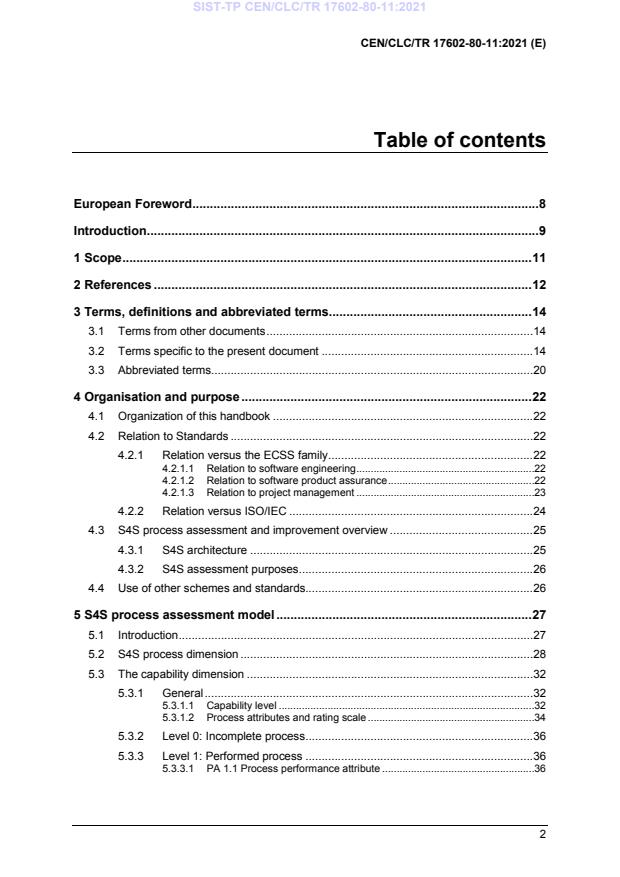
Table of contents
European Foreword . 8
Introduction . 9
1 Scope . 11
2 References . 12
3 Terms, definitions and abbreviated terms . 14
3.1 Terms from other documents . 14
3.2 Terms specific to the present document . 14
3.3 Abbreviated terms. 20
4 Organisation and purpose . 22
4.1 Organization of this handbook . 22
4.2 Relation to Standards . 22
4.2.1 Relation versus the ECSS family . 22
4.2.1.1 Relation to software engineering .22
4.2.1.2 Relation to software product assurance .22
4.2.1.3 Relation to project management .23
4.2.2 Relation versus ISO/IEC . 24
4.3 S4S process assessment and improvement overview . 25
4.3.1 S4S architecture . 25
4.3.2 S4S assessment purposes . 26
4.4 Use of other schemes and standards. 26
5 S4S process assessment model . 27
5.1 Introduction . 27
5.2 S4S process dimension . 28
5.3 The capability dimension . 32
5.3.1 General . 32
5.3.1.1 Capability level .32
5.3.1.2 Process attributes and rating scale .34
5.3.2 Level 0: Incomplete process . 36
5.3.3 Level 1: Performed process . 36
5.3.3.1 PA 1.1 Process performance attribute .36
5.3.4 Level 2: Managed process . 36
5.3.4.1 PA 2.1 Performance management attribute .36
5.3.4.2 PA 2.2 Work product management attribute .37
5.3.5 Level 3: Established process . 37
5.3.5.1 PA 3.1 Process definition attribute .37
5.3.5.2 PA 3.2 Process deployment attribute .37
5.3.6 Level 4: Predictable process . 38
5.3.6.1 PA 4.1 Process measurement attribute .38
5.3.6.2 PA 4.2 Process control attribute .38
5.3.7 Level 5: Optimizing process . 39
5.3.7.1 PA 5.1 Process innovation attribute .39
5.3.7.2 PA 5.2 Process optimization attribute .39
6 Process assessment method . 40
6.1 Introduction . 40
6.2 Assessment process definition. 41
6.2.1 Introduction . 41
6.2.2 Assessment process . 43
6.2.2.1 Assessment initiation .43
6.2.2.2 Assessment planning .47
6.2.2.3 Briefing (recommended activities) .50
6.2.2.4 Data acquisition .50
6.2.2.5 Data validation .52
6.2.2.6 Process rating .53
6.2.2.7 Assessment reporting and recording .54
6.2.2.8 Inputs to the risk management process (recommended activity).57
6.2.3 Assessment actors and roles . 60
6.2.3.1 Introduction .60
6.2.3.2 Assessment sponsor (AS) .60
6.2.3.3 Local assessment coordinator (LAC) .61
6.2.3.4 Assessment team leader (ATL) .61
6.2.3.5 Other assessors in the Assessment Team (AT) .62
6.2.3.6 Technical specialists (AT) .62
6.2.3.7 Observers .62
6.2.3.8 Assessment participants (AP) .62
6.2.3.9 Organizational unit (OU).63
6.3 Assessment process guidance . 63
6.3.1 Introduction . 63
6.3.2 Selection of assessment purpose . 63
6.3.3 Assessment guidance for capability determination . 64
6.3.3.1 Introduction .64
6.3.3.2 Assessment purpose (INI 3) .64
6.3.3.3 Selecting the assessment team (INI 7) .64
6.3.3.4 Assessment scope (INI 10) .64
6.3.3.5 Data and data validation criteria (INI 11) .67
6.3.3.6 Defining ownership and responsibilities for assessment outputs
(INI 11).67
6.3.3.7 Mapping the OU to the S4S model (INI 12) .67
6.3.3.8 Selecting participants (INI 13) .67
6.3.3.9 Assessment schedule (PLN 1) .68
6.3.3.10 Assessment data collection (PLN 3) .68
6.3.3.11 Verify conformance to requirements (PLN 5) .69
6.3.3.12 Briefing (BRF 1 and BRF 2) .69
6.3.3.13 Data collection (DAT 1) .69
6.3.3.14 Rating of process attributes (PRT 2) .69
6.3.3.15 Process profiles (PRT 3) .70
6.3.3.16 Assessment instruments .70
6.3.3.17 Act on results .71
6.3.4 Assessment for process improvement. 71
6.3.4.1 Introduction .71
6.3.4.2 Assessment scope (INI 10) .71
6.3.4.3 Data acquisition (DAT 1 and DAT 2) .71
6.3.4.4 Process rating (PRT 1) .71
6.3.5 Assessment for ECSS conformance . 72
6.3.5.1 Introduction .72
6.3.5.2 Planning for mandatory base practices (PLN 2) .72
6.3.5.3 Data acquisition (DAT 1 and DAT 2) .73
6.3.5.4 Process rating (PRT 1) .73
6.3.5.5 Act on results .73
6.4 Competency of assessors . 73
6.4.1 Introduction . 73
6.4.2 Gaining competency . 74
6.4.2.1 General .74
6.4.2.2 Key relationships .74
6.4.2.3 Levels of competency .75
6.4.3 Maintaining competency . 75
6.4.4 Verification of competency . 75
6.4.5 Assessor competence instructions . 76
6.4.6 Assessor experience instructions . 77
7 Process improvement . 78
7.1 Introduction . 78
7.2 Process improvement cycle . 79
7.2.1 Introduction . 79
7.2.2 Process improvement process . 80
7.2.2.1 Examine the organization’s needs and business goals Role: (TM),
IPM .80
7.2.2.2 Initiate process improvement .81
7.2.2.3 Prepare for and conduct a process assessment Role: (see subclause
6.2) .83
7.2.2.4 Analyse assessment output and derive action plan(s) .84
7.2.2.5 Implement improvements Role: (SPIG) .89
7.2.2.6 Confirm improvements Role: (IPM), IPL, SPIG, OU, AT .90
7.2.2.7 Sustain improvements Role: (TM), OU .90
7.2.2.8 Monitor performance Role: (IPM), OU .91
7.2.2.9 Management of the process improvement project Role: (IPM), IPL .91
7.2.3 Roles and responsibilities. 91
7.2.3.1 Top management (TM) .91
7.2.3.2 Improvement programme manager (IPM) .92
7.2.3.3 Improvement project leader (IPL) .92
7.2.3.4 Software process improvement group (SPIG) members .93
7.2.3.5 Process owners (PO) .93
7.2.3.6 (Staff of the) Organizational unit (OU) .93
7.2.3.7 Assessment team (AT) .93
7.3 Special considerations for the success of process improvement . 94
7.3.1 Ensuring the ongoing commitment of management . 94
7.3.2 Values, attitudes and behaviour . 94
7.3.3 Short term benefits . 95
7.3.4 Collection of baseline data . 95
7.3.5 Information policy . 95
7.3.6 Select and use pilot projects . 95
7.3.7 Incremental implementation . 95
7.3.8 Training, mentoring, coaching . 96
7.3.9 Communication and teamwork . 96
7.3.10 Recognition . 97
7.4 Software process improvement failure factors . 97
7.4.1 Exclusive top-down or bottom-up improvement . 97
7.4.2 Unsuitable pilot project . 97
7.4.3 Confining to training . 97
7.4.4 Confining to CASE tools . 97
7.4.5 Confining to capability levels . 98
7.4.6 Too many promises . 98
7.4.7 Late impact . 98
7.5 Recognition of process improvement . 98
7.5.1 Introduction . 98
7.5.2 The process improvement cycle . 99
7.5.2.1 General .99
7.5.2.2 Initiate process improvement .99
7.5.2.3 Prepare for and conduct a process assessment .99
7.5.2.4 Analyse assessment output and derive action plan(s) .99
7.5.2.5 Implement improvements .99
7.5.2.6 Confirm improvements .100
7.5.2.7 Sustain improvements .100
7.5.2.8 Review improvement programme .100
7.5.2.9 Management of the process improvement project .100
8 Recognition of assessment schemes and results . 101
8.1 Introduction . 101
8.2 Recognition of assessment schemes . 101
8.2.1 General . 101
8.2.2 Recognition of the use of S4S . 101
8.2.3 Recognition of other schemes . 101
8.2.3.2 Process assessment model scope .101
8.2.3.3 Process assessment model indicators .102
8.2.3.4 Mapping process assessment models to process reference models .102
8.2.3.5 Recognition of assessment methods .102
8.3 Recognition of S4S results . 105
Annex A Examples of target profiles (informative) . 106
A.1 General . 106
A.2 Rationale behind target profiles . 106
A.3 Use of target profiles in verifying the capability of software projects or supplier
organisations . 109
Annex B Recommendations for the content of SW process assessment
outputs . 110
B.1 Assessment plan . 110
B.2 Assessment report . 115
B.3 Assessor record . 120
Annex C Bibliography . 122
Figures
Figure 1 SW life cycle processes in ECSS Standards (ECSS-E-ST-40C and ECSS-
Q-ST-80C) . 24
Figure 2 Relationship between assessment indicators and process capability. . 35
Figure 3 S4S process assessment purposes . 40
Figure 4 Process diagram notation . 41
Figure 5 The assessment process definition . 42
Figure 6 Assessment initiation. 44
Figure 7 Assessment planning . 48
Figure 8 Data acquisition . 51
Figure 9 Data validation . 52
Figure 10 Process rating . 53
Figure 11 Reporting . 55
Figure 12 Inputs to the risk management process . 58
Figure 13 Use of target and actual profiles . 58
Figure 14 Sample assessment schedule . 68
Figure 15 Example of process profile . 70
Figure 16 Demonstration and validation of assessor’s competency [ISO/IEC 15504] . 74
Figure 17 Basic organization of a certification scheme . 76
Figure 18 Process improvement cycle. 78
Figure 19 Improvement cycle . 80
Figure 20 Initiate process improvement . 81
Figure 21 Analyse assessment output and derive action plan(s) . 84
Figure 22 Suggested target profile according to software criticality . 108
Tables
Table 2 S4S set of processes . 29
Table 3 Process description components . 31
Table 4 Capability levels and process attributes . 34
Table 5 Sample target capability . 65
Table 6 Establishing a target profile . 65
Table 7 Example of assessor competence requirements . 76
Table 8 Typical improvement cycle time-scale . 83
Table A-1 : Proposed target profile . 106
European Foreword
This document (CEN/CLC/TR 17602-80-11:2021) has been prepared by Technical Committee
CEN/CLC/JTC 5 “Space”, the secretariat of which is held by DIN.
It is highlighted that this technical report does not contain any requirement but only collection of data
or descriptions and guidelines about how to organize and perform the work in support of EN 16602-
80.
This Technical report (CEN/CLC/TR 17602-80-11:2021) originates from ECSS-Q-HB-80-02 Part 1A.
Attention is drawn to the possibility that some of the elements of this document may be the subject of
patent rights. CEN [and/or CENELEC] shall not be held responsible for identifying any or all such
patent rights.
This document has been prepared under a mandate given to CEN by the European Commission and
the European Free Trade Association.
This document has been developed to cover specifically space systems and has therefore precedence
over any TR covering the same scope but with a wider domain of applicability (e.g.: aerospace).
Introduction
This handbook provides a framework for the assessment and improvement of software processes for
the European space industry and organizations, weather customers or suppliers.
The framework presented in this handbook is called SPiCE for Space (S4S). As its name already
mentions, S4S is based on SPICE (Software Process Capability dEtermination), a major international
initiative to support the development of ISO/IEC 15504. In turn, ISO/IEC 15504 provides a common
internationally recognized framework for the terminology and reference process assessment
description.
The process assessment and improvement standardization efforts within the SPICE project have tried
to be as general as possible, to be applicable to all domains, including the space domain. The space
software development processes are not substantially different from software processes in some other
application domains (e.g. defence, public transport), therefore S4S uses the material provided in
ISO/IEC 15504 ‘as is’ as much as possible.
The major benefits of using a standardized approach to process assessment and improvement are that
it can:
• lead to a common understanding of the use of process assessment for process improvement and
capability determination;
• facilitate capability determination in procurement;
• contribute to increase the efficiency and competitiveness of an organization
• be controlled and regularly reviewed in the light of experience of use;
• be changed and improved only by international consensus;
• encourage harmonization of existing schemes
Nevertheless, a number of requirements were identified from the ECSS Standards which appear to be
unique, or which are of particular importance for space software processes. All space requirements
not adequately represented within the ISO/IEC 15504 process assessment model were addressed and
incorporated into S4S.
This Handbook provides the instruments and information to determine the level of process
performance and capability, to improve the software processes identifying the changes or additions
that should be done, and to ensure that all ECSS requirements are met for a given project. ECSS
Standards impose requirements on processes but do not constitute process descriptions themselves.
S4S can be used by an organization to:
• understand the state of its own processes for process improvement;
• determine the suitability of its own processes for a particular requirement or class of
requirements;
• determine the suitability of another organization's processes for a particular contract or class of
contracts;
• improve weaknesses of organization's processes.
As such, this handbook should be of interest to quality managers, project managers, or software
process improvement managers of companies and organizations currently within the space domain or
who wish to enter the space domain.
S4S allows managers to focus on particular areas for process improvement.
Organisations performing their own internal assessments can choose to assess a single project, a
business unit, or the entire organization, as deemed appropriate. The assessment responsible can
select which processes to assess up to which capability level.
Organisations willing to improve their overall quality require using a proven, consistent and reliable
method for assessing the state of their processes. They need also the means to use the results as part of
a coherent improvement programme. The use of process assessment and improvement within an
entire organization enables:
• a culture of constant improvement and the establishment of proper mechanisms to support and
maintain that culture;
• the definition and implementation of processes to meet business goals;
• to better control resources, cost and schedule;
• to increase the quality of products and processes;
• to increase the efficiency and competitiveness of an organization.
Customers can also benefit from the use of process assessment and improvement. Its use as means for
capability determination or in a conformance assessment can:
• reduce uncertainties in selecting suppliers of software by enabling the risks associated with the
supplier's capability to be identified before contract award;
• enable appropriate controls to be put in place for risk containment;
• provide a quantified basis for choice in balancing business needs, requirements and estimated
project cost against the capability of competing suppliers.
Scope
This handbook defines methods for process assessment and improvement that may be used to meet
the requirements on process assessment and improvement of the ECSS-Q-ST-80C subclause 5.7. These
methods constitute a clear and proven way of implementing those requirements. Alternative methods
can be used provided that they meet the detailed instructions provided in this handbook for
recognition of software process assessment schemes and results and process improvement.
This handbook provides a detailed method for the implementation of the requirements of the ECSS-Q-
ST-80C for software process assessment and improvement. It also establishes detailed instructions for
alternative methods intended to meet the same ECSS-Q-ST-80C requirements.
The process assessment and improvement scheme presented in this handbook is based on and
conformant to the ISO/IEC 15504 International Standard. In designing this process assessment and
improvement scheme the ISO/IEC 15504 exemplar process assessment model was adopted and
extended to address ECSS specific requirements.
The methods provided in this handbook can support organizations in meeting their business goals
and in this context they can be tailored to suit their specific needs and requirements. However when
used to claim compliance with relevant requirements in ECSS-Q-ST-80C only the steps and activities
explicitly marked as recommended in this handbook may be omitted or modified.
References
EN Reference Reference in text Title
EN 16601-00-01 ECSS-S-ST-00-01 ECSS System - Glossary of terms
Space project management - Project planning and
EN 16601-10 ECSS-M-ST-10C rev.1
implementation
Space project management - Organization and
EN 16601-10-01 ECSS-M-ST-10-01C
conduct of reviews
Space project management - Configuration and
EN 16601-40 ECSS-M-ST-40C rev.1
information management
Space project management - Cost and schedule
EN 16601-60 ECSS-M-ST-60C
management
EN 16601-80 ECSS-M-ST-80C Space project management - Risk management
Space product assurance - Product assurance
EN 16602-10 ECSS-Q-ST-10C
management
EN 16602-10-04 ECSS-Q-ST-10-04C Space product assurance - Critical-item control
Space product assurance - Nonconformance control
EN 16602-10-09 ECSS-Q-ST-10-09C
system
EN 16602-20 ECSS-Q-ST-20C Space product assurance - Quality assurance
Space product assurance - Quality assurance for test
EN 16602-20-07 ECSS-Q-20-07A
centres
EN 16602-30 ECSS-Q-ST-30C Space product assurance - Dependability
EN 16602-40 ECSS-Q-ST-40C Space product assurance - Safety
Space product assurance - Software product
EN 16602-80 ECSS-Q-ST-80C
assurance
Space engineering - System engineering general
EN 16603-10 ECSS-E-ST-10C
requirements
EN 16603-10-02 ECSS-E-ST-10-02C Space engineering - Verification
EN 16603-10-03 ECSS-E-10-03A Space engineering - Testing
EN 16603-40 ECSS-E-ST-40C Space engineering - Software
EN Reference Reference in text Title
Information technology – Process assessment
Part 1: Concepts and vocabulary (normative)
Part 2: Performing an assessment (normative)
Part 3: Guidance on performing an assessment
ISO/IEC 15504: 2003-
(informative)
Part 4: Guidance on use for process improvement and
process capability determination (informative)
Part 5: An exemplar process assessment model
(informative)
ISO/IEC 12207:2004
Information Technology – Software life cycle processe
Amd 1/Amd2
Terms, definitions and abbreviated terms
3.1 Terms from other documents
For the purpose of this document, the terms and definitions from ECSS-S-ST-00-01 apply.
3.2 Terms specific to the present document
3.2.1 accreditation
procedure by which an authoritative body gives formal recognition that a body or person is
competent to carry out specific tasks
[ISO Guide 2]
3.2.2 assessment indicator
an objective attribute or characteristic of a practice or work product that supports the judgment of the
performance of, or capability of, an implemented process
[ISO/IEC 15504-1]
3.2.3 assessment instrument
a tool or set of tools that is used throughout an assessment to assist the assessor in evaluating the
performance or capability of processes and in handling assessment data and recording the assessment
results
[ISO/IEC 15504 Part 1]
3.2.4 assessment method
process and associated set of procedures and supporting instruments that guide and support the
performance of a process assessment meeting defined requirements
3.2.5 assessment process
set of interrelated activities to plan, manage and execute an assessment
NOTE Includes definition of these activities, of their input and output, and of their
interrelationships
3.2.6 assessment purpose
a statement, provided as part of the assessment input, which defines the reason for performing the
assessment
[ISO/IEC 15504 Part 1]
3.2.7 assessment scope
a definition of the boundaries of the assessment, provided as part of the assessment input,
encompassing the organizational limits of the assessment, the processes to be included, and the
context within which the processes operate (see process context)
[ISO/IEC 15504 Part 1]
3.2.8 base practice
an activity that, when consistently performed, contributes to achieve the purpose of a particular
process
[ISO/IEC 15504 Part 5]
NOTE This term corresponds to ECSS detailed activities or tasks.
3.2.9 capability dimension
the set of process attributes comprising the capability aspects of the reference model of processes and
process capability
[ISO/IEC 15504 Part 1]
3.2.10 capability profile
representation of all achieved processes capability levels derived from the processes attribute ratings
for the assessed processes respectively
NOTE See process capability level rating.
3.2.11 certification
procedure by which a third party gives written assurance that a product, process or service conforms
to specified requirements
[ISO Guide 2]
3.2.12 certified S4S assessor
person who is in possession of a certificate, granted by a certification body, attesting that he meets the
criteria to perform assessments conformant with the methods in this Handbook
3.2.13 competent assessor
an assessor who has demonstrated the competencies to conduct an assessment and to monitor and
verify the conformance of a process assessment
[ISO/IEC 15504 Part 1]
3.2.14 conformant assessment model
an operational model, used for performing assessments, which meets the defined requirements (for
model purpose, scope, elements and indicators, mapping to the reference model, and translation of
results) for conformance
[ISO/IEC 15504 Part 1]
3.2.15 defined process
a process that is managed (planned, monitored and adjusted), tailored from the organization’s set of
standard processes according to the organization’s tailoring guidelines
NOTE A defined process has a maintained process description; and contributes work
products, measures, and other process improvement information to the
organization’s process assets. A project’s defined process provides a basis for
planning, performing, and improving the project’s tasks and activities.
[ISO/IEC 15504 Part 1]
3.2.16 generic practice
a management activity that addresses the implementation of a specific process attribute associated to
any capability level from level 2 up to level 5
[ISO/IEC 15504 Part 5]
3.2.17 generic practice indicator
activity of a generic type that provides guidance on the implementation of process attribute's
characteristics
[ISO/IEC 15504 Part 5]
3.2.18 generic resource indicator
associated resource that may be used when performing a process in order to achieve a process
attribute’s outcomes
[ISO/IEC 15504 Part 5]
3.2.19 generic work-product indicator
A work product that is typically related to the enactment of the process, when it achieves the process
attribute outcomes
[ISO/IEC 15504 Part 5]
3.2.20 implemented process
basis on which the performance of, or capability of, a process is assessed
3.2.21 indicator (assessment indicator)
an objective attribute or characteristic of a practice or work product that supports the judgment of the
performance of, or capability of, an implemented process
[ISO/IEC 15504 Part 1]
3.2.22 organizational unit
the part of an organization that is the subject assessed
NOTE 1 An organizational unit deploys one or more processes that have a coherent
process context and operates within a coherent set of business goals.
NOTE 2 An organizational unit is typically part of a larger organization, although in a
small organization, the organizational unit may be the whole organization. An
organizational unit may be, for example:
o a specific project or set of (related) projects;
o a unit within an organization focused on a specific life cycle phase (or
phases) such as acquisition, development, maintenance or support;
o a part of an organization responsible for all aspects of a particular product or
product set.
[ISO/IEC 15504 Part 1]
3.2.23 process assessment
a disciplined evaluation of an organization's processes against a model compatible with the reference
model
[ISO/IEC 15504 Part1]
3.2.24 process assessment model
a model describing life cycle processes, based on good engineering and process management
principles and suitable for the purpose of assessing process capability
[ISO/IEC 15504 Part 1]
3.2.25 process attribute
a measurable characteristic of process capability applicable to any process
[ISO/IEC 15504 Part 1]
3.2.26 process attribute rating
a judgment of the level of achievement of the defined capability of the process attribute for the
assessed process
[ISO/IEC 15504 Part 1]
3.2.27 process capability
the ability of a process to achieve a required goal or contribute (along with other processes) to the
achievement of required goal
[ISO/IEC 15504 Part 1]
3.2.28 process capability determination
a systematic assessment and analysis of selected software processes within an organization against a
target capability, carried out with the aim of identifying the strengths, weaknesses and risks
associated with deploying the processes to meet a particular specified requirement
[ISO/IEC 15504 Part 1]
3.2.29 process capability level
a point on the six-point ordinal scale (of process capability) that represents the increasing capability of
the performed process; each level builds on the capability of the level below
[ISO/IEC 15504 Part 1]
3.2.30 process capability level rating
a representation of the achieved process capability level derived from the attribute ratings for an
assessed process
[ISO/IEC 15504 Part 1]
3.2.31 process category
a set of processes addressing the same general area of activity
NOTE The process categories address five general areas of activity: customer-
supplier, engineering, support, mana
...