

oSIST prEN 489-1:2026
(Main)District heating pipes - Bonded single and twin pipe systems for buried hot and coldwater networks - Part 1: Joint casing assemblies and thermal insulation for hot and cold-water networks with metal service pipes in accordance with EN 13941-series
- Abstract
This document specifies requirements and test methods for joint casing systems for single and twin pipes between adjacent factory-made pipe, and/or fitting and/or valve assemblies for buried heating and cooling water networks with rigid pipe systems with metal service pipes in accordance with EN 13941-1 [4] and EN 13941-2 [5] as well as rigid pipe systems with plastic service pipes according to series EN 17415 and flexible pipe systems with metal service pipes according to EN 15632-4 .
NOTE There are no differences in requirements for single and twin pipe joint casing systems.
For bedding materials other than those defined in 5.2.3 additional precautions are defined inEN 13941-2 [5].
- Status
- Not Published
- Public Enquiry End Date
- 30-Oct-2026
- Technical Committee
- I13 - Imaginarni 13
- Current Stage
- 4020 - Public enquire (PE) (Adopted Project)
- Start Date
- 04-Sep-2026
- Due Date
- 22-Jan-2027

oSIST prEN 489-1:2026 is a draft European Standard published by SIST and prepared by CEN/TC 107. It specifies requirements and test methods for joint casing assemblies and thermal insulation in bonded single and twin pipe systems for buried hot and cold-water district heating and cooling networks, including the metal service pipe cases in the EN 13941 series and the related rigid plastic and flexible pipe system cases named in the scope. It is aimed at manufacturers, test laboratories, installers, and buyers who need to qualify, test, mark, and document these joint systems.
What does oSIST prEN 489-1:2026 specify?
oSIST prEN 489-1:2026 covers joint casing systems for single and twin pipes between adjacent factory-made pipe, fitting, and valve assemblies in buried heating and cooling water networks. The scope includes rigid pipe systems with metal service pipes, rigid pipe systems with plastic service pipes, and flexible pipe systems with metal service pipes.
The document also states that the requirements are the same for single and twin pipe joint casing systems. For bedding materials other than those defined in 5.2.3, additional precautions are given in EN 13941-2.
The document is organized into scope, normative references, terms and definitions, requirements, test methods, marking, reporting, and three annexes.
| Annex | What it covers |
|---|---|
| Annex A | Overview and classification of available joint casing systems, with the test logic for sealed and welded systems |
| Annex B | Schematic drawings showing the principle of the joint casing systems |
| Annex C | Guidelines for inspection and testing, including type test, quality control, and additional inspection |
What are the key requirements of oSIST prEN 489-1:2026?
oSIST prEN 489-1:2026 sets both product requirements and the tests used to prove them. In practice, the standard is about showing that the joint remains watertight, mechanically stable, and correctly installed under buried service conditions.
Joint design and materials
- Clause 4.2.1 requires product data sheets, installation instructions, and relevant safety data sheets for type testing. This matters because the test is not only on the product, but also on the documented system that will be installed in the field.
- Clause 4.2.2 requires the joint casing system to be watertight and able to withstand radial forces, temperature, and temperature changes. This is the basic functional target for buried service.
- Clause 4.3.1 allows joint casings made of PE or PE-X. PE-X joint casings must meet the stated crosslinking requirement when tested to EN ISO 10147, so material control and proof of material condition are part of qualification.
- Clause 4.3.2 requires the PUR foam thermal insulation to be installed according to the supplier instruction and to completely fill the joint. The foam properties are tied to EN 253, which means the insulation is treated as a performance-critical part of the joint, not just filler.
Test performance
- Clause 4.3.3 requires the soil stress test from 5.2 for the relevant systems. A joint passes when the follow-up watertightness test shows no water ingress, even if the joint looks acceptable visually. This means leakage performance is the pass criterion.
- Clause 4.3.4 requires no water ingress in the watertightness test of 5.3. In practice, the joint casing must stay sealed under water pressure after immersion.
- Clause 4.3.5 requires each circumferential and longitudinal weld to pass the SCR test of 5.4. The weld must survive to the specified failure time, so weld quality and crack resistance are verified separately from the sealing function.
- Clause 4.3.6 covers plugs. Sealed plugs are treated as part of the sealed joint route, while welded plugs must also pass the bending test in 5.7. This matters because plug closure is part of the final joint integrity.
- Clause 4.3.7 requires the MFR of welded plug material to be determined to 5.5 and to fall within the stated range. This gives a material consistency check for welded plugs.
Installation, surveillance, and documentation
- Clause 4.4 requires installation instructions to be part of the manufacturer’s documentation and of the type test report. The instruction must address storage, installation conditions, component identification, tools, surface preparation, leak testing if relevant, foam quality, foam quantity, and on-site inspection.
- Clause 4.5 requires that, where a surveillance system is installed in the joint, the connection procedure be specified before assembly and comply with EN 14419. That matters for projects that monitor the pipe system after installation.
- Clause 5.1 requires test specimens for type testing to be prepared under witness of the testing institute. This helps ensure the tested assembly matches the manufacturer’s stated installation method.
What terms does oSIST prEN 489-1:2026 define?
oSIST prEN 489-1:2026 uses the terms and definitions of EN 17248, and several terms are central to the document.
- Joint casing system - the assembled joint solution that seals and insulates the connection between adjacent pipe sections, fittings, or valves.
- Sealed joint - a joint casing arrangement that relies on sealing components such as adhesive, shrink sleeve, film, or similar elements.
- Welded joint - a joint casing arrangement that uses circumferential or longitudinal welds as the main joining principle.
- Polyurethane (PUR) foam thermal insulation - the insulation material used to fill the joint area and maintain thermal continuity.
- Stress crack resistance (SCR) - the resistance of casing welds to stress cracking, checked by the ISO 16770-based test route.
- Melt mass-flow rate (MFR) - the flow property used to check welded plug material consistency.
- Surveillance system - measuring elements and their connection procedure when the joint includes monitoring equipment, handled in line with EN 14419.
Who uses oSIST prEN 489-1:2026?
oSIST prEN 489-1:2026 is used by joint system manufacturers, pipe system suppliers, and installers who build or close buried district heating and cooling joints. It is also used by test laboratories that perform type tests, soil stress tests, watertightness tests, SCR tests, and plug tests.
Quality managers use it to define factory control, witness rules, and inspection records. Buyers, specifiers, and utilities use it to compare joint casing systems, ask for the right evidence, and check that installation instructions and test reports are complete. External inspectors use Annex C as a guide for additional inspection and sampling.
What changed in oSIST prEN 489-1:2026 from the previous edition?
oSIST prEN 489-1:2026 supersedes EN 489-1:2019. The foreword lists these technical changes:
- the scope was extended to flexible pipe systems according to EN 15632-4 with metal service pipes
- editorial updates and reference updates were made throughout
- a minimum requirement and evidence for the degree of crosslinking in crosslinked PE materials was added in 4.3.1
- 4.3.3 was reworded for clarity
- witness requirements for test-specimen preparation in 5.1 were clarified
- the permissible sand loss in the sandbox test in 5.2.5 was reduced
- the SCR test in 5.4 now specifies how to determine joint casing dimensions
- joint casing system 1.5 was added to Annex A
- schematic drawings were added in Annex B
- Annex C was expanded with additional inspection guidance
Which standards are used with oSIST prEN 489-1:2026?
| Standard | What it contributes |
|---|---|
| EN 13941-1 | Design basis for directly buried bonded single and twin pipe systems with metal service pipes |
| EN 13941-2 | Installation basis and additional precautions for bedding materials |
| EN 17415 series | Terms and context for rigid pipe systems with plastic service pipes |
| EN 15632-4 | Requirements and test methods for flexible pipe systems with metal service pipes |
| EN 253 | Reference for PUR foam properties and related thermal insulation checks |
| EN 14419 | Procedures for surveillance systems installed in the joint |
| EN ISO 10147 | Test method for degree of crosslinking in PE-X |
| EN ISO 1133-1 | Test method for MFR of thermoplastics |
| EN 12814-1 | Bend test method used for welded plugs |
| ISO 16770 | Environmental stress cracking test basis for SCR on welds |
| EN 17248 | Terms and definitions used throughout the document |
What does the oSIST prEN 489-1:2026 document contain?
oSIST prEN 489-1:2026 contains a requirements section and a matching test-method section, so each performance claim has a corresponding way to verify it. Clause 4 covers general requirements, type-test documentation, joint casing material, PUR foam insulation, soil stress, watertightness, SCR, plugs, installation instructions, and surveillance systems.
Clause 5 gives the practical test set-ups and procedures, including specimen preparation, the sand box test, water immersion and pressure test, the SCR test specimen setup, the MFR test, the foam property checks, and the bending test on welded plugs. Annex A provides the classification of joint casing systems and shows which components are tested together or separately. Annex B gives principle drawings, and Annex C provides recommended inspection and test frequencies for type testing, factory quality control, and additional inspection.
Relations
- Effective Date
- 06-Aug-2025
Get Certified
Connect with accredited certification bodies for this standard

Institut za varilstvo d.o.o. (Welding Institute)
Slovenia's leading welding institute since 1952. ISO 3834, EN 1090, pressure equipment certification, NDT personnel, welder qualification. Only IIW Au
Sponsored listings
Frequently Asked Questions
oSIST prEN 489-1:2026 is a draft published by the Slovenian Institute for Standardization (SIST). Its full title is "District heating pipes - Bonded single and twin pipe systems for buried hot and coldwater networks - Part 1: Joint casing assemblies and thermal insulation for hot and cold-water networks with metal service pipes in accordance with EN 13941-series". This standard covers: This document specifies requirements and test methods for joint casing systems for single and twin pipes between adjacent factory-made pipe, and/or fitting and/or valve assemblies for buried heating and cooling water networks with rigid pipe systems with metal service pipes in accordance with EN 13941-1 [4] and EN 13941-2 [5] as well as rigid pipe systems with plastic service pipes according to series EN 17415 and flexible pipe systems with metal service pipes according to EN 15632-4 . NOTE There are no differences in requirements for single and twin pipe joint casing systems. For bedding materials other than those defined in 5.2.3 additional precautions are defined inEN 13941-2 [5].
This document specifies requirements and test methods for joint casing systems for single and twin pipes between adjacent factory-made pipe, and/or fitting and/or valve assemblies for buried heating and cooling water networks with rigid pipe systems with metal service pipes in accordance with EN 13941-1 [4] and EN 13941-2 [5] as well as rigid pipe systems with plastic service pipes according to series EN 17415 and flexible pipe systems with metal service pipes according to EN 15632-4 . NOTE There are no differences in requirements for single and twin pipe joint casing systems. For bedding materials other than those defined in 5.2.3 additional precautions are defined inEN 13941-2 [5].
oSIST prEN 489-1:2026 is classified under the following ICS (International Classification for Standards) categories: 23.040.07 - Pipeline and its parts for district heat; 23.040.60 - Flanges, couplings and joints. The ICS classification helps identify the subject area and facilitates finding related standards.
oSIST prEN 489-1:2026 has the following relationships with other standards: It is inter standard links to SIST EN 489-1:2020. Understanding these relationships helps ensure you are using the most current and applicable version of the standard.
oSIST prEN 489-1:2026 is available in PDF format for immediate download after purchase. The document can be added to your cart and obtained through the secure checkout process. Digital delivery ensures instant access to the complete standard document.
Standards Content (Sample)
SLOVENSKI STANDARD
01-oktober-2026
Cevi za daljinsko ogrevanje - Predizolirani enocevni ali dvocevni sistemi za
vkopana vročevodna omrežja - 1. del: Spojeni cevni sestavi in toplotna izolacija za
vročevodna in hladnovodna omrežja vezane kovinske cevi v skladu z EN 13941-1
District heating pipes - Bonded single and twin pipe systems for buried hot and coldwater
networks - Part 1: Joint casing assemblies and thermal insulation for hot and cold-water
networks with metal service pipes in accordance with EN 13941-series
Fernwärmerohre - Einzel- und Doppelrohr-Verbundsysteme für erdverlegte Fernwärme-
und Fernkältenetze - Teil 1: Mantelrohrverbindungen und Wärmedämmung für
Fernwärme- und Fernkältenetze mit metallischen Versorgungsleitungen nach EN
13941‑1
Tuyaux de chauffage urbain - Systèmes bloqués de tuyaux monotubes et bitubes pour
les réseaux d'eau chaude et froide enterrés - Partie 1 : Kits de protection et d’isolation
des jonctions de tubes pour les réseaux d'eau chaude et froide avec tubes de service en
acier conformes à la série EN 13941
Ta slovenski standard je istoveten z: prEN 489-1
ICS:
23.040.07 Cevovodi za daljinsko Pipeline and its parts for
ogrevanje in njihovi deli district heat
23.040.60 Prirobnice, oglavki in spojni Flanges, couplings and joints
elementi
2003-01.Slovenski inštitut za standardizacijo. Razmnoževanje celote ali delov tega standarda ni dovoljeno.
DRAFT
EUROPEAN STANDARD
NORME EUROPÉENNE
EUROPÄISCHE NORM
August 2026
ICS 23.040.07; 23.040.60 Will supersede EN 489-1:2019
English Version
District heating pipes - Bonded single and twin pipe
systems for buried hot and coldwater networks - Part 1:
Joint casing assemblies and thermal insulation for hot and
cold-water networks with metal service pipes in
accordance with EN 13941-series.
Tuyaux de chauffage urbain - Systèmes bloqués de Fernwärmerohre - Einzel- und Doppelrohr-
tuyaux monotubes et bitubes pour les réseaux d'eau Verbundsysteme für erdverlegte Fernwärme- und
chaude et froide enterrés - Partie 1 : Kits de protection Fernkältenetze - Teil 1: Mantelrohrverbindungen und
et d'isolation des jonctions de tubes pour les réseaux Wärmedämmung für Fernwärme- und Fernkältenetze
d'eau chaude et froide avec tubes de service en acier mit metallischen Versorgungsleitungen nach EN
conformes à la série EN 13941 13941-1
This draft European Standard is submitted to CEN members for enquiry. It has been drawn up by the Technical Committee
CEN/TC 107.
If this draft becomes a European Standard, CEN members are bound to comply with the CEN/CENELEC Internal Regulations
which stipulate the conditions for giving this European Standard the status of a national standard without any alteration.
This draft European Standard was established by CEN in three official versions (English, French, German). A version in any other
language made by translation under the responsibility of a CEN member into its own language and notified to the CEN-CENELEC
Management Centre has the same status as the official versions.
CEN members are the national standards bodies of Austria, Belgium, Bulgaria, Croatia, Cyprus, Czech Republic, Denmark, Estonia,
Finland, France, Germany, Greece, Hungary, Iceland, Ireland, Italy, Latvia, Lithuania, Luxembourg, Malta, Netherlands, Norway,
Poland, Portugal, Republic of North Macedonia, Romania, Serbia, Slovakia, Slovenia, Spain, Sweden, Switzerland, Türkiye and
United Kingdom.
Recipients of this draft are invited to submit, with their comments, notification of any relevant patent rights of which they are
aware and to provide supporting documentation.
Warning : This document is not a European Standard. It is distributed for review and comments. It is subject to change without
notice and shall not be referred to as a European Standard.
EUROPEAN COMMITTEE FOR STANDARDIZATION
COMITÉ EUROPÉEN DE NORMALISATION
EUROPÄISCHES KOMITEE FÜR NORMUNG
CEN-CENELEC Management Centre: Rue de la Science 23, B-1040 Brussels
© 2026 CEN All rights of exploitation in any form and by any means reserved Ref. No. prEN 489-1:2026 E
worldwide for CEN national Members.
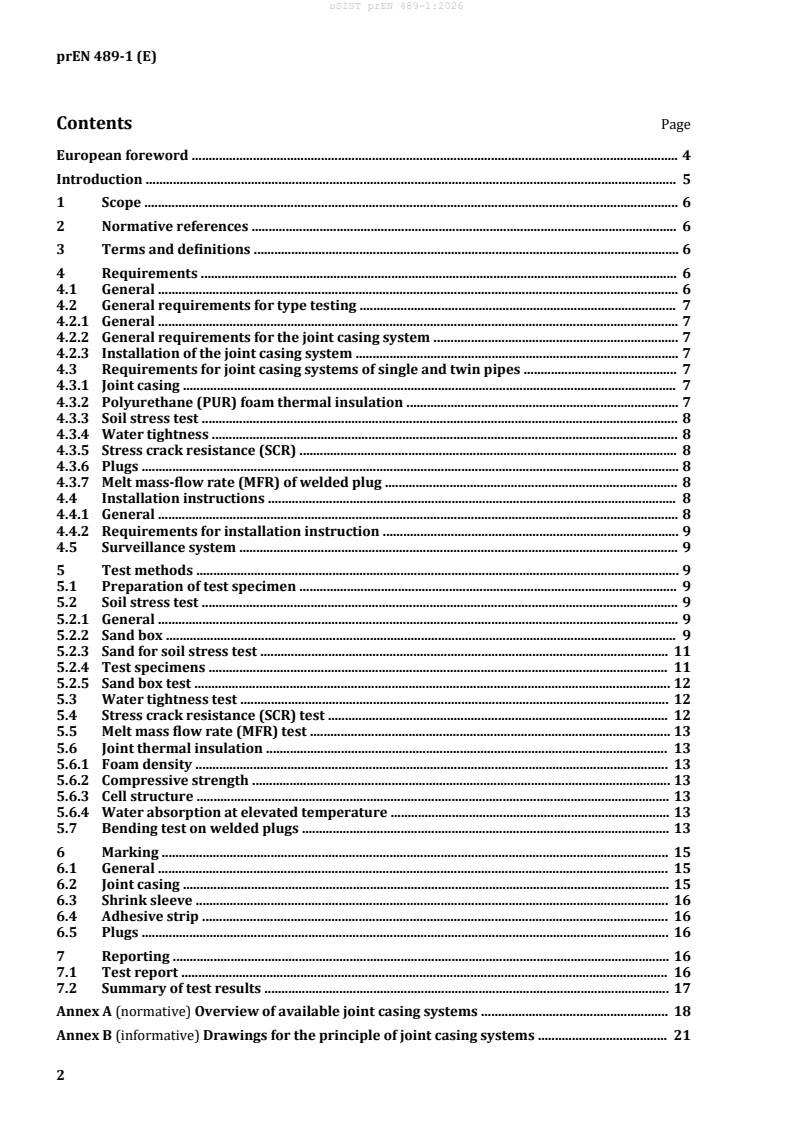
Contents Page
European foreword . 4
Introduction . 5
1 Scope . 6
2 Normative references . 6
3 Terms and definitions . 6
4 Requirements . 6
4.1 General . 6
4.2 General requirements for type testing . 7
4.2.1 General . 7
4.2.2 General requirements for the joint casing system . 7
4.2.3 Installation of the joint casing system . 7
4.3 Requirements for joint casing systems of single and twin pipes . 7
4.3.1 Joint casing . 7
4.3.2 Polyurethane (PUR) foam thermal insulation . 7
4.3.3 Soil stress test . 8
4.3.4 Water tightness . 8
4.3.5 Stress crack resistance (SCR) . 8
4.3.6 Plugs . 8
4.3.7 Melt mass-flow rate (MFR) of welded plug . 8
4.4 Installation instructions . 8
4.4.1 General . 8
4.4.2 Requirements for installation instruction . 9
4.5 Surveillance system . 9
5 Test methods . 9
5.1 Preparation of test specimen . 9
5.2 Soil stress test . 9
5.2.1 General . 9
5.2.2 Sand box . 9
5.2.3 Sand for soil stress test . 11
5.2.4 Test specimens . 11
5.2.5 Sand box test . 12
5.3 Water tightness test . 12
5.4 Stress crack resistance (SCR) test . 12
5.5 Melt mass flow rate (MFR) test . 13
5.6 Joint thermal insulation . 13
5.6.1 Foam density . 13
5.6.2 Compressive strength . 13
5.6.3 Cell structure . 13
5.6.4 Water absorption at elevated temperature . 13
5.7 Bending test on welded plugs . 13
6 Marking . 15
6.1 General . 15
6.2 Joint casing . 15
6.3 Shrink sleeve . 16
6.4 Adhesive strip . 16
6.5 Plugs . 16
7 Reporting . 16
7.1 Test report . 16
7.2 Summary of test results . 17
Annex A (normative) Overview of available joint casing systems . 18
Annex B (informative) Drawings for the principle of joint casing systems . 21
Annex C (informative) Guidelines for inspection and testing . 22
C.1 General . 22
C.2 Manufacturer's type test . 22
C.3 Manufacturer’s quality control . 22
C.4 Additional inspection . 22
Bibliography . 24
European foreword
This document (prEN489-1:2026) has been prepared by Technical Committee CEN/TC"107", the
secretariat of which is held by DS.
This document is currently submitted to the CEN Enquiry.
This document will supersede EN 489-1:2019 [1].
In comparison with the previous edition, the following technical modifications have been made:
— The scope was changed to cover also flèxiblè pipe systems according to EN 15632-4 [2] with metal
service pipes;
— editorial adjustments and updates to references throughout the document;
— minimum requirement and evidence of the degree of crosslinking in crosslinked PE-materials was
added in 4.3.1;
— clause 4.3.3 has been reworded to make it clearer;
— clarification of witness during the preparation of the test specimen in 5.1;
— the permissible loss of sand in the sandbox test has been reduced in 5.2.5;
— determination of the dimensions of the joint casings in the SCR test in 5.4;
— joint casing system 1.5 was added to Annex A;
— Schematic drawings of joint casing systems have been newly included in Annex B;
— additions to the inspection of joint casing systems in Annex C.
Introduction
The first edition of EN 489 was approved in 1994 and updated in 2003, 2009 and 2019.
With the 2019 edition, the number of the standard was changed from EN 489 to EN 489-1 in order to
include EN 489-2 for joint casing systems for flèxiblè pipe systems in the same series of standards.
This spècification is part of the series of standards for bonded systems using polyurethane foam thermal
insulation applied to bond to a steel service pipe and a polyethylene casing.
For information on the minimum expected thermal life with operation at various temperatures with
respect to PUR foam performance see FprCEN/TR 18341 [3].
1 Scope
This document spècifiès requirements and test methods for joint casing systems for single and twin
pipes between adjacent factory-made pipe, and/or fitting and/or valve assemblies for buried heating
and cooling water networks with rigid pipe systems with metal service pipes in accordance with EN
13941-1 [4] and EN 13941-2 [5] as well as rigid pipe systems with plastic service pipes according to
series EN 17415 and flèxiblè pipe systems with metal service pipes according to EN 15632-4 .
NOTE There are no differences in requirements for single and twin pipe joint casing systems.
For bedding materials other than those dèfinèd in 5.2.3 additional precautions are dèfinèd inEN 13941-2
[5].
2 Normative references
The following documents are referred to in the text in such a way that some or all of their content
constitutes requirements of this document. For dated references, only the edition cited applies. For
undated references, the latest edition of the referenced document (including any amendments) applies.
ISO 16770, Plastics — Determination of environmental stress cracking (ESC) of polyethylene — Full-notch
creep test (FNCT)
EN 253, District heating pipes - Bonded single pipe systems for directly buried hot water networks - Factory
made pipe assembly of steel service pipe, polyurethane thermal insulation and a casing of polyethylene
EN ISO 1133-1, Plastics - Determination of the melt mass-flow rate (MFR) and melt volume-flow rate (MVR)
of thermoplastics - Part 1: Standard method (ISO 1133-1:2022)
EN ISO 10147, Pipes and fittings made of crosslinked polyethylene (PE-X) - Estimation of the degree of
crosslinking by determination of the gel content (ISO 10147:2011)
EN 12814-1, Testing of welded joints of thermoplastics semi-finished products - Part 1: Bend test
EN 14419, District heating pipes - Bonded single and twin pipe systems for buried hot water networks -
Surveillance systems
EN 17248, District heating and district cooling pipe systems - Terms and definitions
3 Terms and definitions
For the purposes of this document, the terms and dèfinitions given in EN 17248 apply.
— ISO Online browsing platform: available at http://www.iso.org/obp
— IEC Electropedia: available at http://www.electropedia.org/
4 Requirements
4.1 General
All joints shall fulfil the requirements of Table 1 :
Table 1 — Requirements to be tested on different systems
Joint requirements Welded joint Sealed joint
Soil stress - 4.3.3
Stress Crack Resistance SCR 4.3.5 -
Water tightness 4.3.4 4.3.4
Foam properties 4.3.2 4.3.2
Plug properties 4.3.6 4.3.6
4.2 General requirements for type testing
4.2.1 General
Each joint casing system to be tested shall be provided with product data sheet, installation instruction
and - if relevant - safety data sheet for any major component.
NOTE Annex A gives a categorization of different joint casing systems and Annex B shows these in schematic
drawings.
4.2.2 General requirements for the joint casing system
The joint casing system shall be:
— watertight;
— able to withstand radial forces;
— able to withstand effects of temperature and temperature variations.
4.2.3 Installation of the joint casing system
Each individual step in the installation of a joint shall follow the system supplier's installation
instructions in order to ensure that the joint obtained is equivalent to the joint as previously type-tested.
4.3 Requirements for joint casing systems of single and twin pipes
4.3.1 Joint casing
Joint casings can be made of non-crosslinked (PE) or crosslinked (PE-X) material. Joint casings of PE-X
can be crosslinked along their entire length or only at the ends where the sealings are made. The degree
of cross-linking shall be at least 40% when tested in accordance with EN ISO 10147.
4.3.2 Polyurethane (PUR) foam thermal insulation
4.3.2.1 General
The installation of the on-site fillèd polyurethane foam thermal insulation (PUR) or the pre-fabricated
thermal joint insulation shall be carried out according to the supplier’s installation instruction.
The thermal insulation shall completely fill the joint.
4.3.2.2 Foam density
The requirement for foam density shall be in accordance with EN 253.
4.3.2.3 Compressive strength
The requirement for compressive strength shall be in accordance with EN 253.
4.3.2.4 Cell structure
The requirement for the composition and the cell structure shall be in accordance with EN 253.
4.3.2.5 Water absorption at elevated temperature
The requirement for water absorption at elevated temperature shall be in accordance with EN 253.
4.3.3 Soil stress test
Joint casing systems shall, as mentioned in Table 1, pass the soil stress test in accordance with 5.2.
A soil stress test is considered passed when the water tightness test according to 4.3.4 executed after
the soil stress test shows no water ingress, independently of the visual appearance of the joint.
4.3.4 Water tightness
For all joint casing systems it applies that no water ingress shall be detected after the water tightness
test in accordance with 5.3.
4.3.5 Stress crack resistance (SCR)
Each circumferential and longitudinal weld shall be individually tested for SCR. When tested in
accordance with 5.4 the time until failure shall be at least 115 h.
4.3.6 Plugs
4.3.6.1 General
Joint casing system to be foamed on-site shall have its foaming and venting holes securely closed by:
• plugs sealed by adhesive or similar (sealed plugs);
• plugs fused by welding (welded plugs).
4.3.6.2 Sealed plugs
Sealed plugs shall be tested following the approach of the sealed joint casing system. This means the
sealed plugs shall be present in the soil stress test and water tightness test as part of the joint casing
system.
4.3.6.3 Welded plugs
Welded plugs shall fulfil the requirement of the bending test in accordance with 5.7 and shall be
performed after the water tightness test.
They shall be tested following the approach of the joint casing system in which they are used.
4.3.7 Melt mass-flow rate (MFR) of welded plug
The melt mass-flow rate (MFR) of the welded plug material shall be determined in accordance with
5.5 . The MFR shall be within 0,2 ≤ MFR ≤ 1,0 g/10 min.
4.4 Installation instructions
4.4.1 General
Installation instructions, crucial for the quality of the joint, shall be a part of the manufacturer's
documentation. These installation instructions shall be a part of the type test report.
The installation instructions shall, as a minimum, deal with the topics mentioned in 4.4.2 and shall be
followed at any installation.
4.4.2 Requirements for installation instruction
The intention of the installation instruction is to enable the installer to install the product in a correct
way. It is the responsibility of the supplier to formulate a complete instruction, but it has as a minimum
to deal with the following topics:
a) storage conditions of components, see also EN 13941-2 [5];
b) environmental conditions for installation;
c) idèntification of components;
d) required installation equipment and tools;
e) proper procedures for the cleaning, drying and preparation of surfaces;
f) test procedures for leak-tightness of joint if relevant;
g) recommendation to check the quality and consistency of the foam components;
h) necessary quantity of foaming material for each joint dimension;
i) procedures for on-site inspection.
4.5 Surveillance system
When measuring elements for a surveillance system are installed in the joint, proper procedures for
connecting the surveillance system shall be spècifièd before the assembly takes place. This spècification
shall comply with EN 14419 .
5 Test methods
5.1 Preparation of test specimen
The test specimens, to be used in a type test, shall be prepared under the witness (physical in person
or from a third party accepted by the testing institute) of the testing institute doing the test, in order to
make sure that the installation instructions provided by the manufacturer are followed.
5.2 Soil stress test
5.2.1 General
The soil stress test shall be carried out as follows in 5.2.2 to 5.2.5 .
5.2.2 Sand
...