

SIST EN 601:2026
(Main)Aluminium and aluminium alloys - Castings - Chemical composition of castings for use in contact with foodstuff
- Abstract
This document specifies the maximum mass content of alloying elements and impurities in aluminium and aluminium alloy cast materials and articles designed to be in contact with foodstuff. It contains provisions for the demonstration of conformity of products with the present document.
NOTE Materials include ingots and liquid metal. Articles are finished goods.
- Status
- Published
- Public Enquiry End Date
- 30-Jul-2025
- Publication Date
- 15-Jun-2026
- Technical Committee
- INEK - Nonferrous metals
- Current Stage
- 6060 - National Implementation/Publication (Adopted Project)
- Start Date
- 11-Jun-2026
- Due Date
- 16-Aug-2026
- Completion Date
- 16-Jun-2026
SIST EN 601:2026 is the Slovenian adoption of EN 601:2026 from CEN. It specifies the maximum mass content of alloying elements and impurities in aluminium and aluminium alloy castings, ingots and liquid metal intended for contact with foodstuff, and it sets out how conformity to those composition limits is shown. It is aimed at producers, suppliers, converters and buyers who need to check whether a cast aluminium material or article can be used for food-contact applications.
What does SIST EN 601:2026 specify?
SIST EN 601:2026 covers the chemical composition limits for cast aluminium and aluminium alloy materials and finished articles designed to contact foodstuff. The document also explains how to demonstrate compliance, so it is not only a composition list but also a conformity framework.
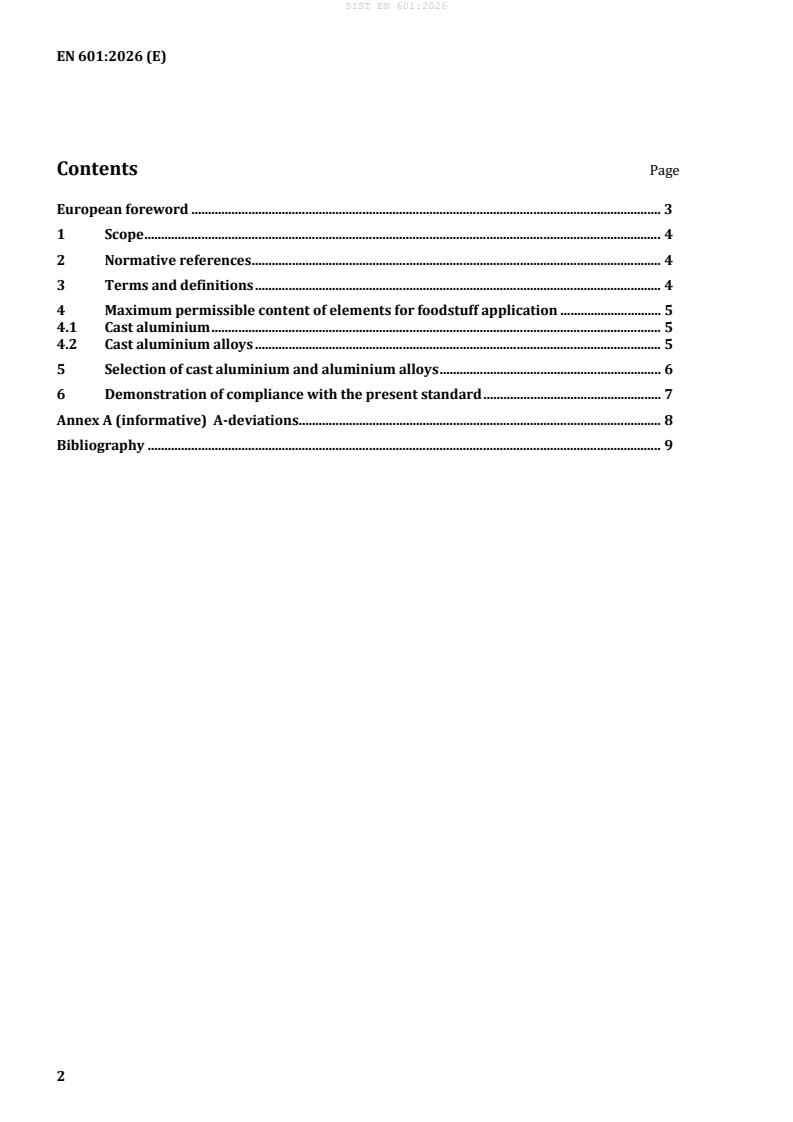
The document is organized into:
- Clause 1 - Scope
- Clause 2 - Normative references
- Clause 3 - Terms and definitions
- Clause 4 - Maximum permissible content of elements for foodstuff application
- Clause 5 - Selection of cast aluminium and aluminium alloys
- Clause 6 - Demonstration of compliance
- Annex A - A-deviations
- Bibliography
| Annex | What it covers |
|---|---|
| Annex A | A-deviations, including a France-specific deviation for bismuth in food-contact aluminium products |
What are the key requirements of SIST EN 601:2026?
SIST EN 601:2026 sets separate composition rules for cast aluminium and for cast aluminium alloys, then ties those rules to product selection and inspection documentation. In practice, the standard tells you what material chemistry is acceptable and what evidence you need to keep.
Cast aluminium
For cast aluminium, Clause 4.1 limits the amount of other elements, with a specific split between iron plus silicon, certain individual trace elements, and a conditional copper allowance. In practice, this means a foundry or buyer must check the chemical analysis of each heat or lot against the cast aluminium limits before using it for food-contact articles.
Cast aluminium alloys
Clause 4.2 gives maximum contents for alloying elements and impurities in cast aluminium alloys. The table covers the main elements used in alloy design and also controls “other elements” as a grouped category, which matters because an alloy may be acceptable only if its full chemistry profile stays within the stated limits.
Clause 4.2 also flags a special use restriction: alloys with high magnesium content are not to be used for pressure-resisting parts in pressure-cooking applications. That matters because a material that is acceptable in general food contact may still be unsuitable for a specific cooking appliance.
Selection of the alloy for the intended use
Clause 5 says the cast aluminium or cast aluminium alloy used to make a food-contact article shall meet the relevant requirements of Clause 4. It also requires checking the maximum contents in EN 1706 for standardized materials against this document, and selecting the alloy according to the intended final use.
For users, this means material choice is not just a catalog decision. Contact time, pH and temperature can also matter, so the alloy selection has to fit the actual service conditions and any applicable European or national rules.
Demonstration of compliance
Clause 6 requires manufacture under a quality assurance system with a procedure that controls the requirements of the standard. The procedure has to address raw material qualification and traceability from the delivered product back to the measured chemical composition of the materials used.
Clause 6 also requires an inspection certificate of type 3.1 according to EN 10204. That certificate may be issued per lot, per shipment, or periodically, but periodic issuance shall not exceed twelve months. For buyers, this gives a clear document to request and file; for producers, it sets the minimum evidence package.
What terms does SIST EN 601:2026 define?
- aluminium - aluminium with more than 99,00 % minimum aluminium content, provided the remaining elements stay within the cast-aluminium limits in Table 1.
- aluminium alloy - aluminium with alloying elements, where aluminium is the predominant element by mass and the composition exceeds the Table 1 limits in the ways described in Clause 3.
- casting - an unwrought product made by solidification of a metal or alloy in a mould or die.
- quality assurance system - the controlled manufacturing framework required by Clause 6 to manage compliance with this document.
- traceability - the link from the delivered product back to the measured chemical composition of the materials used.
- inspection certificate of type 3.1 - the EN 10204 inspection document used here to certify that delivered products meet the standard.
Who uses SIST EN 601:2026?
SIST EN 601:2026 is used by foundries, alloy producers, food-contact article manufacturers, purchasing teams, quality managers and inspection bodies. It is especially relevant where aluminium castings are supplied for packaging, cookware, food-processing equipment or other articles that touch food.
In practice, these users apply the standard to choose suitable alloys, review supplier certificates, define acceptance criteria for incoming material, and document conformity for finished goods.
What changed in SIST EN 601:2026 from the previous edition?
SIST EN 601:2026 supersedes EN 601:2004. The European foreword states these significant changes:
- addition of a bismuth element limitation in Table 2
- deletion of nickel, antimony and strontium element limitations from Table 2
- informative reference to European Parliament and Council Directive 94/62/EC and its 2018 amendment on packaging and packaging waste
- addition of a bibliography
Which standards are used with SIST EN 601:2026?
- EN 1706 - provides the cast aluminium and aluminium alloy chemical composition and mechanical property framework used when checking standardized materials.
- EN 10204 - provides the inspection document types, including the type 3.1 certificate required by Clause 6.
- EN 12258-1 - provides general aluminium terms and definitions used in Clause 3.
What does the SIST EN 601:2026 document contain?
SIST EN 601:2026 contains one main composition table for cast aluminium and one for cast aluminium alloys, plus the supporting rules for selecting materials and proving compliance. It also includes the document’s own term definitions, a quality-assurance-based conformity procedure, and an informative annex on national A-deviations.
Annex A records a France-specific deviation for bismuth in food-contact aluminium products. The bibliography points readers to food-contact, good manufacturing practice, packaging and toxicology references that support the technical background of the limits.
Relations
- Effective Date
- 08-Jul-2026
- Effective Date
- 10-Jun-2026
- Effective Date
- 26-Mar-2025
Get Certified
Connect with accredited certification bodies for this standard

BSI Group
BSI (British Standards Institution) is the business standards company that helps organizations make excellence a habit.

Bureau Veritas
Bureau Veritas is a world leader in laboratory testing, inspection and certification services.

DNV
DNV is an independent assurance and risk management provider.
Sponsored listings
Frequently Asked Questions
SIST EN 601:2026 is a standard published by the Slovenian Institute for Standardization (SIST). Its full title is "Aluminium and aluminium alloys - Castings - Chemical composition of castings for use in contact with foodstuff". This standard covers: This document specifies the maximum mass content of alloying elements and impurities in aluminium and aluminium alloy cast materials and articles designed to be in contact with foodstuff. It contains provisions for the demonstration of conformity of products with the present document. NOTE Materials include ingots and liquid metal. Articles are finished goods.
This document specifies the maximum mass content of alloying elements and impurities in aluminium and aluminium alloy cast materials and articles designed to be in contact with foodstuff. It contains provisions for the demonstration of conformity of products with the present document. NOTE Materials include ingots and liquid metal. Articles are finished goods.
SIST EN 601:2026 is classified under the following ICS (International Classification for Standards) categories: 67.250 - Materials and articles in contact with foodstuffs; 77.150.10 - Aluminium products. The ICS classification helps identify the subject area and facilitates finding related standards.
SIST EN 601:2026 has the following relationships with other standards: It is inter standard links to SIST EN 1706:2020+A1:2021, SIST EN 14392:2008, SIST EN 601:2004. Understanding these relationships helps ensure you are using the most current and applicable version of the standard.
SIST EN 601:2026 is available in PDF format for immediate download after purchase. The document can be added to your cart and obtained through the secure checkout process. Digital delivery ensures instant access to the complete standard document.
Standards Content (Sample)
Contents
- 1 Scope
- 2 Normative references
- 3 Terms and definitions
- 3.1 aluminium
- 3.2 aluminium alloy
- 3.3 casting
- 4 Maximum permissible content of elements for foodstuff application
- 4.1 Cast aluminium
- 4.2 Cast aluminium alloys
- 5 Selection of cast aluminium and aluminium alloys
- 6 Demonstration of compliance with the present standard
- Annex A
- 4.2 France
- Bibliography
1 Scope
This document specifies the maximum mass content of alloying elements and impurities in aluminium and aluminium alloy cast materials and articles designed to be in contact with foodstuff. It contains provisions for the demonstration of conformity of products with the present document. NOTE Materials include ingots and liquid metal. Articles are finished goods.
2 Normative references
The following documents are referred to in the text in such a way that some or all of their content constitutes requirements of this document. For dated references, only the edition cited applies. For undated references, the latest edition of the referenced document (including any amendments) applies. EN 1706, Aluminium and aluminium alloys — Castings — Chemical composition and mechanical properties EN 10204, Metallic products - Types of inspection documents EN 12258-1, Aluminium and aluminium alloys - Terms and definitions - Part 1: General terms
3 Terms and definitions
For the purposes of this document, the terms and definitions given in EN 12258-1 and the following apply. ISO and IEC maintain terminology databases for use in standardization at the following addresses:
- ISO Online browsing platform: available at https://www.iso.org/obp/
- IEC Electropedia: available at https://www.electropedia.org/
3.1 aluminium
aluminium without alloying elements where the minimum aluminium content is specified to be greater than 99,00 %, provided that the content by mass of any other element does not exceed the limit specified in Table 1 Table 1 — Aluminium - Other elements Element Maximum content % (by mass) Iron + Silicon 1,0 0,10 (if Cr and / or Mn ≥ 0,05) Copper 0,20 (if Cr < 0,05 and Mn < 0,05) a Other elements 0,10 each a Other elements are for example, Cr, Mg, Mn, Ni, Zn.
[SOURCE: EN 12258-1, 2.1.2, modified (title changed from “unalloyed aluminium” as “aluminium”, using Note 1 to entry of EN 12258-1, 2.1.2 – text addition mentioning limits for specific chemical elements with reference to Table 1 – Introduction of Table 1]
SIST EN 601:2026 EN 601:2026 (E)
3.2 aluminium alloy
aluminium which contains alloying elements, where aluminium predominates by mass over each of the other elements and where the aluminium content is not greater than 99,00 %, and for which a) the content by mass of at least one of the other elements, or iron plus silicon taken together, is greater than the limits specified in Table 1; or b) the total content by mass of such other elements exceeds 1,0 % [SOURCE: EN 12258-1, 2.2.2, modified - text addition with items a) and b)]
3.3 casting
unwrought product at or near finished shape, formed by solidification of a metal or alloy in a mould or a die [SOURCE: EN 12258-1, 2.5.1]
4 Maximum permissible content of elements for foodstuff application
4.1 Cast aluminium
The content by mass of the other elements which are present in cast aluminium shall not exceed the following limits:
- iron + silicon ≤ 1,0 %;
- chromium, copper, magnesium, manganese, nickel, zinc, titanium, tin ≤ 0,10 % each;
- copper can be in a proportion greater than 0,10 % but not more than 0,20 % provided that neither the chromium nor manganese content exceeds 0,05 %.
4.2 Cast aluminium alloys
The content by mass of the elements which are added to form aluminium alloy cast materials and articles, or which are present as impurities, shall not exceed the maximum values given in Table 2.
...