

SIST EN 1706:2020+A1:2021
(Main)Aluminium and aluminium alloys - Castings - Chemical composition and mechanical properties
General Information
- Abstract
This document specifies the chemical composition limits for aluminium casting alloys and mechanical properties of separately cast test pieces for these alloys.
Annex C is included as a guide to the selection of alloys for a specific use or process.
This document is intended to be used in conjunction with EN 576, EN 1559-1, EN 1559-4, EN 1676 and EN ISO 8062-3.
- Status
- Published
- Publication Date
- 02-Sep-2021
- Technical Committee
- INEK - Nonferrous metals
- Current Stage
- 6060 - National Implementation/Publication (Adopted Project)
- Start Date
- 25-Aug-2021
- Due Date
- 30-Oct-2021
- Completion Date
- 03-Sep-2021



Overview
EN 1706:2020+A1:2021 is the CEN European standard that defines the chemical composition limits and mechanical property requirements for aluminium and aluminium-alloy castings. It covers designation systems, sampling and analysis methods, mechanical testing (tensile and hardness), test-piece preparation and ordering information. Annex C provides guidance for selecting alloys for specific uses or processes. This standard is intended to be used in conjunction with EN 576, EN 1559‑1, EN 1559‑4, EN 1676 and EN ISO 8062‑3.
Key topics and technical requirements
- Chemical composition limits: Table 1 (in the standard) lists composition limits for aluminium casting alloys; ingot limits (from EN 1676) are included in brackets where they differ. Writing rules follow EN 1780‑3.
- Designation systems: Numerical and chemical‑symbol based alloy designations conform to EN 1780‑1/2; temper (F, O, T1, T4, T5, T6, T64, T7) and casting process codes (S, K, D, L) are mandated.
- Sampling and chemical analysis: Spark emission spectrometry samples should be taken from the melt and cast into a metallic die. If analysis is performed on a casting, remelting a part into a metallic die is recommended to reduce segregation effects. Certain elements (e.g., sodium, strontium, magnesium) are best analysed directly on the casting. EN 14361, EN 14242 and EN 14726 are recommended sampling/analysis references.
- Mechanical properties and testing: Specifies requirements for mechanical properties of separately cast test pieces, procedures for tensile testing (EN ISO 6892‑1) and Brinell hardness (EN ISO 6506‑1). Test-piece types include separately cast samples and pieces taken from castings; Annexes A and B provide further practical information.
- Ordering and documentation: Complete designation (standard number, alloy, casting process, temper) must appear on drawings and order documents. Rounding and compliance rules are specified.
Applications and users
This standard is essential for:
- Foundries and casting manufacturers producing aluminium castings
- Materials and quality engineers verifying chemical and mechanical conformity
- Design and specification authors who select alloys for function and manufacturability
- Procurement and inspection teams ensuring supplier compliance
- Laboratories performing spectrometric analysis and mechanical testing
Practical uses include alloy selection for sand, permanent‑mould, die and investment casting; preparing order documents and drawings; and evaluating conformity of castings and separate test pieces.
Related standards
- EN 576, EN 1559‑1, EN 1559‑4, EN 1676, EN ISO 8062‑3 (intended companion documents)
- EN 1780‑1/2/3 (designation systems)
- EN ISO 6892‑1 (tensile testing), EN ISO 6506‑1 (Brinell hardness)
- EN 14361, EN 14242, EN 14726 (sampling and analysis)
Keywords: EN 1706:2020+A1:2021, aluminium castings, chemical composition, mechanical properties, aluminium alloys, casting standards, CEN.
Relations
- Effective Date
- 28-Jan-2026
- Effective Date
- 28-Jan-2026
- Effective Date
- 28-Jan-2026
- Effective Date
- 28-Jan-2026
- Effective Date
- 28-Jan-2026
- Effective Date
- 28-Jan-2026
- Effective Date
- 28-Jan-2026
- Effective Date
- 08-Jul-2026
- Effective Date
- 28-Jan-2026
- Referred By
SIST EN 40-6:2002 - Lighting columns - Part 6: Requirements for aluminium lighting columns - Effective Date
- 28-Jan-2026
- Effective Date
- 28-Jan-2026
- Effective Date
- 28-Jan-2026
- Referred By
SIST EN 14420-2:2013 - Hose fittings with clamp units - Part 2: Hose side parts of hose tail - Effective Date
- 28-Jan-2026
- Effective Date
- 28-Jan-2026
- Effective Date
- 28-Jan-2026
Get Certified
Connect with accredited certification bodies for this standard

Element Materials Technology
Materials testing and product certification.

Inštitut za kovinske materiale in tehnologije
Institute of Metals and Technology. Materials testing, metallurgical analysis, NDT.
Sponsored listings
Frequently Asked Questions
SIST EN 1706:2020+A1:2021 is a standard published by the Slovenian Institute for Standardization (SIST). Its full title is "Aluminium and aluminium alloys - Castings - Chemical composition and mechanical properties". This standard covers: This document specifies the chemical composition limits for aluminium casting alloys and mechanical properties of separately cast test pieces for these alloys. Annex C is included as a guide to the selection of alloys for a specific use or process. This document is intended to be used in conjunction with EN 576, EN 1559-1, EN 1559-4, EN 1676 and EN ISO 8062-3.
This document specifies the chemical composition limits for aluminium casting alloys and mechanical properties of separately cast test pieces for these alloys. Annex C is included as a guide to the selection of alloys for a specific use or process. This document is intended to be used in conjunction with EN 576, EN 1559-1, EN 1559-4, EN 1676 and EN ISO 8062-3.
SIST EN 1706:2020+A1:2021 is classified under the following ICS (International Classification for Standards) categories: 77.040.30 - Chemical analysis of metals; 77.150.10 - Aluminium products. The ICS classification helps identify the subject area and facilitates finding related standards.
SIST EN 1706:2020+A1:2021 has the following relationships with other standards: It is inter standard links to SIST EN 1559-1:2011, SIST EN ISO 6506-1:2014, SIST EN ISO 6892-1:2020, SIST EN 12258-1:2012, SIST EN 1780-1:2004, SIST EN 576:2004, SIST EN 1559-4:2015, SIST EN 601:2026, SIST-TP CEN/TR 16748:2015, SIST EN 40-6:2002, SIST EN 15088:2006, SIST EN 14420-8:2013, SIST EN 14420-2:2013, SIST EN 14420-7:2013, SIST EN 601:2004. Understanding these relationships helps ensure you are using the most current and applicable version of the standard.
SIST EN 1706:2020+A1:2021 is available in PDF format for immediate download after purchase. The document can be added to your cart and obtained through the secure checkout process. Digital delivery ensures instant access to the complete standard document.
Standards Content (Sample)
SLOVENSKI STANDARD
01-oktober-2021
Aluminij in aluminijeve zlitine - Ulitki - Kemična sestava in mehanske lastnosti
Aluminium and aluminium alloys - Castings - Chemical composition and mechanical
properties
Aluminium und Aluminiumlegierungen - Gussstücke - Chemische Zusammensetzung
und mechanische Eigenschaften
Aluminium et alliages d'aluminium - Pièces moulées - Composition chimique et
propriétés mécaniques
Ta slovenski standard je istoveten z: EN 1706:2020+A1:2021
ICS:
77.040.30 Kemijska analiza kovin Chemical analysis of metals
77.150.10 Aluminijski izdelki Aluminium products
2003-01.Slovenski inštitut za standardizacijo. Razmnoževanje celote ali delov tega standarda ni dovoljeno.
EN 1706:2020+A1
EUROPEAN STANDARD
NORME EUROPÉENNE
August 2021
EUROPÄISCHE NORM
ICS 77.150.10 Supersedes EN 1706:2020
English Version
Aluminium and aluminium alloys - Castings - Chemical
composition and mechanical properties
Aluminium et alliages d'aluminium - Pièces moulées - Aluminium und Aluminiumlegierungen - Gussstücke -
Composition chimique et propriétés mécaniques Chemische Zusammensetzung und mechanische
Eigenschaften
This European Standard was approved by CEN on 2 March 2020 and includes Amendment 1 approved by CEN on 1 July 2021.
CEN members are bound to comply with the CEN/CENELEC Internal Regulations which stipulate the conditions for giving this
European Standard the status of a national standard without any alteration. Up-to-date lists and bibliographical references
concerning such national standards may be obtained on application to the CEN-CENELEC Management Centre or to any CEN
member.
This European Standard exists in three official versions (English, French, German). A version in any other language made by
translation under the responsibility of a CEN member into its own language and notified to the CEN-CENELEC Management
Centre has the same status as the official versions.
CEN members are the national standards bodies of Austria, Belgium, Bulgaria, Croatia, Cyprus, Czech Republic, Denmark, Estonia,
Finland, France, Germany, Greece, Hungary, Iceland, Ireland, Italy, Latvia, Lithuania, Luxembourg, Malta, Netherlands, Norway,
Poland, Portugal, Republic of North Macedonia, Romania, Serbia, Slovakia, Slovenia, Spain, Sweden, Switzerland, Turkey and
United Kingdom.
EUROPEAN COMMITTEE FOR STANDARDIZATION
COMITÉ EUROPÉEN DE NORMALISATION
EUROPÄISCHES KOMITEE FÜR NORMUNG
CEN-CENELEC Management Centre: Rue de la Science 23, B-1040 Brussels
© 2021 CEN All rights of exploitation in any form and by any means reserved Ref. No. EN 1706:2020+A1:2021 E
worldwide for CEN national Members.
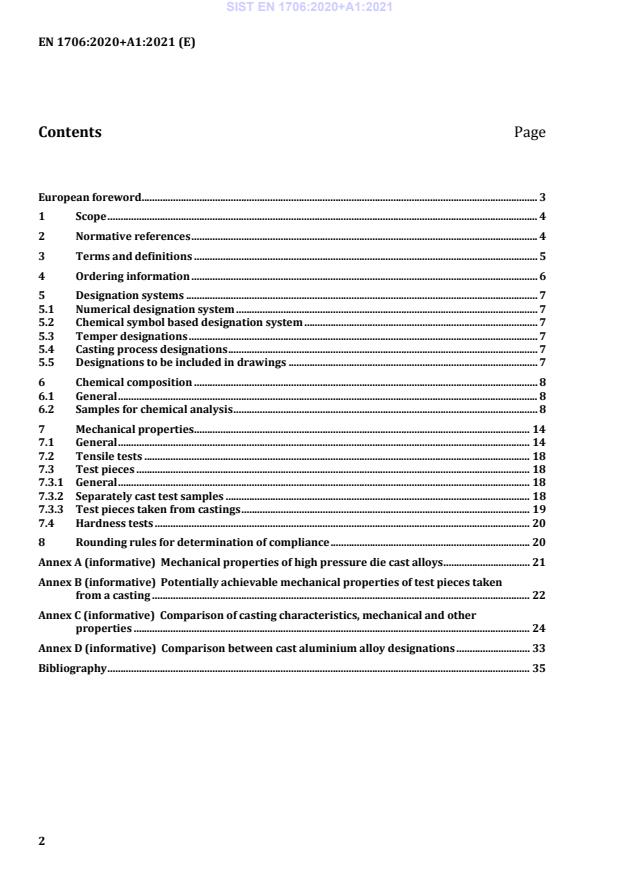
Contents Page
European foreword . 3
1 Scope . 4
2 Normative references . 4
3 Terms and definitions . 5
4 Ordering information . 6
5 Designation systems . 7
5.1 Numerical designation system . 7
5.2 Chemical symbol based designation system . 7
5.3 Temper designations . 7
5.4 Casting process designations . 7
5.5 Designations to be included in drawings . 7
6 Chemical composition . 8
6.1 General . 8
6.2 Samples for chemical analysis . 8
7 Mechanical properties . 14
7.1 General . 14
7.2 Tensile tests . 18
7.3 Test pieces . 18
7.3.1 General . 18
7.3.2 Separately cast test samples . 18
7.3.3 Test pieces taken from castings . 19
7.4 Hardness tests . 20
8 Rounding rules for determination of compliance . 20
Annex A (informative) Mechanical properties of high pressure die cast alloys . 21
Annex B (informative) Potentially achievable mechanical properties of test pieces taken
from a casting . 22
Annex C (informative) Comparison of casting characteristics, mechanical and other
properties . 24
Annex D (informative) Comparison between cast aluminium alloy designations . 33
Bibliography . 35
European foreword
This document (EN 1706:2020+A1:2021) has been prepared by Technical Committee CEN/TC 132
“Aluminium and aluminium alloys”, the secretariat of which is held by AFNOR.
This European Standard shall be given the status of a national standard, either by publication of an
identical text or by endorsement, at the latest by February 2022, and conflicting national standards
shall be withdrawn at the latest by February 2022.
Attention is drawn to the possibility that some of the elements of this document may be the subject of
patent rights. CEN shall not be held responsible for identifying any or all such patent rights.
CEN/TC 132 affirms it is its policy that in the case when a patentee refuses to grant licences on
standardized products under reasonable and not discriminatory conditions, then this product shall be
removed from the corresponding standard.
This document supersedes !EN 1706:2020".
!deleted text"
This document includes Amendment 1 approved by CEN on 7 June 2021.
The start and finish of text introduced or altered by amendment is indicated in the text by tags !".
Within its programme of work, Technical Committee CEN/TC 132 entrusted CEN/TC 132/WG 23
“Revision of EN 1676 and EN 1706” to revise EN 1706:2010.
!Any feedback and questions on this document should be directed to the users’ national standards
body. A complete listing of these bodies can be found on the CEN website."
According to the CEN-CENELEC Internal Regulations, the national standards organisations of the
following countries are bound to implement this European Standard: Austria, Belgium, Bulgaria,
Croatia, Cyprus, Czech Republic, Denmark, Estonia, Finland, France, Germany, Greece, Hungary, Iceland,
Ireland, Italy, Latvia, Lithuania, Luxembourg, Malta, Netherlands, Norway, Poland, Portugal, Republic of
North Macedonia, Romania, Serbia, Slovakia, Slovenia, Spain, Sweden, Switzerland, Turkey and the
United Kingdom.
1 Scope
This document specifies the chemical composition limits for aluminium casting alloys and mechanical
properties of separately cast test pieces for these alloys.
Annex C is included as a guide to the selection of alloys for a specific use or process.
This document is intended to be used in conjunction with EN 576, EN 1559-1, EN 1559-4, EN 1676 and
EN ISO 8062-3.
2 Normative references
The following documents are referred to in the text in such a way that some or all of their content
constitutes requirements of this document. For dated references, only the edition cited applies. For
undated references, the latest edition of the referenced document (including any amendments) applies.
EN 576, Aluminium and aluminium alloys — Unalloyed aluminium ingots for remelting — Specifications
EN 1559-1, Founding — Technical conditions of delivery — Part 1: General
EN 1559-4, Founding — Technical conditions of delivery — Part 4: Additional requirements for
aluminium alloy castings
EN 1780-1, Aluminium and aluminium alloys — Designation of alloyed aluminium ingots for remelting,
master alloys and castings — Part 1: Numerical designation system
EN 1780-2, Aluminium and aluminium alloys — Designation of alloyed aluminium ingots for remelting,
master alloys and castings — Part 2: Chemical symbol based designation system
EN 1780-3, Aluminium and aluminium alloys — Designation of alloyed aluminium ingots for remelting,
master alloys and castings — Part 3: Writing rules for chemical composition
EN ISO 6892-1, Metallic materials — Tensile testing — Part 1: Method of test at room temperature
(ISO 6892-1)
EN ISO 6506-1, Metallic materials — Brinell hardness test — Part 1: Test method (ISO 6506-1)
EN 12258-1:2012, Aluminium and aluminium alloys — Terms and definitions — Part 1: General terms
3 Terms and definitions
For the purposes of this document, the terms and definitions given in EN 12258-1:2012 and the
following apply.
ISO and IEC maintain terminological databases for use in standardization at the following addresses:
• IEC Electropedia: available at http://www.electropedia.org/
• ISO Online browsing platform: available at https://www.iso.org/obp/ui
3.1
casting
product at or near finished shape, formed by solidification of the metal in a mould or a die
[SOURCE: EN 12258-1:2012, 2.5.1]
3.2
sand casting
casting produced by pouring molten metal into a sand mould and allowing it to solidify
[SOURCE: EN 12258-1:2012, 2.5.2]
3.3
permanent mould casting
casting produced by introducing molten metal by gravity or low pressure into a mould constructed of
durable material, typically iron or steel, and allowing it to solidify
Note 1 to entry: Permanent mould casting where the metal solidifies in a metal mould under low pressure
(typically less than 1 bar above atmospheric pressure) is also referred to as “low pressure die casting”.
Note 2 to entry: Permanent mould casting, which is made using an expendable core such as sand, is often
(mainly in the USA) termed “semi-permanent mould casting”.
[SOURCE: EN 12258-1:2012, 2.5.3]
3.4
low pressure die casting
process in which molten metal is poured into a metal mould and solidified under low pressure
(typically 7 kPa above atmospheric pressure)
Note 1 to entry: This process can also be used with a sand mould, being called “low pressure sand casting”.
3.5
high pressure die casting
process in which molten metal is poured into a permanent metal mould and solidified under high
pressure (typically 7 MPa)
3.6
investment casting
precision casting formed by a three step process comprising:
a) fabrication of a ceramic mould around a wax or thermoplastic pattern with a refractory slurry that
sets at room temperature;
b) removal of the pattern through the use of heat;
c) pouring of metal into this mould and allowing it to solidify.
[SOURCE: EN 12258-1:2012, 2.5.6]
3.7
fluidity
ability of a liquid metal to flow (into a mould)
[SOURCE: EN 12258-1:2012, 4.5.23]
3.8
hot tearing
tendency for a crack to form in a casting due to the development of internal stress during solidification
3.9
pressure tightness
absence of leakage at a specified pressure
[SOURCE: EN 12258-1:2012, 4.3.27]
3.10
order document
document or set of documents to which supplier and purchaser agreed at the time of ordering
Note 1 to entry: An ordering document can be an order of the purchaser confirmed by the supplier or a
quotation of the supplier confirmed by the purchaser.
[SOURCE: EN 12258-1:2012, 3.11.10]
4 Ordering information
The order document shall include a reference to this document. It shall include all the ordering
information as required in EN 1559-1 and EN 1559-4.
5 Designation systems
5.1 Numerical designation system
The numerical designation system shall be in accordance with EN 1780-1.
5.2 Chemical symbol based designation system
The chemical symbol based designation system shall be in accordance with EN 1780-2.
For unalloyed grades, the designation shall be in accordance with EN 576.
5.3 Temper designations
The following abbreviations shall be used as temper designations for the conditions of heat treatment,
referred in Tables 2, 3 and 4 and Table A.1:
— F as cast;
— O annealed;
— T1 controlled cooling from casting and naturally aged;
— T4 solution heat treated and naturally aged where applicable;
— T5 controlled cooling from casting and artificially aged or over-aged;
— T6 solution heat treated and fully artificially aged;
— T64 solution heat treated and artificially under-aged;
— T7 solution heat treated and artificially over-aged (stabilized).
NOTE For aluminium alloy castings, solution heat treatment involves quenching from elevated temperatures
and distortion can occur.
5.4 Casting process designations
The following abbreviations shall be used as designations for the different casting processes:
— S sand casting;
— K chill or permanent mould casting;
— D high pressure die casting;
— L investment casting.
5.5 Designations to be included in drawings
The complete designation of the casting shall be included in the drawings being part of the order
information. This designation includes:
— the number of this document;
— the alloy designation;
— the casting process designation;
— the temper designation.
EXAMPLE EN 1706 AC-42000-K-T6 is the complete designation of the alloy EN AC-42000, chill cast, solution
heat treated and fully artificially aged.
6 Chemical composition
6.1 General
Chemical composition shall be expressed in accordance with the writing rules given in EN 1780-3. The
chemical composition of aluminium castings shall be in conformity with the limits specified in Table 1.
NOTE Table 1 also includes the chemical compositions of ingots used to produce castings. These are shown in
brackets where they differ from the casting limits and are taken from EN 1676.
The chemical analysis of elements for which specific limits are given in Table 1 shall be carried out. By
agreement between supplier and purchaser other elements may be determined. This particularly
applies to modifying or refining elements such as sodium, strontium, antimony and phosphorus.
Alloying elements and impurities shall be expressed in the following sequence: silicon, iron, copper,
manganese, magnesium, chromium, nickel, zinc, lead, tin, titanium, other elements each/total,
aluminium.
Additional specified elements with specific limits shall be inserted, in alphabetical order with respect to
their chemical symbols after titanium, or be specified in footnotes.
6.2 Samples for chemical analysis
When a chemical analysis is carried out by spark emission spectrometry, samples shall be taken from
the melt at the time the castings are made and shall be cast into a metallic die.
If chemical analysis by emission spectrometry is carried out on a casting, it is recommended that a part
of the casting is remelted and cast into a metallic die to minimize the unavoidable segregation effect.
The content of certain elements such as sodium, strontium and magnesium, is normally reduced by the
remelting, and chemical analysis of such elements should be made directly on the casting.
For sampling the use of EN 14361 is recommended. For chemical analysis the use of EN 14242 and
EN 14726 is recommended.
Table 1 — Chemical composition of aluminium castings
Expressed in percentage by mass
m h a g
Alloy designation Si Fe Cu Mn Mg Cr Ni Zn Sn
Pb Ti Others
Alloy
Group
Numerical Chemical symbols Each Total Aluminium
e
— Al 99,6E 0,10 0,30 0,01 0,007 0,02 0,005 — 0,04 — — - — 99,60 min.
0,03
d
Al
f
— Al 99,7E 0,07 0,20 0,01 0,005 0,02 0,004 — 0,04 — — - — 99,70 min.
0,03
0,15 to 0,30
0,20 0,35 0,15 to 0,35
EN AC-21000 EN AC-Al Cu4MgTi 4,2 to 5,0 0,10 — 0,05 0,10 0,05 0,05 0,03 0,10 Remainder
(0,15 to
(0,15) (0,30) (0,20 to 0,35)
0,25)
AlCu
0,15 to 0,30
0,18 0,19
EN AC-21100 EN AC-Al Cu4Ti 4,2 to 5,2 0,55 — — — 0,07 — — 0,03 0,10 Remainder
(0,15 to
(0,15) (0,15)
0,25)
0,05 to 0,20
0,60 0,10 0,45 to 0,65
0,30 to
i
AlSiMgTi EN AC-Al Si2MgTi 1,6 to 2,4 — 0,05 0,10 0,05 0,05 0,05 0,15 Remainder
EN AC-41000 (0,07 to
0,50
(0,50) (0,08) (0,50 to 0,65)
0,15)
j
0,55 0,20 0,20 to 0,65
0,25
i
EN AC-Al Si7Mg 6,5 to 7,5 0,35 — 0,15 0,15 0,15 0,05 0,05 0,15 Remainder
EN AC-42000
(0,45) (0,15) (0,25 to 0,65)
(0,20)
j
0,19 0,05 0,25 to 0,45
0,25
i
EN AC-Al Si7Mg0,3 6,5 to 7,5 0,10 — — 0,07 — — 0,03 0,10 Remainder
EN AC-42100
(0,15) (0,03) (0,30 to 0,45)
(0,18)
j
0,19 0,05 0,45 to 0,70
0,25
AlSi7Mg i
EN AC-Al Si7Mg0,6 6,5 to 7,5 0,10 — — 0,07 — — 0,03 0,10 Remainder
EN AC-42200
(0,15) (0,03) (0,50 to 0,70)
(0,18)
j
0,19 0,05 0,10 to 0,25
0,25
i
EN AC-Al Si7(Mg) 6,5 to 7,5 0,10 — — 0,07 — — 0,03 0,10 Remainder
EN AC-42300
(0,15) (0,03) (0,10 to 0,30)
(0,18)
0,25 0,05 0,10 to 0,45 0,20
0,35 to
i c
6,5 to 8,5 — — 0,03 — — 0,05 0,15 Remainder
EN AC-42400 EN AC-Al Si7MnMg
0,75
(0,20) (0,03) (0,15 to 0,45) (0,15)
k
0,55 0,20 to 0,45
0,05
i
AlSi10Mg EN AC-Al Si10Mg 9,0 to 11,0 0,45 — 0,05 0,10 0,05 0,05 0,15 0,05 0,15 Remainder
EN AC-43000
(0,40) (0,25 to 0,45)
(0,03)
m h a g
Alloy designation Si Fe Cu Mn Mg Cr Ni Zn Sn
Pb Ti Others
Alloy
Group
Numerical Chemical symbols Each Total Aluminium
0,65 0,35 0,20 to 0,45 0,20
EN AC-Al
EN AC-43200 9,0 to 11,0 0,55 — 0,15 0,35 0,10 — 0,05 0,15 Remainder
Si10Mg(Cu)
(0,55) (0,30) (0,25 to 0,45) (0,15)
0,19 0,05 0,20 to 0,45
i
EN AC-Al Si9Mg 9,0 to 10,0 0,10 — — 0,07 — — 0,15 0,03 0,10 Remainder
EN AC-43300
(0,15) (0,03) (0,25 to 0,45)
1,0
0,10 0,20 to 0,50 0,20
i
EN AC-Al Si10Mg(Fe) 9,0 to 11,0 0,55 — 0,15 0,15 0,15 0,05 0,05 0,15 Remainder
EN AC-43400 (0,45 to
(0,08) (0,25 to 0,50) (0,15)
0,9)
0,25 0,05 0,10 to 0,60 0,20
0,40 to
i c
9,0 to 11,5 — — 0,07 — — 0,05 0,15 Remainder
EN AC-43500 EN AC-Al Si10MnMg
0,80
(0,20) (0,03) (0,15 to 0,60) (0,15)
0,19 0,05
i
EN AC-Al Si11 10,0 to 11,8 0,10 0,45 — — 0,07 — — 0,15 0,03 0,10 Remainder
EN AC-44000
(0,15) (0,03)
0,65 0,15 0,20
i
EN AC-Al Si12(b) 10,5 to 13,5 0,55 0,10 — 0,10 0,15 0,10 — 0,05 0,15 Remainder
EN AC-44100
(0,55) (0,10) (0,15)
0,55 0,05
i
EN AC-Al Si12(a) 10,5 to 13,5 0,35 — — — 0,10 — — 0,15 0,05 0,15 Remainder
EN AC-44200
(0,40) (0,03)
1,0
0,10
i
EN AC-Al Si12(Fe)(a) 10,5 to 13,5 0,55 — — — 0,15 — — 0,15 0,05 0,25 Remainder
EN AC-44300 (0,45 to
(0,08)
0,9)
AlSi
0,65 0,10
i
EN AC-Al Si9 8,0 to 11,0 0,50 0,10 - 0,05 0,15 0,05 0,05 0,15 0,05 0,15 Remainder
EN AC-44400
(0,55) (0,08)
1,0
0,20
i
EN AC-Al Si12(Fe)(b) 10,5 to 13,5 0,55 0,40 — — 0,30 — — 0,15 0,05 0,25 Remainder
EN AC-44500 (0,45 to
(0,18)
0,9)
0,10 to
0,25 0,20
0,30 to
i
EN AC-Al Si10Mn 9,5 to 11,5 0,03 0,15 — — 0,03 — — 0,05 0,15 Remainder
EN AC-44600
0,75
(0,10 to (0,15)
0,20)
m h a g
Alloy designation Si Fe Cu Mn Mg Cr Ni Zn Sn
Pb Ti Others
Alloy
Group
Numerical Chemical symbols Each Total Aluminium
1,0 0,25
0,20 to
EN AC-45000 EN AC-Al Si6Cu4 5,0 to 7,0 3,0 to 5,0 0,55 0,15 0,45 2,0 0,29 0,15 0,05 0,35 Remainder
0,65
(0,9) (0,20)
0,60 0,15 to 0,45 0,25
EN AC-45100 EN AC-Al Si5Cu3Mg 4,5 to 6,0 2,6 to 3,6 0,55 — 0,10 0,20 0,10 0,05 0,05 0,15 Remainder
(0,50) (0,20 to 0,45) (0,20)
j
0,65 0,35 to 0,65
0,25
EN AC-45300 EN AC-Al Si5Cu1Mg 4,5 to 5,5 1,0 to 1,5 0,55 — 0,25 0,15 0,15 0,05 0,05 0,15 Remainder
(0,55) (0,40 to 0,65)
(0,20)
AlSi5Cu
0,60 0,25
EN AC-45400 EN AC-Al Si5Cu3 4,5 to 6,0 2,6 to 3,6 0,55 0,05 — 0,10 0,20 0,10 0,05 0,05 0,15 Remainder
(0,50) (0,20)
EN AC-Al 0,20 to 0,45
j
EN AC-45500 6,5 to 7,5 0,25 0,2 to 0,7 0,15 — — 0,07 — — 0,03 0,10 Remainder
0,20
Si7Cu0,5Mg (0,25 to 0,45)
j
0,19 0,45 to 0,70
EN AC-Al 0,25
EN AC-45600 6,5 to 7,5 0,8 to 1,6 0,10 — — 0,07 — — 0,03 0,10 Remainder
Si7Cu1Mg0,6
(0,15) (0,50 to 0,70)
(0,18)
1,3
0,05 to 0,55 0,25
EN AC-46000 EN AC-Al Si9Cu3(Fe) 8,0 to 11,0 2,0 to 4,0 0,55 0,15 0,55 1,2 0,29 0,15 0,05 0,25 Remainder
(0,6 to
(0,15 to 0,55) (0,20)
1,1)
1,1
EN AC-Al 0,25
EN AC-46100 10,0 to 12,0 (0,45 to 1,5 to 2,5 0,55 0,30 0,15 0,45 1,7 0,25 0,15 0,05 0,25 Remainder
Si11Cu2(Fe) (0,20)
1,0)
0,8 0,15 to 0,05 to 0,55 0,25
EN AC-46200 EN AC-Al Si8Cu3 7,5 to 9,5 2,0 to 3,5 — 0,35 1,2 0,25 0,15 0,05 0,25 Remainder
(0,7) 0,65 (0,15 to 0,55) (0,20)
0,8 0,20 to 0,30 to 0,60 0,25
AlSi9Cu
EN AC-46300 EN AC-Al Si7Cu3Mg 6,5 to 8,0 3,0 to 4,0 — 0,30 0,65 0,15 0,10 0,05 0,25 Remainder
(0,7) 0,65 (0,35 to 0,60) (0,20)
j
0,8 0,25 to 0,65
0,15 to
0,20
EN AC-46400 EN AC-Al Si9Cu1Mg 8,3 to 9,7 0,8 to 1,3 — 0,20 0,8 0,10 0,10 0,05 0,25 Remainder
0,55
(0,7) (0,30 to 0,65)
(0,18)
1,3
EN AC-Al 0,05 to 0,55 0,25
EN AC-46500 8,0 to 11,0 (0,6 to 2,0 to 4,0 0,55 0,15 0,55 3,0 0,29 0,15 0,05 0,25 Remainder
Si9Cu3(Fe)(Zn) (0,15 to 0,55) (0,20)
1,2)
0,8 0,25
0,15 to
EN AC-46600 EN AC-Al Si7Cu2 6,0 to 8,0 1,5 to 2,5 0,35 — 0,35 1,0 0,25 0,15 0,05 0,15 Remainder
0,65
(0,7) (0,20)
m h a g
Alloy designation Si Fe Cu Mn Mg Cr Ni Zn Sn
Pb Ti Others
Alloy
Group
Numerical Chemical symbols Each Total Aluminium
0,8 1,0 0,20
0,05 to
EN AC-47000 EN AC-Al Si12(Cu) 10,5 to 13,5 0,35 0,10 0,30 0,55 0,20 0,10 0,05 0,25 Remainder
0,55
(0,7) (0,9) (0,15)
1,3
0,20
EN AC-Al
AlSi(Cu)
EN AC-47100 10,5 to 13,5 0,7 to 1,2 0,55 0,35 0,10 0,30 0,55 0,20 0,10 0,05 0,25 Remainder
(0,6 to
Si12Cu1(Fe)
(0,15)
1,1)
0,15
0,10 to
l
EN AC-Al Si12(Fe) 10,5 to 13,5 0,6 to 1,1 0,4 0,10 to 0,40 0,05 0,20 0,50 0,20 0,10 0,05 0,25 Remainder
EN AC-47200
0,50
(0,20)
0,7 0,8 to 1,5 0,25
EN AC-Al 0,7 to
EN AC-48000 10,5 to 13,5 0,8 to 1,5 0,35 — 0,35 — — 0,05 0,15 Remainder
Si12CuMgNi 1,3
(0,6) (0,9 to 1,5) (0,20)
1,3 0,25 to 0,65 0,25
AlSiCuMg EN AC-48100 EN AC-Al Si17Cu4Mg 16,0 to 18,0 4,0 to 5,0 0,50 — 0,3 1,5 — 0,15 0,05 0,25 Remainder
(1,0) (0,45 to 0,65) (0,20)
0,55 to 0,90 0,05 to 0,15
EN AC-Al 0,40 to 0,05 to
EN AC-48200 14,5 to 16,5 0,7 to 1,2 3,0 to 4,0 0,30 1,0 — 0,30 0,05 0,25 Remainder
Si15Cu3MgFe 0,60 0,30
(0,55 to 0,95) (0,15)
0,55 0,55 0,05 2,5 to 3,5 0,20
i
EN AC-Al Mg3 0,45 — — 0,10 — — 0,05 0,15 Remainder
EN AC-51100
(0,45) (0,40) (0,03) (2,7 to 3,5) (0,15)
1,0
0,10 8,0 to 10,5 0,20
i
EN AC-Al Mg9 2,5 0,55 — 0,10 0,25 0,10 0,10 0,05 0,15 Remainder
EN AC-51200 (0,45 to
(0,08) (8,5 to 10,5) (0,15)
0,9)
b 0,55 0,55 0,10 4,3 to 6,8 0,20
AlMg
i
EN AC-Al Mg5 0,45 — — 0,10 — — 0,05 0,15 Remainder
EN AC-51300
(0,35) (0,45) (0,05) (4,5 to 6,8) (0,15)
1,5 0,55 0,05 4,5 to 6,5 0,20
i
EN AC-Al Mg5(Si) 0,45 — — 0,10 — — 0,05 0,15 Remainder
EN AC-51400
(1,3) (0,45) (0,03) (4,8 to 6,5) (0,15)
0,25 0,05 4,7 to 6,0 0,25
0,4 to
i
EN AC-Al Mg5Si2Mn 1,8 to 2,6 — — 0,07 — — 0,05 0,15 Remainder
EN AC-51500
0,8
(0,20) (0,03) (5,0 to 6,0) (0,20)
0,45 0,10 0,20 to 0,50
9,0 to
AlZnSiMg EN AC-71100 EN AC-Al Zn10Si8Mg 7,5 to 9,5 0,45 — — — — 0,15 0,05 0,15 Remainder
10,5
(0,40) (0,08) (0,25 to 0,50)
m h a g
Alloy designation Si Fe Cu Mn Mg Cr Ni Zn Sn
Pb Ti Others
Alloy
Group
Numerical Chemical symbols Each Total Aluminium
NOTE 1 Figures in brackets are ingot compositions (prefix EN AB instead of EN AC) where they differ from the casting. See EN 1676 for information.
NOTE 2 Limits are expressed as a maximum unless shown as a range.
a
“Others” does not include modifying or refining elements such as Na, Sr, Sb and P.
b
For alloys with Mg ≥ 3 %, the alloy may contain a maximum Be content of 0,005 % which is not considered as an impurity.
c
Sr addition is recommended.
d
These grades of unalloyed aluminium are specified in EN 576, and included in this document due to its importance for electrotechnical applications.
e
B max. 0,04 %; Mn + Ti + Cr + V max. 0,030 %.
f
B max. 0,04 %; Mn + Ti + Cr + V max. 0,020 %.
g
“Others” includes all the elements which are not listed in this table or without specific values.
h
Refining agents such as Ti, B or master alloys containing nucleating particles such as TiB shall not be considered as impurities. Nevertheless, the minimum and maximum
content of refining elements should be agreed between the manufacturer and the purchaser.
i
These alloys are in compliance with EN 601 (for information only).
j
Minimum Ti limits are not required if the grain refining is not required or reached by other means.
k
If corrosion resistance is less important or not required, a maximum Cu content of 0,10 % is allowed.
l
When intentionally modifying the alloy by adding strontium, sodium and/or antimony, a patent might be violated.
m
European Regulations and Directives need to be taken into account. See [7] to [10] for information.
7 Mechanical properties
7.1 General
The minimum mechanical properties for separately cast test pieces for sand cast, chill cast, investment
cast, low pressure die cast and pressure die cast processes shall be in accordance with Tables 2, 3 and 4.
For each alloy, mechanical properties are only specified for the commonly used methods of casting and
for commonly used tempers. For other processes and tempers, characteristics shall be agreed between
supplier and purchaser.
NOTE 1 The mechanical properties of high pressure die castings are very dependent on injection parameters
and the properties in Table A.1 are for guidance only.
NOTE 2 For F temper, the values specified in Tables 2, 3 and 4 can be eventually obtained only after holding a
few days at room temperature.
Table 2 — Mechanical properties of sand cast alloys for separately cast test pieces
Alloy designation Tensile Yield
Brinell
a
Elongation
strength strength
hardness
A
Alloy Temper
R R
HBW
m p0,2
group designation
Numerical Chemical symbols
MPa MPa %
min. min. min. min.
— Al 99,6E F 75 — 30 17
Al
— Al 99,7E F 75 — 30 17
EN AC-21000 EN AC-Al Cu4MgTi T4 300 200 5 90
AlCu
T6 300 200 3 95
EN AC-21100 EN AC-Al Cu4Ti
T64 280 180 5 85
F 140 70 3 50
AlSiMgTi EN AC-41000 EN AC-Al Si2MgTi
T6 240 180 3 85
F 140 80 2 50
EN AC-42000 EN AC-Al Si7Mg
T6 220 180 1 75
T6 230 190 2 75
EN AC-42100 EN AC-Al Si7Mg0,3
AlSi7Mg
T64 200 120 4 60
EN AC-42200 EN AC-Al Si7Mg0,6 T6 250 210 1 85
EN AC-42300 EN AC-Al Si7(Mg) T6 200 140 3 60
F 150 80 2 50
EN AC-43000 EN AC-Al Si10Mg
T6 220 180 1 75
F 160 80 1 50
AlSi10Mg EN AC-43200 EN AC-Al Si10Mg(Cu)
T6 220 180 1 75
F 160 80 2 50
EN AC-43300 EN AC-Al Si9Mg
T6 230 190 2 75
EN AC-44000 EN AC-Al Si11 F 150 70 6 45
EN AC-44100 EN AC-Al Si12(b) F 150 70 4 50
AlSi
EN AC-44200 EN AC-Al Si12(a) F 150 70 5 50
EN AC-44400 EN AC-Al Si9 F 170 80 4 50
Alloy designation Tensile Yield
Brinell
a
Elongation
strength strength
hardness
Alloy Temper A
R R HBW
m p0,2
group designation
Numerical Chemical symbols
MPa MPa %
min. min. min. min.
EN AC-45000 EN AC-Al Si6Cu4 F 150 90 1 60
T4 170 120 2 80
EN AC-45300 EN AC-Al Si5Cu1Mg
T6 230 200 < 1 100
AlSi5Cu
EN AC-45500 EN AC-Al Si7Cu0,5Mg T6 250 190 1 85
T7 290 260 2 100
EN AC-45600 EN AC-Al Si7Cu1Mg0,6
T64 280 250 3 100
EN AC-46200 EN AC-Al Si8Cu3 F 150 90 1 60
AlSi9Cu EN AC-46400 EN AC-Al Si9Cu1Mg F 135 90 1 60
EN AC-46600 EN AC-Al Si7Cu2 F 150 90 1 60
AlSi(Cu) EN AC-47000 EN AC-Al Si12(Cu) F 150 80 1 50
EN AC-51100 EN AC-Al Mg3 F 140 70 3 50
AlMg EN AC-51300 EN AC-Al Mg5 F 160 90 3 55
EN AC-51400 EN AC-Al Mg5(Si) F 160 100 3 60
AlZnSiMg EN AC-71100 EN AC-Al Zn10Si8Mg T1 210 190 1 80
T4 tempers shall be avoided for castings subjected even temporarily to temperatures from 70 °C to
160 °C and thereafter subjected to corrosive media.
NOTE 1 MPa = 1 N/mm
a
...