

SIST EN 1706:2020/oprA1:2021
(Amendment)Aluminium and aluminium alloys - Castings - Chemical composition and mechanical properties
- Abstract
This document specifies the chemical composition limits for aluminium casting alloys and mechanical properties of separately cast test pieces for these alloys.
Annex C is included as a guide to the selection of alloys for a specific use or process.
This document is intended to be used in conjunction with EN 576, EN 1559-1, EN 1559-4, EN 1676 and EN ISO 8062-3.
- Status
- Not Published
- Public Enquiry End Date
- 19-Jan-2021
- Technical Committee
- INEK - Nonferrous metals
- Current Stage
- 98 - Abandoned project (Adopted Project)
- Start Date
- 16-Sep-2021
- Due Date
- 21-Sep-2021
- Completion Date
- 16-Sep-2021

Overview
EN 1706:2020/prA1:2020 - issued by CEN - defines the chemical composition limits for aluminium casting alloys and the mechanical properties of separately cast test pieces for those alloys. The standard provides a normative framework for specifying alloy chemistry and verifying mechanical performance of castings across different casting processes. Annex C is included as a practical guide for selecting suitable alloys for a given use or process. The draft amendment A1 updates Table C.1 to clarify casting-process classifications (e.g., permanent mould casting / low pressure die casting and high pressure die casting).
Key topics and requirements
- Chemical composition limits: Specifies allowable element concentrations for aluminium casting alloys (used when ordering or certifying materials).
- Mechanical properties of test pieces: Defines required mechanical characteristics based on separately cast test specimens for each alloy.
- Alloy selection guidance: Annex C offers comparative information to help select alloys based on casting characteristics and mechanical/other properties.
- Casting process classification: Amendment A1 refines the mapping between alloy behaviour and casting processes (permanent mould, low-pressure, high-pressure die casting).
- Use with related standards: Intended to be applied alongside EN 576, EN 1559‑1, EN 1559‑4, EN 1676 and EN ISO 8062‑3 to cover inspection, dimensional tolerances and casting-specific procedures.
Applications
- Specifying material requirements for aluminium cast components across industries such as automotive, transport, consumer products, and general engineering.
- Quality control and incoming material verification in foundries and fabrication plants.
- Supporting procurement and contract specifications where alloy chemistry and mechanical performance must be guaranteed.
- Informing material selection for specific casting processes (permanent mould, low-pressure die casting, high-pressure die casting) using Annex C guidance.
Who uses this standard
- Foundry engineers and metallurgists selecting and producing aluminium castings.
- Design and mechanical engineers specifying material grades for parts.
- Quality assurance, testing laboratories and certification bodies verifying composition and mechanical test results.
- Purchasing and standards teams creating compliant procurement documents.
Related standards
- EN 576 (casting terminology/requirements)
- EN 1559-1, EN 1559-4 (sand moulding and other casting methods)
- EN 1676 (sampling and testing)
- EN ISO 8062-3 (dimensional tolerances for castings)
By aligning alloy chemistry, test-piece mechanical properties and casting-process guidance, EN 1706:2020/prA1:2020 helps ensure consistent, auditable specifications for aluminium casting alloys across European supply chains.
Relations
- Consolidated By
SIST EN 1706:2020+A1:2021 - Aluminium and aluminium alloys - Castings - Chemical composition and mechanical properties - Effective Date
- 16-Jun-2021
- Effective Date
- 01-Jan-2021
Get Certified
Connect with accredited certification bodies for this standard

Element Materials Technology
Materials testing and product certification.

Inštitut za kovinske materiale in tehnologije
Institute of Metals and Technology. Materials testing, metallurgical analysis, NDT.
Sponsored listings
Frequently Asked Questions
SIST EN 1706:2020/oprA1:2021 is a draft published by the Slovenian Institute for Standardization (SIST). Its full title is "Aluminium and aluminium alloys - Castings - Chemical composition and mechanical properties". This standard covers: This document specifies the chemical composition limits for aluminium casting alloys and mechanical properties of separately cast test pieces for these alloys. Annex C is included as a guide to the selection of alloys for a specific use or process. This document is intended to be used in conjunction with EN 576, EN 1559-1, EN 1559-4, EN 1676 and EN ISO 8062-3.
This document specifies the chemical composition limits for aluminium casting alloys and mechanical properties of separately cast test pieces for these alloys. Annex C is included as a guide to the selection of alloys for a specific use or process. This document is intended to be used in conjunction with EN 576, EN 1559-1, EN 1559-4, EN 1676 and EN ISO 8062-3.
SIST EN 1706:2020/oprA1:2021 is classified under the following ICS (International Classification for Standards) categories: 77.150.10 - Aluminium products. The ICS classification helps identify the subject area and facilitates finding related standards.
SIST EN 1706:2020/oprA1:2021 has the following relationships with other standards: It is inter standard links to SIST EN 1706:2020+A1:2021, SIST EN 1706:2020. Understanding these relationships helps ensure you are using the most current and applicable version of the standard.
SIST EN 1706:2020/oprA1:2021 is available in PDF format for immediate download after purchase. The document can be added to your cart and obtained through the secure checkout process. Digital delivery ensures instant access to the complete standard document.
Standards Content (Sample)
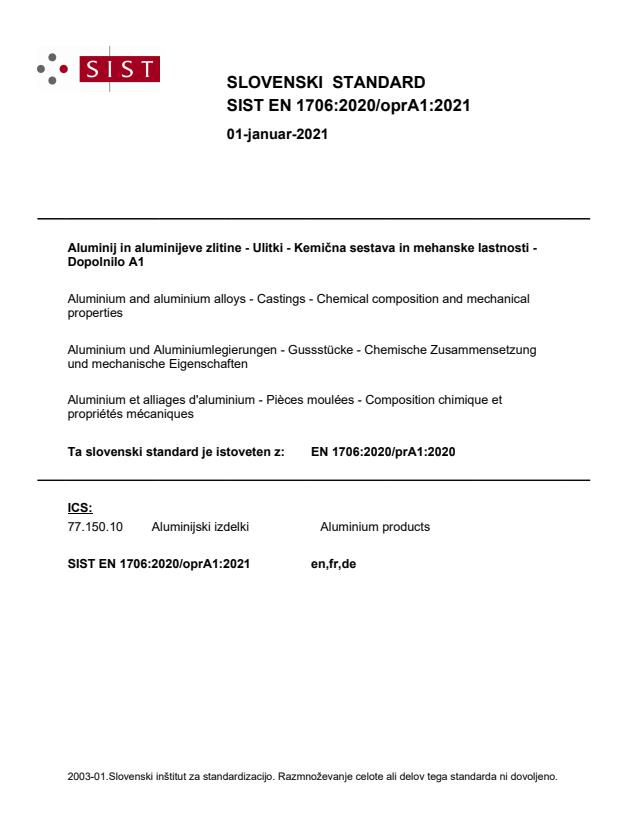
SLOVENSKI STANDARD
01-januar-2021
Aluminij in aluminijeve zlitine - Ulitki - Kemična sestava in mehanske lastnosti -
Dopolnilo A1
Aluminium and aluminium alloys - Castings - Chemical composition and mechanical
properties
Aluminium und Aluminiumlegierungen - Gussstücke - Chemische Zusammensetzung
und mechanische Eigenschaften
Aluminium et alliages d'aluminium - Pièces moulées - Composition chimique et
propriétés mécaniques
Ta slovenski standard je istoveten z: EN 1706:2020/prA1:2020
ICS:
77.150.10 Aluminijski izdelki Aluminium products
2003-01.Slovenski inštitut za standardizacijo. Razmnoževanje celote ali delov tega standarda ni dovoljeno.
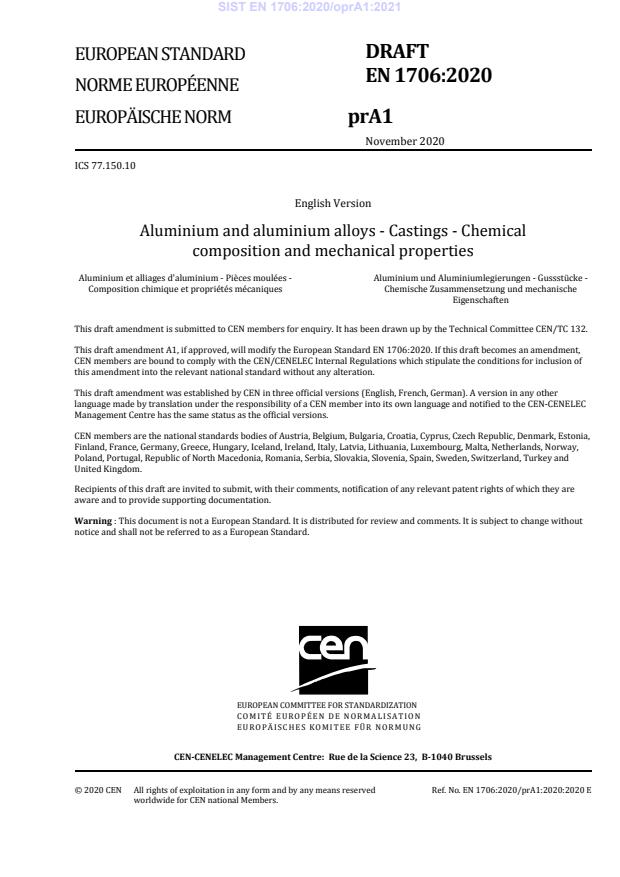
DRAFT
EUROPEAN STANDARD
EN 1706:2020
NORME EUROPÉENNE
EUROPÄISCHE NORM
prA1
November 2020
ICS 77.150.10
English Version
Aluminium and aluminium alloys - Castings - Chemical
composition and mechanical properties
Aluminium et alliages d'aluminium - Pièces moulées - Aluminium und Aluminiumlegierungen - Gussstücke -
Composition chimique et propriétés mécaniques Chemische Zusammensetzung und mechanische
Eigenschaften
This draft amendment is submitted to CEN members for enquiry. It has been drawn up by the Technical Committee CEN/TC 132.
This draft amendment A1, if approved, will modify the European Standard EN 1706:2020. If this draft becomes an amendment,
CEN members are bound to comply with the CEN/CENELEC Internal Regulations which stipulate the conditions for inclusion of
this amendment into the relevant national standard without any alteration.
This draft amendment was established by CEN in three official versions (English, French, German). A version in any other
language made by translation under the responsibility of a CEN member into its own language and notified to the CEN-CENELEC
Management Centre has the same status as the official versions.
CEN members are the national standards bodies of Austria, Belgium, Bulgaria, Croatia, Cyprus, Czech Republic, Denmark, Estonia,
Finland, France, Germany, Greece, Hungary, Iceland, Ireland, Italy, Latvia, Lithuania,
...