

SIST EN 602:2026
(Main)Aluminium and aluminium alloys - Wrought products - Chemical composition of semi-finished products used for the fabrication of articles for use in contact with foodstuff
- Abstract
This document specifies the maximum percentage content of alloying elements and impurities present in wrought aluminium and aluminium alloys which are fabricated into materials and articles designed to be in contact with foodstuff. It contains provisions for the demonstration of conformity of products with the present standard.
NOTE Materials include semi-finished products. Articles are finished goods.
- Status
- Published
- Public Enquiry End Date
- 30-May-2025
- Publication Date
- 13-Jul-2026
- Technical Committee
- INEK - Nonferrous metals
- Current Stage
- 6060 - National Implementation/Publication (Adopted Project)
- Start Date
- 09-Jul-2026
- Due Date
- 13-Sep-2026
- Completion Date
- 14-Jul-2026
SIST EN 602:2026 is the Slovenian adoption of EN 602:2026 from the Slovenski inštitut za standardizacijo (SIST) and the European Committee for Standardization (CEN). It specifies the maximum chemical content of alloying elements and impurities in wrought aluminium and wrought aluminium alloys used as semi-finished products for articles intended to come into contact with foodstuff, and it sets out how conformity is demonstrated.
What does SIST EN 602:2026 specify?
SIST EN 602:2026 specifies composition limits for wrought aluminium and wrought aluminium alloys used to make food-contact articles. It is aimed at material selection and conformity control, not at the design of the finished article itself.
The document is organized into six clauses, plus one informative annex and a bibliography:
| Annex | What it covers |
|---|---|
| Annex A | A-deviations, including a French national deviation on bismuth for food-contact aluminium materials |
Clause 1 gives the scope, Clause 2 lists the normative references, Clause 3 gives terms and definitions, Clause 4 sets the maximum permissible content of elements, Clause 5 explains selection of suitable wrought aluminium and wrought aluminium alloys, and Clause 6 covers demonstration of conformity.
What are the key requirements of SIST EN 602:2026?
Composition limits for food-contact use
Clause 4 is the core of SIST EN 602:2026. It sets maximum contents for elements in wrought aluminium and wrought aluminium alloys so that the material can be used for foodstuff applications.
- Clause 4.1 applies to wrought aluminium. In practice, this means the base metal must stay within the specified limits for iron plus silicon, copper, lead, cadmium, mercury, hexavalent chromium, and other elements.
- Clause 4.2 applies to wrought aluminium alloys. Table 2 gives the maximum content for each named element, so the user has to verify the alloy chemistry against the table before release or purchase.
- Clause 4.2 also states that no specific alloy compositions are prescribed. That means the standard sets chemical boundaries, while the actual alloy choice remains a technical decision.
Selection and conformity
Clause 5 states that the wrought aluminium or wrought aluminium alloy used for food-contact articles shall conform to Clause 4. The end product manufacturer is responsible for choosing a suitable material for the intended final use.
Conformity is established by checking the chemical composition in EN 573-3 against the limits in Clause 4. In practice, this makes supplier data and incoming material verification central to purchasing and quality control.
Clause 5 also notes that contact time, pH, temperature and other application conditions can affect suitability. For food-contact work, the alloy may meet the composition limits and still need an application-specific check against applicable legislation.
Quality assurance and certification
Clause 6 requires manufacture to be carried out within a quality assurance system. The manufacturer shall keep a procedure for controlling the requirements of Clause 4, with attention to raw-material qualification, labelling and traceability.
Clause 6 also requires an inspection certificate of type 3.1 according to EN 10204. This matters in practice because the delivered lot or shipment needs documented evidence of compliance, and the certificate can be issued periodically for up to twelve months unless otherwise agreed.
What terms does SIST EN 602:2026 define?
- Aluminium - metal with at least 99.0% aluminium by mass, with other elements limited by Table 1.
- Aluminium alloy - a metallic substance where aluminium predominates by mass, and the other elements exceed the aluminium limits given for aluminium.
- Wrought product - a product made by hot and/or cold working, such as extruding, forging, rolling or drawing.
- Semi-finished products - intermediate materials used to fabricate the final food-contact articles.
- Articles - finished goods intended to be in contact with foodstuff.
- Inspection certificate of type 3.1 - the EN 10204 document used here to certify compliance of delivered products.
Who uses SIST EN 602:2026?
SIST EN 602:2026 is used by producers of wrought aluminium and wrought aluminium alloys, especially when their products are supplied for food-contact applications. It is also used by manufacturers of finished food-contact articles, such as packaging or other consumer products, who need to choose compliant semi-finished material.
Quality assurance teams, incoming inspectors, purchasing departments and laboratories use it to check chemical composition, traceability and certification. Buyers and specifiers use it to confirm that a proposed aluminium material fits the intended food-contact use and the applicable documentary controls.
What changed in SIST EN 602:2026 from the previous edition?
SIST EN 602:2026 supersedes EN 602:2004. The foreword identifies these technical changes:
- reference to lead was added in Table 1
- a bismuth limit was added in Table 2
- the nickel limit at 3.0% was deleted from Table 2
- a reference was added to Directive 94/62/EC and its 2018 amendment on packaging and packaging waste
Which standards are used with SIST EN 602:2026?
- EN 573-3 - provides the chemical composition standard used to check wrought products against the limits in this document.
- EN 10204 - defines inspection documents, including the type 3.1 certificate required for conformity demonstration.
- EN 12258-1 - provides the general terms and definitions used for aluminium and aluminium alloys.
What does the SIST EN 602:2026 document contain?
The document contains composition tables for wrought aluminium and wrought aluminium alloys, with the detailed limits placed in Table 1 and Table 2. It also contains the selection rule in Clause 5 and the conformity procedure in Clause 6, which together link material choice, supplier data and certification.
Annex A gives an informative A-deviation for France, including a national bismuth limit for certain food-contact aluminium products. The bibliography points to food-contact law, good manufacturing practice, packaging-waste legislation and supporting toxicology references behind the revised limits.
Relations
- Effective Date
- 08-Jul-2026
- Effective Date
- 08-Jul-2026
- Effective Date
- 08-Jul-2026
- Effective Date
- 08-Jul-2026
- Effective Date
- 08-Jul-2026
- Effective Date
- 08-Jul-2026
- Effective Date
- 08-Jul-2026
- Effective Date
- 08-Jul-2026
- Effective Date
- 07-Jun-2023
Get Certified
Connect with accredited certification bodies for this standard

BSI Group
BSI (British Standards Institution) is the business standards company that helps organizations make excellence a habit.

Bureau Veritas
Bureau Veritas is a world leader in laboratory testing, inspection and certification services.

DNV
DNV is an independent assurance and risk management provider.
Sponsored listings
Frequently Asked Questions
SIST EN 602:2026 is a standard published by the Slovenian Institute for Standardization (SIST). Its full title is "Aluminium and aluminium alloys - Wrought products - Chemical composition of semi-finished products used for the fabrication of articles for use in contact with foodstuff". This standard covers: This document specifies the maximum percentage content of alloying elements and impurities present in wrought aluminium and aluminium alloys which are fabricated into materials and articles designed to be in contact with foodstuff. It contains provisions for the demonstration of conformity of products with the present standard. NOTE Materials include semi-finished products. Articles are finished goods.
This document specifies the maximum percentage content of alloying elements and impurities present in wrought aluminium and aluminium alloys which are fabricated into materials and articles designed to be in contact with foodstuff. It contains provisions for the demonstration of conformity of products with the present standard. NOTE Materials include semi-finished products. Articles are finished goods.
SIST EN 602:2026 is classified under the following ICS (International Classification for Standards) categories: 67.250 - Materials and articles in contact with foodstuffs; 77.150.10 - Aluminium products. The ICS classification helps identify the subject area and facilitates finding related standards.
SIST EN 602:2026 has the following relationships with other standards: It is inter standard links to SIST EN 573-3:2019+A1:2022, SIST EN 541:2007, SIST EN 14392:2008, SIST EN 485-1:2016, SIST EN 851:2022, SIST EN 14095:2004, SIST EN 573-3:2019, SIST EN 851:2014, SIST EN 602:2004. Understanding these relationships helps ensure you are using the most current and applicable version of the standard.
SIST EN 602:2026 is available in PDF format for immediate download after purchase. The document can be added to your cart and obtained through the secure checkout process. Digital delivery ensures instant access to the complete standard document.
Standards Content (Sample)
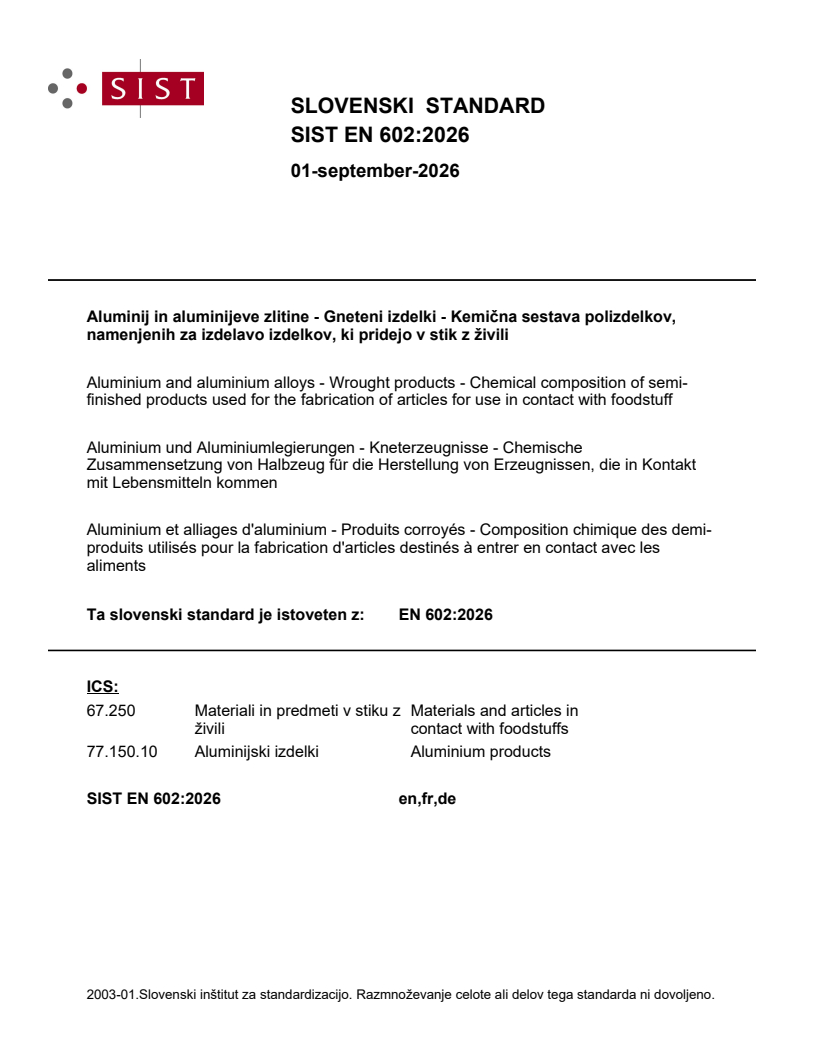
SLOVENSKI STANDARD
01-september-2026
Aluminij in aluminijeve zlitine - Gneteni izdelki - Kemična sestava polizdelkov,
namenjenih za izdelavo izdelkov, ki pridejo v stik z živili
Aluminium and aluminium alloys - Wrought products - Chemical composition of semi-
finished products used for the fabrication of articles for use in contact with foodstuff
Aluminium und Aluminiumlegierungen - Kneterzeugnisse - Chemische
Zusammensetzung von Halbzeug für die Herstellung von Erzeugnissen, die in Kontakt
mit Lebensmitteln kommen
Aluminium et alliages d'aluminium - Produits corroyés - Composition chimique des demi-
produits utilisés pour la fabrication d'articles destinés à entrer en contact avec les
aliments
Ta slovenski standard je istoveten z: EN 602:2026
ICS:
67.250 Materiali in predmeti v stiku z Materials and articles in
živili contact with foodstuffs
77.150.10 Aluminijski izdelki Aluminium products
2003-01.Slovenski inštitut za standardizacijo. Razmnoževanje celote ali delov tega standarda ni dovoljeno.
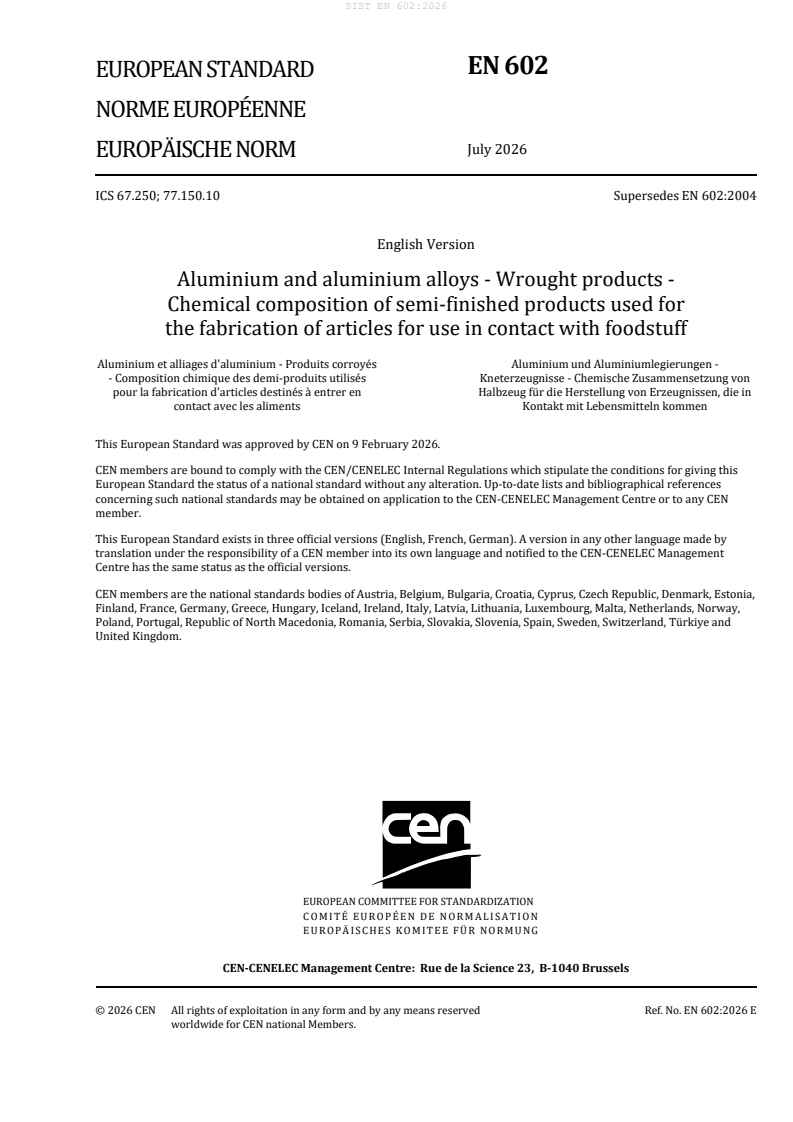
EN 602
EUROPEAN STANDARD
NORME EUROPÉENNE
July 2026
EUROPÄISCHE NORM
ICS 67.250; 77.150.10 Supersedes EN 602:2004
English Version
Aluminium and aluminium alloys - Wrought products -
Chemical composition of semi-finished products used for
the fabrication of articles for use in contact with foodstuff
Aluminium et alliages d'aluminium - Produits corroyés Aluminium und Aluminiumlegierungen -
- Composition chimique des demi-produits utilisés Kneterzeugnisse - Chemische Zusammensetzung von
pour la fabrication d'articles destinés à entrer en Halbzeug für die Herstellung von Erzeugnissen, die in
contact avec les aliments Kontakt mit Lebensmitteln kommen
This European Standard was approved by CEN on 9 February 2026.
CEN members are bound to comply with the CEN/CENELEC Internal Regulations which stipulate the conditions for giving this
European Standard the status of a national standard without any alteration. Up-to-date lists and bibliographical references
concerning such national standards may be obtained on application to the CEN-CENELEC Management Centre or to any CEN
member.
This European Standard exists in three official versions (English, French, German). A version in any other language made by
translation under the responsibility of a CEN member into its own language and notified to the CEN-CENELEC Management
Centre has the same status as the official versions.
CEN members are the national standards bodies of Austria, Belgium, Bulgaria, Croatia, Cyprus, Czech Republic, Denmark, Estonia,
Finland, France, Germany, Greece, Hungary, Iceland, Ireland, Italy, Latvia, Lithuania, Luxembourg, Malta, Netherlands, Norway,
Poland, Portugal, Republic of North Macedonia, Romania, Serbia, Slovakia, Slovenia, Spain, Sweden, Switzerland, Türkiye and
United Kingdom.
EUROPEAN COMMITTEE FOR STANDARDIZATION
COMITÉ EUROPÉEN DE NORMALISATION
EUROPÄISCHES KOMITEE FÜR NORMUNG
CEN-CENELEC Management Centre: Rue de la Science 23, B-1040 Brussels
© 2026 CEN All rights of exploitation in any form and by any means reserved Ref. No. EN 602:2026 E
worldwide for CEN national Members.
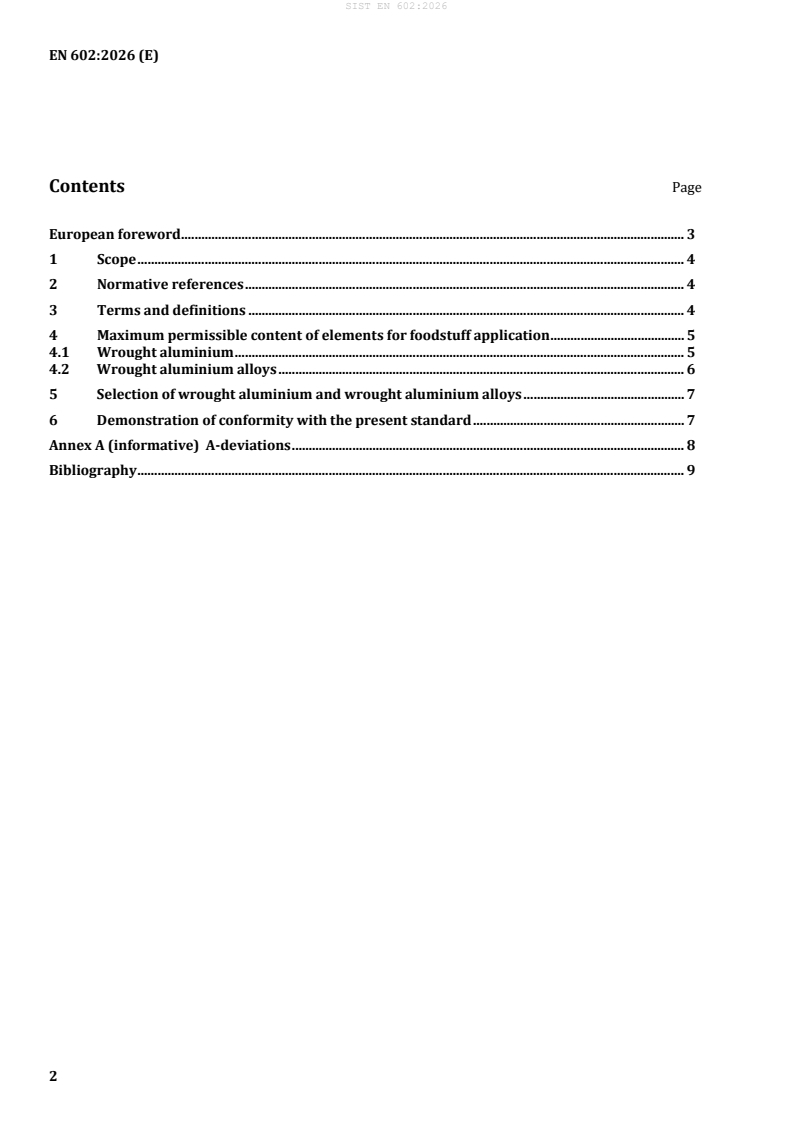
Contents Page
European foreword . 3
1 Scope . 4
2 Normative references . 4
3 Terms and definitions . 4
4 Maximum permissible content of elements for foodstuff application . 5
4.1 Wrought aluminium . 5
4.2 Wrought aluminium alloys . 6
5 Selection of wrought aluminium and wrought aluminium alloys . 7
6 Demonstration of conformity with the present standard . 7
Annex A (informative) A-deviations . 8
Bibliography . 9
European foreword
This document (EN 602:2026) has been prepared by Technical Committee CEN/TC 132 “Aluminium and
aluminium alloys”, the secretariat of which is held by AFNOR.
This European Standard shall be given the status of a national standard, either by publication of an identical
text or by endorsement, at the latest by January 2027, and conflicting national standards shall be withdrawn
at the latest by January 2027.
Attention is drawn to the possibility that some of the elements of this document may be the subject of patent
rights. CEN shall not be held responsible for identifying any or all such patent rights.
This document supersedes EN 602:2004.
— Addition of reference to lead element in Table 1 ;
— Addition of bismuth element limitation in Table 2 ;
— Deletion of nickel element limitation at 3,0 % from Table 2 ;
— Reference to European Parliament and Council Directive 94/62/EC of 20 December 1994 and its
amendment from 2018 on packaging and packaging waste.
Any feedback and questions on this document should be directed to the users’ national standards body. A
complete listing of these bodies can be found on the CEN website.
According to the CEN-CENELEC Internal Regulations, the national standards organisations of the following
countries are bound to implement this European Standard: Austria, Belgium, Bulgaria, Croatia, Cyprus, Czech
Republic, Denmark, Estonia, Finland, France, Germany, Greece, Hungary, Iceland, Ireland, Italy, Latvia,
Lithuania, Luxembourg, Malta, Netherlands, Norway, Poland, Portugal, Republic of North Macedonia,
Romania, Serbia, Slovakia, Slovenia, Spain, Sweden, Switzerland, Türkiye and the United Kingdom.
1 Scope
This document specifies the maximum percentage content of alloying elements and impurities present in
wrought aluminium and aluminium alloys which are fabricated into materials and articles designed to be in
contact with foodstuff. It contains provisions for the demonstration of conformity of products with the present
standard.
NOTE Materials include semi-finished products. Articles are finished goods.
2 Normative references
The following documents are referred to in the text in such a way that some or all of their content constitutes
requirements of this document. For dated references, only the edition cited applies. For undated references,
the latest edition of the referenced document (including any amendments) applies.
EN 573-3, Aluminium and aluminium alloys — Chemical composition and form of wrought products — Part 3:
Chemical composition
EN 10204, Metallic products - Types of inspection documents
EN 12258-1, Aluminium and aluminium alloys - Terms and definitions - Part 1: General terms
3 Terms and definitions
For the purposes of this document the terms and definitions given in EN 12258-1 and the following apply.
ISO and IEC maintain terminology databases for use in standardization at the following addresses:
— ISO Online browsing platform: available at https://www.iso.org/obp/
— IEC Electropedia: available at https://www.electropedia.org/
3.1
aluminium
metal with a minimum content of 99,0 % by mass of aluminium, provided that the content by mass of any
...