

oSIST prEN 18293:2026
(Main)Outdoor hydrogen refuelling points dispensing liquid hydrogen and incorporating fuelling protocols
General Information
- Abstract
This document defines the minimum requirements to ensure the interoperability of hydrogen refuelling points, including refuelling protocols that dispense liquid hydrogen to road vehicles that comply with legislation applicable to such vehicles. This document focuses on heavy-duty vehicles as defined in Regulation (EU) 2023/1804.
The safety and performance requirements for the entire hydrogen fuelling station, addressed in accordance with existing relevant European and national legislation, are not included in this document.
This document applies to hydrogen refuelling points and dispensing systems providing liquid hydrogen to vehicles compliant with Regulation (EU) 2019/2144.
NOTE Guidance on considerations for hydrogen fuelling stations is provided in ISO 13984:2026.
- Status
- Not Published
- Public Enquiry End Date
- 01-Apr-2026
- Technical Committee
- TLP - Pressure vessels
- Current Stage
- 4020 - Public enquire (PE) (Adopted Project)
- Start Date
- 19-Jan-2026
- Due Date
- 08-Jun-2026
- Completion Date
- 03-Apr-2026

Overview
oSIST prEN 18293:2026 is a draft European Standard developed by CEN that specifies the minimum requirements for outdoor hydrogen refuelling points dispensing liquid hydrogen to heavy-duty road vehicles. The standard is designed to ensure interoperability across hydrogen fuelling infrastructure, focusing on refuelling protocols for liquid hydrogen in compliance with EU vehicle regulations, particularly targeting vehicles defined in Regulation (EU) 2023/1804 and Regulation (EU) 2019/2144.
This standard addresses the needs of a rapidly growing hydrogen mobility sector in Europe by defining technical requirements and fuelling protocol specifications. It excludes safety and performance criteria for entire hydrogen fuelling stations, directing users to other relevant legislation and standards for those aspects.
Key Topics
Interoperability Requirements
- Defines criteria ensuring hydrogen refuelling points can serve all compliant heavy-duty vehicles.
- Interoperability covers connector design, fuel quality, pressure, and temperature limits.
Fuelling Protocols
- Establishes technical conditions to perform safe and effective liquid hydrogen dispensing.
- Protocols must adhere to ISO 13984 or be validated and communicated to vehicle manufacturers.
- Includes measures for leak detection, pressure control, and purging before and after fuelling.
System Characteristics
- Specifies necessary features for dispensing systems, such as filtration to meet EN 17124 quality standards, and robust control against over-pressure and incompatible refuelling.
Inspection and Validation
- Details requirements for factory and site acceptance testing to verify each refuelling point’s compliance and interoperability.
- Periodic inspections are mandated after modifications or maintenance operations impacting interoperability.
Vehicle Compatibility
- Only vehicles compliant with Regulation (EU) 2019/2144 are to be fuelled unless risks are adequately assessed and managed.
Applications
Hydrogen Mobility Deployment
- Provides essential requirements for operators, vehicle manufacturers, and infrastructure developers establishing hydrogen fuelling points for heavy-duty vehicles.
Supporting an EU-wide Hydrogen Corridor
- Facilitates seamless cross-border hydrogen vehicle operation by ensuring consistent refuelling protocols and connection standards.
Quality and Safety Assurance
- Mandates the use of fuel quality filtration and process controls to protect vehicles and stations, supporting reliable and safe hydrogen use.
Regulatory Compliance
- Helps stakeholders align with EU mandates for alternative fuel infrastructure as set out in Regulation (EU) 2023/1804, improving investment certainty and public adoption.
Technology Platform Development
- Enables industry players to develop future-proof hydrogen refuelling infrastructure that accommodates new generations of heavy-duty hydrogen vehicles.
Related Standards
- EN 17124: Covers product specification and quality assurance for hydrogen refuelling points dispensing gaseous hydrogen.
- EN ISO 25578: Addresses connectors for hydrogen refuelling points dispensing liquid hydrogen.
- ISO 13984: Provides guidance and requirements on fuelling protocols for liquid hydrogen land vehicles.
- ISO 13985: Specifies requirements for liquid hydrogen vehicle fuel storage systems.
- EN 16942: Outlines labelling requirements for alternative fuels, including hydrogen, at refuelling stations.
- ISO 19880-1: Details safety and testing procedures for gaseous hydrogen fuelling stations.
oSIST prEN 18293:2026 is a critical reference for ensuring that Europe’s hydrogen refuelling infrastructure is interoperable, reliable, and ready to support the transition to hydrogen-powered heavy-duty vehicles. This makes it essential for anyone involved in hydrogen infrastructure planning, construction, and operation.
Get Certified
Connect with accredited certification bodies for this standard

DNV
DNV is an independent assurance and risk management provider.

Lloyd's Register
Lloyd's Register is a global professional services organisation specialising in engineering and technology.
DNV Energy Systems
Energy and renewable energy certification.
Sponsored listings
Frequently Asked Questions
oSIST prEN 18293:2026 is a draft published by the Slovenian Institute for Standardization (SIST). Its full title is "Outdoor hydrogen refuelling points dispensing liquid hydrogen and incorporating fuelling protocols". This standard covers: This document defines the minimum requirements to ensure the interoperability of hydrogen refuelling points, including refuelling protocols that dispense liquid hydrogen to road vehicles that comply with legislation applicable to such vehicles. This document focuses on heavy-duty vehicles as defined in Regulation (EU) 2023/1804. The safety and performance requirements for the entire hydrogen fuelling station, addressed in accordance with existing relevant European and national legislation, are not included in this document. This document applies to hydrogen refuelling points and dispensing systems providing liquid hydrogen to vehicles compliant with Regulation (EU) 2019/2144. NOTE Guidance on considerations for hydrogen fuelling stations is provided in ISO 13984:2026.
This document defines the minimum requirements to ensure the interoperability of hydrogen refuelling points, including refuelling protocols that dispense liquid hydrogen to road vehicles that comply with legislation applicable to such vehicles. This document focuses on heavy-duty vehicles as defined in Regulation (EU) 2023/1804. The safety and performance requirements for the entire hydrogen fuelling station, addressed in accordance with existing relevant European and national legislation, are not included in this document. This document applies to hydrogen refuelling points and dispensing systems providing liquid hydrogen to vehicles compliant with Regulation (EU) 2019/2144. NOTE Guidance on considerations for hydrogen fuelling stations is provided in ISO 13984:2026.
oSIST prEN 18293:2026 is classified under the following ICS (International Classification for Standards) categories: 27.075 - Hydrogen technologies; 75.160.20 - Liquid fuels. The ICS classification helps identify the subject area and facilitates finding related standards.
oSIST prEN 18293:2026 is associated with the following European legislation: EU Directives/Regulations: 2014/94/EU, 2023/1804; Standardization Mandates: M/581. When a standard is cited in the Official Journal of the European Union, products manufactured in conformity with it benefit from a presumption of conformity with the essential requirements of the corresponding EU directive or regulation.
oSIST prEN 18293:2026 is available in PDF format for immediate download after purchase. The document can be added to your cart and obtained through the secure checkout process. Digital delivery ensures instant access to the complete standard document.
Standards Content (Sample)
SLOVENSKI STANDARD
01-marec-2026
[Not translated]
Outdoor hydrogen refuelling points dispensing liquid hydrogen and incorporating fuelling
protocols
Wasserstofftankstellen im Außenbereich zur Abgabe flüssigen Wasserstoffs und
Betankungsprotokolle umfassend
Points de ravitaillement en hydrogène en extérieur distribuant de l'hydrogène liquide et
intégrant des protocoles de remplissage
Ta slovenski standard je istoveten z: prEN 18293
ICS:
27.075 Tehnologija vodika Hydrogen technologies
2003-01.Slovenski inštitut za standardizacijo. Razmnoževanje celote ali delov tega standarda ni dovoljeno.
DRAFT
EUROPEAN STANDARD
prEN 18293
NORME EUROPÉENNE
EUROPÄISCHE NORM
January 2026
ICS 27.075
English Version
Outdoor hydrogen refuelling points dispensing liquid
hydrogen and incorporating fuelling protocols
Points de ravitaillement en hydrogène en extérieur Wasserstofftankstellen im Außenbereich zur Abgabe
distribuant de l'hydrogène liquide et intégrant des flüssigen Wasserstoffs und Betankungsprotokolle
protocoles de remplissage umfassend
This draft European Standard is submitted to CEN members for enquiry. It has been drawn up by the Technical Committee
CEN/TC 268.
If this draft becomes a European Standard, CEN members are bound to comply with the CEN/CENELEC Internal Regulations
which stipulate the conditions for giving this European Standard the status of a national standard without any alteration.
This draft European Standard was established by CEN in three official versions (English, French, German). A version in any other
language made by translation under the responsibility of a CEN member into its own language and notified to the CEN-CENELEC
Management Centre has the same status as the official versions.
CEN members are the national standards bodies of Austria, Belgium, Bulgaria, Croatia, Cyprus, Czech Republic, Denmark, Estonia,
Finland, France, Germany, Greece, Hungary, Iceland, Ireland, Italy, Latvia, Lithuania, Luxembourg, Malta, Netherlands, Norway,
Poland, Portugal, Republic of North Macedonia, Romania, Serbia, Slovakia, Slovenia, Spain, Sweden, Switzerland, Türkiye and
United Kingdom.
Recipients of this draft are invited to submit, with their comments, notification of any relevant patent rights of which they are
aware and to provide supporting documentation.
Warning : This document is not a European Standard. It is distributed for review and comments. It is subject to change without
notice and shall not be referred to as a European Standard.
EUROPEAN COMMITTEE FOR STANDARDIZATION
COMITÉ EUROPÉEN DE NORMALISATION
EUROPÄISCHES KOMITEE FÜR NORMUNG
CEN-CENELEC Management Centre: Rue de la Science 23, B-1040 Brussels
© 2026 CEN All rights of exploitation in any form and by any means reserved Ref. No. prEN 18293:2026 E
worldwide for CEN national Members.
prEN 18293:2026 (E)
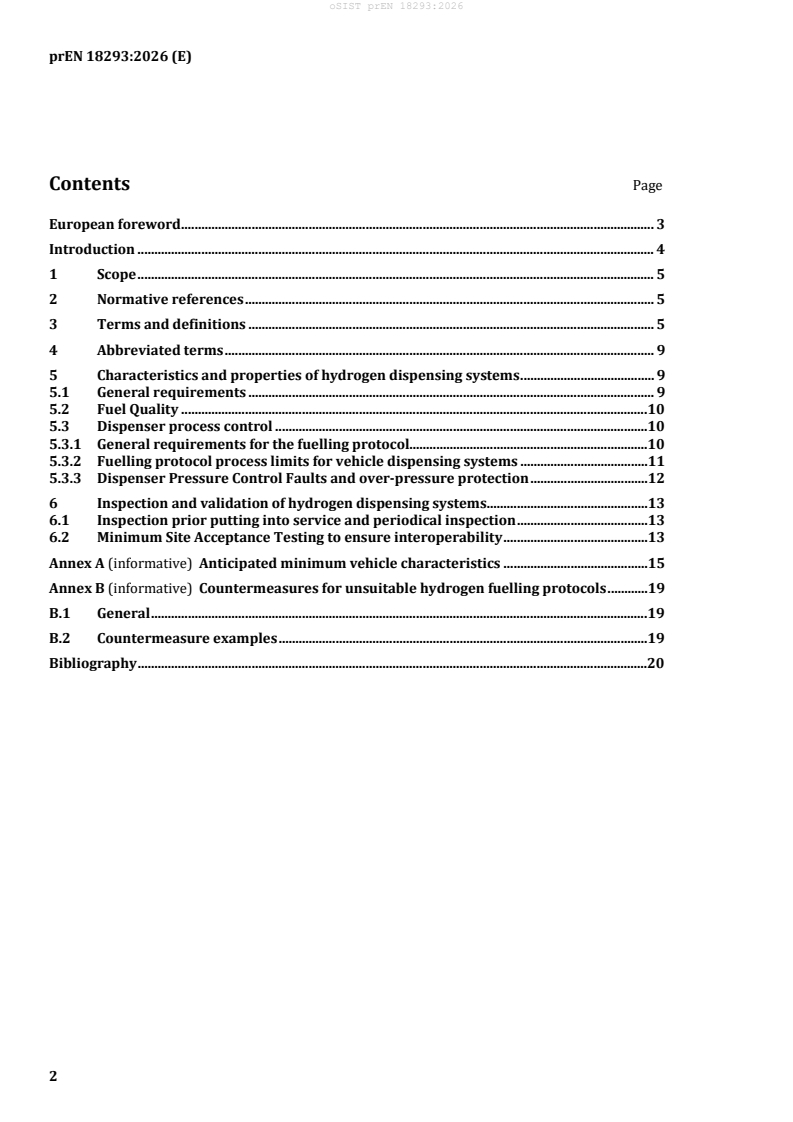
Contents Page
European foreword . 3
Introduction . 4
1 Scope . 5
2 Normative references . 5
3 Terms and definitions . 5
4 Abbreviated terms . 9
5 Characteristics and properties of hydrogen dispensing systems . 9
5.1 General requirements . 9
5.2 Fuel Quality .10
5.3 Dispenser process control .10
5.3.1 General requirements for the fuelling protocol.10
5.3.2 Fuelling protocol process limits for vehicle dispensing systems .11
5.3.3 Dispenser Pressure Control Faults and over-pressure protection .12
6 Inspection and validation of hydrogen dispensing systems .13
6.1 Inspection prior putting into service and periodical inspection .13
6.2 Minimum Site Acceptance Testing to ensure interoperability .13
Annex A (informative) Anticipated minimum vehicle characteristics .15
Annex B (informative) Countermeasures for unsuitable hydrogen fuelling protocols .19
B.1 General .19
B.2 Countermeasure examples .19
Bibliography .20
prEN 18293:2026 (E)
European foreword
This document (prEN 18293:2026) has been prepared by Technical Committee CEN/TC 268 “Cryogenic
vessels and specific hydrogen technologies applications”, the secretariat of which is held by AFNOR.
This document is currently submitted to the CEN Enquiry.
This document has been prepared under a standardization request addressed to CEN by the European
Commission. The Standing Committee of the EFTA States subsequently approves these requests for its
Member States.
prEN 18293:2026 (E)
Introduction
The European Commission in its standardization requests M/533 of March 12th, 2015 and M/581 of
March 24th, 2022 aims to ensure that technical specifications for interoperability of refuelling points are
specified in European Standards compatible with the relevant International Standards. These
specifications aim to meet the European needs, be compatible and aligned as much as possible with
relevant International Standards and as far as possible with existing refuelling infrastructure already in
place and leave room to accommodate the adopted standard to local technical, analytical and regulatory
needs. The requested European Standards aim to be technologically and commercially neutral and based
on the know-how currently in the possession of the EU industry and of the public sector on a fair,
reasonable and non-discriminatory basis.
According to the legal requirements given in the new EU Regulation (EU) 2023/1804 repealing the
Directive 2014/94/EU (AFIR) and M/533 and M/581, European Standards specifying only the required
specifications for ensuring the interoperability of refuelling points are expected to be provided. European
standards and common requirements with respect to “interoperability” mean the capability of an
infrastructure to supply energy (in this document, hydrogen) that is compatible with all vehicle
technologies and allows seamless EU-wide mobility and a clear definition of fuel pressure and
temperature levels and connector designs.
The European Standardization Organizations (ESOs) adopt European Standards in accordance with
Article 10 of Regulation (EU) No 1025/2012 of the European Parliament and of the Council, and those
standards are based on current International Standards or ongoing international standardization work,
where applicable.
Directions from the standardization request M/581 for European Standards for hydrogen supply are to
develop European Standards containing technical solutions for interoperability with technical
specifications in regard to Article 6 and point 3 of Annex II, in particular for:
a) hydrogen purity dispensed by hydrogen refuelling points;
b) fuelling algorithms and equipment of hydrogen refuelling points;
c) connectors for refuelling points dispensing liquid hydrogen for heavy-duty vehicles.
This document specifies Item b).
Item a) is covered by EN 17124 and Item c) by EN ISO 25578.
This document also addresses the standardization request M/581 for a European standard supporting
an interoperable infrastructure for hydrogen supply for road transport and containing technical
specifications with a unified solution for hydrogen refuelling points dispensing liquid hydrogen for heavy
duty vehicles.
prEN 18293:2026 (E)
1 Scope
This document defines the minimum requirements to ensure the interoperability of hydrogen refuelling
points, including refuelling protocols that dispense liquid hydrogen to road vehicles that comply with
legislation applicable to such vehicles. This document focuses on heavy-duty vehicles as defined in
Regulation (EU) 2023/1804.
The safety and performance requirements for the entire hydrogen fuelling station, addressed in
accordance with existing relevant European and national legislation, are not included in this document.
This document applies to hydrogen refuelling points and dispensing systems providing liquid hydrogen
to vehicles compliant with Regulation (EU) 2019/2144.
NOTE Guidance on considerations for hydrogen fuelling stations is provided in ISO 13984:— .
2 Normative references
The following documents are referred to in the text in such a way that some or all of their content
constitutes requirements of this document. For dated references, only the edition cited applies. For
undated references, the latest edition of the referenced document (including any amendments) applies.
EN 17124, Hydrogen fuel — Product specification and quality assurance for hydrogen refuelling points
dispensing gaseous hydrogen — Proton exchange membrane (PEM) fuel cell applications for vehicles
ISO 13984, Liquid hydrogen — Land vehicle fueling protocol
ISO 13985:— , Liquid hydrogen — Land vehicle fuel storage system
3 Terms and definitions
For the purposes of this document, the following terms and definitions apply.
ISO and IEC maintain terminology databases for use in standardization at the following addresses:
— IEC Electropedia: available at https://www.electropedia.org/
— ISO Online browsing platform: available at https://www.iso.org/obp
3.1
liquefied hydrogen storage system
LHSS
system that stores the liquid hydrogen, allows its fuelling from a dispenser, allows its feeding to a
hydrogen conversion system and maintains integrity and safety
Note1 to entry: It is composed of the liquefied hydrogen storage container(s), pressure relief devices, shut-off
devices, check-valves, boil-off valve and interconnection pipings and fittings between the above components, on-
board vehicle, as defined in ISO 13985.
[SOURCE: ISO 13984:—]
Under preparation. Current stage is: ISO/FDIS 13984:2025.
Under preparation. Current stage is: ISO/DIS 13985:2025.
prEN 18293:2026 (E)
3.2
backgas
gaseous hydrogen flowing back from the vehicle to the fuelling station during the fuelling process
[SOURCE: ISO 13984:—]
3.3
dispenser
equipment of the hydrogen fuelling station, including the dispenser cabinet(s) and support structure, that
is physically located in the fuelling area
Note 1 to entry: The hydrogen dispenser typically includes, as a minimum, one or more fuelling assemblies
consisting of a nozzle, hose and break-away coupling, required temperature and pressure instrumentation, filters,
and the user interface to conduct vehicle fuelling.
Note 2 to entry: The manufacturer of the hydrogen dispenser can elect to include additional equipment in the
dispenser, including the possibility of all equipment of the hydrogen fuelling station.
3.4
dispenser cabinet
protective housing that encloses process piping and can also enclose measurement, control and ancillary
dispenser equipment
[SOURCE: ISO 19880-1:2020]
3.5
dispenser fuel pressure
pressure of the hydrogen supplied to the vehicle by the nozzle(s) it is connected to
Note 1 to entry: See Annex A for discussion of pressure terminology and its application to dispensing systems.
3.6
dispenser fuel temperature
temperature of the hydrogen gas supplied to the vehicle by the nozzle(s) it is connected to
3.7
hydrogen refuelling point
refuelling facility for the provision of any gaseous hydrogen, through a fixed or mobile installation, which
is capable of refuelling only one road vehicle at a time
[SOURCE: Regulation (EU) 2023/1804]
3.8
dispensing system
system comprising all equipment and control systems necessary to specifically carry out the vehicle
fuelling operation using a fuelling protocol, through which the liquid hydrogen is supplied to the vehicle
and which transferred quantity may be measured
3.9
liquid hydrogen fuelling station
station
facility for the dispensing of liquid hydrogen, often referred to as a hydrogen refuelling station (HRS) or
hydrogen filling station, including the supply, transfer, storage and dispensing systems
prEN 18293:2026 (E)
3.10
interoperability
capability of a hydrogen refuelling point to supply hydrogen at the fuelling station/vehicle interface that
is compatible with road vehicles and allows seamless EU-wide mobility through applying clear definitions
of connector designs, fuel quality, pressure levels, temperatures and other applicable considerations
3.11
liquid hydrogen
LH2
hydrogen that has been liquefied, i.e. brought to a liquid state
[SOURCE: ISO 13984:—]
3.12
maximum allowable working pressure
MAWP
maximum pressure permissible in a vessel or system at the temperature specified for the pressure
Note 1 to entry: The maximum allowable working pressure can also be defined as the design pressure, the
maximum allowable operating pressure, the maximum permissible working pressure, or the maximum allowable
pressure for the rating of pressure vessels and equipment manufactured in accordance with national pressure
vessel codes.
Note 2 to entry: See Annex A for application of pressure terminology to hydrogen dispenser systems and vehicles.
3.13
Maximum fuelling pressure
MFP
maximum pressure expected during a normal (fault-free) vehicle fuelling
Note 1 to entry: Further guidance on pressure terminology is included in Annex D.
[SOURCE: ISO 19880-1:2020, 3.47, modified – different notes]
3.14
maximum operating pressure
MOP
highest pressure that is expected for a component or system during normal operation including
anticipated transients
Note 1 to entry: See Annex A for application of pressure terminology to hydrogen dispenser systems and vehicles.
3.15
pressure relief valve
PRV
pressure activated valve that opens at specified set point to protect a system from rupture and re-closes
when the pressure falls below the set point and which can reclose above the MOP
prEN 18293:2026 (E)
3.16
fuelling protocol
technical descriptions, instructions, or constructs that define how the dispensing of liquid hydrogen to
storage systems on vehicles should be conducted and that serves as the basis for defining control
strategies and algorithms for implementation in the basic process control of the dispensing control
system hardware and software
Note 1 to entry: Fuelling protocols can range from simple descriptions that can be performed in hardware to
complex programmable control functions using prescribed values, tables, and/or reduced-order models as well as
conventional process controls such as feed-forward/feedback and predictor/corrector control functions.
Note 2 to entry: A fuelling protocol can be also referred to as a fuelling algorithm.
3.17
target pressure
P
target
dispenser fuel pressure that the hydrogen fuelling protocol targets for the end of refuelling. The pressure
measurement is the closest from the hose assembly
3.18
vehicle fuel system
VFS
LHSS fuel system
assembly of components used to store or supply hydrogen fuel to a fuel cell (FC) or internal combustion
engine (ICE), according to GTR#13
Note 1 to entry: The fuel system typically includes one or more LHSS, receptacles, interconnecting lines, boil-off gas
management system
[SOURCE: ISO 13984:—]
3.19
verification
evaluation using subscale and full-scale tests, analyses, or a combination of tests and analyses that that a
product, service, or system complies with a regulations, requirements, specifications, or imposed
conditions
Note 1 to entry: Verification is typically conducted as part of the development process.
prEN 18293:2026 (E)
4 Abbreviated terms
FAT Factory Acceptance Test
LHSS Liquefied Hydrogen Storage System
LH2 Liquid Hydrogen
MAWP Maximum Allowable Working Pressure
MFP Maximum Fuelling Pressure
MOP Maximum Operating Pressure
PRV Pressure Relief Valve
SAT Site Acceptance Test
SDO Standards Development Organization
VFS Vehicle Fuel System
5 Characteristics and properties of hydrogen dispensing systems
5.1 General requirements
The hydrogen dispensing system shall be able to refuel liquid hydrogen vehicles certified according to
Regulation (EU) 2019/2144 and ISO 13985:— and in particular be in conformance with its Clause A.1
LHSS requirements without compromising their specification limits.
The vehicle fuel system shall be equipped with a receptacle according to an approved LH2 connector
standard and with the appropriate MAWP for the application.
Until an appropriate European Standard on LH connectors is available, the fuelling connector shall have
an MAWP suitable for the application and follow the recognized state of the art.
NOTE 1 At the time of publication of this European Standard, ISO standardization activities for the connector
were ongoing.
NOTE 2 Assumptions made on the minimum characteristics of the hydrogen vehicle necessary to ensure
interoperability with the dispensing systems defined in this document are outlined in Annex A.
Hydrogen dispensing systems that would potentially be harmful to vehicles compliant with Regulation
(EU) 2019/2144 (for example, due to the protocol used) shall use countermeasures to prevent unsafe
refuelling from occurring.
NOTE 3 Examples of countermeasures that can be employed to prevent vehicles refuelling at dispensing systems
where the protocol could be unsafe for vehicles compliant with Regulation (EU) 2019/2144 are provided in
Annex B.
The vehicle should have means to monitor the LHSS initial conditions. If these are not compatible with
the fuelling protocol intended to be used, for example leakage detection or initial pressure too low,
measures should be provided on the vehicle to prevent refuelling. Vehicle risk assessment shall
determine these measures. Before refuelling and for the duration of refuelling the vehicle should
additionally be secured against rolling.
Instructions for use of the hydrogen refuelling point by the general public shall be included on or in the
vicinity of each dispenser. The fuel (i.e. liquid hydrogen) shall be clearly indicated. Dispenser operation
instructions for dispensing hydrogen into a vehicle may be displayed as markings or as an electronic
display at the dispenser.
prEN 18293:2026 (E)
These instructions shall include prohibitions against:
— the use of adapters (e.g. alternative fuel nozzles);
— the refuelling of cylinder systems (whether in a vehicle or not) that are incompatible with the fuelling
protocol employed at the dispensing system, see 5.3.
NOTE 4 EN 16942 includes information on labelling requirements for hydrogen refuelling points, and hydrogen
vehicles, in Europe.
The nozzle shall be free of moisture or ice, that could be transferred to the vehicle fuel system, before
being released to the customer.
The dispensing system shall prevent any transfer of fluid until all locking mechanisms are secured and
all station systems controls are ready.
The fuelling station shall be able to detect the presence of a warm LHSS. Means shall be considered to
prevent a warm LHSS from reaching the opening pressure of its first PRV due to rapid pressurization, for
example, but not limited to: minimal initial flow rate, subsequent automatic venting, etc.
The dispenser shall be protected from vehicle collision damage.
5.2 Fuel Quality
The hydrogen quality at the nozzle shall meet the requirements of EN 17124.
To prevent hydrogen containing function-impairing impurities (i.e. particulates) that would affect the
liquid hydrogen storage system of the vehicle, specifically the vehicle LHSS valves, hydr
...