


oSIST prEN 10160:2026
(Main)Non-destructive testing - Ultrasonic testing of steel flat product of thickness equal or greater than 5 mm (reflection method)
Non-destructive testing - Ultrasonic testing of steel flat product of thickness equal or greater than 5 mm (reflection method)
This document describes a method for the ultrasonic testing of uncoated flat steel product for internal discontinuities.
This document is applicable to flat product in nominal thickness range of 5 mm to 200 mm of non-alloyed or alloyed steel, excluding austenitic or austenoferritic steels. However, this document can be applied to the latter types of steels provided that the difference between the amplitude of the noise signal and that of the echo detection threshold is sufficient for the limit fixed.
This document also defines five quality classes for the flat product body (classes S0, S1, SA, S2 and S3) and five classes (E0, E1, E2, E3, E4) for the edges (see Clause 13).
Other methods of testing (e.g. by phased-array) or other test equipment may be used at the manufacturer's discretion provided that they give identical results to those obtained under the conditions of this document. In the event of a dispute, only the method defined in this document shall prevail.
Testing of flat product of thickness less than 5 mm or higher than 200 mm may be the subject of special agreements between the parties concerned.
The inspection is normally carried out in the place of production or on the premises of the supplier. If specified on the order, the inspection takes place in the presence of the purchaser or his representative1.
A list of equivalent terms in several European languages is given in Annex A.
Ultraschallprüfung von Flacherzeugnissen aus Stahl mit einer Dicke größer oder gleich 6 mm (Reflexionsverfahren)
Dieses Dokument beschreibt ein Verfahren für die Ultraschallprüfung von unbeschichteten Flacherzeugnissen aus Stahl zur Ermittlung innerer Inhomogenitäten.
Dieses Dokument gilt für Flacherzeugnisse mit einem Nenndickenbereich von 5 mm bis 200 mm aus nichtlegiertem oder legiertem Stahl, jedoch nicht für austenitische oder austenitisch-ferritische Stähle. Dieses Dokument kann jedoch auf die zuletzt genannten Stahlsorten angewendet werden, wenn der Abstand zwischen der Amplitude der Rauschanzeige und der Amplitude, die der Nachweisgrenze entspricht, für den festgelegten Grenzwert ausreicht.
Dieses Dokument legt auch fünf Qualitätsklassen für die Prüfung des mittleren Bereiches des Flacherzeugnisses (Klassen S0, S1, SA, S2 und S3) sowie fünf Klassen für die Randzonenprüfung (E0, E1, E2, E3, E4) fest (siehe Abschnitt 13) fest.
Andere Prüfverfahren (z. B. phasengesteuertes Array) oder andere Prüfgeräte dürfen nach Ermessen des Herstellers verwendet werden, wenn die damit erhaltenen Ergebnisse mit denen übereinstimmen, die nach den Bedingungen dieses Dokuments erhalten werden. In Schiedsfällen darf nur das in diesem Dokument festgelegte Verfahren gültig sein.
Die Prüfung von Flacherzeugnissen mit einer Dicke von weniger als 5 mm oder mehr als 200 mm darf Gegenstand von Sondervereinbarungen zwischen den Beteiligten sein.
Die Prüfung wird üblicherweise in der Fertigungsstätte oder beim Lieferanten durchgeführt. Bei entsprechender Festlegung im Auftrag erfolgt die Prüfung in Anwesenheit des Auftraggebers oder seines Vertreters1.
Anhang A enthält eine Liste gleichwertiger Begriffe in verschiedenen europäischen Sprachen.
Contrôle ultrasonore des produits plats en acier d'épaisseur égale ou supérieure à 6 mm (méthode par réflexion)
Le présent document décrit une méthode de contrôle ultrasonore des discontinuités internes des produits plats en acier non revêtus.
Il est applicable aux produits plats d'épaisseur nominale supérieure ou égale à 5 mm et inférieure ou égale à 200 mm en acier non allié ou allié, à l'exclusion des aciers austénitiques ou austénoferritiques. Cependant, le présent document peut être appliqué à ces types d'acier sous réserve que la différence entre l'amplitude du bruit de fond et celui du niveau de l'écho de détection soit suffisante pour la limite fixée.
Le présent document définit également cinq classes de qualité pour le corps du produit plat (classes S0, S1, SA, S2 et S3) et cinq classes (E0, E1, E2, E3, E4) pour les rives (voir l'Article 13).
D'autres techniques de contrôle, par exemple la technique multi-éléments ou d'autres équipements de contrôle peuvent être employés au choix du producteur sous réserve qu'ils donnent des résultats équivalents à ceux obtenus dans les conditions du présent document. En cas de litige, seule la technique définie dans le présent document doit faire foi.
Le contrôle de produits plats d'épaisseur inférieure à 5 mm ou supérieure à 200 mm peut faire l'objet d'un accord particulier entre les parties concernées.
Le contrôle est généralement effectué au lieu de production ou dans les locaux du fournisseur. Si cela est spécifié dans la commande, le contrôle peut être réalisé en présence de l'acheteur ou de son représentant1.
Une liste des termes équivalents en plusieurs langues européennes est donnée à l’Annexe A.
Neporušitvene preiskave - Ultrazvočne preiskave ploščatih jeklenih izdelkov, debelih 5 mm in več (tehnika impulz-odmev)
General Information
- Status
- Not Published
- Public Enquiry End Date
- 27-Feb-2026
- Technical Committee
- PKG - Testing of metallic materials
- Current Stage
- 4020 - Public enquire (PE) (Adopted Project)
- Start Date
- 18-Dec-2025
- Due Date
- 07-May-2026
Relations
- Effective Date
- 05-Oct-2024
Overview
The oSIST prEN 10160:2026 standard, developed by CEN, specifies the method for non-destructive ultrasonic testing (UT) of steel flat products with a nominal thickness of 5 mm or more using the reflection method. It applies to uncoated flat steel products ranging from 5 mm to 200 mm thickness, covering both non-alloyed and alloyed steels, with exceptions for austenitic and austenoferritic steels-although it may still be applicable to these if certain signal criteria are met.
This standard ensures consistent detection and assessment of internal discontinuities such as inclusions, laminations, and planar defects in steel products, fostering improved quality assurance within steel manufacturing and supply chains.
Key Topics
Scope of Application:
- Suitable for flat steel products 5 mm to 200 mm thick.
- Covers both non-alloyed and alloyed steels, excluding certain stainless grades unless signal conditions allow.
- Defines quality classes for product bodies (S0, S1, SA, S2, S3) and edges (E0 to E4) to categorize inspection sensitivity and acceptance criteria.
Testing Methodology:
- Utilizes ultrasonic reflection, where ultrasonic waves are introduced perpendicular to the product surface.
- Discontinuities are identified by comparing echo amplitudes to reference defects using methods like DAC (Distance Amplitude Correction) or DGS (Distance Gain Size).
- Dimensions of detected discontinuities are assessed using amplitude drop-off techniques.
Testing Procedures and Requirements:
- Testing is performed onsite-either at the producer’s facility or supplier’s premises-with options for purchaser presence during inspection.
- Written procedures outlining the testing protocol, equipment settings, personnel qualifications, scanning plans, and acceptance criteria are mandatory.
- Personnel conducting tests must be qualified and certified per EN ISO 9712 standards.
Equipment Specifications:
- Use of ultrasonic instruments with A-scan presentation complying with EN ISO 22232 series.
- Probes required may include single transducer, dual transducer, or multi-transducer types, always ensuring the beam axis is perpendicular to the surface.
- Alternative testing methods (e.g., phased-array ultrasonic testing) may be employed if equivalent results to this standard are demonstrated.
Quality Control and Acceptance:
- Clearly defined criteria ensure uniform defect evaluation and classification.
- Inspection includes evaluation of discontinuities’ size, type, and density within the product volume and edges.
- Acceptance levels correspond to predefined product quality classes to suit different customer and application requirements.
Applications
The oSIST prEN 10160:2026 standard facilitates robust quality assurance and internal defect detection practices for flat steel products employed in critical sectors such as:
- Construction and Infrastructure: Ensuring structural steel components meet integrity requirements to prevent failure in buildings, bridges, and frameworks.
- Automotive Industry: Verifying steel plate quality for vehicle body and chassis manufacturing, to maintain safety and durability standards.
- Manufacturing and Engineering: Monitoring steel plate quality used in heavy machinery, pressure vessels, and pipelines.
- Steel Production and Supply Chain: Standardizing inspection practices to enable reliable supplier certification and product acceptance.
By establishing uniform testing protocols, this standard optimizes defect detection, reduces rework costs, and supports compliance with international quality norms.
Related Standards
oSIST prEN 10160:2026 references multiple relevant international and European standards in non-destructive testing including:
- EN 1330-1 & EN 1330-2: Terminology for NDT methods and ultrasonic testing terms.
- EN ISO 5577: Ultrasonic testing vocabulary for common definitions.
- EN ISO 9712: Certification and qualification of NDT personnel.
- EN ISO 16810 & EN ISO 16811: General principles and sensitivity/range settings for ultrasonic testing.
- EN ISO 16827: Characterization and sizing of discontinuities.
- EN ISO 18563 series: Verification and characterization of ultrasonic phased array equipment instruments and probes.
- EN ISO 22232 series: Characterization and verification of ultrasonic test equipment including instruments and probes.
These interconnected standards ensure the consistency, traceability, and reliability of ultrasonic testing practices in the steel industry.
Keywords: oSIST prEN 10160:2026, ultrasonic testing, non-destructive testing, steel flat products, reflection method, internal discontinuities, quality classes, steel inspection standards, ultrasonic probes, defect detection, EN ISO 9712, steel quality assurance.

Get Certified
Connect with accredited certification bodies for this standard

Element Materials Technology
Materials testing and product certification.

Inštitut za kovinske materiale in tehnologije
Institute of Metals and Technology. Materials testing, metallurgical analysis, NDT.
Sponsored listings
Frequently Asked Questions
oSIST prEN 10160:2026 is a draft published by the Slovenian Institute for Standardization (SIST). Its full title is "Non-destructive testing - Ultrasonic testing of steel flat product of thickness equal or greater than 5 mm (reflection method)". This standard covers: This document describes a method for the ultrasonic testing of uncoated flat steel product for internal discontinuities. This document is applicable to flat product in nominal thickness range of 5 mm to 200 mm of non-alloyed or alloyed steel, excluding austenitic or austenoferritic steels. However, this document can be applied to the latter types of steels provided that the difference between the amplitude of the noise signal and that of the echo detection threshold is sufficient for the limit fixed. This document also defines five quality classes for the flat product body (classes S0, S1, SA, S2 and S3) and five classes (E0, E1, E2, E3, E4) for the edges (see Clause 13). Other methods of testing (e.g. by phased-array) or other test equipment may be used at the manufacturer's discretion provided that they give identical results to those obtained under the conditions of this document. In the event of a dispute, only the method defined in this document shall prevail. Testing of flat product of thickness less than 5 mm or higher than 200 mm may be the subject of special agreements between the parties concerned. The inspection is normally carried out in the place of production or on the premises of the supplier. If specified on the order, the inspection takes place in the presence of the purchaser or his representative1. A list of equivalent terms in several European languages is given in Annex A.
This document describes a method for the ultrasonic testing of uncoated flat steel product for internal discontinuities. This document is applicable to flat product in nominal thickness range of 5 mm to 200 mm of non-alloyed or alloyed steel, excluding austenitic or austenoferritic steels. However, this document can be applied to the latter types of steels provided that the difference between the amplitude of the noise signal and that of the echo detection threshold is sufficient for the limit fixed. This document also defines five quality classes for the flat product body (classes S0, S1, SA, S2 and S3) and five classes (E0, E1, E2, E3, E4) for the edges (see Clause 13). Other methods of testing (e.g. by phased-array) or other test equipment may be used at the manufacturer's discretion provided that they give identical results to those obtained under the conditions of this document. In the event of a dispute, only the method defined in this document shall prevail. Testing of flat product of thickness less than 5 mm or higher than 200 mm may be the subject of special agreements between the parties concerned. The inspection is normally carried out in the place of production or on the premises of the supplier. If specified on the order, the inspection takes place in the presence of the purchaser or his representative1. A list of equivalent terms in several European languages is given in Annex A.
oSIST prEN 10160:2026 is classified under the following ICS (International Classification for Standards) categories: 77.040.20 - Non-destructive testing of metals; 77.140.50 - Flat steel products and semi-products. The ICS classification helps identify the subject area and facilitates finding related standards.
oSIST prEN 10160:2026 has the following relationships with other standards: It is inter standard links to SIST EN 10160:2001. Understanding these relationships helps ensure you are using the most current and applicable version of the standard.
oSIST prEN 10160:2026 is available in PDF format for immediate download after purchase. The document can be added to your cart and obtained through the secure checkout process. Digital delivery ensures instant access to the complete standard document.
Standards Content (Sample)
SLOVENSKI STANDARD
01-februar-2026
Neporušitvene preiskave - Ultrazvočno preskušanje ploščatih jeklenih izdelkov,
debelih 5 mm in več (tehnika impulz-odmev)
Non-destructive testing - Ultrasonic testing of steel flat product of thickness equal or
greater than 5 mm (reflection method)
Ultraschallprüfung von Flacherzeugnissen aus Stahl mit einer Dicke größer oder gleich 6
mm (Reflexionsverfahren)
Contrôle ultrasonore des produits plats en acier d'épaisseur égale ou supérieure à 6 mm
(méthode par réflexion)
Ta slovenski standard je istoveten z: prEN 10160
ICS:
77.040.20 Neporušitveno preskušanje Non-destructive testing of
kovin metals
77.140.50 Ploščati jekleni izdelki in Flat steel products and semi-
polizdelki products
2003-01.Slovenski inštitut za standardizacijo. Razmnoževanje celote ali delov tega standarda ni dovoljeno.
DRAFT
EUROPEAN STANDARD
NORME EUROPÉENNE
EUROPÄISCHE NORM
January 2026
ICS 77.040.20 Will supersede EN 10160:1999
English Version
Non-destructive testing - Ultrasonic testing of steel flat
product of thickness equal or greater than 5 mm
(reflection method)
Essais non destructifs - Contrôle ultrasonore des Zerstörungsfreie Prüfung - Ultraschallprüfung von
produits plats en acier d'épaisseur égale ou supérieure Flacherzeugnissen aus Stahl mit einer Dicke größer
à 5 mm (méthode par réflexion) oder gleich 5 mm (Reflexionsverfahren)
This draft European Standard is submitted to CEN members for enquiry. It has been drawn up by the Technical Committee
CEN/TC 459/SC 1.
If this draft becomes a European Standard, CEN members are bound to comply with the CEN/CENELEC Internal Regulations
which stipulate the conditions for giving this European Standard the status of a national standard without any alteration.
This draft European Standard was established by CEN in three official versions (English, French, German). A version in any other
language made by translation under the responsibility of a CEN member into its own language and notified to the CEN-CENELEC
Management Centre has the same status as the official versions.
CEN members are the national standards bodies of Austria, Belgium, Bulgaria, Croatia, Cyprus, Czech Republic, Denmark, Estonia,
Finland, France, Germany, Greece, Hungary, Iceland, Ireland, Italy, Latvia, Lithuania, Luxembourg, Malta, Netherlands, Norway,
Poland, Portugal, Republic of North Macedonia, Romania, Serbia, Slovakia, Slovenia, Spain, Sweden, Switzerland, Türkiye and
United Kingdom.
Recipients of this draft are invited to submit, with their comments, notification of any relevant patent rights of which they are
aware and to provide supporting documentation.
Warning : This document is not a European Standard. It is distributed for review and comments. It is subject to change without
notice and shall not be referred to as a European Standard.
EUROPEAN COMMITTEE FOR STANDARDIZATION
COMITÉ EUROPÉEN DE NORMALISATION
EUROPÄISCHES KOMITEE FÜR NORMUNG
CEN-CENELEC Management Centre: Rue de la Science 23, B-1040 Brussels
© 2026 CEN All rights of exploitation in any form and by any means reserved Ref. No. prEN 10160:2026 E
worldwide for CEN national Members.
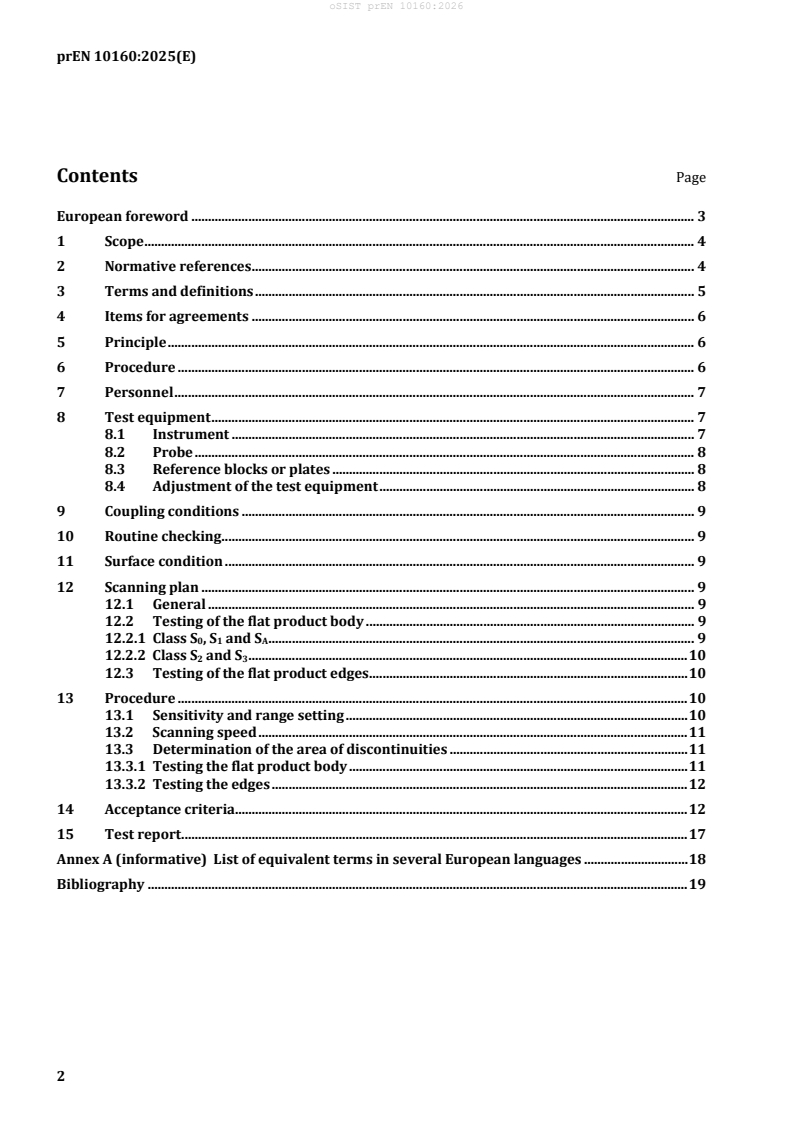
Contents Page
European foreword . 3
1 Scope . 4
2 Normative references . 4
3 Terms and definitions . 5
4 Items for agreements . 6
5 Principle . 6
6 Procedure . 6
7 Personnel . 7
8 Test equipment . 7
8.1 Instrument . 7
8.2 Probe . 8
8.3 Reference blocks or plates . 8
8.4 Adjustment of the test equipment . 8
9 Coupling conditions . 9
10 Routine checking . 9
11 Surface condition . 9
12 Scanning plan . 9
12.1 General . 9
12.2 Testing of the flat product body . 9
12.2.1 Class S , S and S . 9
0 1 A
12.2.2 Class S and S . 10
2 3
12.3 Testing of the flat product edges . 10
13 Procedure . 10
13.1 Sensitivity and range setting . 10
13.2 Scanning speed . 11
13.3 Determination of the area of discontinuities . 11
13.3.1 Testing the flat product body . 11
13.3.2 Testing the edges . 12
14 Acceptance criteria. 12
15 Test report . 17
Annex A (informative) List of equivalent terms in several European languages . 18
Bibliography . 19
European foreword
This document (prEN 10160:2025) has been prepared by Technical Committee CEN/TC 459/SC 1 “Test
methods for steel (other than chemical analysis)”, the secretariat of which is held by AFNOR.
This document is currently submitted to the CEN Enquiry.
This document will supersede EN 10160:1999.
— The Scope was modified: thickness extended and new quality class added;
— Normative references updated;
— Definition 3.5 redrafted and a Note 1 to entry added;
— Clause 4 Items for agreement: added;
— Clause 6 – Procedure and Clause 13 – Operation procedure: more details and guidelines added;
— A new quality class S as an acceptance criteria in Tables 3 and 4 was added;
A
— Table 5 was added only for dual-transducer probes;
— Table 6 was added to give acceptance criteria for single-tranducer probes.
1 Scope
This document describes a method for the ultrasonic testing of uncoated flat steel product for internal
discontinuities.
This document is applicable to flat product in nominal thickness range of 5 mm to 200 mm of non-
alloyed or alloyed steel, excluding austenitic or austenoferritic steels. However, this document can be
applied to the latter types of steels provided that the difference between the amplitude of the noise
signal and that of the echo detection threshold is sufficient for the limit fixed.
This document also defines five quality classes for the flat product body (classes S , S , S , S and S ) and
0 1 A 2 3
five classes (E , E , E , E , E ) for the edges (see Clause 13).
0 1 2 3 4
Other methods of testing (e.g. by phased-array) or other test equipment may be used at the
manufacturer's discretion provided that they give identical results to those obtained under the
conditions of this document. In the event of a dispute, only the method defined in this document shall
prevail.
Testing of flat product of thickness less than 5 mm or higher than 200 mm may be the subject of special
agreements between the parties concerned.
The inspection is normally carried out in the place of production or on the premises of the supplier. If
specified on the order, the inspection takes place in the presence of the purchaser or his
representative .
A list of equivalent terms in several European languages is given in Annex A.
2 Normative references
The following documents are referred to in the text in such a way that some or all of their content
constitutes requirements of this document. For dated references, only the edition cited applies. For
undated references, the latest edition of the referenced document (including any amendments) applies.
EN 1330-1, Non-destructive testing — Terminology – Part 1: List of general terms
EN 1330-2, Non-destructive testing— Terminology — Part 2: Terms common to the non-destructive
testing methods
EN ISO 5577, Non-destructive testing — Ultrasonic testing — Vocabulary (ISO 5577)
EN ISO 9712, Non-destructive testing — Qualification and certification of NDT personnel (ISO 9712)
EN ISO 16810, Non-destructive testing — Ultrasonic testing — General principles (ISO 16810)
EN ISO 16811, Non-destructive testing — Ultrasonic testing — Sensitivity and range setting (ISO 16811)
EN ISO 16827, Non-destructive testing — Ultrasonic testing — Characterization and sizing of
discontinuities (ISO 16827)
EN ISO 18563-1, Non-destructive testing — Characterization and verification of ultrasonic phased array
equipment — Part 1: Instruments (ISO 18563-1)
EN ISO 18563-2, Non-destructive testing — Characterization and verification of ultrasonic phased array
equipment — Part 2: Array probes (ISO 18563-2)
In this case, all steps should be taken to ensure that the production process is not disturbed.
EN ISO 18563-3, Non-destructive testing — Characterization and verification of ultrasonic phased array
equipment — Part 3: Complete systems (ISO 18563-3)
EN ISO 22232-1, Non-destructive testing — Characterization and verification of ultrasonic test
equipment — Part 1: Instruments (ISO 22232-1)
EN ISO 22232-2, Non-destructive testing — Characterization and verification of ultrasonic test
equipment — Part 2: Probes (ISO 22232-2)
EN ISO 22232-3, Non-destructive testing — Characterization and verification of ultrasonic test
equipment — Part 3: Combined equipment (ISO 22232-3)
3 Terms and definitions
For the purposes of this document, the terms and definitions given in EN 1330-1, EN 1330-2,
EN ISO 5577 and the following apply.
ISO and IEC maintain terminology databases for use in standardization at the following addresses:
— ISO Online browsing platform: available at https://www.iso.org/obp/
— IEC Electropedia: available at https://www.electropedia.org/
3.1
internal discontinuity
any imperfection lying within the thickness of the flat product, e.g planar or laminar imperfection,
single-plane or multi-plane inclusion bands or clusters
Note 1 to entry: It is referred to in the text as discontinuity.
3.2
defect
unacceptable internal discontinuity, i.e. exceeding the specified maximum size or population density
limits
3.3
population density
number of individual internal discontinuities of a size greater than a specified minimum size and less
than a specified maximum size per specified area of body or length of edge zone
3.4
manual and assisted manual testing
testing by an operator applying an ultrasonic probe, or probes, to the flat product surface, manually
executing the appropriate scanning pattern on the flat product surface and visually assessing ultrasonic
signal indications on the ultrasonic instrument either by direct viewing or by built-in signal amplitude
alarm devices
3.5
automated and semi-automated testing
testing using a mechanized means of applying the ultrasonic probe or probes to, and executing the
appropriate scanning pattern on the flat product surface, together with ultrasonic signal indication
evaluation by using fully automated software-based data acquisition
Note 1 to entry: Such testing shall be either fully automatic or semi-automatic when the operator performs basic
equipment operation functions and validates testing results.
4 Items for agreements
The following aspects of ultrasonic testing may be agreed at the time of enquiry and order:
a) the manufacturing stage(s) at which ultrasonic testing shall be performed (see Clause 10);
b) the volume(s) to be tested and whether grid scanning coverage or complete scanning coverage is
required (see Clause 13);
c) the Quality Class required, or the Quality Classes and the zones to which they apply (see Clause 15);
d) the applicable recording level and acceptance criteria if different from those detailed in Table 3,
Table 4, Table 5 and Table 6;
e) whether any special scanning coverage, equipment or couplant is required in addition to that
detailed in Clauses 8 and 13;
f) the techniques to evaluate discontinuities (see Clause 14);
g) the technique(s) to be used for setting sensitivity (see Clause 12);
h) whether the test is to be conducted in the presence of the purchaser or his representative;
i) whether a written procedure shall be submitted for approval by the purchaser (see Clause 6).
5 Principle
The method used shall be based on the reflection of ultrasonic waves, the beam axis of which is
perpendicular to the surface of the product.
The examination shall consist of:
a) locating any discontinuity by comparing the amplitude of the discontinuity echo with the amplitude
of the echo of a flat-bottomed hole of a given diameter and located at the same depth as the
discontinuity (DAC, DGS, or equivalent methods);
NOTE Only those discontinuities giving an echo higher in amplitude to that of the echo obtained with the
reference flat-bottomed hole are taken into consideration.
b) if applicable according to Clause 14, determining the contour of the discontinuity being defined by
the positions of the centre of the probe corresponding to an echo amplitude of half the maximum
amplitude of the discontinuity under consideration (6 dB drop method). The width of the
discontinuity shall be determined perpendicular to the direction of rolling. The length shall be
determined in the rolling direction.
The examination shall be carried out during the first ultrasonic scan for all the flat product thicknesses
and from one side only.
6 Procedure
The testing shall be carried out in the place of production or on the premises of the supplier. If specified
on the order, the testing may take place in the presence of the purchaser or his representative (see
Clause 4 h)).
Ultrasonic testing shall be performed in accordance with a written procedure. Where specified in the
enquiry or order, the written procedure shall be submitted to the purchaser for approval prior to
testing.
This written procedure shall be in the form of:
— a product specification; or
— a procedure written specifically for the application; or
— this document may be used if it is accompanied by examination details specific to the application.
The procedure shall contain the following details as a minimum requirement:
a) description of the item to be examined;
b) reference documents;
c) qualification and certification of examination personnel;
d) stage of manufacture at which the examination is carried out;
e) examination zones specified in terms of the applicable Quality Classes;
f) any special preparation of scanning surfaces, if applicable;
g) couplant;
h) description of examination equipment;
i) setting;
j) scanning plan;
k) description and sequence of examination operations;
l) recording levels;
m) characterization of discontinuities;
n) acceptance criteria;
o) examination report.
7 Personnel
Testing shall be carried out by a qualified and certified personnel under the responsibility of a qualified
and certified Level 3 personnel in accordance with EN ISO 9712.
8 Test equipment
8.1 Instrument
Instrument for manual testing shall feature A-scan presentation and shall comply with the
requirements of EN ISO 22232-1. or EN ISO 18563-1, if applicable.
8.2 Probe
The probe used for testing shall comply with the requirements of EN ISO 22232-2 or EN ISO 18563-2.
The test equipment shall include at least one probe which may be either a probe with a single
transducer serving
...
Questions, Comments and Discussion
Ask us and Technical Secretary will try to provide an answer. You can facilitate discussion about the standard in here.
Loading comments...