


oSIST prEN IEC 63494-1:2024
(Main)Lighting systems - Electro-mechanical interfaces - Part 1: Safety
Lighting systems - Electro-mechanical interfaces - Part 1: Safety
Systèmes d'éclairage - Interfaces électromécaniques - Partie 1: Sécurité
Sistemi razsvetljave - Elektromehanski vmesniki - 1. del: Varnost
General Information
Standards Content (Sample)
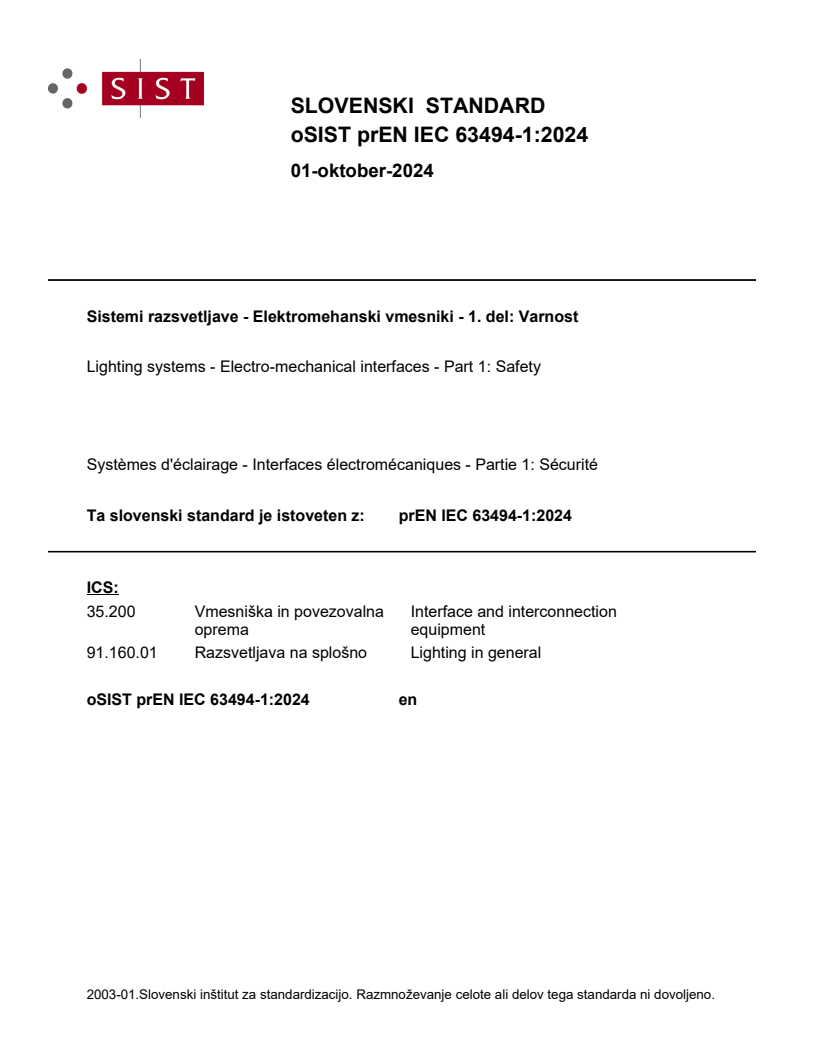
SLOVENSKI STANDARD
01-oktober-2024
Sistemi razsvetljave - Elektromehanski vmesniki - 1. del: Varnost
Lighting systems - Electro-mechanical interfaces - Part 1: Safety
Systèmes d'éclairage - Interfaces électromécaniques - Partie 1: Sécurité
Ta slovenski standard je istoveten z: prEN IEC 63494-1:2024
ICS:
35.200 Vmesniška in povezovalna Interface and interconnection
oprema equipment
91.160.01 Razsvetljava na splošno Lighting in general
2003-01.Slovenski inštitut za standardizacijo. Razmnoževanje celote ali delov tega standarda ni dovoljeno.
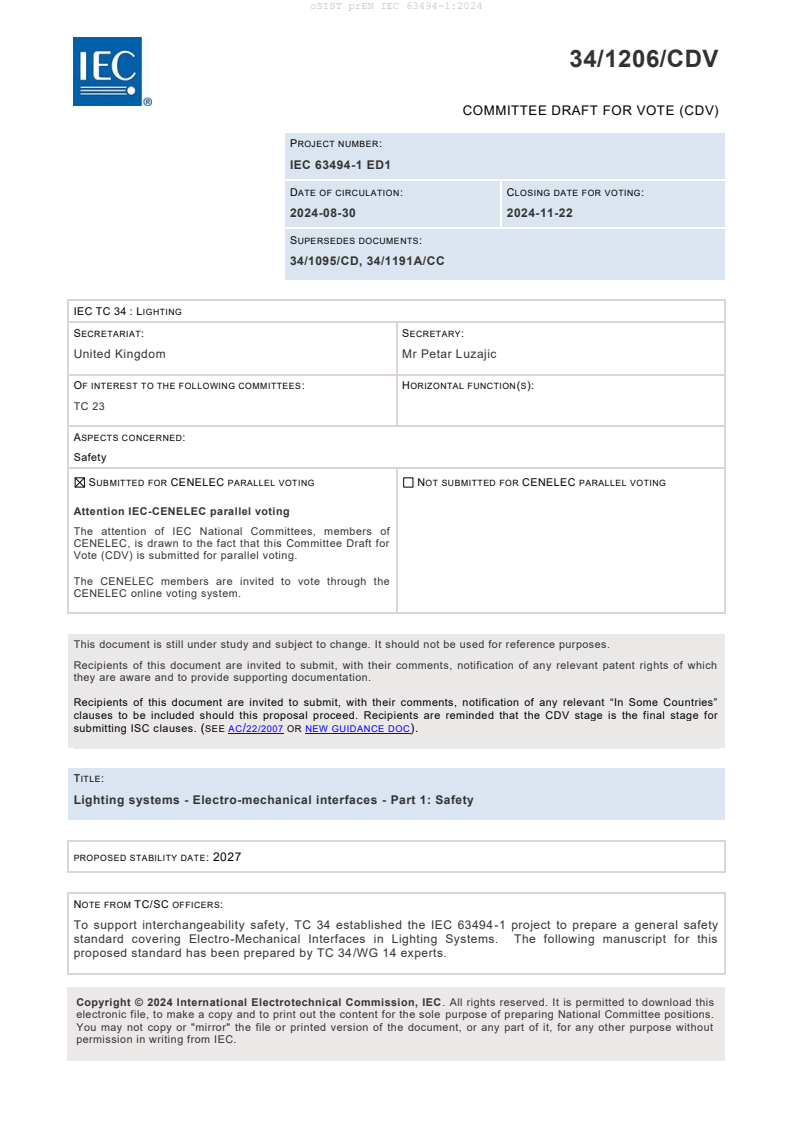
34/1206/CDV
COMMITTEE DRAFT FOR VOTE (CDV)
PROJECT NUMBER:
IEC 63494-1 ED1
DATE OF CIRCULATION: CLOSING DATE FOR VOTING:
2024-08-30 2024-11-22
SUPERSEDES DOCUMENTS:
34/1095/CD, 34/1191A/CC
IEC TC 34 : LIGHTING
SECRETARIAT: SECRETARY:
United Kingdom Mr Petar Luzajic
OF INTEREST TO THE FOLLOWING COMMITTEES: HORIZONTAL FUNCTION(S):
TC 23
ASPECTS CONCERNED:
Safety
SUBMITTED FOR CENELEC PARALLEL VOTING NOT SUBMITTED FOR CENELEC PARALLEL VOTING
Attention IEC-CENELEC parallel voting
The attention of IEC National Committees, members of
CENELEC, is drawn to the fact that this Committee Draft for
Vote (CDV) is submitted for parallel voting.
The CENELEC members are invited to vote through the
CENELEC online voting system.
This document is still under study and subject to change. It should not be used for reference purposes.
Recipients of this document are invited to submit, with their comments, notification of any relevant patent rights of which
they are aware and to provide supporting documentation.
Recipients of this document are invited to submit, with their comments, notification of any relevant “In Some Countries”
clauses to be included should this proposal proceed. Recipients are reminded that the CDV stage is the final stage for
submitting ISC clauses. (SEE AC/22/2007 OR NEW GUIDANCE DOC).
TITLE:
Lighting systems - Electro-mechanical interfaces - Part 1: Safety
PROPOSED STABILITY DATE: 2027
NOTE FROM TC/SC OFFICERS:
To support interchangeability safety, TC 34 established the IEC 63494-1 project to prepare a general safety
standard covering Electro-Mechanical Interfaces in Lighting Systems. The following manuscript for this
proposed standard has been prepared by TC 34/WG 14 experts.
electronic file, to make a copy and to print out the content for the sole purpose of preparing National Committee positions.
You may not copy or "mirror" the file or printed version of the document, or any part of it, for any other purpose without
permission in writing from IEC.
IEC CDV 63494-1 © IEC 2024 2 34/1206/CDV
1 CONTENTS
2 CONTENTS . 2
3 FOREWORD . 4
4 1 Scope . 6
5 2 Normative references . 6
6 3 Terms and definitions. 6
7 4 General . 7
8 5 Marking . 7
9 5.1 Product identification . 7
10 5.2 Product characteristics . 7
11 5.3 Durability and legibility . 7
12 6 Mechanical Safety . 8
13 6.1 Physical protection during insertion and removal . 8
14 6.2 Physical safety in latching release mechanisms . 8
15 6.3 Protection against damaging pins during insertion . 8
16 6.4 Mechanical strength . 8
17 6.4.1 General . 8
18 6.4.2 Base plate tests . 9
19 6.4.3 Receptacle tests . 9
20 6.5 Retention force and torque . 9
21 6.5.1 General requirements . 9
22 6.5.2 Receptacle tests . 9
23 6.5.3 Base plate tests . 9
24 6.6 Bending moment . 10
25 6.6.1 Base plate bending moment . 10
26 6.6.2 Receptacle bending moment . 10
27 6.6.3 Compliance . 10
28 7 Electrical safety . 10
29 7.1 Electric shock protection . 10
30 7.2 Electric strength . 10
31 7.2.1 General . 10
32 7.2.2 Insulation voltage classification . 11
33 7.2.3 Dielectric withstand voltage. 11
34 7.2.4 Creepage and clearance . 11
35 7.2.5 Live insertion and disconnection . 11
36 7.3 Electrical interchangeability . 12
37 7.4 Endurance tests . 12
38 7.4.1 Heat aging . 12
39 7.4.2 Contact resistance . 12
40 8 Ambient condition safety . 13
41 8.1 Ingress protection – IP rating . 13
42 8.2 Rough service . 13
43 9 Construction . 13
44 9.1 Current carrying parts . 13
45 9.2 Resistance to heat, fire and tracking . 13
46 9.3 Polarisation . 13
IEC CDV 63494-1 © IEC 2024 3 34/1206/CDV
47 9.4 Protection against corrosion . 14
48 Annex A : Test sequence and gauges . 15
49 Bibliography . 18
IEC CDV 63494-1 © IEC 2024 4 34/1206/CDV
53 INTERNATIONAL ELECTROTECHNICAL COMMISSION
54 ____________
56 Lighting systems – Electro-mechanical interfaces – Part 1: Safety
59 FOREWORD
60 1) The International Electrotechnical Commission (IEC) is a worldwide organization for standardization comprising all national
61 electrotechnical committees (IEC National Committees). The object of IEC is to promote international co -operation on all
62 questions concerning standardization in the electrical and electronic fields. To this end and in addition to other activities ,
63 IEC publishes International Standards, Technical Specifications, Technical Reports, Publicly Available Specifications (PAS)
64 and Guides (hereafter referred to as “IEC Publication(s)”). Their preparation is entrusted to technical committees; any IEC
65 National Committee interested in the subject dealt with may participate in this preparatory work. International, governmental
66 and non-governmental organizations liaising with the IEC also participate in this preparation. IEC collaborates closely with
67 the International Organization for Standardization (ISO) in accordance with conditions determined by agreement between
68 the two organizations.
69 2) The formal decisions or agreements of IEC on technical matters express, as nearly as possible, an international consensus
70 of opinion on the relevant subjects since each technical committee has representation from all interested IEC National
71 Committees.
72 3) IEC Publications have the form of recommendations for international use and are accepted by IEC National Committees in
73 that sense. While all reasonable efforts are made to ensure that the technical content of IEC Publications is accurate, IEC
74 cannot be held responsible for the way in which they are used or for any misinterpretation by any end user.
75 4) In order to promote international uniformity, IEC National Committees undertake to apply IEC Publications transparently to
76 the maximum extent possible in their national and regional publications. Any divergence between any IEC Publication and
77 the corresponding national or regional publication shall be clearly indicated in the latter.
78 5) IEC itself does not provide any attestation of conformity. Independent certification bodies provide conformity assessment
79 services and, in some areas, access to IEC marks of conformity. IEC is not responsible for any services carried out by
80 independent certification bodies.
81 6) All users should ensure that they have the latest edition of this publication.
82 7) No liability shall attach to IEC or its directors, employees, servants or agents including individual experts and members of
83 its technical committees and IEC National Committees for any personal injury, property damage or other damage of any
84 nature whatsoever, whether direct or indirect, or for costs (including legal fees) and expenses arising out of the publicatio n,
85 use of, or reliance upon, this IEC Publication or any other IEC Publications.
86 8) Attention is drawn to the Normative references cited in this publication. Use of the referenced publications is indispensable
87 for the correct application of this publication.
88 9) Attention is drawn to the possibility that some of the elements of this IEC Publication may be the subject of patent rights.
89 IEC shall not be held responsible for identifying any or all such patent rights.
90 International Standard IEC 63494-1 has been prepared by IEC technical committee 34: Lighting.
91 The text of this standard is based on the following documents:
FDIS Report on voting
XX/XXX/FDIS XX/XXX/RVD
93 Full information on the voting for the approval of this standard can be found in the report on voting
94 indicated in the above table.
95 This publication has been drafted in accordance with the ISO/IEC Directives, Part 2.
96 The committee has decided that the contents of this publication will remain unchanged until the stability
97 date indicated on the IEC web site under "http://webstore.iec.ch" in the data related to the specific
98 publication. At this date, the publication will be
99 • reconfirmed;
100 • withdrawn;
101 • replaced by a revised edition, or
102 • amended.
IEC CDV 63494-1 © IEC 2024 5 34/1206/CDV
The National Committees are requested to note that for this publication the stability data is
20XX.
THIS TEXT IS INCLUDED FOR THE INFORMATION OF THE NATIONAL COMMITTEES AND
WILL BE DELETED AT THE PUBLICATION STAGE.
IEC CDV 63494-1 © IEC 2024 6 34/1206/CDV
104 Lighting systems – Electro-mechanical interfaces – Part 1: Safety
105 1 Scope
106 This document specifies the safety requirements for electro-mechanical interfaces connecting lighting
107 system devices to luminaires. These interfaces are used to mechanically connect, electrically power,
108 and enable communication of lighting system devices on luminaires . Electro-mechanical interfaces up
109 to and including 1 000 V AC or 1 500 V DC are included. The document specifies safety related
110 mechanical, electrical, ambient conditions, and construction requirements for the interface
111 components including protective covers. Specific requirements for the devices that can utilize the
112 interface such as sensors, communication modules, cameras, etc. are out of scope for this document.
113 The document does not specify the following aspects:
114 • The lighting technology
115 • The illumination performance
116 • Data communication
117 • Functional safety
118 • The performance and interchangeability of devices on the interface
119 • Electromagnetic compatibility (EMC)
120 The document does not specify safety for the following:
121 • Product safety covered in existing standards (e.g. control gear, light sources, luminaires,
122 electrical connectors, PoE, USB)
123 • Device safety aspects for devices using the electro-mechanical interface
124 • Couplers for mains input power to the luminaire
126 The purpose of IEC 63494-1 is to provide a set of requirements and tests which are considered
127 generally applicable to electro-mechanical interfaces. Detailed requirements for particular electro-
128 mechanical interfaces are specified in the IEC 63494-2 series.
129 NOTE: If the electro-mechanical interface is not standardized in the IEC 63494-2 series then interchangeability aspects are
130 not covered.
131 NOTE: Although manual operation is anticipated at this time, future use of insertion and removal tools can be utilized and
132 covered by this safety standard.
133 2 Normative references
134 The following referenced documents are indispensable for the application of this document. For dated
135 references, only the edition cited applies. For undated references, the latest edition of the referenced
136 document (including any amendments) applies.
137 IEC 60050 series, International Electrical Vocabulary
138 IEC 63105 Lighting systems and related equipment – Vocabulary
139 IEC 60598-1:202X Ed 10.0 Luminaires – Part 1: General requirements and tests (in maintenance
140 cycle, see 34D/1690/CDV)
141 IEC 62504 General lighting – Light emitting diode (LED) products and related equipment – Terms and
142 definitions
143 IEC 60320-3 Appliance couplers for household and similar general purposes – Part 3: Standard
144 sheets and gauges
145 IEC 61984:2008 Connectors - Safety requirements and tests
146 3 Terms and definitions
147 For the purposes of this document, the terms and definitions in IEC 60050 (IEV), IEC 63105 and IEC
148 62504 apply.
149 ISO and IEC maintain terminological databases for use in standardization at the following address:
IEC CDV 63494-1 © IEC 2024 7 34/1206/CDV
150 • ISO Online browsing platform: available at http://www.iso.org.obp
151 • IEC Electropedia: available at http://www.electropedia.org/
152 3.1 device-side interface
153 part of the device for use with a luminaire-side interface, comprising one or more electrical contacts
154 embedded in insulating material
155 3.2 luminaire-side interface
156 connector intended for use in a luminaire or similar apparatus, comprising one or more electrical
157 contacts mounted in a holder made of insulating material
158 3.3 base plate
159 device-side interface for use with a mating receptacle
160 NOTE TO ENTRY: The base plate may be an integral or separable part of the device.
161 3.4 receptacle
162 luminaire-side interface mounted on an exterior or interior surface of the luminaire
163 4 General
164 The requirements of clauses 5, 6, 7, 8 and 9 are applicable to electro-mechanical interfaces not covered
165 in an IEC 63494-2 series standard. Specific requirements for particular electro-mechanical interfaces
166 can be found in the relevant IEC 63494-2 standard. A recommended grouping of tests, sequential
167 ordering and potential gauges is found in Annex A.
168 5 Marking
169 5.1 Product identification
170 The following shall be marked on the electro-mechanical interface product or on the smallest unit
171 package if space is limited on the product.
172 • Mark of origin (this may take the form of a trade mark, the manufacturer's identification mark or
173 the name of the responsible vendor)
174 • Maker's model number or type reference
175 • Positions for the contacts and protective earthing contacts, if applicable
176 • Marking of protective earthing contacts shall apply the symbol or PE
177 Note: The protective earthing symbol is from IEC 60417-5019:2006-08.
178 5.2 Product characteristics
179 The following information shall be given either on the electro-mechanical interface or be made
180 available in the datasheet or website of the manufacturer or responsible vendor:
181 • Maximum temperature, T , and, if declared, the heat resistance of specific components
max
182 deviating from this Tmax temperature
183 • Maximum current rating
184 • Rated voltage and current for each contact
185 • IP rating of the electro-mechanical interface
186 • Circuit type supported by the interface (e.g. SELV, PELV, FELV, LV, etc.)
187 • Type of insulation between different electrical circuits and accessible conductive parts
188 • Receptacle to luminaire mounting dimensions and characteristics
189 • Device to base plate mounting dimensions and characteristics
190 5.3 Durability and legibility
191 Marking shall be durable and legible.
IEC CDV 63494-1 © IEC 2024 8 34/1206/CDV
192 Compliance is checked by inspection and by trying to remove the marking by rubbing lightly for 15 s
193 each time, with two pieces of cloth, one soaked with water and the other with aliphatic solvent hexane.
194 As an alternative, a reagent grade hexane with a minimum of 85 % as n-hexane may be used.
195 NOTE 2 n-hexane according to ACS (American Chemical Society) is identified as CAS# 110-54-3.
196 The marking shall be legible after the test. If the marking is on a separable label, the label shall remain
197 fixed to the product.
198 6 Mechanical Safety
199 6.1 Physical protection during insertion and removal
200 The electro-mechanical interface shall be designed and constructed to provide ease-of-insertion and
201 removal of the device-side interface into and from the luminaire-side interface without undue force or
202 torque by hand without the use of tools.
203 The following test shall be applied on a receptacle plus device or cap, if applicable: Prepare the
204 sample by completing 5 mating cycles of the device-side interface and luminaire-side interface, then
205 measure the insertion and removal force or torque, as applicable.
206 Compliance: For plug-in interfaces, the insertion and removal force shall not exceed 50 N.
207 Compliance: For twist-lock interfaces, the insertion and removal torque shall not exceed 5 Nm.
208 Compliance: For interfaces with both a plug-in and twist-lock features, both of the above requirements
209 shall be met.
210 The installer shall be protected against pinching or sharp edges without needing the use of personal
211 protective equipment during insertion or removal of the device.
212 Compliance shall be checked by inspection.
213 6.2 Physical safety in latching release mechanisms
214 If the device electro-mechanical interface is designed with a release mechanism for safe removal from
215 the luminaire-side interface, the mechanism shall operate by hand without undue force and fully
216 release the device.
217 The maximum force for hand operation shall be 50 N.
218 The maximum torque for hand operation shall be 5 Nm.
219 Compliance shall be checked by inspection.
220 6.3 Protection
...
Questions, Comments and Discussion
Ask us and Technical Secretary will try to provide an answer. You can facilitate discussion about the standard in here.
Loading comments...