

SIST EN 16240:2014
(Main)Light transmitting flat solid polycarbonate (PC) sheets for internal and external roofs, walls and ceilings - Requirements and test methods
General Information
- Abstract
This European Standard specifies the requirements for light transmitting flat solid polycarbonate (PC) sheets for internal and external use in walls, roofs and ceilings.
This European Standard applies to light transmitting flat extruded solid PC sheets of minimum thickness 2 mm, without or with uniform functional layers (e.g. coating, co-extruded layer) made from PC-based or other materials.
It also specifies the test methods needed for the evaluation of conformity and marking of the sheets.
- Status
- Published
- Public Enquiry End Date
- 24-Apr-2011
- Publication Date
- 07-Jan-2014
- Technical Committee
- IKER - Ceramics
- Current Stage
- 6060 - National Implementation/Publication (Adopted Project)
- Start Date
- 23-Dec-2013
- Due Date
- 27-Feb-2014
- Completion Date
- 08-Jan-2014


Overview
EN 16240:2013 is a CEN European Standard that defines requirements and test methods for light-transmitting, flat, solid polycarbonate (PC) sheets used internally and externally in roofs, walls and ceilings. It applies to extruded solid PC sheets (minimum thickness 2 mm) with or without uniform functional layers (coatings or co-extruded layers). The standard covers product characteristics at delivery and the test methods needed for conformity assessment, marking and CE declaration.
Key topics and technical requirements
The standard addresses a comprehensive set of performance and test topics for light-transmitting flat solid PC sheets, including:
- Visual appearance, dimensions and tolerances (sheet length, width, thickness, mass per unit area)
- Spectral and optical characteristics (light transmittance, total solar energy transmittance, reflectance, absorbance)
- Impact resistance (puncture/impact behaviour test methods)
- Durability and ageing (artificial ageing, yellowness index and related limits)
- Deformation behaviour and mechanical properties (flexural modulus, tensile/yield properties)
- Thermal performance (thermal transmittance U-value, linear thermal expansion, thermal conductivity)
- Acoustic performance (airborne sound insulation)
- Moisture and airtightness (water vapour permeability, water/air tightness)
- Fire performance (reaction to fire, external fire on roofs, heat of combustion, presence of dangerous substances)
- Resistance to fixings, temporary protective coverings and presence of functional layers
- Assessment and verification of constancy of performance (AVCP), factory production control (FPC) and marking/CE requirements (Annex ZA)
EN 16240 also specifies the relevant test and calculation methods to evaluate these characteristics (e.g., artificial ageing, yellowness index, small hard body impact tests, thermal and acoustic measurement standards).
Applications and who uses it
EN 16240 is intended for:
- Manufacturers of extruded solid polycarbonate sheets to define product specifications, testing and CE-marking
- Product certifiers and test laboratories conducting conformity and performance tests
- Architects, specifiers and façade/roof system designers selecting translucent cladding, rooflights and internal glazing
- Building contractors and façade installers for product selection and procurement
- Regulatory authorities for performance verification under the Construction Products Regulation
The standard is used where reliable optical, mechanical, thermal and fire-related performance of light-transmitting PC sheets is required in building envelopes and interior applications.
Related standards
- EN 1873 - Individual roof lights of plastics (product spec and tests)
- EN 14963 - Continuous plastic rooflights (classification and tests)
- ETAG 010 / EOTA ETA-Guideline 010 - Self-supporting translucent roof kits
Keywords: EN 16240:2013, polycarbonate sheets, light transmitting PC, flat solid PC sheets, rooflights, test methods, durability, thermal transmittance, impact resistance, CE marking.
Relations
- Effective Date
- 04-Feb-2026
- Refers
SIST EN 14500:2008 - Blinds and shutters - Thermal and visual comfort - Test and calculation methods - Effective Date
- 28-Jan-2026
- Effective Date
- 28-Jan-2026
- Effective Date
- 28-Jan-2026
- Effective Date
- 28-Jan-2026
- Effective Date
- 28-Jan-2026
- Effective Date
- 28-Jan-2026
- Effective Date
- 28-Jan-2026
- Effective Date
- 28-Jan-2026
- Effective Date
- 28-Jan-2026
- Effective Date
- 28-Jan-2026
- Refers
SIST EN ISO/CIE 11664-2:2022 - Colorimetry - Part 2: CIE standard illuminants (ISO/CIE 11664-2:2022) - Effective Date
- 28-Jan-2026
- Effective Date
- 28-Jan-2026
- Effective Date
- 28-Jan-2026
- Effective Date
- 28-Jan-2026
Get Certified
Connect with accredited certification bodies for this standard

DIN CERTCO
DIN Group product certification.
DIBt (Deutsches Institut für Bautechnik)
German Institute for Building Technology.

Aboma Certification B.V.
Specialized in construction, metal, and transport sectors.
Sponsored listings
Frequently Asked Questions
SIST EN 16240:2014 is a standard published by the Slovenian Institute for Standardization (SIST). Its full title is "Light transmitting flat solid polycarbonate (PC) sheets for internal and external roofs, walls and ceilings - Requirements and test methods". This standard covers: This European Standard specifies the requirements for light transmitting flat solid polycarbonate (PC) sheets for internal and external use in walls, roofs and ceilings. This European Standard applies to light transmitting flat extruded solid PC sheets of minimum thickness 2 mm, without or with uniform functional layers (e.g. coating, co-extruded layer) made from PC-based or other materials. It also specifies the test methods needed for the evaluation of conformity and marking of the sheets.
This European Standard specifies the requirements for light transmitting flat solid polycarbonate (PC) sheets for internal and external use in walls, roofs and ceilings. This European Standard applies to light transmitting flat extruded solid PC sheets of minimum thickness 2 mm, without or with uniform functional layers (e.g. coating, co-extruded layer) made from PC-based or other materials. It also specifies the test methods needed for the evaluation of conformity and marking of the sheets.
SIST EN 16240:2014 is classified under the following ICS (International Classification for Standards) categories: 83.140.10 - Films and sheets; 91.060.10 - Walls. Partitions. Facades; 91.060.20 - Roofs. The ICS classification helps identify the subject area and facilitates finding related standards.
SIST EN 16240:2014 has the following relationships with other standards: It is inter standard links to SIST EN ISO 11925-2:2026, SIST EN 14500:2008, SIST EN 1873:2006, SIST EN 14963:2007, SIST EN ISO/CIE 11664-1:2019, SIST EN ISO 10140-5:2021, SIST EN ISO 527-2:2025, SIST EN ISO 717-1:2021, SIST-TP CEN ISO/TR 3834-6:2007, SIST EN ISO 10140-4:2021, SIST EN ISO 1716:2018, SIST EN ISO/CIE 11664-2:2022, SIST EN 13501-1:2019, SIST EN 1990:2004, SIST EN ISO 1043-1:2012. Understanding these relationships helps ensure you are using the most current and applicable version of the standard.
SIST EN 16240:2014 is associated with the following European legislation: EU Directives/Regulations: 305/2011, 89/106/EEC; Standardization Mandates: M/121, M/122. When a standard is cited in the Official Journal of the European Union, products manufactured in conformity with it benefit from a presumption of conformity with the essential requirements of the corresponding EU directive or regulation.
SIST EN 16240:2014 is available in PDF format for immediate download after purchase. The document can be added to your cart and obtained through the secure checkout process. Digital delivery ensures instant access to the complete standard document.
Standards Content (Sample)
2003-01.Slovenski inštitut za standardizacijo. Razmnoževanje celote ali delov tega standarda ni dovoljeno.Lichtdurchlässige, flache, massive Platten aus Polycarbonat (PC) für Innen- und Außenanwendungen an Dächern, Wänden und Decken - Anforderungen und PrüfverfahrenPlaques d'éclairement pleines planes en polycarbonate (PC) pour toitures, bardages et plafonds intérieurs et extérieurs - Exigences et méthodes d'essaiLight transmitting flat solid polycarbonate (PC) sheets for internal and external roofs, walls and ceilings - Requirements and test methods91.060.20StreheRoofs91.060.10Stene. Predelne stene. FasadeWalls. Partitions. Facades83.140.10Filmi in folijeFilms and sheetsICS:Ta slovenski standard je istoveten z:EN 16240:2013SIST EN 16240:2014en,de01-februar-2014SIST EN 16240:2014SLOVENSKI
STANDARD
EUROPEAN STANDARD NORME EUROPÉENNE EUROPÄISCHE NORM
EN 16240
December 2013 ICS 83.140.10; 91.060.10 English Version
Light transmitting flat solid polycarbonate (PC) sheets for internal and external use in roofs, walls and ceilings - Requirements and test methods
Plaques d'éclairement pleines planes en polycarbonate (PC) pour usage intérieur ou extérieur dans les toitures, bardages et plafonds - Exigences et méthodes d'essai
Lichtdurchlässige, flache Massivplatten aus Polycarbonat (PC) für Innen- und Außenanwendungen an Dächern, Wänden und Decken - Anforderungen und Prüfverfahren This European Standard was approved by CEN on 5 October 2013.
CEN members are bound to comply with the CEN/CENELEC Internal Regulations which stipulate the conditions for giving this European Standard the status of a national standard without any alteration. Up-to-date lists and bibliographical references concerning such national standards may be obtained on application to the CEN-CENELEC Management Centre or to any CEN member.
This European Standard exists in three official versions (English, French, German). A version in any other language made by translation under the responsibility of a CEN member into its own language and notified to the CEN-CENELEC Management Centre has the same status as the official versions.
CEN members are the national standards bodies of Austria, Belgium, Bulgaria, Croatia, Cyprus, Czech Republic, Denmark, Estonia, Finland, Former Yugoslav Republic of Macedonia, France, Germany, Greece, Hungary, Iceland, Ireland, Italy, Latvia, Lithuania, Luxembourg, Malta, Netherlands, Norway, Poland, Portugal, Romania, Slovakia, Slovenia, Spain, Sweden, Switzerland, Turkey and United Kingdom.
EUROPEAN COMMITTEE FOR STANDARDIZATION
COMITÉ EUROPÉEN DE NORMALISATION EUROPÄISCHES KOMITEE FÜR NORMUNG
CEN-CENELEC Management Centre:
Avenue Marnix 17,
B-1000 Brussels © 2013 CEN All rights of exploitation in any form and by any means reserved worldwide for CEN national Members. Ref. No. EN 16240:2013 ESIST EN 16240:2014
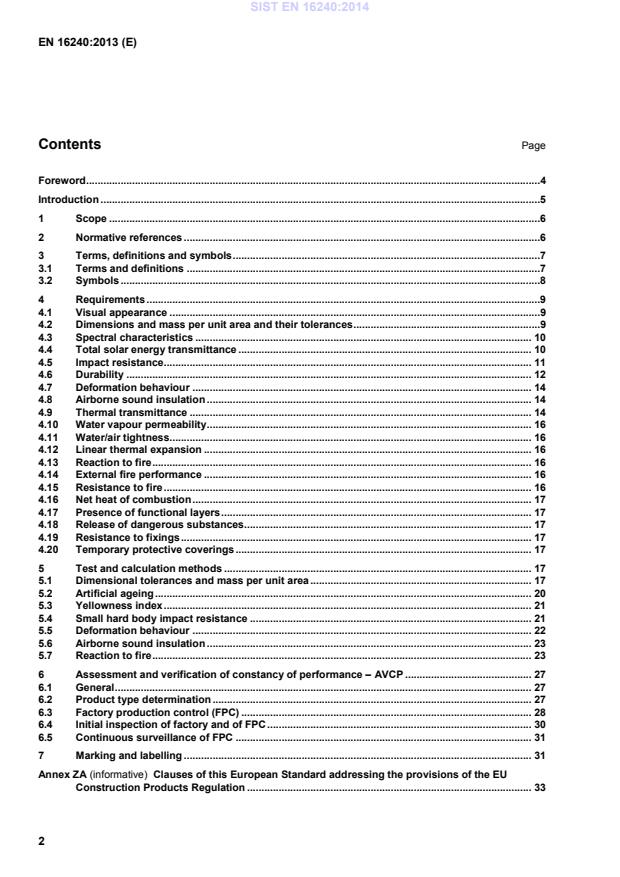
Foreword .4 Introduction .5 1 Scope .6 2 Normative references .6 3 Terms, definitions and symbols .7 3.1 Terms and definitions .7 3.2 Symbols .8 4 Requirements .9 4.1 Visual appearance .9 4.2 Dimensions and mass per unit area and their tolerances .9 4.3 Spectral characteristics . 10 4.4 Total solar energy transmittance . 10 4.5 Impact resistance. 11 4.6 Durability . 12 4.7 Deformation behaviour . 14 4.8 Airborne sound insulation . 14 4.9 Thermal transmittance . 14 4.10 Water vapour permeability . 16 4.11 Water/air tightness. 16 4.12 Linear thermal expansion . 16 4.13 Reaction to fire . 16 4.14 External fire performance . 16 4.15 Resistance to fire . 16 4.16 Net heat of combustion . 17 4.17 Presence of functional layers . 17 4.18 Release of dangerous substances . 17 4.19 Resistance to fixings . 17 4.20 Temporary protective coverings . 17 5 Test and calculation methods . 17 5.1 Dimensional tolerances and mass per unit area . 17 5.2 Artificial ageing . 20 5.3 Yellowness index . 21 5.4 Small hard body impact resistance . 21 5.5 Deformation behaviour . 22 5.6 Airborne sound insulation . 23 5.7 Reaction to fire . 23 6 Assessment and verification of constancy of performance – AVCP . 27 6.1 General . 27 6.2 Product type determination . 27 6.3 Factory production control (FPC) . 28 6.4 Initial inspection of factory and of FPC . 30 6.5 Continuous surveillance of FPC . 31 7 Marking and labelling . 31 Annex ZA (informative)
Clauses of this European Standard addressing the provisions of the EU Construction Products Regulation . 33 SIST EN 16240:2014
he External heat transfer coefficient 4.4 and 4.9 hi Internal heat transfer coefficient 4.4 and 4.9 Lsp Length of a test specimen 5.1 m Mass of a test specimen 5.1.5; 5.1.6 qi Secondary internal heat transfer factor 4.4 Rse External surface resistance 4.9 Rsi Internal surface resistance 4.9 RT Total thermal resistance
4.9 Rw (C;Ctr) Sound reduction index 4.8; 5.6 U Thermal transmittance 4.9 Ws Sheet width 5.1 YI Yellowness index 4.6.1.2 and 5.3 . Linear thermal expansion 4.12 .e Solar direct absorbance 4.4 / Water vapour permeability 4.10 ûY Variation of yellowness index 4.6.1.2 and 5.3
Design thermal conductivity 4.9
Poisson's ratio 4.7 SIST EN 16240:2014
5.1.5 e Solar direct reflectance 4.4 1M Tensile stress at yield 4.7 and 5.5.3 2e Solar direct transmittance 4.4 2e,n-h Normal-hemispherical solar transmittance (see 4.3, NOTE 1). 4.3 2v Light transmittance 4.3 2v,n-h Normal-hemispherical light transmittance (see 4.3, NOTES 1 and 2).
4.3 4 Requirements 4.1 Visual appearance The sheets shall have regular, smooth or patterned surfaces. There shall be no scratches, marks or other defects larger than 4 mm2 each anywhere on the sheet surface. There shall be no obvious bubbles, inclusions, cracks, depressions or other defects anywhere in the sheets that could adversely affect the performance of the sheets in its intended application. The edges of the sheet shall be straight and cut cleanly. The colour distribution shall be visually uniform, unless otherwise specified. For specific uses, further requirements concerning the visual aspects of the sheets might be considered. 4.2 Dimensions and mass per unit area and their tolerances The dimensional tolerances and mass per unit area shall be assessed when subject to regulatory requirement. When tested in accordance with the test methods specified in 5.1.1 to 5.1.8, the dimensional tolerances and mass per unit area of the sheets shall conform to the requirements given in Table 2. The test methods given in Table 2 are used for initial type testing, and are the reference test methods. Table 2 — Requirements for dimensions and mass per unit area and their tolerances Characteristic Test method Requirement Sheet thickness 5.1.4 The nominal sheet thickness of the sheet shall be declared in millimetres. The sheet thickness at any point shall not vary by more than: – ± 5 % of the declared nominal sheet thickness for nominal sheet thickness greater or equal to 2 mm and up or equal to 5 mm. – ± 10 % of the declared nominal sheet thickness for nominal sheet thickness greater than 5 mm. For sheets with patterned surfaces, the sheet thickness is the overall thickness of the sheet. Mass per unit area 5.1.5 The nominal mass per unit area of the sheet shall be declared in grams per square metre. The mass per unit area of a sheet shall be not less than 95 % of the declared nominal mass per unit area. SIST EN 16240:2014
5.1.8 The deviation from flat across the width of the sheet shall be ≤ 3 mm per metre of width. The deviation from flat along the length of the sheet shall be ≤ 3 mm per metre of length. 4.3 Spectral characteristics The spectral characteristics of solid PC sheets shall be assessed when subject to regulatory requirement. The spectral characteristics of a solid PC sheet include the luminous and solar characteristics, and the reflection and transmission characteristics. The solid PC sheets are defined by their thickness, colour, texture and functional layer(s). A change of one of these characteristics affects the spectral characteristics of a solid PC sheet. The spectral characteristics shall be measured according to EN 14500 considering the samples cut from solid PC sheets as thick translucent samples (for the definition of thick translucent samples, see EN 14500:2008, 6.3.2). For accurate measurements, the sphere diameter should be much larger than the diameter of the light entrance port. The sphere diameter should be greater or equal to 1 000 mm and the entrance diameter equal to 100 mm. NOTE 1 The normal-hemispherical light transmittance, 2v,n-h, and the normal-hemispherical solar transmittance, 2e,n-h, as designated in EN 14500 are corresponding respectively to the light transmittance, 2v, and the solar direct transmittance, 2e, as designated in EN 410. NOTE 2 The normal-hemispherical light transmittance, 2v,n-h, is corresponding to the total luminous transmittance, 2D65, as stated in EN 1873:2005 and ETA-Guideline 010. The normal-normal light transmittance, 2v,n-n, should be determined according to EN 14500, where relevant. Test samples shall be clean and dry, unless otherwise specified. The storage and the cleaning procedures stated by the manufacturer shall be followed. The spectral characteristics, i.e. the light transmittance, 2v, and the solar direct transmittance, 2e, shall be declared and subsequent measurements shall be within ± 3 absolute value (or units) of the declared values. EXAMPLE For a declared value of the light transmittance equal to 40 %, the actual light transmittance of a sheet may be included between 37 % and 43 %. 4.4 Total solar energy transmittance The total solar energy transmittance of solid PC sheets shall be assessed when subject to regulatory requirement. The total solar energy transmittance of flat solid PC sheets shall be measured when subject to outdoor uses. The total solar energy transmittance, g, is given by Formula (1): ieqg+=τ (1) SIST EN 16240:2014
is the solar direct absorbance; 2e
is the solar direct transmittance; e
is the solar direct reflectance. NOTE 2 The value of heat transfer coefficient towards the outside corresponds to summer conditions. NOTE 3 Formula (2) comes from EN 410:2011, 5.4.6.2 and Formula (3) comes from EN 410:2011, 5.4.2. 4.5 Impact resistance 4.5.1 Small hard body impact resistance The small hard body impact resistance shall be assessed when subject to regulatory requirement. The small hard body impact resistance shall be evaluated by determining the impact behaviour according to 5.4. Failure occurs when a crack or a break appears on the test specimen. White discolorations are not considered as cracks. SIST EN 16240:2014
as defined in EN ISO 527-1, is 0,35. 4.8 Airborne sound insulation The method(s) of installation shall consider the airborne sound insulation. The sound reduction index, Rw (C;Ctr), of the solid sheets shall be assessed when subject to regulatory requirement. The sound reduction index, Rw (C;Ctr), shall be measured in accordance with 5.6 and declared. 4.9 Thermal transmittance The thermal transmittance, U value, shall be assessed when subject to regulatory requirement. SIST EN 16240:2014
is the thickness of the flat solid PC sheet, in metres;
is the design thermal conductivity of PC material, in watts per metre Kelvin; Rse
is the external surface resistance in square metres Kelvin per watt; Rsi
is the internal surface resistance in square metres Kelvin per watt. Rse is given by Formula (6): esehR1= (6) where he
is the external heat transfer coefficient, in watts per square metre Kelvin (see 4.4). Rsi is given by Formula (7): isehR1= (7) where hi
is the internal heat transfer coefficient, in watts per square metre Kelvin (see 4.4). For PC material, the design thermal conductivity, , is 0,20 W/(m„K). In the absence of specific information on the boundary conditions, considering a horizontal thermal flux crossing and normal to the face of the flat PC sheet, Rse and Rsi are equal to respectively, 0,04 m2„K/W and 0,13 m2„K/W (from EN ISO 10456). The value of the thermal transmittance, U value, shall be round off to one decimal place. SIST EN 16240:2014
is the length, in millimetres, of the test specimen. Record the value of a to the nearest 10 g/m2. All the measured values shall fulfil the tolerances given in Table 2. SIST EN 16240:2014
Key Lsp sheet length Ws sheet width d1 flatness across the sheet width d2 flatness along the sheet length Figure 1 — Determination of the flatness 5.2 Artificial ageing The exposure to artificial ageing shall be carried out according to EN ISO 4892-2:2013, Method A, cycle No 1. The UV range is corresponding to 300 nm to 400 nm. According to EN ISO 4892-1:2000, Table 1, the UV radiant exposure, corresponding to the 300 nm to 400 nm range, is representing 6,8 % of the radiant exposure in the total daylight, expressed in GJ/m2. The duration of testing shall be determined so as to fulfil one of the levels of radiant exposure in the total daylight given in Table 3. With an irradiance of 60 W/m2, the test durations corresponding to the four levels of radiant exposure in the total daylight range are given in Table 4. Table 4 — Test duration for artificial ageing Radiant exposure in the total daylight range (300 nm to 2 500 nm) GJ/m2 Radiant exposure in the range 300 nm to 400 nm GJ/m2 Test duration 60 W/m2 (300 nm to 400 nm) h 18 10 1 224 0,68 5 666 3 148 SIST EN 16240:2014
...