

SIST EN 14450:2018+A1:2024
(Main)Secure storage units - Requirements, classification and methods of test for resistance to burglary - Secure cabinets
General Information
- Abstract
This document establishes the basis for testing and classifying secure cabinets.
The standard covers products meant for purposes where the security resistance required is less than that measured by EN 1143-1. Normally these products are used in lower risk situations.
- Status
- Published
- Publication Date
- 17-Jan-2024
- Technical Committee
- PPV - Secure storage units and door locks
- Current Stage
- 6060 - National Implementation/Publication (Adopted Project)
- Start Date
- 07-Dec-2023
- Due Date
- 11-Feb-2024
- Completion Date
- 18-Jan-2024

Overview
EN 14450:2017+A1:2023 (CEN) is the European standard that defines requirements, classification and test methods for secure cabinets designed to resist burglary. It sets the basis for type-testing and labeling secure storage units intended for lower-risk applications (i.e., products with security resistance below EN 1143‑1). The standard includes Amendment 1 (approved October 2023) and specifies classification levels, permitted attack tools, timing rules and anchoring requirements.
Key topics and technical requirements
- Scope and intent: Applies to “secure cabinets” - lockable units with at least one internal side ≤ 1 m, protecting contents against burglary in lower risk situations. It does not cover fraudulent access testing.
- Classification levels: Two resistance classes:
- S1 - minimum 2.00 SU, tool point limit 40 TP, minimum anchoring strength 20 kN per hole.
- S2 - minimum 5.00 SU, tool point limit 60 TP, minimum anchoring strength 30 kN per hole.
- Locks: Minimum requirement of one lock complying with EN 1300 or EN 17646.
- Tool attack test: Defines permitted tools (mostly hand tools) with assigned tool points and SU/min coefficients. For repeatability, two mains-driven tools are allowed: an electric drill and an electric disc grinder.
- Timing and test metrics: Distinguishes working time (tools actively used) and gross time (total elapsed). Gross attack time limits and procedures are specified to calculate resistance.
- Anchoring strength test: Verifies anchoring assemblies sustain the minimum kN specified for the class. Test equipment capacity requirement updated in the amendment.
- Test specimen and installation: Free-standing, wall and floor cabinets have specific test and encasement requirements; wall/floor units must be encased and installed per manufacturer recommendations during testing.
- Documentation, marking and reporting: Technical documentation (drawings, materials, lock lists, installation instructions) and test reports are required; restrictions on penetrations through protection material (locks, anchoring, limited cable entries) are defined.
Applications and users
Who uses EN 14450:
- Manufacturers of secure cabinets and storage furniture seeking CE/national compliance and market acceptance.
- Test laboratories performing burglary resistance type tests.
- Specifiers and purchasers (retailers, offices, small businesses, hotels, medical practices) selecting cabinets for low-to-medium risk asset protection.
- Security consultants, insurers and installers evaluating suitability, anchoring and installation procedures.
Practical benefits:
- Clear, repeatable test methods to compare products.
- Defined anchoring and lock requirements to improve on-site security.
- Useful for procurement specifications and insurance assessments.
Related standards
- EN 1143‑1 - higher-resistance safes (EN 14450 covers lower resistance levels).
- EN 1300 / EN 17646 - lock classification standards referenced for locking requirements.
Relations
- Effective Date
- 01-Feb-2024
- Effective Date
- 28-Jan-2026
- Effective Date
- 28-Jan-2026
- Effective Date
- 01-Feb-2024
Get Certified
Connect with accredited certification bodies for this standard

BSI Group
BSI (British Standards Institution) is the business standards company that helps organizations make excellence a habit.

CIS Institut d.o.o.
Personal Protective Equipment (PPE) certification body. Notified Body NB-2890 for EU Regulation 2016/425 PPE.

Kiwa BDA Testing
Building and construction product certification.
Sponsored listings
Frequently Asked Questions
SIST EN 14450:2018+A1:2024 is a standard published by the Slovenian Institute for Standardization (SIST). Its full title is "Secure storage units - Requirements, classification and methods of test for resistance to burglary - Secure cabinets". This standard covers: This document establishes the basis for testing and classifying secure cabinets. The standard covers products meant for purposes where the security resistance required is less than that measured by EN 1143-1. Normally these products are used in lower risk situations.
This document establishes the basis for testing and classifying secure cabinets. The standard covers products meant for purposes where the security resistance required is less than that measured by EN 1143-1. Normally these products are used in lower risk situations.
SIST EN 14450:2018+A1:2024 is classified under the following ICS (International Classification for Standards) categories: 13.310 - Protection against crime; 35.220.99 - Other data storage devices. The ICS classification helps identify the subject area and facilitates finding related standards.
SIST EN 14450:2018+A1:2024 has the following relationships with other standards: It is inter standard links to SIST EN 14450:2018, SIST EN 17646:2022, SIST EN 1300:2023, SIST EN 14450:2018/kprA1:2023. Understanding these relationships helps ensure you are using the most current and applicable version of the standard.
SIST EN 14450:2018+A1:2024 is available in PDF format for immediate download after purchase. The document can be added to your cart and obtained through the secure checkout process. Digital delivery ensures instant access to the complete standard document.
Standards Content (Sample)
SLOVENSKI STANDARD
01-februar-2024
Varnostne shranjevalne enote - Zahteve, klasifikacija in metode preskušanja
protivlomne odpornosti - Varnostne omare
Secure storage units - Requirements, classification and methods of test for resistance to
burglary - Secure cabinets
Wertbehältnisse - Anforderungen, Klassifizierung und Methoden zur Prüfung des
Widerstandes gegen Einbruchdiebstahl - Sicherheitsschränke
Unités de stockage en lieu sûr - Exigences, classification et méthodes d'essai de
résistance à l'effraction - Armoires et mobilier de sécurité
Ta slovenski standard je istoveten z: EN 14450:2017+A1:2023
ICS:
13.310 Varstvo pred kriminalom Protection against crime
35.220.99 Druge naprave za Other data storage devices
shranjevanje podatkov
2003-01.Slovenski inštitut za standardizacijo. Razmnoževanje celote ali delov tega standarda ni dovoljeno.
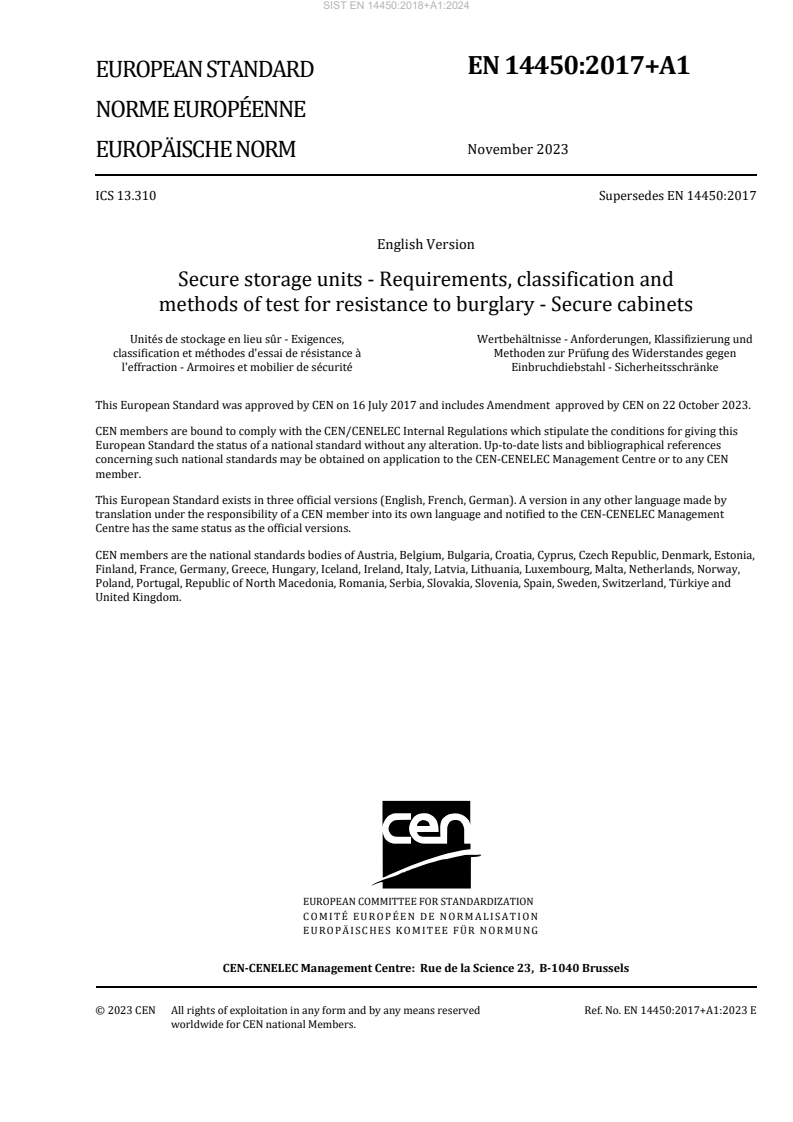
EN 14450:2017+A1
EUROPEAN STANDARD
NORME EUROPÉENNE
November 2023
EUROPÄISCHE NORM
ICS 13.310 Supersedes EN 14450:2017
English Version
Secure storage units - Requirements, classification and
methods of test for resistance to burglary - Secure cabinets
Unités de stockage en lieu sûr - Exigences, Wertbehältnisse - Anforderungen, Klassifizierung und
classification et méthodes d'essai de résistance à Methoden zur Prüfung des Widerstandes gegen
l'effraction - Armoires et mobilier de sécurité Einbruchdiebstahl - Sicherheitsschränke
This European Standard was approved by CEN on 16 July 2017 and includes Amendment approved by CEN on 22 October 2023.
CEN members are bound to comply with the CEN/CENELEC Internal Regulations which stipulate the conditions for giving this
European Standard the status of a national standard without any alteration. Up-to-date lists and bibliographical references
concerning such national standards may be obtained on application to the CEN-CENELEC Management Centre or to any CEN
member.
This European Standard exists in three official versions (English, French, German). A version in any other language made by
translation under the responsibility of a CEN member into its own language and notified to the CEN-CENELEC Management
Centre has the same status as the official versions.
CEN members are the national standards bodies of Austria, Belgium, Bulgaria, Croatia, Cyprus, Czech Republic, Denmark, Estonia,
Finland, France, Germany, Greece, Hungary, Iceland, Ireland, Italy, Latvia, Lithuania, Luxembourg, Malta, Netherlands, Norway,
Poland, Portugal, Republic of North Macedonia, Romania, Serbia, Slovakia, Slovenia, Spain, Sweden, Switzerland, Türkiye and
United Kingdom.
EUROPEAN COMMITTEE FOR STANDARDIZATION
COMITÉ EUROPÉEN DE NORMALISATION
EUROPÄISCHES KOMITEE FÜR NORMUNG
CEN-CENELEC Management Centre: Rue de la Science 23, B-1040 Brussels
© 2023 CEN All rights of exploitation in any form and by any means reserved Ref. No. EN 14450:2017+A1:2023 E
worldwide for CEN national Members.
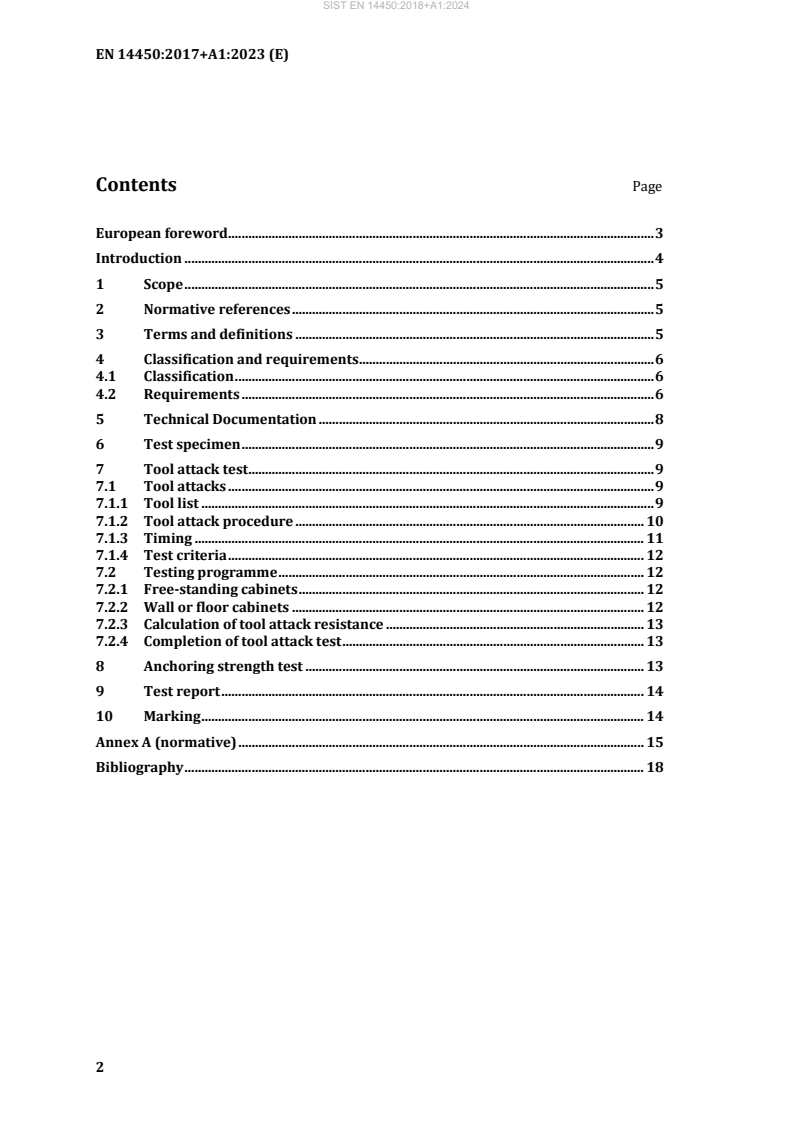
Contents Page
European foreword . 3
Introduction . 4
1 Scope . 5
2 Normative references . 5
3 Terms and definitions . 5
4 Classification and requirements . 6
4.1 Classification . 6
4.2 Requirements . 6
5 Technical Documentation . 8
6 Test specimen . 9
7 Tool attack test . 9
7.1 Tool attacks . 9
7.1.1 Tool list . 9
7.1.2 Tool attack procedure . 10
7.1.3 Timing . 11
7.1.4 Test criteria . 12
7.2 Testing programme . 12
7.2.1 Free-standing cabinets . 12
7.2.2 Wall or floor cabinets . 12
7.2.3 Calculation of tool attack resistance . 13
7.2.4 Completion of tool attack test . 13
8 Anchoring strength test . 13
9 Test report . 14
10 Marking . 14
Annex A (normative) . 15
Bibliography . 18
European foreword
This document (EN 14450:2017+A1:2023) has been prepared by Technical Committee
CEN/TC 263 “Secure safe cabinets”, the secretariat of which is held by BSI.
This European Standard shall be given the status of a national standard, either by publication of
an identical text or by endorsement, at the latest by May 2024, and conflicting national standards
shall be withdrawn at the latest by May 2024.
Attention is drawn to the possibility that some of the elements of this document may be the
subject of patent rights. CEN shall not be held responsible for identifying any or all such patent
rights.
This document includes Amendment 1 approved by CEN on 22 October 2023.
This document supersedes !EN 14450:2017".
The start and finish of text introduced or altered by amendment is indicated in the text by tags
!".
In comparison with EN 14450:2005, the following changes have been made:
— updating introduction;
— changing testing requirements regarding marking time (Clause 7.1.3.2) and anchoring
(Clause 7.1.2.1);
— size of the tool “wedge” changed in Clause 7.1.1;
— a note was changed to a requirement and the test equipment shall now have a capacity of at
least 30 kN (Clause 8);
— editorial clarification of the positioning of anchoring holes (Clause 4.2.2);
— editorial changes amongst others in Clauses 4.1, 7.1.2.4, 7.1.3, 7.1.4.6, 7.2, Table 1, Table 2
and Annex A).
Any feedback and questions on this document should be directed to the users’ national standards
body. A complete listing of these bodies can be found on the CEN website.
According to the CEN-CENELEC Internal Regulations, the national standards organisations of the
following countries are bound to implement this European Standard: Austria, Belgium, Bulgaria,
Croatia, Cyprus, Czech Republic, Denmark, Estonia, Finland, France, Germany, Greece, Hungary,
Iceland, Ireland, Italy, Latvia, Lithuania, Luxembourg, Malta, Netherlands, Norway, Poland,
Portugal, Republic of North Macedonia, Romania, Serbia, Slovakia, Slovenia, Spain, Sweden,
Switzerland, Türkiye and the United Kingdom.
Introduction
Tests are made and the results used to classify resistance to burglary.
The standard covers products meant for purposes where the security resistance required is less
than that measured by EN 1143-1. Normally these products are used in lower risk situations.
!Secure safe cabinets" aim to protect against burglars who typically have no specific
information on the level of resistance offered by construction and are not prepared to take high
risks. The burglar attempts to gain access to the cabinet using simple tools which they normally
bring to access premises. To reflect this limitation the tools permitted in the type tests of this
standard are mostly manual tools (“hand tools”).
However for purpose of repeatability two mains driven tools are included:
— electric drill (to eliminate power loss to battery state);
— electric disc grinder (represents and replaces hammer and chisel testing to eliminate tester's
fatigue and risk of injury especially in respect of the test conditions by counting the gross
time).
Depending on the criminal, the conditions at the place of crime and the availability of tools,
considerably longer times are likely to occur in real burglar attacks than in a type test.
It should be noted that results of manual testing are dependent of the skills of the testing team. It
is therefore recommended that testing teams exchange skills and experience on a regular basis.
There is no requirement under this standard to test for resistance to fraudulent access.
1 Scope
This document establishes the basis for testing and classifying !secure safe cabinets".
The standard covers products meant for purposes where the security resistance required is less
than that measured by EN 1143-1. Normally these products are used in lower risk situations.
2 Normative references
The following documents, in whole or in part, are normatively referenced in this document and
are indispensable for its application. For dated references, only the edition cited applies. For
undated references, the latest edition of the referenced document (including any amendments)
applies.
EN 1300, Secure storage units - Classification for high security locks according to their resistance to
unauthorized opening
!EN 17646, Secure storage units - Classification for high security locks according to their
resistance to unauthorized opening - Distributed systems"
3 Terms and definitions
For the purpose of this document, the following terms and definitions apply.
3.1
!secure cabinet"
storage unit which protects its content against burglary, which has at least one internal side ≤ 1 m
length when closed, and the interior of which is accessed through a lockable door or lid
3.2
free-standing cabinet
!secure cabinet" whose protection against burglary depends only upon the materials and
construction of its primary manufacture and not upon materials added or attached during
installation
3.3
wall cabinet
!secure cabinet" for installation into a wall and whose protection against burglary is partly
dependent upon the wall(s) and the materials added during installation
3.4
floor cabinet
!secure cabinet" for installation into a floor and whose protection against burglary is partly
dependent upon materials added during installation
3.5
working time
time spent during testing during which one or more tools are used to create a change in the test
specimen
3.6
gross time
time from when a test is started to when the test is complete or abandoned
3.7
encasement
material added at installation to protect and anchor wall cabinets and floor cabinets
3.8
tool points, TP
numerical value assigned to test tool
3.9
security units, SU
numerical value expressing resistance against burglary attack
4 Classification and requirements
4.1 Classification
!Secure cabinets" are classified to a resistance level according to Table 1.
Table 1 — Requirements for classification of secure safe cabinets
S1 S2
Minimum resistance for 2,00 SU 5,00 SU
access
Limit to number and type of 40 TP 60 TP
tools used for testing
Minimum strength 20 kN 30 kN
per anchoring hole
Minimum locking !One lock !One lock
according to according to
EN 1300 or EN 1300 or
EN 17646" EN 17646"
Gross attack time is limited as described in 7.2.4 b).
4.2 Requirements
4.2.1 !There shall be no holes through the protection material other than those for
a) locks (spindle holes, key holes, lock cable holes),
b) anchoring,
c) cables (for instance for alarms, electricity or lighting): Not more than four cable holes in the
body are permitted. These shall be at least 200 mm apart from their centre points. One
additional hole in the door is permitted. Cable holes shall not exceed 100 mm each. Unused
cable entry openings shall be obstructed or plugged by the manufacturer by a means of which
cannot be removed from the outside without leaving visible traces."
4.2.2 A free-standing cabinet with a mass less than 1 000 kg shall have at least two holes by
which it can be anchored. These holes shall be at one face or at two different faces through which
it is to be anchored. The anchoring assembly for each anchoring hole shall sustain the minimum
anchoring strength given in Table 1.
4.2.3 !Secure cabinets" shall be provided with operating and installation instructions,
including instructions in respect of the locks and anchoring. For freestanding secure safe cabinets
the installation instruction shall note that the cabinet shall be anchored on site through at least
two of the anchoring holes (see 4.2.2).
5 Technical Documentation
The technical documentation shall contain the following information:
5.1 Date of issue and the name of the manufacturer (or the name and status of the applicant
requesting testing) shall be on each page.
5.2 Statement of the type and model number of !secure cabinet", e.g. free-standing
cabinet, wall cabinet or floor cabinet.
5.3 Drawings of the test specimen and documents giving the following:
a) weight, outside and inside dimensions, and the manufacturing tolerances of the dimensions;
b) horizontal and vertical cross-sections;
c) the quantity, layout and features of locks, boltwork and relocking devices;
d) the quantity, pitch and position of door bolts, their dimensions (e.g. cross-section), throw and
engagement and their type (e.g. moving or fixed);
e) the location and design of any local areas of special protection material;
f) purpose, position and dimensions of any holes which pass through the protection material
with details of any associated special protection;
g) details of optional features, e.g. time locking and time delay locking;
h) specification of the materials of construction.
5.4 Operating and installation instructions, including instructions in respect of the locks and
anchoring.
5.5 In addition to 5.2, 5.3 and 5.4, for wall cabinets and floor cabinets the following information
shall be provided:
a) details of the recommended procedure for installation;
b) drawing showing the re
...