

SIST EN 1300:2023
(Main)Secure storage units - Classification for high security locks according to their resistance to unauthorized opening
General Information
- Abstract
This document specifies requirements for high security locks (HSL) for reliability, resistance to burglary and manipulation with methods of testing. It also provides a scheme for classifying HSL in accordance with their assessed resistance to burglary and unauthorized opening.
It is applicable to mechanical and electronic HSL. For electronic locks used in a distributed system, see EN 17646 for further information.
The following features can be included as optional subjects but they are not mandatory:
a) recognized code for preventing code altering and/or enabling/disabling parallel codes;
b) recognized code for disabling time set up;
c) integration of alarm components or functions;
d) resistance to attacks with acids;
e) resistance to X-rays;
f) resistance to explosives;
g) time functions.
- Status
- Published
- Public Enquiry End Date
- 27-Feb-2022
- Publication Date
- 13-Nov-2023
- Technical Committee
- PPV - Secure storage units and door locks
- Current Stage
- 6060 - National Implementation/Publication (Adopted Project)
- Start Date
- 11-Oct-2023
- Due Date
- 16-Dec-2023
- Completion Date
- 14-Nov-2023

Overview
EN 1300:2023 - published by CEN - defines requirements and test methods for high security locks (HSL) used in secure storage units. The standard covers both mechanical and electronic locks, sets criteria for reliability, resistance to burglary and manipulation, and provides a classification scheme that rates locks according to their assessed resistance to unauthorized opening.
EN 1300:2023 supersedes EN 1300:2018 and includes updated test procedures, documentation requirements and new technical expectations for electronic components and firmware.
Key topics and technical requirements
- Scope: Requirements for reliability, manipulation resistance and destructive burglary resistance for HSL; classification scheme for assessed resistance levels. Applicable to mechanical and electronic HSL. (Distributed electronic systems: see EN 17646.)
- Testing & classification: Specifies test specimens, test methods and how to assign a lock to a resistance class. Number of test specimens updated to seven.
- Security tests: Manipulation resistance, destructive burglary resistance, spying resistance, electrical/electromagnetic resistance, physical/environmental and temperature resistance.
- Reliability: Cycling tests, code change procedures, dynamic code input (mechanical combination locks) and requirements for usable codes.
- Electronic lock specifics:
- Requirements for electronic tokens, encryption levels (e.g., contactless tokens for class B now require 128-bit encryption).
- Event recording minimums and firmware update procedures.
- Power-supply test updates (AC 230 V effective value; DC tests to 60 V; extended check time to 24 h).
- Increased focus on manipulation involving PCs and lock‑specific software.
- Optional features (not mandatory): anti‑code alteration, time disabling codes, integrated alarm functions, resistance to acids/X‑rays/explosives, and time functions.
- Documentation & marking: Technical documentation, test reports and marking requirements including declaration templates and firmware declarations.
Applications and who uses it
EN 1300:2023 is intended for:
- Manufacturers and designers of safes, vault doors and secure cabinets who need to certify HSL performance.
- Test laboratories performing lock resistance and reliability testing.
- Security consultants, insurers and procurement teams specifying lock performance for banks, retail, public institutions and data centres.
- Regulators and standardization bodies aligning national standards with CEN requirements.
Practical benefits: objective classification for procurement, improved resilience against forced entry and manipulation, clear requirements for electronic token security and firmware management.
Related standards
- EN 17646 - electronic locks in distributed systems (see for networked/remote lock applications)
- EN 1143‑1 / EN 1143‑2 - secure storage units and burglary resistance
- EN 1047‑1 / EN 1047‑2 - fire resistance for data cabinets and rooms
Keywords: EN 1300:2023, high security locks, HSL, classification, resistance to unauthorized opening, mechanical locks, electronic locks, testing methods, CEN.
Relations
- Effective Date
- 09-Feb-2026
- Effective Date
- 09-Feb-2026
- Effective Date
- 09-Feb-2026
- Effective Date
- 09-Feb-2026
- Refers
SIST EN 60068-2-6:2008 - Environmental testing - Part 2-6: Tests - Test Fc: Vibration (sinusoidal) - Effective Date
- 09-Feb-2026
- Effective Date
- 09-Feb-2026
- Effective Date
- 28-Jan-2026
- Effective Date
- 28-Jan-2026
- Effective Date
- 28-Jan-2026
- Effective Date
- 28-Jan-2026
- Effective Date
- 28-Jan-2026
- Effective Date
- 28-Jan-2026
- Effective Date
- 28-Jan-2026
- Effective Date
- 28-Jan-2026
- Effective Date
- 28-Jan-2026
Get Certified
Connect with accredited certification bodies for this standard

CIS Institut d.o.o.
Personal Protective Equipment (PPE) certification body. Notified Body NB-2890 for EU Regulation 2016/425 PPE.

Kiwa BDA Testing
Building and construction product certification.
Kmetijski inštitut Slovenije
Agricultural Institute of Slovenia. Soil testing, plant health, agricultural product analysis.
Sponsored listings
Frequently Asked Questions
SIST EN 1300:2023 is a standard published by the Slovenian Institute for Standardization (SIST). Its full title is "Secure storage units - Classification for high security locks according to their resistance to unauthorized opening". This standard covers: This document specifies requirements for high security locks (HSL) for reliability, resistance to burglary and manipulation with methods of testing. It also provides a scheme for classifying HSL in accordance with their assessed resistance to burglary and unauthorized opening. It is applicable to mechanical and electronic HSL. For electronic locks used in a distributed system, see EN 17646 for further information. The following features can be included as optional subjects but they are not mandatory: a) recognized code for preventing code altering and/or enabling/disabling parallel codes; b) recognized code for disabling time set up; c) integration of alarm components or functions; d) resistance to attacks with acids; e) resistance to X-rays; f) resistance to explosives; g) time functions.
This document specifies requirements for high security locks (HSL) for reliability, resistance to burglary and manipulation with methods of testing. It also provides a scheme for classifying HSL in accordance with their assessed resistance to burglary and unauthorized opening. It is applicable to mechanical and electronic HSL. For electronic locks used in a distributed system, see EN 17646 for further information. The following features can be included as optional subjects but they are not mandatory: a) recognized code for preventing code altering and/or enabling/disabling parallel codes; b) recognized code for disabling time set up; c) integration of alarm components or functions; d) resistance to attacks with acids; e) resistance to X-rays; f) resistance to explosives; g) time functions.
SIST EN 1300:2023 is classified under the following ICS (International Classification for Standards) categories: 13.310 - Protection against crime. The ICS classification helps identify the subject area and facilitates finding related standards.
SIST EN 1300:2023 has the following relationships with other standards: It is inter standard links to SIST EN IEC 60068-2-1:2026, SIST EN IEC 60068-2-2:2026, SIST EN IEC 61000-4-2:2025, SIST EN IEC 61000-4-3:2021, SIST EN 60068-2-6:2008, SIST EN 61000-4-5:2014, SIST EN 1143-2:2024, SIST EN 17646:2022, SIST EN 14450:2018+A1:2024, SIST EN ISO 22479:2022, SIST EN 16523-1:2015+A1:2018, SIST EN 1555-5:2010, SIST EN 1143-1:2019, SIST EN ISO 18497-3:2024, SIST EN 14450:2018. Understanding these relationships helps ensure you are using the most current and applicable version of the standard.
SIST EN 1300:2023 is associated with the following European legislation: EU Directives/Regulations: 2020-01-0063. When a standard is cited in the Official Journal of the European Union, products manufactured in conformity with it benefit from a presumption of conformity with the essential requirements of the corresponding EU directive or regulation.
SIST EN 1300:2023 is available in PDF format for immediate download after purchase. The document can be added to your cart and obtained through the secure checkout process. Digital delivery ensures instant access to the complete standard document.
Standards Content (Sample)
SLOVENSKI STANDARD
01-december-2023
Varnostne shranjevalne enote - Klasifikacija visoko varnostnih ključavnic po
odpornosti proti nepooblaščenemu odpiranju
Secure storage units - Classification for high security locks according to their resistance
to unauthorized opening
Wertbehältnisse - Klassifizierung von Hochsicherheitsschlössern nach ihrem
Widerstandswert gegen unbefugtes Öffnen
Unités de stockage en lieu sûr - Classification des serrures haute sécurité en fonction de
leur résistance à l'effraction
Ta slovenski standard je istoveten z: EN 1300:2023
ICS:
13.310 Varstvo pred kriminalom Protection against crime
2003-01.Slovenski inštitut za standardizacijo. Razmnoževanje celote ali delov tega standarda ni dovoljeno.
EN 1300
EUROPEAN STANDARD
NORME EUROPÉENNE
September 2023
EUROPÄISCHE NORM
ICS 13.310 Supersedes EN 1300:2018
English Version
Secure storage units - Classification for high security locks
according to their resistance to unauthorized opening
Unités de stockage en lieu sûr - Classification des Wertbehältnisse - Klassifizierung von
serrures haute sécurité en fonction de leur résistance à Hochsicherheitsschlössern nach ihrem
l'effraction Widerstandswert gegen unbefugtes Öffnen
This European Standard was approved by CEN on 16 July 2023.
CEN members are bound to comply with the CEN/CENELEC Internal Regulations which stipulate the conditions for giving this
European Standard the status of a national standard without any alteration. Up-to-date lists and bibliographical references
concerning such national standards may be obtained on application to the CEN-CENELEC Management Centre or to any CEN
member.
This European Standard exists in three official versions (English, French, German). A version in any other language made by
translation under the responsibility of a CEN member into its own language and notified to the CEN-CENELEC Management
Centre has the same status as the official versions.
CEN members are the national standards bodies of Austria, Belgium, Bulgaria, Croatia, Cyprus, Czech Republic, Denmark, Estonia,
Finland, France, Germany, Greece, Hungary, Iceland, Ireland, Italy, Latvia, Lithuania, Luxembourg, Malta, Netherlands, Norway,
Poland, Portugal, Republic of North Macedonia, Romania, Serbia, Slovakia, Slovenia, Spain, Sweden, Switzerland, Türkiye and
United Kingdom.
EUROPEAN COMMITTEE FOR STANDARDIZATION
COMITÉ EUROPÉEN DE NORMALISATION
EUROPÄISCHES KOMITEE FÜR NORMUNG
CEN-CENELEC Management Centre: Rue de la Science 23, B-1040 Brussels
© 2023 CEN All rights of exploitation in any form and by any means reserved Ref. No. EN 1300:2023 E
worldwide for CEN national Members.
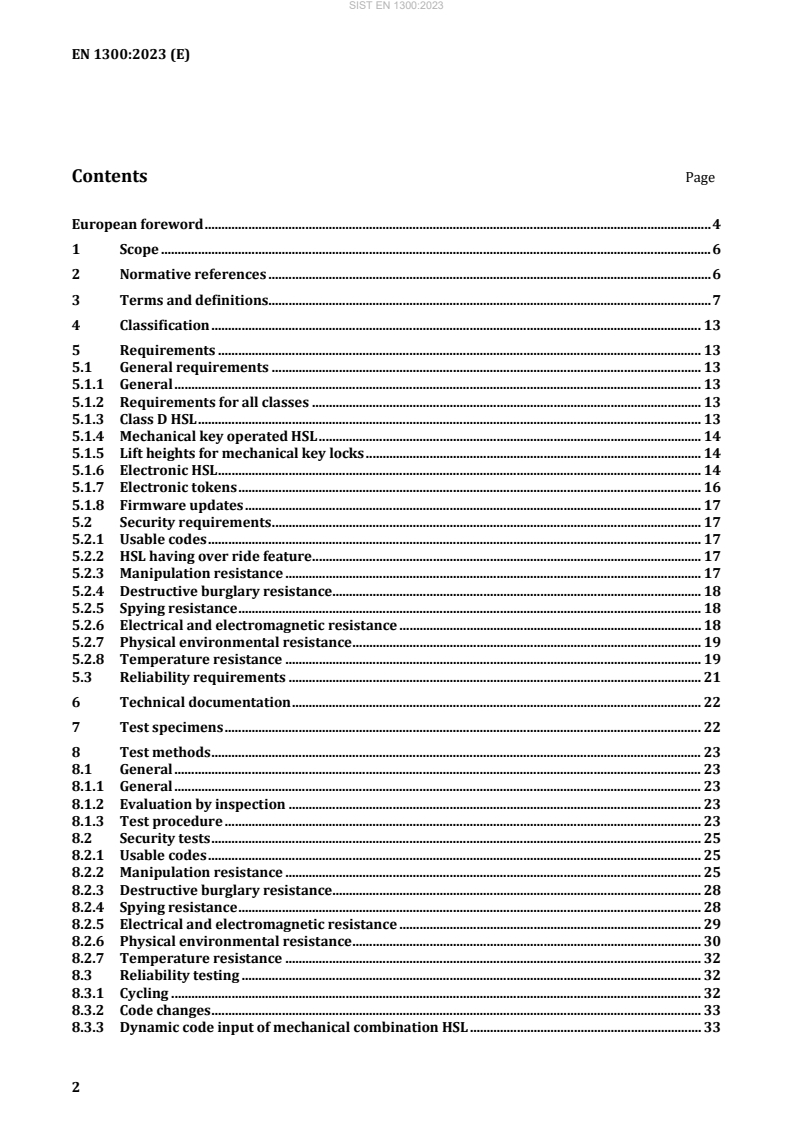
Contents Page
European foreword . 4
1 Scope . 6
2 Normative references . 6
3 Terms and definitions. 7
4 Classification . 13
5 Requirements . 13
5.1 General requirements . 13
5.1.1 General . 13
5.1.2 Requirements for all classes . 13
5.1.3 Class D HSL . 13
5.1.4 Mechanical key operated HSL . 14
5.1.5 Lift heights for mechanical key locks . 14
5.1.6 Electronic HSL . 14
5.1.7 Electronic tokens . 16
5.1.8 Firmware updates . 17
5.2 Security requirements . 17
5.2.1 Usable codes . 17
5.2.2 HSL having over ride feature . 17
5.2.3 Manipulation resistance . 17
5.2.4 Destructive burglary resistance . 18
5.2.5 Spying resistance . 18
5.2.6 Electrical and electromagnetic resistance . 18
5.2.7 Physical environmental resistance . 19
5.2.8 Temperature resistance . 19
5.3 Reliability requirements . 21
6 Technical documentation . 22
7 Test specimens . 22
8 Test methods . 23
8.1 General . 23
8.1.1 General . 23
8.1.2 Evaluation by inspection . 23
8.1.3 Test procedure . 23
8.2 Security tests . 25
8.2.1 Usable codes . 25
8.2.2 Manipulation resistance . 25
8.2.3 Destructive burglary resistance . 28
8.2.4 Spying resistance . 28
8.2.5 Electrical and electromagnetic resistance . 29
8.2.6 Physical environmental resistance . 30
8.2.7 Temperature resistance . 32
8.3 Reliability testing . 32
8.3.1 Cycling . 32
8.3.2 Code changes . 33
8.3.3 Dynamic code input of mechanical combination HSL . 33
9 Test report . 34
10 Marking . 34
Annex A (normative) Parameters for installation and operation instructions . 35
Annex B (normative) Determination of manipulation resistance due to the design
requirement . 37
B.4.2 Sniffing the code via the data cable connection . 44
B.4.3 Sniffing the code via key logger . 45
B.4.4 Replay attack via the cable connection . 46
B.4.5 Brute force attack . 47
B.4.6 Side channel attacks . 48
B.4.7 Lock spiking. 49
B.4.8 Mechanical bypassing . 49
B.4.9 Optical code spying . 49
Annex C (informative) Example of manufacturer's declaration . 50
Annex D (informative) Typical locking device dimensions . 52
Annex E (normative) Determination of burglary resistance due to the design requirement . 53
Annex F (informative) Example of firmware declaration . 54
Annex G (informative) A-deviations . 55
European foreword
This document (EN 1300:2023) has been prepared by Technical Committee CEN/TC 263 “Secure storage
of cash, valuables and data media”, the secretariat of which is held by BSI.
This European Standard shall be given the status of a national standard, either by publication of an
identical text or by endorsement, at the latest by March 2024 and conflicting national standards shall be
withdrawn at the latest by March 2024.
Attention is drawn to the possibility that some of the elements of this document may be the subject of
patent rights. CEN shall not be held responsible for identifying any or all such patent rights.
This document supersedes EN 1300:2018.
General changes:
— editorial changes in the Scope;
— references have been updated in Clause 2;
— definitions in Clause 3 have been added (opening event, opening related event, relevant audit
information, non relevant audit information, character). Other definitions have been updated (one
time code, locked door, secured HSL condition, fail secure, penalty time, authentication, firmware);
— requirements have been added for the used clocks (see 8.2.2.2.1 and 8.2.3.2.1);
— requirements have been added that the test report shall include any deviations from the procedure
and unusual features observed (see Clause 9);
— Annex C and Annex F have been changed from normative to informative;
— editorial changes for clarification in 5.1.4.5, 5.1.5.1, 5.1.5.3, 5.2.1, 5.2.6.5, 5.2.3.1, 5.2.7, 8.1.3, 8.2.1.4,
8.2.2.1, 8.2.2.3, 8.2.2.5, 8.2.4.3.2, 8.2.6.2.5, 8.2.6.3.1, 8.2.6.3.2, 8.2.6.3.3, 10, A.2b), B.2.2, B.2.4, Annex G,
Figure 1, Table 1 and Table 2.
Technical changes for any type of lock:
— requirement for indication of blocking status (5.1.2.5 and Annex A) has been updated;
— test requirement has been changed from “normal condition” to “operating condition” in several
clauses (see 5.2.8.1, 5.2.8.2, 8.2.5.1, 8.2.5.2, 5.3.1, 5.3.3, 8.2.6.1, 8.2.6.3.2, 8.2.6.3.3, 8.2.7.1, 8.2.7.2,
8.3.1.1, 8.3.1.4, 8.3.2.1, 8.3.2.3 and 8.3.3.1);
— number of test specimens has changed from four to seven (see 7.1);
— the manipulation tool “personal computer” has now been classified with 0 basic units (with standard
software) and with 25 basic units (with lock specific manipulation software), see Table 4.
Changes for mechanical combination locks:
— a dynamic code entry requirement was added (see 5.3.4) that corresponds to the already existing
test requirement in 8.3.3.
Technical changes for electronic locks:
— removal of requirements regarding distributed systems into the European Standard EN 17646 (see
Clause 1, 5.2.5.2, 5.2.5.4, Annex A, Annex F);
— raising encryption requirements for contactless electronic tokens for class B (from 64 bits to
128 bits, see 5.1.7.2.3) and for all classes, if the range is more than 15 cm (shall be tested according
to EN 17646, see 5.1.7.2.1);
— Clause 5.1.7.2.4 is now also applicable for contacted electronic tokens (5.1.7.3);
— new minimum requirements for recording events (see 5.1.6.2);
— updating requirements for local firmware updates (see 5.1.8);
— adding tolerance for usable codes for electronic locks (see Table 1);
— including new requirements for the manipulation of electronic locks and mechanical locks with
electronic components 5.2.5.4, 8.2.2.1, Table 4 and Annex B;
— updating of power supply tests: raising current from 220 V to an effective value of 230 V (AC) and
changing it to 60 V (DC), re-structuring of the clauses for better reading, changing checking time from
12 h to 24 h, adding test requirements for electronic HSL with separate processing unit not included
in the locking device used in secure cabinets (see 5.1.6.8, 5.2.6.1, 5.2.6.2, 8.2.5.3, 8.2.5.4 and Annex E);
— updates in 5.1.6.6 and 5.1.6.7.
This document has been prepared by the Working Group 3 of CEN/TC 263 as one of a series of standards
for secure storage of cash valuable and data media. Other standards in the series are, among others:
— EN 1047-1, Secure storage units — Classification and methods of test for resistance to fire — Part 1:
Data cabinets and diskette inserts
— EN 1047-2, Secure storage units — Classification and methods of test for resistance to fire — Part 2:
Data rooms and data container
— EN 1143-1, Secure storage units — Requirements, classification and methods of test for resistance to
burglary — Part 1: Safes, ATM safes, strongroom doors and strongrooms
— EN 1143-2, Secure storage units — Requirements, classification and methods of test for resistance to
burglary — Part 2: Deposit systems
— EN 14450, Secure storage units — Requirements, classification and methods of test for resistance to
burglary — Secure safe cabinets
Any feedback and questions on this document should be directed to the users’ national standards body.
A complete listing of these bodies can be found on the CEN website.
According to the CEN-CENELEC Internal Regulations, the national standards organizations of the
following countries are bound to implement this European Standard: Austria, Belgium, Bulgaria, Croatia,
Cyprus, Czech Republic, Denmark, Estonia, Finland, France, Germany, Greece, Hungary, Iceland, Ireland,
Italy, Latvia, Lithuania, Luxembourg, Malta, Netherlands, Norway, Poland, Portugal, Republic of North
Macedonia, Romania, Serbia, Slovakia, Slovenia, Spain, Sweden, Switzerland, Türkiye and the United
Kingdom.
1 Scope
This document specifies requirements for high security locks (HSL) for reliability, resistance to burglary
and manipulation with methods of testing. It also provides a scheme for classifying HSL in accordance
with their assessed resistance to burglary and unauthorized opening.
It is applicable to mechanical and electronic HSL. For electronic locks used in a distributed system, see
EN 17646 for further information.
The following features can be included as optional subjects but they are not mandatory:
a) recognized code for preventing code altering and/or enabling/disabling parallel codes;
b) recognized code for disabling time set up;
c) integration of alarm components or functions;
d) resistance to attacks with acids;
e) resistance to X-rays;
f) resistance to explosives;
g) time functions.
2 Normative references
The following documents are referred to in the text in such a way that some or all of their content
constitutes requirements of this document. For dated references, only the edition cited applies. For
undated references, the latest edition of the referenced document (including any amendments) applies.
EN 1143-1, Secure storage units - Requirements, classification and methods of test for resistance to burglary
- Part 1: Safes, ATM safes, strongroom doors and strongrooms
EN 1143-2, Secure storage units - Requirements, classification and methods of tests for resistance to
burglary - Part 2: Deposit systems
EN 14450, Secure storage units - Requirements, classification and methods of test for resistance to burglary
- Secure safe cabinets
EN 17646, Secure storage units - Classification for high security locks according to their resistance to
unauthorized opening - Distributed systems
EN 60068-2-1, Environmental testing - Part 2-1: Tests - Test A: Cold (IEC 60068-2-1)
EN 60068-2-2, Environmental testing - Part 2-2: Tests - Test B: Dry heat (IEC 60068-2-2)
EN 60068-2-6, Environmental testing - Part 2-6: Tests - Test Fc: Vibration (sinusoidal) (IEC 60068-2-6)
EN 61000-4-2, Electromagnetic compatibility (EMC) - Part 4-2: Testing and measurement techniques -
Electrostatic discharge immunity test (IEC 61000-4-2)
EN IEC 61000-4-3, Electromagnetic compatibility (EMC) - Part 4-3: Testing and measurement techniques -
Radiated, radio-frequency, electromagnetic field immunity test (IEC 61000-4-3)
EN 61000-4-5, Electromagnetic compatibility (EMC) - Part 4-5: Testing and measurement techniques -
Surge immunity test (IEC 61000-4-5)
EN ISO 22479, Corrosion of metals and alloys - Sulfur dioxide test in a humid atmosphere (fixed gas method)
(ISO 22479)
ISO/IEC 9798-2, IT Security techniques - Entity authentication - Part 2: Mechanisms using authenticated
encryption
ISO/IEC 9798-4, Information technology - Security techniques - Entity authentication - Part 4: Mechanisms
using a cryptographic check function
NIST/SP 800-57, Recommendation for Key Management - Part 1: General
3 Terms and definitions
For the purposes of this document, the following terms and definitions apply.
ISO and IEC maintain terminology databases for use in standardization at the following addresses:
— IEC Electropedia: available at https://www.electropedia.org/
— ISO Online browsing platform: available at https://www.iso.org/obp/
3.1
High Security Lock
HSL
independent assembly normally fitted to doors of secure storage units
Note 1 to entry: Codes can be entered into an HSL for comparison with memorized codes (processing unit). A
correct match of an opening code allows movement of a blocking feature.
3.2
code
identification information required which can be entered into an HSL and which, if correct, enables the
security status of the HSL to be changed
3.2.1
opening code
identification information which allows the HSL to be opened
3.2.2
recognized code
identification information which allows access to the processing unit and which may also be an opening
code
Note 1 to entry: Master codes, manager codes, authorization codes and services codes may fall under recognized
codes.
3.2.3
duress code
parallel code which initiates some additional function
3.2.4
parallel code
opening code which has identical function to that of an existing opening code but constructed of different
characters
3.3
coding means
method by which the code is held
3.3.1
material code
code defined by the physical features or other properties of a token
3.3.2
mnemonic code
remembered code consisting of numeric and/or alphabetic information
3.3.3
biometric code
code comprising human characteristics
3.3.4
one time code
temporary code that expires after a single use
3.4
input unit
part of an HSL which communicates codes to a processing unit
3.5
processing unit
part of an HSL which evaluates whether the input code is correct and enables or prevents movement of a
locking device
3.6
locking device
mechanical unit as part of the HSL inside of the secure storage unit that contains the blocking feature, the
lock case, the lock cover and other mechanical and/or electronic parts
Note 1 to entry: An example of a locking device is shown in Annex D.
3.7
token
object whose physical form or properties specifies a recognized code
EXAMPLE A key.
Note 1 to entry: An electronic token incorporates an integrated circuit containing volatile and non-volatile
memory, associated firmware/software and in many cases a microcontroller which communicates with an input
unit by contact or contactless means.
3.8
mechanical HSL
HSL which is secured by means of mechanical elements only
3.9
electronic HSL
HSL which is secured partly or fully by electrical or electronic elements
3.10
blocking feature
part of an HSL which, after inputting the correct opening code moves, or can be moved, typically this is a
bolt
Note 1 to entry: A blocking feature either secures a door or prevents movement of a boltwork. The bolt of a lock
is an example of a blocking feature.
3.11
locking element
part of the HSL which enables the blocking feature to be moved
EXAMPLES Levers, spindles, wheels, motors, solenoids
3.12
destructive burglary
attack which damages the HSL in such a manner that it is irreversible and cannot be hidden from the
authorized user
3.13
reliability
ability to function and achieve the security requirements of this standard after a large number of duty
cycles
3.14
manipulation
method of attack aimed at removing the blocking function without causing damage obvious to the user
Note 1 to entry: An HSL may function after manipulation although its security could be permanently degraded.
3.15
spying
attempt to obtain unauthorized information
3.16
usable codes
codes or tokens permitted by the manufacturer and conforming to the requirements of this standard
Note 1 to entry: For mechanical HSL the number of usable codes is much less than the total number of codes to
which the HSL can be set.
3.17
scrambled condition
coding elements are not in the configuration necessary for the HSL to be opened without entering the
complete correct code or proper token
3.18
locking sequence
series of actions which start with an open door and are complete when the door is closed, bolted, locked
and secure
3.19
open door
door which is not in its frame
3.20
closed door
door which is within its frame ready for throwing its bolt(s)
3.21
bolted door
closed door where the bolts of the boltwork are thrown, but the HSL may still be open
3.22
locked door
bolted door where the boltwork cannot be withdrawn because it is blocked by the HSL
3.23
secured door
door, which is closed, bolted and locked with an HSL in the secured HSL condition
3.24
secured HSL condition
the blocking feature is thrown and the HSL has been locked and scrambled
3.25
unsecured HSL condition
HSL not being in secure HSL condition
3.26
operating condition
HSL specimen is in the secured HSL condition and can be unlocked with the opening code(s), but not all
design functions are operable
3.27
fail secure
HSL specimen is in the secured HSL condition, but not all design functions are operable therefore it might
not be unlocked with the opening code(s)
3.28
Resistance Unit
RU
value for burglary and manipulation resistance
Note 1 to entry: It shows a calculated result from using a tool with a certain value over a period of time.
3.29
penalty time
period of time during which the HSL cannot be operated to prevent the limit of incorrect code entries
being exceeded
3.30
authentication
method to prevent fraud by ensuring that communication can only be established after the identity of the
components have been properly confirmed
3.31
cryptographic algorithm
mathematical method for the transformation of data that includes the definition of parameters
EXAMPLE Key length and number of iterations or rounds.
3.31.1
asymmetric cryptographic algorithm
cryptographic algorithm that uses two related keys, a public key and a private key, which have the
property that deriving the private key from the public key is computationally infeasible
3.31.2
symmetric cryptographic algorithm
cryptographic algorithm that uses a single secret key for both encryption and decryption
3.32
cryptographic key
parameter used in conjunction with a cryptographic algorithm which is used to control a cryptographic
process such as encryption, decryption or authentication
Note 1 to entry: Knowledge of an appropriate key allows correct en- and/or decryption or validation of a
message.
3.33
distributed system
system with components connected by a transmission system, wired or wireless
Note 1 to entry: It is assumed that the transmitted information can be accessed by a third party. A high security
lock with components in separate locations is defined as distributed system. A lock system with two input units,
one on the safe and the other remote (= distributed input unit) is an example of a distributed system. An electronic
lock with a non-accessible transmission system in the sense of 5.1.6.3 of this standard or with a temporary on-site
wired connection to a trusted device (e.g. trusted Personal Computer) supervised by an authorized person is not
considered as a distributed system.
3.34
encryption
procedure that renders the contents of a message or file unintelligible to anyone not authorized to read
it
Note 1 to entry: During the encryption procedure, a cryptographic algorithm using the cryptographic key is used
to transform plaintext into cipher text. This procedure is composed of:
— the mode of operation, describing the way to process data with the algorithm;
— the padding scheme, describing the way to fill up data strings to a specified length.
3.35
transmission system
communication system between the elements of a distributed system
Note 1 to entry: Dedicated lines, wired and wireless public switched networks may be used as the transmission
path.
3.36
security relevant information
codes according to 3.2, authentications, any code or key transmissions and changes as well as firmware
updates of input and processing units
3.37
firmware
software code that operates the processing or input units of the HSL
3.38
trusted device
wire-connected device, on which no unauthorized person will have access to security-relevant
information
3.39
opening event
entry of a recognized code with the aim to change the HSL to unsecured HSL condition
Note 1 to entry: The entry of a recognized code with the intention to change settings or for other purposes than
changing to unsecured HSL condition is not an opening event (for instance changing the time, adding users, etc).
3.40
opening related event
recorded event, which is directly connected to an opening
EXAMPLES Entering an opening code, entering a partial opening code (dual code function), presenting a token
(for single or two factor authentication), activating the locking element after entering opening code, opening the
blocking feature, changing HSL to secured condition
Note 1 to entry: It is not mandatory to store these events, but if they are stored the requirements in 5.1.6.2 are
relevant.
3.41
relevant audit information
recorded event, which is directly connected to the HSL and which is neither an opening event nor an
opening related event
EXAMPLES Activation of penalty time, adding new user, deleting user, tamper switch activation, time delay
change, time change, incorrect code entered, connection to a programming or auditing device related to the HSL,
low battery indication, change of user profiles, change of lock profiles, security and communication error messages,
lock reset
Note 1 to entry: It is not mandatory to store these events, but if they are stored the requirements in 5.1.6.2 are
relevant.
3.42
non relevant audit information
recorded event, which is not directly connected to the HSL
EXAMPLES Temperature, humidity, pressure, vibration, door opened, door closed, boltwork opened, boltwork
closed, connected to alarm systems (excluding duress alarm code as opening code), regular battery status
Note 1 to entry: It is not mandatory to store these events, but if they are stored the requirements in 5.1.6.2 are
relevant.
3.43
character
letter, digit, or other symbol having at least ten distinguishable variants used to represent parts of a
mnemonic code
EXAMPLES One of the characters 0 to 9 in a decimal numeration system.
4 Classification
HSL are classified to an HSL class (A, B, C or D) according to Table 1, Table 2 and Table 3 by their security
requirements. General requirements (see 5.1 and 5.2, 5.3) security and reliability requirements shall be
met.
NOTE HSL class A has the lowest requirements and HSL class D has the highest requirements.
5 Requirements
5.1 General requirements
5.1.1 General
All requirements shall be tested according to 8.1.2.
5.1.2 Requirements for all classes
5.1.2.1 HSL shall only be opened by valid opening codes. The opening code(s) shall be retained as the
only valid opening code(s) until deliberately reset. Overlaying or undocumented code(s) are not
permitted.
5.1.2.2 Where mnemonic codes are used with an HSL these shall be able to be changed.
5.1.2.3 Any supplementary device (e.g. micro switch) which is fitted by the HSL manufacturer shall
not be capable of being used to obtain information about the code.
5.1.2.4 An input unit is a necessary part of a mnemonic and electronic HSL although one input unit
may operate more than one processing unit.
All HSL shall have a processing unit to validate the correct code. Each HSL shall also incorporate a
blocking feature or be capable of causing movement of a blocking feature. If this feature shall be activated
before first use a note to this effect is to be included in the instructions for the use of the lock
5.1.2.5 If the blocking feature is not moved manually there shall be a means of indicating whether
the HSL is in secured HSL condition. If the HSL does not fulfil the requirement by itself automatically and
the secure and locked condition can solely be checked by trying to turn the handle of the boltwork of the
secure storage unit, then specific requirements shall be included in the installation instructions as well
as in the operating instructions (according to Annex A).
5.1.2.6 An opening code shall not be capable of being altered or being changed other than by a
recognized code.
5.1.3 Class D HSL
5.1.3.1 Means shall be provided by which the locking status, locked or unlocked, is made obvious.
5.1.3.2 A mechanical combination HSL shall be in a scrambled condition after locking.
5.1.3.3 A class D HSL shall contain a device which indicates the scrambled condition.
5.1.4 Mechanical key operated HSL
5.1.4.1 For all mechanical key operated HSL (see Clause 4), the same codes for the key sets shall not
be repeated until 100 % of the usable codes have been used. If a manufacturer has more than one
manufacturing plant the requirement is to be applied per plant. No synchronization between the plants
is needed. However multiple manufacturing plants shall not start at the same code at the same time.
5.1.4.2 Codes (and sets of code tokens) shall be chosen at random.
5.1.4.3 There shall be no number or marking on either token or HSL which identifies the code. Also,
no legitimization card shall be issued.
5.1.4.4 It shall not be possible to remove the key from an HSL whilst that HSL is in the open position
except for code changing. This requirement is applicable to all classes. Note that it is acceptable for this
feature to be activated immediately prior to the first use of the HSL.
5.1.4.5 The key shall not break under the applied maximum torque of (2,5 ± 0,1) Nm and the tested
key shall still be usable to open the HSL. The test shall be conducted according to 8.2.1.4.
5.1.4.6 In addition to the foregoing requirements the manufacturer is also to complete the
declaration set out in Annex C.
5.1.5 Lift heights for mechanical key locks
5.1.5.1 The maximum allowed number of coding elements (levers) of the same lift height shall be
calculated by taking 40 % of the coding elements. Round the result according to the example below.
EXAMPLE If the result would be 0,405 the rounded result is 41 %. If the result would be 0,404 the rounded
result is 40 %.
5.1.5.2 Usable codes shall not have more than two neighbouring elements, e.g. two levers next to each
other, with the same lift height.
5.1.5.3 In usable codes, the difference between the highest and lowest lift height shall be equal or
more than 60 % of the maximum lift height difference of the HSL. Calculation shall be rounded according
to the example in 5.1.5.1.
5.1.6 Electronic HSL
5.1.6.1 Electronic HSL shall not require the use of electric power to stay in secured condition.
5.1.6.2 Electronic HSL as of class B and with more than 2 opening codes and all HSL of class C and D
shall fulfil the following:
The HSL shall retain the records of the opening events and shall have the means to retain the record for
at least 1 year, even in the event of a power failure.
The record shall not contain any security relevant information.
The minimum number of stored events shall fulfil one of the following:
a) have a minimum size of 2 000 entries; or
b) store opening events (see 3.39) and audit entries relating to firmware updates in such a way that the
minimum requirements of Table 1 are always fulfilled; or
c) shall have a minimum size according to the following formula. If non-relevant audit entries are used,
these shall be stored in a separate memory:
R T+ T×∑OR+ 5×T×RE+F
( ) ( )
min
where
is the minimum total number of retained events;
R
min
T is the minimum number of retained records of opening events (see column 2 of Table 1).
OR is the number of different opening related events (see 3.40). The opening event itself is
not counted as OR;
RE is either 0 in case no other relevant audit information is recorded or 1 in case other
relevant audit information is recorded;
F is the minimum number of recorded firmware update events including version and date
of the relevant HSL class according to Table 1 (not relevant, if the HSL does not have a
firmware update function).
EXAMPLE 1 A HSL of class B only records opening events without any opening related events or other events.
The minimum number of retained audit events is then 10 + (10 x 0) + (5 x 10 x 0) + 0 = 10.
EXAMPLE 2 A HSL of class C records the following event types: “user entering code to initiate opening of the
HSL” (see 3.39), “HSL unlocked” (connected to opening event, see 3.40), “HSL locked” (connected to opening event,
see 3.40), user code changed (connected to HSL, see 3.41), tamper switch activated (connected to HSL, see 3.41 and
5.1.6.4), penalty time activated (see 3.41 and 5.2.3.1) as well as “firmware update performed” (see Table 1). The
minimum number of retained events is then (50 + (50 x 2) + (5 x 50 x 1) + 3 = 403.
5.1.6.3 For non-distributed systems all component parts of the input unit shall be fixed to the secure
storage unit. With the input unit being fixed to the secure storage unit the cabling from input unit to
processing unit shall be non-accessible.
5.1.6.4 In class C and D any manipulation or replacement of the input unit shall generate an audit
entry and automatically display information to the user at each use until it’s neutralized by an authorized
person.
5.1.6.5 If the Penalty Time is active there shall be a clear indication, in all classes of HSL, to the user.
5.1.6.6 For battery powered locks, where it is not possible to connect a power source from outside
of the secure storage unit or a mechanical override does not exist, the following requirements shall be
met: They shall be able to operate for at least 3 000 complete lock openings. The battery capacity shall be
monitored. In the case of a low battery/low batteries an audible or visual signal shall occur during or
immediately after an opening process. After the first low battery signal at least ten (10) complete opening
and locking processes shall still be possible.
5.1.6.7 The processing unit evaluating and memorizing the code which is relevant for the opening of
the HSL shall be located inside the secure storage unit.
5.1.6.8 All electronic HSL shall stay in secured condition when attacked with power supply according
to 8.2.5.3 b) and as of class B and higher electronic HSL shall additionally be attacked with power supply
according to 8.2.2.
For all electronic HSL constructed according to E.2.1 additionally Annex E is applicable.
5.1.6.9 Any application software generating one-time codes shall use authorization methods (e.g.
password or dongle) to access and operate it and shall use data protection to store any kind of data. The
manufacturer shall state which authorization methods and data protection is used for his system to the
testing laboratory (see Annex C).
The manufacturer shall give a statement in his manuals that any application software generating one-
time codes shall only be installed and operated in a secured environment.
=
5.1.7 Electronic tokens
5.1.7.1 General
The manufacturer shall give a statement in his manuals that electronic tokens shall be secured like
mechanical keys.
5.1.7.2 Contactless electronic tokens
5.1.7.2.1 General
The following requirements for contactless electronic tokens are only applicable for near field
communication devices, where a typical operation range is less than 15 cm, e.g. NFC or Mifare.
If the typical distance between electronic token and input unit for data transmission is more than 15 cm
or the electronic token is used for a class D HSL, the requirements of EN 17646 shall be met.
NOTE Optical systems are considered to be distributed systems. An example for a contactless electronic token
is RFID card.
5.1.7.2.2 Mutual authentication
Mutual authentication according to ISO/IEC 9798-2 or ISO/IEC 9798-4 shall be used. The time variant
parameter such as time stamp, sequence numbers or random numbers to prevent valid authentication
information from being accepted at a later time or more than once (see ISO/IEC 9798-1:2010, Annex B)
shall have at least 32 bits. In addition to mutual authentication a valid opening code shall be used to open
the HSL.
5.1.7.2.3 Cryptographic key
The cryptographic key for symmetric algorithms shall have a minimum length of 64 bits for class A and
128 bits for classes B, C and D and shall be intended only for the specific HSL model. Asymmetric
algorithms shall have comparable key lengths with regard to the security level (NIST/SP 800-57). The
cryptographic key for symmetric algorithms or the private key for asymmetric algorithms shall never be
sent out of the token. It may be part of the transmitted communication data into the electronic token for
initialising purposes. The initialization process shall be done by an authorized person in a secure
environment. This shall be stated in the user instructions.
5.1.7.2.4 Identification number
Each electronic token shall have a unique identification number. The identification number shall have a
length of at least 32 bits. Normally, the identification number is required for audit purposes only. If the
serial number is also used as security relevant information, it shall not be visible on the token.
5.1.7.3 Contacted electronic tokens
Contacted electronic tokens for locks other than class D may not meet the same additional requirements
as contactless electronic tokens of 5.1.7.2.1, 5.1.7.2.2 and 5.1.7.2.3. The manufacturer then shall give a
statement in his manuals if any security relevant information is stored unencrypted.
Security relevant information should be stored secure in the token and there should be a secure
authentication.
5.1.7.4 Multi-use
If the electronic token is designed to be used in applications other than the HSL system, the security
relevant information shall not be accessible to the other applications.
If the electronic token is not protected against multi-use, the following statement shall be included in the
manual: Never use this electronic token in applications other than this HSL model.
SIST EN 1
...