

SIST EN 10302:2008
(Main)Creep resisting steels, nickel and cobalt alloys
General Information
- Abstract
1.1 This European Standard covers the grades of wrought steels and alloys listed in Table 1 and Table 2, which are usually employed for components and equipment, for which the main requirement is their creep resistance under mechanical long-time stressing at temperatures above 500 C.
NOTE Heat resisting grades given in EN 10095 [9] may also be used for similar applications if so agreed.
1.2 This European Standard specifies the technical delivery conditions for semi-finished products, for hot or cold rolled sheet/plate and strip, hot or cold formed (cold drawn) bars, rods, wire and sections.
1.3 The general technical delivery conditions specified in EN 10021:2006 apply in addition to the specifications of this European Standard, unless otherwise specified in this European Standard.
1.4 This European Standard does not apply to components manufactured by further processing the product forms listed in 1.2 with quality characteristics altered as a result of such further processing.
1.5 This European Standard shall not be used for aerospace and pressure purposes.
1.6 For steels and alloys with similar chemical composition, but intended for different applications, see the Bibliography.
- Status
- Published
- Publication Date
- 03-Apr-2008
- Technical Committee
- IFEK - Ferrous metals
- Current Stage
- 6060 - National Implementation/Publication (Adopted Project)
- Start Date
- 25-Mar-2008
- Due Date
- 30-May-2008
- Completion Date
- 04-Apr-2008
- Directive
- 97/23/EC - Pressure equipment


Overview
EN 10302:2008 - Creep resisting steels, nickel and cobalt alloys (CEN) defines the technical delivery conditions for wrought steels, nickel and cobalt alloys whose principal requirement is creep resistance at temperatures above 500 °C. The standard covers the grades listed in its tables and applies to semi‑finished products and common product forms: hot or cold rolled sheet/plate and strip, hot or cold formed (cold drawn) bars, rods, wire and sections. EN 10302:2008 specifies chemical composition (cast and product analysis), mechanical and creep properties, delivery conditions, inspection and testing, surface condition, dimensions/tolerances and purchaser information.
Key topics and requirements
- Scope and limitations
- Targeted at materials used under long‑term mechanical stress at >500 °C.
- Not intended for aerospace or pressure‑vessel design unless specifically agreed.
- Materials covered
- Martensitic and austenitic steels, nickel alloys and cobalt alloys (as listed in the standard’s tables).
- Technical delivery conditions
- Product forms, delivery condition (process routes and heat treatments), and required information to be provided by the purchaser.
- Chemical composition
- Cast analysis limits and allowable deviations for product analysis.
- Mechanical and creep properties
- Tensile properties at room and elevated temperatures, plus creep strength to 1% plastic strain and creep rupture data (Annex C).
- Surface, dimensions and soundness
- Surface quality allowances; tighter requirements can be agreed at ordering. Internal soundness, dimensional tolerances and mass calculation rules (Annex A, D).
- Inspection, testing and documentation
- Types of inspection documents, sampling/preparation (EN ISO 377/14284) and test methods (tensile, creep). Purchaser options include special melting routes, product analysis methods, elevated‑temperature testing and marking.
Applications
EN 10302:2008 is used when specifying materials for components and equipment that must resist long‑term deformation (creep) at high temperatures. Typical applications include components in:
- Power generation (boilers, steam components)
- Petrochemical and chemical processing plants
- Heat treatment equipment and industrial furnaces
- Turbine and high‑temperature structural parts (Use is for any application where creep resistance above 500 °C is the principal material requirement.)
Who uses this standard
- Material specifiers and procurement engineers placing orders for semi‑finished high‑temperature materials
- Designers and mechanical engineers defining material requirements for long‑service high‑temperature components
- Manufacturers of bars, plates, strip and sections of creep‑resisting alloys
- Quality control, inspection and testing laboratories
Related standards
EN 10302 references and works alongside other standards such as:
- EN 10021 (general delivery conditions for steel products)
- EN 10095 (heat resisting steels) - for related grades
- EN 10002‑1/5 (tensile testing at ambient and elevated temperature)
- EN 10163‑2 (surface condition for plates)
- EN 10204 (inspection documents)
- EN ISO 377, EN ISO 14284 (sampling and test piece preparation)
For procurement and compliance, purchasers should specify product form, grade name/number, dimensional standard, desired process route and any options at the time of order.
Relations
- Effective Date
- 01-May-2008
- Effective Date
- 01-May-2008
- Effective Date
- 19-Aug-2026
- Refers
SIST EN 10168:2004 - Steel products - Inspection documents - List of information and description - Effective Date
- 28-Jan-2026
- Effective Date
- 28-Jan-2026
- Effective Date
- 28-Jan-2026
- Effective Date
- 28-Jan-2026
- Effective Date
- 28-Jan-2026
- Effective Date
- 28-Jan-2026
- Effective Date
- 28-Jan-2026
- Refers
SIST EN ISO 9443:2018 - Surface quality classes for hot-rolled bars and wire rod (ISO 9443:2018) - Effective Date
- 28-Jan-2026
- Effective Date
- 28-Jan-2026
- Effective Date
- 28-Jan-2026
- Effective Date
- 28-Jan-2026
- Effective Date
- 28-Jan-2026
Get Certified
Connect with accredited certification bodies for this standard

Element Materials Technology
Materials testing and product certification.

Inštitut za kovinske materiale in tehnologije
Institute of Metals and Technology. Materials testing, metallurgical analysis, NDT.
Sponsored listings
Frequently Asked Questions
SIST EN 10302:2008 is a standard published by the Slovenian Institute for Standardization (SIST). Its full title is "Creep resisting steels, nickel and cobalt alloys". This standard covers: 1.1 This European Standard covers the grades of wrought steels and alloys listed in Table 1 and Table 2, which are usually employed for components and equipment, for which the main requirement is their creep resistance under mechanical long-time stressing at temperatures above 500 C. NOTE Heat resisting grades given in EN 10095 [9] may also be used for similar applications if so agreed. 1.2 This European Standard specifies the technical delivery conditions for semi-finished products, for hot or cold rolled sheet/plate and strip, hot or cold formed (cold drawn) bars, rods, wire and sections. 1.3 The general technical delivery conditions specified in EN 10021:2006 apply in addition to the specifications of this European Standard, unless otherwise specified in this European Standard. 1.4 This European Standard does not apply to components manufactured by further processing the product forms listed in 1.2 with quality characteristics altered as a result of such further processing. 1.5 This European Standard shall not be used for aerospace and pressure purposes. 1.6 For steels and alloys with similar chemical composition, but intended for different applications, see the Bibliography.
1.1 This European Standard covers the grades of wrought steels and alloys listed in Table 1 and Table 2, which are usually employed for components and equipment, for which the main requirement is their creep resistance under mechanical long-time stressing at temperatures above 500 C. NOTE Heat resisting grades given in EN 10095 [9] may also be used for similar applications if so agreed. 1.2 This European Standard specifies the technical delivery conditions for semi-finished products, for hot or cold rolled sheet/plate and strip, hot or cold formed (cold drawn) bars, rods, wire and sections. 1.3 The general technical delivery conditions specified in EN 10021:2006 apply in addition to the specifications of this European Standard, unless otherwise specified in this European Standard. 1.4 This European Standard does not apply to components manufactured by further processing the product forms listed in 1.2 with quality characteristics altered as a result of such further processing. 1.5 This European Standard shall not be used for aerospace and pressure purposes. 1.6 For steels and alloys with similar chemical composition, but intended for different applications, see the Bibliography.
SIST EN 10302:2008 is classified under the following ICS (International Classification for Standards) categories: 77.080.20 - Steels; 77.120.40 - Nickel, chromium and their alloys; 77.120.70 - Cadmium, cobalt and their alloys. The ICS classification helps identify the subject area and facilitates finding related standards.
SIST EN 10302:2008 has the following relationships with other standards: It is inter standard links to SIST EN 10302:2003, SIST EN 10302:2003/AC:2005, SIST EN ISO 6892-2:2026, SIST EN 10168:2004, SIST EN ISO 6892-1:2020, SIST EN ISO 377:1998, SIST-TP CEN/TR 10261:2023, SIST EN 10079:2007, SIST EN 10021:2007, SIST EN 10204:2004, SIST EN ISO 9443:2018, SIST EN 10020:2000, SIST EN ISO 14284:2003, SIST EN 10027-1:2016, SIST EN 10163-2:2005. Understanding these relationships helps ensure you are using the most current and applicable version of the standard.
SIST EN 10302:2008 is associated with the following European legislation: EU Directives/Regulations: 97/23/EC; Standardization Mandates: M/071. When a standard is cited in the Official Journal of the European Union, products manufactured in conformity with it benefit from a presumption of conformity with the essential requirements of the corresponding EU directive or regulation.
SIST EN 10302:2008 is available in PDF format for immediate download after purchase. The document can be added to your cart and obtained through the secure checkout process. Digital delivery ensures instant access to the complete standard document.
Standards Content (Sample)
2003-01.Slovenski inštitut za standardizacijo. Razmnoževanje celote ali delov tega standarda ni dovoljeno.Jekla ter nikljeve in kobaltove zlitine, odporne proti lezenjuWarmfeste Stähle, Nickel- und CobaltlegierungenAciers et alliage a base de nickel et de cobalt résistant au fluageCreep resisting steels, nickel and cobalt alloys77.120.70Kadmij, kobalt in njune zlitineCadmium, cobalt and their alloys77.120.40Nikelj, krom in njune zlitineNickel, chromium and their alloys77.080.20JeklaSteelsICS:Ta slovenski standard je istoveten z:EN 10302:2008SIST EN 10302:2008en,de01-maj-2008SIST EN 10302:2008SLOVENSKI
STANDARDSIST EN 10302:2003/AC:2005SIST EN 10302:20031DGRPHãþD
EUROPEAN STANDARDNORME EUROPÉENNEEUROPÄISCHE NORMEN 10302March 2008ICS 77.120.01; 77.140.01; 77.150.01Supersedes EN 10302:2002
English VersionCreep resisting steels, nickel and cobalt alloysAciers et alliage à base de nickel et de cobalt résistant aufluageWarmfeste Stähle, Nickel- und CobaltlegierungenThis European Standard was approved by CEN on 10 February 2008.CEN members are bound to comply with the CEN/CENELEC Internal Regulations which stipulate the conditions for giving this EuropeanStandard the status of a national standard without any alteration. Up-to-date lists and bibliographical references concerning such nationalstandards may be obtained on application to the CEN Management Centre or to any CEN member.This European Standard exists in three official versions (English, French, German). A version in any other language made by translationunder the responsibility of a CEN member into its own language and notified to the CEN Management Centre has the same status as theofficial versions.CEN members are the national standards bodies of Austria, Belgium, Bulgaria, Cyprus, Czech Republic, Denmark, Estonia, Finland,France, Germany, Greece, Hungary, Iceland, Ireland, Italy, Latvia, Lithuania, Luxembourg, Malta, Netherlands, Norway, Poland, Portugal,Romania, Slovakia, Slovenia, Spain, Sweden, Switzerland and United Kingdom.EUROPEAN COMMITTEE FOR STANDARDIZATIONCOMITÉ EUROPÉEN DE NORMALISATIONEUROPÄISCHES KOMITEE FÜR NORMUNGManagement Centre: rue de Stassart, 36
B-1050 Brussels© 2008 CENAll rights of exploitation in any form and by any means reservedworldwide for CEN national Members.Ref. No. EN 10302:2008: ESIST EN 10302:2008
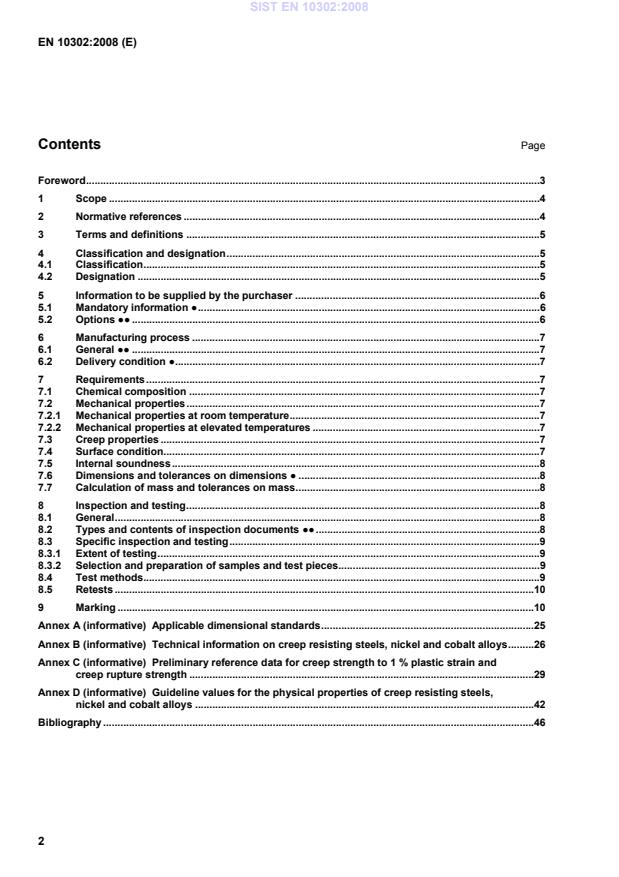
Applicable dimensional standards.25 Annex B (informative)
Technical information on creep resisting steels, nickel and cobalt alloys.26 Annex C (informative)
Preliminary reference data for creep strength to 1 % plastic strain and creep rupture strength.29 Annex D (informative)
Guideline values for the physical properties of creep resisting steels, nickel and cobalt alloys.42 Bibliography.46
1.3 The general technical delivery conditions specified in EN 10021 apply in addition to the specifications of this European Standard, unless otherwise specified in this European Standard. 1.4 This European Standard does not apply to components manufactured by further processing the product forms listed in 1.2 with quality characteristics altered as a result of such further processing. 1.5 This European Standard shall not be used for aerospace and pressure purposes. 1.6 For steels and alloys with similar chemical composition, but intended for different applications, see the Bibliography. 2 Normative references The following referenced documents are indispensable for the application of this document. For dated references, only the edition cited applies. For undated references, the latest edition of the referenced document (including any amendments) applies. EN 10002-1, Metallic materials - Tensile testing - Part 1: Method of test (at ambient temperature) EN 10002-5, Metallic materials - Tensile testing - Part 5: Method of testing at elevated temperature EN 10020:2000, Definition and classification of grades of steel EN 10021:2006, General technical delivery conditions for steels products EN 10027-1, Designation systems for steels - Part 1: Steel names EN 10027-2, Designation systems for steels - Part 2: Numerical system EN 10052:1993, Vocabulary of heat treatment terms for ferrous products EN 10079:2007, Definition of steel products EN 10163-2, Delivery requirements for surface condition of hot rolled steel plates, wide flats and sections - Part 2: Plate and wide flats EN 10168:2004, Steel products – Inspection documents – List of information and description EN 10204, Metallic products - Types of inspection documents EN 10221, Surface quality classes for hot-rolled bars and rods - Technical delivery conditions prCEN/TR 10261, Iron and steel - Review of
available methods of chemical analysis EN ISO 377:1997, Steel and steel products - Location and preparation of samples and test pieces for mechanical testing (ISO 377:1997) SIST EN 10302:2008
steels, nickel- or cobalt-alloys with a minimum of 8 % chromium, which are characterised by good mechanical behaviour at temperatures above 500 °C under long-range service conditions; i.e. primarily by creep strength to 1 % plastic strain or creep rupture strength during long-time stressing NOTE For supplementary information on creep resisting steels and alloys see Annex B. 4 Classification and designation 4.1 Classification Materials covered in this European Standard are classified according to their structure into: martensitic steels; austenitic steels; nickel alloys; and cobalt alloys. 4.2 Designation The names and numbers of the steels (see Table 1) were formed in accordance with EN 10027-1 and
EN 10027-2 respectively. NOTE Explanation on the designation of nickel and cobalt alloys (see Table 2). name: The preceding chemical symbols indicate the main alloy elements and the figure immediately following indicates the average content of these alloys which is subsequently followed by the symbol for the other important alloying elements added. material number: The structure is set out according to EN 10027-2 with the number 2 for the material group number. This material group comprises chemically resistant and high temperature or heat resistant nickel and cobalt alloys. SIST EN 10302:2008
5 Information to be supplied by the purchaser 5.1 Mandatory information ≤ The following information shall be supplied by the purchaser at the time of enquiry and order: a) quantity to be delivered; b) designation of the product form (e.g. bar or rod, strip or plate); c) where an appropriate dimensional standard is available (see Annex A) the number of the standard and the indications required by this, also the nominal dimensions and tolerances; d) type of material (steel, cobalt or nickel alloy); e) number of this European Standard (EN 10302:2008); f) name or number of the steel grade, nickel or cobalt alloy (see 4.2); g) if for the relevant material in the table more than one treatment condition for the mechanical properties is covered, the symbol for the desired heat treatment condition or work hardened condition; h) desired process route (see symbols in Table 5 and Table 6). 5.2 Options ≤≤ A number of options are specified in this European Standard and listed below. If the purchaser does not indicate his wish to implement any of these options, the supplier shall supply in accordance with the basic specification of this European Standard (see 5.1). a) any requirement concerning a special melting or forming process (see 6.1); b) any requirement relating to surface condition (see 7.4); c) any requirement concerning tolerances on mass not specified in the dimensional standard (see 7.7.2); d) any requirement to determine the product analysis (see Table 11, footnote b); e) any requirement concerning the method of product analysis (see 8.4.1); f) any requirement concerning elevated temperature tensile testing (see 8.4.3); g) any requirement concerning special marking of the products (see 9.2, 9.3 and Table 12); h) any requirement concerning the issue of an inspection document (see 8.2). EXAMPLE 10 t rounds of a steel grade with the name X6NiCrTiMoVB25-15-2 and the number 1.4980 as specified in EN 10302 of 50 mm diameter, dimensional tolerances as specified in EN 10060, in process route 1D (see Table 6). 10 t rounds EN 10060–50 steel EN 10302 - X6NiCrTiMoVB25-15-2+1D or 10 t rounds EN 10060–50 steel EN 10302-1.4980+1D SIST EN 10302:2008
Dimensions in millimetres Type of test Round cross-section products Rectangular cross-section products Tensile
a Samples of product may alternatively be tested unmachined, in accordance with EN ISO 377.
Figure 1 — Position of test pieces for steel bars and rods ≤ 160 mm diameter or thickness (longitudinal test pieces) SIST EN 10302:2008
≤ 30
Tensile a
> 30
longitudinal
transverse
a In cases of doubt or dispute the gauge length shall be Lo = 5,65 0S for test pieces from products t ≥ 3 mm. For products with a thickness t < 3 mm, non-proportional test pieces with a gauge length of 80 mm and a width of 20 mm shall be used, but test pieces with a gauge length of 50 mm and a width of 12,5 mm may also be applied. For products with a thickness 3 mm ≤ t ≤ 10 mm (or t ≤ 8 mm in case of alloys) flat proportional test pieces with two rolled surfaces and a maximum width of 30 mm shall be used. For products with a thickness t > 10 mm (or t > 8 mm in case of alloys), one of the following proportional test pieces may be used: - either a flat test piece with a maximum thickness of 30 mm; the thickness may be reduced to 10 mm by machining, but one rolled surface shall be preserved. - or a round test piece with a diameter of d ≥ 5 mm the axis of which shall be located as near as possible to a plane in the outer third of half the product thickness. Key 1 Rolling surface 2 Alternatives Figure 2 — Position of the tensile test pieces in flat products
such elements from scrap and other materials used in production, which would impair mechanical properties and the suitability of the steel.
such elements from scrap and other materials used in production, which would impair mechanical properties and the suitability of the alloy.
for the cast analysis of creep resisting steels Element Specified limits, cast analysis % by mass Permissible tolerance a % by mass Carbon
> 0,030 > 0,20 ≤ 0,030 ≤ 0,20 ≤ 0,35 + 0,005 ± 0,01 ± 0,02 Silicon
≤ 1,00 ± 0,05 Manganese
> 1,00 ≤ 1,00 ≤ 2,00 ± 0,03 ± 0,04 Phosphorus
≤ 0,035 + 0,005 Sulphur
≤ 0,015 + 0,003 Nitrogen
> 0,05 ≤ 0,05 ≤ 0,20 ± 0,005 ± 0,01 Aluminium
> 0,10 > 0,30 ≤ 0,10 ≤ 0,30 ≤ 0,65 + 0,01 ± 0,05 ± 0,10 Chromium
> 10,5 > 15,0 > 20,0 ≤ 10,5 ≤ 15,0 ≤ 20,0 ≤ 26,0 ± 0,10 ± 0,15 ± 0,20 ± 0,25 Molybdenum
> 0,60 > 1,75 ≤ 0,60 ≤ 1,75 ≤ 3,5 ± 0,03 ± 0,05 ± 0,10 Niobium
≤ 1,25 ± 0,05 Nickel
> 1,00 > 5,0 > 10,0 > 20,0 ≤ 1,00 ≤ 5,0 ≤ 10,0 ≤ 20,0 ≤ 34,0 ± 0,03 ± 0,07 ± 0,10 ± 0,15 ± 0,20 Titanium
> 1,00 ≤ 1,00 ≤ 2,30 ± 0,05 ± 0,07 Tungsten
> 1,00 ≤ 1,00 ≤ 3,5 ± 0,05 ± 0,07 Vanadium
≤ 0,85 ± 0,03 Boron
> 0,0015 ≤ 0,0015 ≤ 0,015 ± 0,0002 ± 0,0003 Cobalt > 1,00 > 7,0 > 10,0 ≤ 7,0 ≤ 10,0 ≤ 21,0 ± 0,10 ± 0,15 ± 0,20 Copper
≤ 0,50 ± 0,07 a If several product analyses are carried out on one cast, and the contents of an individual element determined lies outside the permissible range of the chemical composition specified for the cast analysis, then it is only allowed to exceed the permissible maximum value or to fall short of the permissible minimum value, but not both for one cast.
> 0,15 ≤ 0,15 ≤ 0,25 ± 0,01 ±‘ 0,02 Silicon
> 0,50 ≤ 0,50 ≤ 1,50 +‘ 0,03 ±‘ 0,05 Manganese
> 1,00 ≤ 1,00 ≤ 2,00 +‘ 0,03 ‘+ 0,04 Phosphorus
≤ 0,030 + 0,005 Sulphur
≤ 0,015 + 0,003 Aluminium
> 1,00 ≤ 1,00 ≤ 2,40 ± 0,05 ± 0,10 Chromium
> 15,0 ≤ 15,0 ≤ 31,0 ± 0,15 ± 0,25 Cobalt
> 5,0 > 10,0 > 21,0 > 60,0 ≤ 5,0 ≤ 10,0 ≤ 21,0 ≤ 60,0 ≤ 80,0 ± 0,10 ± 0,15 ± 0,20 ± 0,35 ± 0,45 Copper
≤ 0,50 + 0,05 Iron
> 5,0 > 10,0 > 20,0 > 60,0 ≤ 5,0 ≤ 10,0 ≤ 20,0 ≤ 60,0 ≤ 80,0 ± 0,07 ± 0,10 ± 0,20 ± 0,35 ± 0,45 Molybdenum
> 1,00 > 2,00 > 8,0 ≤ 1,00 ≤ 2,00 ≤ 8,0 ≤ 10,0 ± 0,03 ± 0,05 ± 0,10 ± 0,15 Nickel
> 11,0 > 25,0 > 40,0 > 60,0 ≤ 11,0 ≤ 25,0 ≤ 40,0 ≤ 60,0 ≤ 80,0 ± 0,15 ± 0,20 ± 0,25 ± 0,35 ± 0,45 Niobium + Tantalum
≤ 5,50 ± 0,15 Titanium
> 1,20 ≤ 1,20 ≤ 3,3 ± 0,03 ± 0,05 Boron > 0,0015 ≤ 0,015 ± 0,0003 Tungsten
> 14,0 ≤ 4,0 ≤ 16,0 ± 0,07 ± 0,20 Yttrium and Zirconium
≤ 0,15 ± 0,01 a If several product analyses are carried out on one cast, and the contents of an individual element determined lies outside the permissible range of the chemical composition specified for the cast analysis, then it is only allowed to exceed the permissible maximum value or to fall short of the permissible minimum value, but not both for one cast.
Abbreviation b Type of treatment Surface finish Notes 1U Hot rolled, not heat treated, not descaled Covered with the rolling scale Suitable for products which are to be further worked, e.g. strip for re-rolling 1C Hot rolled, heat treated, not descaled Covered with the rolling scale Suitable for parts which will be descaled or machined in subsequent production or for certain heat-resisting applications 1E Hot rolled, heat treated, mechanically descaled Free of scale The type of mechanical descaling, e.g. coarse grinding or shot blasting, depends on the steel or alloy grade and the product and is left to the manufacturer's discretion, unless otherwise agreed.
Hot rolled 1D Hot rolled, heat treated, pickled Free of scale Common finish for most steels and alloys to ensure good corrosion resistance; also common finish for further processing. It is permissible for grinding marks to be present. Not as smooth as 2D or 2B 2C Cold rolled, heat treated, not descaled Smooth with scale from heat treatment Suitable for parts which will be descaled or machined in subsequent production or for certain heat-resisting applications 2E Cold rolled, heat treated, mechanically descaled Rough and dull Usually applied to steels and alloys with a scale which is very resistant to pickling solutions. May be followed by pickling. 2D Cold rolled, heat treated, pickled Smooth Finish for good ductility, but not as smooth as 2B or 2R. 2B Cold rolled, heat treated, pickled, skin passed Smoother than 2D Most common finish for most steels and alloys to ensure good corrosion resistance, smoothness and flatness. Also common finish for further processing. Skin passing may be by tension levelling.
Cold rolled 2R Cold rolled, bright annealed Smooth, bright and reflective Smoother and brighter than 2B. Also common finish for further processing. a Not all process routes and surface finishes are available for all steels and alloys. b First digit: 1 = hot rolled; 2 = cold rolled.
Abbreviation b Type of process route Surface finish
Rods Bars, sections Wire Semi- finished products
Notes 1U Hot formed, not heat treated, not descaled Covered with scale (spot ground if necessary) x x - x Suitable for products to be further hot formed. For semi-finished products, ground on all sides can be specified. 1C Hot formed, heat treatedc, not descaled Covered with scale (spot ground if necessary) x x - x Suitable for products to be further processed. For semi-finished products, ground on all sides can be specified. 1E Hot formed, heat treated c, mechanically descaled Largely free of scale (but some black spots may remain) x x - x The type of mechanical descaling, e.g. grinding, peeling or shot blasting is left to the manufacturer's discretion unless otherwise agreed. Suitable for products to be further processed. 1D Hot formed, heat treated c, pickled Free of scale x x - - Tolerance ≥ IT 14 e 1X Hot formed, heat treated c, rough machined (peeled or rough turned) Metallically clean - x - - Tolerance ≥ IT 12 e
Hot formed 1Z Warm worked with or without stress relieving Largely free of scale (but some black spots may remain) - x - - The type of mechanical descaling, e.g. grinding, peeling or shot blasting is left to the manufacturer's discretion unless otherwise agreed. 2H Heat treated c, mechanically or chemically descaled, cold processedd Smooth and bright. Substantially smoother than finishes 1E, 1D or 1X - x x - On products formed by cold drawing without subsequent heat treatment, the tensile strength is substantially increased, particularly on austenitic structure, depending on the degree of forming. Tolerance IT 9 or IT 11. e 2D Cold processed d, heat treated c, pickled (skin passed) Smoother than finishes 1E or 1D - x x - Finish for good ductility
Cold processed 2B Heat treated c, machined (peeled), mechanically smoothed Smoother and brighter than finishes 1E, 1D, 1X - x - - Pre-finish for close ISO-tolerance, Tolerance IT 9 or IT 11.e a Not all process routes and surface finishes are available for all steels and alloys. b First digit: 1 = hot formed; 2 = cold processed. c On austenitic grades, the heat treatment may be omitted if the conditions for hot forming and subsequent cooling are such that the requirements for the mechanical properties of the product are obtained. d The type of cold forming processing, e.g. cold drawing, turning, or centreless grinding, is left to the manufacturer's discretion, provided that the requirements concerning tolerances on dimensions and
surface roughness are respected. e Specific tolerance within the ranges shall be agreed upon at the time of enquiry and order.
MPaa
min. Rm
MPa a Long products 0,5 ≤ a < 3 l, tr 3 ≤ a tr Martensitic steels X10CrMoVNb9-1 1.4903 +QT 450 620 to 850 20 - - X11CrMoWVNb9-1-1 1.4905 +QT 450 620 to 850 19 - - X8CrCoNiMo10-6 1.4911 +QT 850 1000 to 1140 10 - - X19CrMoNbVN11-1 1.4913 +QT (d ≤ 160) 750 900 to 1050 12 - - X20CrMoV11-1 1.4922 +QT 500 700 to 850 16 - 15 X22CrMoV12-1 1.4923 +QT (d ≤ 160) 600 800 to 950 14 - 14 +QT 700 500 700 to 850 16 - 15 X20CrMoWV12-1 1.4935 +QT 800 600 800 to 950 14 - - X12CrNiMoV12-3 1.4938 +QT (d ≤ 160) 760 930 to 1130 14 - 14 Austenitic steels X3CrNiMoBN17-13-3 1.4910 +AT (d ≤ 160) 260 550 to 750 35 - 35 X6CrNiMoB17-12-2 1.4919 +AT (d ≤ 160) 205 490 to 690 35 30 35 X6CrNiTiB18-10 1.4941 +AT (d ≤ 160) 195 490 to 680 35 30 35 +AT 250 540 to 740 30 - 30 X6CrNiWNbN16-16 1.4945
+WW (warm worked) (d≤ 60) 490 630 to 840 17 - - X6CrNi25-20 1.4951 +AT 200 510 to 710 35 35 35 +AT (d ≤ 160) 170 500 to 750 35 30 30 X5NiCrAlTi31-20 1.4958 +RA 210 500 to 750 35 30 30 X8NiCrAlTi32-21 1.4959 +AT (d ≤ 160) 170 500 to 750 35 30 30 X8CrNiNb16-13 1.4961 +AT 200 510 to 690 35 30 35 +AT 230 500 to 750 30 - 30 X12CrNiWTiB16-13 1.4962 +WW (warm worked) (d≤ 60) 440 590 to 790 20 - - X12CrCoNi21-20 1.4971 +AT 300 690 to 900 30 - 35 X6NiCrTiMoVB25-15-2 1.4980 +P (d ≤ 160) 600 900 to 1150 15 - 15 X8CrNiMoNb16-16 1.4981 +AT 215 530 to 690 35 - 35 X6CrNiMoTiB17-13 1.4983 +AT 205 530 to 730 35 30 35 X8CrNiMoVNb16-13 1.4988 +P 255 540 to 740 30 - 30 a 1 MPa = 1 N/mm².
Alloy grade A % min. Flat products Name Number Heat treatment Rp0,2
MPae
min. Rm
MPa e min. Long products 3 ≤ ab tr Nickel alloys NiCr26MoW 2.4608 +AT 240 550 30 30 NiCr20Co18Ti 2.4632 +P 700 1100 15 - NiCr25FeAlY 2.4633 +AT 270 680 30 30 NiCr29Fe 2.4642 +AT 240 590 30 30 NiCo20Cr20MoTi 2.4650 +P (570)c,d (970)c,d (30)c,d (30)c,d NiCr20Co13Mo4Ti3Al 2.4654 +P 760 1100 15 20 NiCr23Co12Mo 2.4663 +AT 270 700 35 35 NiCr22Fe18Mo 2.4665 +AT 270 690 30 30 NiCr19Fe19Nb5Mo3 2.4668 +P 1030 1230 12 12 +P980 630 980 8 - NiCr15Fe7TiAl 2.4669 +P1170 790 1170 15 15 NiCr20TiAl 2.4952 +P 600 1000 18 18 +P1080 650 1080 15 - NiCr25Co20TiMo 2.4878 +P1100 700 1100 12 - Cobalt alloy CoCr20W15Ni 2.4964 +AT 340 860 35 35 a The tensile properties apply to long products ≤ 160 mm thickness/diameter or flat products ≤ 20 mm
thickness. b For a < 3 mm minimum elongation values for flat products are five units lower. c This grade is not tested at room temperature, but if tested at a temperature of 780 °C the following values
apply: RP0,2 ≥ 400 MPa; Rm ≥ 540 MPa; A ≥ 12 % (long and flat products). d The values in brackets are for information only. e 1 MPa = 1 N/mm².
Table 9 — Minimum 0,2 %-proof strength values at elevated temperatures for creep resisting steels in the usual delivery condition Steel grade Minimum 0,2 %-proof strength, MPa at a temperature (in °C) of Name Number Heat treatmenta 50 100 150 200 250 300 350 400 450 500 550 600 650 700 750 800 850 900 Martensitic steels X10CrMoVNb9-1 1.4903 +QT - 410 - 380 370 360 350 340 320 300 270 215 - - - - X11CrMoWVNb9-1-1 1.4905 +QT - 412 - 390 383 376 357 356 342 319 287 231 167 - - - X8CrCoNiMo10-6 1.4911 +QT - - - 800 795 780 745 690 635 590 470 340 - - - - X19CrMoNbVN11-1 1.4913 +QT
(d ≤ 160) 726*) 701 676 651 643 627 610 577 544 495 412 305 - - - - X20CrMoV11-1 1.4922 +QT 465 460 445 430 415 390 380 360 330 290 250 - - - - - X22CrMoV12-1 1.4923 +QT (d ≤ 160) 585*) 560 545*) 530 505*) 480 450*) 420 380 335 280 - - - - - +QT 700 465 460 445 430 415 390 380 360 330 290 250 - - - - - X20CrMoWV12-1 1.4935 +QT 800 585 560 545 530 505 480 450 420 380 335 280 - - - - - X12CrNiMoV12-3 1
...