

SIST EN 303 098-1 V1.2.1:2014
(Main)Electromagnetic compatibility and Radio spectrum Matters (ERM) - Maritime low power personal locating beacons employing AIS - Part 1: Technical characteristics and methods of measurement
General Information
- Abstract
The present document lays down the minimum requirements for low power maritime personal locating devices employing AIS and an integrated GNSS receiver to provide the locating function. The present document incorporates the relevant provisions of the International Telecommunication Union (ITU) radio regulations [i.3] included in Recommendation ITU-R M.1371-5 [1]. For this application, both the radiated power and the length of time of operation are limited to enable the equipment to be sufficiently small and light to be worn comfortably at all times and to limit the operating range to a local area.
- Status
- Published
- Public Enquiry End Date
- 31-Jul-2013
- Publication Date
- 12-Oct-2014
- Technical Committee
- MOC - Mobile Communications
- Current Stage
- 6060 - National Implementation/Publication (Adopted Project)
- Start Date
- 22-Sep-2014
- Due Date
- 27-Nov-2014
- Completion Date
- 13-Oct-2014
Buy Documents
ETSI EN 303 098-1 V1.1.0 (2013-05) - Electromagnetic compatibility and Radio spectrum Matters (ERM); Maritime low power personal locating beacons employing AIS Part 1: Technical characteristics and methods of measurement
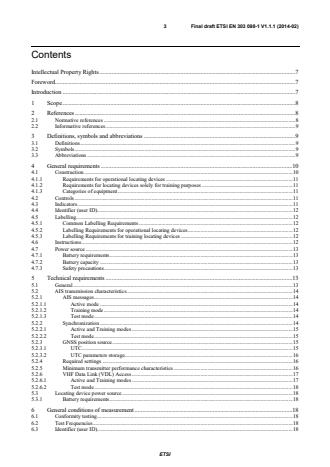
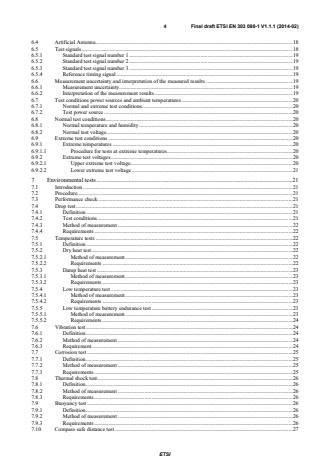
ETSI EN 303 098-1 V1.1.1 (2014-02) - Electromagnetic compatibility and Radio spectrum Matters (ERM); Maritime low power personal locating devices employing AIS; Part 1: Technical characteristics and methods of measurement
ETSI EN 303 098-1 V1.2.1 (2014-07) - Electromagnetic compatibility and Radio spectrum Matters (ERM); Maritime low power personal locating devices employing AIS; Part 1: Technical characteristics and methods of measurement
ETSI EN 303 098-1 V1.2.1 (2014-09) - Electromagnetic compatibility and Radio spectrum Matters (ERM); Maritime low power personal locating devices employing AIS; Part 1: Technical characteristics and methods of measurement

Overview
SIST EN 303 098-1 V1.2.1:2014 sets the minimum requirements for maritime low power personal locating beacons that use the Automatic Identification System (AIS) and incorporate a Global Navigation Satellite System (GNSS) receiver. This standard, developed by SIST in collaboration with ETSI, ensures devices are designed to support reliable locating functions while being small, lightweight, and comfortable for continuous wear. Compliance with electromagnetic compatibility (EMC) and radio spectrum matters is central, allowing these beacons to deliver effective performance without causing interference.
Key Topics
- Technical Requirements: Details the characteristics for AIS-enabled locating beacons, including transmitter power, frequency, and operational range. Limits on radiated power and operation time are set to ensure safe, efficient maritime use.
- Construction & Labelling: Guidelines for beacon construction, user identification, and labeling are established to support traceability and user safety.
- Measurement Methods: Defines standardized test conditions and procedures for conformity assessment, such as:
- Transmission characteristics
- Environmental and performance testing (temperature, vibration, corrosion, buoyancy, solar radiation, etc.)
- Synchronization and message standards
- Battery & Power Management: Specifies the minimum requirements for battery capacity, endurance, and safety, critical for devices expected to operate in emergencies.
- Environmental Robustness: Outlines tests for physical robustness to ensure beacons function correctly even in harsh maritime conditions.
- AIS & GNSS Integration: Focuses on the functional relationship between AIS messaging and GNSS-based locating, central to rapid and accurate search and rescue (SAR) response.
Applications
- Personal Safety at Sea: Low power AIS beacons are essential for enhancing crew and passenger safety by enabling rapid localization during emergencies and man-overboard situations.
- Commercial Maritime Operations: Used by shipping companies, fishing fleets, and offshore platforms to comply with safety regulations and improve emergency response capabilities.
- Leisure and Sports Boating: Yachts, sailboats, and recreational vessels benefit from compliant devices, offering peace of mind to boaters and their families.
- Emergency Services & SAR: Rescue coordination centers and maritime authorities rely on standardized beacons to efficiently locate and assist individuals in distress within local waters.
- Wearable Maritime Accessories: Due to their compact, lightweight design, these beacons are often integrated into lifejackets or survival suits.
By setting the standard for both minimum technical performance and methods of conformity testing, SIST EN 303 098-1 V1.2.1:2014 supports consistent, reliable operation across a variety of use scenarios.
Related Standards
- Recommendation ITU-R M.1371-5: Defines technical specifications for AIS in the maritime VHF band.
- EN 61108 series: Addresses performance standards and testing methods for maritime GNSS equipment, including GPS, GLONASS, and Galileo receivers.
- ETSI TR 100 028 & TR 102 273-7: Describes methods for EMC measurement and evaluation, particularly for mobile and radiocommunication equipment.
- SIST EN 303 098-2: Complements Part 1 by covering essential requirements under relevant EU directives.
Practical Value
Compliance with SIST EN 303 098-1 V1.2.1:2014 ensures:
- Enhanced user safety and maritime situational awareness
- Interoperability between devices and international SAR systems
- Alignment with the latest radio spectrum and EMC regulations
- Support for regulatory approval and market access in Europe and beyond
Organizations involved in the design, manufacture, certification, or operation of maritime locating beacons should adhere to this standard to guarantee optimal device performance and regulatory compliance.
Buy Documents
ETSI EN 303 098-1 V1.1.0 (2013-05) - Electromagnetic compatibility and Radio spectrum Matters (ERM); Maritime low power personal locating beacons employing AIS Part 1: Technical characteristics and methods of measurement
ETSI EN 303 098-1 V1.1.1 (2014-02) - Electromagnetic compatibility and Radio spectrum Matters (ERM); Maritime low power personal locating devices employing AIS; Part 1: Technical characteristics and methods of measurement
ETSI EN 303 098-1 V1.2.1 (2014-07) - Electromagnetic compatibility and Radio spectrum Matters (ERM); Maritime low power personal locating devices employing AIS; Part 1: Technical characteristics and methods of measurement
ETSI EN 303 098-1 V1.2.1 (2014-09) - Electromagnetic compatibility and Radio spectrum Matters (ERM); Maritime low power personal locating devices employing AIS; Part 1: Technical characteristics and methods of measurement
Get Certified
Connect with accredited certification bodies for this standard

DNV
DNV is an independent assurance and risk management provider.

Lloyd's Register
Lloyd's Register is a global professional services organisation specialising in engineering and technology.

FSC International
Forest Stewardship Council certification.
Sponsored listings
Frequently Asked Questions
SIST EN 303 098-1 V1.2.1:2014 is a standard published by the Slovenian Institute for Standardization (SIST). Its full title is "Electromagnetic compatibility and Radio spectrum Matters (ERM) - Maritime low power personal locating beacons employing AIS - Part 1: Technical characteristics and methods of measurement". This standard covers: The present document lays down the minimum requirements for low power maritime personal locating devices employing AIS and an integrated GNSS receiver to provide the locating function. The present document incorporates the relevant provisions of the International Telecommunication Union (ITU) radio regulations [i.3] included in Recommendation ITU-R M.1371-5 [1]. For this application, both the radiated power and the length of time of operation are limited to enable the equipment to be sufficiently small and light to be worn comfortably at all times and to limit the operating range to a local area.
The present document lays down the minimum requirements for low power maritime personal locating devices employing AIS and an integrated GNSS receiver to provide the locating function. The present document incorporates the relevant provisions of the International Telecommunication Union (ITU) radio regulations [i.3] included in Recommendation ITU-R M.1371-5 [1]. For this application, both the radiated power and the length of time of operation are limited to enable the equipment to be sufficiently small and light to be worn comfortably at all times and to limit the operating range to a local area.
SIST EN 303 098-1 V1.2.1:2014 is classified under the following ICS (International Classification for Standards) categories: 33.060.01 - Radiocommunications in general; 33.100.01 - Electromagnetic compatibility in general; 47.020.70 - Navigation and control equipment. The ICS classification helps identify the subject area and facilitates finding related standards.
SIST EN 303 098-1 V1.2.1:2014 is available in PDF format for immediate download after purchase. The document can be added to your cart and obtained through the secure checkout process. Digital delivery ensures instant access to the complete standard document.
Standards Content (Sample)
Draft ETSI EN 303 098-1 V1.1.0 (2013-05)
European Standard
Electromagnetic compatibility and
Radio spectrum Matters (ERM);
Maritime low power personal locating beacons employing AIS
Part 1: Technical characteristics and methods of measurement
2 Draft ETSI EN 303 098-1 V1.1.0 (2013-05)
Reference
DEN/ERM-TG26-100-1
Keywords
maritime, radio, SAR, testing
ETSI
650 Route des Lucioles
F-06921 Sophia Antipolis Cedex - FRANCE
Tel.: +33 4 92 94 42 00 Fax: +33 4 93 65 47 16
Siret N° 348 623 562 00017 - NAF 742 C
Association à but non lucratif enregistrée à la
Sous-Préfecture de Grasse (06) N° 7803/88
Important notice
Individual copies of the present document can be downloaded from:
http://www.etsi.org
The present document may be made available in more than one electronic version or in print. In any case of existing or
perceived difference in contents between such versions, the reference version is the Portable Document Format (PDF).
In case of dispute, the reference shall be the printing on ETSI printers of the PDF version kept on a specific network drive
within ETSI Secretariat.
Users of the present document should be aware that the document may be subject to revision or change of status.
Information on the current status of this and other ETSI documents is available at
http://portal.etsi.org/tb/status/status.asp
If you find errors in the present document, please send your comment to one of the following services:
http://portal.etsi.org/chaircor/ETSI_support.asp
Copyright Notification
No part may be reproduced except as authorized by written permission.
The copyright and the foregoing restriction extend to reproduction in all media.
© European Telecommunications Standards Institute 2013.
All rights reserved.
TM TM TM
DECT , PLUGTESTS , UMTS and the ETSI logo are Trade Marks of ETSI registered for the benefit of its Members.
TM
3GPP and LTE™ are Trade Marks of ETSI registered for the benefit of its Members and
of the 3GPP Organizational Partners.
GSM® and the GSM logo are Trade Marks registered and owned by the GSM Association.
ETSI
3 Draft ETSI EN 303 098-1 V1.1.0 (2013-05)
Contents
Intellectual Property Rights . 7
Foreword . 7
Introduction . 7
1 Scope . 8
2 References . 8
2.1 Normative references . 8
2.2 Informative references . 9
3 Definitions, symbols and abbreviations . 9
3.1 Definitions . 9
3.2 Symbols . 9
3.3 Abbreviations . 9
4 General requirements . 10
4.1 Construction . 10
4.1.1 Categories of equipment . 10
4.2 Controls . 11
4.3 Indicators . 11
4.4 Identifier (user ID). 11
4.5 Labelling. 11
4.6 Instructions . 12
4.7 Power source . 12
4.7.1 Battery requirements . 12
4.7.2 Safety precautions . 12
5 Technical requirements . 13
5.1 General . 13
5.2 AIS transmission characteristics . 13
5.2.1 AIS messages . 13
5.2.1.1 Active mode . 13
5.2.1.2 Training mode . 13
5.2.1.3 Test mode . 14
5.2.2 Synchronization . 14
5.2.2.1 Active and Training modes . 14
5.2.2.2 Test mode . 14
5.2.3 GNSS position source . 14
5.2.3.1 UTC Time . 15
5.2.3.2 Almanac Storage . 15
5.2.4 Required settings . 15
5.2.5 Minimum transmitter performance characteristics . 16
5.2.6 VHF Data Link (VDL) Access . 16
5.2.6.1 Active and Training modes . 16
5.2.6.2 Test mode . 17
5.3 Locating beacon power source . 17
5.3.1 Battery requirements . 17
6 General conditions of measurement . 17
6.1 Conformity testing . 17
6.2 Test Frequencies . 17
6.3 Identifier (user ID). 17
6.4 Artificial Antenna . 17
6.5 Test signals . 18
6.5.1 Standard test signal number 1 . 18
6.5.2 Standard test signal number 2 . 18
6.5.3 Standard test signal number 3 . 18
6.5.4 Reference timing signal . 18
ETSI
4 Draft ETSI EN 303 098-1 V1.1.0 (2013-05)
6.6 Measurement uncertainty and interpretation of the measured results . 18
6.6.1 Measurement uncertainty . 18
6.6.2 Interpretation of the measurement results . 18
6.7 Test conditions power sources and ambient temperatures . 19
6.7.1 Normal and extreme test conditions. 19
6.7.2 Test power source . 19
6.8 Normal test conditions . 19
6.8.1 Normal temperature and humidity . 19
6.8.2 Normal test voltage . 19
6.9 Extreme test conditions . 19
6.9.1 Extreme temperatures . 19
6.9.1.1 Procedure for tests at extreme temperatures . 19
6.9.2 Extreme test voltages . 20
6.9.2.1 Upper extreme test voltage . 20
6.9.2.2 Lower extreme test voltage . 20
7 Environmental tests . 20
7.1 Introduction . 20
7.2 Procedure . 20
7.3 Performance check . 20
7.4 Drop test . 20
7.4.1 Definition . 20
7.4.2 Test conditions . 20
7.4.3 Method of measurement . 21
7.4.4 Requirements . 21
7.5 Temperature tests . 21
7.5.1 Definition . 21
7.5.2 Dry heat test . 21
7.5.2.1 Method of measurement . 21
7.5.2.2 Requirement . 21
7.5.3 Damp heat test . 22
7.5.3.1 Method of measurement . 22
7.5.3.2 Requirement . 22
7.5.4 Low temperature test . 22
7.5.4.1 Method of measurement . 22
7.5.4.2 Requirement . 22
7.6 Vibration test . 22
7.6.1 Definition . 22
7.6.2 Method of measurement . 22
7.6.3 Requirement . 23
7.7 Corrosion test . 23
7.7.1 Definition . 23
7.7.2 Method of measurement . 23
7.7.3 Requirements . 24
7.8 Thermal shock test. 24
7.8.1 Definition . 24
7.8.2 Method of measurement . 24
7.8.3 Requirements . 24
7.9 Buoyancy test . 24
7.9.1 Definition . 24
7.9.2 Method of measurement . 24
7.9.3 Requirements . 24
7.10 Compass safe distance test . 25
7.10.1 Definition . 25
7.10.2 Method of measurement . 25
7.10.3 Requirements . 25
7.11 Solar radiation test . 26
7.11.1 Definition . 26
7.11.2 Method of measurement . 26
7.11.3 Requirements . 26
7.12 Oil resistance test. 26
7.12.1 Definition . 26
ETSI
5 Draft ETSI EN 303 098-1 V1.1.0 (2013-05)
7.12.2 Method of measurement . 26
7.12.3 Requirements . 27
7.13 Protection of the transmitter . 27
7.13.1 Definition . 27
7.13.2 Method of measurement . 27
7.13.3 Requirement . 27
8 Tests on the AIS transmitter . 27
8.1 Frequency error . 27
8.1.1 Definition . 27
8.1.2 Method of measurement . 27
8.1.3 Limit . 27
8.2 Conducted Power . 27
8.2.1 Definition . 28
8.2.2 Method of measurement under normal test conditions . 28
8.2.3 Limit . 28
8.3 Maximum Effective Radiated Power (ERP). 28
8.3.1 Definition . 28
8.3.2 Method of measurement . 28
8.3.3 Limits . 29
8.4 Transmitter spectrum mask . 29
8.4.1 Definition . 29
8.4.2 Method of measurement . 29
8.4.3 Limit . 30
8.5 Transmitter transient behaviour (output power) . 30
8.5.1 Definition . 30
8.5.2 Method of measurement . 31
8.5.3 Limit . 32
8.6 Transmitter Transient Behaviour (frequency deviation) . 32
8.6.1 Definition . 32
8.6.2 Method of measurement . 32
8.6.3 Limit . 33
8.7 Synchronization accuracy . 33
8.7.1 Definition . 33
8.7.2 Method of measurement . 33
8.7.3 Limit . 34
8.8 Spurious emissions . 35
8.8.1 Definition . 35
8.8.2 Method of measurement . 35
8.8.3 Limit . 35
9 VDL Link layer tests . 35
9.1 Active mode tests . 35
9.1.1 Method of measurement . 35
9.1.2 Initialization period - Required results. 36
9.1.3 Message content of Message 1 - Required results . 36
9.1.4 Message content of Message 14 - Required results . 36
9.1.5 Transmission schedule for Message 1 - Required results . 36
9.1.6 Communication state of Message 1 - Required results . 37
9.1.7 Transmission schedule of Message 14 - Required results. 37
9.1.8 Transmission with lost GNSS - Required results . 37
9.2 Test mode tests with GNSS data available . 38
9.2.1 Method of measurement . 38
9.2.2 Required results . 38
9.3 Test mode tests without GNSS data available . 38
9.3.1 Method of measurement . 38
9.3.2 Required results . 38
Annex A (normative): Radiated measurements . 39
A.1 Test sites and general arrangements for measurements involving the use of radiated fields . 39
A.1.1 Anechoic chamber . 39
A.1.2 Anechoic chamber with a ground plane . 40
ETSI
6 Draft ETSI EN 303 098-1 V1.1.0 (2013-05)
A.1.3 OATS . 41
A.1.4 Test antenna . 42
A.1.5 Substitution antenna . 42
A.1.6 Measuring antenna . 43
A.2 Guidance on the use of radiation test sites . 43
A.2.1 Verification of the test site . 43
A.2.2 Preparation of the EUT . 43
A.2.3 Power supplies to the EUT . 43
A.2.4 Volume control setting for analogue speech tests . 43
A.2.5 Range length . 44
A.2.6 Site preparation . 44
A.3 Coupling of signals . 45
A.3.1 General . 45
A.3.2 Data signals . 45
A.3.3 Speech and analogue signals . 45
A.3.3.1 Acoustic coupler description. 45
A.3.3.2 Calibration . 46
A.4 Standard position . 46
Annex B (normative): Locating beacon message bursts . 47
B.1 Active mode . 47
B.2 Training mode . 48
B.3 Test mode . 49
B.4 Default message field values . 49
History . 50
ETSI
7 Draft ETSI EN 303 098-1 V1.1.0 (2013-05)
Intellectual Property Rights
IPRs essential or potentially essential to the present document may have been declared to ETSI. The information
pertaining to these essential IPRs, if any, is publicly available for ETSI members and non-members, and can be found
in ETSI SR 000 314: "Intellectual Property Rights (IPRs); Essential, or potentially Essential, IPRs notified to ETSI in
respect of ETSI standards", which is available from the ETSI Secretariat. Latest updates are available on the ETSI Web
server (http://ipr.etsi.org).
Pursuant to the ETSI IPR Policy, no investigation, including IPR searches, has been carried out by ETSI. No guarantee
can be given as to the existence of other IPRs not referenced in ETSI SR 000 314 (or the updates on the ETSI Web
server) which are, or may be, or may become, essential to the present document.
Foreword
This draft European Standard (EN) has been produced by ETSI Technical Committee Electromagnetic compatibility
and Radio spectrum Matters (ERM), and is now submitted for the combined Public Enquiry and Vote phase of the ETSI
standards EN Approval Procedure.
The present document is part 1 of a multi-part deliverable covering the Electromagnetic compatibility and Radio
spectrum Matters (ERM); Maritime low power personal locating beacons employing AIS, as identified below:
Part 1: "Technical characteristics and methods of measurement";
Part 2: "Harmonized EN covering the essential requirements of article 3.2 of the R&TTE Directive";
Part 3: "Harmonized EN covering the essential requirements of article 3.3 (e) of the R&TTE Directive".
The present document lays down the minimum requirements for "Maritime low power personal locating beacons
employing AIS", and incorporates the relevant provisions of the International Telecommunication Union (ITU) radio
regulations.
Proposed national transposition dates
Date of latest announcement of this EN (doa): 3 months after ETSI publication
Date of latest publication of new National Standard
or endorsement of this EN (dop/e): 6 months after doa
Date of withdrawal of any conflicting National Standard (dow): 18 months after doa
Introduction
The present document has been produced by ETSI in response to a mandate from the European Commission issued
under Council Directive 98/34/EC [i.4] laying down a procedure for the provision of information in the field of
technical standards and regulations.
ETSI
8 Draft ETSI EN 303 098-1 V1.1.0 (2013-05)
1 Scope
The present document lays down the minimum requirements for low power maritime personal locating beacons
employing AIS and an integrated GNSS receiver to provide the locating function. The present document incorporates
the relevant provisions of the International Telecommunication Union (ITU) radio regulations included in
Recommendation ITU-R M.1371-4 [1]
For this application, both the radiated power and the length of time of operation are limited to enable the equipment to
be sufficiently small and light to be worn comfortably at all times and to limit the operating range to a local area.
2 References
References are either specific (identified by date of publication and/or edition number or version number) or
non-specific. For specific references, only the cited version applies. For non-specific references, the latest version of the
reference document (including any amendments) applies.
Referenced documents which are not found to be publicly available in the expected location might be found at
http://docbox.etsi.org/Reference.
NOTE: While any hyperlinks included in this clause were valid at the time of publication, ETSI cannot guarantee
their long term validity.
2.1 Normative references
The following referenced documents are necessary for the application of the present document.
[1] Recommendation ITU-R M.1371-4 (04/2010): "Technical characteristics for an automatic
identification system using time-division multiple access in the VHF maritime mobile band".
[2] ETSI TR 100 028 (all parts) (V1.4.1): "Electromagnetic compatibility and Radio spectrum Matters
(ERM); Uncertainties in the measurement of mobile radio equipment characteristics".
[3] ETSI TR 102 273-7 (2001): "Electromagnetic compatibility and Radio spectrum Matters (ERM);
Improvement on Radiated Methods of Measurement (using test site) and evaluation of the
corresponding measurement uncertainties; Part 7: Artificial human beings".
[4] CENELEC EN 61108-1 (2003): "Maritime navigation and radiocommunication equipment and
systems - Global navigation satellite systems (GNSS) - Part 1: Global positioning system (GPS) -
Receiver equipment - Performance standards, methods of testing and required test results".
[5] CENELEC EN 61108-2 (1998): "Maritime navigation and radiocommunication equipment and
systems - Global navigation satellite systems (GNSS) - Part 2: Global navigation satellite system
(GLONASS) - Receiver equipment - Performance standards, methods of testing and required test
results".
[6] CENELEC EN 61108-3 (2010): "Maritime navigation and radiocommunication equipment and
systems - Global navigation satellite systems (GNSS) - Part 3: Galileo receiver equipment -
Receiver equipment - Performance standards, methods of testing and required test results".
[7] Recommendation ITU-T O.153 (10/92): "Basic parameters for the measurement of error
performance at bit rates below the primary rate".
ETSI
9 Draft ETSI EN 303 098-1 V1.1.0 (2013-05)
2.2 Informative references
The following referenced documents are not necessary for the application of the present document but they assist the
user with regard to a particular subject area.
[i.1] ETSI TR 102 273 (Parts 2, 3 and 4) (V1.2.1): "Electromagnetic compatibility and Radio spectrum
Matters (ERM); Improvement on Radiated Methods of Measurement (using test site) and
evaluation of the corresponding measurement uncertainties".
[i.2] ANSI C63.5-2006: "American National Standard for Calibration of Antennas Used for Radiated
Emission Measurements in Electro Magnetic Interference".
[i.3] IEC 60489-3 (edition 2.0) (Appendix F of Amendment 1): "Methods of measurement for radio
equipment used in the mobile services. Part 3: Receivers for A3E or F3E emissions".
[i.4] Directive 98/34/EC of the European Parliament and of the Council of 22 June 1998 laying down a
procedure for the provision of information in the field of technical standards and regulations.
3 Definitions, symbols and abbreviations
3.1 Definitions
For the purposes of the present document the following terms and definitions apply:
active mode: activated mode, transmitting in an emergency situation
test mode: self testing mode, not involved in a genuine emergency
training mode: activated mode for training purposes only
UTC lock: GNSS has precisely locked to UTC time so that it can determine SOTDMA slot timing correctly, including
leap second corrections
3.2 Symbols
For the purposes of the present document, the following symbols apply:
ε permittivity
σ Conductivity
λ wavelength
cSt centi-Stokes
dB decibel
div division
S Siemens
μT microtesla
3.3 Abbreviations
For the purposes of the present document, the following abbreviations apply:
AIS Automatic Identification System
ASTM American Society for Testing and Materials
COG Course Over Ground
CRC Cyclic Redundancy Check
CSP Channel Spacing
CW Continuous Wave
ERP Effective Radiated Power
EUT Equipment Under Test
ETSI
10 Draft ETSI EN 303 098-1 V1.1.0 (2013-05)
GLONASS Globalnaya Navigatsionnaya Sputnikovaya Sistema
GMSK Gaussian Minimum Shift Keying
GNSS Global Navigation Satellite System
GPS Global Positioning System
GTRF Galileo Terrestrial Reference Frame System
ITRF International Terrestrial Reference Frame
MOB Man Over-Board
NRZI Non Return to Zero, Inverted
OATS Open Area Test Site
PPS Pulses Per Second
RAIM Receiver Autonomous Integrity Monitoring
RF Radio Frequency
SINAD (Signal+Noise+Distortion) to (Noise + Distortion)
SOG Speed Over Ground
SOTDMA Self-Organised Time Division Multiple Access
TDMA Time Division Multiple Access
UTC Coordinated Universal Time
VDL AIS VHF data link
VHF Very High Frequency
VSWR Voltage Standing Wave Ratio
4 General requirements
4.1 Construction
The manufacturer shall declare that compliance to the requirements of this clause (clause 4) is achieved and shall provide
relevant documentation.
In all respects, the mechanical and electrical design and the construction and finish of the equipment shall conform with
good engineering practice.
The equipment shall be designed to minimize the risk of internal and external damage during use or stowage.
The exterior of the equipment shall have no sharp edges or projections that could easily damage inflatable rafts or injure
personnel.
The general construction and method of operation shall provide a high degree of proof against inadvertent operation due
to magnetic influences, handling, stowage and transit, whilst still providing a simple means of operation in an
emergency.
The equipment shall be portable, lightweight, compact and be designed as one integral unit. The locating beacon shall
derive its energy from a battery forming a part of the equipment and incorporate a permanently attached antenna which
may be either fixed length or extendible.
The locating beacon may be fitted with a test facility by which the functioning of the transmitter and battery can be
easily tested without the use of any external equipment.
The equipment shall be capable of being used by an unskilled person.
The locating beacon shall be watertight and buoyant.
A substantial part of the equipment shall be of highly visible yellow or orange colour to assist visual location.
The equipment shall not be unduly affected by sea water or oil and shall be resistant to deterioration by prolonged
exposure to sunlight.
4.1.1 Categories of equipment
Two categories are defined:
• Category 1 radio beacons shall have sufficient positive buoyancy to float in fresh water.
ETSI
11 Draft ETSI EN 303 098-1 V1.1.0 (2013-05)
• Category 2 radio beacons intended to be incorporated into or attached to a buoyancy device are not required to
float.
...
Final draft ETSI EN 303 098-1 V1.1.1 (2014-02)
European Standard
Electromagnetic compatibility and
Radio spectrum Matters (ERM);
Maritime low power personal locating devices employing AIS;
Part 1: Technical characteristics and methods of measurement
2 Final draft ETSI EN 303 098-1 V1.1.1 (2014-02)
Reference
DEN/ERM-TG26-100-1
Keywords
maritime, radio, SAR, testing
ETSI
650 Route des Lucioles
F-06921 Sophia Antipolis Cedex - FRANCE
Tel.: +33 4 92 94 42 00 Fax: +33 4 93 65 47 16
Siret N° 348 623 562 00017 - NAF 742 C
Association à but non lucratif enregistrée à la
Sous-Préfecture de Grasse (06) N° 7803/88
Important notice
Individual copies of the present document can be downloaded from:
http://www.etsi.org
The present document may be made available in more than one electronic version or in print. In any case of existing or
perceived difference in contents between such versions, the reference version is the Portable Document Format (PDF).
In case of dispute, the reference shall be the printing on ETSI printers of the PDF version kept on a specific network drive
within ETSI Secretariat.
Users of the present document should be aware that the document may be subject to revision or change of status.
Information on the current status of this and other ETSI documents is available at
http://portal.etsi.org/tb/status/status.asp
If you find errors in the present document, please send your comment to one of the following services:
http://portal.etsi.org/chaircor/ETSI_support.asp
Copyright Notification
No part may be reproduced except as authorized by written permission.
The copyright and the foregoing restriction extend to reproduction in all media.
© European Telecommunications Standards Institute 2014.
All rights reserved.
TM TM TM
DECT , PLUGTESTS , UMTS and the ETSI logo are Trade Marks of ETSI registered for the benefit of its Members.
TM
3GPP and LTE™ are Trade Marks of ETSI registered for the benefit of its Members and
of the 3GPP Organizational Partners.
GSM® and the GSM logo are Trade Marks registered and owned by the GSM Association.
ETSI
3 Final draft ETSI EN 303 098-1 V1.1.1 (2014-02)
Contents
Intellectual Property Rights . 7
Foreword . 7
Introduction . 7
1 Scope . 8
2 References . 8
2.1 Normative references . 8
2.2 Informative references . 9
3 Definitions, symbols and abbreviations . 9
3.1 Definitions . 9
3.2 Symbols . 9
3.3 Abbreviations . 9
4 General requirements . 10
4.1 Construction . 10
4.1.1 Requirements for operational locating devices . 11
4.1.2 Requirements for locating devices solely for training purposes . 11
4.1.3 Categories of equipment . 11
4.2 Controls . 11
4.3 Indicators . 11
4.4 Identifier (user ID). 12
4.5 Labelling. 12
4.5.1 Common Labelling Requirements . 12
4.5.2 Labelling Requirements for operational locating devices . 12
4.5.3 Labelling Requirements for training locating devices . 12
4.6 Instructions . 12
4.7 Power source . 13
4.7.1 Battery requirements . 13
4.7.2 Battery capacity . 13
4.7.3 Safety precautions . 13
5 Technical requirements . 13
5.1 General . 13
5.2 AIS transmission characteristics . 14
5.2.1 AIS messages . 14
5.2.1.1 Active mode . 14
5.2.1.2 Training mode . 14
5.2.1.3 Test mode . 14
5.2.2 Synchronization . 14
5.2.2.1 Active and Training modes . 15
5.2.2.2 Test mode . 15
5.2.3 GNSS position source . 15
5.2.3.1 UTC. 15
5.2.3.2 UTC parameters storage . 16
5.2.4 Required settings . 16
5.2.5 Minimum transmitter performance characteristics . 16
5.2.6 VHF Data Link (VDL) Access . 17
5.2.6.1 Active and Training modes . 17
5.2.6.2 Test mode . 18
5.3 Locating device power source . 18
5.3.1 Battery requirements . 18
6 General conditions of measurement . 18
6.1 Conformity testing . 18
6.2 Test Frequencies . 18
6.3 Identifier (user ID). 18
ETSI
4 Final draft ETSI EN 303 098-1 V1.1.1 (2014-02)
6.4 Artificial Antenna . 18
6.5 Test signals . 18
6.5.1 Standard test signal number 1 . 19
6.5.2 Standard test signal number 2 . 19
6.5.3 Standard test signal number 3 . 19
6.5.4 Reference timing signal . 19
6.6 Measurement uncertainty and interpretation of the measured results . 19
6.6.1 Measurement uncertainty . 19
6.6.2 Interpretation of the measurement results . 19
6.7 Test conditions power sources and ambient te mperature s . 20
6.7.1 Normal and extreme test conditions. 20
6.7.2 Test power source . 20
6.8 Normal test conditions . 20
6.8.1 Normal temperature and humidity . 20
6.8.2 Normal test voltage . 20
6.9 Extreme test conditions . 20
6.9.1 Extreme temperatures . 20
6.9.1.1 Procedure for tests at extreme temperatures . 20
6.9.2 Extreme test voltages . 20
6.9.2.1 Upper extreme test voltage . 20
6.9.2.2 Lower extreme test voltage . 21
7 Environmental tests . 21
7.1 Introduction . 21
7.2 Procedure . 21
7.3 Performance check . 21
7.4 Drop test . 21
7.4.1 Definition . 21
7.4.2 Test conditions . 21
7.4.3 Method of measurement . 22
7.4.4 Requirements . 22
7.5 Temperature tests . 22
7.5.1 Definition . 22
7.5.2 Dry heat test . 22
7.5.2.1 Method of measurement . 22
7.5.2.2 Requirements . 22
7.5.3 Damp heat test . 23
7.5.3.1 Method of measurement . 23
7.5.3.2 Requirements . 23
7.5.4 Low temperature test . 23
7.5.4.1 Method of measurement . 23
7.5.4.2 Requirements . 23
7.5.5 Low temperature battery endurance test . 23
7.5.5.1 Method of measurement . 23
7.5.5.2 Requirements . 24
7.6 Vibration test . 24
7.6.1 Definition . 24
7.6.2 Method of measurement . 24
7.6.3 Requirement . 24
7.7 Corrosion test . 25
7.7.1 Definition . 25
7.7.2 Method of measurement . 25
7.7.3 Requirements . 25
7.8 Thermal shock test. 26
7.8.1 Definition . 26
7.8.2 Method of measurement . 26
7.8.3 Requirements . 26
7.9 Buoyancy test . 26
7.9.1 Definition . 26
7.9.2 Method of measurement . 26
7.9.3 Requirements . 26
7.10 Compass safe distance test . 27
ETSI
5 Final draft ETSI EN 303 098-1 V1.1.1 (2014-02)
7.10.1 Definition . 27
7.10.2 Method of measurement . 27
7.10.3 Requirements . 27
7.11 Solar radiation test . 28
7.11.1 Definition . 28
7.11.2 Method of measurement . 28
7.11.3 Requirements . 28
7.12 Oil resistance test. 28
7.12.1 Definition . 28
7.12.2 Method of measurement . 28
7.12.3 Requirements . 29
7.13 Protection of the transmitter . 29
7.13.1 Definition . 29
7.13.2 Method of measurement . 29
7.13.3 Requirement . 29
8 Tests on the AIS transmitter . 29
8.1 Frequency error . 29
8.1.1 Definition . 29
8.1.2 Method of measurement . 29
8.1.3 Limit . 30
8.2 Conducted Power . 30
8.2.1 Definition . 30
8.2.2 Method of measurement under normal test conditions . 30
8.2.3 Limit . 30
8.3 Maximum Effective Radiated Power (ERP). 30
8.3.1 Definition . 30
8.3.2 Method of measurement . 30
8.3.3 Limits . 31
8.4 Transmitter spectrum mask . 31
8.4.1 Definition . 31
8.4.2 Method of measurement . 31
8.4.3 Limit . 32
8.5 Transmitter transient behaviour (output power) . 32
8.5.1 Definition . 32
8.5.2 Method of measurement . 33
8.5.3 Limit . 34
8.6 Transmitter Transient Behaviour (frequency deviation) . 34
8.6.1 Definition . 34
8.6.2 Method of measurement . 34
8.6.3 Limit . 35
8.7 Synchronization accuracy . 35
8.7.1 Definition . 35
8.7.2 Method of measurement . 35
8.7.3 Limit . 36
8.8 Spurious emissions . 37
8.8.1 Definition . 37
8.8.2 Method of measurement . 37
8.8.3 Limit . 37
9 VDL Link layer tests . 37
9.1 Active mode tests . 37
9.1.1 Method of measurement . 37
9.1.2 Initialization period - Required results. 38
9.1.3 Message content of Message 1 - Required results . 38
9.1.4 Message content of Message 14 - Required results . 38
9.1.5 Transmission schedule for Message 1 - Required results . 38
9.1.6 Communication state of Message 1 - Required results . 39
9.1.7 Transmission schedule of Message 14 - Required results. 39
9.1.8 Transmission with lost GNSS - Required results . 39
9.2 Test mode tests with GNSS data available . 40
9.2.1 Method of measurement . 40
ETSI
6 Final draft ETSI EN 303 098-1 V1.1.1 (2014-02)
9.2.2 Required results . 40
9.3 Test mode tests without GNSS data available . 40
9.3.1 Method of measurement . 40
9.3.2 Required results . 40
Annex A (normative): Radiated measurements . 41
A.1 Test sites and general arrangements for measurements involving the use of radiated fields . 41
A.1.1 Anechoic chamber . 41
A.1.2 Anechoic chamber with a ground plane . 42
A.1.3 OATS . 43
A.1.4 Test antenna . 44
A.1.5 Substitution antenna . 44
A.1.6 Measuring antenna . 45
A.2 Guidance on the use of radiation test sites . 45
A.2.1 Verification of the test site . 45
A.2.2 Preparation of the EUT . 45
A.2.3 Power supplies to the EUT . 45
A.2.4 Volume control setting for analogue speech tests . 45
A.2.5 Range length . 46
A.2.6 Site preparation . 46
A.3 Coupling of signals . 47
A.3.1 General . 47
A.3.2 Data signals . 47
A.4 Standard position . 47
A.4.1 Artificial human support . 47
A.4.2 Float-free support . 48
Annex B (normative): Locating device message bursts . 49
B.1 Active mode . 49
B.2 Training mode . 50
B.3 Test mode . 51
B.4 Default message field values . 51
Annex C (informative): Bibliography . 52
History . 53
ETSI
7 Final draft ETSI EN 303 098-1 V1.1.1 (2014-02)
Intellectual Property Rights
IPRs essential or potentially essential to the present document may have been declared to ETSI. The information
pertaining to these essential IPRs, if any, is publicly available for ETSI members and non-members, and can be found
in ETSI SR 000 314: "Intellectual Property Rights (IPRs); Essential, or potentially Essential, IPRs notified to ETSI in
respect of ETSI standards", which is available from the ETSI Secretariat. Latest updates are available on the ETSI Web
server (http://ipr.etsi.org).
Pursuant to the ETSI IPR Policy, no investigation, including IPR searches, has been carried out by ETSI. No guarantee
can be given as to the existence of other IPRs not referenced in ETSI SR 000 314 (or the updates on the ETSI Web
server) which are, or may be, or may become, essential to the present document.
Foreword
This final draft European Standard (EN) has been produced by ETSI Technical Committee Electromagnetic
compatibility and Radio spectrum Matters (ERM), and is now submitted for the Vote phase of the ETSI standards EN
Approval Procedure.
The present document is part 1 of a multi-part deliverable covering the Electromagnetic compatibility and Radio
spectrum Matters (ERM); Maritime low power personal locating devices employing AIS, as identified below:
Part 1: "Technical characteristics and methods of measurement";
Part 2: "Harmonized EN covering the essential requirements of article 3.2 of the R&TTE Directive";
Part 3: "Harmonized EN covering the essential requirements of article 3.3 (e) of the R&TTE Directive".
Proposed national transposition dates
Date of latest announcement of this EN (doa): 3 months after ETSI publication
Date of latest publication of new National Standard
or endorsement of this EN (dop/e): 6 months after doa
Date of withdrawal of any conflicting National Standard (dow): 18 months after doa
Introduction
The present document has been produced by ETSI in response to a mandate from the European Commission issued
under Directive 98/34/EC [i.3] laying down a procedure for the provision of information in the field of technical
standards and regulations.
ETSI
8 Final draft ETSI EN 303 098-1 V1.1.1 (2014-02)
1 Scope
The present document lays down the minimum requirements for low power maritime personal locating devices
employing AIS and an integrated GNSS receiver to provide the locating function. The present document incorporates
the relevant provisions of the International Telecommunication Union (ITU) radio regulations included in
Recommendation ITU-R M.1371-4 [1].
For this application, both the radiated power and the length of time of operation are limited to enable the equipment to
be sufficiently small and light to be worn comfortably at all times and to limit the operating range to a local area.
2 References
References are either specific (identified by date of publication and/or edition number or version number) or
non-specific. For specific references, only the cited version applies. For non-specific references, the latest version of the
reference document (including any amendments) applies.
Referenced documents which are not found to be publicly available in the expected location might be found at
http://docbox.etsi.org/Reference.
NOTE: While any hyperlinks included in this clause were valid at the time of publication, ETSI cannot guarantee
their long term validity.
2.1 Normative references
The following referenced documents are necessary for the application of the present document.
[1] Recommendation ITU-R M.1371-4 (04/2010): "Technical characteristics for an automatic
identification system using time-division multiple access in the VHF maritime mobile band".
[2] ETSI TR 100 028 (all parts) (V1.4.1): "Electromagnetic compatibility and Radio spectrum Matters
(ERM); Uncertainties in the measurement of mobile radio equipment characteristics".
[3] ETSI TR 102 273-7 (2001): "Electromagnetic compatibility and Radio spectrum Matters (ERM);
Improvement on Radiated Methods of Measurement (using test site) and evaluation of the
corresponding measurement uncertainties; Part 7: Artificial human beings".
[4] CENELEC EN 61108-1 (2003): "Maritime navigation and radiocommunication equipment and
systems - Global navigation satellite systems (GNSS) - Part 1: Global positioning system (GPS) -
Receiver equipment - Performance standards, methods of testing and required test results".
[5] CENELEC EN 61108-2 (1998): "Maritime navigation and radiocommunication equipment and
systems - Global navigation satellite systems (GNSS) - Part 2: Global navigation satellite system
(GLONASS) - Receiver equipment - Performance standards, methods of testing and required test
results".
[6] CENELEC EN 61108-3 (2010): "Maritime navigation and radiocommunication equipment and
systems - Global navigation satellite systems (GNSS) - Part 3: Galileo receiver equipment -
Performance requirements, methods of testing and required test results".
[7] Recommendation ITU-T O.153 (10/92): "Basic parameters for the measurement of error
performance at bit rates below the primary rate".
[8] IMO ANNEX 11 - RESOLUTION MSC.149(77) - (adopted on 3 June 2003): "Adoption of the
revised performance standards for survival craft portable two-way VHF radiotelephone apparatus".
ETSI
9 Final draft ETSI EN 303 098-1 V1.1.1 (2014-02)
2.2 Informative references
The following referenced documents are not necessary for the application of the present document but they assist the
user with regard to a particular subject area.
[i.1] ETSI TR 102 273 (Parts 2, 3 and 4) (V1.2.1): "Electromagnetic compatibility and Radio spectrum
Matters (ERM); Improvement on Radiated Methods of Measurement (using test site) and
evaluation of the corresponding measurement uncertainties".
[i.2] ANSI C63.5-2006: "American National Standard for Calibration of Antennas Used for Radiated
Emission Measurements in Electro Magnetic Interference".
[i.3] Directive 98/34/EC of the European Parliament and of the Council of 22 June 1998 laying down a
procedure for the provision of information in the field of technical standards and regulations.
3 Definitions, symbols and abbreviations
3.1 Definitions
For the purposes of the present document, the following terms and definitions apply:
active mode: activated mode, transmitting in an emergency situation
test mode: self testing mode, not involved in a genuine emergency
training mode: activated mode for training purposes only
UTC lock: GNSS has precisely locked to UTC so that it can determine SOTDMA slot timing correctly.
UTC Parameters: "Coordinated Universal Time (UTC) offset parameters" GNSS data that contains leap second offset
information.
3.2 Symbols
For the purposes of the present document, the following symbols apply:
ε permittivity
σ Conductivity
λ wavelength
cSt centi-Stokes
dB decibel
div division
S Siemens
μT microtesla
3.3 Abbreviations
For the purposes of the present document, the following abbreviations apply:
AIS Automatic Identification System
ASTM American Society for Testing and Materials
CIRM Comité International Radio-Maritime
COG Course Over Ground
CRC Cyclic Redundancy Check
CSP Channel SPacing
CW Continuous Wave
EIRP Effective Isotropic Radiated Power
ERP Effective Radiated Power
ETSI
10 Final draft ETSI EN 303 098-1 V1.1.1 (2014-02)
EUT Equipment Under Test
GLONASS GLObal NAvigation Satellite System (Russian system)
GMSK Gaussian Minimum Shift Keying
GNSS Global Navigation Satellite System
GPS Global Positioning System
GTRF Galileo Terrestrial Reference Frame system
IMO MSC International Maritime Organization Maritime Safety Committee
ISO International Organization for Standardization
ITRF International Terrestrial Reference Frame
ITU-R International Telecommunication Union Radiocommunication sector
ITU-T International Telecommunication Union Telecommunication sector
MOB Man Over-Board
NRZI Non Return to Zero, Inverted
OATS Open Area Test Site
PPS Pulses Per Second
PZ-90 Parametry Zemli 1990
RAIM Receiver Autonomous Integrity Monitoring
RF Radio Frequency
SOG Speed Over Ground
SOTDMA Self-Organized Time Division Multiple Access
TDMA Time Division Multiple Access
UTC Coordinated Universal Time
VDL VHF Data Link
VHF Very High Frequency
VSWR Voltage Standing Wave Ratio
WGS-84 World Geodetic System 1984
4 General requirements
4.1 Construction
The manufacturer shall declare that compliance to the requirements of this clause (clause 4) is achieved and shall provide
relevant documentation.
In all respects, the mechanical and electrical design and the construction and finish of the equipment shall conform with
good engineering practice.
The equipment shall be designed to minimize the risk of internal and external damage during use or stowage.
The exterior of the equipment shall have no sharp edges or project
...
Final draft ETSI EN 303 098-1 V1.2.1 (2014-06)
EUROPEAN STANDARD
Electromagnetic compatibility and
Radio spectrum Matters (ERM);
Maritime low power personal locating devices employing AIS;
Part 1: Technical characteristics and methods of measurement
2 Final draft ETSI EN 303 098-1 V1.2.1 (2014-06)
Reference
DEN/ERM-TG26-100-1
Keywords
maritime, radio, SAR, testing
ETSI
650 Route des Lucioles
F-06921 Sophia Antipolis Cedex - FRANCE
Tel.: +33 4 92 94 42 00 Fax: +33 4 93 65 47 16
Siret N° 348 623 562 00017 - NAF 742 C
Association à but non lucratif enregistrée à la
Sous-Préfecture de Grasse (06) N° 7803/88
Important notice
The present document can be downloaded from:
http://www.etsi.org
The present document may be made available in electronic versions and/or in print. The content of any electronic and/or
print versions of the present document shall not be modified without the prior written authorization of ETSI. In case of any
existing or perceived difference in contents between such versions and/or in print, the only prevailing document is the
print of the Portable Document Format (PDF) version kept on a specific network drive within ETSI Secretariat.
Users of the present document should be aware that the document may be subject to revision or change of status.
Information on the current status of this and other ETSI documents is available at
http://portal.etsi.org/tb/status/status.asp
If you find errors in the present document, please send your comment to one of the following services:
http://portal.etsi.org/chaircor/ETSI_support.asp
Copyright Notification
No part may be reproduced or utilized in any form or by any means, electronic or mechanical, including photocopying
and microfilm except as authorized by written permission of ETSI.
The content of the PDF version shall not be modified without the written authorization of ETSI.
The copyright and the foregoing restriction extend to reproduction in all media.
© European Telecommunications Standards Institute 2014.
All rights reserved.
TM TM TM
DECT , PLUGTESTS , UMTS and the ETSI logo are Trade Marks of ETSI registered for the benefit of its Members.
TM
3GPP and LTE™ are Trade Marks of ETSI registered for the benefit of its Members and
of the 3GPP Organizational Partners.
GSM® and the GSM logo are Trade Marks registered and owned by the GSM Association.
ETSI
3 Final draft ETSI EN 303 098-1 V1.2.1 (2014-06)
Contents
Intellectual Property Rights . 7
Foreword . 7
Modal verbs terminology . 7
1 Scope . 8
2 References . 8
2.1 Normative references . 8
2.2 Informative references . 9
3 Definitions, symbols and abbreviations . 9
3.1 Definitions . 9
3.2 Symbols . 9
3.3 Abbreviations . 9
4 General requirements . 10
4.1 Construction . 10
4.1.1 Categories of equipment . 11
4.2 Controls . 11
4.3 Indicators . 11
4.4 Identifier (user ID). 11
4.5 Labelling. 12
4.5.1 Labelling Requirements . 12
4.6 Instructions . 12
4.7 Power source . 12
4.7.1 Battery requirements . 12
4.7.2 Battery capacity . 13
4.7.3 Safety precautions . 13
5 Technical requirements . 13
5.1 General . 13
5.2 AIS transmission characteristics . 13
5.2.1 AIS messages . 13
5.2.1.1 Active mode . 14
5.2.1.2 Test mode . 14
5.2.2 Synchronization . 14
5.2.2.1 Active mode . 14
5.2.2.2 Test mode . 14
5.2.3 GNSS position source . 14
5.2.3.1 UTC. 15
5.2.3.2 UTC parameters storage . 15
5.2.4 Required settings . 15
5.2.5 Minimum transmitter performance characteristics . 16
5.2.6 VHF Data Link (VDL) Access . 16
5.2.6.1 Active mode . 16
5.2.6.2 Test mode . 17
6 General conditions of measurement . 17
6.1 Conformity testing . 17
6.2 Test Frequencies . 17
6.3 Identifier (user ID). 17
6.4 Artificial Antenna . 17
6.5 Test signals . 18
6.5.1 Standard test signal number 1 . 18
6.5.2 Standard test signal number 2 . 18
6.5.3 Standard test signal number 3 . 18
6.5.4 Reference timing signal . 18
6.6 Measurement uncertainty and interpretation of the measured results . 18
ETSI
4 Final draft ETSI EN 303 098-1 V1.2.1 (2014-06)
6.6.1 Measurement uncertainty . 18
6.6.2 Interpretation of the measurement results . 19
6.7 Test conditions power sources and ambient te mperature s . 19
6.7.1 Normal and extreme test conditions. 19
6.7.2 Test power source . 19
6.8 Normal test conditions . 19
6.8.1 Normal temperature and humidity . 19
6.8.2 Normal test voltage . 19
6.9 Extreme test conditions . 19
6.9.1 Extreme temperatures . 19
6.9.1.1 Procedure for tests at extreme temperatures . 20
6.9.2 Extreme test voltages . 20
6.9.2.1 Upper extreme test voltage . 20
6.9.2.2 Lower extreme test voltage . 20
7 Environmental tests . 20
7.1 Introduction . 20
7.2 Procedure . 20
7.3 Performance check . 20
7.4 Drop test . 20
7.4.1 Definition . 20
7.4.2 Test conditions . 21
7.4.3 Method of measurement . 21
7.4.4 Requirements . 21
7.5 Temperature tests . 21
7.5.1 Definition . 21
7.5.2 Dry heat test . 21
7.5.2.1 Method of measurement . 21
7.5.2.2 Requirements . 22
7.5.3 Damp heat test . 22
7.5.3.1 Method of measurement . 22
7.5.3.2 Requirements . 22
7.5.4 Low temperature test . 22
7.5.4.1 Method of measurement . 22
7.5.4.2 Requirements . 22
7.5.5 Low temperature battery endurance test . 23
7.5.5.1 Method of measurement . 23
7.5.5.2 Requirements . 23
7.6 Vibration test . 23
7.6.1 Definition . 23
7.6.2 Method of measurement . 23
7.6.3 Requirement . 24
7.7 Corrosion test . 24
7.7.1 Definition . 24
7.7.2 Method of measurement . 24
7.7.3 Requirements . 24
7.8 Thermal shock test. 25
7.8.1 Definition . 25
7.8.2 Method of measurement . 25
7.8.3 Requirements . 25
7.9 Buoyancy test . 25
7.9.1 Definition . 25
7.9.2 Method of measurement . 25
7.9.3 Requirements . 25
7.10 Compass safe distance test . 26
7.10.1 Definition . 26
7.10.2 Method of measurement . 26
7.10.3 Requirements . 26
7.11 Solar radiation test . 27
7.11.1 Definition . 27
7.11.2 Method of measurement . 27
7.11.3 Requirements . 27
ETSI
5 Final draft ETSI EN 303 098-1 V1.2.1 (2014-06)
7.12 Oil resistance test. 27
7.12.1 Definition . 27
7.12.2 Method of measurement . 27
7.12.3 Requirements . 28
7.13 Protection of the transmitter . 28
7.13.1 Definition . 28
7.13.2 Method of measurement . 28
7.13.3 Requirement . 28
8 Tests on the AIS transmitter . 28
8.1 Frequency error . 28
8.1.1 Definition . 28
8.1.2 Method of measurement . 28
8.1.3 Limit . 29
8.2 Conducted Power . 29
8.2.1 Definition . 29
8.2.2 Method of measurement under normal test conditions . 29
8.2.3 Limit . 29
8.3 Maximum Effective Radiated Power (ERP). 29
8.3.1 Definition . 29
8.3.2 Method of measurement . 29
8.3.3 Limits . 30
8.4 Transmitter spectrum mask . 30
8.4.1 Definition . 30
8.4.2 Method of measurement . 30
8.4.3 Limit . 31
8.5 Transmitter transient behaviour (output power) . 31
8.5.1 Definition . 31
8.5.2 Method of measurement . 32
8.5.3 Limit . 33
8.6 Transmitter Transient Behaviour (frequency deviation) . 33
8.6.1 Definition . 33
8.6.2 Method of measurement . 33
8.6.3 Limit . 34
8.7 Synchronization accuracy . 34
8.7.1 Definition . 34
8.7.2 Method of measurement . 34
8.7.3 Limit . 35
8.8 Spurious emissions . 36
8.8.1 Definition . 36
8.8.2 Method of measurement . 36
8.8.3 Limit . 36
9 VDL Link layer tests . 36
9.1 Active mode tests . 36
9.1.1 Method of measurement . 36
9.1.2 Initialization period - Required results. 37
9.1.3 Message content of Message 1 - Required results . 37
9.1.4 Message content of Message 14 - Required results . 37
9.1.5 Transmission schedule for Message 1 - Required results . 37
9.1.6 Communication state of Message 1 - Required results . 38
9.1.7 Transmission schedule of Message 14 - Required results. 38
9.1.8 Transmission with lost GNSS - Required results . 38
9.2 Test mode tests with GNSS data available . 39
9.2.1 Method of measurement . 39
9.2.2 Required results . 39
9.3 Test mode tests without GNSS data available . 39
9.3.1 Method of measurement . 39
9.3.2 Required results . 39
Annex A (normative): Radiated measurements . 40
A.1 Test sites and general arrangements for measurements involving the use of radiated fields . 40
ETSI
6 Final draft ETSI EN 303 098-1 V1.2.1 (2014-06)
A.1.1 Anechoic chamber . 40
A.1.2 Anechoic chamber with a ground plane . 41
A.1.3 OATS . 42
A.1.4 Test antenna . 43
A.1.5 Substitution antenna . 43
A.1.6 Measuring antenna . 44
A.2 Guidance on the use of radiation test sites . 44
A.2.1 Verification of the test site . 44
A.2.2 Preparation of the EUT . 44
A.2.3 Power supplies to the EUT . 44
A.2.4 Volume control setting for analogue speech tests . 44
A.2.5 Range length . 45
A.2.6 Site preparation . 45
A.3 Coupling of signals . 46
A.3.1 General . 46
A.3.2 Data signals . 46
A.4 Standard position . 46
A.4.1 Artificial human support . 46
A.4.2 Float-free support . 47
Annex B (normative): Locating device message bursts . 48
B.1 Active mode . 48
B.2 Test mode . 49
B.3 Default message field values . 50
Annex C (informative): Bibliography . 51
History . 52
ETSI
7 Final draft ETSI EN 303 098-1 V1.2.1 (2014-06)
Intellectual Property Rights
IPRs essential or potentially essential to the present document may have been declared to ETSI. The information
pertaining to these essential IPRs, if any, is publicly available for ETSI members and non-members, and can be found
in ETSI SR 000 314: "Intellectual Property Rights (IPRs); Essential, or potentially Essential, IPRs notified to ETSI in
respect of ETSI standards", which is available from the ETSI Secretariat. Latest updates are available on the ETSI Web
server (http://ipr.etsi.org).
Pursuant to the ETSI IPR Policy, no investigation, including IPR searches, has been carried out by ETSI. No guarantee
can be given as to the existence of other IPRs not referenced in ETSI SR 000 314 (or the updates on the ETSI Web
server) which are, or may be, or may become, essential to the present document.
Foreword
This final draft European Standard (EN) has been produced by ETSI Technical Committee Electromagnetic
compatibility and Radio spectrum Matters (ERM), and is now submitted for the Vote phase of the ETSI standards EN
Approval Procedure.
The present document is part 1 of a multi-part deliverable covering the Electromagnetic compatibility and Radio
spectrum Matters (ERM); Maritime low power personal locating devices employing AIS, as identified below:
Part 1: "Technical characteristics and methods of measurement";
Part 2: "Harmonized EN covering the essential requirements of article 3.2 of the R&TTE Directive";
Proposed national transposition dates
Date of latest announcement of this EN (doa): 3 months after ETSI publication
Date of latest publication of new National Standard
or endorsement of this EN (dop/e): 6 months after doa
Date of withdrawal of any conflicting National Standard (dow): 18 months after doa
Modal verbs terminology
In the present document "shall", "shall not", "should", "should not", "may", "may not", "need", "need not", "will",
"will not", "can" and "cannot" are to be interpreted as described in clause 3.2 of the ETSI Drafting Rules (Verbal forms
for the expression of provisions).
"must" and "must not" are NOT allowed in ETSI deliverables except when used in direct citation.
ETSI
8 Final draft ETSI EN 303 098-1 V1.2.1 (2014-06)
1 Scope
The present document lays down the minimum requirements for low power maritime personal locating devices
employing AIS and an integrated GNSS receiver to provide the locating function. The present document incorporates
the relevant provisions of the International Telecommunication Union (ITU) radio regulations [i.3] included in
Recommendation ITU-R M.1371-5 [1].
For this application, both the radiated power and the length of time of operation are limited to enable the equipment to
be sufficiently small and light to be worn comfortably at all times and to limit the operating range to a local area.
2 References
References are either specific (identified by date of publication and/or edition number or version number) or
non-specific. For specific references, only the cited version applies. For non-specific references, the latest version of the
reference document (including any amendments) applies.
Referenced documents which are not found to be publicly available in the expected location might be found at
http://docbox.etsi.org/Reference.
NOTE: While any hyperlinks included in this clause were valid at the time of publication, ETSI cannot guarantee
their long term validity.
2.1 Normative references
The following referenced documents are necessary for the application of the present document.
[1] Recommendation ITU-R M.1371-5 (02/2014): "Technical characteristics for an automatic
identification system using time-division multiple access in the VHF maritime mobile band".
[2] ETSI TR 100 028 (all parts) (V1.4.1): "Electromagnetic compatibility and Radio spectrum Matters
(ERM); Uncertainties in the measurement of mobile radio equipment characteristics".
[3] ETSI TR 102 273-7 (2001): "Electromagnetic compatibility and Radio spectrum Matters (ERM);
Improvement on Radiated Methods of Measurement (using test site) and evaluation of the
corresponding measurement uncertainties; Part 7: Artificial human beings".
[4] CENELEC EN 61108-1 (2003): "Maritime navigation and radiocommunication equipment and
systems - Global navigation satellite systems (GNSS) - Part 1: Global positioning system (GPS) -
Receiver equipment - Performance standards, methods of testing and required test results".
[5] CENELEC EN 61108-2 (1998): "Maritime navigation and radiocommunication equipment and
systems - Global navigation satellite systems (GNSS) - Part 2: Global navigation satellite system
(GLONASS) - Receiver equipment - Performance standards, methods of testing and required test
results".
[6] CENELEC EN 61108-3 (2010): "Maritime navigation and radiocommunication equipment and
systems - Global navigation satellite systems (GNSS) - Part 3: Galileo receiver equipment -
Performance requirements, methods of testing and required test results".
[7] Recommendation ITU-T O.153 (10/1992): "Basic parameters for the measurement of error
performance at bit rates below the primary rate".
[8] IMO ANNEX 11 - RESOLUTION MSC.149(77) - (adopted on 3 June 2003): "Adoption of the
revised performance standards for survival craft portable two-way VHF radiotelephone apparatus".
ETSI
9 Final draft ETSI EN 303 098-1 V1.2.1 (2014-06)
2.2 Informative references
The following referenced documents are not necessary for the application of the present document but they assist the
user with regard to a particular subject area.
[i.1] ETSI TR 102 273 (Parts 2, 3 and 4) (V1.2.1): "Electromagnetic compatibility and Radio spectrum
Matters (ERM); Improvement on Radiated Methods of Measurement (using test site) and
evaluation of the corresponding measurement uncertainties".
[i.2] ANSI C63.5-2006: "American National Standard for Calibration of Antennas Used for Radiated
Emission Measurements in Electro Magnetic Interference".
[i.3] ITU-R Radio Regulations 2012.
3 Definitions, symbols and abbreviations
3.1 Definitions
For the purposes of the present document, the following terms and definitions apply:
active mode: activated mode, transmitting in an emergency situation
test mode: self testing mode, not involved in a genuine emergency
UTC lock: GNSS has precisely locked to UTC so that it can determine SOTDMA slot timing correctly.
UTC parameters: "Coordinated Universal Time (UTC) offset parameters" GNSS data that contains leap second offset
information
3.2 Symbols
For the purposes of the present document, the following symbols apply:
ε permittivity
σ conductivity
λ wavelength
cSt centi-Stokes
dB decibel
div division
S Siemens
μT microtesla
3.3 Abbreviations
For the purposes of the present document, the following abbreviations apply:
AIS Automatic Identification System
ASTM American Society for Testing and Materials
CIRM Comité International Radio-Maritime
COG Course Over Ground
CRC Cyclic Redundancy Check
CSP Channel SPacing
CW Continuous Wave
EIRP Effective Isotropic Radiated Power
ERP Effective Radiated Power
EUT Equipment Under Test
GLONASS GLObal NAvigation Satellite System (Russian system)
GMSK Gaussian Minimum Shift Keying
ETSI
10 Final draft ETSI EN 303 098-1 V1.2.1 (2014-06)
GNSS Global Navigation Satellite System
GPS Global Positioning System
GTRF Galileo Terrestrial Reference Frame system
IMO MSC International Maritime Organization Maritime Safety Committee
ISO International Organization for Standardization
ITRF International Terrestrial Reference Frame
ITU-R International Telecommunication Union Radiocommunication sector
ITU-T International Telecommunication Union Telecommunication sector
MOB Man Over-Board
NRZI Non Return to Zero, Inverted
OATS Open Area Test Site
PPS Pulses Per Second
PZ-90 Parametry Zemli 1990
RAIM Receiver Autonomous Integrity Monitoring
RF Radio Frequency
SOG Speed Over Ground
SOTDMA Self-Organized Time Division Multiple Access
TDMA Time Division Multiple Access
UTC Coordinated Universal Time
VDL VHF Data Link
VHF Very High Frequency
VSWR Voltage Standing Wave Ratio
WGS-84 World Geodetic System 1984
4 General requirements
4.1 Construction
The manufacturer shall provide evidence that all requirements in clause 4 are fulfilled.
In all respects, the mechanical and electrical design and the construction and finish of the equipment shall conform with
good engineering practice.
The equipment shall be designed to minimize the risk of internal and external damage during use or stowage.
The exterior of the equipment shall have no sharp edges or projections that could easily damage inflatable rafts or injure
personnel.
The general construction and method of operation shall provide a high degree of proof against inadvertent operation due
to magnetic influences, handling, stowage and transit, whilst still providing a simple means of operation in an
emergency.
The equipment shall be portable, lightweight, compact and be designed as one integral unit. The locating device shall
derive its energy from a battery forming a part of the equipment and incorporate a permanently attached antenna which
may be either fixed length or extendible.
The locating device may be fitted with a test facility by which the functioning of the transmitter and battery can be
easily tested without the use of any external equipment.
The equipment shall be capable of being used by an unskilled person.
The locating device shall be watertight to a depth of 1 m (see clause 7.13).
The equipment shall not be unduly affected by sea water or oil and shall be resistant to deterioration by prolonged
exposure to sunlight.
A substantial part of the equipment shall be of highly visible yellow or orange colour to assist visual
...
ETSI EN 303 098-1 V1.2.1 (2014-09)
EUROPEAN STANDARD
Electromagnetic compatibility and
Radio spectrum Matters (ERM);
Maritime low power personal locating devices employing AIS;
Part 1: Technical characteristics and methods of measurement
2 ETSI EN 303 098-1 V1.2.1 (2014-09)
Reference
DEN/ERM-TG26-100-1
Keywords
maritime, radio, SAR, testing
ETSI
650 Route des Lucioles
F-06921 Sophia Antipolis Cedex - FRANCE
Tel.: +33 4 92 94 42 00 Fax: +33 4 93 65 47 16
Siret N° 348 623 562 00017 - NAF 742 C
Association à but non lucratif enregistrée à la
Sous-Préfecture de Grasse (06) N° 7803/88
Important notice
The present document can be downloaded from:
http://www.etsi.org
The present document may be made available in electronic versions and/or in print. The content of any electronic and/or
print versions of the present document shall not be modified without the prior written authorization of ETSI. In case of any
existing or perceived difference in contents between such versions and/or in print, the only prevailing document is the
print of the Portable Document Format (PDF) version kept on a specific network drive within ETSI Secretariat.
Users of the present document should be aware that the document may be subject to revision or change of status.
Information on the current status of this and other ETSI documents is available at
http://portal.etsi.org/tb/status/status.asp
If you find errors in the present document, please send your comment to one of the following services:
http://portal.etsi.org/chaircor/ETSI_support.asp
Copyright Notification
No part may be reproduced or utilized in any form or by any means, electronic or mechanical, including photocopying
and microfilm except as authorized by written permission of ETSI.
The content of the PDF version shall not be modified without the written authorization of ETSI.
The copyright and the foregoing restriction extend to reproduction in all media.
© European Telecommunications Standards Institute 2014.
All rights reserved.
TM TM TM
DECT , PLUGTESTS , UMTS and the ETSI logo are Trade Marks of ETSI registered for the benefit of its Members.
TM
3GPP and LTE™ are Trade Marks of ETSI registered for the benefit of its Members and
of the 3GPP Organizational Partners.
GSM® and the GSM logo are Trade Marks registered and owned by the GSM Association.
ETSI
3 ETSI EN 303 098-1 V1.2.1 (2014-09)
Contents
Intellectual Property Rights . 7
Foreword . 7
Modal verbs terminology . 7
1 Scope . 8
2 References . 8
2.1 Normative references . 8
2.2 Informative references . 9
3 Definitions, symbols and abbreviations . 9
3.1 Definitions . 9
3.2 Symbols . 9
3.3 Abbreviations . 9
4 General requirements . 10
4.1 Construction . 10
4.1.1 Categories of equipment . 11
4.2 Controls . 11
4.3 Indicators . 11
4.4 Identifier (user ID). 11
4.5 Labelling. 12
4.5.1 Labelling Requirements . 12
4.6 Instructions . 12
4.7 Power source . 12
4.7.1 Battery requirements . 12
4.7.2 Battery capacity . 13
4.7.3 Safety precautions . 13
5 Technical requirements . 13
5.1 General . 13
5.2 AIS transmission characteristics . 13
5.2.1 AIS messages . 13
5.2.1.1 Active mode . 14
5.2.1.2 Test mode . 14
5.2.2 Synchronization . 14
5.2.2.1 Active mode . 14
5.2.2.2 Test mode . 14
5.2.3 GNSS position source . 14
5.2.3.1 UTC. 15
5.2.3.2 UTC parameters storage . 15
5.2.4 Required settings . 15
5.2.5 Minimum transmitter performance characteristics . 16
5.2.6 VHF Data Link (VDL) Access . 16
5.2.6.1 Active mode . 16
5.2.6.2 Test mode . 17
6 General conditions of measurement . 17
6.1 Conformity testing . 17
6.2 Test Frequencies . 17
6.3 Identifier (user ID). 17
6.4 Artificial Antenna . 17
6.5 Test signals . 18
6.5.1 Standard test signal number 1 . 18
6.5.2 Standard test signal number 2 . 18
6.5.3 Standard test signal number 3 . 18
6.5.4 Reference timing signal . 18
6.6 Measurement uncertainty and interpretation of the measured results . 18
ETSI
4 ETSI EN 303 098-1 V1.2.1 (2014-09)
6.6.1 Measurement uncertainty . 18
6.6.2 Interpretation of the measurement results . 19
6.7 Test conditions power sources and ambient te mperature s . 19
6.7.1 Normal and extreme test conditions. 19
6.7.2 Test power source . 19
6.8 Normal test conditions . 19
6.8.1 Normal temperature and humidity . 19
6.8.2 Normal test voltage . 19
6.9 Extreme test conditions . 19
6.9.1 Extreme temperatures . 19
6.9.1.1 Procedure for tests at extreme temperatures . 20
6.9.2 Extreme test voltages . 20
6.9.2.1 Upper extreme test voltage . 20
6.9.2.2 Lower extreme test voltage . 20
7 Environmental tests . 20
7.1 Introduction . 20
7.2 Procedure . 20
7.3 Performance check . 20
7.4 Drop test . 20
7.4.1 Definition . 20
7.4.2 Test conditions . 21
7.4.3 Method of measurement . 21
7.4.4 Requirements . 21
7.5 Temperature tests . 21
7.5.1 Definition . 21
7.5.2 Dry heat test . 21
7.5.2.1 Method of measurement . 21
7.5.2.2 Requirements . 22
7.5.3 Damp heat test . 22
7.5.3.1 Method of measurement . 22
7.5.3.2 Requirements . 22
7.5.4 Low temperature test . 22
7.5.4.1 Method of measurement . 22
7.5.4.2 Requirements . 22
7.5.5 Low temperature battery endurance test . 23
7.5.5.1 Method of measurement . 23
7.5.5.2 Requirements . 23
7.6 Vibration test . 23
7.6.1 Definition . 23
7.6.2 Method of measurement . 23
7.6.3 Requirement . 24
7.7 Corrosion test . 24
7.7.1 Definition . 24
7.7.2 Method of measurement . 24
7.7.3 Requirements . 24
7.8 Thermal shock test. 25
7.8.1 Definition . 25
7.8.2 Method of measurement . 25
7.8.3 Requirements . 25
7.9 Buoyancy test . 25
7.9.1 Definition . 25
7.9.2 Method of measurement . 25
7.9.3 Requirements . 25
7.10 Compass safe distance test . 26
7.10.1 Definition . 26
7.10.2 Method of measurement . 26
7.10.3 Requirements . 26
7.11 Solar radiation test . 27
7.11.1 Definition . 27
7.11.2 Method of measurement . 27
7.11.3 Requirements . 27
ETSI
5 ETSI EN 303 098-1 V1.2.1 (2014-09)
7.12 Oil resistance test. 27
7.12.1 Definition . 27
7.12.2 Method of measurement . 27
7.12.3 Requirements . 28
7.13 Protection of the transmitter . 28
7.13.1 Definition . 28
7.13.2 Method of measurement . 28
7.13.3 Requirement . 28
8 Tests on the AIS transmitter . 28
8.1 Frequency error . 28
8.1.1 Definition . 28
8.1.2 Method of measurement . 28
8.1.3 Limit . 29
8.2 Conducted Power . 29
8.2.1 Definition . 29
8.2.2 Method of measurement under normal test conditions . 29
8.2.3 Limit . 29
8.3 Maximum Effective Radiated Power (ERP). 29
8.3.1 Definition . 29
8.3.2 Method of measurement . 29
8.3.3 Limits . 30
8.4 Transmitter spectrum mask . 30
8.4.1 Definition . 30
8.4.2 Method of measurement . 30
8.4.3 Limit . 31
8.5 Transmitter transient behaviour (output power) . 31
8.5.1 Definition . 31
8.5.2 Method of measurement . 32
8.5.3 Limit . 33
8.6 Transmitter Transient Behaviour (frequency deviation) . 33
8.6.1 Definition . 33
8.6.2 Method of measurement . 33
8.6.3 Limit . 34
8.7 Synchronization accuracy . 34
8.7.1 Definition . 34
8.7.2 Method of measurement . 34
8.7.3 Limit . 35
8.8 Spurious emissions . 36
8.8.1 Definition . 36
8.8.2 Method of measurement . 36
8.8.3 Limit . 36
9 VDL Link layer tests . 36
9.1 Active mode tests . 36
9.1.1 Method of measurement . 36
9.1.2 Initialization period - Required results. 37
9.1.3 Message content of Message 1 - Required results . 37
9.1.4 Message content of Message 14 - Required results . 37
9.1.5 Transmission schedule for Message 1 - Required results . 37
9.1.6 Communication state of Message 1 - Required results . 38
9.1.7 Transmission schedule of Message 14 - Required results. 38
9.1.8 Transmission with lost GNSS - Required results . 38
9.2 Test mode tests with GNSS data available . 39
9.2.1 Method of measurement . 39
9.2.2 Required results . 39
9.3 Test mode tests without GNSS data available . 39
9.3.1 Method of measurement . 39
9.3.2 Required results . 39
Annex A (normative): Radiated measurements . 40
A.1 Test sites and general arrangements for measurements involving the use of radiated fields . 40
ETSI
6 ETSI EN 303 098-1 V1.2.1 (2014-09)
A.1.1 Anechoic chamber . 40
A.1.2 Anechoic chamber with a ground plane . 41
A.1.3 OATS . 42
A.1.4 Test antenna . 43
A.1.5 Substitution antenna . 43
A.1.6 Measuring antenna . 44
A.2 Guidance on the use of radiation test sites . 44
A.2.1 Verification of the test site . 44
A.2.2 Preparation of the EUT . 44
A.2.3 Power supplies to the EUT . 44
A.2.4 Volume control setting for analogue speech tests . 44
A.2.5 Range length . 45
A.2.6 Site preparation . 45
A.3 Coupling of signals . 46
A.3.1 General . 46
A.3.2 Data signals . 46
A.4 Standard position . 46
A.4.1 Artificial human support . 46
A.4.2 Float-free support . 47
Annex B (normative): Locating device message bursts . 48
B.1 Active mode . 48
B.2 Test mode . 49
B.3 Default message field values . 50
Annex C (informative): Bibliography . 51
History . 52
ETSI
7 ETSI EN 303 098-1 V1.2.1 (2014-09)
Intellectual Property Rights
IPRs essential or potentially essential to the present document may have been declared to ETSI. The information
pertaining to these essential IPRs, if any, is publicly available for ETSI members and non-members, and can be found
in ETSI SR 000 314: "Intellectual Property Rights (IPRs); Essential, or potentially Essential, IPRs notified to ETSI in
respect of ETSI standards", which is available from the ETSI Secretariat. Latest updates are available on the ETSI Web
server (http://ipr.etsi.org).
Pursuant to the ETSI IPR Policy, no investigation, including IPR searches, has been carried out by ETSI. No guarantee
can be given as to the existence of other IPRs not referenced in ETSI SR 000 314 (or the updates on the ETSI Web
server) which are, or may be, or may become, essential to the present document.
Foreword
This European Standard (EN) has been produced by ETSI Technical Committee Electromagnetic compatibility and
Radio spectrum Matters (ERM).
The present document is part 1 of a multi-part deliverable covering the Electromagnetic compatibility and Radio
spectrum Matters (ERM); Maritime low power personal locating devices employing AIS, as identified below:
Part 1: "Technical characteristics and methods of measurement";
Part 2: "Harmonized EN covering the essential requirements of article 3.2 of the R&TTE Directive";
National transposition dates
Date of adoption of this EN: 1 September 2014
Date of latest announcement of this EN (doa): 31 December 2014
Date of latest publication of new National Standard
or endorsement of this EN (dop/e): 30 June 2015
Date of withdrawal of any conflicting National Standard (dow): 30 June 2016
Modal verbs terminology
In the present document "shall", "shall not", "should", "should not", "may", "may not", "need", "need not", "will",
"will not", "can" and "cannot" are to be interpreted as described in clause 3.2 of the ETSI Drafting Rules (Verbal forms
for the expression of provisions).
"must" and "must not" are NOT allowed in ETSI deliverables except when used in direct citation.
ETSI
8 ETSI EN 303 098-1 V1.2.1 (2014-09)
1 Scope
The present document lays down the minimum requirements for low power maritime personal locating devices
employing AIS and an integrated GNSS receiver to provide the locating function. The present document incorporates
the relevant provisions of the International Telecommunication Union (ITU) radio regulations [i.3] included in
Recommendation ITU-R M.1371-5 [1].
For this application, both the radiated power and the length of time of operation are limited to enable the equipment to
be sufficiently small and light to be worn comfortably at all times and to limit the operating range to a local area.
2 References
References are either specific (identified by date of publication and/or edition number or version number) or
non-specific. For specific references, only the cited version applies. For non-specific references, the latest version of the
reference document (including any amendments) applies.
Referenced documents which are not found to be publicly available in the expected location might be found at
http://docbox.etsi.org/Reference.
NOTE: While any hyperlinks included in this clause were valid at the time of publication, ETSI cannot guarantee
their long term validity.
2.1 Normative references
The following referenced documents are necessary for the application of the present document.
[1] Recommendation ITU-R M.1371-5 (02/2014): "Technical characteristics for an automatic
identification system using time-division multiple access in the VHF maritime mobile band".
[2] ETSI TR 100 028 (all parts) (V1.4.1): "Electromagnetic compatibility and Radio spectrum Matters
(ERM); Uncertainties in the measurement of mobile radio equipment characteristics".
[3] ETSI TR 102 273-7 (2001): "Electromagnetic compatibility and Radio spectrum Matters (ERM);
Improvement on Radiated Methods of Measurement (using test site) and evaluation of the
corresponding measurement uncertainties; Part 7: Artificial human beings".
[4] CENELEC EN 61108-1 (2003): "Maritime navigation and radiocommunication equipment and
systems - Global navigation satellite systems (GNSS) - Part 1: Global positioning system (GPS) -
Receiver equipment - Performance standards, methods of testing and required test results".
[5] CENELEC EN 61108-2 (1998): "Maritime navigation and radiocommunication equipment and
systems - Global navigation satellite systems (GNSS) - Part 2: Global navigation satellite system
(GLONASS) - Receiver equipment - Performance standards, methods of testing and required test
results".
[6] CENELEC EN 61108-3 (2010): "Maritime navigation and radiocommunication equipment and
systems - Global navigation satellite systems (GNSS) - Part 3: Galileo receiver equipment -
Performance requirements, methods of testing and required test results".
[7] Recommendation ITU-T O.153 (10/1992): "Basic parameters for the measurement of error
performance at bit rates below the primary rate".
[8] IMO ANNEX 11 - RESOLUTION MSC.149(77) - (adopted on 3 June 2003): "Adoption of the
revised performance standards for survival craft portable two-way VHF radiotelephone apparatus".
ETSI
9 ETSI EN 303 098-1 V1.2.1 (2014-09)
2.2 Informative references
The following referenced documents are not necessary for the application of the present document but they assist the
user with regard to a particular subject area.
[i.1] ETSI TR 102 273 (Parts 2, 3 and 4) (V1.2.1): "Electromagnetic compatibility and Radio spectrum
Matters (ERM); Improvement on Radiated Methods of Measurement (using test site) and
evaluation of the corresponding measurement uncertainties".
[i.2] ANSI C63.5-2006: "American National Standard for Calibration of Antennas Used for Radiated
Emission Measurements in Electro Magnetic Interference".
[i.3] ITU-R Radio Regulations 2012.
3 Definitions, symbols and abbreviations
3.1 Definitions
For the purposes of the present document, the following terms and definitions apply:
active mode: activated mode, transmitting in an emergency situation
test mode: self testing mode, not involved in a genuine emergency
UTC lock: GNSS has precisely locked to UTC so that it can determine SOTDMA slot timing correctly.
UTC parameters: "Coordinated Universal Time (UTC) offset parameters" GNSS data that contains leap second offset
information
3.2 Symbols
For the purposes of the present document, the following symbols apply:
ε permittivity
σ conductivity
λ wavelength
cSt centi-Stokes
dB decibel
div division
S Siemens
μT microtesla
3.3 Abbreviations
For the purposes of the present document, the following abbreviations apply:
AIS Automatic Identification System
ASTM American Society for Testing and Materials
CIRM Comité International Radio-Maritime
COG Course Over Ground
CRC Cyclic Redundancy Check
CSP Channel SPacing
CW Continuous Wave
EIRP Effective Isotropic Radiated Power
ERP Effective Radiated Power
EUT Equipment Under Test
GLONASS GLObal NAvigation Satellite System (Russian system)
GMSK Gaussian Minimum Shift Keying
ETSI
10 ETSI EN 303 098-1 V1.2.1 (2014-09)
GNSS Global Navigation Satellite System
GPS Global Positioning System
GTRF Galileo Terrestrial Reference Frame system
IMO MSC International Maritime Organization Maritime Safety Committee
ISO International Organization for Standardization
ITRF International Terrestrial Reference Frame
ITU-R International Telecommunication Union Radiocommunication sector
ITU-T International Telecommunication Union Telecommunication sector
MOB Man Over-Board
NRZI Non Return to Zero, Inverted
OATS Open Area Test Site
PPS Pulses Per Second
PZ-90 Parametry Zemli 1990
RAIM Receiver Autonomous Integrity Monitoring
RF Radio Frequency
SOG Speed Over Ground
SOTDMA Self-Organized Time Division Multiple Access
TDMA Time Division Multiple Access
UTC Coordinated Universal Time
VDL VHF Data Link
VHF Very High Frequency
VSWR Voltage Standing Wave Ratio
WGS-84 World Geodetic System 1984
4 General requirements
4.1 Construction
The manufacturer shall provide evidence that all requirements in clause 4 are fulfilled.
In all respects, the mechanical and electrical design and the construction and finish of the equipment shall conform with
good engineering practice.
The equipment shall be designed to minimize the risk of internal and external damage during use or stowage.
The exterior of the equipment shall have no sharp edges or projections that could easily damage inflatable rafts or injure
personnel.
The general construction and method of operation shall provide a high degree of proof against inadvertent operation due
to magnetic influences, handling, stowage and transit, whilst still providing a simple means of operation in an
emergency.
The equipment shall be portable, lightweight, compact and be designed as one integral unit. The locating device shall
derive its energy from a battery forming a part of the equipment and incorporate a permanently attached antenna which
may be either fixed length or extendible.
The locating device may be fitted with a test facility by which the functioning of the transmitter and battery can be
easily tested without the use of any external equipment.
The equipment shall be capable of being used by an unskilled person.
The locating device shall be watertight to a depth of 1 m (see clause 7.13).
The equipment shall not be unduly affected by sea water or oil and shall be resistant to deterioration by prolonged
exposure to sunlight.
A substantial part of the equipment shall be of highly visible yellow or orange colour to assist visual location.
ETSI
11 ETSI EN 303 098-1 V1.2.1 (2014-09)
4.1.1 Categories of equipment
Two categories are defined:
• Category 1 locating devices shal
...
2003-01.Slovenski inštitut za standardizacijo. Razmnoževanje celote ali delov tega standarda ni dovoljeno.Electromagnetic compatibility and Radio spectrum Matters (ERM) - Maritime low power personal locating beacons employing AIS - Part 1: Technical characteristics and methods of measurement47.020.70Navigacijska in krmilna opremaNavigation and control equipment33.100.01Elektromagnetna združljivost na splošnoElectromagnetic compatibility in general33.060.01Radijske komunikacije na splošnoRadiocommunications in generalICS:Ta slovenski standard je istoveten z:EN 303 098-1 Version 1.2.1SIST EN 303 098-1 V1.2.1:2014en01-november-2014SIST EN 303 098-1 V1.2.1:2014SLOVENSKI
STANDARD
ETSI EN 303 098-1 V1.2.1 (2014-09) Electromagnetic compatibility and Radio spectrum Matters (ERM); Maritime low power personal locating devices employing AIS; Part 1: Technical characteristics and methods of measurement
EUROPEAN STANDARD SIST EN 303 098-1 V1.2.1:2014
ETSI ETSI EN 303 098-1 V1.2.1 (2014-09) 2
Reference DEN/ERM-TG26-100-1 Keywords maritime, radio, SAR, testing ETSI 650 Route des Lucioles F-06921 Sophia Antipolis Cedex - FRANCE
Tel.: +33 4 92 94 42 00
Fax: +33 4 93 65 47 16
Siret N° 348 623 562 00017 - NAF 742 C Association à but non lucratif enregistrée à la Sous-Préfecture de Grasse (06) N° 7803/88
Important notice The present document can be downloaded from: http://www.etsi.org The present document may be made available in electronic versions and/or in print. The content of any electronic and/or print versions of the present document shall not be modified without the prior written authorization of ETSI. In case of any existing or perceived difference in contents between such versions and/or in print, the only prevailing document is the print of the Portable Document Format (PDF) version kept on a specific network drive within ETSI Secretariat. Users of the present document should be aware that the document may be subject to revision or change of status. Information on the current status of this and other ETSI documents is available at http://portal.etsi.org/tb/status/status.asp If you find errors in the present document, please send your comment to one of the following services: http://portal.etsi.org/chaircor/ETSI_support.asp Copyright Notification No part may be reproduced or utilized in any form or by any means, electronic or mechanical, including photocopying and microfilm except as authorized by written permission of ETSI. The content of the PDF version shall not be modified without the written authorization of ETSI. The copyright and the foregoing restriction extend to reproduction in all media.
© European Telecommunications Standards Institute 2014. All rights reserved.
DECTTM, PLUGTESTSTM, UMTSTM and the ETSI logo are Trade Marks of ETSI registered for the benefit of its Members. 3GPPTM and LTE™ are Trade Marks of ETSI registered for the benefit of its Members and of the 3GPP Organizational Partners. GSM® and the GSM logo are Trade Marks registered and owned by the GSM Association. SIST EN 303 098-1 V1.2.1:2014
ETSI ETSI EN 303 098-1 V1.2.1 (2014-09) 3 Contents Intellectual Property Rights . 7 Foreword . 7 Modal verbs terminology . 7 1 Scope . 8 2 References . 8 2.1 Normative references . 8 2.2 Informative references . 9 3 Definitions, symbols and abbreviations . 9 3.1 Definitions . 9 3.2 Symbols . 9 3.3 Abbreviations . 9 4 General requirements . 10 4.1 Construction . 10 4.1.1 Categories of equipment . 11 4.2 Controls . 11 4.3 Indicators . 11 4.4 Identifier (user ID). 11 4.5 Labelling. 12 4.5.1 Labelling Requirements . 12 4.6 Instructions . 12 4.7 Power source . 12 4.7.1 Battery requirements . 12 4.7.2 Battery capacity . 13 4.7.3 Safety precautions . 13 5 Technical requirements . 13 5.1 General . 13 5.2 AIS transmission characteristics . 13 5.2.1 AIS messages . 13 5.2.1.1 Active mode . 14 5.2.1.2 Test mode . 14 5.2.2 Synchronization . 14 5.2.2.1 Active mode . 14 5.2.2.2 Test mode . 14 5.2.3 GNSS position source . 14 5.2.3.1 UTC. 15 5.2.3.2 UTC parameters storage . 15 5.2.4 Required settings . 15 5.2.5 Minimum transmitter performance characteristics . 16 5.2.6 VHF Data Link (VDL) Access . 16 5.2.6.1 Active mode . 16 5.2.6.2 Test mode . 17 6 General conditions of measurement . 17 6.1 Conformity testing . 17 6.2 Test Frequencies . 17 6.3 Identifier (user ID). 17 6.4 Artificial Antenna . 17 6.5 Test signals . 18 6.5.1 Standard test signal number 1 . 18 6.5.2 Standard test signal number 2 . 18 6.5.3 Standard test signal number 3 . 18 6.5.4 Reference timing signal . 18 6.6 Measurement uncertainty and interpretation of the measured results . 18 SIST EN 303 098-1 V1.2.1:2014
ETSI ETSI EN 303 098-1 V1.2.1 (2014-09) 4 6.6.1 Measurement uncertainty . 18 6.6.2 Interpretation of the measurement results . 19 6.7 Test conditions power sources and ambient temperatures . 19 6.7.1 Normal and extreme test conditions. 19 6.7.2 Test power source . 19 6.8 Normal test conditions . 19 6.8.1 Normal temperature and humidity . 19 6.8.2 Normal test voltage . 19 6.9 Extreme test conditions . 19 6.9.1 Extreme temperatures . 19 6.9.1.1 Procedure for tests at extreme temperatures . 20 6.9.2 Extreme test voltages . 20 6.9.2.1 Upper extreme test voltage . 20 6.9.2.2 Lower extreme test voltage . 20 7 Environmental tests . 20 7.1 Introduction . 20 7.2 Procedure . 20 7.3 Performance check . 20 7.4 Drop test . 20 7.4.1 Definition . 20 7.4.2 Test conditions . 21 7.4.3 Method of measurement . 21 7.4.4 Requirements . 21 7.5 Temperature tests . 21 7.5.1 Definition . 21 7.5.2 Dry heat test . 21 7.5.2.1 Method of measurement . 21 7.5.2.2 Requirements . 22 7.5.3 Damp heat test . 22 7.5.3.1 Method of measurement . 22 7.5.3.2 Requirements . 22 7.5.4 Low temperature test . 22 7.5.4.1 Method of measurement . 22 7.5.4.2 Requirements . 22 7.5.5 Low temperature battery endurance test . 23 7.5.5.1 Method of measurement . 23 7.5.5.2 Requirements . 23 7.6 Vibration test . 23 7.6.1 Definition . 23 7.6.2 Method of measurement . 23 7.6.3 Requirement . 24 7.7 Corrosion test . 24 7.7.1 Definition . 24 7.7.2 Method of measurement . 24 7.7.3 Requirements . 24 7.8 Thermal shock test. 25 7.8.1 Definition . 25 7.8.2 Method of measurement . 25 7.8.3 Requirements . 25 7.9 Buoyancy test . 25 7.9.1 Definition . 25 7.9.2 Method of measurement . 25 7.9.3 Requirements . 25 7.10 Compass safe distance test . 26 7.10.1 Definition . 26 7.10.2 Method of measurement . 26 7.10.3 Requirements . 26 7.11 Solar radiation test . 27 7.11.1 Definition . 27 7.11.2 Method of measurement . 27 7.11.3 Requirements . 27 SIST EN 303 098-1 V1.2.1:2014
ETSI ETSI EN 303 098-1 V1.2.1 (2014-09) 5 7.12 Oil resistance test. 27 7.12.1 Definition . 27 7.12.2 Method of measurement . 27 7.12.3 Requirements . 28 7.13 Protection of the transmitter . 28 7.13.1 Definition . 28 7.13.2 Method of measurement . 28 7.13.3 Requirement . 28 8 Tests on the AIS transmitter . 28 8.1 Frequency error . 28 8.1.1 Definition . 28 8.1.2 Method of measurement . 28 8.1.3 Limit . 29 8.2 Conducted Power . 29 8.2.1 Definition . 29 8.2.2 Method of measurement under normal test conditions . 29 8.2.3 Limit . 29 8.3 Maximum Effective Radiated Power (ERP). 29 8.3.1 Definition . 29 8.3.2 Method of measurement . 29 8.3.3 Limits . 30 8.4 Transmitter spectrum mask . 30 8.4.1 Definition . 30 8.4.2 Method of measurement . 30 8.4.3 Limit . 31 8.5 Transmitter transient behaviour (output power) . 31 8.5.1 Definition . 31 8.5.2 Method of measurement . 32 8.5.3 Limit . 33 8.6 Transmitter Transient Behaviour (frequency deviation) . 33 8.6.1 Definition . 33 8.6.2 Method of measurement . 33 8.6.3 Limit . 34 8.7 Synchronization accuracy . 34 8.7.1 Definition . 34 8.7.2 Method of measurement . 34 8.7.3 Limit . 35 8.8 Spurious emissions . 36 8.8.1 Definition . 36 8.8.2 Method of measurement . 36 8.8.3 Limit . 36 9 VDL Link layer tests . 36 9.1 Active mode tests . 36 9.1.1 Method of measurement . 36 9.1.2 Initialization period - Required results. 37 9.1.3 Message content of Message 1 - Required results . 37 9.1.4 Message content of Message 14 - Required results . 37 9.1.5 Transmission schedule for Message 1 - Required results . 37 9.1.6 Communication state of Message 1 - Required results . 38 9.1.7 Transmission schedule of Message 14 - Required results. 38 9.1.8 Transmission with lost GNSS - Required results . 38 9.2 Test mode tests with GNSS data available . 39 9.2.1 Method of measurement . 39 9.2.2 Required results . 39 9.3 Test mode tests without GNSS data available . 39 9.3.1 Method of measurement . 39 9.3.2 Required results . 39 Annex A (normative): Radiated measurements . 40 A.1 Test sites and general arrangements for measurements involving the use of radiated fields . 40 SIST EN 303 098-1 V1.2.1:2014
ETSI ETSI EN 303 098-1 V1.2.1 (2014-09) 6 A.1.1 Anechoic chamber . 40 A.1.2 Anechoic chamber with a ground plane . 41 A.1.3 OATS . 42 A.1.4 Test antenna . 43 A.1.5 Substitution antenna . 43 A.1.6 Measuring antenna . 44 A.2 Guidance on the use of radiation test sites . 44 A.2.1 Verification of the test site . 44 A.2.2 Preparation of the EUT . 44 A.2.3 Power supplies to the EUT . 44 A.2.4 Volume control setting for analogue speech tests . 44 A.2.5 Range length . 45 A.2.6 Site preparation . 45 A.3 Coupling of signals . 46 A.3.1 General . 46 A.3.2 Data signals . 46 A.4 Standard position . 46 A.4.1 Artificial human support . 46 A.4.2 Float-free support . 47 Annex B (normative): Locating device message bursts . 48 B.1 Active mode . 48 B.2 Test mode . 49 B.3 Default message field values . 50 Annex C (informative): Bibliography . 51 History . 52
ETSI ETSI EN 303 098-1 V1.2.1 (2014-09) 7 Intellectual Property Rights IPRs essential or potentially essential to the present document may have been declared to ETSI. The information pertaining to these essential IPRs, if any, is publicly available for ETSI members and non-members, and can be found in ETSI SR 000 314: "Intellectual Property Rights (IPRs); Essential, or potentially Essential, IPRs notified to ETSI in respect of ETSI standards", which is available from the ETSI Secretariat. Latest updates are available on the ETSI Web server (http://ipr.etsi.org). Pursuant to the ETSI IPR Policy, no investigation, including IPR searches, has been carried out by ETSI. No guarantee can be given as to the existence of other IPRs not referenced in ETSI SR 000 314 (or the updates on the ETSI Web server) which are, or may be, or may become, essential to the present document. Foreword This European Standard (EN) has been produced by ETSI Technical Committee Electromagnetic compatibility and Radio spectrum Matters (ERM). The present document is part 1 of a multi-part deliverable covering the Electromagnetic compatibility and Radio spectrum Matters (ERM); Maritime low power personal locating devices employing AIS, as identified below: Part 1: "Technical characteristics and methods of measurement"; Part 2: "Harmonized EN covering the essential requirements of article 3.2 of the R&TTE Directive";
National transposition dates Date of adoption of this EN: 1 September 2014 Date of latest announcement of this EN (doa): 31 December 2014 Date of latest publication of new National Standard or endorsement of this EN (dop/e):
30 June 2015 Date of withdrawal of any conflicting National Standard (dow): 30 June 2016
Modal verbs terminology In the present document "shall", "shall not", "should", "should not", "may", "may not", "need", "need not", "will", "will not", "can" and "cannot" are to be interpreted as described in clause 3.2 of the ETSI Drafting Rules (Verbal forms for the expression of provisions). "must" and "must not" are NOT allowed in ETSI deliverables except when used in direct citation. SIST EN 303 098-1 V1.2.1:2014
ETSI ETSI EN 303 098-1 V1.2.1 (2014-09) 8 1 Scope The present document lays down the minimum requirements for low power maritime personal locating devices employing AIS and an integrated GNSS receiver to provide the locating function. The present document incorporates the relevant provisions of the International Telecommunication Union (ITU) radio regulations [i.3] included in Recommendation ITU-R M.1371-5 [1]. For this application, both the radiated power and the length of time of operation are limited to enable the equipment to be sufficiently small and light to be worn comfortably at all times and to limit the operating range to a local area. 2 References References are either specific (identified by date of publication and/or edition number or version number) or non-specific. For specific references, only the cited version applies. For non-specific references, the latest version of the reference document (including any amendments) applies. Referenced documents which are not found to be publicly available in the expected location might be found at http://docbox.etsi.org/Reference. NOTE: While any hyperlinks included in this clause were valid at the time of publication, ETSI cannot guarantee their long term validity. 2.1 Normative references The following referenced documents are necessary for the application of the present document. [1] Recommendation ITU-R M.1371-5 (02/2014): "Technical characteristics for an automatic identification system using time-division multiple access in the VHF maritime mobile band". [2] ETSI TR 100 028 (all parts) (V1.4.1): "Electromagnetic compatibility and Radio spectrum Matters (ERM); Uncertainties in the measurement of mobile radio equipment characteristics". [3] ETSI TR 102 273-7 (2001): "Electromagnetic compatibility and Radio spectrum Matters (ERM); Improvement on Radiated Methods of Measurement (using test site) and evaluation of the corresponding measurement uncertainties; Part 7: Artificial human beings". [4] CENELEC EN 61108-1 (2003): "Maritime navigation and radiocommunication equipment and systems - Global navigation satellite systems (GNSS) - Part 1: Global positioning system (GPS) - Receiver equipment - Performance standards, methods of testing and required test results". [5] CENELEC EN 61108-2 (1998): "Maritime navigation and radiocommunication equipment and systems - Global navigation satellite systems (GNSS) - Part 2: Global navigation satellite system (GLONASS) - Receiver equipment - Performance standards, methods of testing and required test results". [6] CENELEC EN 61108-3 (2010): "Maritime navigation and radiocommunication equipment and systems - Global navigation satellite systems (GNSS) - Part 3: Galileo receiver equipment - Performance requirements, methods of testing and required test results". [7] Recommendation ITU-T O.153 (10/1992): "Basic parameters for the measurement of error performance at bit rates below the primary rate". [8] IMO ANNEX 11 - RESOLUTION MSC.149(77) - (adopted on 3 June 2003): "Adoption of the revised performance standards for survival craft portable two-way VHF radiotelephone apparatus". SIST EN 303 098-1 V1.2.1:2014
ETSI ETSI EN 303 098-1 V1.2.1 (2014-09) 9 2.2 Informative references The following referenced documents are not necessary for the application of the present document but they assist the user with regard to a particular subject area. [i.1] ETSI TR 102 273 (Parts 2, 3 and 4) (V1.2.1): "Electromagnetic compatibility and Radio spectrum Matters (ERM); Improvement on Radiated Methods of Measurement (using test site) and evaluation of the corresponding measurement uncertainties". [i.2] ANSI C63.5-2006: "American National Standard for Calibration of Antennas Used for Radiated Emission Measurements in Electro Magnetic Interference". [i.3] ITU-R Radio Regulations 2012. 3 Definitions, symbols and abbreviations 3.1 Definitions For the purposes of the present document, the following terms and definitions apply: active mode: activated mode, transmitting in an emergency situation test mode: self testing mode, not involved in a genuine emergency UTC lock: GNSS has precisely locked to UTC so that it can determine SOTDMA slot timing correctly. UTC parameters: "Coordinated Universal Time (UTC) offset parameters" GNSS data that contains leap second offset information 3.2 Symbols For the purposes of the present document, the following symbols apply: ε permittivity σ conductivity λ wavelength cSt centi-Stokes dB decibel div division S Siemens μT microtesla 3.3 Abbreviations For the purposes of the present document, the following abbreviations apply: AIS Automatic Identification System ASTM American Society for Testing and Materials CIRM Comité International Radio-Maritime COG Course Over Ground CRC Cyclic Redundancy Check CSP Channel SPacing CW Continuous Wave EIRP Effective Isotropic Radiated Power ERP Effective Radiated Power EUT Equipment Under Test GLONASS GLObal NAvigation Satellite System (Russian system) GMSK Gaussian Minimum Shift Keying SIST EN 303 098-1 V1.2.1:2014
ETSI ETSI EN 303 098-1 V1.2.1 (2014-09) 10 GNSS Global Navigation Satellite System GPS Global Positioning System GTRF Galileo Terrestrial Reference Frame system IMO MSC International Maritime Organization Maritime Safety Committee ISO International Organization for Standardization ITRF International Terrestrial Reference Frame ITU-R International Telecommunication Union Radiocommunication sector ITU-T International Telecommunication Union Telecommunication sector MOB Man Over-Board NRZI Non Return to Zero, Inverted OATS Open Area Test Site PPS Pulses Per Second PZ-90 Parametry Zemli 1990 RAIM Receiver Autonomous Integrity Monitoring RF Radio Frequency SOG Speed Over Ground SOTDMA Self-Organized Time Division Multiple Access TDMA Time Division Multiple Access UTC Coordinated Universal Time VDL VHF Data Link VHF Very High Frequency VSWR Voltage Standing Wave Ratio WGS-84 World Geodetic System 1984 4 General requirements 4.1 Construction The manufacturer shall provide evidence that all requirements in clause 4 are fulfilled. In all respects, the mechanical and electrical design and the construction and finish of the equipment shall conform with good engineering practice. The equipment shall be designed to minimize the risk of internal and external damage during use or stowage. The exterior of the equipment shall have no sharp edges or projections that could easily damage inflatable rafts or injure personnel. The general construction and method of operation shall provide a high degree of proof against inadvertent operation due to magnetic influences, handling, stowage and transit, whilst still providing a simple means of operation in an emergency. The equipment shall be portable, lightweight, compact and be designed as one integral unit. The locating device shall derive its energy from a battery forming a part of the equipment and incorporate a permanently attached antenna which may be either fixed length or extendible. The locating device may be fitted with a test facility by which the functioning of the transmitter and battery can be easily tested without the use of any external equipment. The equipment shall be capable of being used by an unskilled person. The locating device shall be watertight to a depth of 1 m (see clause 7.13). The equipment shall not be unduly affected by sea water or oil and shall be resistant to deterioration by prolonged exposure to sunlight. A substantial part of the equipment shall be of highly visible yellow or orange colour to assist visual location. SIST EN 303 098-1 V1.2.1:2014
ETSI ETSI EN 303 098-1 V1.2.1 (2014-09) 11 4.1.1 Categories of equipment Two categories are defined: • Cate
...