

SIST EN 50171:2022/oprA1:2026
(Amendment)Central safety power supply systems
- Abstract
This document specifies the general requirements for central power supply systems for an independent energy supply to essential safety equipment. This standard covers systems that are permanently connected to AC supply voltages not exceeding 1 000 V and use batteries as an alternative power source.
Central safety power supply systems are intended to ensure energy supply to emergency escape lighting in the event of normal supply failure and may be suitable for energizing other essential safety equipment, for example:
– electric circuits of automatic fire extinguishing installations;
– paging systems and signalling safety installations;
– smoke extraction equipment;
– carbon monoxide warning systems;
– special safety installations related to specific buildings, e.g. high-risk areas.
The power supply of CPS systems should be dedicated only to the essential safety equipment, and not for other type of loads such as general purpose IT or industrial systems etc.
Combinations of the aforementioned safety equipment types are permitted together on the same central safety power supply system providing the availability for safety equipment loads is not impaired. A fault occurring in a circuit should not cause the interruption in any other circuit used to supply essential safety equipment.
Schematic representations of typical central safety power supply equipment are depicted in Clause 4.
Power supply systems for fire alarm equipment that are covered by EN 54 (series) are excluded.
- Status
- Not Published
- Public Enquiry End Date
- 30-Jul-2026
- Technical Committee
- MOV - Measuring equipment for electromagnetic quantities
- Current Stage
- 4020 - Public enquire (PE) (Adopted Project)
- Start Date
- 26-May-2026
- Due Date
- 13-Oct-2026
- Completion Date
- 24-Sep-2026

SIST EN 50171:2022/oprA1:2026 is an amendment to EN 50171:2021 for central safety power supply systems. It specifies requirements for permanently connected AC systems up to 1 000 V that use batteries as the alternative power source for essential safety equipment. The document focuses on emergency escape lighting and other safety loads that must keep working when the normal supply fails.
What does SIST EN 50171:2022/oprA1:2026 specify?
SIST EN 50171:2022/oprA1:2026 specifies the general requirements for central power supply systems that provide independent energy for essential safety equipment. In practice, it is the standard for battery-backed central supplies that must keep safety circuits energized during a mains failure.
The scope covers systems dedicated to essential safety equipment such as:
- emergency escape lighting
- automatic fire extinguishing installations
- paging systems and signalling safety installations
- smoke extraction equipment
- carbon monoxide warning systems
- special safety installations for specific buildings, including high-risk areas
The power supply should be used only for essential safety loads, not for general IT or industrial loads. Different safety loads may be combined on the same system if their availability is not impaired, and a fault in one circuit must not interrupt another safety circuit. Fire alarm equipment covered by the EN 54 series is outside the scope.
The document is organized as amendments to Clause 1 on scope, Clause 2 on normative references, Clause 3 on terms and definitions, Clause 4 on operating modes, Clause 5 on normal operating conditions and user-specified requirements, and Clause 6 on general technical requirements.
What are the key requirements of SIST EN 50171:2022/oprA1:2026?
SIST EN 50171:2022/oprA1:2026 strengthens the technical rules for battery-backed safety supply, with a strong focus on continuity of supply, monitoring, EMC, and battery protection.
Load separation and continuity of supply
The CPS is intended only for essential safety equipment, and mixed safety loads are allowed only when one load does not reduce the availability of another. Clause 6.1 adds that, in battery mode, the CPS must keep emergency lighting supplied even if there is a first insulation failure in the battery circuit or luminaire circuit. In practice, the wiring and insulation design must tolerate a first fault without losing lighting.
Operating modes and switching behavior
Clause 4 covers changeover mode, mode without interruption, non-maintained changeover mode, and variants with additional control switching devices for central or partial load switching. The amendment replaces the graphics for these modes, so the document remains tied to the operating principles shown in the figures. Clause 6.5.4 also tightens one response requirement to activation within 5 s, which matters for switching and acceptance tests.
Battery protection, monitoring, and life
Clause 5.1 requires deep discharge protection, and Clause 6.7 refers to deep discharge indication. Clause 6.8.1 and 6.8.2 add battery charge/discharge current and a clearer ready-to-operate condition. Clause 6.13.2 sets a design life expectancy of at least 10 years at 20 °C for batteries used in CPS and LPS. In practice, users need battery selection, monitoring, and maintenance plans that fit long-life safety service.
EMC and UPS interface requirements
Clause 5.1 links immunity and emissions to the installation location. Immunity follows EN IEC 61000-6-2, while emissions depend on whether the location is residential, commercial and light-industrial, or industrial. If the CPS uses a UPS to feed the essential safety system, it also has to meet EN IEC 62040-1 and EN IEC 62040-2, with category requirements applied according to location. This matters when choosing equipment for hospitals, offices, public buildings, or industrial sites.
User information and test provisions
Clause 5.2 requires the user to specify the type and intended location of the battery. Clause 6.12.1 adds requirements for automatic test units with recording: if monitoring is periodic, the interval must be shorter than 5 min. This gives installers and maintenance teams a clear basis for status checks and records.
What terms does SIST EN 50171:2022/oprA1:2026 define?
- residential location - an area for domestic dwellings directly connected to the low-voltage public mains network.
- commercial location and light-industrial location - a non-residential location connected to the low-voltage public network, or through a dedicated DC source intended to interface with it.
- industrial location - a location with a separate power network supplied from a high- or medium-voltage transformer for the installation.
- CPS - central safety power supply systems, the central battery-backed supply arrangement covered by the document.
- UPS - uninterruptible power systems, used when a CPS relies on a UPS to feed the essential safety system.
- LPS - low power safety supply systems, which are also subject to the battery life requirement in Clause 6.13.2.
Who uses SIST EN 50171:2022/oprA1:2026?
SIST EN 50171:2022/oprA1:2026 is used by manufacturers, system integrators, designers, installers, and maintenance teams for emergency and life-safety power systems. It is also relevant to quality managers, buyers, and specifiers for buildings that use emergency escape lighting or other essential safety loads.
Typical applications include automatic fire extinguishing systems, paging and signalling safety systems, smoke extraction, carbon monoxide warning systems, and special safety installations in high-risk areas. The standard helps these users define the battery-backed supply, the operating mode, the monitoring arrangement, and the acceptance checks.
What changed in SIST EN 50171:2022/oprA1:2026 from the previous edition?
This amendment modifies EN 50171:2021. The changes stated in the document include:
- a wording change in the scope from “the interruption” to “a failure”
- updated normative references to EN IEC 62040-1 and EN IEC 61000-6-2, -6-3, -6-4, -6-8, and EN IEC 62040-2
- three added location definitions: residential, commercial and light-industrial, and industrial
- replacement graphics for the operating modes in Clause 4
- a new requirement for deep discharge protection
- revised EMC requirements by location
- added user information on battery type and intended location
- continuity during a first insulation failure in the battery or luminaire circuit
- UPS-related requirements for CPS
- activation within 5 s in one clause
- updated test and monitoring text, including automatic test unit monitoring intervals shorter than 5 min
- a 10-year battery life expectancy at 20 °C
Which standards are used with SIST EN 50171:2022/oprA1:2026?
- EN IEC 62040-1 - provides safety requirements for UPS when a CPS uses a UPS to feed the essential safety system.
- EN IEC 62040-2 - provides EMC requirements for the UPS used in that role.
- EN IEC 61000-6-2 - provides the immunity standard for industrial environments.
- EN IEC 61000-6-3 - provides the emission standard for residential locations.
- EN IEC 61000-6-4 - provides the emission standard for industrial environments.
- EN IEC 61000-6-8:2020 - provides the emission standard for professional equipment in commercial and light-industrial locations.
What does the SIST EN 50171:2022/oprA1:2026 document contain?
The document contains clause-by-clause amendments to the main standard, with updates to scope, references, definitions, operating-mode graphics, EMC rules, battery requirements, and verification wording. Clause 4 gives the schematic representations of the main operating modes, while Clause 6 collects the technical requirements for batteries, monitoring, deep discharge protection, and service life.
It also includes practical verification text for system status, test units, and compliance checks in both normal and emergency mode. For users, that means the document is meant to guide design, inspection, testing, and maintenance of central safety power supply systems rather than to describe the safety loads in general terms.
Relations
- Effective Date
- 15-Oct-2024
- Effective Date
- 15-Oct-2024
Get Certified
Connect with accredited certification bodies for this standard

IMQ S.p.A. (Certification)
Italian electrical product certification.

SLG Prüf- und Zertifizierungs GmbH
German testing and certification body.

UL Solutions
Global safety science company with testing, inspection and certification.
Sponsored listings
Frequently Asked Questions
SIST EN 50171:2022/oprA1:2026 is a draft published by the Slovenian Institute for Standardization (SIST). Its full title is "Central safety power supply systems". This standard covers: This document specifies the general requirements for central power supply systems for an independent energy supply to essential safety equipment. This standard covers systems that are permanently connected to AC supply voltages not exceeding 1 000 V and use batteries as an alternative power source. Central safety power supply systems are intended to ensure energy supply to emergency escape lighting in the event of normal supply failure and may be suitable for energizing other essential safety equipment, for example: – electric circuits of automatic fire extinguishing installations; – paging systems and signalling safety installations; – smoke extraction equipment; – carbon monoxide warning systems; – special safety installations related to specific buildings, e.g. high-risk areas. The power supply of CPS systems should be dedicated only to the essential safety equipment, and not for other type of loads such as general purpose IT or industrial systems etc. Combinations of the aforementioned safety equipment types are permitted together on the same central safety power supply system providing the availability for safety equipment loads is not impaired. A fault occurring in a circuit should not cause the interruption in any other circuit used to supply essential safety equipment. Schematic representations of typical central safety power supply equipment are depicted in Clause 4. Power supply systems for fire alarm equipment that are covered by EN 54 (series) are excluded.
This document specifies the general requirements for central power supply systems for an independent energy supply to essential safety equipment. This standard covers systems that are permanently connected to AC supply voltages not exceeding 1 000 V and use batteries as an alternative power source. Central safety power supply systems are intended to ensure energy supply to emergency escape lighting in the event of normal supply failure and may be suitable for energizing other essential safety equipment, for example: – electric circuits of automatic fire extinguishing installations; – paging systems and signalling safety installations; – smoke extraction equipment; – carbon monoxide warning systems; – special safety installations related to specific buildings, e.g. high-risk areas. The power supply of CPS systems should be dedicated only to the essential safety equipment, and not for other type of loads such as general purpose IT or industrial systems etc. Combinations of the aforementioned safety equipment types are permitted together on the same central safety power supply system providing the availability for safety equipment loads is not impaired. A fault occurring in a circuit should not cause the interruption in any other circuit used to supply essential safety equipment. Schematic representations of typical central safety power supply equipment are depicted in Clause 4. Power supply systems for fire alarm equipment that are covered by EN 54 (series) are excluded.
SIST EN 50171:2022/oprA1:2026 is classified under the following ICS (International Classification for Standards) categories: 29.200 - Rectifiers. Converters. Stabilized power supply; 29.240 - Power transmission and distribution networks. The ICS classification helps identify the subject area and facilitates finding related standards.
SIST EN 50171:2022/oprA1:2026 has the following relationships with other standards: It is inter standard links to SIST EN 50171:2022, SIST EN 50171:2022/AC:2024. Understanding these relationships helps ensure you are using the most current and applicable version of the standard.
SIST EN 50171:2022/oprA1:2026 is associated with the following European legislation: EU Directives/Regulations: 2014/30/EU, 2014/35/EU; Standardization Mandates: M/511, M/552. When a standard is cited in the Official Journal of the European Union, products manufactured in conformity with it benefit from a presumption of conformity with the essential requirements of the corresponding EU directive or regulation.
SIST EN 50171:2022/oprA1:2026 is available in PDF format for immediate download after purchase. The document can be added to your cart and obtained through the secure checkout process. Digital delivery ensures instant access to the complete standard document.
Standards Content (Sample)
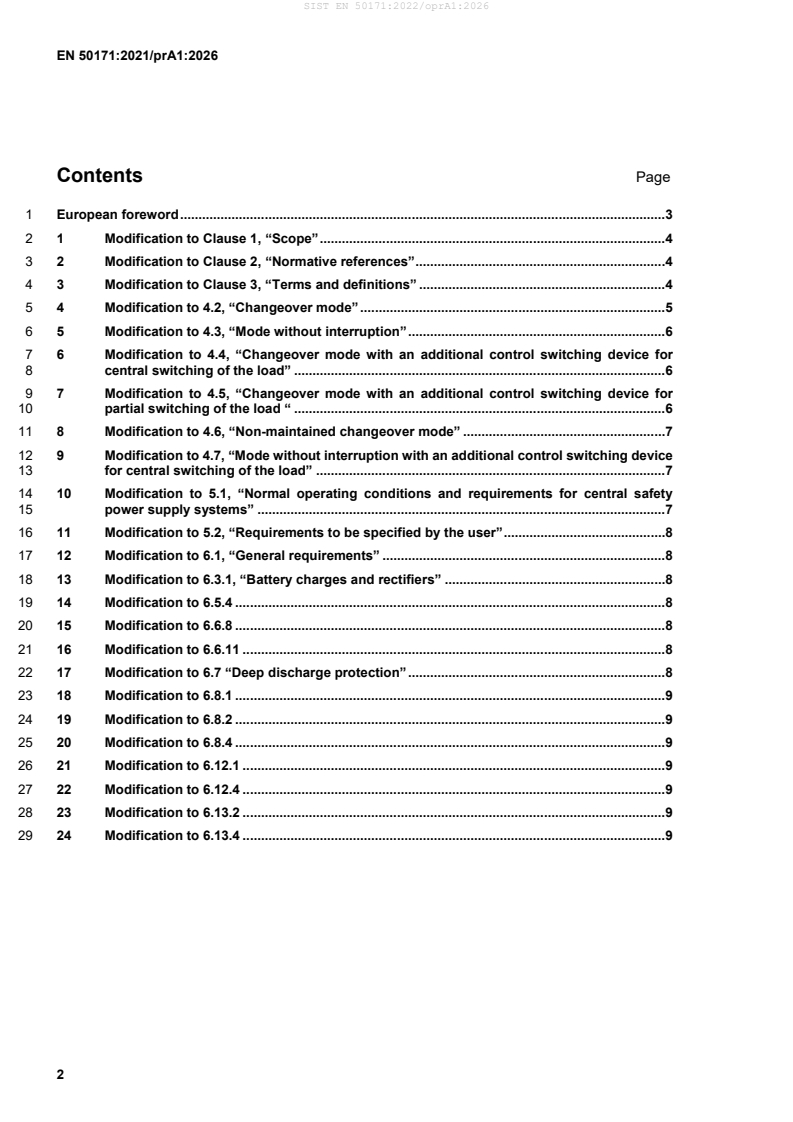
Contents
- 1 European foreword
- 2 1 Modification to Clause 1, “Scope”
- 3 2 Modification to Clause 2, “Normative references”
- 4 3 Modification to Clause 3, “Terms and definitions”
- 5 4 Modification to 4.2, “Changeover mode”
- 6 5 Modification to 4.3, “Mode without interruption”
- 7 6 Modification to 4.4, “Changeover mode with an additional control switching device for 8 central switching of the load”
- 9 7 Modification to 4.5, “Changeover mode with an additional control switching device for 10 partial switching of the load “
- 11 8 Modification to 4.6, “Non-maintained changeover mode”
- 12 9 Modification to 4.7, “Mode without interruption with an additional control switching device 13 for central switching of the load”
- 14 10 Modification to 5.1, “Normal operating conditions and requirements for central safety 15 power supply systems”
- 16 11 Modification to 5.2, “Requirements to be specified by the user”
- 17 12 Modification to 6.1, “General requirements”
- 18 13 Modification to 6.3.1, “Battery charges and rectifiers”
- 19 14 Modification to 6.5.4
- 20 15 Modification to 6.6.8
- 21 16 Modification to 6.6.11
- 22 17 Modification to 6.7 “Deep discharge protection”
- 23 18 Modification to 6.8.1
- 24 19 Modification to 6.8.2
- 25 20 Modification to 6.8.4
- 26 21 Modification to 6.12.1
- 27 22 Modification to 6.12.4
- 28 23 Modification to 6.13.2
- 29 24 Modification to 6.13.4
30 European foreword 31 This document (EN 50171:2021/prA1:2026) has been prepared by CLC/TC 22X “Power electronics”. 32 This document is currently submitted to the Enquiry.
33 The following dates are proposed:
- latest date by which the existence of this (doa) dav + 6 months document has to be announced at national level
- latest date by which this document has to be (dop) dav + 12 months implemented at national level by publication of an identical national standard or by endorsement
- latest date by which the national standards (dow) dav + 36 months conflicting with this document have to be (to be confirmed or withdrawn modified when voting) 35 1 Modification to Clause 1, “Scope” nd 36 In the 4th paragraph, 2 sentence, replace “the interruption” with “a failure”.
37 2 Modification to Clause 2, “Normative references” 38 Replace the references to EN 62040-1, EN 61000-6-2, EN 61000-6-3 and EN 61000-6-4 with the following, 39 respectively:
...